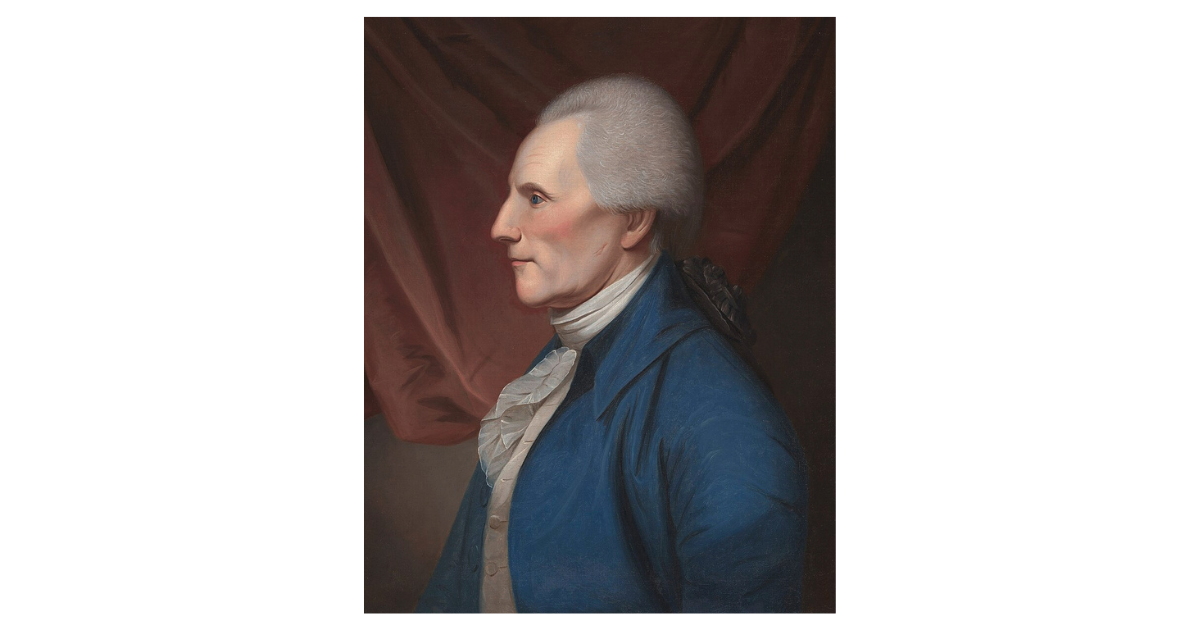
The General Who Made the Words Matter


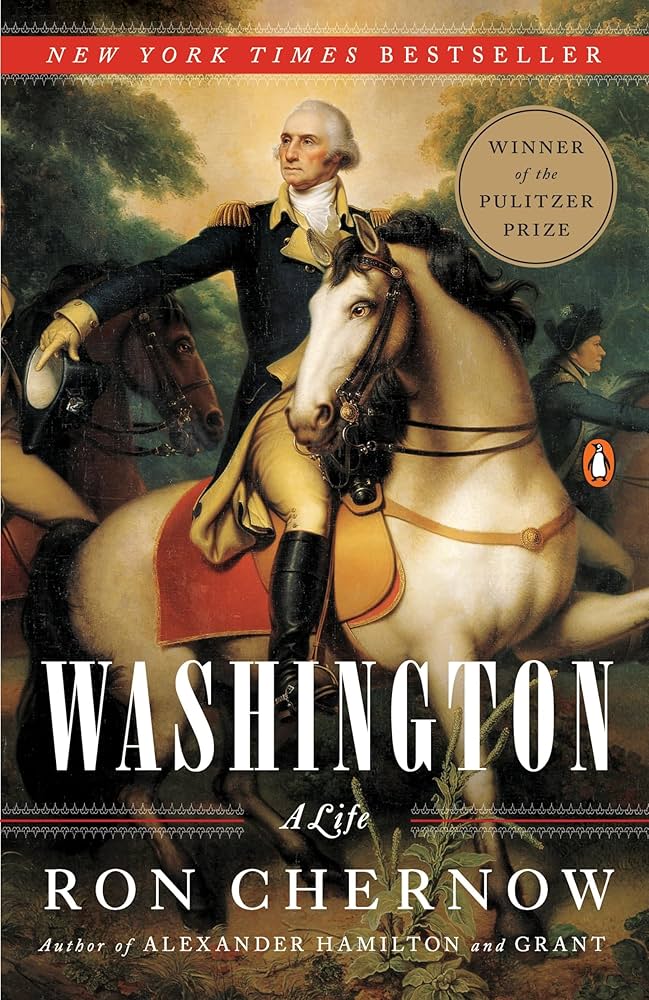
Though Washington was commanding the Continental Army rather than sitting in Congress, his leadership gave the Continental Congress the confidence to declare independence. Ron Chernow’s landmark biography Washington: A Life closes this section by connecting the Declaration to the military reality that made it more than words on parchment.


May and June – Architects of Independence, Part Nine

The Man Who Was Not in the Room

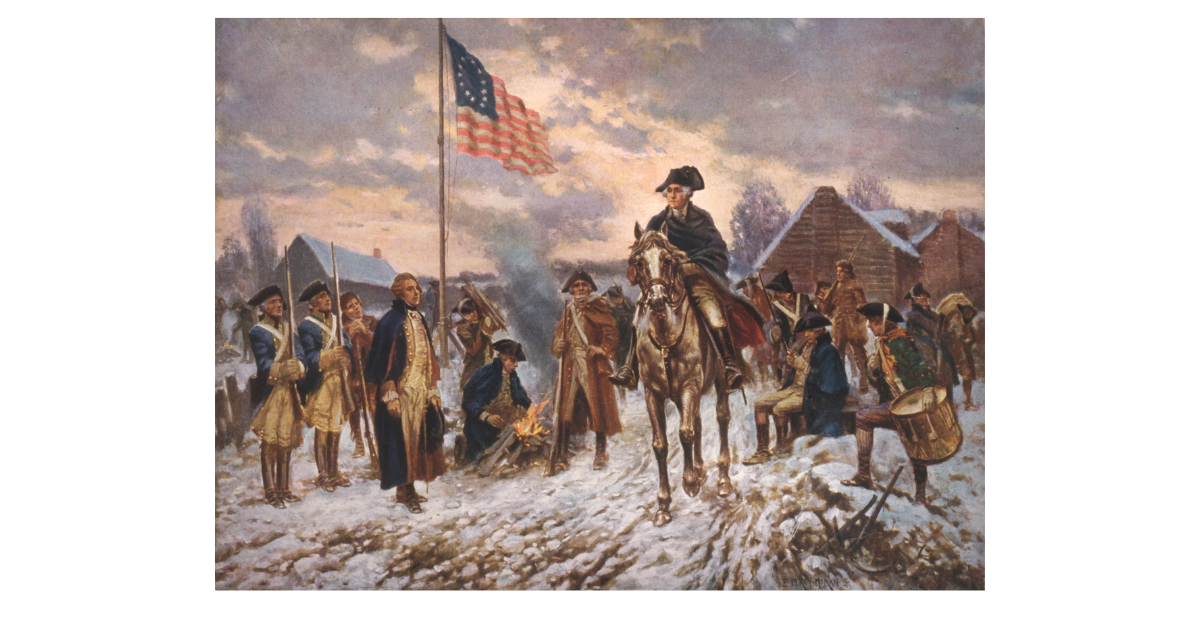
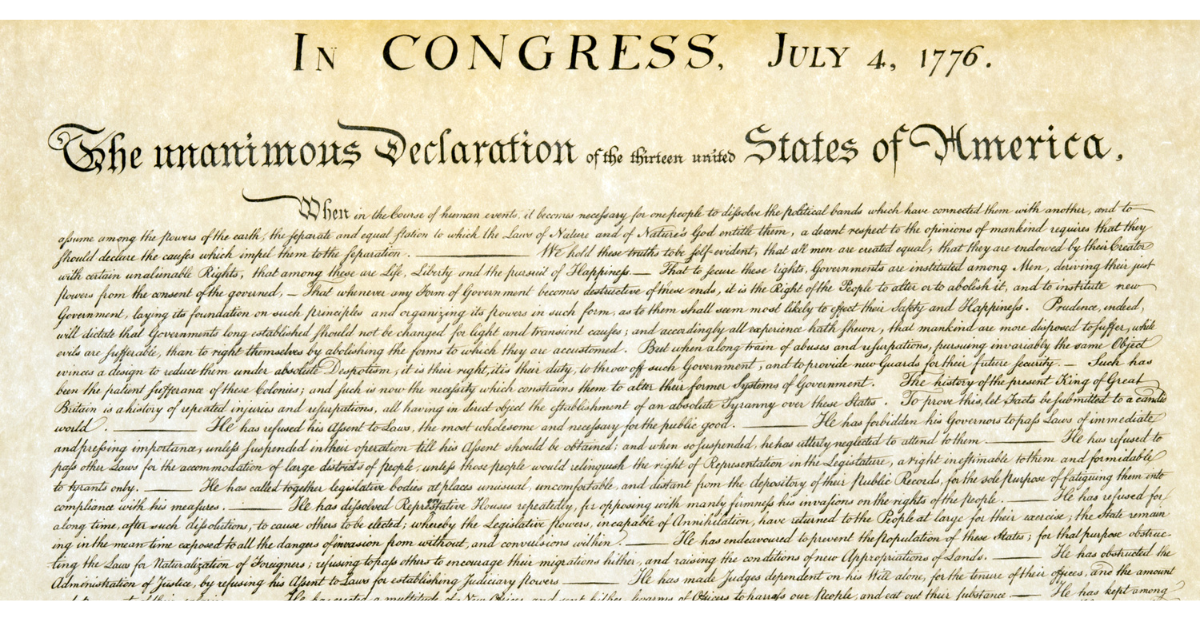
On July 9, 1776 – three days after the Declaration of Independence was formally approved – a young captain read aloud from one of John Holt’s freshly printed broadsides to the assembled Continental Army on the New York City Common. When the reading was done, the crowd surged toward Bowling Green and toppled the gilded equestrian statue of King George III, later melting it into musket balls. Watching from nearby was the man most responsible for the fact that those words now meant something beyond philosophy: George Washington, Commander-in-Chief of the Continental Army.

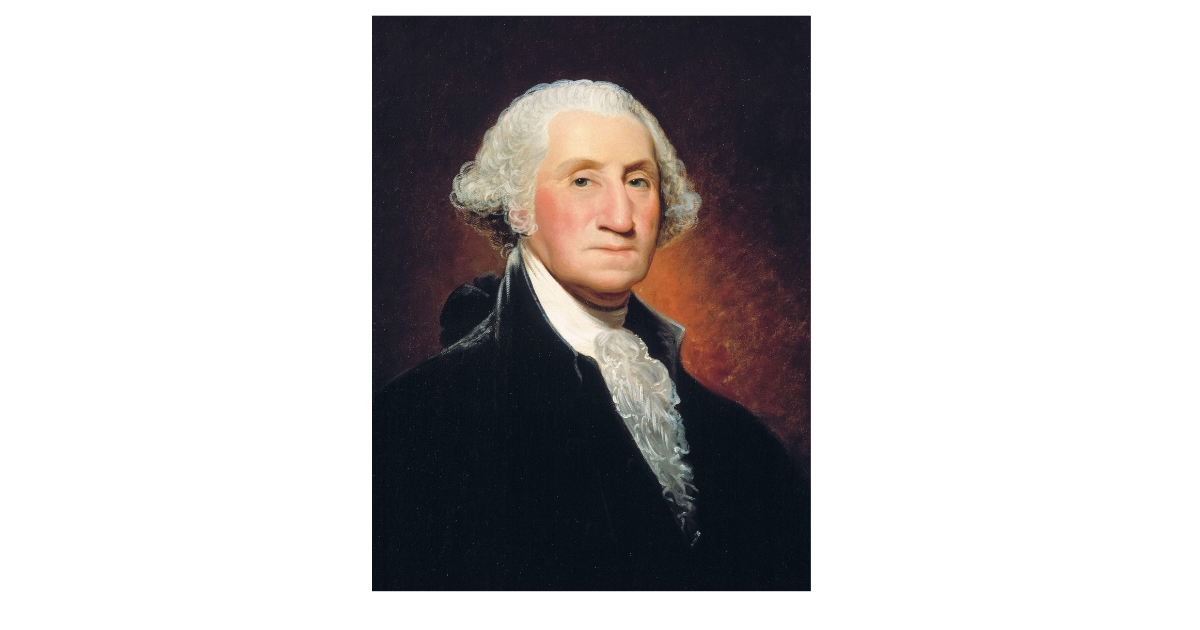
Washington had not been in Philadelphia helping Thomas Jefferson craft elegant phrases. He had no seat on the Committee of Five. He had not argued for independence in Congress alongside John Adams, nor lent the moral weight of his reputation to the enterprise the way Benjamin Franklin had. And yet, as Ron Chernow’s distinguished biography makes undeniably clear, the Declaration of Independence would have been a rhetorical exercise without him – a document declaring rights that no one had the power to defend. Washington was not an architect of the Declaration’s language. He was the architect of its possibility.

In an era when democratic institutions face tests of durability, and when the gap between stated ideals and the willingness to defend them is perpetually on trial, Chernow’s portrait of Washington as the indispensable military guardian of political liberty carries a relevance that extends well beyond the eighteenth century.

A Biographer at the Height of His Powers

When Washington: A Life was published in October 2010, Ron Chernow had already established himself as the foremost practitioner of the grand-scale American biography. His 1990 debut, The House of Morgan, won the National Book Award for Nonfiction. His 2004 Alexander Hamilton – which would later inspire Lin-Manuel Miranda’s Broadway phenomenon – demonstrated his gift for making complicated, morally contested Founders feel urgently alive. Washington was the capstone of this project: a 904-page, cradle-to-grave reckoning with the most famous and most misunderstood figure of the founding generation.

Chernow came to Washington not as an academic historian but as what he calls a “self-made historian” – a Yale and Cambridge-educated journalist who had spent decades learning to inhabit the inner lives of powerful men through painstaking archival research. For Washington, he drew extensively on the University of Virginia’s ongoing Papers of George Washington project, a scholarly edition of Washington’s letters and documents that by 2010 had already produced sixty substantial volumes. This documentary foundation gave Chernow access to a Washington rarely glimpsed in popular history: a man who wrote candidly about his fears, his frustrations, his ambitions, and his increasingly radical break from the British identity he had once sought so earnestly to claim.

How this seemingly dull, phlegmatic man, in a stupendous act of nation building, presided over the victorious Continental Army and forged the office of the presidency is a mystery to most Americans. Something essential about Washington has been lost to posterity, making him seem a worthy but plodding man who somehow stumbled into greatness.

That mystery – how a man so often described as cold and distant became the indispensable center of a revolution – is precisely what Chernow set out to solve.

Self-Mastery as a Political Act

Chernow’s central interpretive claim is that Washington’s public greatness was the product of relentless, consciously sustained self-discipline. Beneath the marble composure that history has bequeathed us was, Chernow argues, a man of “fiery emotional temperament” – vain, sensitive to criticism, consumed by appearances, prone to sudden anger – who understood, with startling self-awareness, that he had to subjugate those qualities entirely to the larger cause. Washington’s granite exterior was not natural constitution; it was performance, and an astonishing one.

Chernow traces this project of self-invention to Washington’s humiliating early experiences with the British military establishment. England repeatedly denied him a permanent commission in the Royal Army, treating colonial officers as inherently second-rate. Chernow argues persuasively that this rejection left a wound that never fully healed – and that it gradually transformed Washington from an ambitious young man who desperately wanted British recognition into a man who came to see the entire colonial relationship as an affront to his dignity and that of his countrymen.

This personal grievance aligning with political principle is, in Chernow’s telling, what made Washington so effective as a revolutionary leader. He wasn’t fighting for abstract Enlightenment ideals. He was fighting because he had been humiliated by a system that treated Americans as lesser subjects – and he understood, with a commander’s instincts, that others felt the same wound.

His unerring judgment, sterling character, rectitude, steadfast patriotism, unflagging sense of duty, and civic-mindedness – these exemplary virtues were achieved only by his ability to subdue the underlying volatility of his nature and direct his entire psychological makeup to the single-minded achievement of a noble cause.

The hallmark of Washington’s approach to power, Chernow writes, was that he consistently appeared not to seek it. He didn’t lobby for the command of the Continental Army. He didn’t campaign for the presidency. “The hallmark of Washington’s career,” Chernow notes, “was that he didn’t seek power but let it come to him.” This was not passivity – it was calculated, and it worked. It made him trustworthy to a generation of men deeply suspicious of concentrated authority.

The Summer the Words Had to be Defended

In the weeks immediately following the Declaration’s adoption, Washington faced what Chernow characterizes as the most dangerous and consequential military crisis of the entire Revolutionary War. While Philadelphia celebrated, Washington was bracing for a British assault on New York of overwhelming scale. By August 1776, General William Howe had assembled roughly 32,000 professional soldiers and Hessian mercenaries on Staten Island – the largest single expeditionary force Britain had ever dispatched. Against them, Washington commanded a ragtag force of poorly supplied, inadequately trained Continental troops and unreliable state militias.

The result was catastrophic. At the Battle of Long Island on August 27, Howe brilliantly flanked the American position through the unguarded Jamaica Pass, inflicting some 2,000 casualties in a matter of hours. Washington, nearly captured himself, executed a masterful nighttime evacuation across the East River that saved the bulk of his army – but the disaster continued. Manhattan fell in September. Fort Washington fell in November. By late 1776 the Continental Army was retreating through New Jersey with the British in pursuit, morale shattered, enlistments expiring, and desertions rampant.

Chernow captures the grinding psychological pressure of this period with particular force. There was, he writes, “scarcely a time during the war when Washington didn’t grapple with a crisis that threatened to disband the army and abort the Revolution.” It was in this context that Washington conceived his celebrated Christmas crossing of the Delaware River and the surprise attack on Trenton – a moment of inspired operational audacity that reversed the revolution’s fortunes, captured nearly a thousand Hessian soldiers, and gave the struggling cause something it desperately needed: a story of victory to sustain belief in the words of the Declaration.

Chernow’s deep insight in these chapters is that Washington understood his job was not simply military. He had to keep an army together long enough for a political idea to take root. Every time he kept the Continental Army in the field – through shortage, defeat, desertion, and despair – he was making the Declaration of Independence real.

Chernow’s Voice at Its Best

Chernow’s prose combines scholarly thoroughness with the storyteller’s instinct for the revealing moment. One of the book’s most memorable formulations concerns Washington’s relationship to power and appearance: “Things didn’t happen accidentally to George Washington, but he managed things with such consummate skill that they seemed to happen accidentally.” The sentence encapsulates Chernow’s core argument in a single elegant observation – this was a man who understood theater, who stage-managed his own legend with the discipline of an actor who never breaks character.

Chernow is equally acute on the subject that gives this series its deepest resonance – Washington’s understanding of what the Continental Army represented. “His fortitude in keeping the impoverished Continental Army intact,” Chernow writes, “was a major historic accomplishment.” This is not triumphalism. Chernow is precise about how often Washington lost, how narrowly the revolution survived, how contingent the outcome always was. He lost more battles than he won. But he never lost the army – and without the army, there was no nation.

On Washington’s complexity as a moral figure, Chernow does not flinch. His treatment of Washington’s relationship to slavery is candid and unflattering: Washington owned enslaved people throughout his life, profited from their labor, and expended considerable legal and personal effort to prevent enslaved individuals from claiming the freedom that his own revolution had declared a self-evident truth. Chernow acknowledges that Washington grew privately uncomfortable with slavery in his later years, and that he made provisions in his will for the freedom of the enslaved people he personally owned – but he places these gestures in honest context, noting their limits and their long delay.

How Chernow Fits the Mosaic

Reading Washington: A Life alongside the other books in this section illuminates both its strengths and the gaps it leaves behind. Chernow’s portrait of Washington is the essential military counterweight to the congressional and philosophical focus of most other entries on this list.

Gordon Wood’s Revolutionary Characters establishes the intellectual world that gave the founding generation its vocabulary of virtue and public purpose. Chernow shows how Washington embodied that vocabulary physically – how he performed the role of disinterested republican leader so effectively that he became the living proof of the ideology Wood describes. The two books are natural companions.

With Joseph Ellis’s Founding Brothers, the relationship is more complex. Ellis, whose Revolutionary Summer offers a parallel account of the military crises of 1776, emphasizes personal relationships and political maneuvering in ways that sometimes paint Washington as more passive than Chernow allows. Chernow’s Washington is an active strategist – of his career as much as his campaigns. Ellis’s Washington is more reactive, shaped as much by circumstances as by will. Both portraits contain truth; read together, they produce something more dimensional than either alone.

The most interesting conversation is with Pauline Maier’s American Scripture: Making the Declaration of Independence, which has been identified as the essential text for understanding the Declaration as a collective achievement. Maier’s argument – that Congress, not Jefferson, deserves primary authorship credit for the final document – actually reinforces Chernow’s thesis in an unexpected way. If the Declaration was a political document shaped by many hands, then Washington’s role as the military guarantor of its implementation becomes even more central than Jefferson’s role as its prose stylist. The words required collective wisdom to write. They required one man’s unwavering resolve to defend.

David McCullough’s John Adams and Walter Isaacson’s Benjamin Franklin both offer portraits of men who were in the room where it happened. Chernow’s contribution is to insist that what happened in that room in Philadelphia only mattered because of what was happening simultaneously on the battlefields of New York and New Jersey.

What We’ve Learned Since 2010

Chernow’s Washington was published at what now appears, in retrospect, to be a transitional moment in American historiography. In the decade and a half since, scholarship on the founding era has shifted significantly in several directions that complicate or extend Chernow’s account.

The most consequential development has been the explosion of serious scholarship on the enslaved people of the founding era – not merely as backdrop to founders’ moral complexity, but as historical actors in their own right. Chernow acknowledges Washington’s slaveholding honestly, but his focus remains on Washington’s interiority: how Washington felt about slavery, what private reservations he may have harbored. Subsequent scholarship has increasingly demanded that we shift the frame, asking what the enslaved people of Mount Vernon thought about a man who declared universal liberty while owning more than three hundred of them. Works like Erica Armstrong Dunbar’s Never Caught (2017), which recovers the story of Ona Judge – an enslaved woman who escaped Washington’s household and evaded his attempts to reclaim her – have added dimensions to the Washington story that Chernow’s biography could not have anticipated.

Military historians have also continued to refine our understanding of Washington’s battlefield record, with some recent scholarship offering more credit to subordinate commanders and the French alliance than the great-man biographical tradition allows. And new attention to the Indigenous peoples whose lands became the theater of the Revolutionary War has added a third perspective largely absent from Chernow’s Washington – one that asks what independence meant for those who had no vote in Philadelphia and no cause for celebration.

None of this diminishes Chernow’s achievement. Washington: A Life remains what Gordon Wood called it at the time of publication: “the best, most comprehensive, and most balanced single-volume biography of Washington ever written.” But it should be read in 2026 with an awareness that the conversation it helped advance has continued, and in some ways has moved in directions Chernow was not yet positioned to follow.

Why This Book Matters in 2026

At a moment when the gap between stated democratic ideals and the political will to defend them is a live and urgent question, Washington: A Life offers something invaluable: a detailed account of what it actually cost to make a declaration of principles into something real.

The Declaration of Independence was not a self-executing document. It required an army. It required a leader willing to absorb catastrophic defeats without losing sight of the larger purpose. It required, in Chernow’s telling, a man who had so thoroughly mastered his own worst impulses that he could project an unwavering calm even when privately consumed by doubt and fear. That Washington managed this across eight years of grinding, uncertain warfare – without pay, with chronic supply shortages, against a professional military force his army was rarely equipped to match in open battle – is one of the great acts of sustained political will in the history of democratic governance.

This book closes the Architects of Independence series with a necessary corrective to any tendency to sentimentalize the founding. The other books in this series have examined the men who wrote the arguments, forged the alliances, drafted the resolutions, and crafted the prose. Chernow’s book asks the harder question: who made sure none of it was just words?

The answer, Chernow argues with force and elegance across 900 pages, was a Virginia planter who had been refused a British commission, who kept his temper in check and his army in the field, who read the Declaration aloud to his troops and then led them into the worst military disaster of his career – and kept going. The Declaration of Independence gave the Revolution its ideals. George Washington gave it its fighting chance.


A Note on This Series

This journey through Revolutionary history is as much about the evolution of historical understanding as the Revolution itself. History isn’t static – each generation reinterprets the past through its own concerns, asking different questions and prioritizing different sources. By reading these books in dialogue across 250 years, we’ll witness how scholarship evolves, how narratives get challenged, and how forgotten stories resurface.

This isn’t about declaring one interpretation “right” and another “wrong,” but appreciating the richness that emerges when multiple perspectives illuminate the same transformative moment. These books won’t provide definitive answers – history rarely does – but they equip us to think more clearly about how real people facing genuine uncertainty chose independence, how ideas had consequences, and how the work of creating a more perfect union continues. As we mark this anniversary, we honor the Revolutionary generation by reading deeplythinking critically, and engaging seriously with both the brilliance and blind spots of what they created.
You can find the entire series listing here.

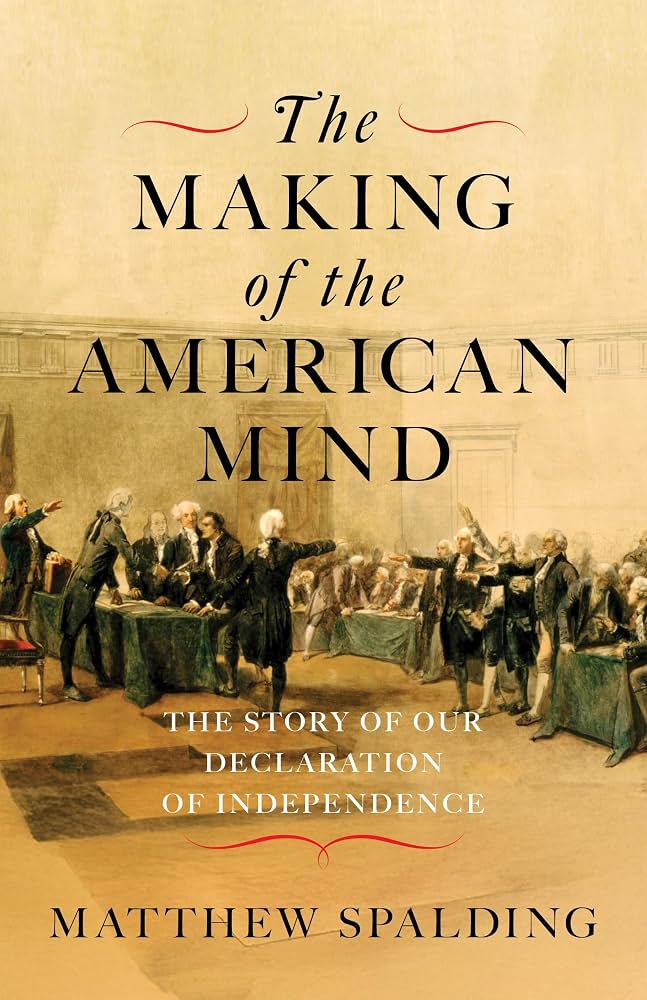
Jefferson Wrote a Draft. Congress Wrote the Declaration.


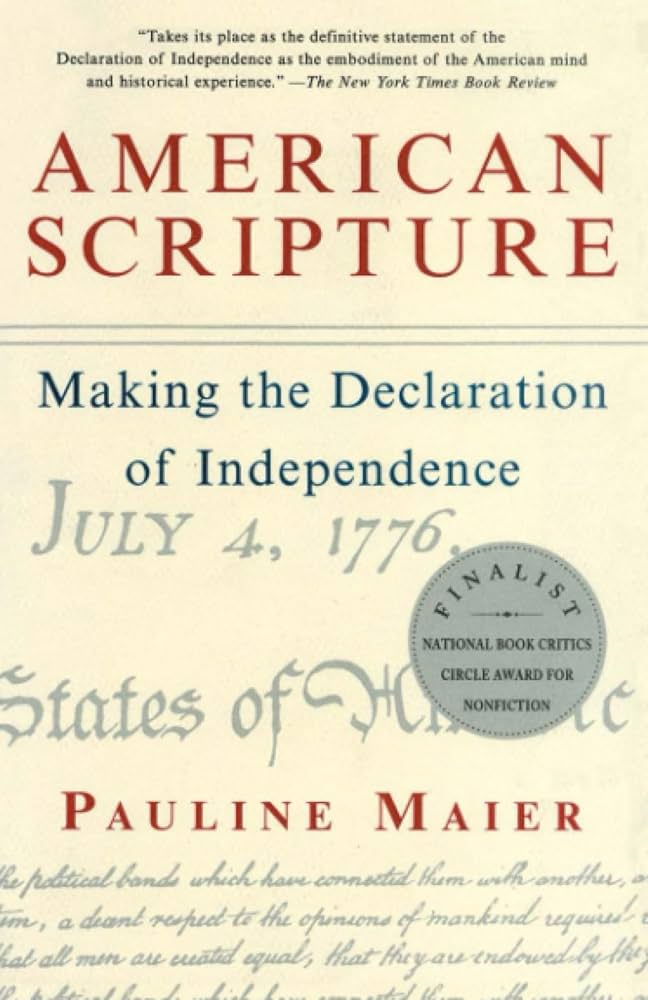
Pauline Maier’s American Scripture: Making the Declaration of Independence is the most essential book in this section. Maier’s meticulous scholarship reconstructs how Congress itself – not Jefferson alone – edited and shaped the final document, making it the definitive account of the Declaration as a collective achievement.


May and June – The Architects of Independence, Part Eight

Every American schoolchild learns the same story: Thomas Jefferson, alone with his portable writing desk in a Philadelphia boarding house, conjured the Declaration of Independence from thin air – a solitary act of genius that changed the world. It is one of the most durable myths in the national imagination. Pauline Maier spent a career dismantling it.

Published in 1997, American Scripture: Making the Declaration of Independence arrived at a moment when the United States was in the middle of one of its periodic arguments about what the founding documents actually mean, who they belong to, and whether they live up to their own promises. That argument has never really stopped. In an era when the Declaration is routinely invoked by politicians of every stripe – as a mandate for immigration, as a rebuke to immigration, as an argument for social transformation, as a defense of tradition – Maier’s meticulous reconstruction of how the document was actually made feels, if anything, more urgent in 2026 than it did nearly thirty years ago. Understanding what the Declaration is requires understanding what it was, and how it got that way.

The Scholar Behind the Argument

Pauline Maier was a historian of early America at MIT, where she taught for decades until her death in 2013. She was not, by temperament, a myth-maker or a debunker for its own sake. Her earlier work – From Resistance to Revolution and The Old Revolutionaries – established her as a scholar of uncommon rigor who was interested in the collective processes of political change rather than the heroic individual. When she turned her attention to the Declaration, she brought that same instinct to bear: what happens when we look at this document not as the product of a single mind, but as the outcome of a long, contentious, and deeply collaborative political process?

The result is a book that is part archival detective story, part intellectual history, and part act of democratic imagination. Maier does not diminish Jefferson. She does something more interesting: she places him inside the machinery of a revolution and shows how that machinery worked.

The Central Argument: Jefferson Did Not Write the Declaration

That is perhaps too stark a way to put it – Jefferson wrote a declaration. But the Declaration of Independence, the one signed on August 2, 1776, the one now enshrined in the National Archives, the one that has shaped two and a half centuries of American political life – that document was written by the Second Continental Congress.

Maier builds this argument on two foundations. The first is her recovery of the dozens of state and local declarations of independence that preceded the Continental Congress’s version. In the months before July 1776, county committees, colonial assemblies, and grand juries across America were drafting their own declarations – documents that articulated the philosophical case for independence, catalogued British abuses, and announced their authors’ readiness to break from the Crown. These were not private letters or pamphlets. They were formal public acts, widely circulated and debated. Jefferson and his colleagues on the drafting committee did not arrive at their task with a blank slate; they arrived with a genre already established, a set of arguments already field-tested, and a vocabulary already in place. The Declaration’s famous second paragraph – the one about self-evident truths and unalienable rights – was not a bolt from the blue. It was the distillation of a conversation already underway across the colonies.

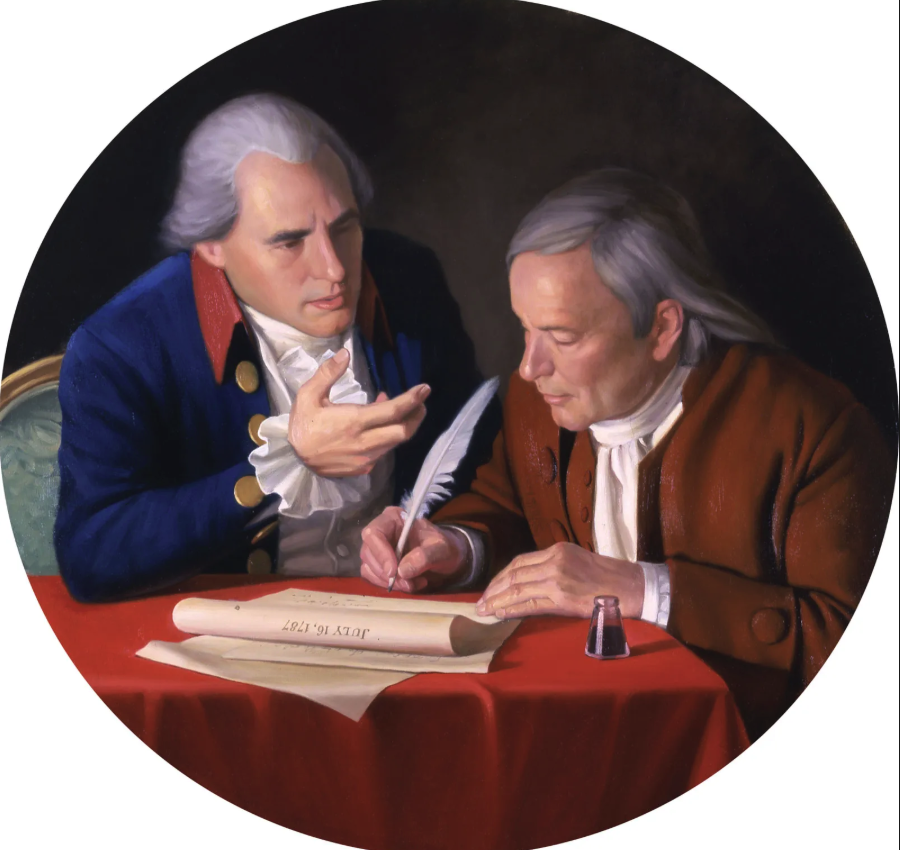
The second foundation of Maier’s argument is her reconstruction of what Congress actually did with Jefferson’s draft. The delegates spent two and a half days going through the document line by line, making more than eighty changes – cutting roughly a quarter of the original text, softening certain phrases, removing others entirely. Jefferson, who was present and kept his own annotated copy, was reportedly miserable throughout. Benjamin Franklin, sitting beside him, tried to cheer him up with a story about a hat-maker whose proposed sign was edited down to nothing but his name. Jefferson did not find it funny.

Maier’s central claim is that this editorial process was not vandalism – it was improvement. Congress’s most significant deletion was Jefferson’s extended and somewhat incoherent attack on the slave trade, in which he blamed George III for introducing slavery into the colonies and then blamed him again for potentially arming enslaved people against the colonists. The passage, Maier shows, was philosophically contradictory and politically unacceptable to delegates from South Carolina and Georgia. Its removal made the document more coherent, not less. The accusation that slavery was the king’s fault was, in any case, historically absurd, and its deletion was an act of editorial honesty – even if the failure to confront slavery directly was a moral catastrophe that the nation would spend the next century paying for in blood.

Immediate Aftermath: The Document Goes to Work

For Jefferson, the weeks following the signing were consumed not by celebration but by a return to Virginia, where he threw himself into the project of reforming the state’s laws – drafting legislation on religious freedom, education, and the revision of the legal code. He was, in some ways, relieved to leave Congress. The experience of having his draft so substantially altered had stung, and he would nurse that grievance for the rest of his life, continuing to send friends copies of his original version alongside the final text so posterity could judge who had written the better document.

Congress, meanwhile, faced the immediate problem of making the Declaration do the work it was designed to do. The document was read aloud in public squares across the colonies, greeted in some places with bonfires and toasts, in others with silence or hostility. George Washington had it read to his troops in New York on July 9 – just as a British fleet was massing in the harbor. Within days, British forces landed on Long Island, and the Continental Army suffered a series of near-catastrophic defeats that came close to ending the revolution before it properly began. The Declaration had announced independence. Washington’s soldiers now had to win it.

A Voice Both Exact and Humane

Maier writes with a precision that never tips into pedantry. Her prose is the prose of a scholar who has spent so long with primary sources that she has internalized their rhythms without being enslaved to them.

On Congress’s editorial work, she is bracingly direct: the delegates “did not see themselves as simple copyeditors” but as co-authors of a collective statement – men who had staked their lives and reputations on the document and therefore had every right to shape it. On the mythology that grew up around Jefferson’s authorship, she notes that the elevation of the Declaration into a kind of secular scripture, with Jefferson as its prophet, was itself a historical process – one that took decades, and that served political purposes that had little to do with what actually happened in Philadelphia in the summer of 1776.

One of her most striking observations concerns the document’s second life. The Declaration, she argues, was largely forgotten as a political instrument in the decades immediately following the Revolution. It was Abraham Lincoln who resurrected it – who made the claim that “all men are created equal” was not merely a statement of 1776 but an ongoing promise, a standard against which the nation had always to be measured. The Declaration, in Maier’s account, did not arrive at its current meaning all at once. It was made, and remade, by successive generations who needed it to say something.

Dialogue with the Architects

Read alongside the other books in this series, American Scripture functions as both complement and corrective.

Gordon Wood’s Revolutionary Characters establishes the intellectual world from which the founders emerged – a republic of ideas, shaped by classical learning and Enlightenment philosophy. Maier’s book grounds that world in the specific, messy, intensely practical work of political drafting. The ideas were real; so was the committee.

Joseph Ellis’s Founding Brothers is preoccupied with personal rivalries and the complicated friendships among the founders. Maier is less interested in personalities than in process. She and Ellis are, in a sense, looking at the same events from different angles: Ellis asks what the men thought of each other; Maier asks what they thought they were making.

David McCullough’s biography of John Adams presents Adams as the driving force behind independence – the man who bullied and persuaded Congress into action and maneuvered Jefferson into the lead role on the drafting committee. Maier’s account neither confirms nor contradicts this, but it shifts the emphasis: even if Adams was the engine, the outcome was shaped by the whole body. Jon Meacham’s Jefferson, for his part, is a figure of almost inexhaustible complexity – a man whose idealism and moral failures coexist in permanent, unresolved tension. Maier’s Jefferson is something slightly different: a gifted writer whose best work was improved by editors he despised.

The book that sits in closest dialogue with American Scripture may be J. Kent McGaughy’s study of Richard Henry Lee. Lee’s resolution of June 7, 1776, was the legislative act that set the drafting process in motion. Maier’s book begins, in a sense, where Lee’s political work ends – she picks up the story at the moment the committee convenes and follows it through to the document’s eventual canonization. Together, the two books reconstruct the full arc from resolution to scripture.

What We Have Learned Since 1997

In the nearly three decades since American Scripture appeared, scholarship on the Declaration has deepened considerably. Historians have paid closer attention to the voices excluded from the founding moment – enslaved people, women, Indigenous nations – and to the ways the Declaration’s universalist language was understood, from the beginning, to apply only selectively. Maier herself was forthright about the document’s failures on slavery, but subsequent scholarship has pushed further, examining how enslaved Americans heard the Declaration read aloud, and what they made of its promises.

The digital humanities have also transformed the study of documentary history. Full-text databases now make it possible to trace the circulation of specific phrases across the colonial declarations that Maier identified, and to map with greater precision the intellectual genealogy of Jefferson’s most famous lines. Her core argument – that the Declaration was a collective achievement rooted in a broader political conversation – has been strengthened, not weakened, by this subsequent work.

Why Read This Book in 2026

Because the Declaration of Independence is not a relic. It is a living political document, invoked almost daily in American public life, and the way we understand its origins shapes the way we understand its claims. If we believe Jefferson wrote it alone, in a flash of genius, we are likely to treat it as the property of a single tradition — as something handed down rather than fought over. If we understand it as Maier shows it to be — the product of a continent-wide argument, refined by a contentious committee, and given its ultimate meaning by generations of Americans who needed it to do new work – then it belongs to everyone who has ever invoked it. That is a more complicated story, and a more honest one. It is also, in its way, more inspiring: the Declaration is great not because one man was touched by lightning, but because a people, arguing and revising and disagreeing, managed to write something that outlasted them all.

American Scripture is the book that tells that story with the seriousness it deserves. In a series devoted to the architects of independence, Maier’s contribution is indispensable – not because she celebrates the founders, but because she shows us how democracy, even at its founding moment, looked a great deal like democracy: loud, imperfect, and stubbornly collective.


A Note on This Series

This journey through Revolutionary history is as much about the evolution of historical understanding as the Revolution itself. History isn’t static – each generation reinterprets the past through its own concerns, asking different questions and prioritizing different sources. By reading these books in dialogue across 250 years, we’ll witness how scholarship evolves, how narratives get challenged, and how forgotten stories resurface.

This isn’t about declaring one interpretation “right” and another “wrong,” but appreciating the richness that emerges when multiple perspectives illuminate the same transformative moment. These books won’t provide definitive answers – history rarely does – but they equip us to think more clearly about how real people facing genuine uncertainty chose independence, how ideas had consequences, and how the work of creating a more perfect union continues. As we mark this anniversary, we honor the Revolutionary generation by reading deeplythinking critically, and engaging seriously with both the brilliance and blind spots of what they created.
You can find the entire series listing here.

The Man Who Signed Everything: Roger Sherman, the Indispensable Founder You’ve Never Heard Of


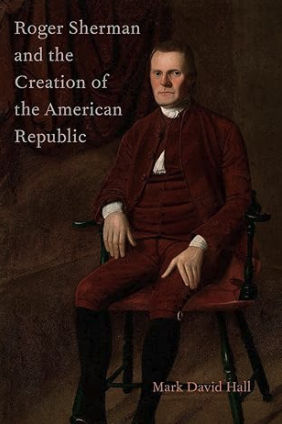
Roger Sherman is the most neglected member of the Committee of Five, yet his practical judgment and steady influence shaped both the Declaration and the constitutional framework that followed. Roger Sherman and the Creation of the American Republic by Mark David Hall gives this under-appreciated founder his due.


May and June – The Architects of Independence

In a season of political dysfunction – when compromise is treated as capitulation and pragmatism is confused with cowardice – it is worth pausing over a man whose entire career was built on the quiet genius of getting things done. Roger Sherman of Connecticut was not a gifted orator. He was not aristocratic, formally educated, or romantically tragic in the way that makes for compelling historical legend. He was a former shoemaker from rural Massachusetts who taught himself law, read theology by candlelight, and ultimately shaped more of the American founding than almost any figure whose name the average citizen cannot recall. Mark David Hall’s Roger Sherman and the Creation of the American Republic (Oxford University Press, 2013) is a determined and largely successful effort to correct this imbalance – and in doing so, it quietly reshapes how we ought to think about the entire founding generation.

The Author and His Argument

Hall is the Herbert Hoover Distinguished Professor of Politics at George Fox University and a senior fellow at Emory University’s Center for the Study of Law and Religion, with a PhD in political science from the University of Virginia. He has spent his career at the intersection of religion, law, and early American political thought, and those preoccupations run through every chapter of this book. Hall is not a dispassionate observer. He writes with conviction about the role of Calvinist theology in the founding era, a role he believes has been systematically minimized by scholars more comfortable with Enlightenment rationalism than Reformed Christianity. Whether one shares that conviction or not, his case for Sherman’s importance stands largely on its own merits.

The book’s central argument is twofold. First, that Roger Sherman was one of the most consequential figures of the founding era, and that his obscurity today is not a reflection of his historical significance but rather an artifact of his personality – he rarely said the kinds of memorable, quotable things that fuel historical celebrity. Second, Hall argues that Sherman’s political thought was shaped at its core by Calvinist theology – by a conviction that human nature is fallen and corruptible, that government must therefore be structured to constrain power rather than concentrate it, and that liberty is not merely a secular political value but a sacred responsibility grounded in the duty of conscience before God.

That second argument is the more contested one, and it distinguishes this book from a simple rehabilitation biography. Hall is making a larger claim: that the Reformed Protestant tradition played a decisive and under-appreciated role in the founding generation’s resistance to British authority and in the institutional design that emerged from that resistance.

The Forgotten Man at the Center of Everything

The basic facts of Sherman’s life already constitute a remarkable American story. Born in Newton, Massachusetts, in 1721, he received no formal education beyond what he absorbed from his father’s private library and the tutelage of a local clergyman. He worked as a shoemaker, then as a surveyor, then taught himself law and was admitted to the Connecticut bar in 1754. He entered politics, rose through the Connecticut General Assembly and Superior Court, and by the 1770s was one of the most respected legislators in the colony.

What happened next is almost structurally improbable. Sherman became the only founding figure to sign all four of the great state papers of the revolutionary era: the Continental Association (1774), the Declaration of Independence (1776), the Articles of Confederation (1777), and the Constitution (1787). No other founder achieved this. His contemporaries recognized it in real time. John Adams called him “that old Puritan, as honest as an angel, and as firm in the cause of American Independence as Mt. Atlas.” Patrick Henry, not easily impressed, said that Sherman and George Mason were “the greatest statesmen he ever knew.” Jefferson, who was often at odds with both Adams and Henry, pointed Sherman out to a visitor and remarked, “That is Mr. Sherman of Connecticut, a man who never said a foolish thing in his life.”

Hall reconstructs Sherman’s path to the Declaration with careful attention to what preceded it. In 1765, as the Stamp Act crisis inflamed the colonies, Sherman led a Connecticut Assembly committee in drafting a list of grievances against the Crown. His position then was already characteristically principled and clear: Parliament had no authority to tax the colonies without their consent. More strikingly, Sherman went further than many of his contemporaries, arguing that Parliament lacked the authority to regulate the colonies at all. “No laws bind the people but such as they consent to be governed by,” he wrote to Thomas Cushing – a formulation that anticipates the Declaration’s logic by more than a decade.

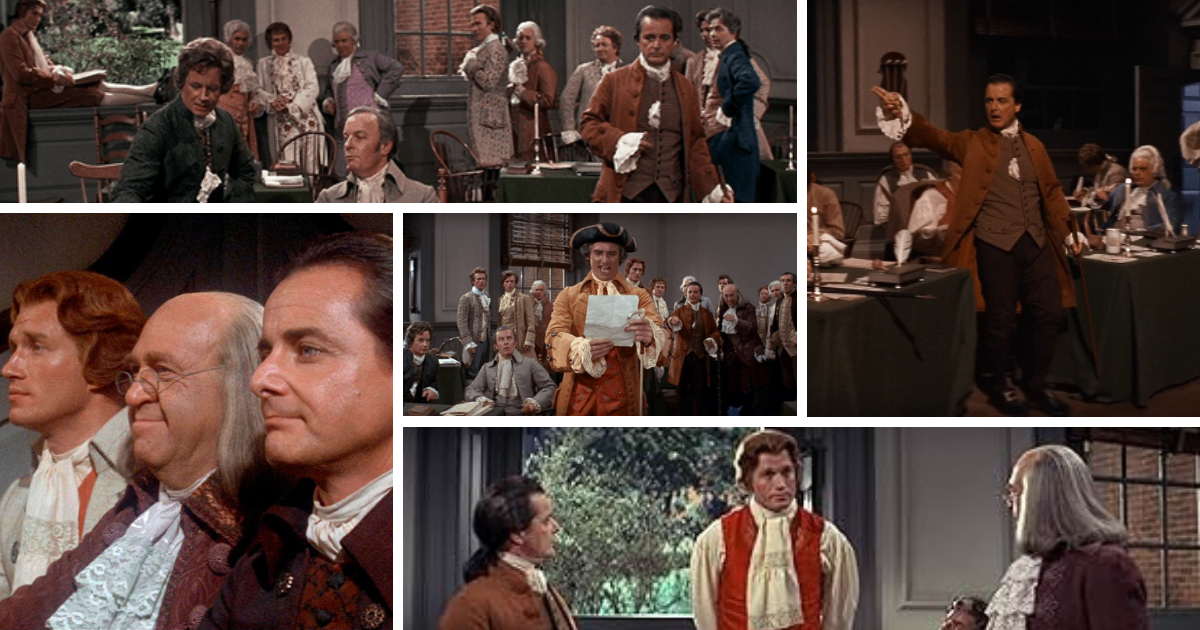
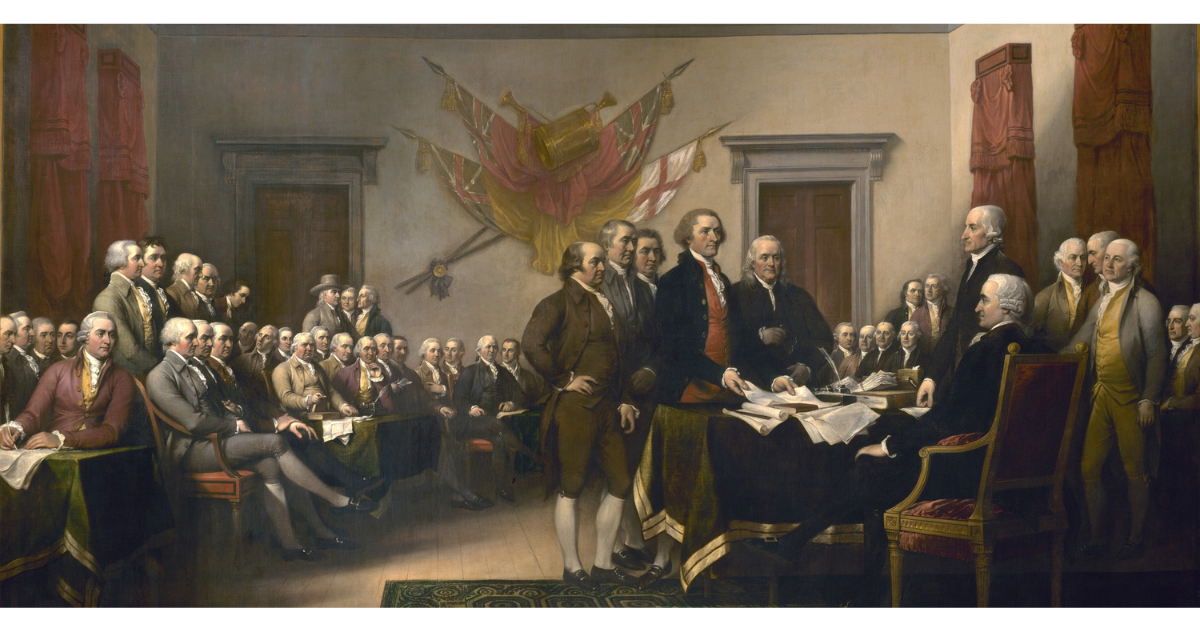
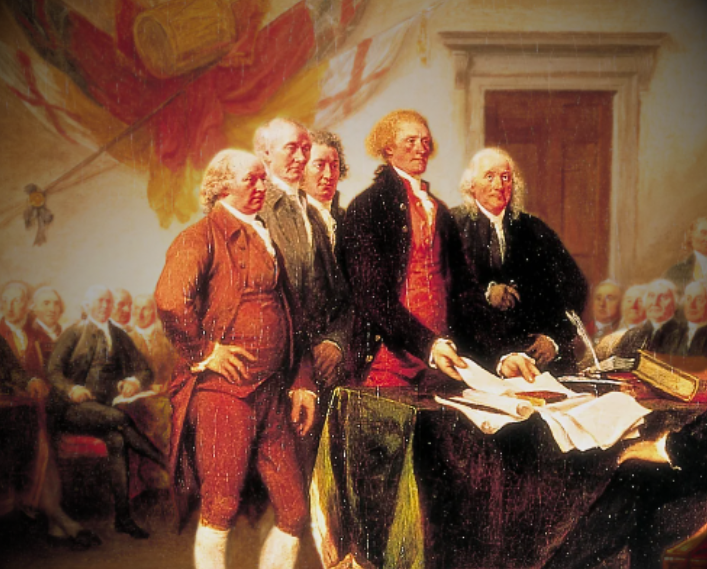
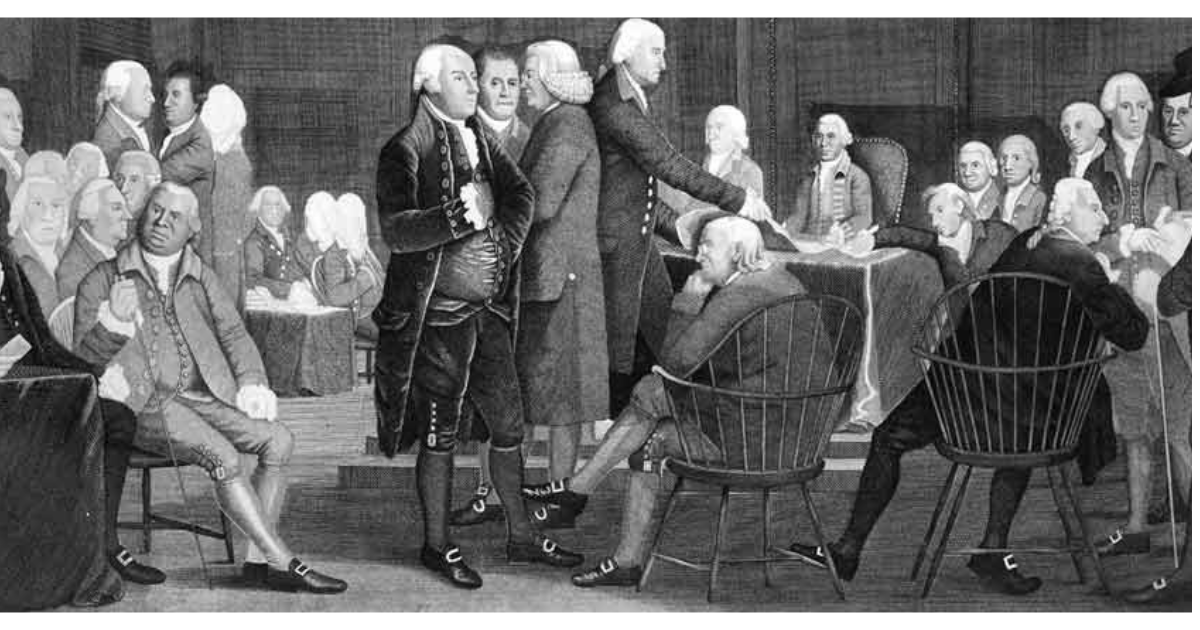
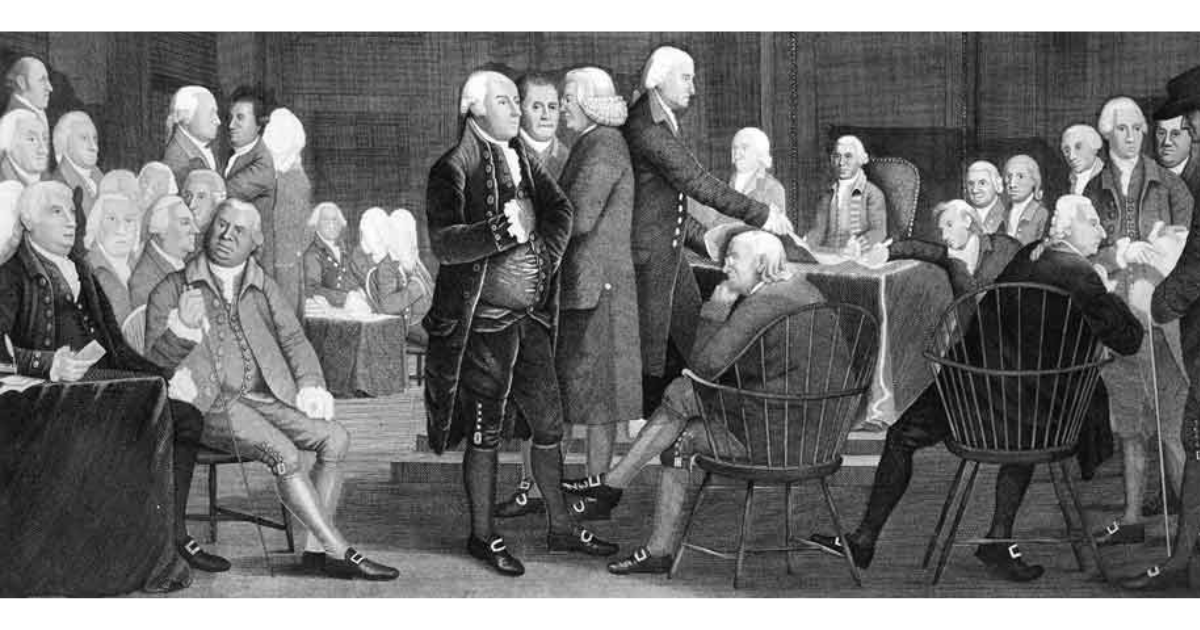
When the Committee of Five was appointed in June 1776 to draft the Declaration of Independence – joining Jefferson, Adams, Franklin, and Robert Livingston – Sherman was not chosen as a token participant or a regional placeholder. He had already demonstrated, through years of congressional service, that he possessed what Hall calls “practical judgment”: the ability to discern what was politically achievable, to navigate competing interests, and to keep complex deliberations moving toward resolution. In 1776 alone, Sherman was the only delegate to serve simultaneously on all three of the most important congressional committees: the Committee of Five drafting the Declaration, the Board of War, and the committee drafting what would become the Articles of Confederation. He was, by any measure, indispensable. In the image below, Sherman is the second from left.

The Calvinist Founder

Hall’s most provocative contribution is his sustained argument that Sherman’s politics were not merely influenced by his faith but were logically derived from it. Sherman was a devout Calvinist – a congregationalist in the orthodox New England tradition – and Hall contends that this shaped his institutional instincts in ways that secular political theory alone cannot explain.

The Reformed tradition, as Hall presents it, held that human beings were fundamentally fallen and that political institutions must therefore be designed to resist the natural human tendency toward corruption, tyranny, and self-aggrandizement. This was not pessimism; it was anthropology with political consequences. Government could not rely on the virtue of its leaders – it had to be structured to contain vice. This conviction, Hall argues, expressed itself in Sherman’s consistent preference for divided power, legislative supremacy over executive authority, and the protection of state-level government against centralization. Sherman once observed that a large, complicated national government was contrary to “the true spirit and genius of republican government,” which should be “small and simple.” Whether one reads this as Calvinist theology or classical republicanism or simply the common sense of a man who had watched powerful institutions abuse their authority, the instinct proved prophetic.

Hall does not claim that Sherman was the only Calvinist among the founders, or even the most theologically sophisticated. His broader point – that the Reformed tradition shaped the founding in ways historians trained in Enlightenment frameworks have systematically overlooked – is a genuine scholarly corrective, even if some readers will find it overstated. The secondary literature on the founding tends to foreground figures like Jefferson and Madison, whose intellectual debts to Locke, Montesquieu, and the Scottish Enlightenment are well documented. Sherman represents a different tradition, one more rooted in the Puritan inheritance of New England, and Hall is right that it deserves fuller treatment.

After the Signing: A Man Who Would Not Stop

The months following the signing of the Declaration of Independence in August 1776 found Sherman doing exactly what one might expect of him: working. While the war that the Declaration made official raged on multiple fronts, Sherman remained embedded in the machinery of Congress, attending to the unglamorous but essential work of sustaining a revolution in progress.

He served simultaneously on the Board of War – helping manage the logistics, supply chains, and strategic coordination of the Continental Army – and on the committee drafting the Articles of Confederation, the document that would serve as the new nation’s first constitution. His three eldest sons served as officers in the Continental Army during this period, adding personal stakes to the public ones. The war hurt Sherman financially; several of his business enterprises collapsed under the strains of revolution, and he supported a large family on a legislator’s uncertain income. Yet he continued to serve.

From 1777 to 1779, he simultaneously held his congressional seat and served on Connecticut’s Council of Safety, the wartime executive committee responsible for coordinating the state’s military and civilian response to the conflict. He attended conventions of the New England states in 1777 to weigh in on taxation and currency, and participated in the New Haven Convention on Prices in 1778. He remained a member of the Continental Congress for the duration of the Revolutionary War, and in 1783 – still not finished – he and colleague Richard Law spent five months revising all of Connecticut’s statutory laws, including the passage of a gradual emancipation act for children born to enslaved people in the state after March 1784. He was, to borrow a phrase, always still in the room.

In Dialogue with the Series

Placed alongside the other books in this section of Booked for the Revolution, Hall’s study performs a distinct and necessary function. Where Gordon Wood’s Revolutionary Characters illuminates the cultural and intellectual world of the founders as a class, and where Joseph Ellis’s Founding Brothers traces the personal dynamics between the famous few, Hall zooms in on a figure whom both books, in their different ways, would likely relegate to the margins. Sherman is not a character who fits the template of the Romantic founder – he had no Hamilton-esque fatal glamour, no Jeffersonian philosophical grandeur, no Franklinian wit.

Pauline Maier’s American Scripture, which appears next in this series, offers the most direct complement to Hall’s argument. Where Maier demonstrates that the Declaration was a collective achievement – shaped by Congress’s editorial interventions as much as by Jefferson’s original draft – Hall prepares the ground for that argument by showing us who was actually in the room doing the work. Sherman is precisely the kind of figure whose quiet, unglamorous contributions get erased when we tell the story through the lens of individual genius. David McCullough’s John Adams portrays Adams as the driving force behind Jefferson’s appointment and independence’s passage – and that portrait is not wrong. But Hall’s Sherman reminds us that the engine Adams was driving had many other moving parts.

Jon Meacham’s Thomas Jefferson: The Art of Power engages with Jefferson’s moral complexity in ways that Hall does not attempt with Sherman. Sherman’s moral world was less internally conflicted – his faith and his politics reinforced each other rather than colliding, as Jefferson’s did constantly. But both books are ultimately asking the same question: What ideas animated these men? Hall’s answer – Calvinist theology, tempered by practical wisdom – is less glamorous than Meacham’s portrait of Jefferson’s classical republicanism, but it may be no less accurate.

What We Have Learned Since 2013

Roger Sherman and the Creation of the American Republic appeared at a moment of renewed scholarly interest in the relationship between religion and the American founding, and that conversation has continued to develop. Subsequent work on the Reformed and Puritan inheritance of New England political thought has largely confirmed Hall’s instinct that this tradition was more formative than mid-twentieth-century secular historiography acknowledged. Scholars like Daniel Walker Howe had already been making related arguments about evangelical and Reformed influences on American political culture, and that line of inquiry has grown more sophisticated in the decade since Hall wrote.

On the specific question of Sherman’s place in the founding, Hall’s rehabilitation has found an appreciative audience among constitutional scholars, particularly those interested in the origins of federalism and the structure of legislative power. Sherman’s Connecticut Compromise – the bicameral legislature with proportional representation in the House and equal state representation in the Senate – is now more widely recognized as one of the most consequential structural decisions in American constitutional history, and appreciation of Sherman’s role in it has grown accordingly.

What remains genuinely open is the degree to which Calvinist theology, as opposed to overlapping currents of classical republicanism and common law tradition, was causally decisive in shaping Sherman’s specific political positions. Hall acknowledges the methodological difficulty here – disentangling theological from secular influences in a figure who read both Calvin and Montesquieu – without fully resolving it. That is a limitation of the argument, though perhaps an honest one.

Why Read This in 2026

There is an obvious contemporary resonance in the story of a man who built a political career on compromise, consensus, and institutional trust rather than on personal charisma or ideological purity. Sherman’s virtues – steady industry, moral consistency, a preference for durable structures over brilliant individual solutions – are not the virtues that our current political culture celebrates. But they are, arguably, the virtues that built the republic.

Hall’s book is also, at roughly 200 pages, genuinely readable. It is neither a doorstop biography nor a dense theoretical treatise. It is a focused, well-argued intellectual portrait of a neglected founder, written by a scholar who clearly believes that what he is recovering matters — and who makes a persuasive case that it does. Whether or not one accepts every dimension of Hall’s theological argument, the historical rehabilitation at the book’s center is both warranted and well executed.

To read this book in the context of this series is to see the Declaration of Independence differently: not as a monument erected by a handful of visionary geniuses, but as the outcome of a long, difficult, contentious process in which many people – including one hardworking cobbler’s son from Connecticut – did the indispensable, unremarkable, essential work of getting a new nation into being.


A Note on This Series

This journey through Revolutionary history is as much about the evolution of historical understanding as the Revolution itself. History isn’t static – each generation reinterprets the past through its own concerns, asking different questions and prioritizing different sources. By reading these books in dialogue across 250 years, we’ll witness how scholarship evolves, how narratives get challenged, and how forgotten stories resurface.

This isn’t about declaring one interpretation “right” and another “wrong,” but appreciating the richness that emerges when multiple perspectives illuminate the same transformative moment. These books won’t provide definitive answers – history rarely does – but they equip us to think more clearly about how real people facing genuine uncertainty chose independence, how ideas had consequences, and how the work of creating a more perfect union continues. As we mark this anniversary, we honor the Revolutionary generation by reading deeplythinking critically, and engaging seriously with both the brilliance and blind spots of what they created.
You can find the entire series listing here.

The Man Who Lit the Fuse: Richard Henry Lee


Richard Henry Lee’s resolution of June 7, 1776 was the direct legislative trigger for the appointment of the drafting committee, making him the political architect behind the Declaration’s creation. This biography restores his pivotal but often overlooked role.

May and June – The Architects of Independence, Part Six

The Forgotten Architect

On June 7, 1776, a Virginia delegate rose before the Second Continental Congress in Philadelphia and spoke words that would split the world in two. “Resolved,” Richard Henry Lee declared, “That these United Colonies are, and of right ought to be, free and independent States.” The motion was not debate-provoking – it was destiny-announcing. Within weeks, a committee had been appointed, a document drafted, and the most consequential declaration in the history of democratic governance was taking shape. And yet, when Americans picture the founding moment, Lee’s face rarely appears in the frame.

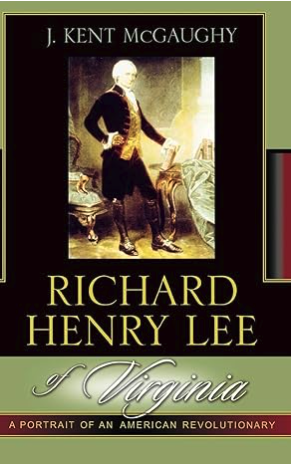
J. Kent McGaughy’s biography, Richard Henry Lee of Virginia: A Portrait of an American Revolutionary, published in 2004, is a deliberate corrective to that omission — and a reminder, particularly urgent in 2026, that history’s most transformative moments are rarely the product of a single heroic individual. They depend on those who do the essential, unglamorous work of legislative architecture: the politicians who know how to move a body, how to frame a resolution, and when to strike.

The Author and His Purpose

McGaughy, a historian whose scholarly focus centers on the political culture of eighteenth-century Virginia, brings to this biography both the rigor of archival research and an evident frustration with how the founding narrative has been written. His purpose, stated plainly in his introduction, is restorative rather than revisionist. He does not argue that Lee was secretly more important than Jefferson or Adams. He argues, more usefully, that we have been asking the wrong question – focusing so heavily on who wrote the Declaration that we have forgotten who made it possible for a declaration to be written at all.

The biography draws on Lee’s extensive correspondence, his speeches in Congress, and the political networks of colonial Virginia to reconstruct a figure who was, in many ways, the connective tissue of the revolutionary movement. McGaughy’s approach is methodical and scholarly rather than cinematic, but his subject rewards the attention. Lee was not a man of dramatic gestures; he was a man of patient, relentless political work, and McGaughy is at his best when showing how that work accumulated into historical consequence.

The Central Argument

McGaughy’s core interpretation is straightforward but important: Richard Henry Lee was the political architect of independence in a way that no other founder was. Jefferson provided the language. Adams provided the passion. Franklin provided the credibility. But Lee provided the mechanism – the formal legislative trigger without which none of those contributions would have had a vehicle.

The resolution Lee introduced on June 7, 1776, was not spontaneous. McGaughy traces the months of careful coalition-building that preceded it, the correspondence Lee maintained with Patrick Henry, Samuel Adams, and other firebrands across the colonies, and the precise political calculation involved in timing the resolution’s introduction. Lee understood that independence required not just sentiment but procedure – that the Continental Congress needed a formal motion to act upon, and that the motion needed to come at a moment when enough delegates were ready to support it, or at least not block it.

McGaughy also rehabilitates Lee’s role in the broader revolutionary period, showing that his advocacy for a bill of rights and his deep suspicion of centralized power were not peripheral concerns but central to the political philosophy that shaped the founding. Lee was a committed republican in the classical sense – wary of executive overreach, committed to the sovereignty of deliberative bodies, and insistent that liberty required structural protections, not merely declarations of principle.

The Months That Followed

The signing of the Declaration on August 2, 1776, did not mark a pause in Lee’s revolutionary activity – it accelerated it. In the months immediately following, Lee remained one of the most active and influential figures in the Continental Congress, even as illness – a recurring affliction that dogged him throughout his life – periodically forced him from Philadelphia.

Lee was deeply involved in the effort to establish foreign alliances, particularly with France, which he understood to be essential to the military survival of the new nation. He corresponded extensively with Arthur Lee, his brother stationed in Europe, coordinating intelligence and diplomatic strategy. He also turned his considerable legislative energy toward the Articles of Confederation, the framework for national governance that would occupy Congress through 1777. True to form, Lee pushed for provisions that protected state sovereignty and checked the accumulation of central power – positions that placed him in tension with some of his fellow founders but were deeply consistent with the Virginia political tradition he embodied.

His physical absences from Congress during this period were not retreats; they were filled with organizing, writing, and lobbying from Virginia, ensuring that his state’s considerable weight remained aligned with the revolutionary cause. Lee returned to active Congressional service repeatedly, understanding that independence declared was not independence secured, and that the legislative work of building a functioning republic was as urgent as the military work of defending one.

The Voice on the Page

McGaughy’s scholarly prose occasionally gives way to passages that capture the particular electricity of Lee’s political world. Describing Lee’s position in the weeks before his June resolution, McGaughy writes with real compression and force: Lee had spent the better part of a decade preparing his colleagues for a vote they had not yet admitted they were willing to take. The resolution was not a leap – it was the last step of a very long walk.

On Lee’s deep commitment to a formal declaration of rights, McGaughy is equally pointed, noting that for Lee, the Declaration of Independence without a subsequent bill of rights was an incomplete document – a statement of freedom that left the mechanisms of freedom dangerously undefined. This premonition, of course, proved prescient: the absence of enumerated rights from the original Constitution would become the central political controversy of the ratification debates a decade later.

McGaughy also captures the particular frustration that animated Lee’s later career – the sense that the Revolution’s promise was being slowly, institutionally diluted by the very men who had helped make it. Lee’s anti-federalism was not reactionary nostalgia. It was, McGaughy argues, the logical extension of the same political principles that had made him a revolutionary in the first place.

In Dialogue with the Series

Read alongside the other books in The Architects of Independence, McGaughy’s biography of Lee performs an essential function: it insists that the Declaration was a legislative achievement before it was a literary one.

Pauline Maier’s American Scripture, the cornerstone of this reading series, makes a complementary argument – that Congress, not Jefferson, was the true author of the final Declaration, having revised and sharpened Jefferson’s draft through collective deliberation. McGaughy arrives at a similar conclusion by a different path, showing that even before the committee sat down to write, a politician had to construct the conditions under which writing could occur. Maier and McGaughy together produce a fully democratic account of the Declaration’s origins: one man built the legislative pathway; one body walked it.

McGaughy is also in productive tension with David McCullough’s John Adams. McCullough’s biography gives Adams enormous credit – perhaps the most of any individual – for driving the independence movement forward in Congress. McGaughy does not dispute Adams’s passion or his indispensability. But he subtly rebalances the ledger, suggesting that Adams’s role was primarily that of advocate and debater, while Lee’s was that of legislative strategist. A motion needs a champion, but it first needs a motion, and that motion needed its author.

Joseph Ellis’s Founding Brothers provides yet another useful counterpoint. Ellis is drawn to the dramatic relationships – the rivalries, the reconciliations, the letters between giants. Lee appears at the margins of Ellis’s account, which is precisely McGaughy’s point: the founders who worked through formal legislative structures rather than through personal drama have been systematically undervalued by a historiography that prizes charisma over procedure.

What We Have Learned Since 2004

McGaughy’s biography appeared before the most recent wave of scholarship on the founding era’s contradictions – particularly regarding slavery. Lee himself owned enslaved people throughout his life, and his revolutionary rhetoric about liberty existed in the same dissonant space as Jefferson’s and Washington’s. McGaughy addresses this tension, but the two decades of scholarship since publication – including work by historians like Woody Holton and Edward Baptist on the political economy of the slaveholding founders – have sharpened the analytical tools available for understanding how men like Lee could hold simultaneously a philosophy of universal liberty and a practice of human bondage.

More recent digital history projects have also expanded access to Lee’s correspondence, allowing scholars to trace his political networks with greater precision than McGaughy could in 2004. The picture that emerges from this subsequent work is largely consistent with McGaughy’s portrait, but richer in texture – Lee’s coalition-building appears even more sophisticated, and his role in coordinating the inter-colonial correspondence networks even more central, than the biography fully conveys.

Why Read This in 2026

There is a particular kind of political figure – essential to every democratic movement but rarely celebrated by it – who understands that ideas require mechanisms. That liberty requires not just a declaration but a procedure, a motion, a vote, a structure. Richard Henry Lee was that figure in 1776, and McGaughy’s biography is a sustained meditation on why such figures matter.

In a political moment when democratic institutions are once again under pressure, when the gap between principled rhetoric and structural reality feels especially wide, Lee’s story carries genuine contemporary force. The Declaration of Independence was not conjured by a lone genius into a vacuum. It required someone who understood how power actually moves through a deliberative body – who knew how to frame a resolution, when to introduce it, and how to build the fragile legislative coalition that would carry it forward.

Richard Henry Lee of Virginia is not the most thrilling book in this reading series. It does not have the biographical sweep of Chernow’s Washington or the narrative propulsion of McCullough’s Adams. But it is, in its own way, the most politically instructive – a reminder that revolutions are not made by declarations alone. They are made by the patient, strategic work of people who understand the machinery of democracy and how to make it move.


A Note on This Series

This journey through Revolutionary history is as much about the evolution of historical understanding as the Revolution itself. History isn’t static – each generation reinterprets the past through its own concerns, asking different questions and prioritizing different sources. By reading these books in dialogue across 250 years, we’ll witness how scholarship evolves, how narratives get challenged, and how forgotten stories resurface.

This isn’t about declaring one interpretation “right” and another “wrong,” but appreciating the richness that emerges when multiple perspectives illuminate the same transformative moment. These books won’t provide definitive answers – history rarely does – but they equip us to think more clearly about how real people facing genuine uncertainty chose independence, how ideas had consequences, and how the work of creating a more perfect union continues. As we mark this anniversary, we honor the Revolutionary generation by reading deeplythinking critically, and engaging seriously with both the brilliance and blind spots of what they created.
You can find the entire series listing here.

The Philosopher Who Played Politics: Thomas Jefferson and the Declaration of Independence


As the Declaration of Independence’s principal author, Jefferson’s inclusion in this series is essential. Jon Meacham’s biography goes beyond historical bias to examine the political genius and moral complexity of the man who gave the Declaration its enduring voice.

April and May – The Architects of Independence, Part Five

He Didn’t Want the Assignment

In the summer of 1776, as Philadelphia baked in the June heat, a thirty-three-year-old Virginia lawyer sat alone in a rented parlor on Market Street and attempted the most consequential act of writing in American history. Thomas Jefferson had not wanted the assignment. He was homesick, worried about his ailing wife Martha back in Monticello, and eager to return to Virginia, where he believed the real revolutionary work – building a new state government from scratch – was being done without him. Yet there he sat, composing a document that would not merely justify a colonial rebellion, but articulate a vision of human equality that would outlast him by centuries, that would be invoked by Frederick Douglass, echoed by Ho Chi Minh, and challenged, tested, and betrayed in ways Jefferson could never have imagined.

That tension – between the soaring idealism of Jefferson’s words and the often messy, self-interested, morally compromised reality of his life – is precisely the subject Jon Meacham sets out to illuminate in Thomas Jefferson: The Art of Power (2012). In an era when political leaders are simultaneously celebrated and diminished in real time, when the gap between rhetoric and action is a source of endless public despair, Meacham’s portrait of history’s most contradictory founding father carries an uncomfortable and urgent resonance.

The Author and His Argument

Jon Meacham is no academic provocateur. A Pulitzer Prize-winning biographer who previously chronicled Andrew Jackson and later Abraham Lincoln and George H.W. Bush, Meacham writes biography as narrative – accessible, propulsive, and attuned to the emotional texture of its subjects’ lives. His fifth book at time of publication, The Art of Power is the most widely-read Jefferson biography available today – well-written and fast-paced, entertaining and enjoyable, requiring little patience or fortitude on the part of the reader.

But Meacham’s accessibility masks a serious central thesis. His core argument is announced in his title and prosecuted on every page: that Jefferson’s genius was not merely philosophical but profoundly political. As Meacham puts it, “Philosophers think; politicians maneuver. Jefferson’s genius was that he was both and could do both, often simultaneously. Such is the art of power.” This is a Jefferson who is not the marble monument of the Jefferson Memorial, but a flesh-and-blood operator – shrewd, calculating, contradiction-tolerating, and above all, effective.

Meacham shows how Jefferson’s deft ability to compromise and improvise made him a transformational leader. We think of Jefferson as the embodiment of noble ideals, as he was, but Meacham shows that he was a practical politician more than a moral theorist. Drawing on archives in the United States, England, and France, including unpublished transcripts from Jefferson’s presidential papers, Meacham presents Jefferson as the most successful political leader of the early republic, and perhaps in all American history – a leader who found the means to endure and to win, whose story resonates today not least because he led his nation through ferocious partisanship amid economic change and external threats.

The Making of the Declaration

Meacham’s account of Jefferson’s role in drafting the Declaration of Independence cuts against two persistent myths: that Jefferson was a lone genius working in inspired isolation, and that the Congress merely rubber-stamped his prose. The truth, as Meacham renders it, was far more collaborative and politically fraught.

On June 11, 1776, the Continental Congress selected Jefferson, John Adams, Benjamin Franklin, Roger Sherman, and Robert R. Livingston to draft a declaration of independence. Knowing Jefferson’s prowess with a pen, Adams urged him to author the first draft, which was then carefully revised by Adams and Franklin before being given to Congress for review on June 28.

Jefferson drafted the document in roughly seventeen days, working from his own prior writings, George Mason’s Virginia Declaration of Rights, and a deep immersion in Enlightenment philosophy – particularly the natural-rights theories of John Locke. Drawing on documents such as the Virginia Declaration of Rights, state and local calls for independence, and his own draft of a Virginia constitution, Jefferson wrote a stunning statement of the colonists’ right to rebel against the British government, establishing their argument on the premise that all men are created equal and have the inalienable rights of life, liberty, and the pursuit of happiness.

What happened next was politically bruising. Congress stripped roughly a quarter of Jefferson’s original text, including his entire passage condemning the slave trade – a deletion that haunted Jefferson for the rest of his life and that Meacham treats as both a political necessity and a moral catastrophe. Among the rejected passages were a critical reference to the English people and, crucially, a denunciation of the slave trade and of slavery itself. Jefferson seethed at these changes but held his tongue – a display of the political discipline Meacham identifies as central to his character.

Interestingly, one of Jefferson’s most famous phrases came close to being something far less memorable. Jefferson first wrote “we hold these truths to be sacred and undeniable.” In the rough draft, the words “sacred and undeniable” were crossed out and “self-evident” written in above the line. Whether that revision was Jefferson’s own second thought or Benjamin Franklin or John Adams’s editorial hand remains a subject of scholarly debate – a small detail that opens a window onto the extraordinary collaborative pressures at work in that Philadelphia room.

Immediately Afterwards: The Revolutionary Governor

By the summer of 1776, Jefferson was seeking to be relieved from congressional service, a principal reason being his desire to be near his ailing wife. He returned to Monticello in September and plunged immediately back into Virginia politics, working closely with James Madison as a member of the new House of Delegates. Their first collaboration – to end the religious establishment in Virginia – became a legislative battle that would culminate with the passage of Jefferson’s Statute for Religious Freedom in 1786.

He was elected to the Virginia House of Delegates for Albemarle County in September 1776, when finalizing the state constitution was a priority. For nearly three years, Jefferson assisted with the constitution and was especially proud of his Bill for Establishing Religious Freedom.

Then, in the spring of 1779, came a new challenge that would test Jefferson’s limits as a leader. Jefferson was only thirty-six years old when he became governor, but he brought a diverse array of experience to the position. His two terms would prove to be the most turbulent and personally damaging years of his public life. His tenure was dominated by repeated British invasions of Virginia during the Revolution. Hampering his efforts to respond was the state constitution, which had relegated little power to the state’s chief executive. Faced with calls to provide the struggling Continental army with troops and the need to reinforce the militia against possible invasion, Jefferson presided over draft lotteries that were met with stiff resistance.

When Benedict Arnold raided Richmond in January 1781, the British forces effectively chased Jefferson from office. General Charles Cornwallis dispatched a cavalry force led by Banastre Tarleton to capture Jefferson and members of the Assembly at Monticello, but Jack Jouett of the Virginia militia thwarted the British plan, and Jefferson escaped to Poplar Forest, his plantation to the west. A subsequent legislative inquiry into his conduct as governor was embarrassing, though ultimately cleared. He retired to Monticello in 1781, shaken, and channeled his energies into writing Notes on the State of Virginia – his only book.

This period matters enormously for how we read the Declaration. Jefferson had written of freedom while enslaving hundreds; he had called for resistance to tyranny while struggling to muster an effective military response to actual invasion. The gap between his words and his governance was already apparent in the months immediately after the document he wrote became the founding creed of a new nation.

Key Passages

Meacham’s prose is at its most illuminating when he captures Jefferson’s own paradoxes in the man’s own words. Jefferson hated confrontation, and yet his understanding of power and of human nature enabled him to move men and to marshal ideas, to learn from his mistakes, and to prevail. This formulation – conflict-averse yet politically masterful – is the engine of Meacham’s entire interpretation.

Jefferson is seen as a man who, given the opportunity, would avoid confrontation, but whose profound understanding of the machinations of power and human nature made him a natural leader of men – able to motivate them to action, create ideas, correct mistakes and learn from them. Meacham repeatedly shows how Jefferson pursued his ends through proxies, through carefully cultivated networks of allies, through letters and newspaper placements and dinner-table conversations – never through direct confrontation. It is a portrait of power operating in the shadows that feels strikingly modern.

Dialogue with the Other Books in This Series

Placed within the “Architects of Independence” reading series, Meacham’s Jefferson both complements and complicates the surrounding biographies. His account aligns well with David McCullough’s John Adams on the mechanics of the drafting process – both authors confirm Adams’s central role in steering the assignment to Jefferson and his subsequent light-touch editing of the draft. Where they diverge is in temperament: McCullough’s Adams is a man of transparent moral seriousness; Meacham’s Jefferson operates through indirection and strategic ambiguity.

With Joseph Ellis’s Founding Brothers, the conversation is even richer. Ellis, who called the Declaration’s words “the most potent and consequential words in American history,” wrote extensively about the founders’ personal rivalries and ideological fault lines. Meacham largely shares Ellis’s view of Jefferson as a political genius but is arguably more sympathetic to his subject than Ellis’s often skeptical lens allows. Some critics felt that Meacham goes out of his way to portray Jefferson as a “man of his time” – and that often his excuses for Jefferson’s backtracking are so generic as to apply to any politician.

Against Pauline Maier’s American Scripture, which argues that the Declaration was ultimately the work of Congress as a collective body rather than Jefferson’s individual genius, Meacham stands in partial tension. He acknowledges Congress’s editorial role but never abandons the fundamental premise that Jefferson’s voice – his particular gift for distilling revolutionary philosophy into ringing prose – was irreplaceable. The two books are best read as complementary: Maier tells us what the document became; Meacham tells us what kind of mind conceived it.

Gordon Wood’s Revolutionary Characters, which opens this reading series, provides the essential framing for Meacham’s Jefferson – the portrait of a founding generation that believed character and public virtue were inseparable from political legitimacy. Meacham’s Jefferson is Wood’s thesis made flesh: a man whose character was simultaneously his greatest asset and his deepest liability.

Historical Reassessment: What We’ve Learned Since 2012

The Art of Power was published in the same year that Monticello opened a major joint exhibit with the Smithsonian on the enslaved community at Jefferson’s plantation – a significant cultural moment in the ongoing reassessment of Jefferson’s legacy. In June 2018, the Thomas Jefferson Foundation asserted that Jefferson’s relationship with Sally Hemings is “settled historical matter.” This is a harder line than Meacham took in 2012, and it shifts the moral weight of the biography considerably.

The scholarly consensus on the Hemings relationship has also firmed considerably in the decade since the book’s publication. Since the 1998 DNA study, several historians have concluded that Jefferson maintained a long sexual relationship with Hemings and fathered six children with her, four of whom survived to adulthood. The relationship began, historians now believe, when Hemings was between fourteen and sixteen years old and Jefferson was in his mid-forties. Meacham addresses this in the book but some readers and reviewers have felt he treats it with insufficient moral gravity – prioritizing the political Jefferson over the enslaving Jefferson.

The broader field of founding-era scholarship has also moved toward centering the enslaved and the dispossessed in ways that challenge the great-man framework Meacham employs. Annette Gordon-Reed’s work, in particular, has made it increasingly difficult to read a Jefferson biography that does not grapple systematically with the Hemings family’s experience as its own story, not merely as a complication in Jefferson’s.

Reader’s Value: Why Read This in 2026?

In an era when democratic institutions are under renewed stress, when the gap between political idealism and political reality feels especially acute, Meacham’s central argument carries fresh urgency. Jefferson was not a saint who fell short of his ideals. He was a politician who understood that ideals themselves are tools – wielded strategically, deployed selectively, powerful precisely because they transcend the compromises required to advance them. His story resonates today not least because he led his nation through ferocious partisanship amid economic uncertainty and external threat – the eternal drama of a leadership striving for greatness in a difficult and confounding world.

The Art of Power is also simply excellent narrative history – Meacham never lets the weight of scholarship bury the human drama of his subject’s life. For readers moving through this Declaration-focused series, it provides the essential bridge between the procedural history of how the document was written (Maier) and the personal dynamics among the men who wrote it (Ellis). Jefferson is the hinge on which the entire history turns, and Meacham’s biography remains the most readable and most complete account of how the man who gave the Declaration its voice actually moved through the world — with genius, with appetite, with contradiction, and with an art of power that both built a nation and left its deepest promises unfulfilled.

To read Jefferson is to read the unfinished argument of American democracy itself. Meacham makes that argument vivid and inescapable – which is exactly what the best biography does.


A Note on This Series

This journey through Revolutionary history is as much about the evolution of historical understanding as the Revolution itself. History isn’t static – each generation reinterprets the past through its own concerns, asking different questions and prioritizing different sources. By reading these books in dialogue across 250 years, we’ll witness how scholarship evolves, how narratives get challenged, and how forgotten stories resurface.

This isn’t about declaring one interpretation “right” and another “wrong,” but appreciating the richness that emerges when multiple perspectives illuminate the same transformative moment. These books won’t provide definitive answers – history rarely does – but they equip us to think more clearly about how real people facing genuine uncertainty chose independence, how ideas had consequences, and how the work of creating a more perfect union continues. As we mark this anniversary, we honor the Revolutionary generation by reading deeplythinking critically, and engaging seriously with both the brilliance and blind spots of what they created.

You can find the entire series listing here.

The Founder Who Made the Declaration Possible


Benjamin Franklin: An American Life by Walter Isaacson. As the elder statesman of the Committee of Five, Franklin’s presence lent credibility and diplomatic weight to the Declaration. Isaacson’s definitive biography illuminates his indispensable role in the founding moment.

May and June – The Architects of Independence, Part Three

The Original American

There is a moment near the end of Benjamin Franklin’s life that captures everything essential about the man. Attending the Constitutional Convention in 1787 at age eighty-one, barely able to walk, carried into the hall by prisoners from a nearby jail because the ride in a sedan chair caused him less pain, he still managed to deliver one of the most eloquent speeches in American political history – urging delegates to sign a document he knew was imperfect, because perfection was the enemy of the possible. That disposition – pragmatic, generous, undeceived about human nature yet still hopeful about human potential – animated everything Franklin contributed to the American founding, including his indispensable presence on the Committee of Five tasked with drafting the Declaration of Independence in the summer of 1776.

In an era when Americans debate what the founding generation actually believed and intended, and when the gap between a nation’s ideals and its practice feels as precipitous as ever, Walter Isaacson’s Benjamin Franklin: An American Life (Simon & Schuster, 2003) offers something genuinely useful: a portrait of the founder who was least like an aristocrat, most like the rest of us, and perhaps most responsible for the Declaration’s survival as a serious document rather than a revolutionary pamphlet.

The Author and His Angle

Walter Isaacson came to Franklin with unusual credentials. A former chairman of CNN and managing editor of Time, he is a biographer drawn to figures who sit at the intersection of ideas and action – men and women who don’t merely think well but make things happen. His subsequent biographies of Steve Jobs and Leonardo da Vinci follow the same logic: genius expressed through craft, through persuasion, through making. Franklin, Isaacson argues, is the original American prototype of this type.

Published in 2003, the biography arrived at a moment when American confidence and American anxiety were intertwined in the aftermath of September 11, and readers were hungry to understand what, precisely, the national inheritance consisted of. Isaacson’s Franklin was timely without being polemical. He neither idolizes his subject nor performs the fashionable demolition of founders that characterized some late-twentieth-century revisionism. Instead, he presents Franklin whole – the genius and the schemer, the moralist who kept a common-law family arrangement for decades, the anti-slavery advocate who owned enslaved people in his middle years, the brilliant diplomat who was also capable of sustained personal vanity.

The Central Argument

Isaacson’s core claim is both simple and consequential: Benjamin Franklin was the most fully American of all the founders, and understanding him is understanding the nation’s practical, self-inventing, pluralist instincts at their best. Where Jefferson was an aristocratic philosopher who wrote magnificently about equality while living in profound tension with it, and Adams was a constitutionalist of great integrity and impossible temperament, Franklin was the founder who had actually been common – a runaway apprentice, a self-made printer, a man who earned his prestige rather than inheriting it.

This matters for the Declaration because Franklin’s role on the Committee of Five was not primarily literary. Jefferson was appointed primary drafter, Adams was the floor champion, and Franklin’s function was something rarer: legitimacy. He was the most famous American in the world, the man whose lightning rod and Poor Richard’s Almanack had made him a celebrity across Europe and the colonies alike. When the Committee presented its work, Franklin’s presence on it signaled to the world – and to nervous moderates in Congress – that this was not the work of hotheads. It was the considered judgment of the most respected mind America had produced.

Beyond prestige, Isaacson documents Franklin’s specific editorial contributions. The most famous is small but profound. Where Jefferson had written that men are endowed with “sacred and undeniable” truths, Franklin changed it to “self-evident.” The shift is philosophically significant: “sacred” grounds the claim in religion; “self-evident” grounds it in reason, making the Declaration’s foundational premise accessible to Enlightenment thinkers across confessional lines. It was a characteristically Franklinian edit – pragmatic, inclusive, durable.

The Months That Followed

The signing of the Declaration on August 2, 1776 did not slow Franklin. At seventy, an age at which most men of his era were already dead, he embarked almost immediately on what would become the most consequential diplomatic mission in American history.

By October 1776, Congress had appointed him minister to France, and he sailed across the Atlantic knowing that the Revolution’s survival depended almost entirely on French financial and military support. He arrived in Paris in December and was received as something between a philosopher-king and a rock star. French salons were fascinated by this American who seemed to embody Enlightenment virtue – simple dress, brilliant conversation, that famous fur cap, which the French took as the costume of a primitive, natural man and which Franklin, ever the strategist, was happy to encourage.

His work in France between 1776 and 1778 produced the Franco-American alliance, formalized in the Treaty of Amity and Commerce, which brought French money, troops, and naval power into the conflict. Without it, as most historians now concede, the Continental Army could not have sustained the war. The Declaration was words on parchment until Saratoga and the French alliance made it something more. Franklin, more than any other single individual, converted the many uncertainties from possibility into reality.

The Author’s Voice

Isaacson writes with a journalist’s instinct for the telling detail and a historian’s respect for evidence. On Franklin’s famous self-improvement regimen, his Autobiography‘s list of thirteen virtues he attempted to master one at a time, Isaacson observes that the project reveals both Franklin’s genius and his limitations:

“The virtue he found most difficult was order… and he eventually decided that a ‘speckled axe’ – one with a few imperfections – was preferable to an exhausting pursuit of perfect orderliness. It was a very American conclusion.”

That compression – biographical insight, national character, gentle irony – is characteristic of Isaacson at his best. He makes Franklin feel recognizable, someone who understood that the pursuit of perfection is often the enemy of the good, in his own life as in his politics.

Dialogue with the Reading List

Placed third in the “Architects of Independence” series, Benjamin Franklin arrives after Gordon Wood’s Revolutionary Characters and Joseph Ellis’s Founding Brothers, and before David McCullough’s John Adams. The conversation among these books is fascinating.

Where Wood situates the founders within a broader intellectual culture of republican virtue that required public men to transcend private interest, Franklin is almost a challenge to that framework: he was transparently interested in his own advancement for much of his life, and yet became genuinely devoted to public service. Ellis’s Founding Brothers gives particular attention to the tensions among the founders, and Franklin appears there as the one figure most capable of navigating those tensions through wit and strategic ambiguity.

The most pointed dialogue, however, is with McCullough’s John Adams. The two men’s relationship was one of the founding era’s great partnerships and occasional frictions. Adams admired Franklin’s genius and resented his celebrity in roughly equal measure, writing in his diary with barely concealed jealousy of the esteem the French showed his colleague. McCullough’s Adams is a man of ferocious principle; Isaacson’s Franklin is a man of flexible strategy. Both books suggest that the Revolution needed both types – and that neither man could have done the other’s job.

Pauline Maier’s American Scripture, later in the series, provides the essential corrective to any biography-centered reading of the Declaration by insisting that Congress, not any individual, made the document what it was. Isaacson’s Franklin actually prepares the reader well for Maier’s argument: he presents Franklin not as a lone genius but as a collaborator, an editor, a man who understood that collective work produces better outcomes than individual performance.

What We’ve Learned Since 2003

Isaacson’s biography predates the major scholarly work on Franklin’s relationship to slavery. More recent historians, particularly in the wake of the 1619 Project and renewed attention to the founding’s contradictions, have pressed harder on Franklin’s early slaveholding and his eventual evolution toward abolitionism – he became president of the Pennsylvania Abolition Society in 1787. While Isaacson addresses this honestly for his time, subsequent scholarship has situated it more centrally within any full account of Franklin’s moral life.

There has also been significant new work on Deborah Read Franklin, Benjamin’s common-law wife, who managed his printing business and household through his long absences and died before he returned from London. Her story, largely invisible in Isaacson’s telling, has been substantially recovered by later scholars and complicates the portrait of Franklin as the self-made man.

Why Read This in 2026?

Because the version of American identity Franklin embodied – pragmatic, pluralist, self-invented, suspicious of dogma, committed to the useful and the improvable – is precisely the version most under pressure right now. He was a founder who trusted institutions he had helped build, who believed that collective deliberation produced better outcomes than individual certainty, and who thought that a nation’s character was something made and remade over time, not fixed at a sacred origin point.

Reading Isaacson’s Benjamin Franklin in this moment is not an exercise in nostalgia. It is an encounter with a founding vision that remains genuinely contested – and, depending on your reading, genuinely available. The Declaration Franklin helped carry into the world was not, in his understanding, a completed achievement. It was, as he might have said, a useful beginning.


A Note on This Series

This journey through Revolutionary history is as much about the evolution of historical understanding as the Revolution itself. History isn’t static – each generation reinterprets the past through its own concerns, asking different questions and prioritizing different sources. By reading these books in dialogue across 250 years, we’ll witness how scholarship evolves, how narratives get challenged, and how forgotten stories resurface.

This isn’t about declaring one interpretation “right” and another “wrong,” but appreciating the richness that emerges when multiple perspectives illuminate the same transformative moment. These books won’t provide definitive answers – history rarely does – but they equip us to think more clearly about how real people facing genuine uncertainty chose independence, how ideas had consequences, and how the work of creating a more perfect union continues. As we mark this anniversary, we honor the Revolutionary generation by reading deeplythinking critically, and engaging seriously with both the brilliance and blind spots of what they created.
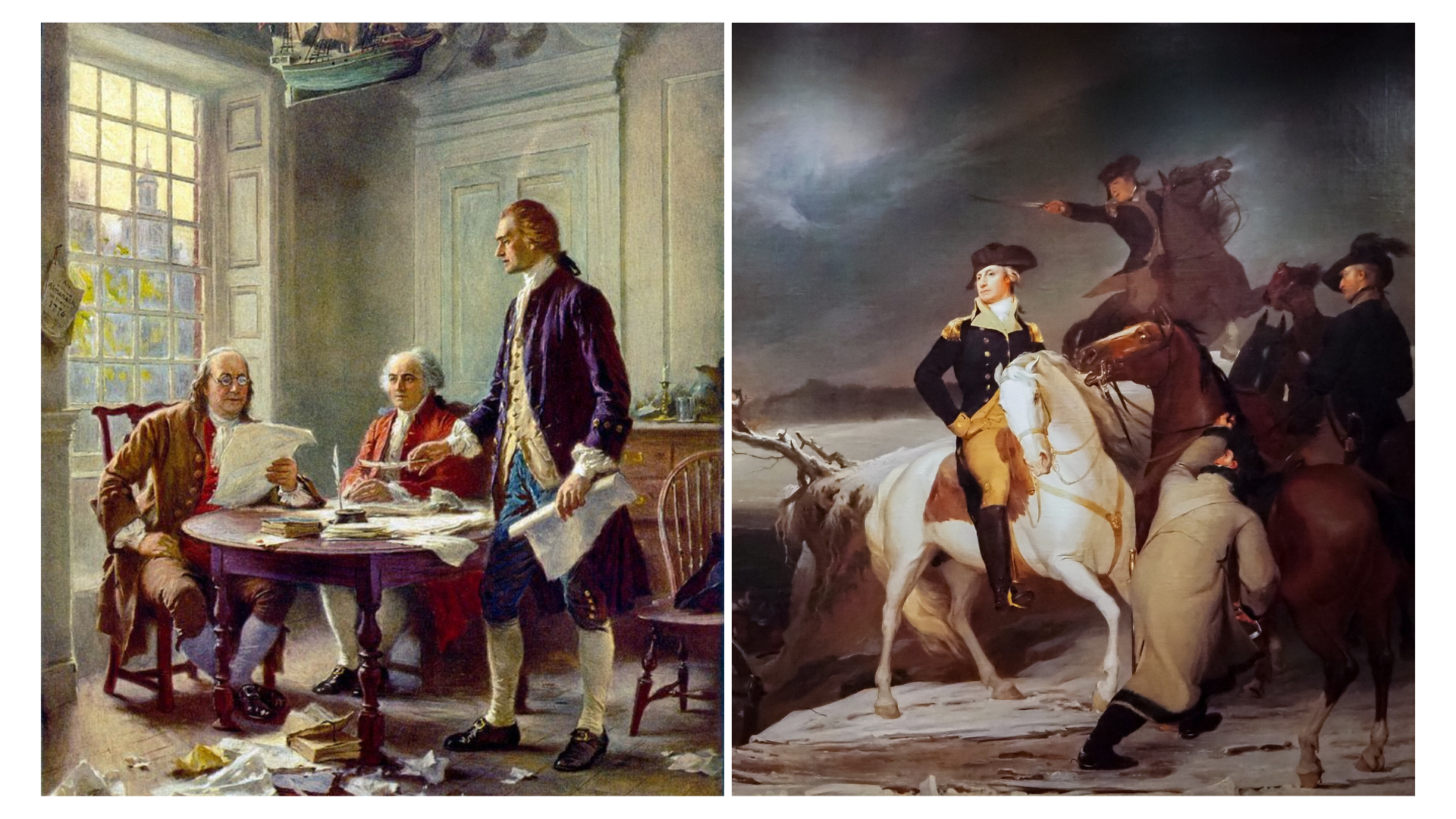
You can find the entire series listing here.

The Revolution Was Personal: The Hidden Drama of “Founding Brothers”


Founding Brothers by Joseph J. Ellis examines the relationships and rivalries among the key founders, revealing how the personal dynamics between the men who wrote and debated the Declaration shaped the document and the nation it created.

May and June – The Architects of Independence, Part Two

A Death on the Fourth of July

On the afternoon of July 2, 1776, John Adams rose before the Continental Congress to argue for independence with a passion that left the chamber speechless. Thomas Jefferson, seated nearby, said nothing – he rarely spoke in public debate – but it was Jefferson who had written the words Congress was preparing to tear apart, line by line, over the sweltering days that followed. Adams and Jefferson had collaborated on the Declaration as members of the Committee of Five, along with Benjamin Franklin, Roger Sherman, and Robert R. Livingston. They had worked in close quarters, traded arguments, and shaped a document that would define a nation. Within a decade, they would become bitter political enemies. Within two decades, they would not speak. And yet on July 4, 1826 – the fiftieth anniversary of the Declaration they helped create – they died within hours of each other, as if history itself had arranged a final curtain call for the two men most responsible for the republic’s founding text.

That extraordinary coincidence of two Declaration men dying together on the Declaration’s birthday is the kind of detail that tempts us to believe the founding was preordained, its heroes larger than life, its outcomes inevitable. Joseph J. Ellis’s Founding Brothers: The Revolutionary Generation, published in 2000 and awarded the Pulitzer Prize the following year, exists to resist exactly that temptation. The men who wrote and debated the Declaration did not know they were making history. They were frightened, quarrelsome, and deeply uncertain whether the republic they were building would survive its first decade, let alone its first century. Ellis’s central wager – that the founding of the United States was a deeply personal, contingent, often furious affair between flawed individuals who happened to be geniuses – has never felt more urgent than it does in 2026, when Americans are once again asking what kind of nation they actually are and how its foundational commitments were won and nearly lost.

The Historian Behind the History

Ellis came to this subject with unique authority. A professor at Mount Holyoke College and later at Amherst, he had spent decades immersed in the founding era, having already written celebrated biographies of Jefferson and John Adams. His command of the primary sources – the letters, the diaries, the congressional records – is total. But what distinguishes Ellis from many academic historians is his willingness to write with narrative energy and psychological acuity. He is a storyteller who happens to be a scholar, and that combination made Founding Brothers accessible to a general readership without sacrificing intellectual seriousness.

It is worth noting one biographical shadow: in 2001, shortly after the book’s Pulitzer, Ellis was exposed for having fabricated personal experiences – claiming to students that he had served in Vietnam when he had not. The episode was damaging to his reputation and widely discussed. It has no bearing on the scholarship of Founding Brothers, which rests on documentary evidence rather than personal testimony, but readers approaching Ellis today do so with that context in mind. His history is not in doubt; his personal character was.

Six Episodes, One Argument

Founding Brothers is structured as six discrete episodes, each organized around a critical moment or relationship: the Hamilton-Burr duel; Washington’s Farewell Address; a congressional debate over slavery and abolition petitions; the dinner-table bargain between Hamilton and Jefferson that located the nation’s capital on the Potomac; John Adams’s lonely and controversial decision to pursue peace with France; and finally, the famous correspondence and reconciliation between Adams and Jefferson in their old age.

The book’s central argument is twofold. First, that the founding of the United States was not inevitable – it was fragile, contested, and nearly undone at almost every turn. The founders themselves lived in terror that the republic would fail. Second, that the personal relationships among these men — their friendships, their hatreds, their jealousies, their silences – were not incidental to the political outcomes but were in fact constitutive of them. The nation that emerged was shaped as much by who liked whom, who owed what to whom, and who was willing to compromise with whom, as by any abstract political philosophy.

The founders were not gods or saints but men, and the America they made was not a perfect creation but a problematic one, brimming with explosive ingredients that their respective visions of what America was or should be could not contain.

Joseph J. Ellis

This is a profoundly democratic argument, in its way. It refuses a hero worship that places the founders beyond criticism while also refusing the cynical revisionism that dismisses them as self-interested hypocrites. Instead, Ellis asks us to hold both truths simultaneously: that these were remarkable men who accomplished something extraordinary, and that the republic they built was stamped with all their contradictions.

The Voice on the Page

Ellis writes with a clarity and precision that rewards the attentive reader. His chapter on the silence over slavery is perhaps the finest in the book – a sober account of how the founders chose, deliberately and with clear eyes, to defer the most catastrophic question in American life. He is not naive about what that choice cost:

The distinguishing feature of the debate was not its intensity but its brevity. For what it’s worth – and one must be careful not to let moral outrage overwhelm historical judgment – the decision to suppress the debate over slavery had a certain tragic logic that is worth understanding before condemning.

The chapter on Washington’s Farewell Address is equally revealing. Ellis shows us a Washington who was not the serene figurehead of legend but a man nursing genuine grievances, writing a document that was in part a settling of scores with the political faction that had attacked him most viciously. The Farewell Address, so often quoted as a kind of secular scripture, turns out to be a deeply personal document dressed up as a philosophical treatise.

The Adams-Jefferson chapter that closes the book may be its most moving. The two men – one crusty, vain, and perpetually under-appreciated, the other graceful, elusive, and morally complicated – resumed their correspondence in 1812 after a decade of silence and wrote to each other until they died within hours of each other on July 4, 1826, the fiftieth anniversary of the Declaration. Ellis renders this friendship-through-letters as something close to a love story between ideas and between men who embodied those ideas.

In Conversation with the Series

Founding Brothers occupies a fascinating middle position among the books in the “Architects of Independence” series. Where Gordon Wood’s Revolutionary Characters (the section’s opening volume) offers the widest-angle view – a portrait of an entire intellectual generation and its cultural world – Ellis zooms in to the human scale, insisting that the texture of the founding is best understood through individual moments and relationships rather than broad cultural forces.

Ellis and Wood are in essential agreement about the founders’ genius and the fragility of the republic they built, but they differ subtly in emphasis. Wood stresses the cultural and ideological distance between the founders and us – they were genuinely different kinds of men, formed by an eighteenth-century world of honor, classical learning, and republican virtue that no longer exists. Ellis, by contrast, insists on their recognizable humanity. His founders lose their tempers, nurse grudges, and maneuver for advantage in ways that feel entirely contemporary.

The book gains added resonance when read alongside the future articles on David McCullough’s John Adams and Walter Isaacson’s Benjamin Franklin. Where McCullough gives us Adams in full biographical depth – the Puritan conscience, the Massachusetts stubbornness, the lifelong wound of being undervalued – Ellis captures the essence of Adams more efficiently, through the crucible of specific decisions. The two books are complementary: McCullough supplies the roots, Ellis shows the fruit. Similarly, Isaacson’s Franklin, with its emphasis on Franklin’s diplomatic genius and strategic intelligence, illuminates Ellis’s portrait of the founders’ dinner-table bargain – one can almost hear Franklin’s dry wit behind the table where Hamilton and Jefferson struck their famous deal.

Perhaps most interestingly, Founding Brothers anticipates the argument that Pauline Maier makes in American Scripture (the section’s essential centerpiece): that the Declaration of Independence was not the product of one man’s genius but of a collective political process involving the whole Congress. Ellis makes the same claim about the founding more broadly – that no single founder was indispensable, that the republic was built in the collisions and compromises between them. This is a democratic corrective to the cult of individual greatness, and it is one of the most important intellectual contributions both books make.

What We Know Now

Founding Brothers was published in 2000, before the major waves of scholarship that have since reshaped our understanding of the founding era. The most significant development is the explosion of serious historical attention to the enslaved people who inhabited the founders’ world – not as backdrop or footnote but as central actors whose labor, resistance, and humanity shaped the republic no less than the men celebrated in Ellis’s pages.

Ellis’s chapter on slavery is careful and well-intentioned, but it is largely told from the perspective of the white founders who chose silence, not from the perspective of the enslaved people whose lives were the stakes of that silence. A reader in 2026 will want to supplement Founding Brothers with work by historians like Annette Gordon-Reed, whose The Hemingses of Monticello transformed our understanding of Jefferson’s Monticello household, or by the rich scholarship on slavery and the Constitution that has appeared in the quarter-century since Ellis wrote.

The book also says relatively little about women. Abigail Adams appears briefly but the domestic and intellectual world of the founders’ wives, sisters, and female correspondents – who often possessed clearer moral vision than their celebrated husbands – is largely absent. Again, this is less a criticism of Ellis than a reflection of where historical scholarship stood in 2000, and of what has flourished since.

None of this diminishes the book’s achievement. It simply asks us to read it as what it is: a landmark work of narrative history that is now itself a historical artifact, reflecting a particular moment in American historiography as much as it reflects the founding era itself.

Why Read This Now

In 2026, at a moment when Americans are debating with extraordinary intensity what the founding documents mean, who they were written for, and whether the republic they established can survive its own contradictions, Founding Brothers offers something rare: it takes the founding seriously without being reverential, and it takes its contradictions seriously without being cynical.

Ellis insists, above all, on the contingency of what was accomplished. The republic did not have to succeed. The founders did not have to find their compromises. The whole experiment nearly failed a dozen times in the first generation. That fragility – the sense that the outcome was never foreordained, that it required constant, difficult, human effort to hold together – is precisely what makes the book galvanizing rather than comforting to read.

Founding Brothers is also, in the best sense, a book about how political disagreement can be navigated without destroying the civic fabric. Adams and Jefferson, who despised each other for a decade, found their way back to friendship and mutual respect. Hamilton and Burr, who could not, paid the ultimate price. The lesson is not that disagreement is bad or that compromise is always possible – Ellis is too honest for such platitudes. The lesson is that the choice between conversation and violence is always live, always personal, and always consequential.

For readers coming to this section of the “Booked for the Revolution” series after Revolutionary Characters, Founding Brothers offers the ideal next step: from the panoramic to the intimate, from the cultural to the human. It is the kind of history that reminds us why the past is not another country but, stubbornly and thrillingly, our own.


A Note on This Series

This journey through Revolutionary history is as much about the evolution of historical understanding as the Revolution itself. History isn’t static – each generation reinterprets the past through its own concerns, asking different questions and prioritizing different sources. By reading these books in dialogue across 250 years, we’ll witness how scholarship evolves, how narratives get challenged, and how forgotten stories resurface.

This isn’t about declaring one interpretation “right” and another “wrong,” but appreciating the richness that emerges when multiple perspectives illuminate the same transformative moment. These books won’t provide definitive answers – history rarely does – but they equip us to think more clearly about how real people facing genuine uncertainty chose independence, how ideas had consequences, and how the work of creating a more perfect union continues. As we mark this anniversary, we honor the Revolutionary generation by reading deeplythinking critically, and engaging seriously with both the brilliance and blind spots of what they created.

You can find the entire series listing here.

The Founders as They Were: “Revolutionary Characters” and the Men Who Made Independence


Revolutionary Characters by Gordon Wood is a sweeping portrait of the founding generation as a whole, establishing the intellectual and cultural world from which the Declaration emerged. Today’s article sets the stage for a new section: the writing of the Declaration of Independence.

Authorized by the Second Continental Congress, the task was assigned to a small committee consisting of John Adams, Benjamin Franklin, Thomas Jefferson, Robert R. Livingston, and Roger Sherman to draft and present the Declaration. Richard Henry Lee was instrumental in his resolution presented on June 7, 1776. The Congress itself made significant changes in wordings from the original drafts. While not present for the actual work on the Declaration, George Washington’s leadership gave the Continental Congress the confidence to declare independence.


May and June – The Architects of Independence, Part One

The Question That Won’t Go Away

Every generation gets the Founders it deserves. Ours, living through a period of ferocious argument about American identity, has found itself returning again and again to the men who first defined it – not for comfort, but for ammunition. We invoke Jefferson to defend liberty and indict him for hypocrisy. We lionize John Adams as the conscience of the Revolution and then fault him for the Alien and Sedition Acts. We celebrate Franklin as the self-made American and wonder how the same man could have kept enslaved servants in Philadelphia. The Founders have become a battlefield, and the fighting shows no sign of stopping.

Into this landscape, Gordon Wood’s Revolutionary Characters: What Made the Founders Different arrives with a deceptively modest premise: that the men who led the American Revolution were genuinely, historically exceptional – and that understanding how and why they were exceptional is both more useful and more honest than either hero-worship or iconoclasm. Published in 2006, the book has only grown in relevance as the culture wars around the founding intensified. It is the ideal opening volume for “The Architects of Independence” because it does what every good overture should: it establishes the key, sets the emotional register, and prepares the ear for everything that follows.

Who Is Gordon Wood, and Why Does it Matter?

Gordon S. Wood is, by nearly any measure, the preeminent living historian of the American founding era. His 1969 doctoral work, The Creation of the American Republic, transformed scholarly understanding of the Revolution’s ideological foundations. His 1992 masterwork, The Radicalism of the American Revolution, won the Pulitzer Prize by arguing, counterintuitively but convincingly, that the Revolution was far more socially disruptive than its genteel surface suggested. By the time Revolutionary Characters appeared, Wood had spent four decades building an interpretive framework capacious enough to hold the founding’s contradictions without collapsing them into easy verdicts.

This matters because Wood writes from a position of earned authority rather than ideological agenda. He is neither a Founders chic celebrant nor a presentist prosecutor. He is, above all, a historian committed to the strangeness of the past – to recovering what it actually felt like to live in a world where the very concept of democratic self-governance was a radical experiment with no guarantee of success. Revolutionary Characters distills a lifetime of that recovery into eight interconnected essays including portraits of Washington, Franklin, Jefferson, and Adams along with one magisterial introduction that is, arguably, the most valuable single chapter in the entire “Architects” series. For readers of “The Architects of Independence,” it is the essays on the men who shaped the Declaration that matter most: the philosophically soaring Jefferson, the diplomatically indispensable Franklin, the tenaciously principled Adams, and the commanding Washington whose military resolve made the Declaration something more than a piece of parchment.

The Central Argument: A World We Have Lost

Wood’s animating thesis is as simple to state as it is difficult to fully absorb: the Founders were the products of an aristocratic, pre-democratic culture that they simultaneously believed in and helped destroy. They were, in Wood’s phrase, “enlightened gentlemen” – men who understood public life as the domain of disinterested virtue, who believed that education and moral cultivation uniquely fitted certain men for leadership, and who regarded the naked pursuit of self-interest as a form of corruption. They prized what the eighteenth century called “reputation” or the judgment of posterity above the approval of the crowd.

This cultural world, Wood argues, made possible both their greatness and their tragic limitations. It enabled men like Washington to subordinate ambition to principle, at least most of the time. It gave Jefferson the philosophical altitude to write that “all men are created equal” even as he enslaved over six hundred human beings – a contradiction that Wood does not excuse but does insist must be understood on its own historical terms before it can be judged on ours. And it meant that their revolution ultimately unleashed democratic energies that swept away the very gentlemanly culture that had produced them, leaving them stranded in a world they had made but no longer recognized.

There is something genuinely moving in Wood’s portrait of these men watching, in their old age, as the Republic they founded was colonized by professional politicians, party operatives, newspaper editors, and popular demagogues – the very forces they had feared. They had built a democracy and were then surprised that it behaved democratically. Wood renders this not as tragedy, exactly, but as historical irony of the deepest kind.

The Author’s Voice: Passages Worth Savoring

Wood writes with the clarity and confidence of a scholar who has nothing left to prove, and Revolutionary Characters contains some of his most quotable prose. On the peculiar nature of founding-era ambition, he observes:

“The Founders were not self-made men in the nineteenth-century meaning of that term. They were not Horatio Alger heroes who had pulled themselves up by their own bootstraps. They did not celebrate work and the getting of money in the way that later Americans would. These were men of the Enlightenment, and they believed that the distinguishing character of a gentleman was his disinterestedness — his ability to act without needing anything for himself.”

On the uniqueness of the founding moment, Wood is equally arresting, noting that the Founders represented perhaps the last cohort in American life to genuinely believe that leadership was a matter of character rather than constituency – that the right man, properly formed, could rise above faction. The tragedy he traces is the speed with which that belief was proved wrong, even in their own lifetimes. By the 1790s, the Republic was already fracturing into parties, and men like Washington and Adams found themselves bewildered by a politics they had hoped to transcend.

His treatment of Thomas Paine is equally illuminating, and particularly relevant to this series. Where most historians regard Paine as the pamphleteer who lit the fuse of independence and then became an embarrassment to the republic he helped create, Wood reads him as the figure who most honestly expressed what the Revolution was actually unleashing: a democratic energy that the gentlemanly founders simultaneously welcomed and feared. Paine did not share the founders’ aristocratic self-conception, and his lack of it both made Common Sense possible and made his later career impossible. He is the exception that clarifies the rule.

In Conversation with the Series: Agreement, Tension, and Nuance

Revolutionary Characters is, in a sense, the intellectual skeleton key for the entire “Architects of Independence” series. Read it first, and every subsequent biography becomes richer.

Consider its relationship to Joseph Ellis’s Founding Brothers (Week Two). Where Wood paints the Founders as a collective type – the enlightened gentleman statesman – Ellis zooms in on the specific textures of their relationships: the charged correspondence between Adams and Jefferson, the way Washington’s commanding presence held the fractious founders together, and the near-miraculous act of collective will that produced independence. The two books are complementary. Wood gives you the forest; Ellis gives you the trees. But they are also occasionally in tension: Ellis is somewhat more inclined to celebrate the Founders’ achievements as personal triumphs of character, while Wood is more interested in the structural and cultural conditions that made those achievements possible – and in what was lost when those conditions changed.

Wood’s treatment of Jefferson as a man of genuine but culturally bounded principle sets up a productive dialogue with Jon Meacham’s Thomas Jefferson: The Art of Power (Week Five). Meacham tends toward admiration for Jefferson’s political genius; Wood’s framework insists we understand that genius as partly a product of an aristocratic self-conception that Jefferson himself would have been reluctant to name. Similarly, Wood’s portrait of Franklin as the great exception – the self-made man who mastered the manners of the gentleman without being born to them – anticipates and deepens Walter Isaacson’s biography (Week Three).

Most significantly, Wood’s emphasis on the Declaration as a product of collective intellectual culture provides an essential complement to Pauline Maier’s American Scripture (Week Eight), which makes the historical case that the Declaration was shaped as much by Congress as by Jefferson. Wood gives Maier’s argument its philosophical scaffolding: if the Founders genuinely believed in disinterested collective deliberation, then it is entirely consistent that the Declaration would be a shared achievement rather than a singular authorial act.

What We’ve Leaned Since 2006: Reassessing Wood

Revolutionary Characters appeared at an interesting historical moment – before the full flowering of the “1619 Project” debate, before the removal of Confederate and colonial-era monuments became a front-page controversy, and before the January 6th insurrection prompted a new round of anxious questioning about whether the Republic’s founding ideals were adequate to sustain it. The book has aged well in some respects and has been productively challenged in others.

Wood has been criticized, not unfairly, for his relative inattention to the experiences of enslaved people, Indigenous nations, and women as co-inhabitants of the founding world. His “enlightened gentlemen” are, by definition, a narrow slice of eighteenth-century America, and his framework can seem to treat their cultural world as the whole world. Historians like Woody Holton, Alan Taylor, and Annette Gordon-Reed have expanded our understanding of the founding era by insisting that the Revolution looked very different depending on where you stood – if you were an enslaved woman at Monticello, a Creek warrior in Georgia, or a working-class sailor in Boston, the Declaration’s promises were either hollow or actively threatening.

Wood has pushed back against some of this revisionism, occasionally with more heat than light. His 2011 book, The Idea of America, included essays that critics read as defensive of the “Founders chic” tradition he had spent his career complicating. The debate reveals a genuine tension in his work: he wants to recover the past on its own terms, but the decision about whose past to recover is itself a choice with present-day implications.

None of this diminishes the achievement of Revolutionary Characters. It simply means that Wood’s book is best read as the beginning of a conversation rather than its conclusion — which is, after all, precisely the role it plays in this series.

Why Read This in 2026?

We live in a moment of intense, sometimes violent disagreement about what America is and what it was always meant to be. One temptation is to resolve that disagreement by flattening the Founders – either into demigods whose vision we must recover intact, or into hypocrites whose contradictions disqualify them from serious admiration. Gordon Wood offers a third way: historical understanding.

To understand the Founders as Wood understands them is to see both their genuine greatness and their genuine limitations as products of a specific historical moment – a moment that is neither recoverable nor entirely irrelevant. They were men who believed in something larger than themselves, who staked their lives and reputations on a political experiment whose outcome was genuinely uncertain, and who built institutions strong enough to survive, so far, nearly two and a half centuries of stress. They were also men of their time: limited by race, class, and gender in ways that caused incalculable suffering and continue to shape American inequality today.

Holding both of those truths simultaneously, without collapsing into either reverence or contempt, is a form of civic maturity that Revolutionary Characters actively cultivates. In 2026, with the Republic’s foundational commitments again under pressure, that cultivation feels less like an academic exercise and more like a democratic necessity.

Read this book before you read the biographies that follow. Read it as a primer on historical thinking, on the distance between past and present, and on the complicated business of inheriting a republic you did not choose. Then read Founding Brothers, and Franklin, and Adams, and Jefferson, and watch how Wood’s framework illuminates every page. The series will make more sense. So, perhaps, will the country.


A Note on This Series

This journey through Revolutionary history is as much about the evolution of historical understanding as the Revolution itself. History isn’t static – each generation reinterprets the past through its own concerns, asking different questions and prioritizing different sources. By reading these books in dialogue across 250 years, we’ll witness how scholarship evolves, how narratives get challenged, and how forgotten stories resurface.

This isn’t about declaring one interpretation “right” and another “wrong,” but appreciating the richness that emerges when multiple perspectives illuminate the same transformative moment. These books won’t provide definitive answers – history rarely does – but they equip us to think more clearly about how real people facing genuine uncertainty chose independence, how ideas had consequences, and how the work of creating a more perfect union continues. As we mark this anniversary, we honor the Revolutionary generation by reading deeplythinking critically, and engaging seriously with both the brilliance and blind spots of what they created.
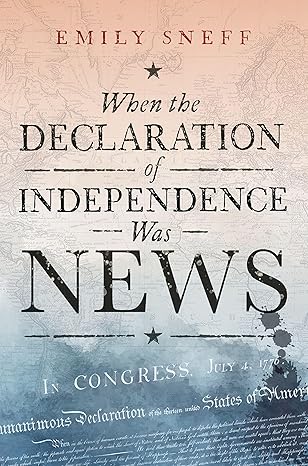
You can find the entire series listing here.

Nine Weeks on a Knife’s Edge: The Radical Messiness of Independence

William Hogeland’s urgent, street-level history strips the mythology from the founding and reveals a revolution nearly lost to faction, fear, and financial interest.


March-April: The Gathering Storm, Part Eight

On the morning of May 1, 1776, no one knew whether America would declare independence. The Continental Congress was a fractious assembly of delegates with competing loyalties, creditors at home, and instructions from colonial legislatures that, in many cases, still explicitly forbade a break with Britain. Two months later — on a day now rendered in bronze and marble — they signed their names to treason. Between those two dates lay nine weeks that William Hogeland insists we have never properly understood. His 2010 book Declaration: The Nine Tumultuous Weeks When America Became Independent, May 1–July 4, 1776 is, in the best sense, a history of contingency: a reminder that what happened almost didn’t, and that the people who made it happen were flawed, frightened, and fiercely divided about what independence would mean for ordinary Americans.

Hogeland is not a comforting writer. He is a former literary editor turned radical-democratic historian whose earlier book The Whiskey Rebellion exposed the founding generation’s willingness to suppress the working-class movement that financed the Revolution from below. In Declaration, he turns that same unsentimental lens on the weeks leading up to July 4 – and what he finds is not a scene of noble unanimity, but a pressure-cooker of class conflict, political manipulation, and ideological improvisation.

The Core Argument: Independence as a Coalition Problem

Hogeland’s central interpretation is deceptively simple but quietly explosive: independence in 1776 was not the inevitable culmination of colonial enlightenment. It was the product of a specific, fragile, and contested political coalition – one that required radical populists from Pennsylvania and conservative merchants from New York and South Carolina to temporarily make common cause, and one that could have collapsed at any moment. The founding was not a consensus; it was a managed contradiction.

The book’s beating heart is Pennsylvania, where the push for independence was simultaneously a push for democratic revolution at home. Ordinary artisans, militia privates, and tradesmen wanted not only to break from Britain but to break the grip of the colony’s Quaker mercantile elite. Hogeland shows how figures like Tom Paine and the radical committeemen of Philadelphia’s wards used the momentum toward independence to rewrite Pennsylvania’s constitution into the most democratic document in the Western world – one with a unicameral legislature, no property requirement for voting, and mandatory legislative transparency. The merchants and lawyers who would later claim sole credit for founding a nation spent much of those nine weeks trying to contain precisely this kind of democratic energy.

The founding generation’s genius was not in agreeing on independence. It was in finding, briefly, a formula by which people who disagreed about nearly everything else could sign the same document – and in ensuring that document said as little as possible about what would come next. – Willam Hogeland

This reading reframes what the Declaration itself actually accomplished. Jefferson’s soaring language about equality was not, Hogeland argues, an accidental ornament on a political document. It was a deliberate act of controlled ambiguity – radical enough to inspire the populists, vague enough to terrify no one with property. The Declaration announced principles that almost none of its signers intended to enforce immediately, and many intended never to enforce at all.

In Dialogue: McCullough’s Heroism, Bailyn’s Ideas

Reading Declaration alongside several other books in this series clarifies exactly what kind of history Hogeland is writing and what he is writing against.

David McCullough’s 1776 is a masterwork of narrative empathy. Its Washington is courageous; its soldiers are stoic; its outcome feels earned. But McCullough operates almost exclusively at the level of military command, and his Revolution is largely a story about leaders. Hogeland’s revolution is not. He insists on the militia privates who debated political philosophy in Philadelphia taverns, the artisans who showed up armed to committee meetings, and the landless men who had no representation in the Congress that was deciding their future. Where McCullough gives us a founding to be proud of, Hogeland gives us one to reckon with.

The relationship with Bernard Bailyn’s The Ideological Origins of the American Revolution is more nuanced. Bailyn’s landmark 1967 work argued that the Revolution was driven by a coherent republican ideology – a fear of tyranny and corruption rooted in English Whig tradition that ran through colonial thought from pamphlets to sermons to newspaper columns. Hogeland is not unsympathetic to this view, but he pushes decisively below it. Ideas matter in Declaration, but they are wielded as weapons in a class conflict that ideological history can obscure. 

When Philadelphia’s radical democrats invoked “the rights of man,” they meant something materially different than when Robert Morris or John Dickinson did. The same words, as Hogeland shows, could be pressed into service for genuinely incompatible visions of the republic that would follow independence. Bailyn maps the intellectual architecture; Hogeland shows who was living in which rooms – and who was locked outside.

The Weeks Themselves: A Timeline of Crisis

EARLY MAY: Pennsylvania radicals force the removal of the colonial assembly; Congress recommends colonies form new governments.

JUNE 7: Richard Henry Lee introduces independence resolution; moderates push for three-week delay.

LATE JUNE: Jefferson drafts; committee revises; slavery clause removed under pressure from Southern delegates.

JULY 2–4: Congress votes independence; Declaration adopted; New York abstains, later ratifies

What Hogeland does brilliantly with this timeline is show how each step was improvised under duress. The delay from early June to July 2 was not procedural politeness – it was a furious negotiation over whether the moderate Middle Colonies could be brought along, or whether New England and Virginia would move without them. Every concession in the Declaration’s final text – including the painful removal of Jefferson’s anti-slavery passage – represents a live argument in a room full of people who disagreed about almost everything except the immediate necessity of French military aid.

What We’ve Learned Since 2010

Hogeland wrote Declaration in the early years of the Tea Party movement, and the book carries the urgency of that moment – a time when competing factions were battling over what the founders “really meant.” Since then, scholarship has continued to deepen his core insights. 

The publication of Alan Taylor’s American Revolutions: A Continental History (2016) and the popular explosion of interest generated by the 1619 Project have further stressed the Revolution’s internal contradictions, particularly around slavery and the deliberate exclusion of Black, Indigenous, and poor white Americans from the republic’s founding promises. Hogeland anticipated this direction. His Pennsylvania radicals now look like the earliest evidence of a long-suppressed democratic tradition that the elite founders not only failed to honor but actively worked to suppress – a tradition that would not resurface with any force until the Jacksonian era and, arguably, not fully until the Progressive movement a century after independence.

In a political moment when the founding is once again being argued over – invoked simultaneously to justify populist rebellion and elite institutional preservation – Hogeland’s book performs an essential service. It refuses to let either side rest easy. His founders were not a band of philosopher-kings whose wisdom we should restore. Nor were they simply hypocrites whose ideals we should discard. They were politicians in a genuine crisis, making deals, suppressing dissent, and writing documents whose meaning they deliberately left unresolved – because resolution would have meant choosing sides in a class war they were not prepared to fight. 

Declaration is the most honest account of those nine weeks precisely because it does not flinch from that conclusion. For readers of this series who came to the founding through McCullough’s warmth or Bailyn’s intellectual elegance, Hogeland is the necessary cold water. Not because the founding was shameful, but because it was human – and because understanding it honestly is the only way to argue seriously about what it means now.


A Note on This Series

This journey through Revolutionary history is as much about the evolution of historical understanding as the Revolution itself. History isn’t static – each generation reinterprets the past through its own concerns, asking different questions and prioritizing different sources. By reading these books in dialogue across 250 years, we’ll witness how scholarship evolves, how narratives get challenged, and how forgotten stories resurface.

This isn’t about declaring one interpretation “right” and another “wrong,” but appreciating the richness that emerges when multiple perspectives illuminate the same transformative moment. These books won’t provide definitive answers – history rarely does – but they equip us to think more clearly about how real people facing genuine uncertainty chose independence, how ideas had consequences, and how the work of creating a more perfect union continues. As we mark this anniversary, we honor the Revolutionary generation by reading deeplythinking critically, and engaging seriously with both the brilliance and blind spots of what they created.
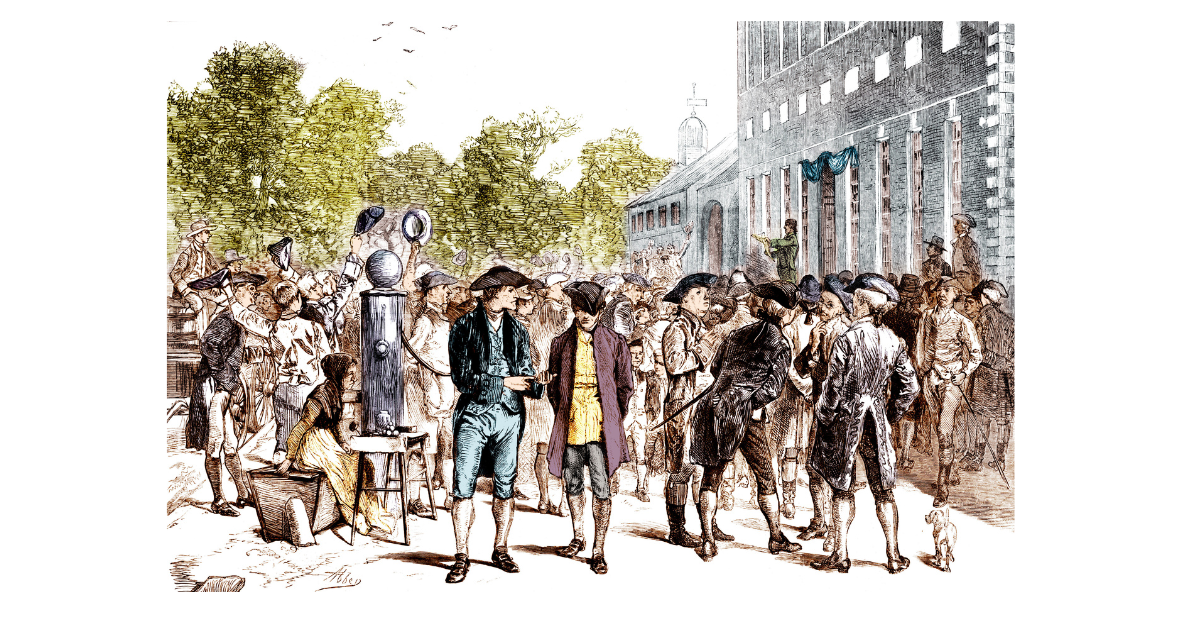
You can find the entire series listing here.

Rowing in the Dark: The Marbleheaders Who Saved America


Patrick K. O’Donnell’s “The Indispensables” rescues the Marblehead Regiment from historical amnesia — and in doing so, redraws the map of who helped make the United States of America.


March and April – The Gathering Storm, Part Seven

Sometime in the small hours of August 29, 1776, with fog settling over the East River and the British army massed on the Brooklyn heights behind them, George Washington’s army ceased to exist as a fighting force – and was reborn. Nine thousand men, their artillery, horses, and supplies, crossed from Long Island to Manhattan in rowboats without losing a single soldier or making a sound that the enemy could hear. The operation took seven hours. The men at the oars were fishermen and sailors from a single Massachusetts seaport, eighteen miles north of Boston. Had they failed, or had the wind shifted before they finished, the Revolution would almost certainly have ended on a muddy riverbank before it had truly begun.

That seaport was Marblehead. The men were the 14th Continental Regiment, commanded by Colonel John Glover. They are the same men who just four months later pulled off the more famous crossing of the Delaware. And until Patrick K. O’Donnell published The Indispensables in 2021, most Americans had never heard of them.

A Combat Historian at the Oar

O’Donnell is not a university historian. He is a combat historian – a distinction that matters enormously to how this book reads and what it values. He embedded with a Marine rifle platoon during the Battle of Fallujah, consulted on Steven Spielberg’s Band of Brothers, and has written thirteen books on American military history. His method is to get as close to the soldier’s experience as the archive will allow: muster rolls, pension files, diaries, letters, and period newspapers. He spent five years reconstructing the Marblehead Regiment from such sources, and it shows. When O’Donnell describes men rowing through ice floes on the Delaware on Christmas night, 1776, he is drawing on the physical logic of cold water and exhausted bodies, not just the diplomatic logic of generals.

That perspective gives The Indispensables both its great strength and its acknowledged limitation. The book is a thrilling narrative, not a structural analysis of colonial society. O’Donnell is interested in what these men did, and in recovering their names and faces from the archive. He is less interested – as he would readily admit – in asking why the social structure of Marblehead produced them.

The Central Argument: Geography Is Destiny, and Diversity Is Strength

O’Donnell’s core interpretation is deceptively simple: the American Revolution was won not by the philosophical abstractions of Philadelphia drawing rooms, but by the contingent competence of specific men in specific places at specific moments – and those moments kept happening to require the same town. Marblehead’s economy was built on deep-sea fishing in the North Atlantic, which produced men who could navigate in darkness, manage a vessel in a storm, and improvise under conditions that would terrify professional soldiers. When the Continental Army needed someone to execute an amphibious evacuation under fire, or to row 2,400 men across an ice-choked river in a blizzard, those men were already trained. The war did not create the Marbleheaders. The Atlantic Ocean did.

O’Donnell’s second argument is equally pointed: the regiment was, from its inception, one of the most racially and ethnically integrated units in the Continental Army. Free Black sailors, Native Americans, and men of Hispanic descent served alongside white New Englanders in Glover’s regiment – not as an ideological project, but as an economic fact. The fishing industry cared about skill, not race. This diverse workforce, bound by occupational brotherhood, became what O’Donnell calls “one of the country’s first diverse units.” The implication is deliberate: America’s founding military achievement was accomplished by an America that looked more like the present than the mythology of the Revolution usually admits.

“To save his army, the Revolution, and a hopeful future bound by liberty and equality for unborn millions, General Washington would turn to the soldier-mariners of Colonel John Glover’s regiment from Marblehead, Massachusetts.”

PATRICK K. O’DONNELL, THE INDISPENSABLES

Henry Knox, Washington’s artillery chief who witnessed the Delaware crossing firsthand, later told the Massachusetts legislature: “I wish the members of this body knew the people of Marblehead as well as I do – I wish that they had stood on the banks of the Delaware River in that bitter night when the commander in chief had drawn up his little army to cross it.” Knox’s testimony captures something O’Donnell understands viscerally: those who were there knew what the Marbleheaders meant. Those who weren’t have spent 250 years forgetting.

Key Moments: From Lexington to the Delaware

1775: Marbleheaders fight at Lexington and Bunker Hill; Glover forms the regiment

Aug 1776: The “American Dunkirk” – 9,000 men evacuated from Brooklyn overnight

Dec 1776: Christmas crossing of the Delaware; surprise attack on Trenton turns the war

1777: Enlistments expire; Marbleheaders walk 300 miles home, many sick and wounded

O’Donnell also recovers lesser-known engagements – the sharp fighting at Throgs Neck and Pell’s Point, where Glover’s regiment bought time for Washington’s retreat across Manhattan – that conventional histories have largely ignored. He traces the regiment’s role in the origins of the Continental Navy, as Marblehead privateers began seizing British merchant ships, functioning as a de facto naval force before any official navy existed. The claim in the subtitle – that they “formed the Navy” – is not hyperbole. It is a precise historical argument.

Dialogue with the Series: Three Towns, Three Revolutions

Read alongside previous installments of this series, The Indispensables completes a striking view of New England communities at the moment of rupture.

The Minutemen and Their World – Robert Gross, 1967

  • Concord as a community under social stress – yeoman farmers defending a way of life, not an abstract liberty. Revolution as local, conservative, and agrarian in character.

Lexington and Concord – George C. Daughn, 2018

  • The opening shots as a military and political event – British miscalculation meeting colonial preparation. Focus on command decisions and the escalation of force.

The Indispensables – Patrick O’Donnell, 2021

  • The war as sustained by maritime, working-class, and diverse communities – not just the farmers and founders. Revolution as a multi-year feat of physical endurance.

Robert Gross showed us Concord’s social world: the anxieties of landless younger sons, the declining church, the committee politics that precede muskets. His Minutemen are embedded in a specific agrarian ecology. George Daughan gave us the military operational picture: the decisions, the march, the firefight, the political consequence. O’Donnell gives us something neither book provides – the sustained, unglamorous, year-long physical effort of keeping an army alive and mobile. His Marbleheaders appear at Lexington and at Bunker Hill, but they are most themselves at the oar, at the tiller, in the dark water. Where Gross’s farmers fought to protect what they had, and Daughan’s colonists fought to make a political point, O’Donnell’s mariners fought because they were good at it and because the country needed them to be.

The books also diverge productively on the question of diversity. Gross’s Concord is notably homogeneous, a town whose internal tensions are about class and land, not race. Daughan’s account focuses on the mechanics of the military encounter. O’Donnell insists that the Revolution, at its most crucial physical moments, was carried out by a multiracial workforce. These are not incompatible views; they describe different communities and different phases of the war. Together, they suggest that the American Revolution was not one event but a coalition of overlapping local revolutions, each with its own sociology.

What We’ve Learned Since 2021

O’Donnell’s book arrived as American debates about whose history gets told were at a cultural peak, and it has been both celebrated and occasionally criticized for its emphasis on the regiment’s diversity. The more substantial historical conversation since publication has focused on the lives of the individual Black and Native American soldiers O’Donnell names. Researchers working in pension records and town archives have continued to flesh out those biographies, and several genealogical projects have extended O’Donnell’s muster-roll research. The picture that has emerged confirms his central point: integration in this regiment was not incidental but structural, rooted in the labor economy of the Atlantic fishing trade.

Some military historians have noted that O’Donnell, perhaps inevitably given his combat-historian lens, occasionally overstates the uniqueness of the Marbleheaders’ contributions at specific engagements where other units also performed with distinction. The Brooklyn evacuation, in particular, involved boats and watermen from other New England communities. The “indispensable” framing is a rhetorical choice as much as a historical verdict. But the regiment’s aggregate importance to the 1776 campaign – Throgs Neck, Pell’s Point, the evacuation, the Delaware crossing, Trenton, Princeton – is difficult to dispute on the evidence.

Why Read This in 2026?

America is in the middle of an extended argument about its founding – about who participated in it, who was excluded, who should be remembered, and whose sacrifices shaped the country. The Indispensables is a remarkably useful book for that argument because it is neither polemical nor evasive. O’Donnell is not making a political argument about diversity; he is recovering a historical fact about how an army actually functioned. The regiment was integrated because the fishing industry was integrated. The integration was decisive because the regiment was decisive. The chain of evidence is clear and the research is meticulous.

There is also a simpler reason to read this book: it is genuinely exciting. O’Donnell writes action sequences with the pacing of a thriller. The Brooklyn evacuation, rendered across several chapters, is among the most gripping set pieces in recent American military history writing. The Christmas crossing of the Delaware – a scene you think you already know from the painting – becomes, in O’Donnell’s hands, a feat of physical courage by men who had been fighting for months, who were sick and exhausted, who knew what failure would mean, and who kept rowing anyway.

Read alongside Gross and Daughan, The Indispensables closes a circuit. Gross gives you the world that produced the Revolution. Daughan gives you the spark. O’Donnell gives you the long, cold, unglamorous work of winning it.

Together, these three books constitute something close to a complete popular history of how the American Revolution actually happened – not as a philosophical event, but as a human one, accomplished by specific people from specific places who were, in O’Donnell’s apt phrase, in the right place at the right time. We have simply forgotten to remember them.


A Note on This Series

This journey through Revolutionary history is as much about the evolution of historical understanding as the Revolution itself. History isn’t static – each generation reinterprets the past through its own concerns, asking different questions and prioritizing different sources. By reading these books in dialogue across 250 years, we’ll witness how scholarship evolves, how narratives get challenged, and how forgotten stories resurface.

This isn’t about declaring one interpretation “right” and another “wrong,” but appreciating the richness that emerges when multiple perspectives illuminate the same transformative moment. These books won’t provide definitive answers – history rarely does – but they equip us to think more clearly about how real people facing genuine uncertainty chose independence, how ideas had consequences, and how the work of creating a more perfect union continues. As we mark this anniversary, we honor the Revolutionary generation by reading deeplythinking critically, and engaging seriously with both the brilliance and blind spots of what they created.
You can find the entire series listing here.