Every document that changes the world starts as ink on paper, written by people who couldn’t have known how far their words would travel. That’s true of the Declaration of Independence, and it’s the reason this next stretch of reading matters. We’ve spent time with the men who wrote it and the summer that shaped it – now we turn to the document itself, and to the argument that America has been having with it, and about it, ever since. What did it actually say? What did “all men are created equal” mean to the people who signed their names beneath it, and what has it come to mean since? These are the questions this section takes up, one book at a time.
July – The Document and Its Meaning, Part One
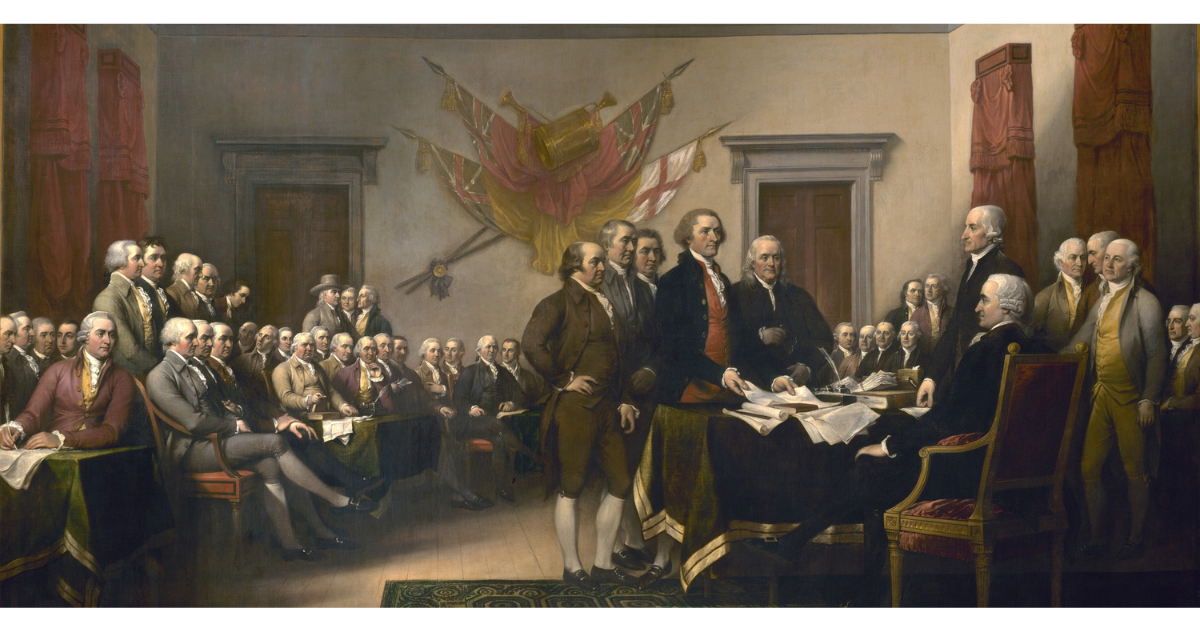
On the morning of July 4, 1776, the delegates in Philadelphia were not thinking about literature. They were thinking about war, about treason, about whether any of them would live to see the outcome of what they had just done. And yet the document they formally adopted that day contained a sentence so compressed, so philosophically loaded, so audacious in its assumptions, that it has never stopped generating argument. Two hundred and fifty years later, those thirty-five words remain the most contested real estate in American public life.
Walter Isaacson’s slim, precise volume The Greatest Sentence Ever Written – published in November 2025 as the nation’s semiquincentennial year approached – is essentially a long love letter to that sentence. The one beginning “We hold these truths to be self-evident.” The one ending with “Life, Liberty, and the pursuit of Happiness”. Isaacson makes no apology for the grandiosity of his title. His argument is that this sentence is, in fact, the greatest sentence ever written – and he proceeds to prove it, clause by clause, word by careful word.
The Biographer’s Eye
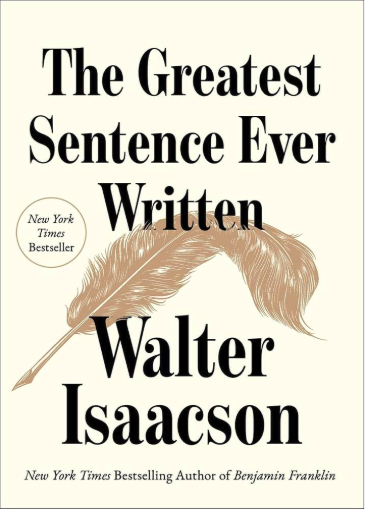
Isaacson comes to this subject with particular credibility. He is the author of the definitive modern biography of Benjamin Franklin, which means he has spent years inside the mind of the man who made perhaps the single most important edit to Jefferson’s original draft. He has also written authoritative biographies of Einstein, Steve Jobs, Leonardo da Vinci, and Elon Musk – a career built on identifying the moment when a person’s genius crystallizes into something permanent. Applying that same lens to a sentence is an unusual move, but it suits him.
The book is deliberately short. At 67 pages of main text, it reads more like a long essay than a conventional history, structured as a sequence of short chapters – each one focused on a specific word or phrase from the sentence. This is not a book about the Declaration broadly. It is not a survey of the Revolutionary period, a political biography of Jefferson, or a comprehensive account of the Continental Congress. It is a work of close reading, and Isaacson is clear about that from the first page. His scope is narrow and his intention is precise: to make you understand what those thirty-five words actually meant in 1776, and why they still matter now.
The Argument
Isaacson’s central claim is twofold. First, the sentence is a masterpiece of collaborative intellectual craftsmanship – not the product of a single inspired mind, but the result of Jefferson’s genius for “felicitous expression” being sharpened by Franklin’s rationalism and Adams’s theological instincts. Second, the sentence contains within it the tools for resolving the crises it also helped create – because its ideals of common ground and the pursuit of the American Dream are not contradictions of each other, but complements.
He unpacks the word “We” first, and the choice is instructive. Before the sentence makes any claim about rights or equality, it makes a claim about collectivity. This is not I hold these truths. It is we. Isaacson traces the Enlightenment lineage behind that collective voice – Locke’s social contract, Hume’s moral epistemology, Rousseau’s general will – and shows how Jefferson distilled a century of European political philosophy into a single pronoun.
The most electrifying section of the book deals with the edit that changed everything: Benjamin Franklin’s substitution of “self-evident” for Jefferson’s original “sacred and undeniable.” The change seems small. It was seismic. Jefferson’s phrase anchored the truths of the Declaration in religious authority. Franklin’s phrase – drawn from the language of Newtonian mathematics and Enlightenment logic – anchored them in reason. In three syllables, Franklin converted a theological assertion into a philosophical one. He made the truths of the Declaration available to anyone capable of rational thought, regardless of religious conviction. Isaacson calls this one of the most consequential edits in the history of political writing, and he is not wrong.
Adams’s contribution comes in the phrase “endowed by their Creator,” which he inserted where Jefferson had written the more legally clinical “from that equal creation, they derive rights.” Adams, a Unitarian with more conventional religious sensibilities than the Deist Jefferson, threaded the Creator back into a sentence that Franklin had otherwise rationalized. The result is a sentence that manages to be simultaneously theological and scientific, a balancing act that has made it legible – and defensible – to almost every American constituency for two and a half centuries.
Voices from the Page
Isaacson’s own prose is clear and unpretentious. He is not trying to match Jefferson’s eloquence; he is trying to explain it. Some of his best moments come when he pauses over a word the way a jeweler pauses over a flawed stone – not to dismiss it, but to understand its facets. On the phrase “all men”:
The restrictiveness behind the seemingly inclusive ‘all men’ is one of the Declaration’s founding contradictions. Of the fifty-six signers, forty-one owned slaves. Jefferson knew this. The sentence was aspirational in a way its author could not fully inhabit.
On the phrase “pursuit of Happiness” – which Isaacson argues is perhaps the most misunderstood concept in the entire document:
Jefferson did not mean what we now mean by happiness. He meant something closer to what Aristotle meant by eudaimonia — the flourishing of the human person through virtue, engagement, and the exercise of reason. The Declaration did not promise you happiness. It promised you the freedom to pursue it. The difference matters.
These passages are characteristic of the book’s best work: precise, contextual, quietly urgent.
In Conversation with the Rest of This Section
Read alongside the other upcoming books in this section of Booked for the Revolution, The Greatest Sentence Ever Written occupies a distinctive position. It is the most intimate of them – the most zoomed-in, the most formally literary in its approach. Where Emily Sneff’s When the Declaration Was News examines the document’s extraordinary afterlife in newspapers and public circulation, Isaacson pulls in the opposite direction, drilling into the genetic code of a single sentence before that sentence ever reached a printer’s shop. The two books are, in a sense, bookends: Sneff shows you what the Declaration became; Isaacson shows you how the sentence that defined it was made.
Joseph Ellis, in Revolutionary Summer, is working at a different scale entirely – the entire arc of the 1776 military and political crisis, with the Declaration as one crucial node in a larger story. Ellis is interested in the interaction between battlefield and committee room, between military desperation and philosophical ambition. Isaacson does not engage that context at all. He is not interested in what was happening to Washington’s army while Jefferson was writing. His is a text-centered argument, and he makes no apology for the narrowness of its frame.
Robert Parkinson’s Tyrants and Rogues takes the most adversarial position toward the Declaration among the section’s books. Parkinson reads the document as a propaganda instrument, shaped in part by racial anxieties and the desire to mobilize white colonists by invoking fears of Black and Native enemies. Isaacson acknowledges the hypocrisy of the sentence’s promises – he is not naïve about slavery – but his interpretation is fundamentally optimistic. He reads the founding ideals as a promissory note that future generations were obligated to redeem, not as a cover story for racial exclusion. These two books do not reconcile easily, and that tension is worth sitting with.
Michael Auslin’s National Treasure reads the Declaration in the context of America’s global standing and democratic mission. Isaacson’s work is less interested in foreign policy implications than in domestic philosophy, but both authors share a conviction that the sentence’s ideals – when taken seriously – point toward civic renewal rather than cynicism. They are, in this sense, temperamentally aligned even when their arguments diverge.
What We Know Now
Isaacson published this book at a specific moment – November 2025, months before the 250th anniversary – and the timeliness is not accidental. The question of what the Declaration actually says, actually meant, and actually obligates has rarely felt more urgent. In an era when the phrase “all men are created equal” is simultaneously invoked to expand rights and to resist the expansion of rights, Isaacson’s granular focus on original meaning is a kind of historical intervention.
What the scholarship since 1776 has made undeniably clear – and what Isaacson does not shy from – is that the sentence was simultaneously radical and constrained. It opened a door and blocked another. The phrase “all men” was not, in 1776, understood to include enslaved people, women, or most propertyless white men. Pauline Maier’s American Scripture, covered in the Architects of Independence portion of this series, established the documentary record of how the document was received by contemporaries; her work makes clear that the revolutionary implications of the sentence’s language were contested from the moment of its first reading. Frederick Douglass understood this in his 1852 speech “What to the Slave Is the Fourth of July?” — before most professional historians had caught up.
One limitation of Isaacson’s approach is worth noting: his focus on Jefferson, Franklin, and Adams occasionally obscures the committee’s full composition. Roger Sherman of Connecticut and Robert Livingston of New York contributed to the drafting process and deserve more credit than the historical record has given them. Isaacson mostly passes them by, as critics have noted. The story of the sentence’s creation is more collaborative, and less dominated by the famous trio, than the book’s framing suggests.
Why Read This in 2026
The honest answer is that this book will take you ninety minutes to read, and it will change the way you hear those thirty-five words for the rest of your life. That is not a small thing.
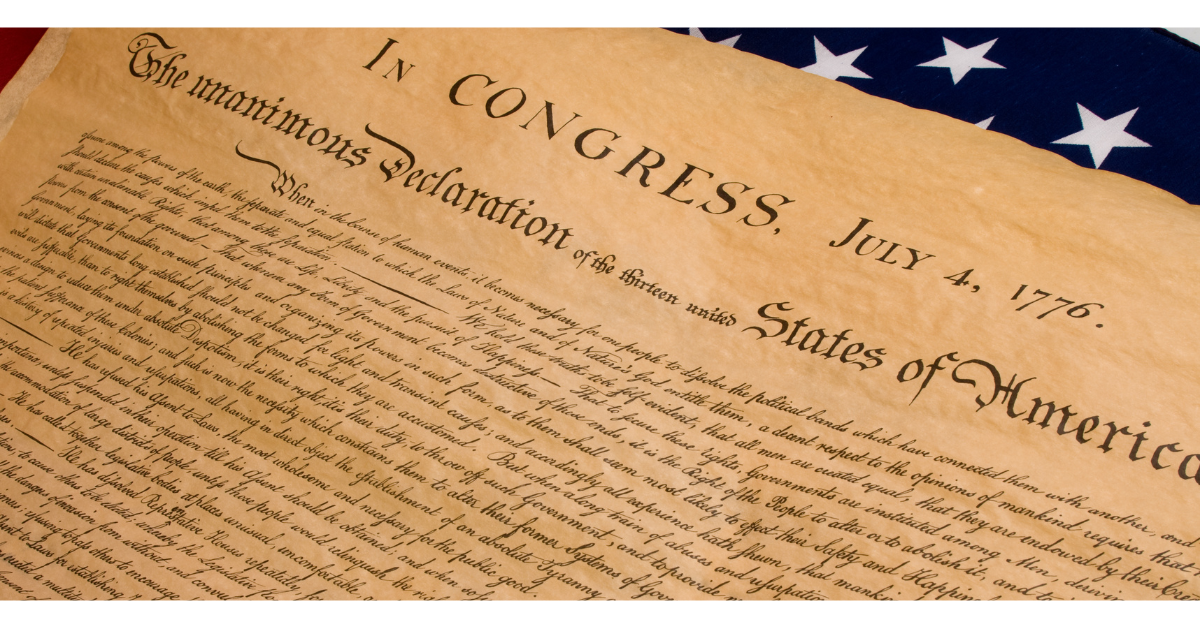
Every July 4th, someone reads the Declaration aloud. Most listeners have the second sentence memorized to the point of near-automaticity – it passes through the ear without registering. Isaacson slows that sentence down. He makes you hear “self-evident” the way Franklin intended it: not as a rhetorical flourish, but as a claim about the structure of reality, as confident and as verifiable as a theorem. He makes you hear “Creator” the way Adams intended it: as a theological anchor that nonetheless left room for Jefferson’s Deism and Franklin’s rationalism to coexist. He makes you hear “pursuit” the way Jefferson intended it — not as a guarantee of arrival, but as a right of motion.
In the context of this series, the book serves as a kind of philosophical plumb line. The other works in Section V will examine what the Declaration has meant – historically, legally, culturally, politically. Isaacson examines what it was designed to mean in the moment of its composition. The distance between those two things — design and reception, intention and inheritance — is where American history has largely been written.
This is the right book to read on the Fourth of July. Not because it is celebratory, though it is that too. But because it takes seriously the idea that the words we memorize without thinking have earned their place in memory – that they are, word for word, worth the full weight of our attention.
A Note on This Series
This journey through Revolutionary history is as much about the evolution of historical understanding as the Revolution itself. History isn’t static – each generation reinterprets the past through its own concerns, asking different questions and prioritizing different sources. By reading these books in dialogue across 250 years, we’ll witness how scholarship evolves, how narratives get challenged, and how forgotten stories resurface.
This isn’t about declaring one interpretation “right” and another “wrong,” but appreciating the richness that emerges when multiple perspectives illuminate the same transformative moment. These books won’t provide definitive answers – history rarely does – but they equip us to think more clearly about how real people facing genuine uncertainty chose independence, how ideas had consequences, and how the work of creating a more perfect union continues. As we mark this anniversary, we honor the Revolutionary generation by reading deeply, thinking critically, and engaging seriously with both the brilliance and blind spots of what they created.