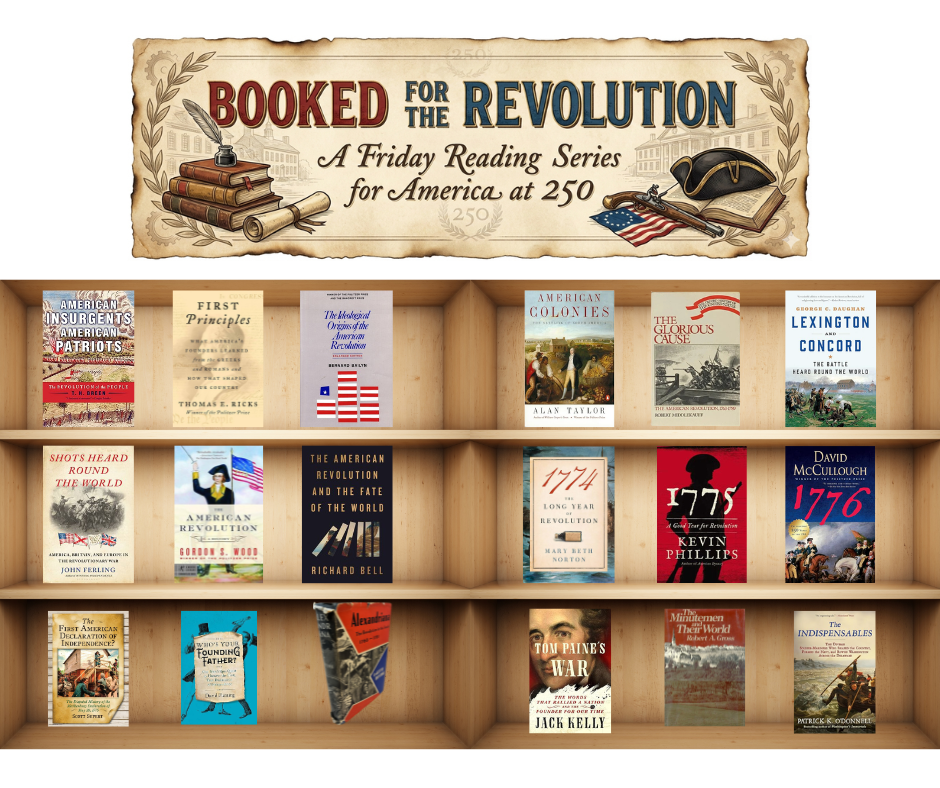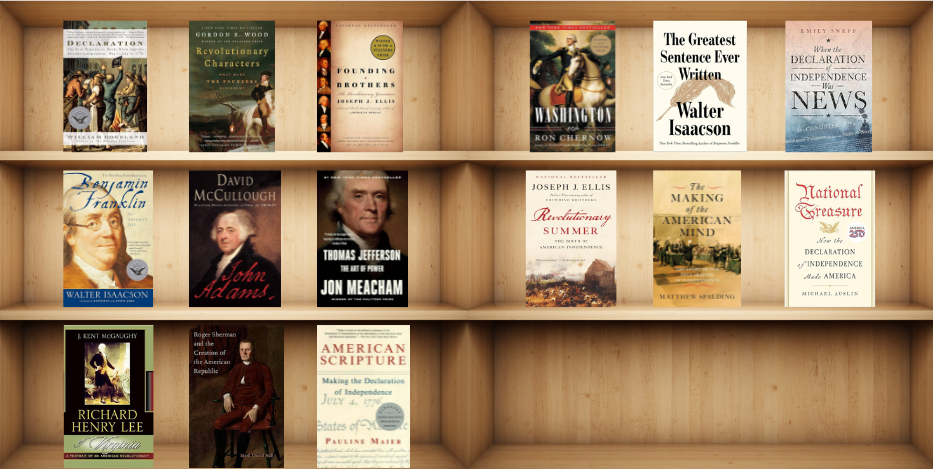
America250: A Year of Revolutionary Reading began as a personal project – a way of honoring a father who loved to read and a Bicentennial summer that first showed me why the past matters – and grew into a seven-month journey through a selection of books that explain how thirteen colonies became a nation.
The series moves chronologically and thematically:
- Seeds of Rebellion lays the colonial groundwork, tracing the ideas, empires, and ordinary lives that made revolution thinkable.
- The Gathering Storm follows the escalating crisis from 1774 through the outbreak of war.
- The Architects of Independence turns to the men who shaped the Declaration itself — Adams, Jefferson, Franklin, Sherman, Lee, and others — read through the historians and biographers who’ve tried to capture them.
- A single article marks July 4, 1776 by examining in depth the single most important sentence of the Declaration.
- The Declaration of Independence and Its Meaning concludes the series, examining how the document was received, contested, and reinterpreted across two and a half centuries.
Each article pairs one or more books with the moment or figure it illuminates, letting historians argue with each other across decades of scholarship. The goal throughout has been the same: not just to recount 1776, but to understand it – and to ask what its promises still owe us in 2026.
This series is my attempt to honor both my parent’s gift and that pivotal Bicentennial year by exploring the moments, movements, and individuals that created the unique country we call the United States of America.
Listed below are links that will take you to each article in the series.
Seeds of Rebellion
What Does 1776 Mean in 2026? A Year of Revolutionary Reading
Before The First Shot There Was The First Sentence
Reimagining a Continent’s Contested Past
Three Empires, One Continent: The Race for North America
The Birth of Rebellion: North Carolina’s Revolutionary Spirit in the 1700s
The Revolutionary Ideas That Built America – And Still Haunt It
When Farmers Became Insurgents: The Forgotten Army That Made Independence Possible
When Revolution Costs Everything
The Gathering Storm
1774: The Year Nobody Wanted War – And Got It Anyway
1775: The Year That Made Independence Inevitable
1776: When The World Was On The Line
How One Town Rewrote the Story of the Revolution
Rowing in the Dark: The Marbleheaders Who Saved America
Nine Weeks on a Knife’s Edge: The Radical Messiness of Independence
The Architects of Independence
The Founders As They Were:
“Revolutionary Characters” and the Men Who Made Independence
The Revolution Was Personal: The Hidden Drama of “Founding Brothers”
The Founder Who Made The Declaration Possible
Off By Two Days: John Adams and the Declaration of Independence
The Philosopher Who Played Politics: Thomas Jefferson and the Declaration Of Independence
The Man Who Lit the Fuse: Richard Henry Lee
The Man Who Signed Everything: Roger Sherman, the Indispensable Founder You’ve Never Heard Of
Jefferson Wrote a Draft. Congress Wrote the Declaration.
The General Who Made the Words Matter
July 4, 1776
Thirty-Five Words That Changed Everything
The Declaration of Independence and Its Meaning
Before It Was Sacred, It Was News
The Parchment That Would Not Stay Still
Two hundred fifty years ago, fifty-six men signed their names to a promise they could not fully keep and likely knew it. That gap between the words and the reality has never closed on its own. It has only ever closed through the deliberate, often unglamorous work of people who took the Declaration’s claims seriously enough to press for them.
That work isn’t finished, and it was never meant to be settled by one generation. The books in this series don’t offer a tidy verdict on what 1776 means – they offer arguments, evidence, and enough disagreement among serious historians to make clear that the meaning of independence is still being written. Reading them is a start. What comes next is up to each of us: studying the founding honestly, including its failures alongside its achievements, and asking where its unfinished promises still need our attention.
My father handed me a love of reading. I don’t know that he set out to hand me a responsibility along with it, but that’s what history tends to do – it asks something of the people who take it seriously. If this series has done its job, it hasn’t left you with a finished picture of 1776. It’s left you with better questions, and maybe some sense of what it costs to keep a declaration like this one alive.
The Revolution ended. The argument it started did not.
That argument is ours now.