Founding Brothers by Joseph J. Ellis examines the relationships and rivalries among the key founders, revealing how the personal dynamics between the men who wrote and debated the Declaration shaped the document and the nation it created.
May and June – The Architects of Independence, Part Two
A Death on the Fourth of July
On the afternoon of July 2, 1776, John Adams rose before the Continental Congress to argue for independence with a passion that left the chamber speechless. Thomas Jefferson, seated nearby, said nothing – he rarely spoke in public debate – but it was Jefferson who had written the words Congress was preparing to tear apart, line by line, over the sweltering days that followed. Adams and Jefferson had collaborated on the Declaration as members of the Committee of Five, along with Benjamin Franklin, Roger Sherman, and Robert R. Livingston. They had worked in close quarters, traded arguments, and shaped a document that would define a nation. Within a decade, they would become bitter political enemies. Within two decades, they would not speak. And yet on July 4, 1826 – the fiftieth anniversary of the Declaration they helped create – they died within hours of each other, as if history itself had arranged a final curtain call for the two men most responsible for the republic’s founding text.
That extraordinary coincidence of two Declaration men dying together on the Declaration’s birthday is the kind of detail that tempts us to believe the founding was preordained, its heroes larger than life, its outcomes inevitable. Joseph J. Ellis’s Founding Brothers: The Revolutionary Generation, published in 2000 and awarded the Pulitzer Prize the following year, exists to resist exactly that temptation. The men who wrote and debated the Declaration did not know they were making history. They were frightened, quarrelsome, and deeply uncertain whether the republic they were building would survive its first decade, let alone its first century. Ellis’s central wager – that the founding of the United States was a deeply personal, contingent, often furious affair between flawed individuals who happened to be geniuses – has never felt more urgent than it does in 2026, when Americans are once again asking what kind of nation they actually are and how its foundational commitments were won and nearly lost.
The Historian Behind the History
Ellis came to this subject with unique authority. A professor at Mount Holyoke College and later at Amherst, he had spent decades immersed in the founding era, having already written celebrated biographies of Jefferson and John Adams. His command of the primary sources – the letters, the diaries, the congressional records – is total. But what distinguishes Ellis from many academic historians is his willingness to write with narrative energy and psychological acuity. He is a storyteller who happens to be a scholar, and that combination made Founding Brothers accessible to a general readership without sacrificing intellectual seriousness.
It is worth noting one biographical shadow: in 2001, shortly after the book’s Pulitzer, Ellis was exposed for having fabricated personal experiences – claiming to students that he had served in Vietnam when he had not. The episode was damaging to his reputation and widely discussed. It has no bearing on the scholarship of Founding Brothers, which rests on documentary evidence rather than personal testimony, but readers approaching Ellis today do so with that context in mind. His history is not in doubt; his personal character was.
Six Episodes, One Argument
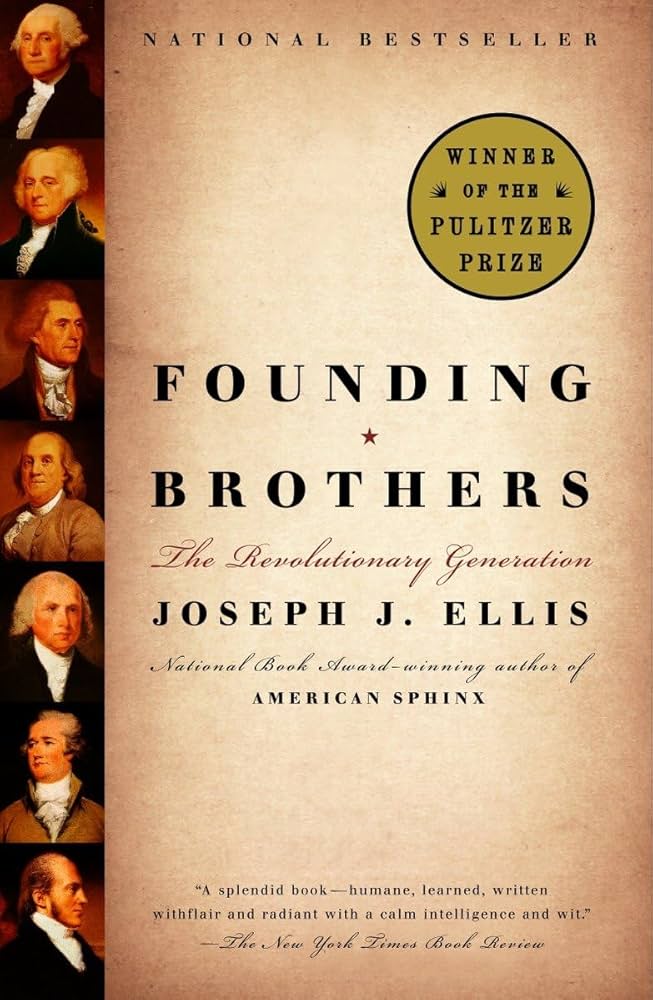
Founding Brothers is structured as six discrete episodes, each organized around a critical moment or relationship: the Hamilton-Burr duel; Washington’s Farewell Address; a congressional debate over slavery and abolition petitions; the dinner-table bargain between Hamilton and Jefferson that located the nation’s capital on the Potomac; John Adams’s lonely and controversial decision to pursue peace with France; and finally, the famous correspondence and reconciliation between Adams and Jefferson in their old age.
The book’s central argument is twofold. First, that the founding of the United States was not inevitable – it was fragile, contested, and nearly undone at almost every turn. The founders themselves lived in terror that the republic would fail. Second, that the personal relationships among these men — their friendships, their hatreds, their jealousies, their silences – were not incidental to the political outcomes but were in fact constitutive of them. The nation that emerged was shaped as much by who liked whom, who owed what to whom, and who was willing to compromise with whom, as by any abstract political philosophy.
The founders were not gods or saints but men, and the America they made was not a perfect creation but a problematic one, brimming with explosive ingredients that their respective visions of what America was or should be could not contain.
Joseph J. Ellis
This is a profoundly democratic argument, in its way. It refuses a hero worship that places the founders beyond criticism while also refusing the cynical revisionism that dismisses them as self-interested hypocrites. Instead, Ellis asks us to hold both truths simultaneously: that these were remarkable men who accomplished something extraordinary, and that the republic they built was stamped with all their contradictions.
The Voice on the Page
Ellis writes with a clarity and precision that rewards the attentive reader. His chapter on the silence over slavery is perhaps the finest in the book – a sober account of how the founders chose, deliberately and with clear eyes, to defer the most catastrophic question in American life. He is not naive about what that choice cost:
The distinguishing feature of the debate was not its intensity but its brevity. For what it’s worth – and one must be careful not to let moral outrage overwhelm historical judgment – the decision to suppress the debate over slavery had a certain tragic logic that is worth understanding before condemning.
The chapter on Washington’s Farewell Address is equally revealing. Ellis shows us a Washington who was not the serene figurehead of legend but a man nursing genuine grievances, writing a document that was in part a settling of scores with the political faction that had attacked him most viciously. The Farewell Address, so often quoted as a kind of secular scripture, turns out to be a deeply personal document dressed up as a philosophical treatise.
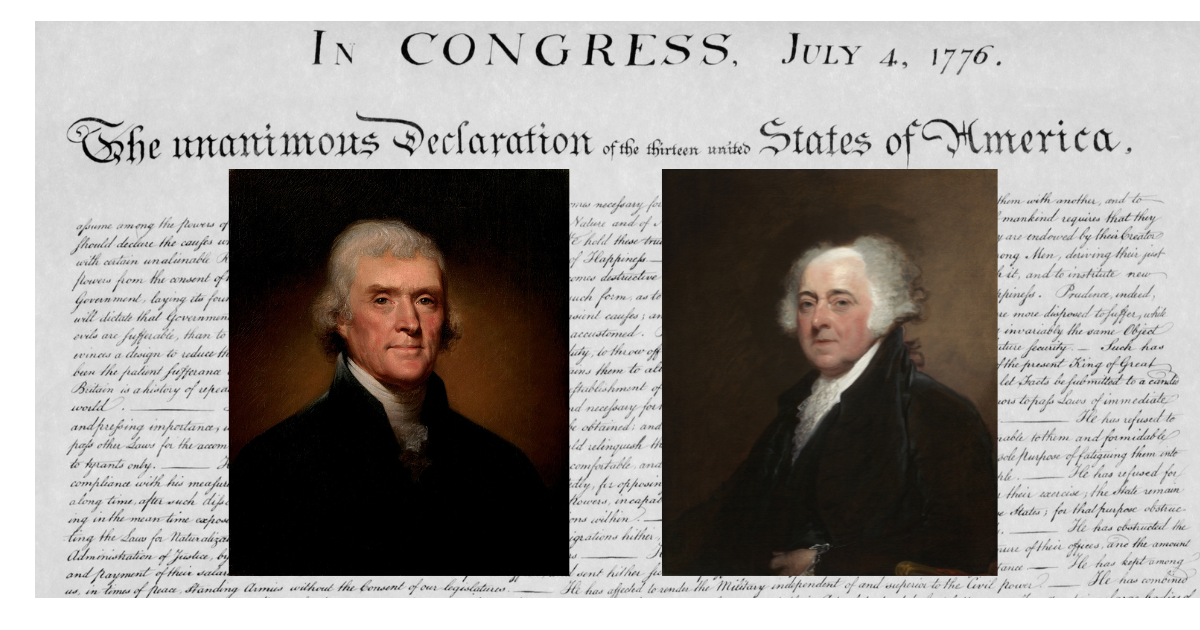
The Adams-Jefferson chapter that closes the book may be its most moving. The two men – one crusty, vain, and perpetually under-appreciated, the other graceful, elusive, and morally complicated – resumed their correspondence in 1812 after a decade of silence and wrote to each other until they died within hours of each other on July 4, 1826, the fiftieth anniversary of the Declaration. Ellis renders this friendship-through-letters as something close to a love story between ideas and between men who embodied those ideas.
In Conversation with the Series
Founding Brothers occupies a fascinating middle position among the books in the “Architects of Independence” series. Where Gordon Wood’s Revolutionary Characters (the section’s opening volume) offers the widest-angle view – a portrait of an entire intellectual generation and its cultural world – Ellis zooms in to the human scale, insisting that the texture of the founding is best understood through individual moments and relationships rather than broad cultural forces.
Ellis and Wood are in essential agreement about the founders’ genius and the fragility of the republic they built, but they differ subtly in emphasis. Wood stresses the cultural and ideological distance between the founders and us – they were genuinely different kinds of men, formed by an eighteenth-century world of honor, classical learning, and republican virtue that no longer exists. Ellis, by contrast, insists on their recognizable humanity. His founders lose their tempers, nurse grudges, and maneuver for advantage in ways that feel entirely contemporary.
The book gains added resonance when read alongside the future articles on David McCullough’s John Adams and Walter Isaacson’s Benjamin Franklin. Where McCullough gives us Adams in full biographical depth – the Puritan conscience, the Massachusetts stubbornness, the lifelong wound of being undervalued – Ellis captures the essence of Adams more efficiently, through the crucible of specific decisions. The two books are complementary: McCullough supplies the roots, Ellis shows the fruit. Similarly, Isaacson’s Franklin, with its emphasis on Franklin’s diplomatic genius and strategic intelligence, illuminates Ellis’s portrait of the founders’ dinner-table bargain – one can almost hear Franklin’s dry wit behind the table where Hamilton and Jefferson struck their famous deal.
Perhaps most interestingly, Founding Brothers anticipates the argument that Pauline Maier makes in American Scripture (the section’s essential centerpiece): that the Declaration of Independence was not the product of one man’s genius but of a collective political process involving the whole Congress. Ellis makes the same claim about the founding more broadly – that no single founder was indispensable, that the republic was built in the collisions and compromises between them. This is a democratic corrective to the cult of individual greatness, and it is one of the most important intellectual contributions both books make.
What We Know Now
Founding Brothers was published in 2000, before the major waves of scholarship that have since reshaped our understanding of the founding era. The most significant development is the explosion of serious historical attention to the enslaved people who inhabited the founders’ world – not as backdrop or footnote but as central actors whose labor, resistance, and humanity shaped the republic no less than the men celebrated in Ellis’s pages.
Ellis’s chapter on slavery is careful and well-intentioned, but it is largely told from the perspective of the white founders who chose silence, not from the perspective of the enslaved people whose lives were the stakes of that silence. A reader in 2026 will want to supplement Founding Brothers with work by historians like Annette Gordon-Reed, whose The Hemingses of Monticello transformed our understanding of Jefferson’s Monticello household, or by the rich scholarship on slavery and the Constitution that has appeared in the quarter-century since Ellis wrote.
The book also says relatively little about women. Abigail Adams appears briefly but the domestic and intellectual world of the founders’ wives, sisters, and female correspondents – who often possessed clearer moral vision than their celebrated husbands – is largely absent. Again, this is less a criticism of Ellis than a reflection of where historical scholarship stood in 2000, and of what has flourished since.
None of this diminishes the book’s achievement. It simply asks us to read it as what it is: a landmark work of narrative history that is now itself a historical artifact, reflecting a particular moment in American historiography as much as it reflects the founding era itself.
Why Read This Now
In 2026, at a moment when Americans are debating with extraordinary intensity what the founding documents mean, who they were written for, and whether the republic they established can survive its own contradictions, Founding Brothers offers something rare: it takes the founding seriously without being reverential, and it takes its contradictions seriously without being cynical.
Ellis insists, above all, on the contingency of what was accomplished. The republic did not have to succeed. The founders did not have to find their compromises. The whole experiment nearly failed a dozen times in the first generation. That fragility – the sense that the outcome was never foreordained, that it required constant, difficult, human effort to hold together – is precisely what makes the book galvanizing rather than comforting to read.
Founding Brothers is also, in the best sense, a book about how political disagreement can be navigated without destroying the civic fabric. Adams and Jefferson, who despised each other for a decade, found their way back to friendship and mutual respect. Hamilton and Burr, who could not, paid the ultimate price. The lesson is not that disagreement is bad or that compromise is always possible – Ellis is too honest for such platitudes. The lesson is that the choice between conversation and violence is always live, always personal, and always consequential.
For readers coming to this section of the “Booked for the Revolution” series after Revolutionary Characters, Founding Brothers offers the ideal next step: from the panoramic to the intimate, from the cultural to the human. It is the kind of history that reminds us why the past is not another country but, stubbornly and thrillingly, our own.
A Note on This Series
This journey through Revolutionary history is as much about the evolution of historical understanding as the Revolution itself. History isn’t static – each generation reinterprets the past through its own concerns, asking different questions and prioritizing different sources. By reading these books in dialogue across 250 years, we’ll witness how scholarship evolves, how narratives get challenged, and how forgotten stories resurface.
This isn’t about declaring one interpretation “right” and another “wrong,” but appreciating the richness that emerges when multiple perspectives illuminate the same transformative moment. These books won’t provide definitive answers – history rarely does – but they equip us to think more clearly about how real people facing genuine uncertainty chose independence, how ideas had consequences, and how the work of creating a more perfect union continues. As we mark this anniversary, we honor the Revolutionary generation by reading deeply, thinking critically, and engaging seriously with both the brilliance and blind spots of what they created.