
Pulitzer Prize–winning historian Joseph J. Ellis focuses tightly on the summer of 1776, when some of the most consequential events in the founding of the United States unfolded. Adams serves as the catalyst of independence, Jefferson as its eloquent spokesperson, and Franklin as the pragmatic statesman who tempers the more aggressive impulses in Congress. Ellis weaves together the political drama in Philadelphia with Washington’s desperate military campaign in New York, arguing lucidly that political events and military actions during those vital months were deeply intertwined. A strong narrative choice for readers who want the Declaration placed in the full context of war and statecraft.
July – The Document and Its Meaning Part Three
Imagine the scene: In one city, fifty-six men are signing their names to a document that, if the war goes badly, will be their death warrants. In another city, four hundred British ships are filling the harbor – the largest invasion fleet ever to cross the Atlantic Ocean. The words of Thomas Jefferson and the cannons of General William Howe are arriving at the same historical moment, and the fate of each depends entirely on the other. This is the audacious premise of Revolutionary Summer: The Birth of American Independence, and it changes how the Declaration of Independence must be read.
We tend to treat the Declaration as a philosophical document – a statement of principles that floated free and pure from the minds of Enlightenment thinkers into permanent history. But Joseph J. Ellis insists it was born in crisis, composed under pressure, and ratified in a room full of men who understood that the words on the page meant nothing if the army outside New York could not survive the summer. Reading the Declaration without that context, Ellis argues, is like reading a wedding vow without knowing the couple was standing in a burning building.
That provocation, delivered with Ellis’s signature blend of intimacy and precision, is what makes Revolutionary Summer an essential entry in any serious reader’s engagement with the Founding.
The Historian Behind the Argument

Joseph J. Ellis is perhaps the most trusted popularizer of the Founding era working today. A Pulitzer Prize winner for Founding Brothers: The Revolutionary Generation and a National Book Award recipient for American Sphinx, his biography of Thomas Jefferson, Ellis has spent five decades at Mount Holyoke College developing a method that might best be described as biographical narrative history: he gets very close to individuals, renders their choices with psychological depth, and then steps back to show how those choices shaped something larger than any of them intended.
His credibility on this particular subject runs especially deep. Before joining academia, Ellis served as an Army captain and taught history at West Point – meaning he brings a soldier’s understanding of command, logistics, and the fog of war to military history that most literary historians approach only from the library. When he writes about Washington’s tactical errors in New York or the desperate calculus of keeping an army together, he is not merely paraphrasing primary sources. He is thinking like a soldier.
Revolutionary Summer, published in 2013 as his tenth book, is compact by design – fewer than 220 pages. Ellis made a deliberate choice to write a focused, fast account rather than another comprehensive narrative of the Revolution. The constraint sharpens his argument.
The Central Argument: Two Epicenters, One Story
Ellis’s core claim, stated plainly in his preface, is that “political and military experiences were two sides of a single story, which are incomprehensible unless told together.” This sounds obvious until you consider how rarely it has actually been done. Most histories of 1776 are either political – focused on the Continental Congress in Philadelphia, the drafting of the Declaration, the debates over slavery and confederation – or military, focused on Washington’s desperate defense of New York against a British force that should have destroyed him. Ellis writes both simultaneously, and the effect is revelatory.
His central insight is causal, not merely concurrent: the British invasion of New York is what galvanized the wavering colonists into accepting independence. As long as the conflict remained a constitutional argument – a dispute over Parliament’s right to tax, a negotiation about the terms of imperial loyalty – compromise was possible. Men like John Dickinson, the great moderate, offered genuinely viable middle paths that statesmen like Burke and Pitt in London were prepared to endorse. But once an armada appeared in the harbor, the constitutional argument collapsed. War changed the chemistry. Moderates were swept to the sidelines, and what had been a political argument became an existential choice.
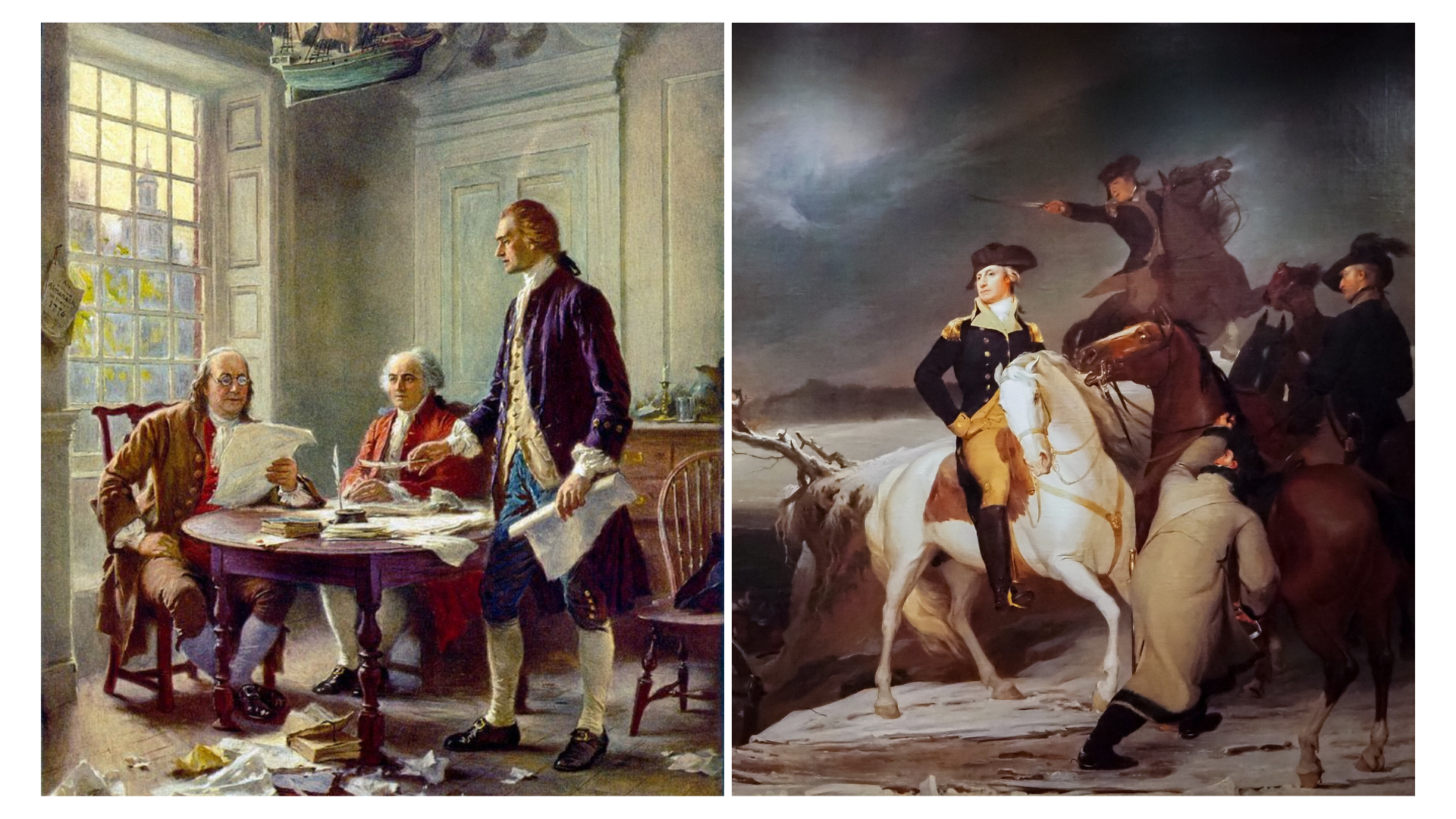
This is Ellis’s sharpest contribution to the historiography of the Declaration: it was not primarily a philosophical document. It was a strategic instrument. It was Adams and Franklin and Jefferson telling the world – and, crucially, potential French allies – that there was no going back. The Declaration burned the ships. It transformed a rebellion that Britain might have suppressed into a revolution that required conquest to end. As Ellis describes the preamble’s famous opening sentences – what he calls “the most important fifty-five words in American history” – he notes that Jefferson deftly grafted a shoot of radicalism into what was, at its core, a conservative movement. Men had inalienable rights. Governments derived their just powers from the consent of the governed. The radicals in the room understood immediately that those words would outlast the summer, possibly outlast all of them.
The Declaration was also, in Ellis’s telling, a monument of deliberate incompleteness. The slavery question – the most explosive fault line in the Congress – was deferred, not resolved. Adams understood the depth of the sectional divide and chose unity over principle, postponing a reckoning that would finally arrive, catastrophically, eighty-five years later. Ellis frames this not as a failure of nerve but as a recognition of political reality: a Declaration that fractured the Congress over slavery would have produced neither independence nor emancipation. Whether one accepts that framing or finds it too forgiving is one of the most productive arguments the book provokes.
Ellis in His Own Voice
One of Ellis’s great gifts is the ability to render historical actors as fully human without diminishing their stature. His portrait of Washington is characteristically incisive:
Washington not only fit the bill physically, he was also almost perfect psychologically, so comfortable with his superiority that he felt no need to explain himself. While less confident men blathered on, he remained silent, thereby making himself a vessel into which admirers poured their fondest convictions, becoming a kind of receptacle for diverse aspirations that magically came together in one man.
This captures something essential about how Washington functioned as a symbol while also functioning as a general – and why, Ellis argues, keeping the Continental Army intact was more strategically important than winning any particular battle. The army was not just a military instrument; it was the physical embodiment of the revolution’s credibility. “The strategic center of the rebellion,” Ellis writes, “was not a place – not New York, Philadelphia, not the Hudson corridor – but the Continental Army itself.”
That formulation is the book’s most enduring contribution. It reframes what “losing” the summer of 1776 would have meant. Washington lost New York. He lost Long Island. He retreated repeatedly before a superior force. But he kept his army in the field, and in doing so preserved the one thing that the Declaration required to mean anything at all.
Dialogue with the Series
Placed alongside the other volumes in “The Declaration of Independence and Its Meaning,” Revolutionary Summer occupies a distinctive and complementary position, most clearly in what it chooses to center and what it chooses to leave aside.
Emily Sneff’s When the Declaration Was News takes up what Ellis largely bypasses: the reception of the Declaration as it spread through colonial newspapers, read aloud in town squares and printed in broadsides. Sneff illuminates the Declaration as a living public document – something people heard and responded to emotionally before they encountered it as a text. Ellis, by contrast, focuses on the Declaration as it was made and the military context that made it necessary. Together, the two books bracket the document: Ellis explains why it was written when it was; Sneff explains what happened when ordinary Americans encountered it.
Michael Auslin’s National Treasure and Matthew Spaulding’s The Making of the American Mind both engage with the Declaration’s philosophical and ideological dimensions – with what the document means as a statement of political principle with ongoing relevance. Ellis’s contribution to that conversation is skeptical without being dismissive. He resists treating the Declaration as a timeless philosophical treatise by insisting on its contingency. It meant what it meant partly because of the moment in which it arrived. The ideological permanence that Auslin and Spaulding trace in the document’s afterlife is something Ellis acknowledges – most powerfully in his observation that Lincoln’s Gettysburg Address reaches back to “four score and seven years” to make 1776, not 1787, the founding moment – but he wants readers to see the historical accident and human improvisation that underlie the enduring principle.
What We’ve Learned Since 2013
The decade since Revolutionary Summer‘s publication has brought significant new scholarship that enriches and occasionally complicates Ellis’s account. The 1619 Project and the historiographical debates it ignited pushed the question of slavery from the margins of Revolutionary history toward its center. Ellis’s relatively brief treatment of the slavery deferral, while honest, now reads as thinner than it should be. Historians like Parkinson and Woody Holton have since argued more forcefully that the Declaration’s evasion of slavery was not merely an Adams-style political calculation but a bargain with a specific Southern interest that had its own logic, its own champions, and its own long-term consequences. The book would look somewhat different written in 2026.
The continuing scholarship on the Howe brothers – particularly their decision not to pursue and destroy Washington’s army at several critical junctures – has also added nuance to Ellis’s portrait of the British side. The mystery of their restraint remains, but more recent work has suggested that London’s political divisions played a larger role than Ellis acknowledges, with the Howes operating under ambiguous and sometimes contradictory instructions.
None of this diminishes Revolutionary Summer as a work of narrative synthesis. Ellis’s core argument – that the Declaration and the war for New York were inseparable – has held up well and been reinforced by subsequent scholarship.
Why Read It in 2026?
At a moment when Americans are again arguing about what the Declaration of Independence means, who it was written for, and whether its promises have ever been fully honored, Revolutionary Summer offers something rare: historical grounding without nostalgia. Ellis refuses to make the Founders either saints or villains. He shows them improvising at speed, making decisions they knew were incomplete, and betting their lives – literally – on principles they could not fully realize in their own lifetimes.
The book is also a reminder that democracy, then as now, is not a philosophical achievement. It is an ongoing exercise in maintaining legitimacy under pressure. The Declaration’s power derived not just from Jefferson’s prose but from Washington’s army staying in the field through a brutal summer of defeat. Ideas need institutions. Institutions need people willing to hold them together when it would be easier t o retreat.
At 219 pages, Revolutionary Summer is the most efficient portal into the most consequential summer in American history. It will not take a week to read. But it may take years to stop thinking about.
A Note on This Series
This journey through Revolutionary history is as much about the evolution of historical understanding as the Revolution itself. History isn’t static – each generation reinterprets the past through its own concerns, asking different questions and prioritizing different sources. By reading these books in dialogue across 250 years, we’ll witness how scholarship evolves, how narratives get challenged, and how forgotten stories resurface.
This isn’t about declaring one interpretation “right” and another “wrong,” but appreciating the richness that emerges when multiple perspectives illuminate the same transformative moment. These books won’t provide definitive answers – history rarely does – but they equip us to think more clearly about how real people facing genuine uncertainty chose independence, how ideas had consequences, and how the work of creating a more perfect union continues. As we mark this anniversary, we honor the Revolutionary generation by reading deeply, thinking critically, and engaging seriously with both the brilliance and blind spots of what they created.


Amen