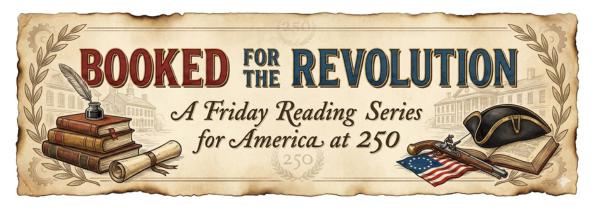
Revolutionary Characters by Gordon Wood is a sweeping portrait of the founding generation as a whole, establishing the intellectual and cultural world from which the Declaration emerged. Today’s article sets the stage for a new section: the writing of the Declaration of Independence.
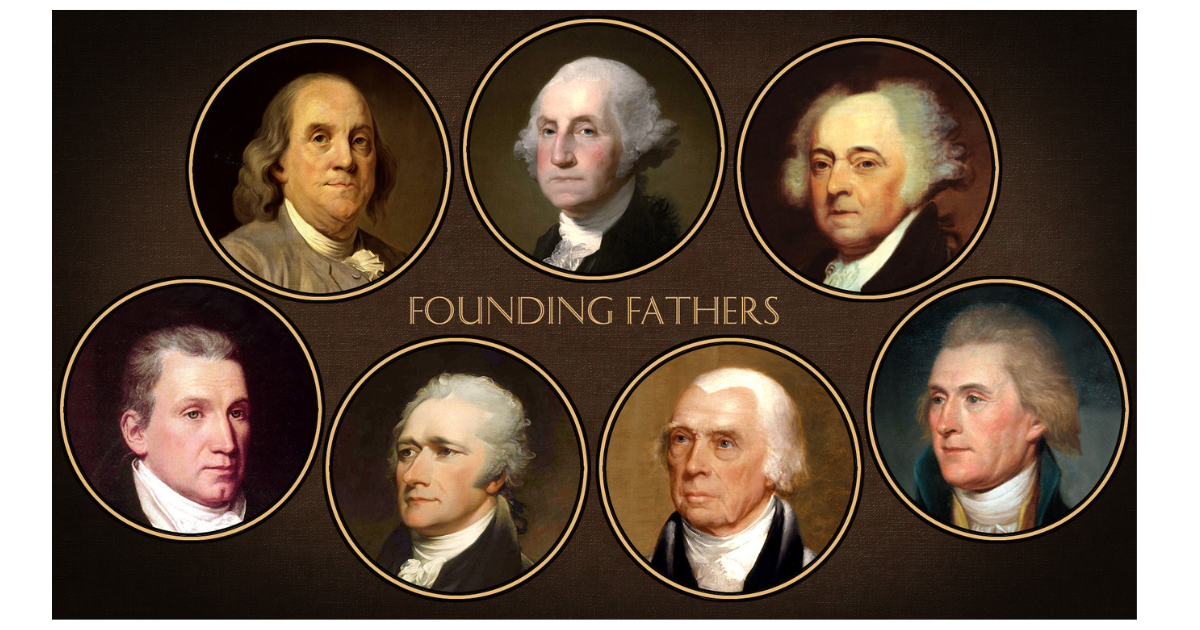
Authorized by the Second Continental Congress, the task was assigned to a small committee consisting of John Adams, Benjamin Franklin, Thomas Jefferson, Robert R. Livingston, and Roger Sherman to draft and present the Declaration. Richard Henry Lee was instrumental in his resolution presented on June 7, 1776. The Congress itself made significant changes in wordings from the original drafts. While not present for the actual work on the Declaration, George Washington’s leadership gave the Continental Congress the confidence to declare independence.
May and June – The Architects of Independence, Part One
The Question That Won’t Go Away
Every generation gets the Founders it deserves. Ours, living through a period of ferocious argument about American identity, has found itself returning again and again to the men who first defined it – not for comfort, but for ammunition. We invoke Jefferson to defend liberty and indict him for hypocrisy. We lionize John Adams as the conscience of the Revolution and then fault him for the Alien and Sedition Acts. We celebrate Franklin as the self-made American and wonder how the same man could have kept enslaved servants in Philadelphia. The Founders have become a battlefield, and the fighting shows no sign of stopping.
Into this landscape, Gordon Wood’s Revolutionary Characters: What Made the Founders Different arrives with a deceptively modest premise: that the men who led the American Revolution were genuinely, historically exceptional – and that understanding how and why they were exceptional is both more useful and more honest than either hero-worship or iconoclasm. Published in 2006, the book has only grown in relevance as the culture wars around the founding intensified. It is the ideal opening volume for “The Architects of Independence” because it does what every good overture should: it establishes the key, sets the emotional register, and prepares the ear for everything that follows.
Who Is Gordon Wood, and Why Does it Matter?
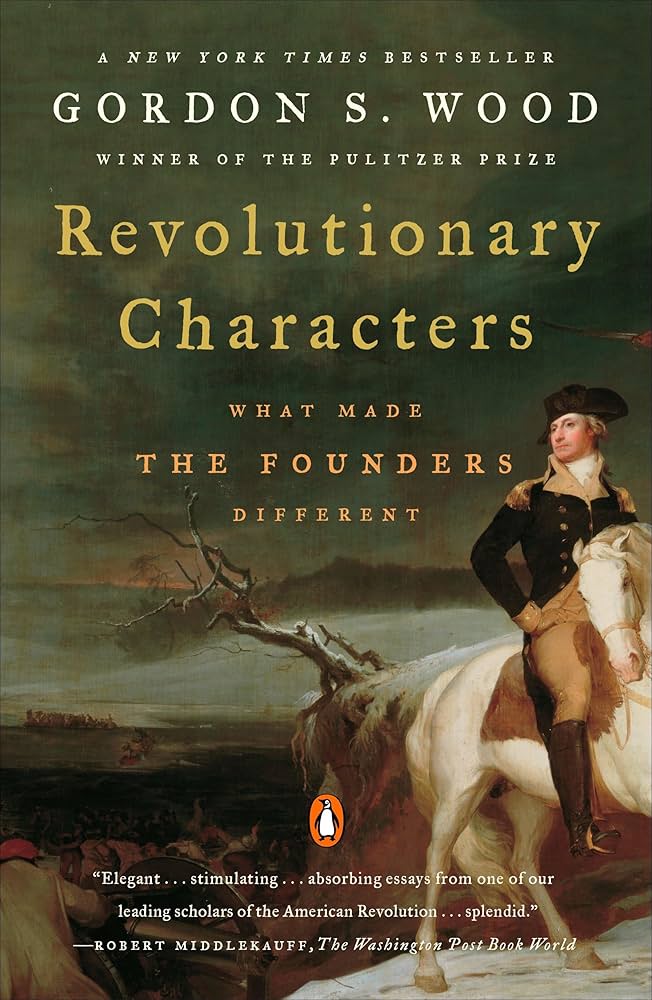
Gordon S. Wood is, by nearly any measure, the preeminent living historian of the American founding era. His 1969 doctoral work, The Creation of the American Republic, transformed scholarly understanding of the Revolution’s ideological foundations. His 1992 masterwork, The Radicalism of the American Revolution, won the Pulitzer Prize by arguing, counterintuitively but convincingly, that the Revolution was far more socially disruptive than its genteel surface suggested. By the time Revolutionary Characters appeared, Wood had spent four decades building an interpretive framework capacious enough to hold the founding’s contradictions without collapsing them into easy verdicts.
This matters because Wood writes from a position of earned authority rather than ideological agenda. He is neither a Founders chic celebrant nor a presentist prosecutor. He is, above all, a historian committed to the strangeness of the past – to recovering what it actually felt like to live in a world where the very concept of democratic self-governance was a radical experiment with no guarantee of success. Revolutionary Characters distills a lifetime of that recovery into eight interconnected essays including portraits of Washington, Franklin, Jefferson, and Adams along with one magisterial introduction that is, arguably, the most valuable single chapter in the entire “Architects” series. For readers of “The Architects of Independence,” it is the essays on the men who shaped the Declaration that matter most: the philosophically soaring Jefferson, the diplomatically indispensable Franklin, the tenaciously principled Adams, and the commanding Washington whose military resolve made the Declaration something more than a piece of parchment.
The Central Argument: A World We Have Lost
Wood’s animating thesis is as simple to state as it is difficult to fully absorb: the Founders were the products of an aristocratic, pre-democratic culture that they simultaneously believed in and helped destroy. They were, in Wood’s phrase, “enlightened gentlemen” – men who understood public life as the domain of disinterested virtue, who believed that education and moral cultivation uniquely fitted certain men for leadership, and who regarded the naked pursuit of self-interest as a form of corruption. They prized what the eighteenth century called “reputation” or the judgment of posterity above the approval of the crowd.
This cultural world, Wood argues, made possible both their greatness and their tragic limitations. It enabled men like Washington to subordinate ambition to principle, at least most of the time. It gave Jefferson the philosophical altitude to write that “all men are created equal” even as he enslaved over six hundred human beings – a contradiction that Wood does not excuse but does insist must be understood on its own historical terms before it can be judged on ours. And it meant that their revolution ultimately unleashed democratic energies that swept away the very gentlemanly culture that had produced them, leaving them stranded in a world they had made but no longer recognized.
There is something genuinely moving in Wood’s portrait of these men watching, in their old age, as the Republic they founded was colonized by professional politicians, party operatives, newspaper editors, and popular demagogues – the very forces they had feared. They had built a democracy and were then surprised that it behaved democratically. Wood renders this not as tragedy, exactly, but as historical irony of the deepest kind.
The Author’s Voice: Passages Worth Savoring
Wood writes with the clarity and confidence of a scholar who has nothing left to prove, and Revolutionary Characters contains some of his most quotable prose. On the peculiar nature of founding-era ambition, he observes:
“The Founders were not self-made men in the nineteenth-century meaning of that term. They were not Horatio Alger heroes who had pulled themselves up by their own bootstraps. They did not celebrate work and the getting of money in the way that later Americans would. These were men of the Enlightenment, and they believed that the distinguishing character of a gentleman was his disinterestedness — his ability to act without needing anything for himself.”
On the uniqueness of the founding moment, Wood is equally arresting, noting that the Founders represented perhaps the last cohort in American life to genuinely believe that leadership was a matter of character rather than constituency – that the right man, properly formed, could rise above faction. The tragedy he traces is the speed with which that belief was proved wrong, even in their own lifetimes. By the 1790s, the Republic was already fracturing into parties, and men like Washington and Adams found themselves bewildered by a politics they had hoped to transcend.
His treatment of Thomas Paine is equally illuminating, and particularly relevant to this series. Where most historians regard Paine as the pamphleteer who lit the fuse of independence and then became an embarrassment to the republic he helped create, Wood reads him as the figure who most honestly expressed what the Revolution was actually unleashing: a democratic energy that the gentlemanly founders simultaneously welcomed and feared. Paine did not share the founders’ aristocratic self-conception, and his lack of it both made Common Sense possible and made his later career impossible. He is the exception that clarifies the rule.
In Conversation with the Series: Agreement, Tension, and Nuance
Revolutionary Characters is, in a sense, the intellectual skeleton key for the entire “Architects of Independence” series. Read it first, and every subsequent biography becomes richer.
Consider its relationship to Joseph Ellis’s Founding Brothers (Week Two). Where Wood paints the Founders as a collective type – the enlightened gentleman statesman – Ellis zooms in on the specific textures of their relationships: the charged correspondence between Adams and Jefferson, the way Washington’s commanding presence held the fractious founders together, and the near-miraculous act of collective will that produced independence. The two books are complementary. Wood gives you the forest; Ellis gives you the trees. But they are also occasionally in tension: Ellis is somewhat more inclined to celebrate the Founders’ achievements as personal triumphs of character, while Wood is more interested in the structural and cultural conditions that made those achievements possible – and in what was lost when those conditions changed.
Wood’s treatment of Jefferson as a man of genuine but culturally bounded principle sets up a productive dialogue with Jon Meacham’s Thomas Jefferson: The Art of Power (Week Five). Meacham tends toward admiration for Jefferson’s political genius; Wood’s framework insists we understand that genius as partly a product of an aristocratic self-conception that Jefferson himself would have been reluctant to name. Similarly, Wood’s portrait of Franklin as the great exception – the self-made man who mastered the manners of the gentleman without being born to them – anticipates and deepens Walter Isaacson’s biography (Week Three).
Most significantly, Wood’s emphasis on the Declaration as a product of collective intellectual culture provides an essential complement to Pauline Maier’s American Scripture (Week Eight), which makes the historical case that the Declaration was shaped as much by Congress as by Jefferson. Wood gives Maier’s argument its philosophical scaffolding: if the Founders genuinely believed in disinterested collective deliberation, then it is entirely consistent that the Declaration would be a shared achievement rather than a singular authorial act.
What We’ve Leaned Since 2006: Reassessing Wood
Revolutionary Characters appeared at an interesting historical moment – before the full flowering of the “1619 Project” debate, before the removal of Confederate and colonial-era monuments became a front-page controversy, and before the January 6th insurrection prompted a new round of anxious questioning about whether the Republic’s founding ideals were adequate to sustain it. The book has aged well in some respects and has been productively challenged in others.
Wood has been criticized, not unfairly, for his relative inattention to the experiences of enslaved people, Indigenous nations, and women as co-inhabitants of the founding world. His “enlightened gentlemen” are, by definition, a narrow slice of eighteenth-century America, and his framework can seem to treat their cultural world as the whole world. Historians like Woody Holton, Alan Taylor, and Annette Gordon-Reed have expanded our understanding of the founding era by insisting that the Revolution looked very different depending on where you stood – if you were an enslaved woman at Monticello, a Creek warrior in Georgia, or a working-class sailor in Boston, the Declaration’s promises were either hollow or actively threatening.
Wood has pushed back against some of this revisionism, occasionally with more heat than light. His 2011 book, The Idea of America, included essays that critics read as defensive of the “Founders chic” tradition he had spent his career complicating. The debate reveals a genuine tension in his work: he wants to recover the past on its own terms, but the decision about whose past to recover is itself a choice with present-day implications.
None of this diminishes the achievement of Revolutionary Characters. It simply means that Wood’s book is best read as the beginning of a conversation rather than its conclusion — which is, after all, precisely the role it plays in this series.
Why Read This in 2026?
We live in a moment of intense, sometimes violent disagreement about what America is and what it was always meant to be. One temptation is to resolve that disagreement by flattening the Founders – either into demigods whose vision we must recover intact, or into hypocrites whose contradictions disqualify them from serious admiration. Gordon Wood offers a third way: historical understanding.
To understand the Founders as Wood understands them is to see both their genuine greatness and their genuine limitations as products of a specific historical moment – a moment that is neither recoverable nor entirely irrelevant. They were men who believed in something larger than themselves, who staked their lives and reputations on a political experiment whose outcome was genuinely uncertain, and who built institutions strong enough to survive, so far, nearly two and a half centuries of stress. They were also men of their time: limited by race, class, and gender in ways that caused incalculable suffering and continue to shape American inequality today.
Holding both of those truths simultaneously, without collapsing into either reverence or contempt, is a form of civic maturity that Revolutionary Characters actively cultivates. In 2026, with the Republic’s foundational commitments again under pressure, that cultivation feels less like an academic exercise and more like a democratic necessity.
Read this book before you read the biographies that follow. Read it as a primer on historical thinking, on the distance between past and present, and on the complicated business of inheriting a republic you did not choose. Then read Founding Brothers, and Franklin, and Adams, and Jefferson, and watch how Wood’s framework illuminates every page. The series will make more sense. So, perhaps, will the country.
A Note on This Series
This journey through Revolutionary history is as much about the evolution of historical understanding as the Revolution itself. History isn’t static – each generation reinterprets the past through its own concerns, asking different questions and prioritizing different sources. By reading these books in dialogue across 250 years, we’ll witness how scholarship evolves, how narratives get challenged, and how forgotten stories resurface.
This isn’t about declaring one interpretation “right” and another “wrong,” but appreciating the richness that emerges when multiple perspectives illuminate the same transformative moment. These books won’t provide definitive answers – history rarely does – but they equip us to think more clearly about how real people facing genuine uncertainty chose independence, how ideas had consequences, and how the work of creating a more perfect union continues. As we mark this anniversary, we honor the Revolutionary generation by reading deeply, thinking critically, and engaging seriously with both the brilliance and blind spots of what they created.