
Have you ever looked at the news and felt a strange, nagging sense of déjà vu – as if the chaos of today is a script we’ve performed before?
In 1992, when I first picked up Generations, the idea that we could predict a national crisis decades in advance felt like fascinating theory; today, it feels like a survival manual. After a career spent navigating the leadership shifts of media, ministry, and consulting, I’ve realized that understanding these patterns isn’t just about history – it’s about knowing where the ground will shift next. In his latest masterwork, The Fourth Turning Is Here, Neil Howe returns to prove that the “Winter” he and William Strauss famously foretold isn’t just coming – it has officially arrived, and it’s reshaping everything we thought we knew about the American future.
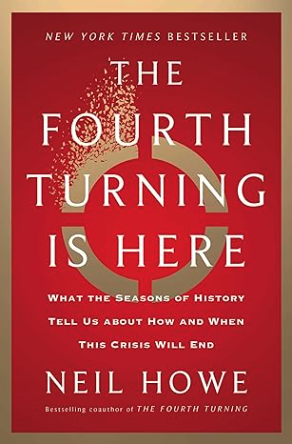
In The Fourth Turning Is Here, Neil Howe revisits the provocative cyclical theory of history he first co-authored thirty years ago, asserting that American history moves in predictable 80- to 100-year cycles. Each cycle consists of four distinct “turnings” that mirror the phases of a long human life, with the final stage – the Fourth Turning – representing a period of intense civic upheaval and national mobilization. Drawing parallels to transformative eras like the American Revolution and World War II, Howe argues that our current period of polarization and global tension is a scheduled crisis that will culminate in a decisive climax by the early 2030s.
This transition marks a period of both extreme peril and immense promise, potentially ushering in a new American golden age depending on how current generations respond. By examining the unique collective personalities of every living generation, Howe explores how different age groups will be shaped by the coming economic and social challenges. Ultimately, the book serves as both a prophecy and a practical guide, urging families and communities to prepare for the profound structural shifts that will redefine the nation over the next decade.
Living Inside the Crisis
If Generations was the map of the historical seasons, The Fourth Turning Is Here is the emergency broadcast for the current one. Howe argues that we are currently deep within a Fourth Turning, a period of “Crisis” that began with the 2008 financial crash and is projected to reach its climax in the early 2030s.
The Anatomy of the Current Crisis
Howe doesn’t just describe the “what”; he explains the “why” behind the institutional decay and social unruliness we see today:
- The Breakdown of Trust: We have moved from a “High” (post-WWII) where institutions were strong, to an era of “precarity” where public trust in government and media has hit rock bottom.
- The Polarization Trap: The nation has split into irreconcilable camps, a predictable feature of a Crisis era where society must decide which new values will govern the next century.
- Economic Entropy: Howe points to widening inequality and massive deficit spending as symptoms of a system that is no longer functioning for the younger generations.
The Engine of Change: Generational Hand-offs
The most compelling part of this summary is how Howe updates his “archetypes” for the 2020s. He argues that history is being driven by four generations currently at their peak influence:
- The Boomers (Prophets): Now the “Wise Elders,” they are the moralistic leaders who are often blamed for the current friction.
- Gen X (Nomads): The “pragmatic survivors” who are now stepping into midlife leadership, trying to keep the systems running amidst the chaos.
- Millennials (Heroes): Rising into their role as the “Civic” generation, tasked with the actual work of rebuilding national institutions.
- Gen Z (Artists): The sensitive children of the Crisis, being raised under extreme protection and poised to become the consensus-builders of the next “High”.
A Prophecy Realized
Reading The Fourth Turning Is Here in 2026 is a sobering exercise. When Strauss and Howe first laid out this framework in the ’90s, they were often dismissed as “prophets” rather than historians. Yet, seeing their predictions about a “great national challenge” unfold in real-time gives this new book a weight that its predecessor lacked.
The Power of Pattern Recognition
The book’s greatest triumph is its consistency. While most political analysts treat every election or pandemic as a random shock, Howe shows that these events are actually the “winter storms” we should have expected. He argues that societies, like forests, require the occasional fire to clear out the “deadwood” of old institutions so that new growth can begin.
A Roadmap to 2033
What sets this book apart from the 1997 sequel, The Fourth Turning, is its specificity. Howe predicts a “climax and resolution” by approximately 2033. He doesn’t sugarcoat the danger – warning that every Fourth Turning in history has involved a massive mobilization that tests the very survival of the nation – but he offers a powerful dose of hope. He suggests that after the “Winter” comes a “New Golden Age” of prosperity and unity, similar to the 1950s.
Critical Critique: The Data vs. The Drama
Skeptics still point out that the Strauss-Howe theory can sometimes feel like “bold, plausible, but unsubstantiated claims”. They argue that Howe occasionally “dunks” on certain generations – particularly Boomers – to make the narrative fit the cycle. However, even the harshest critics admit that no one else has accurately predicted the timing of the 21st-century’s turbulence with such eerie precision.
The Verdict: Preparation, Not Panic
If Generations was the book that set my career on a new path, The Fourth Turning Is Here is the book that helps me understand the new path I’m on. It is a “tour de force” of historical analysis that shifts the reader’s perspective from fear to preparation.
Howe’s message is clear: the crisis is not an ending; it is a transition. We are living through the birth pangs of a new era. For those of us who have lived through multiple turnings, this book is a reminder that while the season is harsh, spring is a mathematical certainty.
This is essential reading for anyone trying to navigate the next decade. It provides the clarity we need to see beyond the daily headlines and understand the grand rhythm of our lives.

Part of a regular series on 27gen, entitled Wednesday Weekly Reader.
During my elementary school years one of the things I looked forward to the most was the delivery of “My Weekly Reader,” a weekly educational magazine designed for children and containing news-based current events.
It became a regular part of my love for reading, and helped develop my curiosity about the world around us.

