
Have you ever stumbled across a single sentence that completely rewires the way you see the world?
For me, that moment arrived in 1992 through a book recommendation that felt like a bolt of lightning. At the time, I was knee-deep in associate pastor duties – juggling education, administration, and a massive project I called “168,” which was built on the idea that our impact on the world happens in every one of the 168 hours of the week, not just the few spent inside a church building. I was obsessed with understanding the people I served, and when my post-graduate advisor, Dr. Kennon Callahan, handed me a copy of Generations by William Strauss and Neil Howe, everything clicked. It wasn’t just a history book; it was a roadmap for the human experience.
Looking back over a career that spanned forty-four years of consulting, hospitality, media production, and church leadership, I can see that this book was the seminal inflection point. My educational background was an eclectic mix: a degree in accounting from Tennessee Tech, a Master’s in Religious Education from Southern Seminary, and minors in history that I hadn’t yet fully “awakened”. Whether I was directing daily children’s television programs in Louisville, technical directing large-scale musical productions, leading computer network installations for a 5,000-member congregation, or directing an entire church’s educational programs, I was always trying to bridge the gap between different age groups.

The subtitle of the book alone stopped me in my tracks: “The History of America’s Future, 1584 to 2069”. It spoke to the budding historian in me and provided the framework I needed to lead more effectively. Today, more than thirty years later, those concepts still drive my thinking, writing, research, and the way I live. As I’ve searched through my old files and memories these past few months, I’ve realized just how much this journey began with that one specific catalyst.
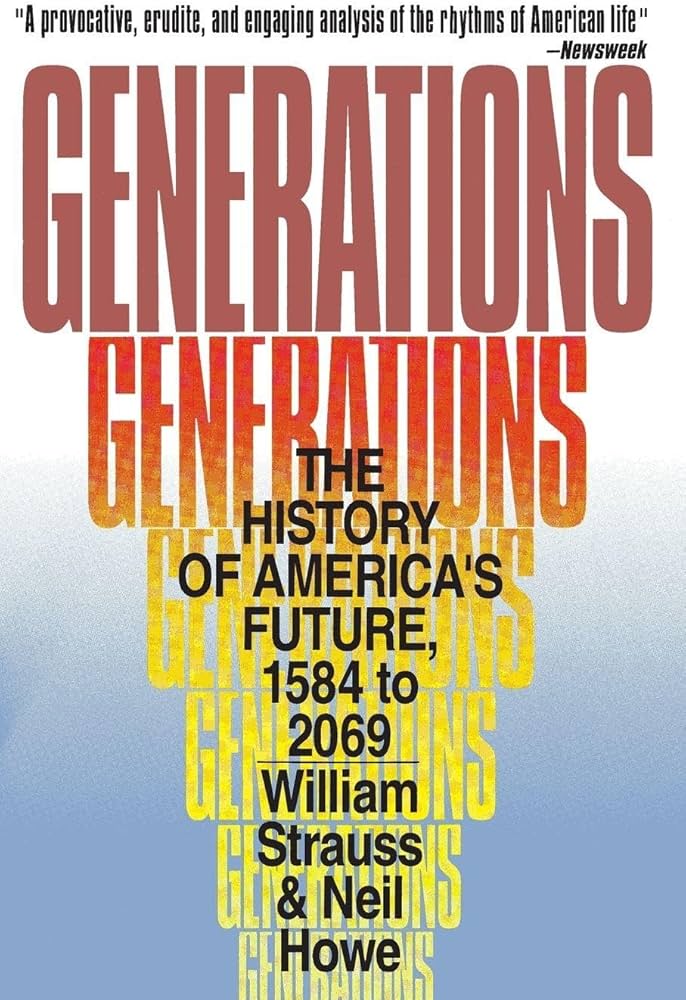
If you’ve ever felt like history isn’t just a random sequence of “one thing after another,” but rather a repeating song with a familiar beat, you’re already in sync with William Strauss and Neil Howe. In 1991 (with the paperback hitting the shelves in ’92), these two authors dropped a literal masterwork – a 500-page beast titled Generations: The History of America’s Future, 1584 to 2069.
It wasn’t just a history book. It was a bold, ambitious, and slightly crazy attempt to map the “DNA” of the American spirit. They didn’t just look at kings or presidents; they looked at the collective “peer personality” of people born in the same era. And honestly? They changed the way we talk about ourselves forever. If you’ve ever used the term “Millennial,” you’re using a word they coined in this very book.
The core premise of Generations is that history moves in cycles. Think of it like the four seasons. Just as winter always follows autumn, a certain type of social “mood” always follows another. Strauss and Howe argue that these cycles, which they call Turnings, last about twenty to twenty-two years – roughly the length of a phase of life (childhood, young adulthood, midlife, elderhood).
The Four Turnings
To understand their summary, you have to understand the “weather” of history:
- The High (Spring): An era of strong institutions and weak individualism. Society is confident about where it’s going, but conformity is high. (Example: The post-WWII era).
- The Awakening (Summer): A period of spiritual exploration and rebellion against the “High.” People start valuing self-expression over institutional logic. (Example: The Consciousness Revolution of the 60s and 70s).
- The Unraveling (Autumn): Institutions become weak and distrusted, while individualism is at its peak. Culture feels fragmented and cynical. (Example: The 80s and 90s).
- The Crisis (Winter): A decisive era of secular upheaval – a “grim” time where society’s very survival feels at stake. Institutions are rebuilt from the ground up. (Example: The Great Depression and WWII).
The Archetypes: The Players on the Stage
How do these cycles happen? Strauss and Howe argue it’s because of the Generational Archetypes. As one generation ages, it reacts to the one that came before it. There are four recurring “seasonal” types:
- Prophets (Idealist): Born during a High. They grow up as the pampered children of post-crisis optimism and become the moralistic leaders of an Awakening (think Baby Boomers).
- Nomads (Reactive): Born during an Awakening. They grow up under-protected while parents are busy with “self-discovery.” They become cynical, pragmatic, and tough (think Gen X).
- Heroes (Civic): Born during an Unraveling. They are over-protected as children and grow up to be the team-oriented “can-do” fixers of a Crisis (think the GIs or the Millennials).
- Artists (Adaptive): Born during a Crisis. They are the sensitive, quiet children who grow up to be the refined, consensus-building leaders of a new High (think the Silent Generation or Gen Z).
The authors walk us through over 400 years of history, showing how these archetypes hand off the baton. It’s a rhythmic dance: the Prophet yells about values, the Nomad tries to keep the lights on, the Hero builds a new world, and the Artist polishes the edges.
From 1992 to Today
Reviewing Generations is a unique challenge because the book itself is a series of predictions. Reading it in 2026 feels like looking at a weather report from thirty years ago and realizing the meteorologist actually nailed the storm’s arrival time, even if they didn’t know exactly how many inches of rain would fall.
The 1990s: “Wait, They’re Serious?”
When Generations first arrived, the academic world was skeptical. Professional historians generally hate “grand theories.” They prefer tiny, specific data points. To suggest that history moves in a predictable circle felt more like astrology than sociology.
However, the public – and politicians – were fascinated. Bill Clinton was reportedly a fan. Why? Because the book gave a name to the friction people felt. It explained the “Generation Gap” not as a fluke, but as a biological necessity. The review of the book in ’92 was often: “Brilliant, but perhaps too neat.” Critics felt the authors were “shoehorning” complex events into their four-stage boxes.
The 2000s: The Prophecy Begins to Bite
The real test of Strauss and Howe’s work came with the arrival of the “Millennial” generation. In Generations, they predicted that the next “Hero” archetype would be a group of children who were more team-oriented, more pressured to achieve, and more protected than the cynical Gen Xers before them.
By the mid-2000s, “Helicopter Parenting” became a buzzword. The authors looked like geniuses. Then came their 1997 follow-up, The Fourth Turning, which doubled down on the prediction that a “Great Crisis” would begin around 2005-2008. When the 2008 financial crash hit, followed by intense political polarization, the Strauss-Howe theory moved from the “New Age” shelf to the “Must-Read” shelf for political strategists (including, famously, Steve Bannon).
The 2020s: Living in the “Winter”
Looking back from our current vantage point, Generations feels hauntingly prescient. They predicted that around 2020, America would be in the depths of a “Crisis” era where the very social contract would be rewritten. Whether you point to the global pandemic, the rise of populism, or the restructuring of the global economy, we are undeniably in the “Winter” they described.
The “Hero” generation they championed – the Millennials – are now the primary workforce. Interestingly, the review of their theory today is more nuanced. While their timing was impeccable, critics note that they may have underestimated the impact of technology. The “Nomad” (Gen X) and “Prophet” (Boomer) clash they described has been amplified by social media algorithms in ways the authors couldn’t have imagined in 1992.
The Verdict: Why It Still Matters
Is Generations a perfect history book? No. It’s US-centric, it sometimes glosses over the experiences of marginalized groups to fit a “national” narrative, and its focus on “archetypes” can feel like it robs individuals of their agency.
However, as a tool for understanding the “vibe” of an era, it is unmatched.
The book’s greatest strength is its empathy. It teaches us that the generation we disagree with isn’t “wrong” – they are simply performing the role their historical season requires of them. Boomers aren’t just “stubborn”; they are Prophets trying to protect a moral vision. Gen Xers aren’t just “cynical”; they are Nomads who learned to survive in a world that didn’t look out for them.
Key Takeaways for the Modern Reader
- History is cyclical, not linear: We aren’t just moving toward a cliff or a utopia; we are moving through a cycle of renewal.
- Generations are shaped by their “Childhood Mood”: How a society treats its children determines what kind of adults they will become 20 years later.
- The “Crisis” is an opportunity: Strauss and Howe argue that while the “Winter” (Fourth Turning) is painful, it is the only time society is brave enough to fix its deepest problems.

Generations remains one of the most provocative pieces of social theory ever written. Even if you don’t buy into the “prophecy” of it all, it forces you to look at your own life as part of a much larger, multi-century story. It reminds us that we are all just players in a play that started long before we were born and will continue long after we’re gone.
In a world that feels increasingly chaotic, Strauss and Howe offer the ultimate comfort: This has happened before, and we know how to get through it.
Summary Table: The Generational Cycle
| Archetype | Turning Born In | Role in Society | Modern Example |
| Prophet | High (Spring) | Moralizing, Visionary | Baby Boomers |
| Nomad | Awakening (Summer) | Pragmatic, Survivalist | Gen X |
| Hero | Unraveling (Autumn) | Community-building, Action | Millennials |
| Artist | Crisis (Winter) | Diplomatic, Consensus-seeking | Gen Z |
Generations is a “Big Idea” book. It’s dense, it’s arguably over-confident, but it provides a lens of clarity that few other historical works can offer. If you want to understand why 2026 feels the way it does, go back to the source. Read the book that predicted our current “Winter” thirty-four years ago.
Oh, by the way – one of the authors, Neil Howe, updated this work in 2023, thirty years after the publication of Generations. And that’s what we will look at next week!

Part of a regular series on 27gen, entitled Wednesday Weekly Reader.
During my elementary school years one of the things I looked forward to the most was the delivery of “My Weekly Reader,” a weekly educational magazine designed for children and containing news-based current events.
It became a regular part of my love for reading, and helped develop my curiosity about the world around us.

