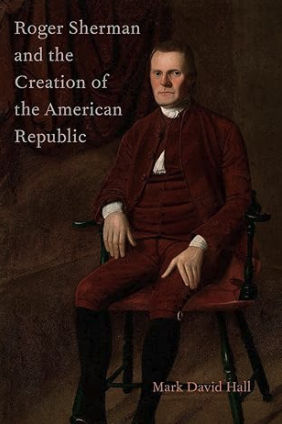
Roger Sherman is the most neglected member of the Committee of Five, yet his practical judgment and steady influence shaped both the Declaration and the constitutional framework that followed. Roger Sherman and the Creation of the American Republic by Mark David Hall gives this under-appreciated founder his due.
May and June – The Architects of Independence
In a season of political dysfunction – when compromise is treated as capitulation and pragmatism is confused with cowardice – it is worth pausing over a man whose entire career was built on the quiet genius of getting things done. Roger Sherman of Connecticut was not a gifted orator. He was not aristocratic, formally educated, or romantically tragic in the way that makes for compelling historical legend. He was a former shoemaker from rural Massachusetts who taught himself law, read theology by candlelight, and ultimately shaped more of the American founding than almost any figure whose name the average citizen cannot recall. Mark David Hall’s Roger Sherman and the Creation of the American Republic (Oxford University Press, 2013) is a determined and largely successful effort to correct this imbalance – and in doing so, it quietly reshapes how we ought to think about the entire founding generation.
The Author and His Argument
Hall is the Herbert Hoover Distinguished Professor of Politics at George Fox University and a senior fellow at Emory University’s Center for the Study of Law and Religion, with a PhD in political science from the University of Virginia. He has spent his career at the intersection of religion, law, and early American political thought, and those preoccupations run through every chapter of this book. Hall is not a dispassionate observer. He writes with conviction about the role of Calvinist theology in the founding era, a role he believes has been systematically minimized by scholars more comfortable with Enlightenment rationalism than Reformed Christianity. Whether one shares that conviction or not, his case for Sherman’s importance stands largely on its own merits.
The book’s central argument is twofold. First, that Roger Sherman was one of the most consequential figures of the founding era, and that his obscurity today is not a reflection of his historical significance but rather an artifact of his personality – he rarely said the kinds of memorable, quotable things that fuel historical celebrity. Second, Hall argues that Sherman’s political thought was shaped at its core by Calvinist theology – by a conviction that human nature is fallen and corruptible, that government must therefore be structured to constrain power rather than concentrate it, and that liberty is not merely a secular political value but a sacred responsibility grounded in the duty of conscience before God.
That second argument is the more contested one, and it distinguishes this book from a simple rehabilitation biography. Hall is making a larger claim: that the Reformed Protestant tradition played a decisive and under-appreciated role in the founding generation’s resistance to British authority and in the institutional design that emerged from that resistance.
The Forgotten Man at the Center of Everything
The basic facts of Sherman’s life already constitute a remarkable American story. Born in Newton, Massachusetts, in 1721, he received no formal education beyond what he absorbed from his father’s private library and the tutelage of a local clergyman. He worked as a shoemaker, then as a surveyor, then taught himself law and was admitted to the Connecticut bar in 1754. He entered politics, rose through the Connecticut General Assembly and Superior Court, and by the 1770s was one of the most respected legislators in the colony.
What happened next is almost structurally improbable. Sherman became the only founding figure to sign all four of the great state papers of the revolutionary era: the Continental Association (1774), the Declaration of Independence (1776), the Articles of Confederation (1777), and the Constitution (1787). No other founder achieved this. His contemporaries recognized it in real time. John Adams called him “that old Puritan, as honest as an angel, and as firm in the cause of American Independence as Mt. Atlas.” Patrick Henry, not easily impressed, said that Sherman and George Mason were “the greatest statesmen he ever knew.” Jefferson, who was often at odds with both Adams and Henry, pointed Sherman out to a visitor and remarked, “That is Mr. Sherman of Connecticut, a man who never said a foolish thing in his life.”
Hall reconstructs Sherman’s path to the Declaration with careful attention to what preceded it. In 1765, as the Stamp Act crisis inflamed the colonies, Sherman led a Connecticut Assembly committee in drafting a list of grievances against the Crown. His position then was already characteristically principled and clear: Parliament had no authority to tax the colonies without their consent. More strikingly, Sherman went further than many of his contemporaries, arguing that Parliament lacked the authority to regulate the colonies at all. “No laws bind the people but such as they consent to be governed by,” he wrote to Thomas Cushing – a formulation that anticipates the Declaration’s logic by more than a decade.
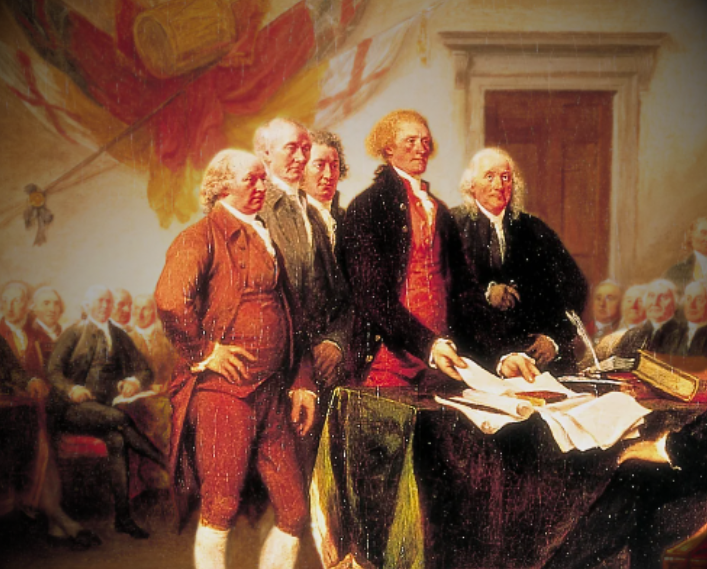
When the Committee of Five was appointed in June 1776 to draft the Declaration of Independence – joining Jefferson, Adams, Franklin, and Robert Livingston – Sherman was not chosen as a token participant or a regional placeholder. He had already demonstrated, through years of congressional service, that he possessed what Hall calls “practical judgment”: the ability to discern what was politically achievable, to navigate competing interests, and to keep complex deliberations moving toward resolution. In 1776 alone, Sherman was the only delegate to serve simultaneously on all three of the most important congressional committees: the Committee of Five drafting the Declaration, the Board of War, and the committee drafting what would become the Articles of Confederation. He was, by any measure, indispensable. In the image below, Sherman is the second from left.
The Calvinist Founder
Hall’s most provocative contribution is his sustained argument that Sherman’s politics were not merely influenced by his faith but were logically derived from it. Sherman was a devout Calvinist – a congregationalist in the orthodox New England tradition – and Hall contends that this shaped his institutional instincts in ways that secular political theory alone cannot explain.
The Reformed tradition, as Hall presents it, held that human beings were fundamentally fallen and that political institutions must therefore be designed to resist the natural human tendency toward corruption, tyranny, and self-aggrandizement. This was not pessimism; it was anthropology with political consequences. Government could not rely on the virtue of its leaders – it had to be structured to contain vice. This conviction, Hall argues, expressed itself in Sherman’s consistent preference for divided power, legislative supremacy over executive authority, and the protection of state-level government against centralization. Sherman once observed that a large, complicated national government was contrary to “the true spirit and genius of republican government,” which should be “small and simple.” Whether one reads this as Calvinist theology or classical republicanism or simply the common sense of a man who had watched powerful institutions abuse their authority, the instinct proved prophetic.
Hall does not claim that Sherman was the only Calvinist among the founders, or even the most theologically sophisticated. His broader point – that the Reformed tradition shaped the founding in ways historians trained in Enlightenment frameworks have systematically overlooked – is a genuine scholarly corrective, even if some readers will find it overstated. The secondary literature on the founding tends to foreground figures like Jefferson and Madison, whose intellectual debts to Locke, Montesquieu, and the Scottish Enlightenment are well documented. Sherman represents a different tradition, one more rooted in the Puritan inheritance of New England, and Hall is right that it deserves fuller treatment.
After the Signing: A Man Who Would Not Stop
The months following the signing of the Declaration of Independence in August 1776 found Sherman doing exactly what one might expect of him: working. While the war that the Declaration made official raged on multiple fronts, Sherman remained embedded in the machinery of Congress, attending to the unglamorous but essential work of sustaining a revolution in progress.
He served simultaneously on the Board of War – helping manage the logistics, supply chains, and strategic coordination of the Continental Army – and on the committee drafting the Articles of Confederation, the document that would serve as the new nation’s first constitution. His three eldest sons served as officers in the Continental Army during this period, adding personal stakes to the public ones. The war hurt Sherman financially; several of his business enterprises collapsed under the strains of revolution, and he supported a large family on a legislator’s uncertain income. Yet he continued to serve.
From 1777 to 1779, he simultaneously held his congressional seat and served on Connecticut’s Council of Safety, the wartime executive committee responsible for coordinating the state’s military and civilian response to the conflict. He attended conventions of the New England states in 1777 to weigh in on taxation and currency, and participated in the New Haven Convention on Prices in 1778. He remained a member of the Continental Congress for the duration of the Revolutionary War, and in 1783 – still not finished – he and colleague Richard Law spent five months revising all of Connecticut’s statutory laws, including the passage of a gradual emancipation act for children born to enslaved people in the state after March 1784. He was, to borrow a phrase, always still in the room.
In Dialogue with the Series
Placed alongside the other books in this section of Booked for the Revolution, Hall’s study performs a distinct and necessary function. Where Gordon Wood’s Revolutionary Characters illuminates the cultural and intellectual world of the founders as a class, and where Joseph Ellis’s Founding Brothers traces the personal dynamics between the famous few, Hall zooms in on a figure whom both books, in their different ways, would likely relegate to the margins. Sherman is not a character who fits the template of the Romantic founder – he had no Hamilton-esque fatal glamour, no Jeffersonian philosophical grandeur, no Franklinian wit.
Pauline Maier’s American Scripture, which appears next in this series, offers the most direct complement to Hall’s argument. Where Maier demonstrates that the Declaration was a collective achievement – shaped by Congress’s editorial interventions as much as by Jefferson’s original draft – Hall prepares the ground for that argument by showing us who was actually in the room doing the work. Sherman is precisely the kind of figure whose quiet, unglamorous contributions get erased when we tell the story through the lens of individual genius. David McCullough’s John Adams portrays Adams as the driving force behind Jefferson’s appointment and independence’s passage – and that portrait is not wrong. But Hall’s Sherman reminds us that the engine Adams was driving had many other moving parts.
Jon Meacham’s Thomas Jefferson: The Art of Power engages with Jefferson’s moral complexity in ways that Hall does not attempt with Sherman. Sherman’s moral world was less internally conflicted – his faith and his politics reinforced each other rather than colliding, as Jefferson’s did constantly. But both books are ultimately asking the same question: What ideas animated these men? Hall’s answer – Calvinist theology, tempered by practical wisdom – is less glamorous than Meacham’s portrait of Jefferson’s classical republicanism, but it may be no less accurate.
What We Have Learned Since 2013
Roger Sherman and the Creation of the American Republic appeared at a moment of renewed scholarly interest in the relationship between religion and the American founding, and that conversation has continued to develop. Subsequent work on the Reformed and Puritan inheritance of New England political thought has largely confirmed Hall’s instinct that this tradition was more formative than mid-twentieth-century secular historiography acknowledged. Scholars like Daniel Walker Howe had already been making related arguments about evangelical and Reformed influences on American political culture, and that line of inquiry has grown more sophisticated in the decade since Hall wrote.
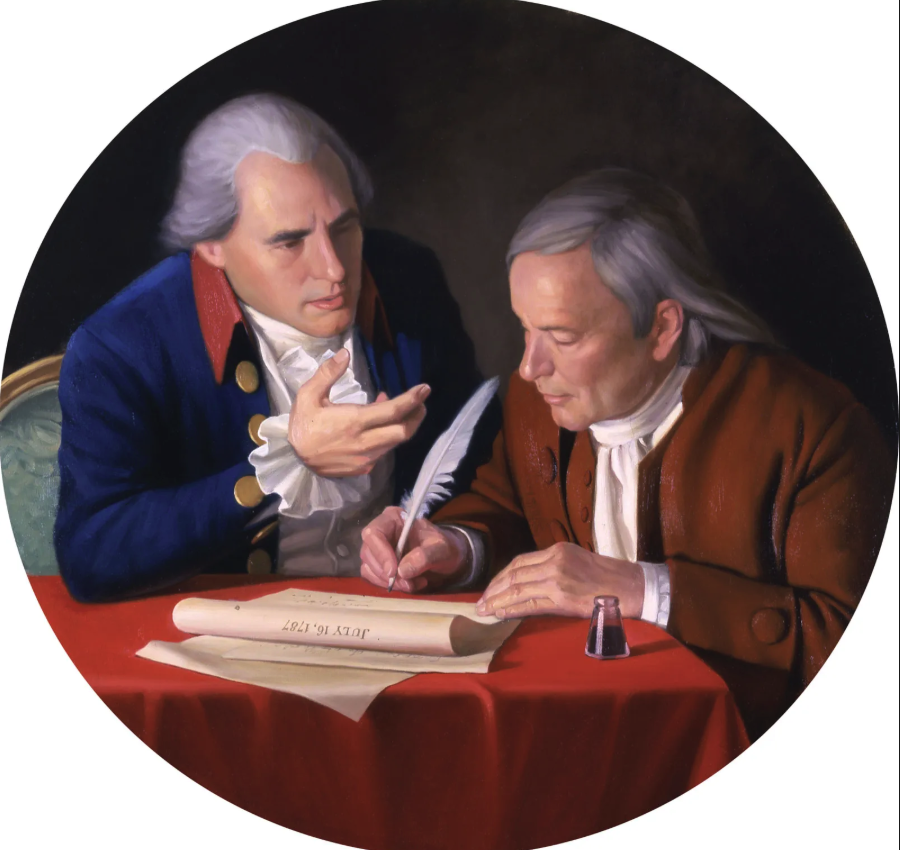
On the specific question of Sherman’s place in the founding, Hall’s rehabilitation has found an appreciative audience among constitutional scholars, particularly those interested in the origins of federalism and the structure of legislative power. Sherman’s Connecticut Compromise – the bicameral legislature with proportional representation in the House and equal state representation in the Senate – is now more widely recognized as one of the most consequential structural decisions in American constitutional history, and appreciation of Sherman’s role in it has grown accordingly.
What remains genuinely open is the degree to which Calvinist theology, as opposed to overlapping currents of classical republicanism and common law tradition, was causally decisive in shaping Sherman’s specific political positions. Hall acknowledges the methodological difficulty here – disentangling theological from secular influences in a figure who read both Calvin and Montesquieu – without fully resolving it. That is a limitation of the argument, though perhaps an honest one.
Why Read This in 2026
There is an obvious contemporary resonance in the story of a man who built a political career on compromise, consensus, and institutional trust rather than on personal charisma or ideological purity. Sherman’s virtues – steady industry, moral consistency, a preference for durable structures over brilliant individual solutions – are not the virtues that our current political culture celebrates. But they are, arguably, the virtues that built the republic.
Hall’s book is also, at roughly 200 pages, genuinely readable. It is neither a doorstop biography nor a dense theoretical treatise. It is a focused, well-argued intellectual portrait of a neglected founder, written by a scholar who clearly believes that what he is recovering matters — and who makes a persuasive case that it does. Whether or not one accepts every dimension of Hall’s theological argument, the historical rehabilitation at the book’s center is both warranted and well executed.
To read this book in the context of this series is to see the Declaration of Independence differently: not as a monument erected by a handful of visionary geniuses, but as the outcome of a long, difficult, contentious process in which many people – including one hardworking cobbler’s son from Connecticut – did the indispensable, unremarkable, essential work of getting a new nation into being.
A Note on This Series
This journey through Revolutionary history is as much about the evolution of historical understanding as the Revolution itself. History isn’t static – each generation reinterprets the past through its own concerns, asking different questions and prioritizing different sources. By reading these books in dialogue across 250 years, we’ll witness how scholarship evolves, how narratives get challenged, and how forgotten stories resurface.
This isn’t about declaring one interpretation “right” and another “wrong,” but appreciating the richness that emerges when multiple perspectives illuminate the same transformative moment. These books won’t provide definitive answers – history rarely does – but they equip us to think more clearly about how real people facing genuine uncertainty chose independence, how ideas had consequences, and how the work of creating a more perfect union continues. As we mark this anniversary, we honor the Revolutionary generation by reading deeply, thinking critically, and engaging seriously with both the brilliance and blind spots of what they created.