
Reclaiming the American Narrative
The machinery of American commemoration is running at full speed, and it is not pretty. Coffee mugs, lawn chairs, car insurance campaigns – all of it draped in red, white, and blue, stamped with some variation of a “250” logo.
That the country’s 250th birthday would generate commercial noise was never in doubt. What stings is the scale of it, the way the actual event – a group of men in Philadelphia signing a document that could have gotten them hanged – gets buried under promotional codes and pop-up advertisements. If you’re looking for something more than that, you have to step away from the marketplace entirely.
The place to go is the historians. Not all of them – but the ones who spent their careers thinking hard about what this country actually is, warts and self-correction included. David McCullough and Stephen Ambrose are two of the obvious candidates, and three of their books in particular speak directly to this moment: Ambrose’s final work, To America: Personal Reflections of an Historian (2002), and McCullough’s The American Spirit (2017) and the posthumous History Matters (2025). Read together, they form something more useful than a reading list. They form a rebuttal.
Two Historians, Two Very Different Urgencies
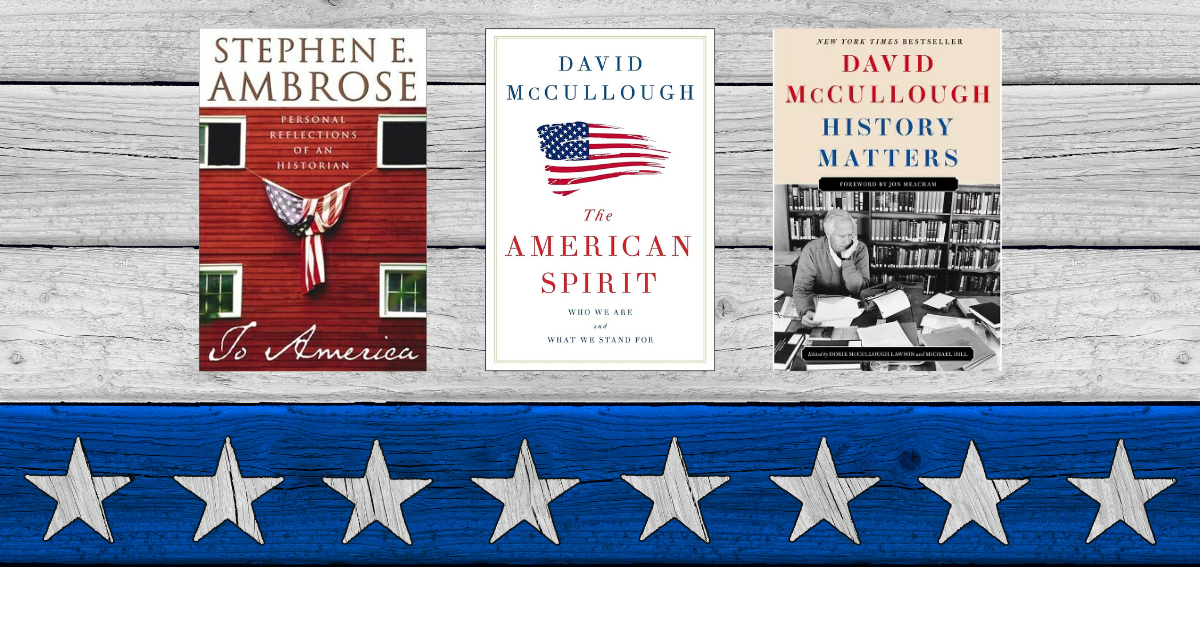
Ambrose wrote To America knowing he was dying. He completed it just before his death in October 2002, in the shadow of September 11, when the country was still sorting through its grief and its anger. That context matters. He wasn’t writing a textbook or a legacy project – he was writing a confession. Having spent decades in the archives of World War II and the Lewis and Clark expedition, he had developed a clear-eyed, sometimes painful sense of what America had done well and what it had willfully refused to do. This book was his chance to say it plainly, without the apparatus of academic argument.
McCullough’s situation was different. He published The American Spirit in 2017, watching the country fragment in ways that alarmed him. A two-time Pulitzer winner, he had earned the status of the nation’s go-to narrator – the voice people trusted to explain the founding generation, the Brooklyn Bridge, the Wright Brothers. But what he kept encountering, in classrooms and public life alike, was a creeping historical amnesia. The American Spirit collected his best speeches – talks given at universities, historic sites, and before Congress – as a kind of intervention. History Matters appeared three years after his death in 2022, assembled by his daughter Dorie McCullough Lawson and long-time researcher Michael Hill, with a foreword by Jon Meacham. It brings together previously unpublished essays that show how McCullough’s thinking developed over decades. The two volumes, read alongside Ambrose, make a complete picture.
What They’re Actually Arguing
The surface agreement between these writers is easy to summarize: America is neither the paradise its boosters claim nor the irredeemable project its critics insist upon. It’s something harder to hold – a country founded on promises its founders couldn’t keep, which subsequent generations have been, fitfully and incompletely, trying to honor ever since. But the surface agreement conceals real differences in emphasis.
Ambrose’s core argument is about the gap. The founders wrote magnificent things – Jefferson’s declaration of human equality is, by any measure, one of the most radical sentences in political history – and then failed to live by them. Slavery. The expulsion of Native Americans. The long exclusion of women from civic life. For Ambrose, these aren’t embarrassing footnotes. They’re the central drama. The true American story is the multi-generational attempt to close the distance between what the country proclaimed and what it actually did.
McCullough’s argument in The American Spirit is more temperamentally optimistic, focused less on the gap and more on the human qualities that have, at crucial moments, narrowed it. Curiosity. Cooperative effort. The refusal to accept that circumstances are fixed. He pushes back hard against the idea that history moves by impersonal forces – his consistent position is that individuals, acting from character, shape outcomes. History Matters deepens this into something more pedagogical: the case that historical literacy isn’t optional for citizens, that it provides the only reliable antidote to the kind of shallow, ahistorical cynicism that makes genuine democratic participation impossible.
The Passages That Stay With You
Ambrose writes the way a trusted professor talks – direct, unpretentious, willing to state the uncomfortable thing without dressing it up. On the central paradox of the founding, he wrote:
We are a people who have achieved much, but we have also sinned much. The men who wrote the Declaration of Independence and the Constitution were progressive thinkers who lived a profound contradiction… They gave the world a model of democracy while practicing the ultimate tyranny of human bondage. Our history is the story of trying to live up to the words they wrote, a journey that is far from over.
That last clause is doing a lot of work. It refuses both the triumphalist reading and the despairing one. The journey isn’t over – which means it’s still ours to continue or abandon.
McCullough operates on a different register. His prose has a symphonic quality, built for public delivery, designed to stir rather than prod. In The American Spirit, speaking to a graduating class, he offered a warning:
History is a spacious country of the mind, and if you do not know your own history, you are like a leaf that doesn’t know it’s part of a tree. We must remember that our founders were not gods; they were human beings, flawed and uncertain, yet they achieved something miraculous because they possessed a sense of purpose larger than themselves. If we lose that sense of purpose, if we become a nation of spectators rather than participants, our democracy will wither from within.
The leaf metaphor is the kind of thing that sounds obvious until you sit with it. And the distinction between spectators and participants is where his argument gets genuinely sharp – democracy doesn’t run on sentiment. It runs on people who show up. In History Matters, McCullough’s voice becomes quieter, more reflective, less oratorical:
Real history is never just about politics or war; it is about the human heart, about character, about the books people read and the art they created. When we look at Harry Truman or George Washington, we are looking at men whose strength came from an old-fashioned adherence to honor, honesty, and hard work. History matters because it reminds us, in the darkest of times, that we have been through worse, and that decent, determined people can prevail.
Where They Agree and Where They Diverge
Both men are categorically opposed to the twin temptations of American historical thinking: the whitewash that erases genuine national sins, and the overcorrection that reduces the entire story to an indictment. Both hold pride and repentance in tension, and both treat human character as the hinge on which history turns. Whether Ambrose is writing about a nineteen-year-old at Omaha Beach or McCullough is tracing John Adams’s obstinate integrity, the argument is the same: what people do, and why they do it, is what history actually is.
But their temperaments differ, and so do their methods. Ambrose is grittier, more political, more attuned to friction. He’s interested in military strategy, in the mechanics of presidential power, in how Eisenhower differed from Nixon and why it mattered. His work has the texture of investigative journalism – he went to the archives and to the veterans themselves, and it shows. McCullough is more interested in culture: painting, architecture, education, the intellectual habits that shape a civilization. He’ll spend as much time on Thomas Eakins or the engineering of the Brooklyn Bridge as on any political figure.
History Matters also gives us something the other books don’t – a view of McCullough’s own formation. His childhood in Pittsburgh, his early mentors, his lifelong attachment to literature and visual art. It’s the backstage pass to the grand claims made in his other works, and it makes those claims more convincing, not less.
Why Read These Books Now
The obvious answer is that these books offer a corrective to the 250th anniversary spectacle. They replace cheap patriotism with the demanding, rewarding kind that requires actually knowing something.
But there’s a more specific case for each of them. Ambrose’s To America is a reality check. It prevents the comfortable nostalgia that imagines the past as simpler or purer than the present. Every generation, he insists, faced catastrophic challenges and internal divisions – and the question each generation had to answer was whether it would do better than the one before. Reading him turns you from a passive consumer of national mythology into something more useful: someone who knows what the mythology is covering up and why it matters.
McCullough’s American Spirit and History Matters perform the complementary service. Against the grinding cynicism that makes civic participation feel pointless, he makes the case for hope – not the greeting-card kind, but the documented kind, grounded in specific people who faced genuinely terrible circumstances and figured something out. The American track record of innovation, resilience, and moral course-correction is real. It doesn’t erase the failures, but it means the failures aren’t the whole story.

When the fireworks go up this summer, the question worth asking isn’t whether the commercialism is crass – it obviously is. The question is what you actually think you’re celebrating. The Declaration of Independence was not a marketing milestone. It was a radical, dangerous act by people who knew it might get them killed. Ambrose and McCullough, each in his own way, help you hold that reality in your mind while the lawn chairs and insurance jingles try their best to crowd it out.
That’s not a small thing.

Part of a regular series on 27gen, entitled Wednesday Weekly Reader.
During my elementary school years one of the things I looked forward to the most was the delivery of “My Weekly Reader,” a weekly educational magazine designed for children and containing news-based current events.
It became a regular part of my love for reading, and helped develop my curiosity about the world around us.

