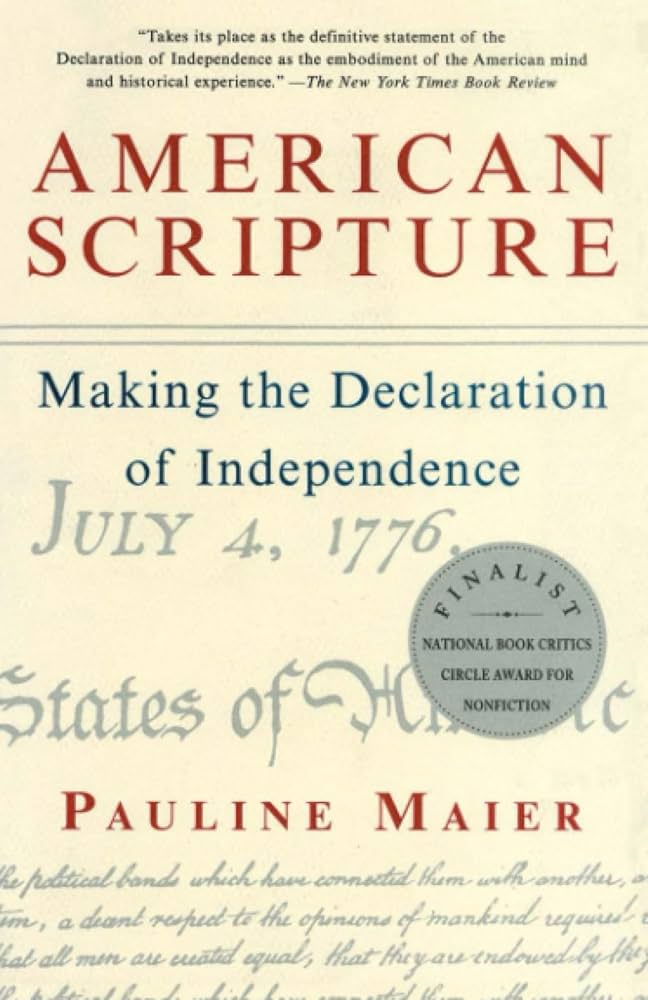
Pauline Maier’s American Scripture: Making the Declaration of Independence is the most essential book in this section. Maier’s meticulous scholarship reconstructs how Congress itself – not Jefferson alone – edited and shaped the final document, making it the definitive account of the Declaration as a collective achievement.
May and June – The Architects of Independence, Part Eight
Every American schoolchild learns the same story: Thomas Jefferson, alone with his portable writing desk in a Philadelphia boarding house, conjured the Declaration of Independence from thin air – a solitary act of genius that changed the world. It is one of the most durable myths in the national imagination. Pauline Maier spent a career dismantling it.
Published in 1997, American Scripture: Making the Declaration of Independence arrived at a moment when the United States was in the middle of one of its periodic arguments about what the founding documents actually mean, who they belong to, and whether they live up to their own promises. That argument has never really stopped. In an era when the Declaration is routinely invoked by politicians of every stripe – as a mandate for immigration, as a rebuke to immigration, as an argument for social transformation, as a defense of tradition – Maier’s meticulous reconstruction of how the document was actually made feels, if anything, more urgent in 2026 than it did nearly thirty years ago. Understanding what the Declaration is requires understanding what it was, and how it got that way.
The Scholar Behind the Argument
Pauline Maier was a historian of early America at MIT, where she taught for decades until her death in 2013. She was not, by temperament, a myth-maker or a debunker for its own sake. Her earlier work – From Resistance to Revolution and The Old Revolutionaries – established her as a scholar of uncommon rigor who was interested in the collective processes of political change rather than the heroic individual. When she turned her attention to the Declaration, she brought that same instinct to bear: what happens when we look at this document not as the product of a single mind, but as the outcome of a long, contentious, and deeply collaborative political process?
The result is a book that is part archival detective story, part intellectual history, and part act of democratic imagination. Maier does not diminish Jefferson. She does something more interesting: she places him inside the machinery of a revolution and shows how that machinery worked.
The Central Argument: Jefferson Did Not Write the Declaration
That is perhaps too stark a way to put it – Jefferson wrote a declaration. But the Declaration of Independence, the one signed on August 2, 1776, the one now enshrined in the National Archives, the one that has shaped two and a half centuries of American political life – that document was written by the Second Continental Congress.
Maier builds this argument on two foundations. The first is her recovery of the dozens of state and local declarations of independence that preceded the Continental Congress’s version. In the months before July 1776, county committees, colonial assemblies, and grand juries across America were drafting their own declarations – documents that articulated the philosophical case for independence, catalogued British abuses, and announced their authors’ readiness to break from the Crown. These were not private letters or pamphlets. They were formal public acts, widely circulated and debated. Jefferson and his colleagues on the drafting committee did not arrive at their task with a blank slate; they arrived with a genre already established, a set of arguments already field-tested, and a vocabulary already in place. The Declaration’s famous second paragraph – the one about self-evident truths and unalienable rights – was not a bolt from the blue. It was the distillation of a conversation already underway across the colonies.
The second foundation of Maier’s argument is her reconstruction of what Congress actually did with Jefferson’s draft. The delegates spent two and a half days going through the document line by line, making more than eighty changes – cutting roughly a quarter of the original text, softening certain phrases, removing others entirely. Jefferson, who was present and kept his own annotated copy, was reportedly miserable throughout. Benjamin Franklin, sitting beside him, tried to cheer him up with a story about a hat-maker whose proposed sign was edited down to nothing but his name. Jefferson did not find it funny.
Maier’s central claim is that this editorial process was not vandalism – it was improvement. Congress’s most significant deletion was Jefferson’s extended and somewhat incoherent attack on the slave trade, in which he blamed George III for introducing slavery into the colonies and then blamed him again for potentially arming enslaved people against the colonists. The passage, Maier shows, was philosophically contradictory and politically unacceptable to delegates from South Carolina and Georgia. Its removal made the document more coherent, not less. The accusation that slavery was the king’s fault was, in any case, historically absurd, and its deletion was an act of editorial honesty – even if the failure to confront slavery directly was a moral catastrophe that the nation would spend the next century paying for in blood.
Immediate Aftermath: The Document Goes to Work
For Jefferson, the weeks following the signing were consumed not by celebration but by a return to Virginia, where he threw himself into the project of reforming the state’s laws – drafting legislation on religious freedom, education, and the revision of the legal code. He was, in some ways, relieved to leave Congress. The experience of having his draft so substantially altered had stung, and he would nurse that grievance for the rest of his life, continuing to send friends copies of his original version alongside the final text so posterity could judge who had written the better document.
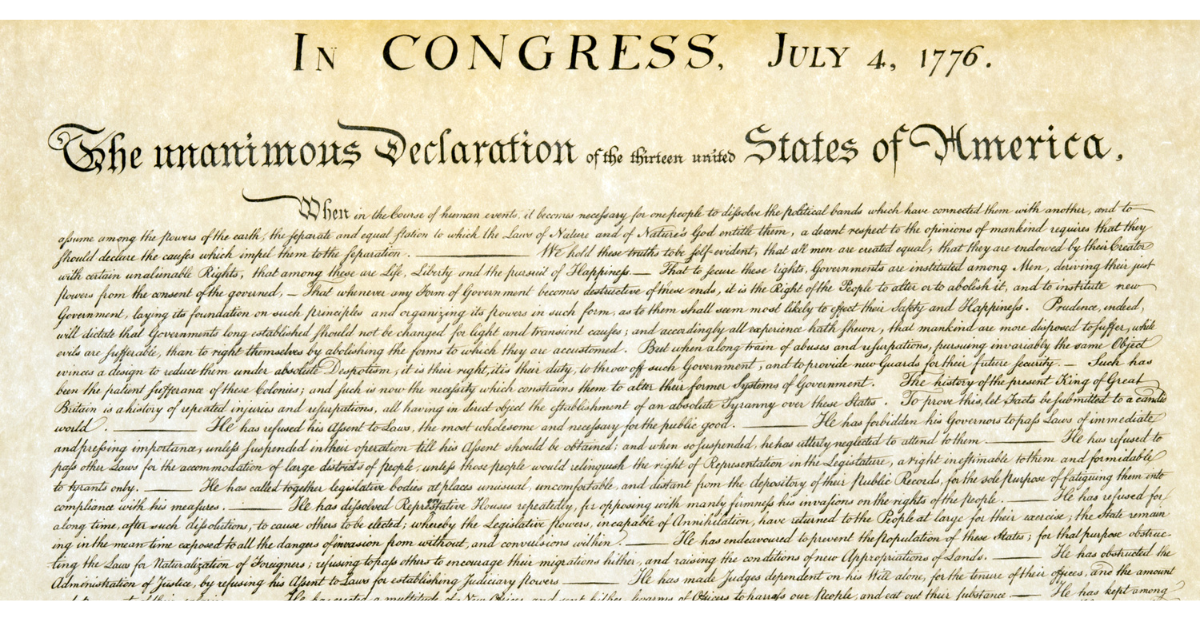
Congress, meanwhile, faced the immediate problem of making the Declaration do the work it was designed to do. The document was read aloud in public squares across the colonies, greeted in some places with bonfires and toasts, in others with silence or hostility. George Washington had it read to his troops in New York on July 9 – just as a British fleet was massing in the harbor. Within days, British forces landed on Long Island, and the Continental Army suffered a series of near-catastrophic defeats that came close to ending the revolution before it properly began. The Declaration had announced independence. Washington’s soldiers now had to win it.
A Voice Both Exact and Humane
Maier writes with a precision that never tips into pedantry. Her prose is the prose of a scholar who has spent so long with primary sources that she has internalized their rhythms without being enslaved to them.
On Congress’s editorial work, she is bracingly direct: the delegates “did not see themselves as simple copyeditors” but as co-authors of a collective statement – men who had staked their lives and reputations on the document and therefore had every right to shape it. On the mythology that grew up around Jefferson’s authorship, she notes that the elevation of the Declaration into a kind of secular scripture, with Jefferson as its prophet, was itself a historical process – one that took decades, and that served political purposes that had little to do with what actually happened in Philadelphia in the summer of 1776.
One of her most striking observations concerns the document’s second life. The Declaration, she argues, was largely forgotten as a political instrument in the decades immediately following the Revolution. It was Abraham Lincoln who resurrected it – who made the claim that “all men are created equal” was not merely a statement of 1776 but an ongoing promise, a standard against which the nation had always to be measured. The Declaration, in Maier’s account, did not arrive at its current meaning all at once. It was made, and remade, by successive generations who needed it to say something.
Dialogue with the Architects
Read alongside the other books in this series, American Scripture functions as both complement and corrective.
Gordon Wood’s Revolutionary Characters establishes the intellectual world from which the founders emerged – a republic of ideas, shaped by classical learning and Enlightenment philosophy. Maier’s book grounds that world in the specific, messy, intensely practical work of political drafting. The ideas were real; so was the committee.
Joseph Ellis’s Founding Brothers is preoccupied with personal rivalries and the complicated friendships among the founders. Maier is less interested in personalities than in process. She and Ellis are, in a sense, looking at the same events from different angles: Ellis asks what the men thought of each other; Maier asks what they thought they were making.
David McCullough’s biography of John Adams presents Adams as the driving force behind independence – the man who bullied and persuaded Congress into action and maneuvered Jefferson into the lead role on the drafting committee. Maier’s account neither confirms nor contradicts this, but it shifts the emphasis: even if Adams was the engine, the outcome was shaped by the whole body. Jon Meacham’s Jefferson, for his part, is a figure of almost inexhaustible complexity – a man whose idealism and moral failures coexist in permanent, unresolved tension. Maier’s Jefferson is something slightly different: a gifted writer whose best work was improved by editors he despised.
The book that sits in closest dialogue with American Scripture may be J. Kent McGaughy’s study of Richard Henry Lee. Lee’s resolution of June 7, 1776, was the legislative act that set the drafting process in motion. Maier’s book begins, in a sense, where Lee’s political work ends – she picks up the story at the moment the committee convenes and follows it through to the document’s eventual canonization. Together, the two books reconstruct the full arc from resolution to scripture.
What We Have Learned Since 1997
In the nearly three decades since American Scripture appeared, scholarship on the Declaration has deepened considerably. Historians have paid closer attention to the voices excluded from the founding moment – enslaved people, women, Indigenous nations – and to the ways the Declaration’s universalist language was understood, from the beginning, to apply only selectively. Maier herself was forthright about the document’s failures on slavery, but subsequent scholarship has pushed further, examining how enslaved Americans heard the Declaration read aloud, and what they made of its promises.
The digital humanities have also transformed the study of documentary history. Full-text databases now make it possible to trace the circulation of specific phrases across the colonial declarations that Maier identified, and to map with greater precision the intellectual genealogy of Jefferson’s most famous lines. Her core argument – that the Declaration was a collective achievement rooted in a broader political conversation – has been strengthened, not weakened, by this subsequent work.
Why Read This Book in 2026
Because the Declaration of Independence is not a relic. It is a living political document, invoked almost daily in American public life, and the way we understand its origins shapes the way we understand its claims. If we believe Jefferson wrote it alone, in a flash of genius, we are likely to treat it as the property of a single tradition — as something handed down rather than fought over. If we understand it as Maier shows it to be — the product of a continent-wide argument, refined by a contentious committee, and given its ultimate meaning by generations of Americans who needed it to do new work – then it belongs to everyone who has ever invoked it. That is a more complicated story, and a more honest one. It is also, in its way, more inspiring: the Declaration is great not because one man was touched by lightning, but because a people, arguing and revising and disagreeing, managed to write something that outlasted them all.
American Scripture is the book that tells that story with the seriousness it deserves. In a series devoted to the architects of independence, Maier’s contribution is indispensable – not because she celebrates the founders, but because she shows us how democracy, even at its founding moment, looked a great deal like democracy: loud, imperfect, and stubbornly collective.
A Note on This Series
This journey through Revolutionary history is as much about the evolution of historical understanding as the Revolution itself. History isn’t static – each generation reinterprets the past through its own concerns, asking different questions and prioritizing different sources. By reading these books in dialogue across 250 years, we’ll witness how scholarship evolves, how narratives get challenged, and how forgotten stories resurface.
This isn’t about declaring one interpretation “right” and another “wrong,” but appreciating the richness that emerges when multiple perspectives illuminate the same transformative moment. These books won’t provide definitive answers – history rarely does – but they equip us to think more clearly about how real people facing genuine uncertainty chose independence, how ideas had consequences, and how the work of creating a more perfect union continues. As we mark this anniversary, we honor the Revolutionary generation by reading deeply, thinking critically, and engaging seriously with both the brilliance and blind spots of what they created.