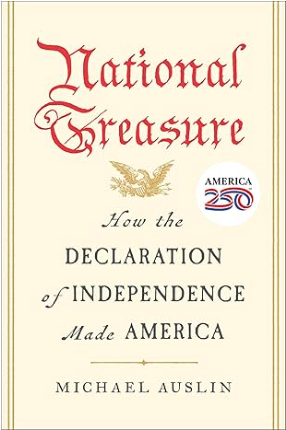
Michael Auslin traces the Declaration from Jefferson’s drafting in a Philadelphia boarding house through its covert signing, its dissemination during the darkest days of the Revolutionary War, and its long and harrowing journey to the present. Through it all, the Declaration’s words inspired implausibly varied causes, from suffragists and civil rights leaders to groups waging war on the U.S. government. Billed as the first complete history of the Declaration from 1776 to the present, National Treasure: How the Declaration of Independence Made America treats the document as both a physical relic and a living set of ideals.
July – The Document and Its Meaning, Part 5
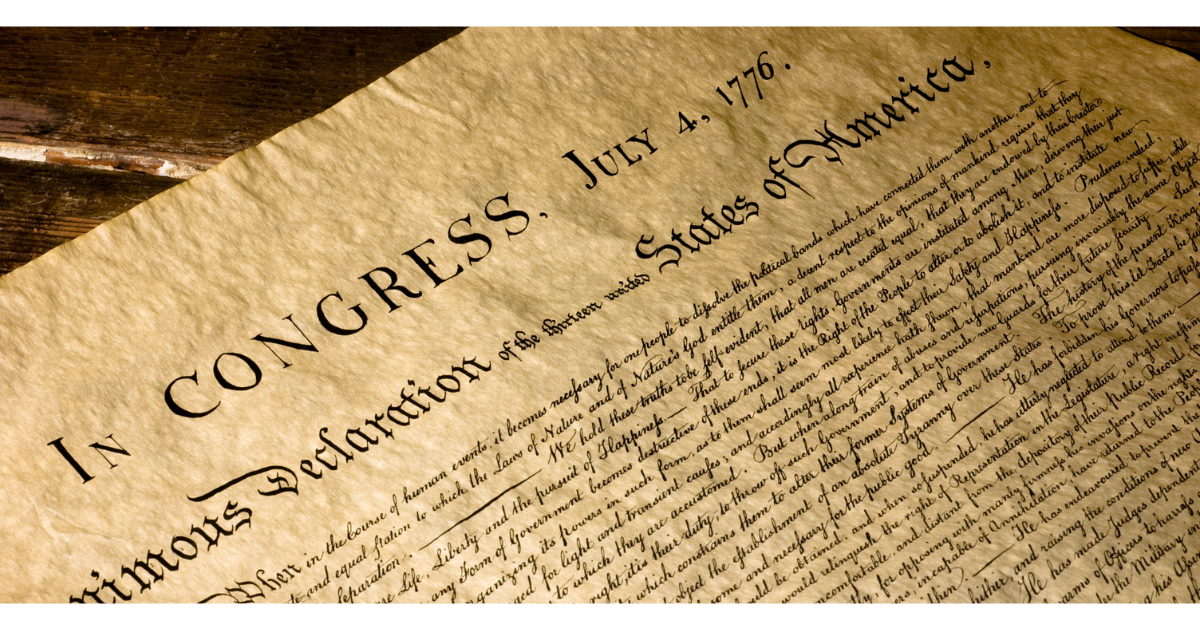
There is a moment in the summer of 1776 that almost no one remembers: the Declaration of Independence, newly signed and printed, was carried into the streets and read aloud to crowds who had never seen it. Soldiers heard it in camp. Colonists gathered around public squares in the August heat. The words “all men are created equal” were not read as constitutional law or philosophical abstraction. They were read as a dare. A promise. A provocation aimed squarely at a king.
That moment, when a document became a living force rather than a piece of paper, is the animating question behind Michael Auslin’s National Treasure: How the Declaration of Independence Made America. Published in May 2026 – timed deliberately for the Semiquincentennial – the book traces the Declaration from Jefferson’s Philadelphia boarding house to the present day, asking a question that sounds simple but turns out to be genuinely difficult: What has this document actually done to us, and what have we done to it?
Author Context
Michael Auslin is not the historian you would expect to write this book. His previous work focused on Japan, on China, on the geopolitical anxieties of the Pacific Rim. He spent years at Yale as a professor of Japanese history before moving to Stanford’s Hoover Institution, where he holds the Payson J. Treat Distinguished Research Fellowship. His books have titles like The End of the Asian Century and Asia’s New Geopolitics. He writes for the Wall Street Journal.
So why the Declaration? Perhaps precisely because he came to it from the outside—as someone who has spent a career watching what American principles look like when they travel abroad, when they get, held up against other systems of governance, when they are tested by people who did not grow up inside them. Auslin wrote National Treasure as a Distinguished Visiting Scholar at the Library of Congress’s Kluge Center and as an American Heritage Partners Fellow at the Society of the Cincinnati’s American Revolution Institute. He did not stumble into this territory. He went looking for it.
The result is a book by a conservative-leaning policy historian who genuinely believes the Declaration is what he calls a “creedal document” – not merely a founding text but an ongoing covenant between Americans and their own stated ideals. That perspective shapes every page, sometimes to the book’s advantage and occasionally to its detriment.
Core Argument
Auslin’s central claim is deceptively straightforward: the Declaration’s preamble – not the long list of grievances against George III – has been the active engine of American history. The charges against the king are scattershot and largely forgotten. The opening passages about self-evident truths and unalienable rights have never stopped working. They have animated abolitionists and suffragists, civil rights leaders and Cold Warriors, immigrants and veterans. The document did not just declare independence. It defined a standard by which Americans would be judged, and by which they would judge themselves.
This is what makes National Treasure unusual among the books examining the Declaration this anniversary year. Auslin is not primarily interested in the politics of 1776 or the intellectual lineage stretching back to Locke and the Scottish Enlightenment. He gives those their due; his treatment of Jefferson’s drafting process is lucid and appropriately concise – but he moves quickly. He wants to know what happened next. He wants to follow the parchment through time.
And so the book becomes something close to a biography of an object and an idea simultaneously. The Declaration was nearly lost during the War of 1812, rolled up and hauled out of Washington as the British advanced. It spent decades displayed under conditions that slowly faded its ink. It was largely ignored in the decades immediately following the founding, then rediscovered by Abraham Lincoln, who understood that the Union could not survive without it. Auslin tracks all of this with a pace that suggests he knows his reader might be tempted to put the book down, and refuses to give them the chance.
Key Passages
The chapter on the 1976 Bicentennial is where Auslin’s voice comes into sharpest focus. Writing about a cynical post-Vietnam, post-Watergate America that nonetheless turned out in the tens of millions to celebrate its founding document, he observes:
In a cynical era, it was perhaps naïve to believe the Declaration still answered the aspirations of Americans, and yet how else to explain the tens of millions who celebrated it? No republic had lasted as long as the United States, and there was little doubt that much of the reason for the survival of the world’s oldest democracy was the philosophy embedded in its founding document.
This is Auslin at his best – not triumphalist, but genuinely curious about why a country would keep returning to a document it has so often failed to live up to. The answer he offers is neither cynical nor naïve. The Declaration survives, he argues, because it makes demands on us that we cannot simply satisfy once and put aside. It is designed, structurally, to remain unfinished business.
Elsewhere he quotes Jefferson directly in a way that reframes the entire project: Jefferson told James Madison that his goal was not to “invent new ideas altogether,” but rather to produce “an expression of the American mind.” Auslin spends the rest of the book testing whether that expression has held – whether the American mind has remained recognizable across 250 years of extraordinary pressure.
Dialogue with Other Works
Place National Treasure alongside the other books in this section and a set of productive tensions emerges.
Emily Sneff’s When the Declaration Was News occupies almost entirely different territory. Sneff is interested in the Declaration as a manuscript object – its paper, its ink, its physical travels, the strange 1787 parchment copy discovered in England that upended what we thought we knew about signatories and their order. Auslin knows this scholarship but largely treats the document’s material existence as prologue. Where Sneff slows down to examine a single copy in granular detail, Auslin accelerates. The two books are complements, not competitors.
Matthew Spalding’s The Making of the American Mind and Auslin’s book are ideological cousins – both treat the Declaration as a living creedal document rather than a historically contingent one – though Spalding writes from within a natural law tradition that Auslin largely sidesteps. Where Spalding grounds his argument in a specific philosophical inheritance, Auslin grounds his in historical evidence: here is what people actually did with these words across 250 years. The empirical approach suits him.
And then there is Joseph Ellis. Revolutionary Summer is where Auslin and Ellis most directly meet, both attending to the gap between the Declaration’s soaring language and the grinding military and political reality of 1776. Ellis’s portrait of the founders as improvisers stumbling forward under pressure balances Auslin’s more confident narrative of intentionality. Read together, they produce something neither achieves alone: the founders were both visionaries and desperate pragmatists, and the Declaration reflects both truths simultaneously.
Historical Reassessment
National Treasure arrives at a moment when the Declaration’s meaning is genuinely contested in ways that go beyond academic debate. The questions Auslin raises – Is the United States a creedal nation? Does the preamble still function as a shared foundation? – are not rhetorical. They are live arguments happening in school boards and legislatures and on the floor of Congress.
Auslin’s book performs a service here that the more scholarly works in this series do not attempt: it tries to synthesize 250 years of invocations – from Lincoln’s Gettysburg Address to Frederick Douglass’s fierce Fourth of July speeches to the Civil Rights marches to the Bicentennial to the arguments of today – into a single coherent story about what this document has meant across time. The synthesis is not without seams. His argument that the colonies were “more dynamic” than eighteenth-century England draws a fair rebuke from historians who point out that Britain in the 1770s was giving the world Hume, Burke, and Adam Smith, while also having abolished slavery on its own soil far ahead of the colonies. That’s a real overreach.
But the core insight holds: the Declaration has been invoked by implausibly varied causes across American history – suffragists and segregationists, labor organizers and libertarians, civil rights leaders and militias – and the very fact of those contradictory invocations tells us something important. The document functions as an aspiration, which means it is always available to anyone who believes the country has not yet lived up to it. That availability, Auslin suggests, is not a weakness. It is the point.
Reader’s Value
Why read National Treasure in 2026? The honest answer is that the Semiquincentennial has generated a small flood of Declaration-adjacent titles, and not all of them deserve the shelf space. National Treasure does. Not because it is the most rigorous scholarly treatment of the document – it is not, and Auslin would not pretend otherwise – but because it is the most ambitious attempt to tell the full story of the Declaration across time, from parchment to present day.
Auslin writes for intelligent general readers who want to understand not just what the founders said, but what we have done with what they said. He writes dynamically, which is both a virtue and occasionally a liability. Some of the book’s most interesting questions, such as the Declaration’s relationship to slavery, could use more room to breathe. But the alternative is a book twice as long that half as many people read.
The conclusion Auslin reaches is not triumphalist, which is to his credit. He argues that the preamble remains the country’s best available rallying cry for unity – not because it has always worked, but because it has consistently created the terms by which Americans hold each other accountable. The document has been forgotten, mangled, mythologized, hijacked, and occasionally lived up to. What it has never been is irrelevant.
That seems right. And in a year when the country is arguing loudly about what it is and what it owes to its own founding ideals, a book that traces those arguments back to their source – and shows how long they have been running – is exactly what the Semiquincentennial calls for.
A Note on This Series
This journey through Revolutionary history is as much about the evolution of historical understanding as the Revolution itself. History isn’t static – each generation reinterprets the past through its own concerns, asking different questions and prioritizing different sources. By reading these books in dialogue across 250 years, we’ll witness how scholarship evolves, how narratives get challenged, and how forgotten stories resurface.
This isn’t about declaring one interpretation “right” and another “wrong,” but appreciating the richness that emerges when multiple perspectives illuminate the same transformative moment. These books won’t provide definitive answers – history rarely does – but they equip us to think more clearly about how real people facing genuine uncertainty chose independence, how ideas had consequences, and how the work of creating a more perfect union continues. As we mark this anniversary, we honor the Revolutionary generation by reading deeply, thinking critically, and engaging seriously with both the brilliance and blind spots of what they created.