Dreamers Live Beyond Themselves in Order to Make Dreams Come True

Even for those of you that don’t follow the Walt Disney Company regularly, the news coming out of Anaheim, CA from the biannual gathering of Disney fans called D23 has been nonstop since last Friday. Even though the event ended Sunday night, recaps, opinions, and second-guessing continues today – and probably will throughout this week and beyond.

With intellectual properties like Disney Studios, theme parks and resorts, and the studios of Pixar, Star Wars, Marvel, and now most of Fox, the entertainment giant is continuing to grow beyond expectations.

D23 was three days of seemingly nonstop announcements about the upcoming movies from all the studios mentioned above, new attractions at theme parks world-wide, new partnerships, and the unveiling of Disney+, the streaming service that will launch November 12. Artists, actors, and people normally behind-the-scenes were onstage everywhere at the Anaheim Convention Center, each presentation seeming to outshine the previous one.

I’m not even going to attempt to unpack everything that happened at D23 – there are much better sources for that.

Instead, I want to leave you with a couple of images – courtesy of Disney – and a quote by Walt Disney:

If you don’t know what these represent:

  • The top image is a representation of four “neighborhoods” coming to Epcot – a transformation of the park in every sense of the word.
  • The image on the lower right is a new statue of Walt Disney what will occupy “Dreamer’s Point,” a transition from Spaceship earth to the rest of the reimagined Epcot.
  • The quote in the lower left is from Walt Disney, part of a longer statement about Epcot he made in October 1966 – only two months before his death.

Think about that.

While Walt Disney was totally immersed in the building of Disneyland in California, and led in the acquisition of the thousands of acres that would become Walt Disney World in Florida, he never saw the first shovel of dirt turned, much less the completion of any part of Walt Disney World.

The EPCOT he dreamed of was not the Epcot Center that opened in 1982; all of the work done in major upgrades since then – and including this projected “transformation” – are not going to make that happen.

But the dream did not die with the dreamer.

His vision of ‘a new Disney world’ outside of Orlando, Florida, especially his concept of Epcot, was so strongly a personal, life-summing statement that many believed the dream might die with Walt. Not so. For in addition to the fantasy empire Walt had created, he had also built a unique organization.

– Richard Beard, Walt Disney’s EPCOT

Led by Walt’s older brother Roy, who postponed his retirement, the talents of the entire Disney organization went ahead with the Florida project.

Because that’s what dreamers do…

…they dream, and make sure there is a team who understands and lives the dream, and will keep it going.

So that’s what Epcot is: an experimental prototype community that will always be in a state of becoming. It will never cease to be a living blueprint of the future…

– Walt Disney


Will your dream live beyond you?


The Class of 2023 is Headed to a College Campus Near You

The Mindset List® has delighted millions for over a decade about what has “always” or “never” been true for entering college students. It was created at Beloit College in 1998 to reflect the world view of entering first year students, and started with the members of the class of 2002, born in 1980.

What started as a witty way of saying to faculty colleagues “watch your references,” has turned into a globally reported and utilized guide to the intelligent if unprepared adolescent consciousness. It is requested by thousands of readers, reprinted in hundreds of print and electronic publications, and used for a wide variety of purposes. It immediately caught the imagination of the public, and in the ensuing years, has drawn responses from around the world. This site now gets more than a million hits a year.

The Mindset List®, an annual compilation of what has always and never been true for new college freshmen, has changed hands from founder Beloit College to Marist College.

Recently, the Mindset List of the Class of 2023 was released.

This fall’s college class of 2023, now arriving on campuses, learned of the attack on New York’s Twin Towers from parents and grandparents once they were old enough to handle it. Born in 2001, they have lived in a world in which shedding shoes at airport security; capturing news from crawling headlines on the TV screen; flying Jet Blue; and recognizing that blackboards, pens, and watches are sometimes smarter than we are have all been routine occurrences.

The creation of Beloit’s former Public Affairs Director Ron Nief and Emeritus Professor of English Tom McBride, authors of The Mindset Lists of American History: From Typewriters to Text Messages, What Ten Generations of Americans Think Is Normal, it was originally created as a reminder to faculty to be aware of dated references. It quickly became an internationally monitored catalog of the changing worldview of each new college generation.

Nief and co-editor Tom McBride, and list co-author Beloit Professor of Sociology Charles Westerberg have been working with Marist during the transition. “This annual list is a cultural touchstone,” noted Marist’s Executive Vice President Geoffrey Brackett. “Every year Ron, Tom, and Charles have done the remarkable work of encapsulating a changing world into a cohesive list. The list has served as a reminder to the wider community of colleges and universities of the importance of understanding the constantly altering landscape outside of higher education. Marist hopes to continue that service by taking on The Mindset List and strategically expanding its capabilities and reach.”

Leaders – of all ages – need to understand what has shaped the lives of today’s entering college freshman class, those 18 year olds characterized by the following:

  • Like Pearl Harbor for their grandparents, and the Kennedy assassination for their parents, 9/11 is an historical event.
  • The primary use of a phone has always been to take pictures.
  • YouTube has become the video version of Wikipedia.

According to Westerberg,

With half of this generation composed of people of color, they are among the most demographically significant cohorts in American history. American politics today is hard to comprehend without taking account of this major trend since, within a year, their generation will represent 25% of the U.S. population.

Here’s a few more characteristics to whet your appetite:

  • They have grown up with Big Data and ubiquitous algorithms that know what they want before they do.
  • Apple iPods have always been nostalgic.
  • Most of them will rent, not buy, their textbooks.
  • The Tech Big Four – Apple, Facebook, Amazon, and Google – are to them what the Big Three automakers were to their grandparents.

You can read the whole list here.

“The Mindset List helps put into context the growing interest high school and college students have in social issues,” noted Martin Shaffer, Dean of Marist’s School of Liberal Arts. “We’re seeing a more engaged, more deeply involved student body on campus.”

Even if you’re not a college professor, you need to read the whole list here.

With contributions from parents and academics around the world, the List has tracked cultural change, stimulated intergenerational conversation, and just made older people feel even older.

– Tom McBride and Charles Westerberg

Indeed.

It’s Hard to Go Wrong When You Follow the Advice of Dr. Seuss

One of my greatest passions is reading.

I developed this passion at an early age, and have continued to strengthen it over the years. In addition to being my passion, reading is also an important part of my role as Vision Room Curator at Auxano. In that role, I am responsible for publishing SUMS Remix every two weeks. SUMS Remix is a modified book summary in which I develop a solution to a common problem faced by church leaders from 3 different books. So, preparing SUMS Remix in 2018 alone means I have gone through over 100 leadership and organization development books to arrive at the 79 used in producing 26 issues this year.

Other parts of my role requires reading current trends books, used for social media posting and content writing.

Then there’s my passion area of Guest Experience, in which I am constantly researching customer service books for application for churches. I’m building The Essential Guest Experience Library.

And, as many readers know, I am a Disney Fanatic – which extends to building a Disney library, currently over 400 volumes and growing!

Finally, there’s just the pure pleasure of reading – an almost nightly hour or two in the late evening reading a wide range of books, both brand new and classics, fiction and nonfiction.

Add those 5 categories all together, and by the end of 2018 I will have “read” 191 books, pretty much following the advice of Dr. Seuss:

First, a disclaimer: I did not read all 191 cover to cover. With such an immense (and pleasurable) task in front of me, and knowing there is more to my job than reading, I have to resort to some method of finding out what an author is trying to say without reading the whole book. There’s a few dozen of that total in which I only read the “highlights,” following the methods below.

Here’s how I did it – and, of course it starts with a book!

How to Read a Book

Literally – that’s the name of a classic book by Mortimer Adler.  The first lesson of reading is to learn that you don’t need to “read” each book the same way. Here are Adler’s 4 levels of reading:

  • Elementary Reading – What does the book say?
  • Inspectional Reading – What is the book about?
  • Analytical Reading – What does the book mean?
  • Syntopical Reading – What does a comparison of books on the subject reveal?

Some books are only meant to be read at the first level; others are meant to be digested at some of the other levels. Know which is which!

To get the most out of a book in the least amount of time, try this strategy:

  • Read the title.
  • Read the introduction
  • Read the Table of Contents
  • Flip through the material, scanning the chapter titles and subheadings. Note the words that stand out as bold, different colors, underlined, or italicized.
  • Examine the illustrations, captions, charts and diagrams. Read the pull-quotes and sidebars.
  • Scan through the index looking for buzz words that interest you.
  • Read the first chapter.
  • Flip through the book and read the first sentence of each paragraph in each chapter. In a well written and edited book, the most important sentence containing the topic is usually the first sentence of the paragraph — but not always.
  • Read the last chapter. If there is an executive summary, read it.
  • Read any other information on the cover or dust jacket.

If the book captures your attention after doing the above tasks, then by all means dive right in!

The converse is true: if a book doesn’t capture your attention after a few attempts, stop reading it. Pick out another one on the topic – there are always more waiting for you!

With that caveat in mind, my “cover-to-cover” reading for 2018 was 127 books.

For the curious, like picking your favorite child (I have four), I don’t typically make a “Best of” list for the year. I find some value in almost every book I read, and for me, that’s good enough.

While the knowledge gained from reading is important, the real benefit is from the habit of reading. When you are continually reading, you condition your mind to keep taking in new knowledge. Your thinking remains fresh and sharp. Your brain is always churning on new ideas, looking for new connections it can make. Every day you pour in more ideas, which your brain must find a way to integrate into your existing knowledge base. Frequent reading fires up your neural activity, even during the periods when you aren’t reading.

Reading is a gift that you can unselfishly give yourself, one that truly keeps on giving. Why don’t you bless yourself and those around you by reading a new book in the first weeks of 2019, and sharing its wisdom with others?

Me? Well, I’m visiting one of my favorite bookstores tomorrow, I’ve got three books lined up for delivery via Amazon by the end of next week, and I’m headed to the library today to pick up another couple on reserve.

After all, you can’t read all day…

…if you don’t start in the morning!


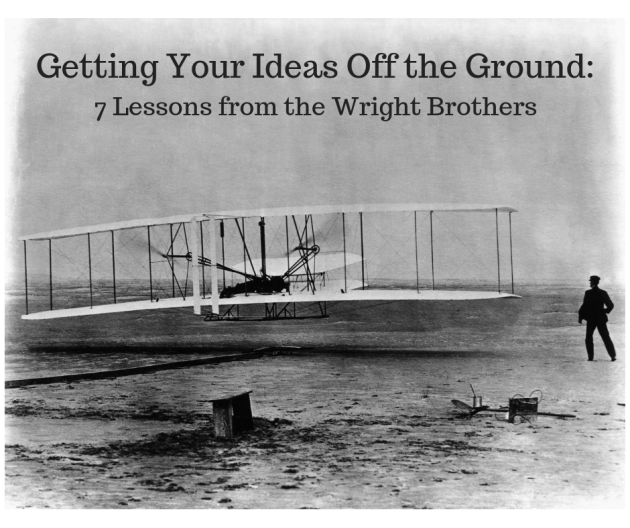
Getting Your Ideas Off the Ground: 7 Lessons from the Wright Brothers

On December 17, 1903, near Kitty Hawk, North Carolina, the Wright Flyer became generally accepted as the first powered, heavier-than-air machine to achieve controlled, sustained flight with a pilot aboard. 

Looking back over these 115 years from a personal viewpoint:

  • In 1903, my grandmother was 5 years old.
  • In 1953, my parents were married.
  • In 2003, the second of my four children began college.
  • Today, in 2018, all 14 of my immediate family have traveled by airplane. My Air Force grandkids, even at 5 and 8, have more frequent flyer miles than I do.

In the lifetime of my extended family, “flying” has come from non-existent to a routine afterthought.

The principles of flying even extend beyond our earth, to travel in space.

How did two men, in 1903, working essentially alone and with little formal scientific training, solve a problem so complex and demanding as heavier-than-air flight, which had defied better-known experimenters for centuries?

Certainly the brothers were talented, but the true answer also lies in their background and early experiences.

With no education beyond public schools, how did the the Wright brothers get past numerous obstacles the world’s other scientists hadn’t even begun to tackle?

In 2003, on the 100th anniversary of the first flight, Mark Eppler published The Wright Way, defining seven essential problem-solving principles the brothers used in accomplishing this enormous feat.

  • A passion for knowledge and information
  • An ability to argue through tough issues in search of truth
  • An ability to identify the hardest part of a problem, and the discipline to begin there
  • A talent for tactile and conceptual tinkering
  • An ability to conceptualize new (often radical) ideas, and the courage to consider them
  • A penchant for method and meticulous attention to detail
  • An ability to create infinitely more together than they could by themselves

On today’s 115th anniversary of the flight at Kitty Hawk, leaders should look at the above list and apply them to problems they are facing.

Applying these principles might just help you get your ideas “off the ground.”

For additional information about the fascinating story of the Wright Brothers, here are four great books I recommend:


Are You Living in the Leadership Loop?

Leaders, by definition (if not practice) have followers. Leaders find, recruit, and train followers for specific tasks. While this is an important task in any organization, a leader who can only lead followers is limited. To make it to the next level of leadership, a leader must be able to lead other leaders – those alongside them.

Leading peers is a unique challenge, no matter what organization a leader is part of. A highly competent leader who is seen – rightly or wrongly – to have considerable influence with his boss is often at a disadvantage when it comes to peer-to-peer relationships.

To succeed at leading alongside your peers, you must work at giving your colleagues reasons to respect and follow you. You do that by helping them win, and in doing so, you will not only help your organization but you will also help yourself.

THE QUICK SUMMARY – The 360° Leader, John Maxwell

Don’t wait for that promotion! Start leading NOW…right where you are!

What’s the number one question leadership expert John C. Maxwell is asked while conducting his leadership conferences? “How can I implement what you teach when I’m not the top leader?” Is it possible to lead well when you’re not the top dog? How about if the person you work for is a bad leader? The answer is a resounding yes!

Welcome to The 360° Leader. People who desire to lead from the middle of organizations face unique challenges. And they are often held back by myths that prevent them from developing their influence. Dr. Maxwell, one of the globe’s most trusted leadership mentors, debunks the myths, shows you how to overcome the challenges, and teaches you the skills you need to become a 360° leader.

If you have found yourself trying to lead from the middle of the organization, as the vast majority of professionals do, then you need Maxwell’s insights. You have a unique opportunity to exercise influence in all directions—up (to the boss), across (among your peers), and down (to those you lead). The good news is that your influence is greater than you know.

Practice the disciplines of 360° leadership and the opportunities will be endless . . . for your organization, for your career, and for your life.

A SIMPLE SOLUTION

The middle of an organization is a great place to practice and build your skills while at the same time extending your influence in all directions. Leaders above you recognize your contributions to the greater organization. Followers below you are grateful for your leadership and influence in developing them.

However, people who find it difficult to lead alongside their peers are often individuals who don’t excel at building relationships. More so than leading up or down, developing and deepening relationships with your peers is critical to your success in leading alongside them.

If you want to gain influence and credibility with people working alongside you, then don’t try to take a shortcut or cheat the process. Instead, learn to understand, practice, and complete the leadership loop with them.

Take a look at the following graphic, which will give you an idea of what the leadership loop looks like:
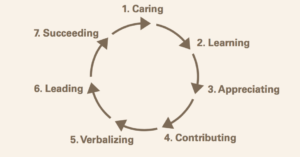
You can see that it’s a cycle that starts with caring and ends with succeeding.

  1. Caring – Taking an Interest in People

You have to show people that you care about them by taking an interest in them. People always move toward someone who increases them and away from anyone who decreased them.

  1. Learning – Get to Know People

Take time to talk to your peers in the organization. Ask to hear their stories. Try to discover their best skills. Ask for their opinions on work-related issues. And as much as you can, try to put yourself in their shoes.

  1. Appreciating – Respect People

We should strive to see others’ unique experiences and skills as a resource and try to learn from them. If you treat your peers with this kind of respect, appreciating them for who they are, then they will be more likely to respect and listen to you in return.

  1. Contributing – Add Value to People

Few things increase the credibility of leader ore than adding value to the people around them. When you go out of your way to add value to your peers, they understand that you really want them to when with no hidden agenda of your own.

  1. Verbalizing – Affirm People

Few things build people up like affirmation. When you affirm people, you make firm within them the things you see about them. If you want to influence your peers, become their best cheerleader.

  1. Leading – Influence People

The things you’ve done up to know have served to build your relationship with them, give you credibility, and display that your motives are good. With that kind of history, you will have earned the opportunity to influence them.

  1. Succeeding – Win With People

Great leaders don’t use people so that they can win. They lead people so that they all can win together. The wonderful thing about helping others succeed is that it earns you more opportunities to help an even greater number of people.

If you help others succeed, additional people will come into your life whom you will have an opportunity to help succeed, and the cycle will start over again.

John C. Maxwell, The 360° Leader

A NEXT STEP

Draw the leadership loop pictured above, and post it in a visible, but out-of-the-way place in your office or work area as a reminder.

Create a matrix on a spreadsheet listing your peer’s names in a horizontal column, and the seven leadership loop actions in a horizontal row across the top.

Over the next month, review the seven actions above on a daily basis, and intentionally schedule and follow through on these actions each day with your peers. At the end of each day, make a brief note in the respective place what action you have taken with each of your peers.

At the end of the week, review your progress, and consider how you will continue and improve in the next week.

At the end of the month, call your team together and debrief your experiment with them.

  • Ask them at what point they realized you were doing something differently.
  • Ask them what they thought about your actions.
  • Encourage them to express what it felt to them as an individual.
  • Ask them if they, in turn, began to do some of the same things with others.
  • Discuss with the group how the actions you took increased the relationships of the team.
  • Challenge your peers to work through the leadership loop in a similar manner.

Excerpt taken from SUMS Remix 79-2, issued November 2017.


Part of a weekly series on 27gen, entitled Wednesday Weekly Reader

Regular daily reading of books is an important part of my life. It even extends to my vocation, where as Vision Room Curator for Auxano I am responsible for publishing SUMS Remix, a biweekly book “excerpt” for church leaders. Each Wednesday on 27gen I will be taking a look back at previous issues of SUMS Remix and publishing an excerpt.

>>Purchase SUMS Remix here<<


Exploring the Continuing Leadership Influence of Walt Disney

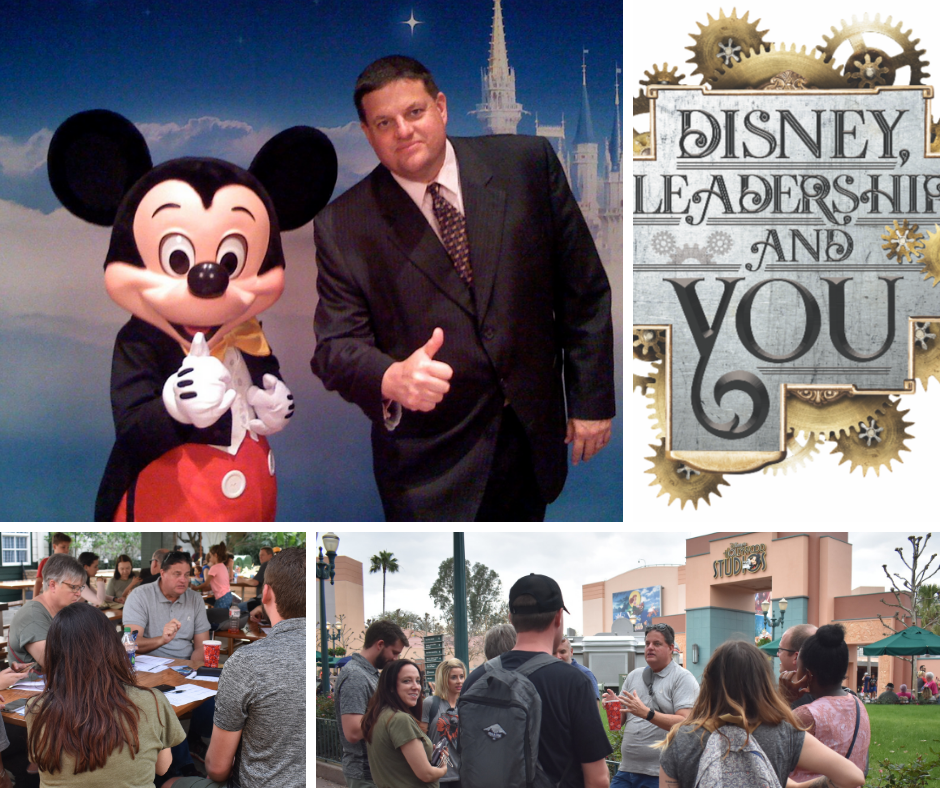
J. Jeff Kober’s latest book, “Disney, Leadership, and You” is an excellent work that more than delivers on its title.

Drawing from an inquisitive mind and keen insight, Kober has nearly five decades experience with Walt Disney – from both within and without the company – which provide a very readable, practical, and thoroughly enjoyable leadership book that you will find yourself returning to time and again for just the right nugget to use.

I have “known” Jeff for years through his writing, and earlier this year was grateful to meet him and engage his services for an immersive park experience with a group I was leading. The warmth, wit, and sheer knowledge of Disney, coupled with his ability to instantly link it to practical applications of my group, was one of the highlights of our experience. That same experience has been translated into this book.

If you are a leader in any size or type of organization, the stories Jeff Kober has captured in “Disney, Leadership, and You” should be a valuable addition to your library, a source of personal encouragement, and a wealth of practical training for both you and your team.

The book is divided into four sections:

  1. Defining Leadership
  2. Leaders Attain Results
  3. Leaders Build Relationships
  4. Putting It All Together

In those four sections you will find 18 themed chapters, each chock full of leadership principles illustrated with stories of Disney leaders from all ranks. The principles are solid in themselves, but what makes them memorable is the stories of the Cast Members.

The stories and principles perfectly describe how Disney Cast Members create magic each day through their hard work and respect for Walt Disney’s original vision.

You organization is not Disney, but you can learn from their excellence. “Disney, Leadership, and You” is an extraordinary source of lessons and learning to help you make a dramatic impact on why you do, what you do, and how you do it.

Effective Leaders Know How to Make the Shift from Critic to Critical Thinker

Leaders, by definition (if not practice) have followers. Leaders find, recruit, and train followers for specific tasks. While this is an important task in any organization, a leader who can only lead followers is limited. To make it to the next level of leadership, a leader must be able to lead other leaders – those alongside them.

Leading peers is a unique challenge, no matter what organization a leader is part of. A highly competent leader who is seen – rightly or wrongly – to have considerable influence with his boss is often at a disadvantage when it comes to peer-to-peer relationships.

To succeed at leading alongside your peers, you must work at giving your colleagues reasons to respect and follow you. You do that by helping them win, and in doing so, you will not only help your organization but you will also help yourself.

SOLUTION #1: Shift from critic to critical thinker

THE QUICK SUMMARY – How to Lead When You’re Not in Charge by Clay Scroggins

Are you letting your lack of authority paralyze you?

One of the greatest myths of leadership is that you must be in charge in order to lead. Great leaders don’t buy it. Great leaders lead with or without the authority and learn to unleash their influence wherever they are.

With practical wisdom and humor, Clay Scroggins will help you nurture your vision and cultivate influence, even when you lack authority in your organization. And he will free you to become the great leader you want to be so you can make a difference right where you are. Even when you’re not in charge.

A SIMPLE SOLUTION

As a leader, you have undoubtedly been told “no” at some point in your life. When that happens, what is your typical reaction? Do you become cynical and defensive, or do you redirect that energy into a more positive direction?

Leaders who want to become a positive influence with their peers must learn how to overcome the tendency to be critical and become a critical thinker.

Great leaders know how to listen, watch, connect the dots, and fix problems because they’re able to think critically.

If you are seeking to develop the skills of a critical thinker, there are four subtle shifts you must make.

Shift #1 – Stop thinking as an employee.

Start thinking as an owner.

Owners see things others don’t see.

Owners have more buy-in than others do.

Owners care more deeply because their future depends on it.

If there is trash in the hallway or in the parking lot, employees may decide to walk past it. Or worse, they call someone in facilities to pick up the trash. Owners pick up the trash because it’s their reputation on the line.

Shift #2 – Stop stacking your meetings.

Start scheduling thinking meetings.

As a staff member, you often get sucked into a multitude of meetings. It’s the natural gravitational pull of any organization. The worst is having a stack of meetings, back to back. While this may seem efficient, it can also be an enemy of critical thinking. You get to the end of the day and realize you’ve generated no new thoughts or new ideas.

Schedule space to think critically, marking it down like a meeting, at points throughout the day. The greatest enemy of thinking critically is an overcrowded schedule.

Shift #3 – Stop being critical.

Start thinking critically.

If thinking critically is a skill, being critical is a snare. Many leaders don’t want to be critical. They don’t sit around planning to be cynics, but they still get caught in the trap.

The key difference between someone who is critical and someone who is a critical thinker is motive. People who are critical want you to lose. They’re bringing problems, not solutions.

People who are great critical thinkers want you to win. They’re motivated to make something better.

Shift #4 – Stop giving others a grade.

Start lending them a hand.

No one likes the feeling of being constantly measured and monitored. If you’re not careful, your critical thinking will make others feel like you’re giving them grades.

This is not about whether you should convey the thoughts that could better those around you. It’s about how you pass on those thoughts. When you communicate critical thoughts to others, you need to do so with a helping hand, not a grading tone.

Clay Scroggins, How to Lead When You’re Not in Charge

A NEXT STEP

On a chart tablet, write each of the shifts, leaving space below each one to add comments.

Set aside time to review your actions in the last week, focusing on activities in which you were involved with one or more of your peers.

Write down, under each shift, the actions that fit the first part of the shifts – the “negatives.” For each one, write out how you can make the shift as described in the second part of the phrase.

Take the initiative to review these actions with your peers, and ask them to comment on the shift you would like to enact.

Excerpt taken from SUMS Remix 79-1, issued November 2017.


Part of a weekly series on 27gen, entitled Wednesday Weekly Reader

Regular daily reading of books is an important part of my life. It even extends to my vocation, where as Vision Room Curator for Auxano I am responsible for publishing SUMS Remix, a biweekly book “excerpt” for church leaders. Each Wednesday on 27gen I will be taking a look back at previous issues of SUMS Remix and publishing an excerpt.

>>Purchase SUMS Remix here<<

The Danger of Being the Brightest Person in the Room

Recently I recalled a consulting job several years ago where I was speaking to a church about the formation of a team to work on the planning for a new building. During one of the sessions I was speaking on the importance of including the facility manager on the building team in a church project, and I tossed out the following statement: The person who sweeps the floor should choose the broom.

That brought out a lot of chuckles from the attendees, but the point hit home: Operational staff members almost never get the chance for input into the decision-making process, yet they are held responsible for the ongoing outcomes of the decisions. That statement and the following story came to mind recently while working on a teamwork project for a future presentation.

James Watson and Francis Crick can arguably say they answered the question, “What is the secret of life”? The pair discovered the double-helix structure of DNA, the biological material that carries life’s genetic information. During an interview on the 50th anniversary of their discovery, Watson was asked how he and Crick had solved the problem ahead of many other highly accomplished, recognized scientists. Watson’s answer included identifying the problem first, being passionate and single-minded about their work, and their willingness to attempt approaches outside their area of familiarity. Then he added something that was astounding: they had cracked the DNA code primarily because they were not the most intelligent scientists pursuing the answer.

Watson went on to say that the most intelligent person working on the project was Rosalind Franklin, a brilliant British scientist who worked alone. “Rosalind was so intelligent that she rarely sought advice. And if you’re the brightest person in the room, then you’re in trouble.”

That comment highlights a common occurrence in church leadership: When dealing with a specific problem or issue, leaders should ensure that they collaborate with team members toward its resolution, even if they are the best-informed, most-experienced, or most skilled person in the group. Far too often, leaders – who, by virtue of greater experience, skill, and wisdom, deem themselves the ablest problem solver in the group – fail to ask for input from team members.

Scientific studies have shown that groups who cooperate in seeking a solution are not just better than the average member working alone, but are even better than the group’s best problem-solver working alone. Lone decision-makers can’t match the diversity of knowledge and perspectives of a multi-person unit that includes them. The ability to distribute many subtasks of a problem to its members – parallel processing – enables the group to outperform the individual who must address them sequentially.

Are you a church leader working in a group? Don’t relinquish your leadership role, but make sure your process allows group members to offer insights, cooperate, and collaborate with each other. The Bible has a lot to say about that, but that’s for another time!

What’s Shaping the Minds of This Year’s Freshman Class, the Class of 2021

Each August since 1998, Beloit College has released the Beloit College Mindset List, providing a look at the cultural touchstones that shape the lives of students entering college this fall.

Today, the Mindset List of the Class of 2021 was released.

The creation of Beloit’s former Public Affairs Director Ron Nief and Keefer Professor of the Humanities Tom McBride, authors of The Mindset Lists of American History: From Typewriters to Text Messages, What Ten Generations of Americans Think Is Normal, it was originally created as a reminder to faculty to be aware of dated references. It quickly became an internationally monitored catalog of the changing worldview of each new college generation.

Leaders – of all ages – need to understand what has shaped the lives of today’s entering college freshman class, those 18 year olds who:

  • Are the last class to be born in the 1900s, making them the last of the Millennials.
  • Are the first generation for whom a “phone” has been primarily a video game, direction finder, electronic telegraph, or a research library.
  • Have always had emojis to cheer them up.

For those who cannot comprehend that it has been 18 years since this year’s entering college students were born, they should recognize that the next four years will go even faster, confirming the authors’ belief that “generation gaps have always needed glue.”

Here are a few nuggets from this year’s Mindset Class for the Class of 2021. You must read the entire list here!

  • They are the first generation to grow up with Watson outperforming Sherlock.
  • Amazon has always invited consumers to follow the arrow from A to Z.
  • They have always been searching for Pokemon.
  • By the time they entered school, laptops were outselling desktops.
  • Whatever the subject, there’s always been a blog for it.
  • Ketchup has always come in green.
  • The BBC has always had a network in the U.S. where they speak American.
  • Family Guy is the successor to the Father Knows Best they never knew.

You can find the rest of the list here.

Read it now.

How to Establish a Systems Thinking Mindset on Your Team

How do you cultivate long-term commitment on your team?

Many teams today are not really teams at all – organizationally, structurally, and motivationally they are not set up to work as individual parts of a larger, unified whole. Often they reflect outdated organizational charts that have little to do with current reality. There are times when a leader realizes their team is actually a collection of individuals who are looking out for themselves. Left in this state, a team can actually become a divisive and damaging cancer to the organization.

Is it little wonder, then, that leaders seek help in cultivating commitment within their teams? The problem isn’t necessarily with the team members or leaders themselves, but what the team is being asked to do: work together without any larger sense of organizational direction or purpose.

If your team needs a boost in commitment, consider establishing a systems thinking mindset on your team.

THE QUICK SUMMARY – The Leadership Equation, by Eric Douglas

What distinguishes the most successful organizations?

What do the leaders and managers in these top organizations actually do?

In this fascinating book, entrepreneur and business consultant, Eric Douglas, paints a clear picture of what happens inside high-performing organizations. He reveals a simple but profound equation: Trust + Spark = Leadership Culture. Leaders and managers are most successful when they focus on building trust and sparking innovation.

In The Leadership Equation, Douglas expands the equation into the 10 most important practices for building trust and spark. As Douglas clearly shows, when trust and spark combine, leaders improve the performance of their team, their department, and the entire organization – and, ultimately, reach their own full potential.

A SIMPLE SOLUTION

Entrepreneur and organizational consultant, Eric Douglas, wants leaders to realize the importance of engaging in systems thinking, and in turn, leading their teams to do the same.

“Systems thinking” is a framework for seeing interrelationships rather than things, for seeing patterns of change rather than static snapshots.

Today, systems thinking is needed more than ever in the increasingly complex world we live and minister in. It is all too easy for organizations to break down despite individual brilliance, because they are unable to pull their diverse functions and talents into a productive whole. 

To achieve a leadership culture, the power of systems thinking needs to spread throughout the organization. Systems thinking teaches us to appreciate how a decision made in isolation can negatively affect others.

We teach our clients to see their organizations holistically, asking them to look at it from five systems perspectives – strategy, governance, performance, process, and people.

Strategy – From this perspective, you focus on the long-term trends affecting your organization. You respond positively by thinking about the long-term use of your resources and how to focus to achieve your most important priorities. You respond negatively by focusing too much on factors beyond your control.

Governance – From this perspective, you focus on the system of decision-making that controls the direction of your organization. You respond positively by thinking about governance and being very specific about delegations of authority. You respond negatively by blaming people for making misguided decisions when the system isn’t clear.

Performance – From this perspective, you focus on systems for measuring performance, first at the organizational level, then to departments, teams, and finally to individuals. You respond positively by deciding which metrics and targets to track at each level and what communication systems to use. You respond negatively by paying too much attention to individual cases of poor performance.

Process – From this perspective, you focus internally on the process of producing value, measuring effectiveness and efficiency. You respond positively by thinking about how to improve the individual components of the process. You respond negatively by singling out specific individuals for not managing a process consistently or efficiently.

People – From this perspective, you focus on your system of hiring and rewarding people. You focus on how to get the right people on board and how to develop them in their roles. Your respond negatively by selecting and promoting people based on arbitrary factors.

– Eric Douglas, The Leadership Equation

A NEXT STEP

Your leaders want to be on a winning team, and teams are most successful when they are innovating and executing around consistent systems. The art of developing systems thinking is found in the organization of your actions and attitudes and the realization that each perspective needs to be measured against every other.

At your next team meeting, list the five systems perspectives above on a whiteboard or flip-chart. Choose a recent leadership team decision and take that decision through each of the five systems perspectives, asking for each, “what worked?”, “what did not work?”, and “what would we do next time?’

At the conclusion of this exercise, sift through the why behind those response to begin to develop a set of guidelines that will help your team see the positive benefits of systems thinking while avoiding the negative consequences.


While all too often teams are “teams” in name only, individual commitment to a larger whole is an integral part of the success of any organization.

By engaging in systems thinking, leaders can help their teams maintain commitment and accomplish their Great Commission call.

Excerpt taken from SUMS Remix 12-3, published April 2015


Part of a weekly series on 27gen, entitled Wednesday Weekly Reader

Regular daily reading of books is an important part of my life. It even extends to my vocation, where as Vision Room Curator for Auxano I am responsible for publishing SUMS Remix, a biweekly book “summary” for church leaders. I’m going to peruse back issues of both SUMS and SUMS Remix and publish excerpts each Wednesday.