The Magic of Place in Your Church’s Guest Experience

The magic of Place has three faces: natural, constructed, and virtual.

> Natural Place Magic is intrinsic to those wonders of the physical world that thrill and awe us by simply existing. It’s the stuff of National Geographic specials that create magic through their natural grandeur. Our primary memories of these places will always be the magic of the natural wonders themselves.  Even so, skillful service magicians can subtly but measurably enhance our experience of Place Magic. A subtle balancing and blending act is the key to creating consistent Place Magic by showing off the main attraction at its best.

> Constructed Place Magic comes in a greater variety than does nature’s Place Magic. While few manmade places are palaces, castles, or world icons, even the most mundane can also be magical. There are hotels and grocery stores and retailers and automobile dealerships and hospitals and dental offices that stand above others and sparkle. People should feel attended to and comfortable in your constructed place.

> Virtual Place Magic demonstrates that place is not always a physical location. Successful organizations must have a presence, a story, and a sense of experience in their virtual world as well as the physical world. The look and feel of your online presence – your digital front door – must reflect the look, feel, and ambiance of your brick and mortar place.  Distinctive and eye-catching design is only beginning of creating a virtual place; you must also build trust and create a unique experience. From the first click, Guests should be drawn in, made curious, and delighted by the virtual place you have created.

Utilizing a Natural Setting

Few organizations will have the benefit of a serene waterfront setting or a majestic mountain view. But everyone has a place that can be enhanced by the following rules:

  • Find your “natural” story – all locations have a story; what’s yours?
  • Educate yourself – steep yourself and your team in the details of your place
  • Create an “elevator” story – what 30 second story can your team tell about your locale and its uniqueness?
  • Dabble in décor – consider enhancing your interior with visual representations of the natural setting
  • Sensory congruence – the smells and sounds need to be in sync with the sights and feel

Creating Illusion, Amazement, and Delight

There is no better contemporary example of building magic into man-made places than the world of the theme park. And there’s no better example of this than Walt Disney, who created an entirely new approach to the concept of entertainment, a business obsessed with the customer point of view, and the precise management of the customer’s experience. With the opening of Disneyland in 1955, Disney developed an obsession for anticipating and controlling every detail that will support – or detract from – his vision. He called it “Imagineering,” and defined it as the blending of creative imagination and technical know-how. It has been best codified by Marty Sklar, the first chairman of Disney Imagineering, in a set of principles dubbed “Mickey’s Ten Commandments.”

  1. Know your audience – before creating a setting, understand who will be visiting your place
  2. Wear your guest’s shoes – evaluate your setting from the customer’s perspective by experiencing it as a customer.
  3. Organize the flow of people and ideas – think of setting as a story and tell the story in a sequenced, organized way.
  4. Create a “wienie” – borrowed from silent film lingo, a wienie is a visual magnet used to orient and attract customers.
  5. Communicate with visual literacy – language is not always composed of words; use the common languages of color, shape, and form to communicate through setting.
  6. Avoid overload by creating turn-ons – do not bombard customers with data; let them choose the information they want when they want it.
  7. Tell one story at a time – create one setting for each idea to avoid confusing customers by mixing multiple stories in a single setting.
  8. Avoid contradictions, maintain identity – every detail and nuance of a setting should support and further the organizational identity and mission.
  9. For every ounce of treatment provide a ton of treat – give your customers the highest value by building an interactive setting that gives them the opportunity to exercise all their senses.
  10. Keep it up – never get complacent and always maintain your setting.

You are practicing Place Magic by creating or enhancing environments that delight, support, and enliven your guests. Magical places are venues with physical attributes that attract and please, subtly enhanced by human endeavor.

Remember that as a church leader, you do have “customers” – they are the Guests who come to your place every weekend.

What are you waiting for? It’s time to create a magical place in your organization!

Adapted from Service Magic by Ron Zemke and Chip Bell
Service Magic

Part of an ongoing, periodic series exploring the translation of customer service in the corporate world to Guest Experiences in ChurchWorld


The Three Ps of Service Magic

Service Magic

An unexpected experience with a touch of style, grace, and imagination the customer remembers with fondness and a smile.

Creating an unexpected, unpredictable, and valuable experience that is both memorable and reproducible.

Today’s customers are often surrounded by lackluster, mediocre service in every industry. How can you win their attention, admiration, and loyalty?

By using the magic of amazement, delight, and enchantment to create a customer experience that soars far beyond their highest Service Magicexpectations. Service wizards Ron Zemke and Chip Bell share their powerful bag of tricks in their book Service Magic. Subtitled “The Art of Amazing Your Customers,” it delivers a powerful bag of tricks to help you add zest, memorability, and value to your customers’ experience in ways they would never expect.

For leaders in ChurchWorld, the translation from customer experience to Guest Experience is an important one – starting with your mindset. You may not think you have “customers” in the traditional mindset – and you don’t. But you do have Guests coming to your church (hopefully!) and they, like you, live in consumer-driven world.

Why not study and learn from some of the best minds and practitioners from the customer experience world, and translate them into Guest Experience practices for your church?

Take Service Magic, for instance.

There is a feeling of awe, wonder, pleasure and delight in Service Magic. When it is present, the customer perceives that something special and unique has been done to, for, or with him or her. It can come from a word spoken, an experience observed, a process experienced, or the context in which the service occurred.

There is magic in Place, Process, and Performance – and all three are available to the skilled service magician and the organization determined to create consistent Service Magic for its Guests.

  • Place Magic: a venue – natural or manmade – with physical attributes that attracts and pleases, and that are subtly enhanced by human endeavor. We vacation at national parks to enjoy the great out-of-doors and visit theme parks for fun and thrills. We remember most of the great views and the rides, but without a little Service Magic, those pleasures would be greatly diminished.

ChurchWorld Application

You meet in a facility – owned or rented – that conveys a powerful impression to your Guests. What does your facility “say”? What are you doing on a regular basis to evaluate your place? What plan do you follow to make sure your place is the best it can be? Does your place invite people to come in – or does it turn people off, or even away? Do you have a plan of constant evaluation and upkeep? How “fresh” are your interiors and exteriors? Does your place fit into your community or does it stand out?

  • Process Magic: the often thankless, almost always invisible effort that makes the difference between policies, procedures, and routines that are difficult, confusing, maddening, and frustrating – and those we experience as surprisingly easy, positive, and memorable. No waiting where once lines were long; sign-ins, sign-ups, and renewals that are hassle-free and even interesting – if not fun – are the result of a little well placed Process Magic.

ChurchWorld Application

Your Guests should experience an invisible, seamless flow of actions from their first contact with you all the way through a worship experience and back again. The processes behind that invisible, seamless flow are probably complicated and maybe even confusing. What are you doing to regularly evaluate and change the process behind the curtains? Do you know what Guests experience when they come to your church? Are you using and speaking with a “churchy” language or do you make things simple to understand and follow?

  • Performance Magic: the surprisingly positive interaction with someone from an organization during the acquisition of a service or a product – or even when a problem with a product or service is being resolved. The wait staff who makes the dining experience “work” for you by correctly reading your mood and engaging you in light-hearted banter or by leaving you alone to your solitude are card-carrying, practicing, professional service magicians.

ChurchWorld Application

When it comes down to it, your front-line teams: parking, greeters, ushers, etc. – make the first and most powerful impact on your Guests. Their actions often dictate whether or not a Guest will return – even before, and often no matter what, the worship experience. When was the last time you ventured out to the front lines to observe? How often do your teams receive training – and encouragement? How high are the expectations for your front-line teams?

Each of these three “magics” is powered by a set of principles – which I hope you will join me in discovering in the next few posts!

12 Days of Christmas Guest Experiences

For all the Connection Pastors, Guest Services Directors, Guest Services team members, and everyone in your church who want to provide a WOW! Guest Experience…

12Days1

On the first day of Christmas Guest Experiences…

>> 1 Word that Says it All

On the second day of Christmas Guest Experiences…

>> 2 Feet that Matter in Guest Experiences

On the third day of Christmas Guest Experiences…

>> 3 Actions to Build a Guest Experience Organization with Clarity of Purpose

On the fourth day of Christmas Guest Experiences…

>> 4 Guest Experience Core Competencies

On the fifth day of Christmas Guest Experiences…

>> 5 Expectations of Disney Service

On the sixth day of Christmas Guest Experiences…

>> 6 Disciplines of Guest Experiences

On the seventh day of Christmas Guest Experiences…

>> 7 Guidelines for Guest Services from Disney

On the eighth day of Christmas Guest Experiences…

>> 8 Ways for the Introvert to Serve on a Guest Team

On the ninth day of Christmas Guest Experiences…

>> 9 Principles of Innovative Guest Experiences

On the tenth day of Christmas Guest Experiences…

>> 10 Commandments for Guest Services from Mickey Mouse

On the eleventh day of Christmas Guest Experiences…

>> 11 Reasons to Smile

On the twelfth day of Christmas Guest Experiences…

>> 12 Principles of Guest Experience Leadership

Tonight, Christmas Eve services are a tradition for many churches. Other churches had special worship services or musical events over the past week.

One of the common threads among all of the events is that churches had the opportunity to welcome Guests, regular attenders, members, and family and friends of all these categories.

Your actions and words have a chance to lower defenses to the Gospel, remove barriers to relationships, and establish an expectation that God is with us…

…make them count!


12DaysGE1

1 Word That Says It All

Here’s a challenge for you: a single word will change your mind-set on this topic.

When it comes to ChurchWorld, more often than not we have visitors.

It may be a little thing to you, just a word, but I think it’s actually a powerful first impression that needs to change.

Do you have Visitor parking? Visitor packets? A Visitor’s Center? Do you welcome your visitors during the worship experience? And on and on…

The first step in creating a WOW! Guest experience is to remove the word visitor from your vocabulary, never to be used again.

It’s a little thing to be sure. But it’s a mindset change that will really impact how you create the rest of the experience at your church.

12DaysGE1


On the first day of Christmas Guest Experiences, you Guest Experience peers give to you:

The 1 word that says it all: Guests.

You are expecting Guests this weekend.

Guests come to your place, looking for a warm greeting, a smiling face, and an experience designed to make them feel like, well, Guests. Nothing phony, manipulative, or in-your-face; just welcome them as guests with the most sincere, energizing, and loving experiences you can.

The Disney organization is known for creating a vocabulary designed to support a culture dedicated to Guest service. Other companies have followed Disney’s lead and adopted this term over the years, but they don’t always understand its meaning. When Walt Disney started using the word “Guest” to refer to Disney customers, he did so because he believed their customers were like guests in your home and should be treated as such. That practice is still followed throughout the Disney organization around the world.

Do you treat everyone who comes to your church like guests in your home? Do your team members understand why that’s important?

Can we agree to start with a simple change that conveys a powerful image, one that will be reflected through your church?

No more “visitors” – you have Guests!

Over the past several years, in conversations with hundreds of church leaders on the topic of Guest Experiences, that one word has been like a light bulb being turned on – it’s like “Wow – I get it!”

I hope you get it!

Tomorrow night, many churches will be offering Christmas Eve worship opportunities. Together with services last Sunday, these two time periods will comprise one of the largest attendances of your year. Many of the people who come are family and friends of your members and regular attenders…

Will they be your Guests?

The Most Important 2 Feet in Your Guest Experience

It’s the space between your Guest and your front-line Guest Experience Team member.

The interactions that take place in those 24 inches are rich with expectations – and can also be filled with missed opportunities.

In that space your front-line team members have become the face and voice of your organization.

12DaysGE1

On the 2nd day of Christmas Guest Experiences, your Guest Experience peers give to you:

The Most Important 2 Feet in Your Guest Experience

There is an idea-generating and innovation factory that remains untapped in most organizations simply because most leaders do not know how to connect the experiences and insights of their front line to solving Guest problems. – Chris DeRose, Judgment on the Front Line

How they represent themselves, what they do (or don’t do), what they say (or don’t say) – that’s the powerful human “first impression” your Guest is experiencing – and will remember.

How does that make you feel?

inspired by What’s Your Green Goldfish, by Stan Phelps

What's Your Green Goldfish

3 Actions to Build a Guest Experience Organization with Clarity of Purpose

Clarity of purpose regarding customers and how to translate the mission operationally is usually very murky in most corporate organizations.

Jeanne Bliss, twenty-five year veteran of corporate customer focus and founder of CustomerBliss, a customer experience consulting firm, highlights this in her book Chief Customer Officer.

There is not a universal and clear understanding or belief that the customer experience is pivotal to the success of the organization. If there is, the clarity of what the experience should be, what the brand stands for, and the point of differentiation to customers has multiple interpretations throughout the corporate machine. 

Beyond the pie in the sky stuff, people around the building can’t consistently cite the true value the brand brings to customers, the one or two things delivered that clearly make that point and what keeps them on track with what they do.

In order to correct this, Bliss encourages organizations to act in 3 specific ways.

12DaysGE1

On the third day of Christmas Guest Experiences, your Guest Experience peers give to you:

3 Actions to Build a Guest Experience Organization with Clarity of Purpose

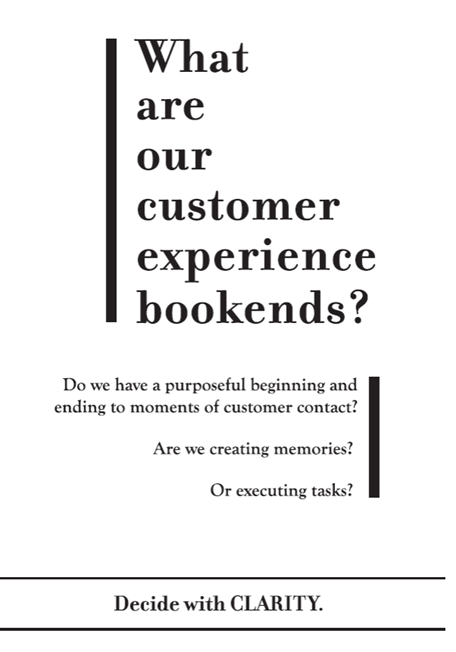
  1. Establish your priority bookend customer experiences (and always be reliable in them)
  2. Get rid of legacy industry practices that make you look “vanilla”
  3. Hire “memory makers” not just functional experts

Poor alignment across the organization stems from lack of clarity on the customer mission and how that translates to accountability and actions. – Jeanne Bliss

ExperienceBookends

What are the Guest Experience bookends at your organization?

inspired by and adapted from Chief Customer Officer, by Jeanne Bliss

ChiefCustomerOfficer

4 Guest Experience Core Competencies

Last year the Temkin Group published an update to one of their reports defining one of their fundamental frameworks, The Four Customer Experience Core Competencies. This report lays out the building blocks for customer experience success. This topic is so important that they are giving this report away for free – download it here.

Research by leading customer experience consultant Bruce Temkin shows that customer experience is highly correlated with loyalty. While any company can improve portions of its customer experience, it takes more than a few superficial changes to create lasting differentiation.

Organizations that want to become customer experience leaders need to master four customer experience competencies: Purposeful Leadership, Employee Engagement, Compelling Brand Values, and Customer Connectedness. To gauge your progress, actively use Temkin Group’s Customer Experience Competency and Maturity Assessment found in the free download here.

ChurchWorld leaders may not think of the term “loyalty” in relation to their Guests, but it is a very relevant concept.

12DaysGE1

On the fourth day of Christmas Guest Experiences, your Guest Experience peers give to you:

4 Guest Experience Core Competencies

  1. Purposeful Leadership: Operate consistently with a clear set of values.
  2. Employee Engagement: Align employees with the goals of the organization.
  3. Compelling Brand Values: Deliver on your brand promises to customers.
  4. Customer Connectedness: Infuse customer insight across the organization.

Here are some tidbits about each of these competencies, adapted slightly to apply to Guest Experiences in ChurchWorld. Be sure to download the entire report – free!

Purposeful Leadership

Just about every church has vision and mission statements floating around their hallways, website, and print materials. But when it comes to making decisions on a day-to-day basis, these documents are nowhere to be found. They play no role in how the organization is actually run.

Instead, organizations make decisions based on individual goals and objectives, a handful of hard metrics, and by making compromises across conflicting team agendas. And that’s the best case scenario! Usually decisions aren’t coordinated at all. That’s why churches need to (re)introduce a clear purpose for their organization that speaks to why they exist and what sets them apart from 10,000 other churches.

Employee Engagement

Engaged team members (both paid staff and volunteers) are valuable assets. They trigger a “virtuous cycle” driving good Guest experience and superior overall results. Temkin’s research shows that engaged employees try harder, engage Guests, and drive positive results. The essence of this connection can be seen in this quote by Herb Kelleher, founder of Southwest Airlines:

I never had control, and I never wanted it. If you create an environment where the people truly participate, you don’t need control.

Compelling Brand Values

True brands are more than just marketing slogans—they’re the fabric that aligns all team members with Guests in the pursuit of a common cause. They’re what you believe about your organization. As Howard Shultz, president and CEO of Starbucks, once said:

Customers must recognize that you stand for something.

Customer Connectedness

In most companies, decisions are made with woefully little Guest insight. People often rely on their “gut feel” or outdated anecdotes about Guest needs, desires, and feedback. But any organization that wants to improve its Guest experience needs to embed deep Guest insight in every aspect of its operations.

Interested in measuring your organization’s progress,? Temkin Group created its Customer Experience Competency and Maturity Assessment. You can download a free copy of Temkin’s complete report, including the assessment, here.

How do you measure up?

inspired by and adapted from The Temkin Group, Bruce Temkin

The Temkin Group

5 Expectations of Disney Service

Having spent 5 days during 3 trips to Disney World in the last 18 months, mostly in the Magic Kingdom and behind the scenes, it’s appropriate that I turn to another former Disney cast member, Bruce Loeffler, for some thoughts about Guest Experiences.

Writing in One Minute Service, Loeffler brings his years of experience with Disney and presents a helpful reminder that organizations of any sizes – including churches – can improve their level of Guest services.

Loeffler served in many capacities while at Disney, and it shaped the development of his current company, Enspiron, and the services it provides.

Taking the Guest perspective, Loeffler defined 5 expectations that Guests have. Although they are not taught as such to cast members, he believes they are the five basic ingredients that most Guests want when they visit Disney – and I agree.

I also happen to think they describe the expectations of Guests coming to your church this weekend.

WD Guest quote DI


On the fifth day of Christmas Guest Experiences, your Guest Experience peers give to you:

The Five Expectations of Disney Service©

  • Excellence – Guests want quality service from you. They want to know your organization strives for excellence and its team members are providing their best effort.
  • Experience – Guests want their visit to be enjoyable and fun. They want to be treated as someone special and to leave with a positive experience.
  • Expediency – Guests want knowledgeable team members who are efficient and able to facilitate their needs with ease and in a timely manner.
  • Enthusiasm – Guests want team members who are out-going, friendly, personable, courteous, and who truly enjoy helping others.
  • Empathy – Guests want team members who can respect and relate to them and will take ownership to resolve problems quickly when they occur.

There is no magic formula for why Disney is so effective. But from my experience, it is successful because Disney creates a model and an image of what excellence should look like; establishes high standards for cast members to aspire to; and then trains each cast member to achieve those expectations.   – Bruce Loeffler

Do you know what your Guests are expecting this weekend?

inspired by and adapted from One Minute Service, by Bruce Loeffler

One Minute Service

6 Essential Guest Experience Disciplines

All organizations routinely perform a set of sound, standard practices that result in a high-quality outcome. It’s true for your church just like any other organization. You don’t get up on Sunday morning and wonder how you will have a sermon that morning – or take care of children, or lead in worship. It’s a part of what your organization is, and does.

Organizations that want to produce a high-quality Guest experience also need to perform a set of sound, standard practices. Harley Manning and Kerry Bodine, in their book Outside In, have developed six high-level disciplines which can be translated into the Guest experience: strategy, Guest understanding, design, measurement, governance, and culture.

These disciplines represent the areas where organizations that are constantly great at Guest experience excel. If you want to deliver a great Guest experience, they are where you need to focus.

12DaysGE1

On the sixth day of Christmas Guest Experiences, your Guest Experience peers give to you:

6 Essential Guest Experience Disciplines

Strategy – this is your game plan. It’s a set of practices for crafting a Guest experience strategy, aligning it with the organization’s overall attributes and brand attributes, and then sharing that strategy with team members to guide decision-making and prioritization across the organization. The strategy discipline is critical because it provides the blueprint for the experience you design, deliver, manage, and measure.

Guest Understanding – a set of practices that create a consistent shared understanding of who Guests are, what they want and need, and how they perceive the interactions they’re having with your organization today. This discipline includes research practices, analyzing the information you’ve collected, and documenting your findings. Guest Understanding provides a foundational level of insight that guides the rest of the disciplines.

Design – a set of practices that help organizations envision and then implement Guest interactions that meet or exceed Guest needs. Design weeds out bad ideas early and focuses your Guest experience efforts on changes that really matter to Guests.

Measurement – a set of practices that lets organizations quantify Guest experience quality in a consistent manner across the organization, and deliver actionable insights to team members. This discipline is key because it lets organizations understand the current state of the Guest experience they provide, uncover opportunities for improvement, and tract progress over time.

Governance – a set of practices that helps organizations manage Guest experiences in a proactive and disciplined way. This practice is essential because it holds the entire team accountable for their role in the Guest experience ecosystem. These practices range from  leader oversight to day-to-day coaching of frontline team members.

Culture – a set of practices that create a system of shared values and behaviors that focuses the team members on delivering a WOW! Guest experience. These practices include volunteer enlistment, socialization activities, and rewards. This discipline is perhaps the most powerful of all the disciplines because it embeds practices from the other five disciplines into team DNA.

Mastering the six essential disciplines of Guest experience takes time and effort but it’s something that you have to do if you want to succeed in connecting with and developing relationships with your Guests.


If you don’t like change, you’re going to like irrelevance even less.

General Eric Shinseki, former Chief of Staff, US Army

inspired by and adapted from Outside In, by Harley Manning & Kerry Bodine

Outside In


7 Guest Service Guidelines: Old School Disney at Its Best

The Disney organization is perhaps the greatest practitioner of Guest Experiences around today. Books have been written about what the “cast members” at Disney do to make people feel welcome (I know – I’ve read all of them, and own most of them).

A year ago about this time, my wife and I “opened and closed” the Magic Kingdom (we were there from the opening at 8 AM to closing at midnight) including Mickey’s Very Merry Christmas Party as a part of our 34th wedding anniversary celebration.

Once again, I was amazed at the exceptional attitude of the cast members.

Observing hundreds of Cast Members, dealing with tens of thousands of Guests, there’s only one word to describe their attitude: Magical.

IMG_5090

So I’m sure you won’t mind if we go backstage and back in time at Disney to learn about their 7 Guest Service Guidelines – a list of actions that every Disney team member learns during their orientation.

When Disneyland opened in 1955, Disney was looking for a set of generic behaviors that ensured that cast members knew how to act courteously and respect the individuality of each Guest. Over the first ten years, the four values of Safety, Courtesy, Show, and Efficiency became the foundation from which all succeeding service standards were developed.

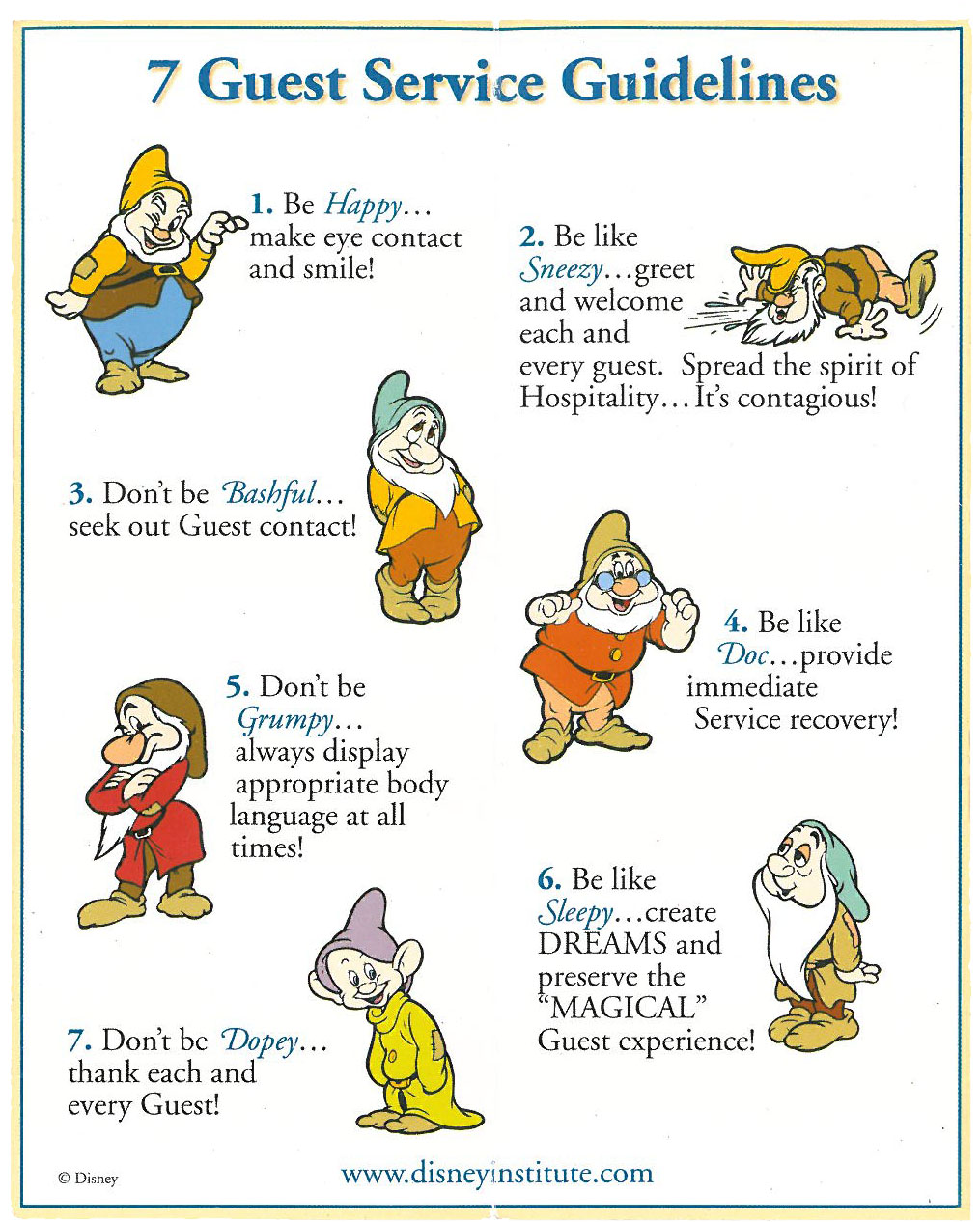
During the 1960s, these standards were translated into a set of behavioral actions called Guidelines for Guest Services, which became the centerpiece of training for all Disney cast members. Appropriately enough, the seven guidelines were personalized with the characters from the seven Dwarfs:

7 Guest Service Guidelines
courtesy of The Disney Institute

On the seventh day of Christmas Guest Experiences, your Guest Experience peers give to you:

7 Guidelines for Guest Services

  • Make eye contact and smile
  • Greet and welcome each and every Guest
  • Seek out Guest contact
  • Provide immediate service recovery
  • Display appropriate body language at all times
  • Preserve the “magical” Guest Experience
  • Thank each and every Guest

These seven phrases serve a variety of purposes. First, they define behavior in terms of Guests. They also communicate cast member responsibilities. Finally, they showcase ways to customize service to individual Guests.

Even though these Guidelines don’t exist in this form anymore, my experiences last year reminded me that the spirit of the Guidelines are very much in practice by cast members today.

Your church won’t have tens of thousands of people coming through your doors every day – but the principles Disney uses as a baseline starting point for training its cast members are appropriate in the context of your church.

inspired by and adapted from Be Our Guest, by The Disney Institute

Be Our Guest revised