Letting Go of the Library: What Downsizing Is Teaching Me About Why I Read

I have a confession that may surprise people who have seen my bookshelves: I did not build my library on purpose from young adulthood. Not many people set out at twenty-two to accumulate thousands of books. It happens one Tuesday at a time, one impulse purchase at a used bookstore, one “I’ll just order this too while I’m at it” click, until one day you look up and realize you have built something. A collection. A record, almost, of every question you’ve ever chased.

That’s the part people miss about book love. They think it’s about the reading – and it is, mostly – but it’s also about the keeping. The shelf is a kind of memory you can touch.

So when I tell you I’ve begun the slow, painful process of downsizing that library, I want to start further back than the boxes currently stacked in my garage. I want to start with where the habit came from, because you can’t understand why parting with a book feels like parting with a small piece of yourself unless you understand how it got there in the first place.

Where It Started

I grew up looking forward to My Weekly Reader landing on my desk every week in first grade – a thin, newsprint magazine of current events written for kids, and about as far from a leather-bound classic as you can get. But it did something classics rarely do, especially for a six-year-old: it made the outside world feel worth paying attention to. That’s an underrated function of reading. Long before it teaches you anything specific, reading teaches you that there’s more to know, and that knowing it is a pleasure rather than a chore.

The habit had a model at home, too. My father would pull a book down from the various shelves around our house most evenings after the workday was done – not performatively, not as a lesson for the children watching, just as a quiet, consistent fact of who he was. I didn’t articulate it this way at the time, but I absorbed something important: reading wasn’t an activity you scheduled around your life. It was part of the architecture of an ordinary evening, as normal as dinner. In my mid-thirties, I noticed I’d fallen into the same rhythm without deciding to. Some inheritances aren’t houses or watches. Some are just habits, passed down so quietly you don’t notice the transfer until you’re the one carrying them.

How a Shelf Becomes a Library

Here is where I’ll admit something that sounds like an exaggeration but isn’t: My “library” is in fact made up of multiple libraries on various topics. The single largest cohesive library is my collection of books about Walt Disney and the company he built, now over five hundred volumes, spanning releases from 1939 up through  a much anticipated purchase coming in a few weeks. Five decades of buying, one book at a time, on a single subject.

Nobody plans that, at least not in the beginning. 

What happens instead is something closer to what Mortimer Adler called synoptical readingthe practice of putting multiple books on the same subject in conversation with each other rather than reading any single one as the final word. You read one author’s account of how Walt Disney approached storytelling, and it raises a question the book doesn’t answer, so you go find another author who tackles it from a different angle. Then a third. You’re not collecting books so much as collecting arguments, perspectives, and blind spots that only become visible once you’ve got enough voices in the room together.

The trouble – if you can call it that – is that this kind of reading is inherently accumulative by design. You can’t practice synoptical reading with three books. You need enough of them to reveal the patterns and the contradictions, and “enough” tends to keep redefining itself upward. My Disney library isn’t really about Walt Disney anymore, not entirely. It’s about vision and leadership and and hospitality and how an organization sustains a creative culture across generations – Disney just happens to be the case study deep enough to keep teaching me something new after fifty years. 
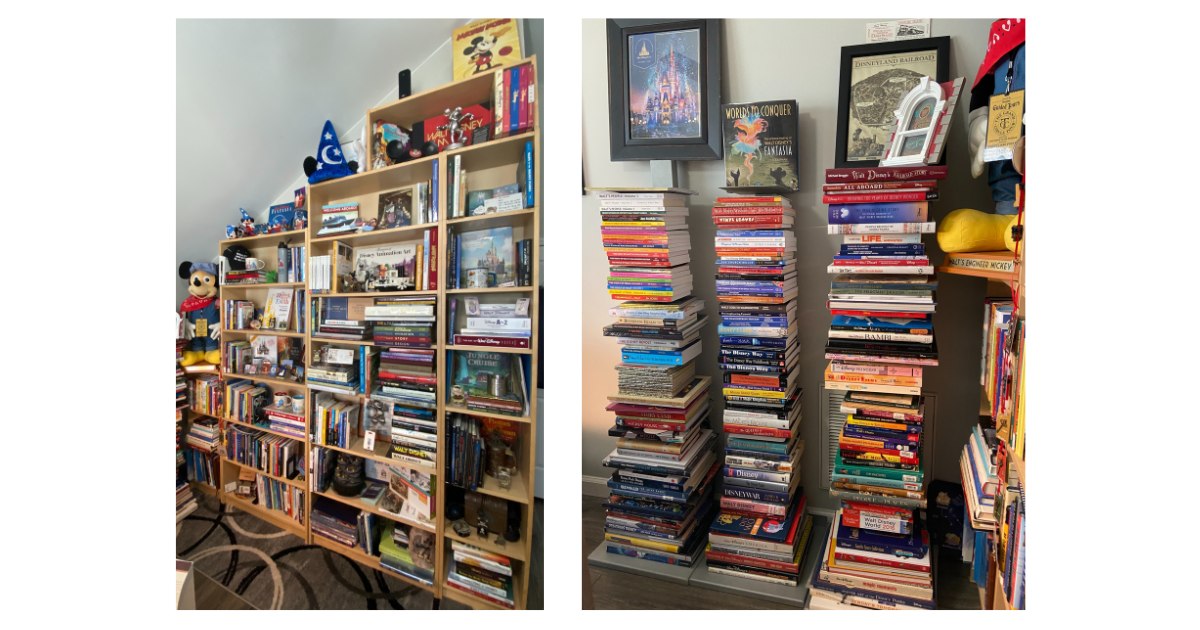
And it’s not the only synoptical library in the house

There are shelves built over the last year for founding-era American history that grew the same way, one book answering a question the last one raised. There are three large vertical shelves on hospitality rooted in the home, with another two shelves containing books on the subject that I have written about. There’s a large selection of books about the hospitality industry seen through a culinary lens. And many more smaller ones: Hamburgers. Donuts. Bridges. J.R.R. Tolkien. Sherlock Holmes. Reading. Shepherding. And not surprisingly, Books. There’s a couple of fiction shelves: All of Stephen Hunter’s books, and the original Tom Clancy works.

Though not technically synoptical, the biggest of all is the general topic of Leadership and Vision – slowly built over at least forty years, first in graduate school, then gaining momentum in three church staff positions, then accelerating 2012-2025 when my job at the time required reading – lots of reading! At one time, that library numbered over two thousand books, but I’ve trimmed it down over the last few years to just under one thousand books.

A personal library, it turns out, is rarely one collection. It’s several, growing at different speeds, for different reasons, until they’ve filled every room that will hold them (plus a garage, plus – until recently – a storage unit).

Part of what fuels the accumulation is simply the hunting. There’s a particular satisfaction in walking into a used bookstore with no list and no agenda, just an open question you’ve been carrying around, and finding the one volume that happens to answer it. I’ve spent whole afternoons doing exactly that, working through curated shelves at a favorite spot and walking out with  a book or two I didn’t know existed that morning. When my former occupation carried me all over the country, you can be sure the first search I performed was “used bookstores near me”. A retailer can get you a specific title in two days. It cannot replicate that particular kind of luck, and I suspect the luck is half of why collectors keep collecting long after the shelves have stopped having room to spare.

The Day That Keeps Finding Me

The beginning of this downsizing project falls near a very auspicious day on the calendar.
August 9th does something odd to my calendar every year. It’s my father’s birthday. It’s also National Book Lovers Day. I’ve written about that coincidence before, and I’m not going to pretend it’s anything more than calendar arithmetic – but coincidences earn their keep when they keep making you think, and this one has never stopped.

Book Lovers Day, at its best, isn’t really about celebrating volume. Plenty of people can point to towering shelves without having been changed much by what’s on them. The day is worth marking because it asks a better question: not how many books have you read, but which ones actually shaped you. For me, that question and my father’s birthday have become impossible to separate. He didn’t hand me a reading list. He handed me an evening habit, and the habit did the rest of the work over the next fifty+ years.

He used to say something I’ve quoted before and will probably keep quoting: “I never made much money, but I made a lot of friends, and that’s what’s important.” He wasn’t talking about books when he said it. But it’s the same instinct, really – the belief that the things worth accumulating in a life are relational, not material. Friends, in his case. In mine, apparently, over five hundred books about a fascinating man who built an empire on curiosity.

Arguing With Your Own Shelves

Which brings me, finally, to the boxes in the garage.

Downsizing a personal library sounds like a logistics problem – what fits on the shelves, what doesn’t – and at the surface it is. But the harder work isn’t physical. It’s that every book on those shelves represents a decision you made once, for a reason that felt sound at the time, and downsizing means reopening every one of those decisions and asking whether you’d make the same call today.

Some of that is easy. The duplicate copies. The books bought for projects that finished years ago and will never be revisited. The reference material now more useful as a searchable PDF than as eleven pounds of hardcover. Letting those go doesn’t cost much.

I started, for what it’s worth, with the “easiest” shelf in the library – a collection of almost three hundred books from a long-practiced career phase that’s behind me now. Once I made the decision, it was relatively easy to call my friend Danny who is the most knowledgeable person in the field, and he graciously agreed to accept the library. Dropping off the books a few days later was gratifying as he perused the books and some of his staff began sorting them for immediate use. This decision was only “easy” in light of the fact that I knew the volumes were going to  a fellow “book nerd” who respected them and would use them appropriately.

Starting there wasn’t strategy so much as self-preservation. If I’d opened with the shelf that holds my father’s books, I’d have quit the whole project in an afternoon. There’s something to be said for building momentum on the boxes that don’t hurt (much), so that by the time you reach the ones that do, you’ve at least got some practice at making the call.

What costs something is the rest of the pile – the books that aren’t really about their contents anymore. The ones your father gave you. The ones you bought the week you started a new chapter of your life and haven’t opened since, but can’t quite explain why you’re still keeping. The signed first edition that will probably never appreciate in value but represents an afternoon you remember more clearly than the book’s actual argument. Synoptical reading taught me to keep gathering perspectives until the picture got clearer. Downsizing is the opposite exercise: learning to let a single memory be enough justification to keep something, without needing to defend it against the logic that says you should let it go.

I’ve started with a simple, imperfect rule: I ask whether I’m keeping the book or keeping the version of myself that bought it. If it’s the second one, I try to find another way to hold onto that memory – a photograph of the shelf before it changes, a note in a journal about why the book mattered – so the object can go without the memory going with it. It doesn’t always work. Some books I’ve picked up to donate and quietly put back, unconvinced by my own argument. That’s fine. This isn’t a project with a deadline. It’s a negotiation, and negotiations take as long as they take.

What I haven’t done, and don’t intend to do, is treat this as pure subtraction. The Disney collection will  stay intact, and even grow – that’s not sentiment, that’s an active research project with decades of momentum behind it. The founding-era shelf is slowly growing, not shrinking, alongside the  current interest and writing it supports. For now, many of the syntopical shelves will remain the same. Downsizing, done honestly, isn’t about arriving at some minimalist ideal where the shelves are bare and the mind is supposedly clearer for it. It’s about being honest for the first time in years about which books are still doing work in your life and which ones are just doing time.

What Stays With You

My father’s books – the actual physical volumes that sat on his shelves – mostly didn’t make it into my collection intact. Estates get divided, and books, unlike heirloom furniture, rarely survive the process as a set. But a handful did make the trip, and they sit now in spots I chose for them deliberately, not filed with everything else. I don’t reread them often. I don’t need to. Their presence is the point, not their content – a small, physical reminder that the habit I’ve spent a lifetime indulging didn’t start with me.

That’s the thing about a personal library that a spreadsheet of titles will never capture. It’s not an inventory. It’s a kind of autobiography written in other people’s words – which books you reached for during which years, which arguments changed your mind, which ones you kept even after you stopped needing them, just because you remembered who you were when you bought them.
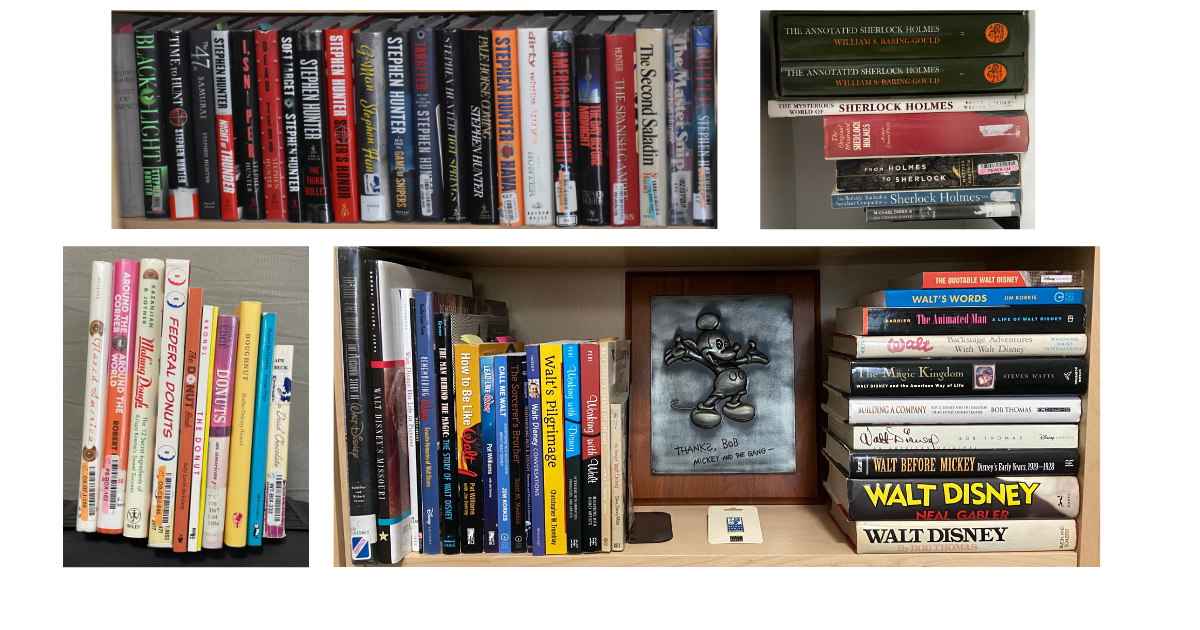
Downsizing doesn’t erase that autobiography. If you do it with any care at all, it just edits it – cutting the passages that no longer serve the story and keeping the ones that do. My shelves are smaller than they were a few months ago, and they’ll keep shrinking more before I’m satisfied. But the books that remain are, if anything, a more honest account of who I am than the fuller shelves ever were.

There’s a version of this essay that ends with a tidy lesson about minimalism, or about letting go, or about how less is somehow more. I don’t believe that version, and I don’t think you should either. Some libraries deserve to keep growing – mine will, on the shelves that are still doing active work. The point was never the size of the collection. It was always whether the books on it could still tell you something true about the person who kept them.

My father taught me to read before he taught me anything else worth remembering. Figuring out which of his books, and which of my own, are worth keeping turns out to be one more thing he taught me – just later than I expected, and the hard way. If you’re standing in front of your own shelves right now, wondering where to start, I’d tell you what I wish someone had told me: start with the easy shelf, be honest about the hard one, and don’t mistake a smaller library for a smaller life

The books that matter will let you know.

They always do.


Part of a regular series on 27gen, entitled Wednesday Weekly Reader.

During my elementary school years one of the things I looked forward to the most was the delivery of “My Weekly Reader,” a weekly educational magazine designed for children and containing news-based current events.

It became a regular part of my love for reading, and helped develop my curiosity about the world around us.

Turn the Page: Exploring National Book Lover’s Day

August 9 is birthdate of my father, H.D. “Doc” Adams, who was born in 1927.

It’s also Book Lover’s Day.

Those two seemingly incongruent circumstances actually have a powerful connection for me.


After suffering a major stroke on February 10, 2012, my father passed away on February 25. By the time I was able to get back to Tennessee to see him, he had lost motor functions and speech capacity. Over the few days I was there, the slow but steady decline continued.

I had last seen him during the previous Christmas holidays. While there, I spent some time alone at home with him. After suffering a series of strokes over the past several years, he could no longer read – but the legacy of his reading lined the bookshelves all over my boyhood home. In the quiet hours when everyone was asleep, I scanned the shelves and remembered hearing him talk about this book or that one. I pulled a few off the shelf, and opening them, was instantly transported back in time to a conversation about the subject, or to memories of the event itself.

I’ve been a reader of books since, well, before I can remember. My father was an avid reader, and he passed that passion along to me at an early age. Even though he worked 6 days a week, 12 hours a day as a gas station owner, he often spent several hours reading each night. A recent revelation from a book brought his actions sharply into focus:

The manual labor of the past that allowed a human being to work in an embodied way, and to contemplate in heart and mind while working with one’s hands, encouraged the desire for reading after the physical exertions were completed. One can imagine why a farmer might kick off his boots after a day of sweat and dirt to read a good book.

Reading for the Love of God, Jessica Hooten Wilson

That was my father.

He insisted my mother take my brother and me to the library in the next town and check out books – every two weeks. I would get the maximum number of books, take them home, and read them – usually in the first day or two. Then it would be an impatient wait till the next library trip.

Reading is a passion I treasure, and one that I am thankful my father instilled in me.

The library habit of my boyhood stuck with me through elementary, junior, and high school; it remained in college and graduate school and post-graduate specialized studies. Each of my vocational roles since school “ended” have included reading as a part of what I brought to the task. It continues to this day, with a weekly visit to my local library to drop off books read and pick up books on hold – usually three or four in each category.


Every year on August 9, bibliophiles around the world unite in celebration of National Book Lover’s Day. This special occasion honors the profound impact that books have on our lives, cultivating imagination, expanding knowledge, and fostering personal growth. As we mark this day, it’s an opportune moment to reflect on the enduring value of reading and explore ways to enrich our literary experiences.

Book Lover’s Day is a great day to celebrate. Just grab an interesting book, find a quiet, cozy place, and crack open the cover. Celebrating Book Lover’s Day in August is pleasurable on the deck, under a shady tree, poolside, or in a cozy hammock. If you fall asleep while reading, that’s okay. It’s all part of the relaxing benefits of being a book lover.

The “WHY” I read so much is covered above. Here’s a clue of the “HOW” and “WHAT” of my reading, and why Book Lover’s Day is important:

I love (and practice) the 4 different levels of reading as espoused by Mortimer Adler in his great book, How to Read a Book, but I really like to latch onto a topic and practice synoptical reading. Also known as comparative reading, it is where many books are read, and placed in relation to one another and to a subject about which they all revolve.

For decades, an ongoing topic of synoptical reading has been about Walt Disney and the “kingdom” he founded. My current Disney library is over 500 books, dating from 1939 to current releases – and I’m still actively researching the subject, and discovering new authors and books regularly. Here’s a few of my latest or soon to be acquired Disney books:

In addition to the pure enjoyment of reading on the subject, these books provide a constant reference for illustrations when I’m writing about hospitality, planning, vision, and other topics that Walt Disney lived out – and to some extent – the Disney organization still practices.

In addition to Disney synoptical reading, I’ve always got small threads of other, diverse, synoptical reading going on, often spurred by long-running interests and subsequent book searches.

Here are a few recent ones:

I am very fortunate in that reading is a part of my work role. As Digital Engagement Leader for Auxano, there’s current reading for our monthly themes and daily social media posts (X, Instagram, LinkedIn, and Facebook), other internal Auxano writing projects, research for Navigators, and believe it or not, reading just for the pleasure of readinga nightly occurrence.

In addition to the above images, here’s a few topics I’ve been reading in the past few months:

  • Ongoing research into the concepts of hospitality in the home (what I’ve termed,”First Place Hospitality”)
  • Tracking the development of hospitality in the U.S. – especially in the food services area
  • Exploring the journey of becoming a “modern elder”
  • Shepherd leadership (biblical concepts relevant for the 21st century)
  • Leadership lessons from the book of Nehemiah

Of course, there’s always some new Disney history coming off the presses that I include in the mix!

So, on Book Lover’s Day, and in memory of my father, I’m trying to emulate Thomas Edison, who believed that voracious reading was the key to self-improvement. He read books on a remarkable range of subjects to address his endless queries.

As Edison noted, “I didn’t read a few books, I read the library.”

How are you celebrating Book Lover’s Day?

On August 9, take time to honor your love of books in meaningful ways. Gift a book to a friend, donate to literacy programs, or simply indulge in an afternoon of uninterrupted reading. Share your favorite quotes or book recommendations on social media using #NationalBookLoversDay to inspire others.

Consider revisiting a beloved childhood story or finally tackling that classic you’ve always meant to read. Organize a book swap with friends or host a literary-themed gathering. Whatever form your celebration takes, use this day as a reminder of the transformative power of books and the joy they bring to our lives.

As we commemorate National Book Lover’s Day, let’s reaffirm our commitment to the written word. In a world of constant digital stimulation, books offer a unique form of engagement – one that nourishes our minds, touches our hearts, and expands our understanding of ourselves and the world around us. So pick up a book, turn the page, and embark on your next literary adventure. After all, every day is an opportunity to celebrate the enduring magic of reading.


If you want to know more about my dad, here is the eulogy I gave at his funeral. After the funeral, while my sons and I were moving some things around his gas station, I discovered one reason I am so passionate about guest experiences. And read this post to find out why readers are leaders.


Remembering My Father, Celebrating Book Lover’s Day

August 9 is birthdate of my father, H.D. “Doc” Adams, who was born in 1927.

It’s also Book Lover’s Day.

Those two seemingly incongruent circumstances actually have a powerful connection for me.


After suffering a major stroke on February 10, 2012, my father passed away on February 25. By the time I was able to get back to Tennessee to see him, he had lost motor functions and speech capacity. Over the few days I was there, the slow but steady decline continued.

I had last seen him during the previous Christmas holidays. While there, I spent some time alone at home with him. After suffering a series of strokes over the past several years, he could no longer read – but the legacy of his reading lined the bookshelves all over my boyhood home. In the quiet hours when everyone was asleep, I scanned the shelves and remembered hearing him talk about this book or that one. I pulled a few off the shelf, and opening them, was instantly transported back in time to a conversation about the subject, or to memories of the event itself.

I’ve been a reader of books since, well, before I can remember. My father was an avid reader, and he passed that passion along to me at an early age. Even though he worked 6 days a week, 12 hours a day as a gas station owner, he often spent several hours reading each night. A recent revelation from a book brought his actions sharply into focus:

The manual labor of the past that allowed a human being to work in an embodied way, and to contemplate in heart and mind while working with one’s hands, encouraged the desire for reading after the physical exertions were completed. One can imagine why a farmer might kick off his boots after a day of sweat and dirt to read a good book.

Reading for the Love of God, Jessica Hooten Wilson

That was my father.

He insisted my mother take my brother and me to the library in the next town and check out books – every two weeks. I would get the maximum number of books, take them home, and read them – usually in the first day or two. Then it would be an impatient wait till the next library trip.

Reading is a passion I treasure, and one that I am thankful my father instilled in me.

The library habit of my boyhood stuck with me through elementary, junior, and high school; it remained in college and graduate school and post-graduate specialized studies. Each of my vocational roles since school “ended” have included reading as a part of what I brought to the task. It continues to this day, with a weekly visit to my local library to drop off books read and pick up books on hold – usually three or four in each category.

Wednesday August 9 is Book Lover’s Day – not an official holiday but one I eagerly celebrate. Book reading is a great hobby. It’s an important one, too. Employers look for it on resumes. Reading is educational, informative, and relaxing. It makes us both smarter and happier people.

Book Lover’s Day is a great day to celebrate. Just grab an interesting book, find a quiet, cozy place, and crack open the cover. Celebrating Book Lover’s Day in August is pleasurable on the deck, under a shady tree, poolside, or in a cozy hammock. If you fall asleep while reading, that’s okay. It’s all part of the relaxing benefits of being a book lover.

I love (and practice) the 4 different levels of reading as espoused by Mortimer Adler in his great book, How to Read a Book, but I really like to latch onto a topic and practice synoptical reading. Also known as comparative reading, it is where many books are read, and placed in relation to one another and to a subject about which they all revolve.

For many years, an ongoing topic of synoptical reading has been about Walt Disney and the “kingdom” he founded. My current Disney library is over 450 books, dating from 1939 to current releases – and I’m still actively researching the subject, and discovering new authors and books regularly. Here’s a few of my latest acquisitions:

In addition to the pure enjoyment of reading on the subject, these books provide a constant reference for illustrations when I’m writing about hospitality, planning, vision, and other topics that Walt Disney lived out – and to some extent – the Disney organization still practices. With 2023 being the 100th anniversary of the founding of the company, there’s a lot to choose from!

In addition to Disney synoptical reading, I’ve always got small threads of other, diverse, synoptical reading going on, often spurred by long-running interests and subsequent book searches. Here’s a current one, entitled #BurgerQuest: a literary, culinary, and arbitrary journey in pursuit of America’s iconic delight. True to my nature, over the years I’ve built up a research library on the burger; here’s just a sampling of the texts dealing with the history of the hamburger:

As I continue to develop #BurgerQuest, I will be diving into the history of the restaurants who have brought the burger from the lunch wagons of the 1890s to today’s wide range of options.

One of the greatest contributors to my synoptical reading was an Auxano project, 8+ years in the running, that ended in 2021. It involved researching 574 books to produce 227 issues of a book excerpt project. For those of you who are curious, that’s a book stack over five stories high. You can read about it here.

Even with that big change in my reading habit, there’s always a book at hand!

There’s current reading for Auxano social media (Tweets, Instagram, LinkedIn, and Facebook posts), other internal Auxano writing projects, and believe it or not, reading just for the pleasure of readinga nightly occurrence.

Currently a few topics I’ve read for pleasure in the past few months include: ongoing research into the concepts of hospitality in the home (what I’ve termed,”First Place Hospitality”); tracking the development of hospitality in the U.S;  exploring the idea of the “modern elder”; select works about small town America, both past and present; the friendship of Thomas Edison, Henry Ford, and  Harvey Firestone and their contribution to America’s development in the early 20th century; and shepherd leadership (biblical concepts relevant for the 21st century).

Of course, there’s always some Disney history coming off the presses that I include in the mix!

So, on Book Lover’s Day, and in memory of my father, I’m trying to emulate Thomas Edison, who believed that voracious reading was the key to self-improvement. He read books on a remarkable range of subjects to address his endless queries.

As Edison noted, “I didn’t read a few books, I read the library.”


If you want to know more about my dad, here is the eulogy I gave at his funeral. After the funeral, while my sons and I were moving some things around his gas station, I discovered one reason I am so passionate about guest experiences. And read this post to find out why readers are leaders.

How are you celebrating Book Lover’s Day?


Part of a regular series on 27gen, entitled Wednesday Weekly Reader

During my elementary school years one of the things I looked forward to the most was the delivery of “My Weekly Reader,” a weekly educational magazine designed for children and containing news-based, current events.

It became a regular part of my love for reading, and helped develop my curiosity about the world around us.