Cooperation Rather Than Confrontation

Following the Civil War, economic recovery and expansion in the United States was to a large part driven by the expansion of the railroad system.

From its infancy in the 1830s through the 1870s, railroad systems developed piecemeal within the borders of each state. Everything from locomotive size to railcar layout to schedules to fares was developed only with a mind to serve a limited scope – usually measured in tens of miles, occasionally getting up into the hundreds of miles. Nowhere was this more glaring than the rail gauge, or distance between rails.

Facing a tremendous rebuilding effort, with grand schemes of expansion beyond that, the independent railroad systems of the mid-1880s realized that it would be better to serve national, rather than local, interests. The idea that it was better for a railroad to have a separate gauge from its local rivals had become redundant.

Cooperation rather than confrontation was now the watchword.

After decades of incessant fighting, railroad companies realized that railroads work best as an integrated system; the longer that passengers and freight can travel without changing trains, the better the service.

In the South, the five-foot gauge was changed to standard (4 feet, 8 ½ inches) over two days in the summer of 1886.

Two days.

27gen012017fb-1


Large gangs of track workers moved one of the rails on 13,000 miles of track. The operation – staggering in its scope – also required converting 1,800 locomotives and 40,000 coaches. Up until this time, trains heading in and out of the South had been subject of delays as their cars were lifted by hoists and attached to wheel sets of the right gauge.

The efforts of tens of thousands of workers over a momentous thirty-six-hour period on May 31-June 1, 1886 created – at last – a unified railroad for almost the whole United States.

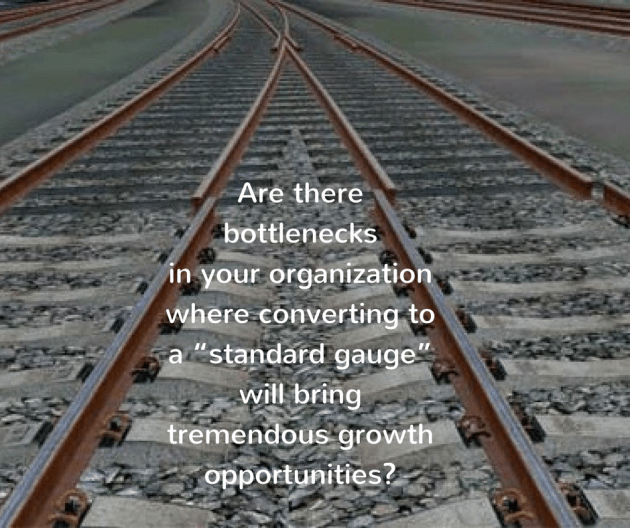
Are there bottlenecks in your organization where converting to a “standard gauge” will bring tremendous growth opportunities?

Background material from The Great Railroad Revolution by Christian Wolmar

How to Rewire Your Teams for Maximum Collaboration

Do key leaders in your organization only think about their ministry area and not the entire organization?

Divisions are necessary in all organizations, even churches. They provide the structure that allows your ministry to function smoothly. Every organization is divided into divisions, functions, or some type of grouping. Doing so allows each group to develop the special skill sets needed to make it function.

But when departments or functional areas become isolated from one another it causes problems. Leaders often refer to this as creating silos.

But organizational silos can also cause problems – the same structural benefits listed above also prevent the flow of information, focus, and control outward. In order for an organization to work efficiently, decisions need to be made across silos.

To break the down the barriers of silos in your organization, the goal is not to destroy the meaningful structural divisions themselves but to eliminate the problems that silos cause.

Many organizations will face the following barriers:

  • Uncoordinated decision-making
  • Competing priorities
  • Dilution of energy and effort

The following excerpt will provide your organization tools to help break down the silos in your organization.

rewireteamsfb-2

THE QUICK SUMMARYMidnight Lunch, Sarah Miller Caldicott

Thomas Edison created multi-billion dollar industries that still exist today. What many people don’t realize is that his innovations were generated through focused approaches to teamwork and collaboration.

Authored by the great grandniece of Thomas Edison, Midnight Lunch provides an intriguing look at how to use Edison’s collaboration methods to strengthen live and virtual teams today.


A SIMPLE SOLUTION

A church accomplishing its mission requires many people working on multiple teams to be successful. Often, these teams drift into a pattern of accomplishing things “their way,” erroneously thinking that what’s best for their team will be best for the organization as a whole.

This lack of coordinated decision making across the organization is the third indicator of silos in the organization.

True collaboration operates like an invisible glue that fuses learning, insight, purpose, complexity, and results together in one continuous effort.

Thomas Edison viewed true collaboration among his teams as a value creation continuum, recognizing that complexity was a norm that all team members needed to understand and address. Here is a four-phase model of the collaboration process that translates Edison’s decades of groundbreaking practices into language for the 21st Century leader. A core question serves as a launching point for the exploration of each phase.

> How do we create the foundation for true collaboration to flourish?

Phase 1 – Capacity: Select small, diverse teams of two to eight people who will thrive in an environment of discovery learning and collegiality.

> How can our collaboration team reframe the problem at hand, driving the greatest range of creativity and breakthrough solutions?

Phase 2 – Context: Focus the outlook of the team toward development of new context that broadly frames the problem or challenge under consideration. Use a combination of individual learning plus hands-on activities to drive perspectives for potential solutions.

> Can the collaboration team stay the course and continue forward despite disagreements?

Phase 3 – Coherence: Maintain collaboration momentum, creating frameworks for progress through inspiration and inspirational leadership even though disagreements may exist. Newly discover, or re-emphasize, the shared purpose that binds the team together.

> How can our collaboration team leverage internal and external networked resources nimbly and with speed?

Phase 4 – Complexity: Equip and reskill teams to implement new ideas or new solutions using internally and externally networked resources, rapidly accessing or managing complex data streams the team must navigate. Leave a footprint that contributes to a broader collective intelligence.

Sarah Miller Caldicott, Midnight Lunch

A NEXT STEP

Church leadership teams aren’t working to invent the next light bulb, but Edison’s Four Collaboration Phases can be instructive for leaders who want to break down silos on their teams

Within the four phases of capacity, context, coherence, and complexity lies the invisible glue that can help your organization develop true collaboration practices to achieve your mission.

Phase 1 – Capacity

Create your own “midnight lunch” experience by ordering pizza or other takeout food. Pick a unique place in your normal environment that is not normally associated with regular tasks, or go offsite. Use the informal atmosphere to foster conversations about interest areas of all your group members. Actively listen to the conversations, and develop a deeper level of knowledge – and connection – with your teammates.

Phase 2 – Context

As a team, take 10 minutes and create an individual list of the various sources of information you draw from each week. Does your team see a pattern in their lists? Now challenge them to create another list of five additional sources that will intentionally shift the context of their information-gathering. During weekly meetings, take five minutes to share how this new context is broadening their ministry context.

Phase 3 – Coherence

When team members begin to use self-referencing language (I, me, mine) more than team-referencing language (us, our, ours), it is an indicator that defenses are being raised and the team is in danger of losing coherence. Often, the language of the team is the first indicator of a team losing its momentum toward a shared goal. Lead your team to be constantly aware of their language, and guide them to practice inclusive language by first modeling it yourself.

Phase 4 – Complexity

Among all organizations, the church has the most potential for the existence of excessive hierarchy. To overcome this, lead your team to clear away internal roadblocks which add unnecessary time and complexity to your process. The use of the strategy map process above can be both a beginning point and continual guide to your journey toward simplification.


Closing Thoughts

Cooperation, communication, and collaboration are three keys to breaking down the organizational silos that are keeping you from achieving your mission.

Taken from SUMS Remix, Issue 9-3, March, 2015


Part of a weekly series on 27gen, entitled Wednesday Weekly Reader

Regular daily reading of books is an important part of my life. It even extends to my vocation, where as Vision Room Curator for Auxano I am responsible for publishing SUMS Remix, a biweekly book “summary” for church leaders. I’m going to peruse back issues of both SUMS and SUMS Remix and publish excerpts each Wednesday.

You can find out more information about SUMS Remix here.

Subscribe to SUMS Remix here.

How to Increase Your Team’s Productivity by Modeling Your Own

You have a pretty good sense that most of your team has too much to handle and not enough time to get it done – you may not have a sense of how much you are contributing to the problem.

In our fast-paced, get-it-done-now culture, the fact is that almost everyone on your team could use some help in increasing their personal productivity. Why not show them how by modeling effectiveness in your leadership?

By its very nature ministry makes the “I’ve gotten something done today” feeling elusive. For many church leaders, there are no edges to their work – it’s not easy to tell when the work is finished, because it really never is. Most of your team have at least half a dozen things they are trying to achieve right now – today! And a pastoral need could arise at any moment to make that to-do list completely irrelevant.

To give your team practical help for personal productivity, blaze the trail by modeling a rock-solid work routine.


www111616fb-2

THE QUICK SUMMARY

Are you over-extended, over-distracted, and overwhelmed? Do you work at a breakneck pace all day, only to find that you haven’t accomplished the most important things on your agenda when you leave the office?

The world has changed and the way we work has to change, too. With wisdom from 20 leading creative minds, Manage Your Day-to-Day will give you a toolkit for tackling the new challenges of a 24/7, always-on workplace.

Manage Your Day-to-Day shows you how to build a rock-solid daily routine field in a constant barrage of messages, find focus amid chaos, and carve out the time you need to do the work that matters

A SIMPLE SOLUTION

The biggest problem we face today is “reactionary workflow.” We live our lives pecking away at the many inboxes around us, trying to stay afloat by responding and reacting to the latest thing: emails, text messages, Tweets, Facebook, and Instagram posts, etc.

Because we are constantly connected to family, friends, and our co-workers, we have become increasingly reactive to what comes to us rather than being proactive about what matters most to us. Being informed and connected becomes a disadvantage when the deluge of information overwhelms your ability to think and act.

It’s time to consider a change in your routine – one that will maximize your creative potential by allocating your best time of the day to it, and then allowing all the other “stuff” to come later.  

The single most important change you can make in your working habits is to switch to creative work first, reactive work second.

The Building Blocks of a Great Routine

Of course, it’s all well and good to say buckle down and ignore pesky requests, but how can you do so on a daily basis?

Start with the rhythm of your energy levels. Certain times of day are especially conducive to focused creativity, thanks to circadian rhythms of arousal and mental alertness. Notice when you seem to have the most energy during the day, and dedicate those valuable periods to your most important creative work.

Use creative triggers. Stick to the same tools, the same surroundings, even the same background music, so that they become associative triggers for you to enter the creative zone.

Manage to-do list creep. Limit your daily to-do list. A 3” by 3” Post-It© is perfect – if you can’t fit everything into that size, how will you do it all in one day? If you keep adding to your to-do list during the day, you will never finish – and your motivation will plummet. Most things can wait till tomorrow – so let them.

Capture every commitment. Train yourself to record every commitment you make (to yourself and others) somewhere that will make it impossible to forget. This will help you respond to requests more efficiently and make you a better collaborator. More importantly, it will give you peace of mind – when you are confident that everything has been captured reliably, you can focus on the task at hand.

Establish hard edges in your day. Set a start time and a finish time for your workday – even if you work alone. Dedicate different times of day to different activities: creative work, meetings, correspondence, administrative work, and so on. These hard edges keep tasks from taking longer than they need to and encroaching on your other important work. They also help you avoid workaholism, which is far less productive than it looks.

– Mark McGuinness, Manage Your Day-to-Day

A NEXT STEP

Over a period of five weeks, commit to experimenting with each of the 5 Building Blocks, one each week. As you use each building block during your work day, evaluate moments of increase or moments of distraction, and modify that particular Building Block to drive effectiveness.

After one month of using the building blocks, make an honest assessment of your work routines by asking the following questions:

  • Do you feel that your work is more productive?
  • Can you list specific ways that your work is more productive?
  • What building block was the hardest to implement? Why?
  • What building block was the easiest to implement? Why?

After you have completed your personal assessment, ask a close colleague or two the same questions. Compare their answers to yours, and make any adjustments needed.


Closing Thoughts

Becoming effective in your own work habits will serve as both an inspiration and guide for your team. By demonstrating an effective, balanced role model, you are leading your team to effectiveness of vision, not just managing their output of activity.

Taken from SUMS Remix, Issue 16-3, June, 2015


Part of a weekly series on 27gen, entitled Wednesday Weekly Reader

Regular daily reading of books is an important part of my life. It even extends to my vocation, where as Vision Room Curator for Auxano I am responsible for publishing SUMS Remix, a biweekly book “summary” for church leaders. I’m going to peruse back issues of both SUMS and SUMS Remix and publish excerpts each Wednesday.

You can find out more information about SUMS Remix here.

Subscribe to SUMS Remix here.
What to Do When You’re Running On Empty

More days than we would like to admit, church leaders face the necessity of leading on an empty tank. The ever present needs of the body, the ongoing call to lead our families through challenging or exciting seasons, and the every day mechanics of ministry leadership compound to drain even the healthiest leader. In fact, the question is not will you ever lead from an empty tank, but HOW will you lead from an empty tank. More importantly, what should a Pastor do when that season emerges?

A pastor’s greatest leadership tool is a healthy soul. Our concentration on skill and technique and strategy has resulted in deemphasizing the interior life. The outcome is an increasing number of men and women leading our churches who are emotionally empty and spiritually dry. – Lance Witt

It is time to face the reality that no numeric or other measurable short-term success in ministry can ever offset the long-term consequences of leading from an unhealthy spirit. What do you do when your tank runs dry?

remix-14-1fb1

Solution: Make a pit stop to replenish and recalibrate.

THE QUICK SUMMARY – Replenish, by Lance Witt

Every leader functions on two stages-the front stage or public world, and the back stage or private world. One cannot lead successfully front stage when one is completely depleted back stage. In a time when pastors are leaving the ministry in record numbers due to cynicism, disillusionment, weariness, health crises and personal scandals, there is an urgent need for soul care in the private lives of leaders.

Replenish helps leaders focus on the back stage, the interior life, in order to remain spiritually healthy. In a caring, encouraging tone, Lance Witt, former Executive Pastor at Saddleback Community Church shows pastors how to prioritize matters of the soul. Urging leaders to develop healthy spiritual practices and address problems that lead to burnout creates a healthy rhythm in their lives, improves their people skills and the spiritual climate of their team, develops better systems in their churches, and discovers how to lead an unhurried life.

For the many ministry leaders feeling alone, in over their heads, or simply worn out, this book will offer welcome relief and a healthy path forward.

A SIMPLE SOLUTION

In NASCAR, the race is won or lost in the pits. With a well-trained crew following the strategy of the crew chief (tasked with constantly adjusting to the realities of the race), a driver’s chances of being a winner are greatly enhanced.

Without a pit stop, though, it’s going to be a short race.

The same is true for leaders who think they can keep going and going, and going…

Instead of feeling constant pressure to be “on” all the time, leaders need to learn how to flow in a rhythm and pace themselves in between intensity and renewal. You really can’t balance the two, but you can work over a period of time to develop a rhythm where allowing for planned, intentional “pit stops” enables leaders to not only race strong, but finish well.

If you could plot the trajectory of your soul, where is it headed? Where you end up in ten or twenty years is largely determined by how well you manage what’s going on inside you now.

Leaders who stay spiritually healthy long term are those who learn the sacred rhythm of advance and retreat. There are times when we’re focused on the mission and taking the next hill for Christ’s kingdom. But you can’t stay on the front lines forever. You have to rest and regroup. In fact, the more fierce and intense the battle, the more you have to retreat.

Times of retreat have two powerful benefits:

Replenishing my soul. When I’m on retreat, something happens inside me that’s hard to explain. I have learned to slow my spirit, and I now realize the world can get along just fine without me for a little while. I am learning to “be” with my heavenly Father, and my soul is replenished in the process.

Recalibrating my perspective. As I ponder and pray, God regularly shifts my outlook by reminding me of what is really important. He regularly convicts me of getting so worked up over things that just aren’t that important. On retreat I have removed most of the white noise form my world, and I can be quiet enough to hear God’s voice.

– Lance Will, Replenish

A NEXT STEP

How do you know when you need a pit stop?

People who dream big and execute well run into particular hazards that most people don’t encounter.  Will Mancini has discovered that it’s not uncommon for a true ministry visionary to be tired. He has developed five causes that block the future-minded leader from feeling 100%.

At your next team meeting, write the following “formulas” on a white board or flip chart:

  • #1 God’s Vision + Man’s agendas  = Too much work
  • #2 Personal Driven-ness + God’s Vision = Too much work
  • #3 God’s Vision – God’s Timetable = Too much work
  • #4 God’s Vision – Empowering Others = Too much work
  • #5 God’s Vision – Personal Growth = Too much work

Reflect on each formula individually and discuss together as a team the extent that each formula is sapping the healthy lifestyle, mental sanity or energy-filled style that faithfulness to God and his vision deserves.

Create action steps to help each team member rewrite the formula in their own life, producing replenished leaders and a team built to finish the race.

Closing Thoughts

Godly leadership is always inside out. God has and always will choose to smile on men and women who are healthy, holy, & humble. – Lance Witt

By making a pit stop to replenish and recalibrate, leaders will help themselves and their teams keep a “full” tank and be healthy emotionally, physically, and spiritually.


Part of a weekly series on 27gen, entitled Wednesday Weekly Reader

Regular daily reading of books is an important part of my life. It even extends to my vocation, where as Vision Room Curator for Auxano I am responsible for publishing SUMS Remix, a biweekly book “summary” for church leaders. I’m going to peruse back issues of both SUMS and SUMS Remix and publish excerpts each Wednesday.

You can find out more information about SUMS Remix here. Subscribe to SUMS Remix here.
How to Cultivate Long-Term Commitment Within Your Team

Many teams today are not really teams at all – organizationally, structurally, and motivationally they are not set up to work as individual parts of a larger, unified whole. Often they reflect outdated organizational charts that have little to do with current reality. There are times when a leader realizes their team is actually a collection of individuals who are looking out for themselves. Left in this state, a team can actually become a divisive and damaging cancer to the organization.

Is it little wonder, then, that leaders seek help in cultivating commitment within their teams? The problem isn’t necessarily with the team members or leaders themselves, but what the team is being asked to do: work together without any larger sense of organizational direction or purpose.

If your team needs a boost in commitment, consider taking the following action.

Solution: Create a robust culture where people buy in.

remix-12-1fb1

THE QUICK SUMMARY – All  In, by Adrian Gostick and Chester Elton

In the highest-performing teams and companies, managers create a “culture of belief,” following seven essential steps of leadership.
To have any hope of succeeding as a manager, you need to get your people all in.

Whether you manage the smallest of teams or a multi-continent organization, you are the owner of a work culture and few things will have a bigger impact on your performance than getting your people to buy into your ideas and your cause and to believe what they do matters.

Bestselling authors, Adrian Gostick and Chester Elton, answer the most overlooked leadership questions of our day: Why are some managers able to get their employees to commit wholeheartedly to their culture and give that extra push that leads to outstanding results? And how can managers at any level build and sustain a profitable, vibrant work-group culture of their own?

All In is a vital resource which will empower leaders everywhere to inspire a new level of commitment and performance.

A SIMPLE SOLUTION

Organizational consultants, Adrian Gostick and Chester Elton, used the results of a massive study of over 303,000 employees from 25 high-performance companies around the world to identify three characteristics that were present in every organization.

They found that team members who were engaged, enabled, and energized provided their organizations with a significant increase in performance.

Team members with high E + E + E characteristics were not only committed to the organization, but were enabled to constantly look for areas where they could add value to the organization, and demonstrate the energy to follow through on their commitments.

If your culture is clear, positive, and strong, then your people will buy into your ideas and cause, and most important, will believe what they do matters, and that they can make a difference.

In the highest performing cultures, leaders not only create high levels of engagement – manifested in a strong attachment to the organization and a willingness to give extra effort – but they also create environments that support productivity and performance, in which team members feel enabled. And finally, they help team members feel a greater sense of well-being and drive at work, in other words, people feel energized.

Engaged – Team members understand how their work benefits the larger organization, and have a clear understanding of how they are responsible and accountable for real results. They are also able to see the value of their contributions to the organization’s larger mission.

Enabled – The organization supports team members with the right tools and training, and leaders spend 75 percent of their time coaching and walking the floor to ensure that team members can navigate the demands of their responsibilities.

Energized – Leaders maintain feelings of well-being and high levels of energy through daily encouragement, helping team members balance work and home life, and recognizing individual contributions.

– Adrian Gostick and Chester Elton, All In

A NEXT STEP

The authors of All In identified the three drivers of Engaged, Enabled, and Energized as necessary to create a strong organizational culture. Not only that, but any single driver without the other two will not produce exceptional results.

Use the following exercise at your next team meeting to determine the roadblocks your team may be encountering in trying to achieve the Engaged + Enabled + Energized goal.

Consider Engaged, Enabled, and Energized as destinations that your team needs to reach in order to be successful. For each of the three destinations, discuss the following questions:

  • What roadblocks are keeping our team from reaching our destination?
  • Who put them there, or keeps them there?
  • Who is most equipped to move each of them?
  • Which of our values assists in moving this roadblock? (To learn more about how working values or missional motivators define culture click here.)
  • What does the road to each destination look like with the roadblock gone?

Develop a plan to dismantle each of the roadblocks identified. Report on the progress monthly until all roadblocks have been cleared.

CLOSING THOUGHT

While all too often teams are “teams” in name only, individual commitment to a larger whole is an integral part of the success of any organization.

By creating a robust culture, church leaders can help their teams maintain commitment and accomplish their Great Commission call.


Part of a weekly series on 27gen, entitled Wednesday Weekly Reader

Regular daily reading of books is an important part of my life. It even extends to my vocation, where as Vision Room Curator for Auxano I am responsible for publishing SUMS Remix, a biweekly book “summary” for church leaders. I’m going to peruse back issues of both SUMS and SUMS Remix and publish excerpts each Wednesday.

You can find out more information about SUMS Remix here. Subscribe to SUMS Remix here.

Leaders Know How to Say “No” Gracefully

Does your organization try to do too much?

Every day ministry leaders spend too much time, managing too much church stuff, for too little life-change. It is safe to say that the church in North America is over-programmed and under-discipled.

Behind this reality is a super-irony: The result of our gospel work is limited, not by our lack of ministry activity, but by our excess.

  • We get too little not because of lacking motivation.
  • We get too little not because we need a better toolbox.
  • We get too little, and money is not the problem.

The gospel-centered, life-change impact of church is actually inhibited by the preponderance of offerings at church. We get too little precisely because we have too much.

It’s time to learn the power of “no.”

remix6-2fb1

THE QUICK SUMMARY – Essentialism, by Greg McKeown

The Way of the Essentialist isn’t about getting more done in less time. It’s about getting only the right things done.  It is not a time management strategy, or a productivity technique. It is a systematic discipline for discerning what is absolutely essential, then eliminating everything that is not, so we can make the highest possible contribution towards the things that really matter.

By forcing us to apply a more selective criteria for what is Essential, the disciplined pursuit of less empowers us to reclaim control of our own choices about where to spend our precious time and energy – instead of giving others the implicit permission to choose for us.

Essentialism is not one more thing – it’s a whole new way of doing everything. A must-read for any leader, manager, or individual who wants to learn who to do less, but better, in every area of their lives, Essentialism is a movement whose time has come.

A SIMPLE SOLUTION

Leaders today often feel like they should load up their calendars to the max, doing everything they possibly can to expand their horizons and improve their organizations. In this age of abundant information and easy access to knowledge, leaders are often driven to have and do it all. However, this mindset soon runs headlong into an unfortunate fact: we can’t do everything.

Instead, we should be focusing on what we should do, thinking instead about what is essential to our lives.

Remember that anytime you fail to say “no” to a nonessential, you are really saying “yes” by default.

Without courage, the disciplined pursuit of less is just lip service. Anyone can talk about the importance of focusing on the things that matter most – and many people do – but to see people who dare to live it is rare.

Once you have sufficiently explored your options, the question you should be asking yourself is not: “What, of my list of competing priorities, should I say yes to?” Instead, ask the essential question: “What will you say no to?”

This is the question that will uncover your true priorities. It is the question that will reveal the best path forward for your team. It is the question that will uncover your true purpose and help you make the highest level of contribution not only to your own goals but to the mission of your organization. It is that question that can deliver the rare and precious clarity necessary to achieve game-changing breakthroughs in your life.

Greg McKeown, Essentialism

A NEXT STEP

Daring to say no doesn’t mean saying no to all requests. It’s important to learn to say no to the nonessentials so we can say yes to the things that really matter. Leaders need to learn to say no – frequently and gracefully – to everything but what is truly vital.

How do you learn to say no gracefully? Here are some general guidelines for delivering a graceful “no.”

  • Separate the decision from the relationship
  • Saying “no” doesn’t have to mean using the word “no”
  • Focus on the trade-off
  • Remind yourself that everyone is selling something
  • Make peace with the fact that saying “no” often requires trading popularity for respect
  • Remember that a clear “no” can be more graceful than a vague or noncommittal “yes”

Saying no is its own leadership skill and follows any skill development path. You start out with little experience, and then learn basic techniques. As you make mistakes, you learn from them. You keep developing more skills and practicing them. In time, you will learn a whole new skill set.

In this case, it’s the skill of saying “no.”

Sometimes abandoning what’s been around for years is the right move, even if you’ve put a lot of time, effort, and other resources into it.

Doing less will actually make your ministry better in the long run.


Part of a new series on 27gen, entitled Wednesday Weekly Reader

Regular daily reading of books is an important part of my life. It even extends to my vocation, where as Vision Room Curator for Auxano I am responsible for publishing SUMS Remix, as biweekly book “summary” for church leaders. I’m going to peruse back issues of both SUMS and SUMS Remix and publish excerpts each Wednesday.

You can find out more information about SUMS Remix here. Subscribe to SUMS Remix here.

What’s On the Mind of the Class of 2020?

It’s mid-August, and school is back in session for most students.

That means it’s time for my annual encouragement for leaders to take a look at the mindset of this year’s entering college freshmen, the class of 2020 – courtesy of Beloit College.

Classof2020

Each August since 1998, Beloit College has released the Beloit College Mindset List, providing a look at the cultural touchstones that shape the lives of students entering college this fall.

Prepared by Beloit’s director of public affairs emeritus Ron Nief, professor of English emeritus Tom McBride, and Associate Dean of the College Charles Westerberg, the list was originally created as a reminder to faculty to be aware of dated references. It quickly became an internationally monitored catalog of the changing worldview of each new college generation.

Leaders – of all ages – need to understand what has shaped the lives of today’s entering college freshman class.

We have had the NOW generation…get ready for the RIGHT NOW generation, entering college this fall. This fall’s entering college students, the class of 2020, were born in 1998 and cannot remember a time when they had to wait for anything. They also can’t recall a time when the United States was not at war, or when someone named Bush or Clinton was not running for office.

And although they think of themselves as a powerful generation—Sanders voters, consumers—they are faced with the prospect of student loan debt and of robots and foreigners taking their jobs making them feel anxious and weak. “They know that they’re going to have to wait for that first breakthrough job and getting their school loans paid off.” said Tom McBride, one of the List’s authors. “They’re an impatient generation learning how to be patient.”

You need to read the whole list here, but these are my Top Ten:

  • There has always been a digital swap meet called eBay.
  • There have always been Cadillac Escalades, but they just don’t seem to be all that into cars.
  • The Sandy Hook tragedy is their Columbine.
  • The United States has always been at war.
  • Serena Williams has always been winning Grand Slam singles titles.
  • They have never had to watch or listen to programs at a scheduled time.
  • Each year they’ve been alive the U.S. population has grown by more than one million Latinos.
  • If you want to reach them, you’d better send a text—emails are oft ignored.
  • Robots have always been surgical partners in the O.R.
  • Michael J. Fox has always spoken publicly about having Parkinson’s disease.

Here’s a slideshow version introducing the class of 2020.

The List was compiled to identify both the common ground that teachers and students share, and the mine fields of misunderstanding that seem to grow wider with every forgotten reference to the Berlin Wall or Monica Lewinsky.

Enjoy!

How to Make Your Daily Routine Build Dynamic Relationships

In 1982 a book called In Search of Excellence, by Tom Peters and Bob Waterman was published. Even though it was a business book, it made quite a hit in my seminary classes as well. (Way back when, even before it became the standard practice it is today, Ralph Hardee had us reading business books!)

One of the most important lessons of that book then, and still important today, is the idea of MBWA, or Managing by Wandering Around.

With MBWA, “what you see is what you get.”

Peters, in his book The Little BIG Things, added these thoughts about MBWA:

  • Get out of your office!
  • Unplug your laptop!
  • Put your smartphone in the drawer!
  • Chat up anybody whose path you cross…especially if they are not among your normal chatees.
  • Go strolling in parts of the organization (or your neighborhood) where you normally don’t stroll.
  • Slow down.
  • Stop.
  • Chat.

There is a lot of value in putting “wandering” on your permanent formal agenda. It may sound counterintuitive, but “aimless wandering” requires strict discipline. We all fall into ruts, even in our wanderings. Same route. Same people. Same time of day. Etc. Etc. Etc. Somehow you’ve got to introduce spontaneity.

Make a pledge to “just wander” at least a half-hour each day. You’ll be amazed at what happens when you come back to the pile of work on your desk or the files open on your screen.

A podcast by Lee Cockerell, former Executive VP for Operations at Walt Disney World, put this into perspective. Before he came to Disney, he was a general manager for Marriott hotels. He made it his practice to walk every floor of his multi-story hotel 3 times per day. This allowed him to see and be seen by all three shifts. It also allowed his team to become comfortable enough to engage in conversations, and bring matters to his attention. This in turn instilled a sense of purpose and value to each employee.

This principle applies to ChurchWorld, too. I’m fortunate, as I get to see it in action every week at the Lake Norman Campus of Elevation Church in Charlotte. Our Campus Pastor, Matthew Drew, and the rest of the staff, Chad, Brennen, and Nicole, make it a part of their weekend routine. It’s not scheduled, but they can be seen circulating outside the entrance, talking with Guests and team members. You see them on the sidewalk between the building and the parking lot, smiling and welcoming everyone they see. On occasion, they even venture into the parking lots, just to check things out.

There’s plenty for them to “do” inside, but they realize the value of connecting with as many people as possible – even if only for a moment – each and every weekend.

They have refined MBWA to LBWA…

LBWA1

Are you the senior leader on your team? When was the last time you walked the front lines?

What are you waiting for?

Does Your Church Make Straight A’s When It Comes To Volunteers?

How does your church bring new volunteers onboard?

Onboarding is the process of acquiring, accommodating, assimilating, and accelerating new team members, whether they come from outside or inside the organization. (Onboarding, Bradt and Vonnegut)

Onboarding1

There’s actually another “a” word that is a perquisite: align. Here’s how the authors of Onboarding define the key processes listed above.

  • Align– make sure your organization agrees on the need for a new team member and the delineating of the role you seek to fill
  • Acquire– identify, recruit, select, and get people to join the team
  • Accommodate– give new team members the tools they need to do the work
  • Assimilate– help them join with others so they can do the work together
  • Accelerate – help them and their team deliver better results faster

Now that’s a list of “straight A’s” I will take anytime!

Though this list comes from a business book, there are great correlations for ChurchWorld as well.

For example, if your church values your volunteer team members, then they would make sure something like the process above is a part of your volunteer leadership development program. The role of bringing new volunteer leaders onboard shouldn’t be an afterthought.

My church considers the role of a team coordinator to be a volunteer staff position. In that role I may not receive a paycheck, but the importance of my role in the total scheme of what we do is not diminished one bit.

What’s it like at your church?