My Big Toe, I Corinthians 12, and the Body of Christ

You’ve seen it hundreds of times in spy movies, or read about it in a book. The hero, after fighting off dozens of bad guys, is finally knocked unconscious, awakening in a dimly lit, cold, dank dungeon. A truly evil face is staring at him as he regains consciousness. “You think you can resist us, but you will change your mind once we begin pulling out your nails, one by one.”

Okay, maybe a little heavy there.

For the last two weeks, I have been self-treating an ingrown toenail on my big toe. Over the past weekend, the pain began to override the every four hours of Advil, and my OTC meds weren’t making a dent. I called my doctor Monday morning to see if he would refer me to a specialist. “No problem,” his nurse said, “He does these all the time. We can see you tomorrow.”

With only a little trepidation (especially after almost passing out this morning after bumping my toe on the bedpost), I greeted my doctor and showed him the toe. With a sly grin that masked the truly evil person he is, he barely touched the toe and said “Does this hurt?” After coming down off the ceiling, I managed to nod. (The preceding sentence is just hyperbole – my doctor is a great guy, has been for the 17+ years I have known him, and furthermore, is my age. Somehow it is comforting to know your doctor really understands what’s going on in your middle-age body).

He then said, “That nail has got to come off so we can treat the whole problem, not just the pain. Are you game?” (Flashback to all those movies)

My reply? “As long as anesthesia is involved, and the end result is the pain going away, I’m good for whatever you recommend.”

12 Just as a body, though one, has many parts, but all its many parts form one body, so it is with Christ. 13 For we were all baptized by one Spirit so as to form one body—whether Jews or Gentiles, slave or free—and we were all given the one Spirit to drink. 14 Even so the body is not made up of one part but of many.

15 Now if the foot should say, “Because I am not a hand, I do not belong to the body,” it would not for that reason stop being part of the body. 16 And if the ear should say, “Because I am not an eye, I do not belong to the body,” it would not for that reason stop being part of the body. 17 If the whole body were an eye, where would the sense of hearing be? If the whole body were an ear, where would the sense of smell be? 18 But in fact God has placed the parts in the body, every one of them, just as he wanted them to be. 19 If they were all one part, where would the body be? 20 As it is, there are many parts, but one body.

21 The eye cannot say to the hand, “I don’t need you!” And the head cannot say to the feet, “I don’t need you!” 22 On the contrary, those parts of the body that seem to be weaker are indispensable, 23 and the parts that we think are less honorable we treat with special honor. And the parts that are unpresentable are treated with special modesty, 24 while our presentable parts need no special treatment. But God has put the body together, giving greater honor to the parts that lacked it, 25 so that there should be no division in the body, but that its parts should have equal concern for each other. 26 If one part suffers, every part suffers with it; if one part is honored, every part rejoices with it. (I Corinthians 12:12-26)

It might have just been a pain in my big toe, but one thing led to another, and before long my whole body was involved:

  • Shifting weight off the front of my foot caused my heel to hurt
  • To relieve the heel pain, I altered my stride while walking
  • Before long, my back began to ache
  • With an achy back, I could not sit in my usual work position
  • With the toe sensitive to even the lightest touch, I did not sleep well
  • Taking 400mg of Advil every 3-4 hours around the clock for 2+ weeks eventually has its own issues

Who knew what big problems a little toe could cause?

In a sense, that’s exactly what the Apostle Paul was talking about in the passage above.

The gathered believers are the Body of Christ, and like the human body, have different roles to play in a healthy Body. When everyone is doing their part, the Body is functioning as it was intended.

But when one part of the Body is not working as it was designed, the whole Body suffers.

God created each believer with as specific role and gifting. If you are not fulfilling that role and using your gift, the Body suffers.

What’s your role?

What’s your gift?

Are you contributing to a whole, healthy Body? Or is your absence causing the Body to suffer?

When You Find a Leader, You Find a Reader

Dr. Al Mohler is one of the most brilliant men I have ever met. He was a PhD student at the Southern Baptist Theological Seminary while I was pursing my Master’s degree there in the early 1980’s. Within a decade, he had returned to Southern as President, celebrating his 20th anniversary next year.

Dr. Mohler released a book this year entitled The Conviction to Lead. It contains 25 principles for leadership that matters. One of those principles is that “Leaders are Readers.”

The following is a compilation of the powerful truths of that statement, as taken from his book. I thought they were an appropriate inclusion in Reading Week 2012.

When you find a leader, you have found a reader. The reason for this is simple—there is no substitute for effective reading when it comes to developing and maintaining the intelligence necessary to lead. In all likelihood, your desk has a stack of books, magazines, and journals waiting to be read, and your briefcase is filled with reading materials. Leadership requires a constant flow of intelligence, ideas, and information. There is no way to gain the basics of leadership without reading.

Leading by conviction demands an even deeper commitment to reading and the mental disciplines that effective reading establishes. Why? Because convictions require continual mental activity. The leader is constantly analyzing, considering, defining, and confirming the convictions that will rule his leadership.

Leaders know that reading is essential, as it is the most important means of developing and deepening understanding. That is why leaders learn to set aside a significant amount of time for reading. We simply cannot lead without a constant flow of intellectual activity in our minds, and there is no substitute for reading when it comes to producing this flow.

The careful reader is not reading merely to receive data. The leader learns to invest deeply in reading as a discipline for critical thinking.

How to Read 

You are already a reader, but how can you hone that skill to your greatest benefit? Reading is like any other skill—most people are satisfied to operate at a low-level. For some, the skill of reading seems to come naturally, while others have to work hard to develop it. The key is to keep improving over a lifetime.

Your first concern is to read for understanding. If you don’t, reading will add little to your life and leadership abilities. Before you start to read a book, ask certain questions about it:

  • What kind of book is it?
  • How dense is the content?
  • What do you need to know about the author?
  • What is the purpose and subject matter of the book?
  • How did it end up on your reading list?

Develop your own rules and habits for reading. I like to start with the book’s cover and table of contents. The cover of a book used to be mostly for its protection, but now it contains a significant amount of information, ranging from a short biography of the author to the identification of the publisher. The table of contents, if well constructed, is like a map of the book. Reading is much more effective if the reader knows where the book is headed.

You should read a book or article only for what it is worth. If you find that the book is not contributing to your life and leadership, set it aside. The world is filled with books and other reading material. Is the book making you think? Do you find that it is sparking new thoughts and reflections as you read? If so, read on. If not, set it down and move on.

Learn to read critically. Reading is not merely an exchange of information and ideas. It is a conversation between the author and the reader. Argue with the book and its author when necessary, and agree and elaborate when appropriate.

Treat the book as a notepad with printed words. In other words, write in your books. Make the book your own by marking points of agreement and disagreement, highlighting particularly important sections of text, and underlining and diagraming where helpful. The activity of marking your books adds tremendously to the value of your reading and to your retention of its contents and your thinking.

Reading critically also means evaluating the author’s credibility and clarity of thought. Does the author have the credentials and authority to make these arguments or to present this information? Do the arguments meet the tests of truthfulness, honesty, and relevance? Are claims backed up with credible evidence and argumentation? These are all crucial questions any reader should ask of a book. A couple more include: What is the author’s purpose in writing this book? What do I hope to get out of the experience of reading this book?

Keep reading and developing the skill of reading over your lifetime.

What to Read

Think of reading like you think of eating. In other words, pay attention to your diet.

For the Christian, the highest reading priority is the Word of God. Our spiritual maturity will never exceed our knowledge of the Bible, which is an especially urgent principle for Christian leaders.

In terms of other reading, Christian leaders should read serious Christian books—books that contain spiritual health and deep thought. The leader’s reading diet should include books covering a range of subjects, though most of us will invest first in those books that are most relevant to our work and mission.

Expanding from there, the leader should learn to consult book reviews and notices in major newspapers, magazines, and online sources. Of course, friends recommend many of the books that will mean most to us. When leaders gather, books are usually part of the conversation.

Should leaders read fiction? This is where many leaders admit uncertainty, but the answer is surely yes. Leaders need to read fiction for enjoyment, for learning, and for context. Fiction is important because it allows the reader to enter into the times, life, and mind of someone else.

Novels and short stories are powerful units of narrative, telling a story with compelling force. While enjoying the story, leaders are also learning how to improve their own narrative presentation and communicative ability.

Leaders are ravenous consumers of historical biographies. Their natural instinct is to learn about leaders of the past in order to embrace their strengths and avoid their weaknesses. But the wise leader will range across the waterfront of disciplines, from history and economics to current events and politics. Add to this the expanding number of business and management titles published each year. No leader can read all of these, of course, but the best of the lot should be on the leader’s reading list.

What about newspapers, magazines, and newsletters? The capable leader knows that these are important as well. Even as printed newspapers suffer from circulation losses, they remain extremely influential and informative.

If newspapers represent the first level of report and analysis, then magazines, journals, and newsletters represent the second. The newsweeklies and major intellectual magazines are extremely influential in terms of popular culture.

In addition to keeping up with the news, leaders will also learn communication and writing skills from the best magazines and journals. The writing in these periodicals tends to be fresh and lively, intended to draw and keep the reader’s attention. That is the wise leader’s concern as well.

When to Read

There will never be enough time to read all that you want to read, or even all that you think you ought to read. Just keep reading. Set aside segments of time devoted to reading and grab every spare minute you can find. Keep reading materials with you at all times, or at least close at hand. Keep a stack of books ready for reading, and take a couple with you as you travel.

When possible, read when you can retain and think most productively. I have found it helpful to plan reading projects. Each year, I plan two or three of these, intending to pursue understanding on a specific issue or area of knowledge. Develop a short list of books in an area, and work your way through them. You will be amazed at how much you can cover in a year.

I also advise dividing your reading plan into three categories. First, books you must read. Second, books you should read. Third, books you want to read. Given a bit of honest thinking, you will have a good idea of how this breaks down for you. Once you have this structure in mind, you can plan the stewardship of your reading time accordingly.

Read With Discernment

Christian leaders learn to read with discernment drawn from our deepest convictions. Constant worldview analysis comes like a reflex as the leader develops the capacity and skill of spiritual discernment. Test everything you read by viewing it through the lens of biblical truth and your convictions. Know that your most faithful and productive thinking will often come as you are reading from an author with whom you disagree, even as you apply critical thinking and discernment. Those who would lead with conviction must read with conviction.


Next: My Favorite Books of 2012

Welcome to Readers Week, 2012!

This Might Work cover

Today kicks off an annual tradition: taking a look at why reading is important for leaders, hearing from leaders on reading, and announcing my version of the best books of 2012.

And there’s no better way to start it off with a little make that a lot of Seth Godin…

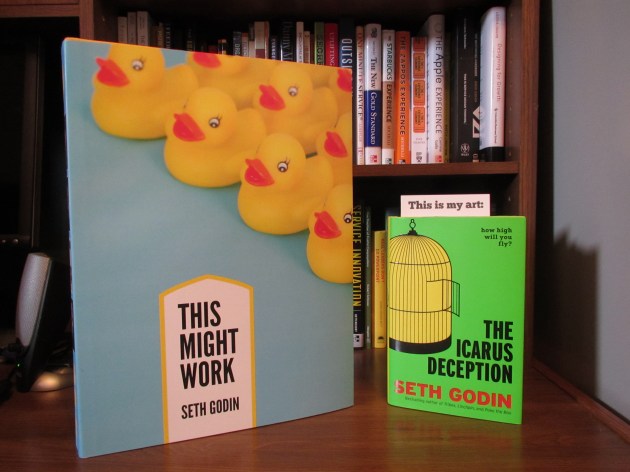
Yesterday I met our mailman at the door with a not too happy look on his face. In addition to the increased volume of holiday mail, he was straining to carry a large, heavy box – one I have been anticipating since mid-summer:

Seth Godin’s latest work, This Might Work, is a huge behemoth of a book weighing in at 15.4 pounds and measuring 15x11x3 inches. It contains Seth’s incomparable blog posts from 2006-2012, curated by his most avid follower, Bernadette Jiwa. Jiwa is an Australian writer and Seth’s only choice to undertake this Herculean task.

She succeeded.

Here is her choice for the opening page, from Seth’s blog on May 20, 2004:

Five years from now…

Assume that:

Hard drive space is free

Wifi like connections are everywhere

Connections speeds are 10 to 100 times faster

Everyone has a digital camera

Everyone carries a device that is sort of like a laptop, but cheap and tiny

The number of new products introduced every day is five times greater than now

Wal-Mart’s sales are three times as big

Any manufactured product that’s more than five years old in design sells at commodity pricing

The retirement age will be five years higher than it is now

Your current profession will either be gone or totally different
What then?

Classic Seth Godin…

Also in the package was Seth’s latest normal book, The Icarus Deception, due out on 12/31. Continuing with the theme he first introduced in Linchpin, Godin shows how we can thrive in an economy that rewards art, not compliance. He explains why true innovators focus on trust, remarkability, leadership, and stories that spread. And he makes a passionate argument for why you should be treating your work as art. A review will be coming soon!

In a few sentences above, this is why leaders read..

And why you should, too.

Next: Thomas Edison on Reading

Generation Flux Revisited

One of the greatest challenges of 21st century leadership is that the world we were raised and trained in no longer exists.

Robert Safian, Editor, Fast Company

Earlier this year I wrote a series of posts about a feature article in Fast Company magazine entitled Generation Flux:

Generation Flux was a term coined by Fast Company magazine Editor Robert Safian. It describes the people who will thrive best in today’s environment. It is a psychographic, not a demographic – you can be any age and be GenFlux. The characteristics of a GenFluxer are clear: an embrace of adaptability and flexibility; an openness to learning from anywhere; decisiveness tempered by the knowledge that organizational life today can shift radically in a short time period.

In the November issue, Safian has written a great follow-up feature, Secrets of the Flux Leader.

According to Safian, “we have grown up with certain assumptions about what works in an enterprise, what the metrics for success are, how we organize and deploy resources. The bulk of those resources are wrong now. The clarity of words we use to discuss business, standbys like marketplace and competitive advantage, are being redefined and rendered almost meaningless.”

It’s the same for ChurchWorld, too. 

Following a single system or outmoded model is foolhardy – churches that are successful in understanding and accomplishing their vision will be nimble and ever-changing.

Attempting to minister in today’s world is nothing if not paradoxical. Churches must be both efficient and transparent; thrifty and ambitious; nimble and stable. Churches and other organizations based on traditional stable structure and management models are not equipped for these dualities.

Generation Flux leaders are the ones who will steer their organizations toward more sophisticated models needed to survive – and thrive – in today’s world.

Are you a GenFluxer?

Of Balloons and Men…

A week ago I was at the Balloon Fiesta in Albuquerque, New Mexico. It was pretty amazing to be at the launch site and see over 200 balloons lift off in a short time. Added to that, another 100+ balloons launched away from the site and “flew” in. This was my ground view of one balloon.

While at the Balloon Fiesta, I heard about the planned “space jump” attempt that week. Weather didn’t permit it then, but it did happen.

Last Sunday, 201 miles southeast of Albuquerque and 23 miles above Roswell, New Mexico, this was the picture:

Same principle, different applications

What heights will you reach today?

It all depends on your perspective…

The Influence of a Father: Mentoring

In the days following the death of my father and his memorial services, I have been thinking a great deal about his legacy and influence on my life: past, present, and future. 

I realized that his influence has impacted not only my life, but hundreds of others as well. In his honor, I will be posting thoughts this week about that influence, and how it challenges me. Along the way, there will be applications for ChurchWorld leaders as well.

Mentoring

As we move through this thing called “life,” don’t we all wish we had a guide, a coach, a model, an advisor?

We’re looking for a mentor.

My father would not have used that word, but he did better than that: he lived and practiced being a mentor for decades.

After he was discharged from the Army Air Corps in 1946, he returned home to Mt. Juliet, TN, and began working with his brother to build and open a Gulf Service Station. After several years of work, Adams Brothers Gulf opened in 1949. 

For the next 44 years, my dad – known as “Doc” to friends and family – operated the gas station as a full service station providing not only gasoline but also preventive maintenance and tire services. He operated the station 6 days a week, 12 hours a day – and he was the only full-time employee.

Doc’s secret? He hired part-time boys in high school, with their hours being after school and Saturdays. They began working in their early teens, and could only work until they graduated – at which point they were “fired.” 

According to my dad, when you graduated from high school it was time for a “real” job or college. And so over the years, about fifteen young boys (including my brother and I) worked for my dad pumping gas, changing tires, sweeping, cleaning, painting, etc. – whatever was required. We all received a paycheck, but the life lessons we learned were far more important than the money.

At the funeral, as many of “Doc’s boys” as we could find served as pall bearers and honorary pall bearers. Some were only a few years younger than my dad; others are barely in their forties. All have gone on to lead a successful family and business life. To a man, they each expressed their heartfelt gratitude for what Doc meant to them. They wouldn’t say it, but they in turn have, and are, influencing others the same way.

If you are a leader, you should be a mentor.

How are you going to influence others today? How are you going to continue to influence others beyond today?

Here are a few other posts on mentoring you might find helpful:

 (a reposting of a previous series on Mentoring, while I am away on vacation)

What Shapes the Mind of Today’s Freshman…the Beloit Mindset List of the Class of 2016 is Out

Each August since 1998, Beloit College has released the Beloit College Mindset List, providing a look at the cultural touchstones that shape the lives of students entering college this fall.

Today, the Mindset List of the Class of 2016 was released.

The creation of Beloit’s former Public Affairs Director Ron Nief and Keefer Professor of the Humanities Tom McBride, authors of The Mindset Lists of American History: From Typewriters to Text Messages, What Ten Generations of Americans Think Is Normal, it was originally created as a reminder to faculty to be aware of dated references. It quickly became an internationally monitored catalog of the changing worldview of each new college generation.

Leaders – of all ages – need to understand what has shaped the lives of today’s entering college freshman class, those 18 year olds who:

  • Were born into cyberspace and therefore measure their output in the fundamental particles of life: bits, bytes, and bauds
  • Came to political consciousness during a time of increasing doubts about America’s future
  • Have never needed an actual airline “ticket”
  • Are the most tribal generation in history, and they despise being separated from contact with their friends

For those who cannot comprehend that it has been 18 years since this year’s entering college students were born, they should recognize that the next four years will go even faster, confirming the authors’ belief that “generation gaps have always needed glue.”

Here are a few nuggets from this year’s Mindset Class for the Class of 2016. You must read the entire list here!

For this generation of entering college students, born in 1994, Kurt Cobain, Jacqueline Kennedy Onassis, Richard Nixon, and John Wayne Gacy have always been dead.

  • They should keep their eyes open for Justin Bieber or Dakota Fanning at freshman orientation.
  • They have always lived in cyberspace, addicted to a new generation of “electronic narcotics.”
  • Bill Clinton is a senior statesman of whose presidency they have little knowledge.
  • There has always been football in Jacksonville but never in Los Angeles.
  • A significant percentage of them will enter college already displaying some hearing loss.
  • Star Wars has always been just a film, not a defense strategy.
  • They were too young to enjoy the 1994 World Series, but then no one else got to enjoy it either.
  • They know many established film stars by their voices on computer-animated blockbusters.
  • History has always had its own channel.
  • Point and shoot cameras are sooooo last millennium.

You can find the rest of the list here.

Read it now.

The 7 Step Road Map to Being All In

To have any hope of succeeding as a leader you need to get your team “all in.”

No matter the size of your team, few things will have a bigger impact on your performance than getting your people to buy into your ideas, your cause, and to believe what matters.

– All In, Adrian Gostick & Chester Elton

Best-selling authors of The Carrot Principle and The Orange Revolution, Adrian Gostick and Chester Elton’s new book All In answers one of the most overlooked leadership questions of the day: Why are some leaders able to get their employees to commit wholeheartedly to their culture and give that extra push that leads to outstanding results?

As with their previous works, a huge (in this case, 300,000 person) study led to a groundbreaking finding: leaders of the highest performing groups create a “culture of belief.” In these distinctive organizations, people believe in their leaders and in the organization’s vision, values, and goals. Team members are engaged, enabled, and energized (the authors use the term Three Es).

Based on the extensive interview process and combined with their years of experience, the authors created a seven-step road map for creating a culture of belief:

  • Define Your Burning Platform – define the mission with great clarity and instill a sense of urgency
  • Create a Customer Focus – focus on customers and mandate a pro-customer orientation
  • Develop Agility – learn to see the future and position your team to meet both seen and unseen challenges
  • Share Everything – create a culture that is a place of truth, has constant communication, and exhibits marked transparency
  • Partner with Your Talent – success is direct result of your teams’ unique ingenuity and talent
  • Root for Each Other – high levels of appreciation and camaraderie create a tangible esprit de corps
  • Establish Clear Accountability – teams must be held accountable for goals, but have the responsibility and tools to ensure their success, with appropriate rewards at completion

All In is a book about culture, but more than that it is the story of how great leaders create unique, inviting, and rewarding places to work – or serve.

What about you – are you ready to lead all in?

How to Be Like Walt, Part 2

Walt Disney had a burning desire for excellence in everything he did. He was always thinking, ‘We can do it better.’ That’s a common trait of all successful people.

Royal Clark, former treasurer of WED Enterprises

Walt Disney’s life provides powerful lessons that can be applied in any leadership position. Author Pat Williams recognized this, and went behind the legend to discover a man every bit as fascinating as the world he created.

How to Be Like Walt is the result of thousands of hours of interviews of the people who knew Walt best. In addition to being a fascinating life story of one of our nation’s most creative minds, the author has distilled Walt’s life into 17 lessons – lessons that we all could learn from. I introduced the topic yesterday; here are a few more:

Plus Every Experience: Sometime during the 1940s, Walt coined the term “plussing.” Normally, the word “plus” is a conjunction, as in “two plus two equals four.” But Walt used the word as a verb – an action word. To “plus” something is to improve it. “Plussing” means giving your guests more than they paid for, more than they expect, more than you have to give them. No matter what “business” you are in, your success depends on your commitment to excellence and attention to detail. If you deliver more than people expect, you will turn people into fans. Pursue excellence in everything you do.

Be a Person of Stick-to-it-ivity: Today we look at Disneyland and say, “Of course! Just what the world needed. How could it miss?” But in 1955, Disneyland was the biggest gamble in the history of American business. The risk paid off – not because Walt was lucky or favored or a genius. It paid off because Walt wouldn’t quit. The success of Disneyland is, first and foremost, the result of sheer dogged determination and persistence in the face of obstacles and opposition. In his own words, “Get a good idea and stay with it. Dog it, and work at it until it’s done, and done right.”

Become Like a Sponge for Ideas: Walt continually fed his mind with information and ideas. He absorbed inspiration wherever he went. If you want to be like Walt – more creative, more imaginative, and more successful – then keep your eyes and ears open. Read. Watch. Travel. Talk to people wherever you go. Ask questions. Invite opinions. Become a sponge for ideas.

Ask Yourself “How About Tomorrow?”: Walt embraced the future and put the stamp of his own personality on tomorrow. If we want to help shape a better tomorrow, then we need to continually ask ourselves the same question Walt asked Ray Bradbury: “How about tomorrow?” The difference between today and tomorrow is something called change. It takes courage to embrace the future, because the future is about change, and change brings uncertainty and anxiety. We fear change; we prefer the comfort of the familiar. But change is inevitable. If we do not become future-focused, we are doomed to obsolescence when tomorrow arrives. There are so many possible futures – which one will you choose?

Here are the rest of the author’s “How to Be Like Walt” lessons:

  • Become an Animated Leader
  • Take a Risk
  • Dealing with Loss
  • Live for the Next Generation
  • Build Complementary Partnerships
  • Stay Focused
  • Accept Your Mortality
  • Make Your Family Your Top Priority
  • Be the Person God Made You to Be

Each of the 17 lessons in the book are richly illustrated with stories by and about Walt Disney. I encourage you to get a copy and prepare to be delighted – and challenged.

Walt’s life challenges us to dream bigger, reach higher, work harder, risk more, and persevere as long as it takes. That is the rich legacy Walt Disney left us. That is the supreme lesson of his endlessly instructive life. The riches of an incredible, adventure-filled life are within our grasp – if we will dare to be like Walt.

Pat Williams

If you liked these two posts, here a few more select Disney-related posts:

The Secret of Disney World

Top Ten Takeaways from Our Disney World Adventure

Understanding Guests Like Disney

A New Way to Play Follow the Leader

Walt Disney’s unique definition of leadership:

The ability to establish and manage a creative climate in which individuals and teams are self-motivated to the successful achievement of long-term goals in an environment of mutual respect and trust.

Today’s post continues excerpts from Innovate the Pixar Way by Bill Capodagli and Lynn Jackson. The authors contend that Pixar has reawakened the innovative spirit of Walt Disney and set new standards for commercial and critical achievement. The book explores how Pixar has built an organization on the simple philosophy that quality is the best business plan. With a track record of 13 for 13 smash feature animation films, it’s hard to argue!

Walt Disney didn’t ascribe to the childhood playbook for “follow the leader” – instead, he created an environment of self-motivated creative thinkers who worked together to deliver a magical, magnetic, enchanting experience for his audience.

Pixar understands leadership the same way.


  • Establishment of a Clear Vision – Pixar has a clear vision and communicates that vision to its team. The best leaders are excellent communicators, engaging their teams by providing them with the tools and information needed for success – and then trusting them to do their jobs.
  • Creative Climate – Creative climates need leadership and a management style that helps them to develop and grow and allows them to have fun in the process. Pixar is in the people development business, going to great lengths to nourish and support its team members. They invest in people, creating a culture of learning, filled with lifelong learners.
  • Individuals and Teams – Pixar thrives on teamwork, but each person on the team is given creative ownership of even the smallest task. This level of autonomy and accountability is practically unheard of in the movie business, where a top-down fear-driven culture is the norm.
  • Self-Motivated Personnel – great leaders know that self-motivated people are essential to developing a creative culture. Pixar is continually on the lookout for new talent that can blossom with their unique culture. The team at Pixar is 100 percent self-motivated to being as creative as they can be and to making movies the best they can. Period.
  • Long-Term Goals – It’s always been about creating for the long-term at Pixar. Their definition of “long-term” speaks volumes about its culture. They go to great lengths to ensure that its culture can support new ventures and still remains true to their values.
  • Mutual Respect and Trust – Pixar team members have embarked on a journey together, nurturing one another in an environment of mutual respect and trust. When leaders exhibit a high level of respect and trust, earned over time, that’s exactly what they will get in return.

There’s no “follow the leader” game at Pixar. Their playbook simply calls for an open playground where leadership serves as a catalyst in the pursuit of big dreams.

If you were to hold up the “magic mirror on the wall” to your leadership style, what would you see?