What Color is Your Pen?

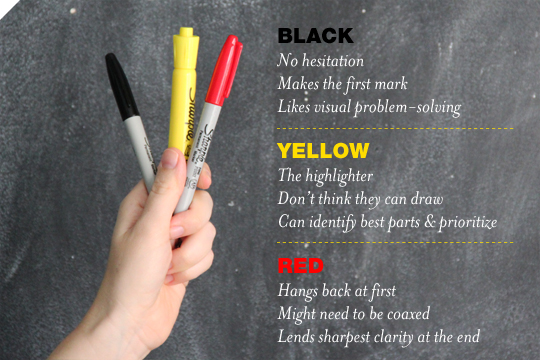
According to author Dan Roam (The Napkin Academy) there are three kinds of visual thinkers:

  • people who can’t wait to start drawing (the Black Pen people)
  • those who are happy to add to someone else’s work (the Yellow Pen people)
  • those who question it all – right up to the moment they pick up the Red Pen and redraw it all.

Which are you?

Hand me the pen! Black pen people show no hesitation in putting the first marks on an empty page. They come across as immediate believers in the power of pictures as a problem-solving tool, and have little concern about their drawing skills – regardless of how primitive their illustrations may turn out to be. They jump at the chance to approach the whiteboard and draw images to describe what they’re thinking. They enjoy visual metaphors and analogies for their ideas, and show great confidence in drawing simple images, both to summarize their ideas and then help work through those ideas.

I can’t draw, but… Yellow Pen people (or highlighters) are often very good at identifying the most important or interesting aspects of what someone else has drawn. These are the people who are happy to watch someone else working at the whiteboard – and after a few minutes will begin to make insightful comments – but who need to be gently prodded to stand and approach the board in order to add to it. Once at the board and with pen tentatively in hand, they always begin by saying “I can’t draw, but…” and then proceed to create conceptual masterworks. These people tend to be more verbal, usually incorporate more words and labels into their sketches, and are more likely to make comparisons to ideas that require supporting verbal descriptions.

I’m not visual Red Pen people are those least comfortable with the use of pictures in a problem-solving context – at least at first. They tend to be quiet while others are sketching away, and when they can be coaxed to comment, most often initially suggest a minor corrections of something already there. Quite often, the Red Pens have the most detailed grasp of the problem at hand – they just need to be coaxed into sharing it. When many images and ideas have been captured on the whiteboard, the Red Pen people will finally take a deep breath, reluctantly pick up the pen, and move to the board – where they redraw everything, often coming up with the clearest picture of them all.

Roam’s conclusion of these different types of people?

Regardless of visual thinking confidence or pen-color preference, everybody already has good visual thinking skills, and everybody can easily improve those skills. Visual thinking is an extraordinarily powerful way to solve problems, and though it may appear to be something new, the fact is that we already know how to do it.

What color is your pen?

The Unwritten Rules of Visual Thinking

We can solve our problems with pictures.

With that simple proposition, author and visual thinking consultant Dan Roam invites the reader to a four-day workshop on visual thinking in his book “Unfolding the Napkin.”

Central to his idea are the unwritten rules of visual thinking:

  1. Whoever is best able to describe the problem is the person most likely to solve it.
  2. We can’t solve a problem that overwhelms us. To understand what we’re seeing, we need to break it into bite-size pieces.
  3. Problems don’t get solved by the smartest or the fastest or the strongest; they get solved by the one who sees the possibilities.
  4. The more human your picture, the more human the response.

Sound too simplistic to be true? Maybe.

But I saw it begin to work last night in a client meeting involving a several million dollar project and a two-year brick wall.

I’m a believer.

Got problems? You need pictures!

The Power of the Humble Napkin

Any problem can be made clearer with a picture, and any picture can be made using the same simple set of tools and rules. (The Back of the Napkin, Dan Roam)

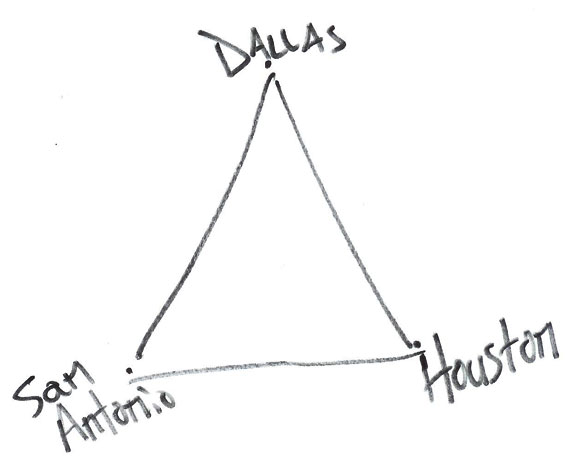
When Herb Kelleher was brainstorming about how to beat the traditional hub-and-spoke airlines, he grabbed a bar napkin and a pen. Three dots to represent Dallas, Houston, and San Antonio. Three arrows to show direct flights.

Problem solved.

The napkin sketch made it easy to sell Southwest Airlines to investors and customers – and the rest is history.

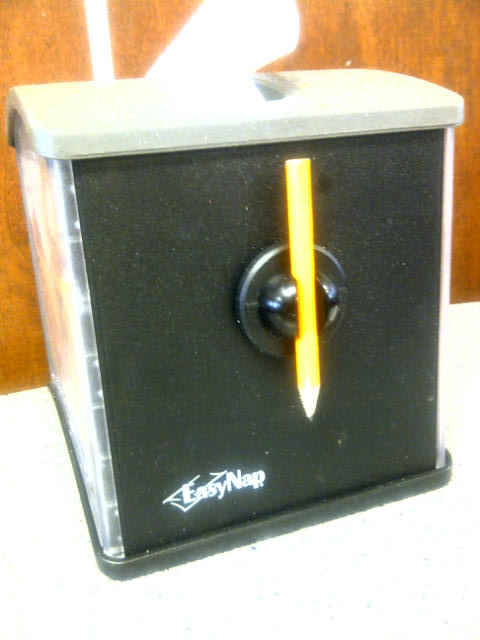
Sitting in Hardees yesterday eating a late lunch, I couldn’t help but notice the napkin dispenser.

What will you create today?

Want to know more about visual thinking?

Think Visual

Your Visual Thinking Toolkit

The Art of Visualization

Out of Site, Out of Mind

It only takes a few seconds for a guest to your website to decide to leave – or stay.

Guest Services in your church is more than just a friendly face greeting everyone who comes onto your property – because increasingly, your Guests have “visited” your website before coming to your church facility. Mark MacDonald, a close friend and founder and Creative Director of Pinpoint Creative Group, recently had this to say: 

 85% of people visit a website before visiting a church. If your church doesn’t “feel” like your web; most of them will never return.

You can read the full article here, but note the close relationship between the digital and the physical: your digital “doorway” must match your physical doorway – at least in “feel.”

While you’re pondering that nugget, add this to the mix:  Evidence points to information from trusted sources getting a better hold on our brains than the noise from everything else.

Martin Lindstrom, consumer advocate consultant and best-selling author, recently elaborated on this topic in a Fast Company online column:

Let’s say that not that long ago you came across a fascinating article. But when you later try to verify some of the facts, you just can’t pinpoint exactly where you first read it. What you do recall is that the source was reliable and you trusted the message. This is a situation I find myself in quite regularly. So much so, that I’ve pondered the conundrum and come up with a theory: we store information according to how trustworthy we deem the source of the message to be.

I make no claims to being a marketing expert (see Mark if you need one) or to being a student of what consumers – including church consumers – are looking for (read more of Lindstrom’s work here).

But when I connect all of the above, it boggles my mind. If you are a leader in ChurchWorld, it ought to do the same to you.

Here’s the summary:

  • An overwhelming majority of Guests coming to your church have visited your website first
  • Your digital doorway must match the physical doorway or your Guests will feel a major disconnect
  • Brands (and that includes your church) that are trusted have a better chance of staying top-of-mind

What are you going to do about it?


Speed Reading Week, Day 1

Here’s the deal: a book a day, with a few nuggets pulled out for your consideration. Ready?

The End of Business as Usual, Brian Solis

Some of today’s biggest trends – the mobile web, social media, gamification, real-time – have forced us to rewire the way we think about and run our organizations. Consumers are creating a new digital culture, and as they connect with one another, a vast and efficient information network is taking shape and is beginning to steer experiences, decisions, and markets.

The End of Business as Usual will change the way you view the world of business, from sales and marketing to customer service and product development to leadership and culture. Its critical insights include:

  • Shared experiences are redefining brands in digital consumer landscapes, and astute brands can now also create and steer these experiences
  • Consumer influence is growing, and businesses can use this to their advantage
  • Connect with a rising audience (and with audiences of audiences) through new touch points between consumers, brands, and new influencers
  • Create a culture to earn trust, influence, and significance among connected customers

Solis has written a powerful book, deep with implications. Here’s a couple of samples:

The nextwork sends and receives information at blinding speeds, creating an efficient human switchboard and network that in theory and in practice, outperforms telephone, terrestrial, cell, emergency, and web networks for the speed and precision at which relevant experiences are shared and re-shared. News no longer breaks – it tweets. (pp 54-55)

An Audience with an Audience of Audiences

This picture serves as both a time capsule immortalizing this important transition and evidence of the emergence of new information nextworks, a series of audiences with extended audiences. Every single one of these students is a representation of the connected customer. They are each connected to others in the room and around the world, figuratively and literally. They are nodes in the human network, playing an instrumental role in the dissemination of information and also the experiences that unite us online and in real life. Your job is to now influence what they share. (p 61)

Questions for ChurchWorld

  • How has the explosion of social media impacted your ministry – personally or corporately?
  • How are your “consumers” influencing your organization differently today than 3 years ago?
  • How are you harnessing the power and influence of social media technologies to connect with your audience?
  • Is the rate of change greater today than it was a year ago? How comfortable are you with that?
  • On a sliding scale, do you view your organization as rigid, social, connected, adaptive, or predictive?

This is your time to lead, not follow; your time to make a difference.

Whiteboard For Skeptics

According to author Dan Roam (The Back of the Napkin, Unfolding the Napkin, and Blah, Blah, Blah), there are three kinds of visual thinkers: people who can’t wait to start drawing (the Black Pen people); those who are happy to add to someone else’s work (the Yellow Pen people); and those who question it all – right up to the moment they pick up the Red Pen and redraw it all.

Hand me the pen! Black pen people show no hesitation in putting the first marks on an empty page. They come across as immediate believers in the power of pictures as a problem-solving tool, and have little concern about their drawing skills – regardless of how primitive their illustrations may turn out to be. They jump at the chance to approach the whiteboard and draw images to describe what they’re thinking. They enjoy visual metaphors and analogies for their ideas, and show great confidence in drawing simple images, both to summarize their ideas and then help work through those ideas.

I can’t draw, but… Yellow Pen people (or highlighters) are often very good at identifying the most important or interesting aspects of what someone else has drawn. These are the people who are happy to watch someone else working at the whiteboard – and after a few minutes will begin to make insightful comments – but who need to be gently prodded to stand and approach the board in order to add to it. Once at the board and with pen tentatively in hand, they always begin by saying “I can’t draw, but…” and then proceed to create conceptual masterworks. These people tend to be more verbal, usually incorporate more words and labels into their sketches, and are more likely to make comparisons to ideas that require supporting verbal descriptions.

I’m not visual Red Pen people are those least comfortable with the use of pictures in a problem-solving context – at least at first. They tend to be quiet while others are sketching away, and when they can be coaxed to comment, most often initially suggest a minor corrections of something already there. Quite often, the Red Pens have the most detailed grasp of the problem at hand – they just need to be coaxed into sharing it. When many images and ideas have been captured on the whiteboard, the Red Pen people will finally take a deep breath, reluctantly pick up the pen, and move to the board – where they redraw everything, often coming up with the clearest picture of them all.
Roam’s conclusion of these different types of people?
Regardless of visual thinking confidence or pen-color preference, everybody already has good visual thinking skills, and everybody can easily improve those skills. Visual thinking is an extraordinarily powerful way to solve problems, and though it may appear to be something new, the fact is that we already know how to do it.

What color is your pen?
Everything Communicates

In a previous post here I wrote about the “Brand You” topic. Since it’s high school graduation season, and having survived our fourth and youngest son’s graduation last Saturday, I thought it appropriate to explore the theme a little more this week. Consider it an extended graduation speech, if you will.

“Everything Communicates” is the fundamental message of Tom Peters’ Fast Company magazine classic, “The Brand Called You.” Companies, products, and services aren’t the only things that get branded: we are all brands. In an economy of knowledge workers and free agents, project-based employment and team-based activities, we have to decide what our brand stands for.

Each of us is a brand, and every choice we make communicates what our brand stands for. Alan Webber, co-founder of Fast Company magazine and author of the great book “Rules of Thumb” lists some of the ways we communicate – even when we don’t realize it:

  • Your business card communicates – from the shape and size to the choice of title and font, you’re sending a message that often speaks louder than the card.
  • Your personal practices communicate – do you have a personal practice that sets you apart?
  • Your web site, blog, Twitter, Linkedin, etc. communicate – because design is so immediate, your digital communication often speaks louder and more frequent that what you intended it to say.
  • Your office communicates – from the front door to the furniture, the spaces we design and occupy tell a lot about us.
  • How you communicate communicates – your brand is a lot more valuable if you can talk business using real English, not the latest buzzwords or insider jargon.

First, figure out your personal brand. Then remember that everything you do – and don’t do – communicates it.