It All Begins with Hospitality

Church leaders need to understand the fact that our competition is not other churches; it’s places that provide WOW! Experiences and to which guests compare our churches.

While that may seem a negative, it can also be turned into a positive by LEARNING from those top-notch places and their leaders.

Take for instance Danny Meyer, the founder and co-owner of multiple top-rated New York restaurants and author of a book entitled “Setting the Table.” Subtitled “The Transforming Power of Hospitality in Business,” Meyer shares the lessons he’s learned while developing the winning recipe for doing the business he calls “enlightened hospitality.” They are lessons that the church can learn from. Here’s a sample:

Hospitality is the foundation of my business philosophy. Virtually nothing else is as important as how one is made to feel in any business transaction. Hospitality exists when you believe the other person is on your side. Hospitality is present when something happens for you. It is absent when something happens to you. Those two prepositions – for and to – express it all.

Understanding the distinction between service and hospitality has been at the foundation of our success. Service is the technical delivery of a product. Hospitality is how the delivery of that product makes it recipient feel. Service is a monologue – we decide how we wan to do thins and set our own standards for service. Hospitality, on the other hand, is a dialogue. To be on a guest’s side requires listening to that person with every sense, and following up with a thoughtful, gracious, appropriate response. It takes both great service and great hospitality to rise to the top.

People duck as a natural reflex when something is hurled at them. Similarly, the excellence reflex is a natural reaction to fix something that isn’t right, or to improve something that could be better. The excellence reflex is rooted in instinct and upbringing, and then constantly honed through awareness, caring, and practice. The overarching concern to do the right thing well is there or it isn’t.

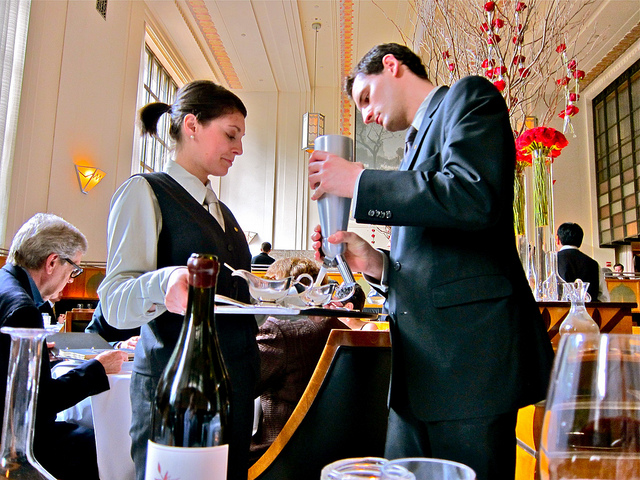
Eleven Madison Park, founded by Danny Meyer

What a great learning environment for churches wanting to improve their Guest Services team!

Last week, I posted a series on hospitality based on Le Bernardin, the famous restaurant in NYC owned by Chef Eric Ripert. If this post resonated with you, click on the links below for more.

Creating experiences of hospitality allow for positive, uplifting outcomes for human experiences and human relationships. They will help you connect to people coming in your door week in and week out.

How will you practice hospitality in your church this weekend?


photo courtesy Julian, CC

Is It True Collaboration… or Is It a Team?

At Auxano, we practice what we preach.

Editing

Our primary tool for working with organizations is the Vision Frame, consisting of Mission, Values, Strategy, Measures, and Vision Proper. Before we led the first client through the process over 11 years ago, the original team of Will Mancini, Jim Randall, and Cheryl Marting worked out Auxano’s Vision Frame – which we still follow today.

One of our Values is Collaborative Genius, which is accomplished partly by the fact that we are a virtual company of over 20 team members living in 15 cities across 4 time zones.

I only thought I knew what collaboration meant!

In my adult work career, I have served as the accountant in an office setting for a food services company, an audiovisual technician as part of a team of 7 for a seminary, various roles on 3 church staff teams, a church consultant for a design-build company, and as the Vision Room Curator for Auxano.

That’s 36+ years in an environment of multiple team members, ostensibly working together for the good of the organization.

Was I collaborating with others, or merely part of a team?

Collaboration is not the same thing as teamwork. Teamwork is simply doing your part. Collaboration involves leveraging the power of every individual to bring out each other’s strengths and differences.  – Greg Cox, COO, Dale Carnegie, Chicago

At Auxano, we don’t just do our part, we collaborate to deliver excellence in all we do. Here’s a great example: our book summaries for leaders, called SUMS Remix.

The original concept of SUMS was dreamed up by our founder, Will Mancini. When I joined Auxano as Vision Room Curator, it was natural that the SUMS project fall under my guidance. Working from a curated list of books with a focus on the Vision Frame, I read the designated book and wrote the draft summary with recommended resources. I then oversaw the following process:

  • Proofing by Mike Gammill, a scholar and grammatical genius
  • Navigator Applications written by 4 of our full-time Navigators, applying the concepts to the local church leadership context thru their unique lenspowered by auxano
  • Editing by Cheryl Marting, who has eagle eyes
  • Review editing by Angela Reed, a production editor at our parent company, LifeWay
  • Design by James Bethany and our Creative Team, who produce a visual masterpiece every time
  • Final review and approval by Will

Beginning in the fall of 2012, every two weeks, a SUMS was distributed to the SUMS subscriber list. Practically every day of that two weeks, some of the actions above were taking place within our team as we work on multiple books at the same time.

That’s collaboration.

As we neared the end of our second year of SUMS, Will and I refined a concept that came to be called SUMS Remix. Instead of a single summary of one book, SUMS Remix consists of brief excerpts from three books, focused on providing simple solutions to a common problem statement that ministry leaders are facing every week in their churches.

SUMS Remix launched in November of 2014, and we release an issue every two weeks. And a similar collaboration process described above is still taking place.

The collaboration process for SUMS Remix is very similar to the one above, but on steroids! Because SUMS Remix involves 3 books for every issue, and we have a 5 week production cycle, and we release an issue every two weeks – well, without collaboration, it just wouldn’t – no, couldn’t – happen.

At any given time during that 5-week cycle, books are being read, notes are being taken, drafts are being written, drafts are being revised, additional research is being conducted, finished drafts are being designed, proofs are being reviewed, and the final SUMS Remix issue is being delivered.

That’s collaboration!

Want to see the end product of that collaboration? You can learn more about SUMS Remix here.

Midnight LunchI’m indebted to Sara Miller Caldicott, great grandniece of Thomas Edison and author of the book Midnight Lunch, for translating Edison’s world-changing innovation methods for use in the 21st century. Here are some of her thoughts on collaboration:

True collaboration embraces:

  • A discovery learning mindset versus a pure task orientation
  • A belief in anticipating and creating rather than merely reacting and responding
  • Presence of inspiration across multiple facets of both individual and team endeavors
  • Coherence of purpose
  • A dedication to elevating the performance of every team member
  • Connections to human and social networks of influence

Do these qualities sound different from the ones valued by your team? Do they draw upon ideas that feel new or seem broader than your current concept of what teamwork embraces?

Based on my experience, the answer would be yes.

So what are you going to do about it?


9 Secret Sauces That Will Make Your Guest Experience Unique

Stock…

…the foundation for all classical French cooking.

At the CIA (that’s Culinary Institute of America), you start off a three-year education by learning how to peel vegetables and prepare a basic stock. You don’t do it once – you do it every day during the three-week rotation of the first class. Students move on after the first three weeks, but will continue to use the stock prepared by the next class of new students. Every three weeks, a new rotation of prospective chefs learn how to prepare stock.

A great stock is judged by:

  • Flavor
  • Clarity
  • Color
  • Body
  • Aroma

The perfect stock has what is referred to as a “neutral” flavor. This is a kind way of saying it doesn’t taste like anything you’re used to eating or would want to eat. But you can do a million different things with a great stock because it has the remarkable quality of taking on other flavors without imposing a flavor of its own. It offers its own richness and body anonymously. When you reduce it, it becomes its own sauce starter. You can add roux to stock and create a demi-glace, and with a demi-glace, you can make over a hundred distinct sauces that define classic French cooking.

What’s your stock?

Personally. Organizationally. However you want to define it.

 What’s that basic “thing” you are, have, or do that makes everything else come together to make things happen?

 >> Learn to make a basic stock, and the possibilities become endless.

Chip Bell knows how to make stock too – or as he calls it, the secret sauce of awesome experiences.

Bell, a well-known consultant and trainer to some of the largest countries in the world, has just released his newest book, “Sprinkles.” SprinklesSubtitled Creating Awesome Experiences Through Innovative Service, it delivers a delicious journey to innovative service.

According to Bell, there are nine “secret sauces” that form the basis for a customer experience that is served gourmet style:

  • Amazement
  • Animation
  • Abundance
  • Ambiance
  • Adoration
  • Allegiance
  • Alliance
  • Accessible
  • Adventure

Just like a chef takes a basic sauce and makes it into the foundation of an exquisite meal, your organization can take the “secret sauces” Bell writes about in Sprinkles and deliver a “value-unique” service that creates an unexpected, enchanting experience for those you serve.

Bon Appetite!

The Magic of Performance in Your Church’s Guest Experience

The empowered team member who confidently goes above and beyond for a customer is a practitioner of Performance Magic.

Service magicians use genuine rapport and personal connection with customers to create performances that are magical. Customers receive the product or service they want or need, but they also get that something extra that makes the experience unexpected, unpredictable, and memorable.

Alert to customer’s needs, service magicians read the often-subtle signals being sent. They know how to establish rapport with customers, sometimes mirroring their emotions and listening intently to ascertain the feelings behind the words – and respond in way that acknowledge those feelings.

> Tricks of the Trade

What do service magicians watch for when they aggressively, proactively observe customers?

  • Clothing – What do people’s clothes telegraph about their view of themselves and the world, and their mood and personality?
  • Eye contact – Does the customer meet your eyes? For how long and how frequently?
  • Body language – What is the customer’s body language telling that he’s not saying?
  • Voice characteristics – What can you glean – beyond the words – from this person’s manner of speaking?

The core skill for effective, active listening is getting focused and staying focused. When listening is your goal, make it the priority – do not let anything distract.

Read customers carefully – then test your assumptions before you act on them.

Service magicians take charge of customer encounters, setting the stage and the mood for the magical connection to come. They unobtrusively direct service encounters, setting the mood and making customers comfortable.

Though service magicians make connecting with customers look effortless, it doesn’t come without working at it.

> Tips for Creating Magical Dialogue

  • Establish – and publicize – a clear service philosophy
  • Build proficiency though practice
  • Develop great conversation openers that fit personality and mood
  • Listen, listen, listen
  • End with a satisfied customer wanting more

Performance magic should leave customers pleased with their experience and just a little puzzled at how you managed it. The trick is, there’s no trick at all:

Performance magic is accomplished through careful observation, fanatical listening, and genuine conversation. A disciplined practice of these actions will enable you to identify our customers’ needs before they even have a chance to voice them.

Performance Magic happens when a surprisingly positive interaction occurs between the customer and organizational personnel during the acquisition and delivery of a service or product. Magical performance is the manner that enables a service magician to take customers on an emotional journey so enchanting they cannot wait to tell their story to others.

>> Remember that as a church leader you have “customers” – they are the Guests who come to your place every weekend.

What are you waiting for? It’s time to utilize magical performances in your organization!


Adapted from Service Magic by Ron Zemke and Chip Bell

Service Magic

Part of an ongoing, periodic series exploring the translation of customer service in the corporate world to Guest Experiences in ChurchWorld

The Magic of Process in Your Church’s Guest Experiences

Process Magic is at work when an organization – large or small – creates a standard operating procedure that seems just the right thing to do.

Practices, policies, and procedures from initial contact to problem solving that amaze the customer with seeming ease are magical. The service magician who implements those practices with style and grace enhances the experience yet again.

Researchers repeatedly confirm that customers use “consistently good” as their gold standard for service. The customer’s sense of reliability, security, and comfort hang on service promises – real or implied – being kept with a high degree of precision and consistency. That “steadfastness” is so important that most organizations take care that their processes come with rigid standards and stern rules.

Those processes fall into one of two categories: algorithmic or heuristic.

Algorithms are step-by-step processes. Think of them as “rules of law” that focus on precision, replication, exactness, and dependability. There are “Red Rule” algorithms, designed to maximize effectiveness, safety, and predictable outcome. There are also “Blue Rule” algorithms, designed to maximize efficiency and sameness.

Heuristics are “rules of thumb” for doing work. They function more as guidelines for behavior rather than step-by-step specifics. Implicit in the guidance of heuristics is an in-context judgment call.

Using a Little Magic on Blue Rule Algorithms

Algorithmic processes are precise, lockstep means of getting the service the customer expects from the service provider to the customer. Helpful rules for adding magic to “Blue Rule” algorithms include:

  • Select a process the customer must endure and enrich it with a little magic. While some processes are crafted exclusively for the convenience of the service provider, make sure they are as customer friendly as possible by zeroing in on the feature most important to the customer.
  • Don’t alter a part of the process without examining the whole experience. If only a part of the process is enhanced, a bland or negative part left unimproved can erase or negate the enchanting memory for the customer.
  • Include props to reinforce consistency. These could include reminders, checklists, job aids, guides, cueing devices – whatever helps the service magician remain disciplined and focused.

Turning Red Rule Algorithms into Magical Memories

The more challenging arena of service processes is the unalterable algorithmic process. The service magician, unable to alter Red Rule processes, must find ways that will yield a magical experience for customers. Helpful rules for altering Red Rule processes include:

  • Alterations must be delivered in matched tones. By definition, the process can’t be changed, so alterations must be made with the experiences that surround the process. Any surrounding experience must be kept in the same tone, style, and manner of the process itself.
  • Alterations must be subtle. The key is to not tamper with anything that causes the customer to question the core values embedded in the process.
  • The magic can operate alongside the process without upsetting requirements. The “add-on” will be surprising and memorable, but it doesn’t have to interfere with the step-by-step nature of the process.
  • Value adds should be of the same nature as the core offering. Adding value works best when understated and cut from the same cloth as the core offering.

Adding Magic to Heuristic Rules of Thumb

“Rule of thumb” – or heuristic – processes are not lockstep, exact, or precise. They may be guidelines born of the folklore of an industry or conventional wisdom learned only through experience. Several universal principles are important to keep in mind before tinkering with heuristic processes. They include:

  • Never tinker with the customer’s core expectation.  The customer has very real expectations as well as a mental picture. If the magic attempted is too extreme, the customer will remember it as disruptive and artificial
  • Make sure the alteration in the process fits. Service magic enchants because it is unexpected and positive, yet it needs to be appropriate to the context and the relationship.
  • Ensure the alteration is a team effort, not an isolated gesture. The customer knows single-relationship magic when he sees it and knows it is vulnerable to turnover. It does not ensure long-term loyalty

Service processes are not naturally magic. Magic occurs when the process is transformed or contains an unanticipated dimension – the more “sparkly” the transformation, the more magical it is. Magic depends on identifying a process alteration that will be permissible by the customer, and then crafting its expression into a form unexpected by the customer.

Select the right process, alter or enhance it in the right way, and you can turn dull into delightful and mundane into magic.

You are practicing Process Magic by filling the space between “customer need” and “customer need met” with experiences of awe and memories of amazement. Magical processes are the policies, procedures, and routines that make transacting business with an organization easy, positive, and memorable.

Remember, that as a church leader you have “customers” – they are the Guests who come to your place every weekend.

What are you waiting for? It’s time to utilize magical processes in your organization!

Adapted from Service Magic by Ron Zemke and Chip Bell

Service Magic

Part of an ongoing, periodic series exploring the translation of customer service in the corporate world to Guest Experiences in ChurchWorld

The Magic of Place in Your Church’s Guest Experience

The magic of Place has three faces: natural, constructed, and virtual.

> Natural Place Magic is intrinsic to those wonders of the physical world that thrill and awe us by simply existing. It’s the stuff of National Geographic specials that create magic through their natural grandeur. Our primary memories of these places will always be the magic of the natural wonders themselves.  Even so, skillful service magicians can subtly but measurably enhance our experience of Place Magic. A subtle balancing and blending act is the key to creating consistent Place Magic by showing off the main attraction at its best.

> Constructed Place Magic comes in a greater variety than does nature’s Place Magic. While few manmade places are palaces, castles, or world icons, even the most mundane can also be magical. There are hotels and grocery stores and retailers and automobile dealerships and hospitals and dental offices that stand above others and sparkle. People should feel attended to and comfortable in your constructed place.

> Virtual Place Magic demonstrates that place is not always a physical location. Successful organizations must have a presence, a story, and a sense of experience in their virtual world as well as the physical world. The look and feel of your online presence – your digital front door – must reflect the look, feel, and ambiance of your brick and mortar place.  Distinctive and eye-catching design is only beginning of creating a virtual place; you must also build trust and create a unique experience. From the first click, Guests should be drawn in, made curious, and delighted by the virtual place you have created.

Utilizing a Natural Setting

Few organizations will have the benefit of a serene waterfront setting or a majestic mountain view. But everyone has a place that can be enhanced by the following rules:

  • Find your “natural” story – all locations have a story; what’s yours?
  • Educate yourself – steep yourself and your team in the details of your place
  • Create an “elevator” story – what 30 second story can your team tell about your locale and its uniqueness?
  • Dabble in décor – consider enhancing your interior with visual representations of the natural setting
  • Sensory congruence – the smells and sounds need to be in sync with the sights and feel

Creating Illusion, Amazement, and Delight

There is no better contemporary example of building magic into man-made places than the world of the theme park. And there’s no better example of this than Walt Disney, who created an entirely new approach to the concept of entertainment, a business obsessed with the customer point of view, and the precise management of the customer’s experience. With the opening of Disneyland in 1955, Disney developed an obsession for anticipating and controlling every detail that will support – or detract from – his vision. He called it “Imagineering,” and defined it as the blending of creative imagination and technical know-how. It has been best codified by Marty Sklar, the first chairman of Disney Imagineering, in a set of principles dubbed “Mickey’s Ten Commandments.”

  1. Know your audience – before creating a setting, understand who will be visiting your place
  2. Wear your guest’s shoes – evaluate your setting from the customer’s perspective by experiencing it as a customer.
  3. Organize the flow of people and ideas – think of setting as a story and tell the story in a sequenced, organized way.
  4. Create a “wienie” – borrowed from silent film lingo, a wienie is a visual magnet used to orient and attract customers.
  5. Communicate with visual literacy – language is not always composed of words; use the common languages of color, shape, and form to communicate through setting.
  6. Avoid overload by creating turn-ons – do not bombard customers with data; let them choose the information they want when they want it.
  7. Tell one story at a time – create one setting for each idea to avoid confusing customers by mixing multiple stories in a single setting.
  8. Avoid contradictions, maintain identity – every detail and nuance of a setting should support and further the organizational identity and mission.
  9. For every ounce of treatment provide a ton of treat – give your customers the highest value by building an interactive setting that gives them the opportunity to exercise all their senses.
  10. Keep it up – never get complacent and always maintain your setting.

You are practicing Place Magic by creating or enhancing environments that delight, support, and enliven your guests. Magical places are venues with physical attributes that attract and please, subtly enhanced by human endeavor.

Remember that as a church leader, you do have “customers” – they are the Guests who come to your place every weekend.

What are you waiting for? It’s time to create a magical place in your organization!

Adapted from Service Magic by Ron Zemke and Chip Bell

Service Magic

Part of an ongoing, periodic series exploring the translation of customer service in the corporate world to Guest Experiences in ChurchWorld

The Three Ps of Service Magic

Service Magic

An unexpected experience with a touch of style, grace, and imagination the customer remembers with fondness and a smile.

Creating an unexpected, unpredictable, and valuable experience that is both memorable and reproducible.

Today’s customers are often surrounded by lackluster, mediocre service in every industry. How can you win their attention, admiration, and loyalty?

By using the magic of amazement, delight, and enchantment to create a customer experience that soars far beyond their highest Service Magicexpectations. Service wizards Ron Zemke and Chip Bell share their powerful bag of tricks in their book Service Magic. Subtitled “The Art of Amazing Your Customers,” it delivers a powerful bag of tricks to help you add zest, memorability, and value to your customers’ experience in ways they would never expect.

For leaders in ChurchWorld, the translation from customer experience to Guest Experience is an important one – starting with your mindset. You may not think you have “customers” in the traditional mindset – and you don’t. But you do have Guests coming to your church (hopefully!) and they, like you, live in consumer-driven world.

Why not study and learn from some of the best minds and practitioners from the customer experience world, and translate them into Guest Experience practices for your church?

Take Service Magic, for instance.

There is a feeling of awe, wonder, pleasure and delight in Service Magic. When it is present, the customer perceives that something special and unique has been done to, for, or with him or her. It can come from a word spoken, an experience observed, a process experienced, or the context in which the service occurred.

There is magic in Place, Process, and Performance – and all three are available to the skilled service magician and the organization determined to create consistent Service Magic for its Guests.

  • Place Magic: a venue – natural or manmade – with physical attributes that attracts and pleases, and that are subtly enhanced by human endeavor. We vacation at national parks to enjoy the great out-of-doors and visit theme parks for fun and thrills. We remember most of the great views and the rides, but without a little Service Magic, those pleasures would be greatly diminished.

ChurchWorld Application

You meet in a facility – owned or rented – that conveys a powerful impression to your Guests. What does your facility “say”? What are you doing on a regular basis to evaluate your place? What plan do you follow to make sure your place is the best it can be? Does your place invite people to come in – or does it turn people off, or even away? Do you have a plan of constant evaluation and upkeep? How “fresh” are your interiors and exteriors? Does your place fit into your community or does it stand out?

  • Process Magic: the often thankless, almost always invisible effort that makes the difference between policies, procedures, and routines that are difficult, confusing, maddening, and frustrating – and those we experience as surprisingly easy, positive, and memorable. No waiting where once lines were long; sign-ins, sign-ups, and renewals that are hassle-free and even interesting – if not fun – are the result of a little well placed Process Magic.

ChurchWorld Application

Your Guests should experience an invisible, seamless flow of actions from their first contact with you all the way through a worship experience and back again. The processes behind that invisible, seamless flow are probably complicated and maybe even confusing. What are you doing to regularly evaluate and change the process behind the curtains? Do you know what Guests experience when they come to your church? Are you using and speaking with a “churchy” language or do you make things simple to understand and follow?

  • Performance Magic: the surprisingly positive interaction with someone from an organization during the acquisition of a service or a product – or even when a problem with a product or service is being resolved. The wait staff who makes the dining experience “work” for you by correctly reading your mood and engaging you in light-hearted banter or by leaving you alone to your solitude are card-carrying, practicing, professional service magicians.

ChurchWorld Application

When it comes down to it, your front-line teams: parking, greeters, ushers, etc. – make the first and most powerful impact on your Guests. Their actions often dictate whether or not a Guest will return – even before, and often no matter what, the worship experience. When was the last time you ventured out to the front lines to observe? How often do your teams receive training – and encouragement? How high are the expectations for your front-line teams?

Each of these three “magics” is powered by a set of principles – which I hope you will join me in discovering in the next few posts!

We’re Not in Kansas Anymore

In today’s increasingly fast-paced and unpredictable environment, church leaders need to be involved in design thinking more than ever.

Pause Button: If you are a ChurchWorld leader and believe that you don’t need to concern yourself with design thinking, you should probably take a look at Why Design Thinking and What if Leaders Thought Like Designers. Just saying…

Design is all about action, and churches too often get stuck at the talking stage

Face it – despite all our planning and analyzing and controlling, the typical church’s track record at translating its rhetoric into results is not impressive. In the business world, researchers estimate that only somewhere between 10% and 60% of the promised returns for new strategies are actually delivered. Having been around ChurchWorld for over 30 years, my observation is the reality would be between 10% and 30% – tops. Practices that consume enormous amounts of time and attention most produce discouraging results. All the empty talk is making it harder  and harder to get anything to actually happen. Churches expect the staff to be member-focused while the majority watches. When a staff or volunteer actually takes a risk, they are punished if it doesn’t succeed. Ambitious growth goals aren’t worth the spreadsheets they are computed on. Getting new results requires new tools – and design has real tools to help move from talk to action.

Design teaches us how to make things feel real, and most church rhetoric today remains largely irrelevant to the people who are supposed to make things happen

Church elders and staff can make plans, bring on new staff, invest in the latest conference success story – but they can’t change the organization without a lot of help. The only people who will care enough to help are those for whom strategy is real. Things that feel real to people are both interesting and personally significant. They are experienced, not just pronounced. While leaders are showing growth spreadsheets, designers are telling stories. We have a lot to learn from design about how to tell a story that engages an audience, captures the experience dimension and makes the future feel real. Look at any presentation created by anybody at a design firm and compare it with the Death by PowerPoint presentation you are forced to sit though by your organization. Enough said.

Design is tailored to dealing with uncertainty, and ChurchWorld is obsessed with analysis that assumes a stable and predictable world

That would be the world we don’t live in anymore. The world that used to give us puzzles but now dishes up mysteries. And no amount of data about yesterday will solve the mystery of tomorrow. ChurchWorld is designed for stability and control and is full of people with veto power over new ideas and initiatives. They are the “designated doubters.” The few who are allowed to try something new are expected to show the data to “prove” their answer and must get implementation right the first time. Designers have no such expectations. They thrive on uncertainty and are enthusiastic about experiments and patient with failure. Design teaches us to let go and allow more chaos into our lives. Designers have developed tools to help them actively manage the uncertainty they expect to deal with.

Design understands that products and services are for human beings, not target markets segmented into demographic categories

It is easy in ChurchWorld to lose sight of the real people behind the masses surrounding our campuses. The reality of human beings and their hopes and hurts fades as they are tabulated and averaged into categories, reduced to the status of preferences in an analysis paper. Lost within that reality is the deep understanding of needs – often ones that aren’t even articulated – that are the starting point for real ministry. This messy reality is something that designers understand well. They master the skills of observation, of understanding human beings and their needs, while typical ChurchWorld leaders learn mostly to evaluate, an activity that rarely involves the kind of empathy that produces fresh insights.

If you want efficiency, you get everybody who thinks the same way and they’ll get to a decision quickly. And that works 80 percent of the time. But for that 20 percent of the time when you need something disruptive, innovative, and creative, you’re going to have to put up with a little bit more ambiguity.

Jeremy Alexis, Illinois Institute of Technology

Who are the designers on your team?

inspired by and adapted from Designing for Growth by Jeanne Liedtka and Tim Ogilvie to fit ChurchWorld realities

Designing for Growth

Design Details Make the Story

Walt Disney had the idea that Guests could feel perfection. A story from Disney “design guru” Imagineer John Hench describes it well:

I once complained to Walt about the construction of some new stagecoaches. Walt had asked that the cab be suspended by leather straps as early western stagecoaches had been. I thought that this was too much and told Walt, ‘People aren’t going to get this, it is too much perfection.’

‘Yes, they will,’ he responded. ‘They will feel good about it. And if they don’t understand it, if you do something and people don’t respond to it, it’s because you are a poor communicator. But if you really reach them and touch them, they will respond because people are okay.’

I knew then that Walt expected us to give our Guests good information in both design and story.

courtesy abcnew.com

courtesy abcnews.com

Disney Institute Programming Manager Bruce Jones continues that line of thinking:

Disney Imagineers like John Hench say attention to detail and exceeding Guests’ expectations is so important. It’s also why Disney over-manages.

Over-managing is a driver of consistent business results and an effect of the alignment of an organization’s values and vision. The goal: be intentional where others are unintentional — over-managing the things most companies ignore or under-manage is what differentiates you. 

As I’ve written before, the secret to Disney “magic” is simple: it’s attention to detail.

Easier said than done in any organization, but the Disney organization certainly leads the way for others to follow.

Disney Imagineers excel at transforming a space into a story place. Every element they design works together to create an identity that supports the story of that place – structures, entrances and exits, walkways, landscaping, water elements, and modes of transportation. Every element in its form and color must engage the Guests’ imagination and appeal to their emotions.

Look for all the rich details in this photo from Hollywood Studios.

Look for all the rich details in this photo from Hollywood Studios.

The minute details that produce the visual experience are really the true art of the Disney themed show, its greatest source of strength. The details corroborate every story point, immersing Guests in the story idea. Walt Disney knew that if details are missing or incorrect, Guests won’t believe in the story, and that if one detail contradicts another, Guests will feel let down or even deceived.

This is why he insisted that even details others thought no Guest would notice – like leather straps on the stagecoaches – were important. Inappropriate details confuse a story’s meaning.

How do you pay attention to the details in your organization?

inspired by and adapted from John Hench’s Designing Disney

Designing Disney

The Most Important 2 Feet in Your Guest Experience

It’s the space between your Guest and your front-line Guest Experience Team member.

The interactions that take place in those 24 inches are rich with expectations – and can also be filled with missed opportunities.

In that space your front-line team members have become the face and voice of your organization.

12DaysGE1

On the 2nd day of Christmas Guest Experiences, your Guest Experience peers give to you:

The Most Important 2 Feet in Your Guest Experience

There is an idea-generating and innovation factory that remains untapped in most organizations simply because most leaders do not know how to connect the experiences and insights of their front line to solving Guest problems. – Chris DeRose, Judgment on the Front Line

How they represent themselves, what they do (or don’t do), what they say (or don’t say) – that’s the powerful human “first impression” your Guest is experiencing – and will remember.

How does that make you feel?

inspired by What’s Your Green Goldfish, by Stan Phelps

What's Your Green Goldfish