The Last Click: Erasing Calendar Blocks, Embracing Possibilities

For the last two decades, my workdays have been shaped by the rhythm of my calendar.

A carefully structured flow of time blocks dictated my tasks, my focus, and, in some ways, my identity. There were the predictable, repeating tasks that formed the backbone of my week – daily social media creation and posting, back-end administrative tasks, and engagement actions. As a part of a virtual team since 2012, there were also corporate huddles, team strategic planning sessions, client planning and deliverables, and the one-on-ones where relationships were nurtured and ideas refined. Then there were the scheduled but fluid blocks, the ones set aside for ideation, creativity, and the deep work that fueled progress. Each of these moments played a role in shaping not only my professional life but the legacy I leave behind.

Now, in my final week on the job, I find myself doing something that once would have felt unthinkable: deleting those time blocks. It is a necessary part of the transition out of my job, but also an unexpectedly emotional one. Each click of the delete button erases a piece of the framework that has defined my work for years. With every disappearing time block, I am reminded that this chapter is closing.

At first, it feels like a simple act of housekeeping – removing obligations that no longer apply. But as I scroll through my calendar, the memories attached to those meetings rise to the surface. The weekly project update on Fridays at 10 AM? That was where our team navigated challenges together, brainstorming solutions and celebrating wins. The recurring morning creative sessions for social media? That was time to connect our monthly themes to engaging images and words. Even the Monday morning planning block – once a dreaded necessity – now feels like a familiar companion, a ritual that grounded my week. The “planned spontaneity” of daily creative time? That was my sacred space to step away from the daily grind and dream about the future.

Deleting these blocks is more than clearing space on a calendar; it is acknowledging that the routines that once shaped my days will soon belong to someone else – or to no one at all. The thought is both liberating and melancholic. On one hand, there is an undeniable sense of relief. The deadlines, the obligations, the demands that once felt so urgent are dissolving. The weight of responsibility is lifting. But on the other hand, there is an ache that comes with letting go of something that has been so deeply ingrained in my life.

As the calendar empties, I recognize that I am also making space for something new. While I don’t yet know exactly what the next chapter holds, I do know that the structure I once relied on will soon be replaced by a different rhythm. And maybe that’s the beauty of it – this transition is not just about endings, but about the beginnings waiting just beyond the horizon.

So I take a deep breath, and with one final click, I delete the last remaining hold on my schedule. The time block vanishes, leaving behind an open space. A blank slate.

And in that emptiness, I choose to see possibility.


Closing the Circle: A Grateful Goodbye and a New Beginning

We live in a world defined by exits. Visual reminders of departure surround us daily, guiding our movements, anticipating our turns, and flashing directions.

From following exit arrows in parking garages to noting emergency exits in darkened theaters, from flight attendants’ safety briefings to kindergartners learning their first important words – “exits” represent efficiency, safety, order, and protection. They structure our physical environment and shape our daily routines, whether we’re navigating unfamiliar highways or traveling well-worn paths in our communities with barely a conscious thought.

The language and metaphors of exit permeate our lives as well. We apply for exit visas before international travel, directors choreograph theatrical exits, poker players “fold” to exit a game on their own terms, and even our news media and crime shows are saturated with references to “exit wounds.” These departures are woven into the fabric of our existence – marking our physical landscapes, embedding our language, shaping our national narratives, and influencing our personal development. Yet despite their ubiquity, exits often remain invisible, overshadowed by our cultural fascination with beginnings, launches, and entries.

Perhaps in our celebration of new starts, we’ve rendered the equally important act of leaving somehow less noble by comparison.

Today, I am invoking a deeply personal ritual of goodbye to my job with the Auxano team.

Saying goodbye is never easy, especially after spending over 12 years as part of the incredible Auxano team. But as I consider a new chapter, I want to take a moment to reflect, appreciate, and look ahead with optimism.

For me, this isn’t just an exit – it’s the closing of a circle, a completion of a season filled with dedication, growth, and countless meaningful experiences. The phrase “closing the circle” often symbolizes bringing something to completion, ensuring that what was started is finished well. That’s exactly how I feel about my time on the Auxano team.

My Journey with Books and Auxano

My Auxano journey began in 2008 with books – specifically, one book and a custom bookcase holding 40 or so leadership books, designed to fit in the back of a Jeep Liberty. That initial encounter led to joining the team full-time in 2012.

My Auxano journey is ending with books – specifically, a book curated by me for each member of the current Auxano team – from my Disney library.

Books have always been a part of my life, going all the way back to my childhood. To a lesser extent, Disney has been ever-present as well. It seemed only natural to put those two together a long time ago, and I haven’t stopped yet!

As I wrapped up my time with the Auxano team earlier this week at our annual Resync, I wanted to celebrate each team member in a special way: From my 500+ book Disney library, I chose a specific book for each member of the team that conveyed a message of how their gifts and encouragement have been demonstrated to me. It is my hope they enjoy reading through the book, and as they do, they will know that I remember our times together on the team with much fondness and appreciation for their friendship.

A Legacy of Dedication

Over the past 12+years, I have had the privilege of working alongside some of the most talented, knowledgeable, and compassionate people I’ve ever met. Whether it was managing key projects, brainstorming fresh ideas, or simply being a reliable presence, I have truly cherished the opportunity to contribute and grow alongside this team.

From my early days navigating the new challenges of an almost-vertical learning curve to the most recent initiatives that pushed us forward, I have learned so much. The resilience, creativity, and shared commitment to our mission have made this journey incredibly rewarding. I am proud of what we have accomplished together, and I know that the impact of our work will continue long after I’ve moved on.

Not an Ending, But a New Beginning

While my job may be coming to an end, the relationships, lessons, and experiences of the Auxano team will stay with me forever. This job has never just been about tasks and deliverables – it has been about the people who make it all happen, and the clients we served.

Now, I am looking ahead to a new season, one filled with possibilities. Whether it’s exploring new career opportunities, diving into passion projects, or simply taking a break, I carry with me the confidence that the same qualities that served me well at Auxano and previous jobs will continue to guide me forward. Change can be daunting, but it is also exhilarating – an open door to new adventures and unforeseen opportunities.

A Heartfelt Thank You

As I close this circle with my Auxano brothers and sisters, I do so with immense gratitude. Thank you to each and every one on the Auxano team for your support, encouragement, and friendship. You have shaped my journey in ways that I will never forget. My work here has mattered, but more importantly, you have mattered to me.

While I will not be logging on to the virtual office space that Auxano thrives in every day, know that I will always carry the memories and lessons from this team with me. I celebrate all that we have accomplished together, and I look forward with excitement to what’s ahead for the team.

So here’s to closing the circle – not as a farewell, but as the completion of a journey well traveled and the beginning of a future full of promise. I can’t wait to see what’s next!

May God continue to richly bless each of you in the days ahead!


All Endings Set Up New Beginnings

Among the many, many lessons from 2020, one certainly has to be that the pace of everything has accelerated.

At Auxano, we always strive to serve church leaders to the best of our ability

When the last two intersect, it’s time to make changes…

As we, like every church leader right now, assess everything we are presently doing in order to maximize future impact, it’s clear that even some of our best resources need to change.

The last issue of SUMS Remix was delivered Thursday, April 22*.

If all you’re doing is the jobs you used to do, you’re certainly missing out on the contributions you’re capable of.

Seth Godin

Those who know me know my personality style, emotional makeup, and characteristics. If you don’t, this should give you a clue:

  • Myers-Briggs – INTJ
  • DISC – C (almost exclusively)
  • Insights – Blue (deep, deep, blue)
  • Enneagram – 5, wing 6
  • Fascination Archetype – The Archer
  • Strengths Finder – Learner, Intellection, Input
  • APEST – Teaching

There’s more, but you get the drift.

SUMS Remix, and SUMS before it, have been an integral part of my work life since the fall of 2012. The idea of a creating a book summary product was one of my three primary tasks when I joined Auxano earlier that year.

Anything connected to reading, learning, and curiosity about the world around us was a natural fit for me – I have been a reader for as long as I can remember. It was instilled in me and modeled by my father, orchestrated by my mother, and a natural part of my brother’s and my childhood.

By the numbers, here’s where I’ve been:

  • 8 years, 5 months of constant production cycles for SUMS and SUMS Remix
  • 227 issues (includes 6 special, “commissioned” issues)
  • 574 books referenced
  • Several hundred more considered, but not used
  • 6 vertical book towers and two shelves in my office, holding the above referenced books
  • 3 postal carriers, and dozens of Amazon drivers, making regular visits to my house
  • 1 very gifted team: Bryan Rose, Andrea Kandler, and James Bethany – creative input, grammar and style development, and graphic designer, respectively. They made it happen, week after week.

And it’s over.

Better is possible… if we care enough to walk away from what was  and brave enough to build something new. 

Seth Godin

To best meet challenges facing leaders in a post-pandemic, accelerated-pace-of-ministry life, our team is redirecting our resources used to produce SUMS Remix to a laser-focus on these four areas:

  • Vision Clarity – because the post-pandemic church must be even more engaging and focus on accomplishing their unique disciple-making call
  • Visionary Planning – because every ministries and leaders must work in complete alignment toward a collaborative understanding of God’s better future
  • Generosity Culture – because giving has been steady over the last year, but we must grow everyone to be generous disciples
  • Generosity Campaign – because healthy growth requires resources, and how the church funds large-scale initiatives must change

If any of those areas resonate within you or your leadership and you would like to know more about how the Auxano team can help your leadership in this new era, just fill out this connection card and one of our Navigators will reach out and schedule a quick call.

I’ve already jumped headfirst into the world of research and writing for engagement, real-time development of content that leaders are asking questions about, and supporting our Navigators in their onsite and virtual journeys with churches across the country.

When it comes to books and reading, I’m still making weekly trips to the library, still curious about the world around us, and still adding to my “To Be Read” lists, because…

Want to talk books, ideas, and such? Leave a comment below!

* That day is significant in many ways, not the least of which it was the only issue (out of 221 SUMS and SUMS Remix) that was not delivered on our “every other Wednesday” target, which began in October 2012. Just sayin’…

Leaders Execute the Vision

Does your lack of organizational focus keep everyone too busy – especially you?

 Do you feel like most days you are running on a ministry treadmill? You know the feeling – it’s when the busyness of ministry creates a progressively irreversible hurriedness in your life as a leader. The sheer immediacy of each next event or ministry demand prevents you from taking the time to look to the future horizon – and sometimes even today’s calendar – until it crashes in on you.

All too often, today’s demands can choke out the needed dialogue for tomorrow. When this occurs, your multiplied activity accomplishes little of value and prevents you from ministry with a clear sense of what God has called you to do.

THE QUICK SUMMARY – Escape Velocity by Geoffrey A. More

In Escape Velocity, Geoffrey A. Moore, author of the marketing masterwork Crossing the Chasm, teaches twenty-first century enterprises how to overcome the pull of the past and reorient their organizations to meet a new era of competition. The world’s leading high-tech business strategist, Moore connects the dots between bold strategies and effective execution, with an action plan that elucidates the link between senior executives and every other branch of a company.

For anyone aiming for the pinnacle of success, Escape Velocity is an irreplaceable roadmap to the top.

A SIMPLE SOLUTION

While forecasting the future should be seen as a necessary action for ministry today, Auxano Founder and Team Leader Will Mancini believes that for every leader who surfs the waves of cultural change there are a hundred who are stuck in a whirlpool vortex – and they feel they can’t keep their heads above the waters.

The world outside us is not stuck. It is changing rapidly even as we find ourselves sinking deeper and deeper into the comfort of yesterday.

It’s time to go back to the drawing board for vision, strategy, and execution.

The larger and more successful the enterprise, the greater the inertial mass, the harder it is to alter course and speed.

What if there is some hidden force that is working against your best efforts? What if this force is operating inside your own company, with the full support of your executive team, your board, and indeed yourself? What if this force is able to mysteriously redirect resource allocation so that it never quite gets deployed against new agendas? That force is the pull of the past.

To move beyond the pull of the past, you must organize and shape your approach to the planning effort of next year with three goals foremost:

Articulate a compelling vision of the future that others will want to support.

Set a strategy consistent with your vision.

Resource your execution so that it can accomplish your highest aspirations.

To free your organization’s future from the pull of the past, to escape the gravitational field of your prior year’s operating plan, you need to apply a force that is greater than the inertial momentum of current operations.

Newton’s first law of motion states that an object at rest tends to stay at rest and an object in motion tends to continue in the direction in which it is currently moving. The same goes for resource allocation.

When organizations begin their strategic planning effort by circulating last year’s operating plan, they reinforce the inertial properties of the resources as currently allocated. This is not a good outcome, but to be frank, there is no help for it.

What you can do, however, is get yourself and your colleagues out in front of it. Execution is acting and reacting in real time to an ever-changing set of circumstances, all the while maintaining your strategic intent. Execution power, by contrast, is created in advance of the real-time moment of truth and focuses on getting the right resources in the right position for maximum impact and efficiency.

Geoffrey A. Moore, Escape Velocity

A NEXT STEP

It’s time to develop a visionary state of mind by practicing two essentials. First, you need to grasp that clarity isn’t everything, but it changes everything. Too many times, church leaders are making decisions and having conversations without the vantage point of clarity first. Is there anything greater that we should be working on? Why would we put our foot on the gas petal before the fog lifts? All activity is not progress. In churches today, it’s all too easy to be busy without intention or direction.

Second, we need to state our vision framework before we frame our vision statement. Leaders must work from a common template to understand and communicate vision, or everyone will stay confused. The story and vision of the church won’t work its way into staff meetings, volunteer training, membership moments, casual conversations or our prayer lives.

Introducing the Vision Frame

No leader should lead, no team should meet, and no initiative should start without understanding the Vision Frame. In short, the Vision Frame reminds us that there are five irreducible questions of clarity. Your church’s vision isn’t totally clear until your leadership team can answer all five questions in a concise and compelling way:

  • MISSION as Missional Mandate: What are we doing?
    The missional mandate is a clear and concise statement describing what your church is ultimately supposed to be doing.
  • VALUES as Missional Motives: Why are we doing it?
    Missional motives are shared convictions that guide the actions and reveal the strengths of your church.
  • STRATEGY as Missional Map: How are we doing it?
    The missional map is the process or picture that demonstrates how your church will accomplish its mandate on the broadest level.
  • MEASURES as Missional Life Marks: When are we successful?
    Missional life marks are a set of attributes in an individual’s life that define or reflect the accomplishment of the church’s missional mandate.
  • VISIONPROPER as Missional Mountaintop + Milestones: Where is God taking us?
    Vision Proper is the living language that anticipates and illustrates God’s better intermediate future.

When you commit to clarity, great things happen. You empower a movement of people to tell the story of what God is doing in and through your church. You can seamlessly share the what, the why, and the how.

Don’t let all the different vision terms and concepts excuse you from being an everyday visionary. It’s time to stop stabbing at the future with a few short phrases. You can guide your church with stunning clarity. Remember Jesus. He walked on Earth with total clarity about His identity, His mission and His destiny. Shouldn’t His body today do the same?

Download a Vision Frame Overview and work through it with your lead team.

Start a conversation with an Auxano Navigator today to learn more about how the Vision Frame can help you execute your vision.

Excerpt taken from SUMS Remix 64-2, released April 2017.


Part of a weekly series on 27gen, entitled Wednesday Weekly Reader

Regular daily reading of books is an important part of my life. It even extends to my vocation, where as Vision Room Curator for Auxano I am responsible for publishing SUMS Remix, a biweekly book “summary” for church leaders. Each Wednesday I will be taking a look back at previous issues of SUMS Remix and publishing an excerpt here.

Leaders Curate Ideas

You don’t make a great museum by putting all the art in the world into a single room.

That’s a warehouse.

What makes a museum great is the stuff that’s not on the walls. Someone says no. A curator is involved, making conscious decisions about what should stay and what should go. There’s an editing process. There’s a lot more stuff off the walls than on the walls. The best is a sub-sub-subset of all the possibilities.

It’s the stuff you leave out that matters.

So constantly look for things to remove, simplify, and streamline. Be a curator. Stick to what’s truly essential. Pare things down until you’re left with only the most important stuff. Then do it again. You can always add stuff back in later if you need to.

The inspirational words above come from the book Rework by Jason Fried and David Heinemeier Hansson, the founders of 37signals. If you don’t own it, you should.

The artwork below is by illustrator Mike Rohde.

Be a curator

Both are important to me, as they represent the role I began at Auxano four years ago today – the Vision Room Curator.

My role has expanded in many ways since 2012 – but at the heart of everything I do is the concept of curation. But I don’t curate things – I curate ideas, represented in the image above by the light bulbs. There’s a lot of ideas floating around in the world today – but only a few need to be turned on.

Being a curator may be my vocational role, but it’s also something every leader needs to practice.

What will you curate today?


Book Summaries Strengthen Reading as a Discipline for Critical Thinking

Underneath the surface of every successful leader is a reader.

Reading provides the best regimen for establishing and nurturing the information necessary to lead others. Reading provides a constant stream of intelligence, ideas, and information that enables the leader to act from a foundation of knowledge.

A survey of the typical leader’s desk, workspace, or briefcase includes a stack of books, a pile of magazines, and at least one personal electronic device with access to a vast digital library of resources.

Having the right information is not as big a problem as much as having too much information!

Enter SUMS.

Screen Shot 2014-01-02 at 6.58.32 AM

For years Auxano Founder & Team Leader Will Mancini dreamed of providing a best of class and totally free book summary service to church leaders. In the fall of 2012, Mancini and his team launched just such a service, called SUMS – a biweekly book summary service.  

>Why Auxano created SUMS

Like many church leaders, Will loves reading, and appreciates book summaries. But he took it to the next level by creating a team who was serious about selection of books for church leaders, designed something great to look at, and created applications for the world church leaders live in every day. As Vision Room Curator, I get the privilege of leading that team – and I love it!

After a two-year run, SUMS underwent changes, including moving to a subscription-based platform which launched last January.

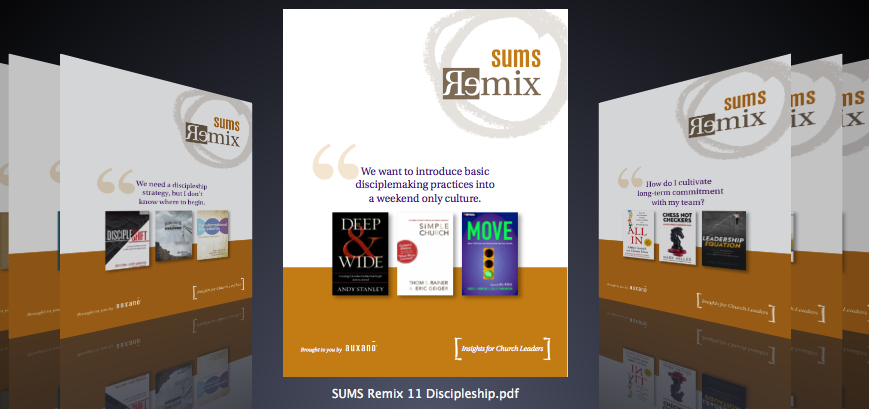
Beginning in 2015, we took the SUMS tool to a whole new level. Every other week subscribers receive not ONE, but THREE book “summaries” all focused around solving a practical church leadership problem. It’s called SUMS Remix.

SUMSRemixCovers

That’s 26 issues of SUMS Remix – addressing the ministry problems you encounter at your church – delivered to your inbox every two weeks.

In a nutshell why is SUMS Remix better?

  • You need content that solves the challenges you face every day
  • You want to scan more information in less time to find the best content
  • You will to achieve more with more credibility as well-read leader
  • You have ready-to-use staff action steps in each issue

For example, the first of four free introductory SUMS Remix focused on the problem, “We want leadership development to be happening all of the time, not just at special events.” To solve this problem we looked at Noel Tichey’s Leadership Engine, Aubrey Malphur’s book (co-authored with Auxano founder Will Mancini), Building Leaders, and Dave & Jon Ferguson’s book, Exponential.

Check it out for yourself and see if you would agree that this is an incredibly innovative content tool for the church. Here are the first four free introductory issues of SUMS Remix:

SUMS Remix 1 We want leadership development to be happening all the time, not just at special events.

SUMS Remix 2 It’s difficult inspiring my team to be more productive.

SUMS Remix 3 I communicate a lot, but don’t consider myself a great storyteller.

SUMS Remix 4 My stomach goes into knots when I think about preaching on the subject of giving.

Click here to subscribe to SUMS Remix. Imagine – an entire year of the gift of insight, delivered to the your inbox – for the low price of $48. 

Think of it as creating a personal leadership and innovation literacy program.

Is It True Collaboration… or Is It a Team?

At Auxano, we practice what we preach.

Editing

Our primary tool for working with organizations is the Vision Frame, consisting of Mission, Values, Strategy, Measures, and Vision Proper. Before we led the first client through the process over 11 years ago, the original team of Will Mancini, Jim Randall, and Cheryl Marting worked out Auxano’s Vision Frame – which we still follow today.

One of our Values is Collaborative Genius, which is accomplished partly by the fact that we are a virtual company of over 20 team members living in 15 cities across 4 time zones.

I only thought I knew what collaboration meant!

In my adult work career, I have served as the accountant in an office setting for a food services company, an audiovisual technician as part of a team of 7 for a seminary, various roles on 3 church staff teams, a church consultant for a design-build company, and as the Vision Room Curator for Auxano.

That’s 36+ years in an environment of multiple team members, ostensibly working together for the good of the organization.

Was I collaborating with others, or merely part of a team?

Collaboration is not the same thing as teamwork. Teamwork is simply doing your part. Collaboration involves leveraging the power of every individual to bring out each other’s strengths and differences.  – Greg Cox, COO, Dale Carnegie, Chicago

At Auxano, we don’t just do our part, we collaborate to deliver excellence in all we do. Here’s a great example: our book summaries for leaders, called SUMS Remix.

The original concept of SUMS was dreamed up by our founder, Will Mancini. When I joined Auxano as Vision Room Curator, it was natural that the SUMS project fall under my guidance. Working from a curated list of books with a focus on the Vision Frame, I read the designated book and wrote the draft summary with recommended resources. I then oversaw the following process:

  • Proofing by Mike Gammill, a scholar and grammatical genius
  • Navigator Applications written by 4 of our full-time Navigators, applying the concepts to the local church leadership context thru their unique lenspowered by auxano
  • Editing by Cheryl Marting, who has eagle eyes
  • Review editing by Angela Reed, a production editor at our parent company, LifeWay
  • Design by James Bethany and our Creative Team, who produce a visual masterpiece every time
  • Final review and approval by Will

Beginning in the fall of 2012, every two weeks, a SUMS was distributed to the SUMS subscriber list. Practically every day of that two weeks, some of the actions above were taking place within our team as we work on multiple books at the same time.

That’s collaboration.

As we neared the end of our second year of SUMS, Will and I refined a concept that came to be called SUMS Remix. Instead of a single summary of one book, SUMS Remix consists of brief excerpts from three books, focused on providing simple solutions to a common problem statement that ministry leaders are facing every week in their churches.

SUMS Remix launched in November of 2014, and we release an issue every two weeks. And a similar collaboration process described above is still taking place.

The collaboration process for SUMS Remix is very similar to the one above, but on steroids! Because SUMS Remix involves 3 books for every issue, and we have a 5 week production cycle, and we release an issue every two weeks – well, without collaboration, it just wouldn’t – no, couldn’t – happen.

At any given time during that 5-week cycle, books are being read, notes are being taken, drafts are being written, drafts are being revised, additional research is being conducted, finished drafts are being designed, proofs are being reviewed, and the final SUMS Remix issue is being delivered.

That’s collaboration!

Want to see the end product of that collaboration? You can learn more about SUMS Remix here.

Midnight LunchI’m indebted to Sara Miller Caldicott, great grandniece of Thomas Edison and author of the book Midnight Lunch, for translating Edison’s world-changing innovation methods for use in the 21st century. Here are some of her thoughts on collaboration:

True collaboration embraces:

  • A discovery learning mindset versus a pure task orientation
  • A belief in anticipating and creating rather than merely reacting and responding
  • Presence of inspiration across multiple facets of both individual and team endeavors
  • Coherence of purpose
  • A dedication to elevating the performance of every team member
  • Connections to human and social networks of influence

Do these qualities sound different from the ones valued by your team? Do they draw upon ideas that feel new or seem broader than your current concept of what teamwork embraces?

Based on my experience, the answer would be yes.

So what are you going to do about it?


Understanding and Using a Journey Map

Journey maps are documents that visually illustrate the particular range of activities of a Guest over time. Many journey maps plot the entire course of a Guest’s relationship with an organization – all of the steps that Guests take as they discover, evaluate, attend, access, use, get support, and leave – or re-engage – the church. Others zoom in to just one particular part of the journey.

The scope of the journey map, the exact visualization, and the degree of detail it contains vary based on how the organization wants to use it.

Jonathan Browne, Forrester Research

At Auxano, our version of a simple journey map is called “The Seven Checkpoints.” We believe the first place to start is to imagine seven checkpoints for your guest. Think of the checkpoints as “gates” or even “hurdles” that any first time Guest must navigate to get from their comfy family room to your worship service.

Auxano7Checkpoints

With every gate comes a simple question: Has the church removed the inherent difficulty of navigating the gate for the first time? 

More specifically we look for every opportunity to make each gate simple, easy and obvious to navigate.

The Seven Checkpoints

#1 Before Departure: Are directions and service times immediately accessible to Guests from your church website, phone recording and yellow pages (yes – they’re still around!)?

#2 Travel to Location: Do Guests know where to turn into your church location?

#3 Parking Lot: Do Guests know where to park?

#4 Building Entrance: Do Guests know which door to enter?

#5 Children’s Ministry: Do Guests know where to take their kids?

#6 Welcome Center: Do Guests know where to go for more information?

#7 Worship: Do Guests know which door to enter?

These seven checkpoints can be plotted on a graph that illustrates how your Guest ministry is doing: is it simple, easy and obvious where your hospitality creates a WOW! or is it complex, confusing, and frustrating where your Guests cry out “Someone help me now?”

Any particular difficulties created by your location or facility should be viewed as hospitality opportunities. By providing a great solution to an obvious barrier, you enhance the wow-factor of the hospitality.

Have you ever considered creating a journey map for Guests coming to your church?

Part 3 of a multi-part series based on the book Outside In

Outside In

These posts “translate” the world of customer experience to the language and setting of Guest Experiences in the church.


>> Read Part 2

Leaders Should be Students of History

Usually the word “history” elicits one of two responses: a glassy-eyed stare and memories of those required classes in school that were mind-numbing, or an excited look followed by the phrase “Did you know that…”

I, proudly, am guilty of the latter.

Not content to read and study “normal” history (both my undergraduate and graduate minors are in history), I default to the obscure and strange. Who else would read books on the history of salt – or the history of dust – or the history of cod. Yes, cod. The little fish, that when salted, kept it edible for long sea voyages, allowing the “discovery” of the Americas by Europeans, among other uses (that’s a two-for-one use of history, in case you didn’t notice).

Leaders need to understand history, too.

Not just the history of books, though that’s a great start. Leaders in the local church need to know the history of the people and place they are serving. Only by understanding the past can you ever hope to lead to the future. Will Mancini, author of Church Unique and founder of Auxano, calls that “vision equity.” It’s the stories and actions over the years that have led that church to the place it is today. It’s the solid foundation that tomorrow is built on. To be ignorant of it or to ignore it is an invitation to mediocrity at best, or disaster at worst.

There is history in a place, too. Last week I was onsite for a Guest Perspective Evaluation at Cape Christian Fellowship in Cape Coral, FL. During my Saturday evening walk around of the campus, I was struck by the visual and audible impact of 3 existing water features, and 1 more in the construction phase:

IMG_5966

A simple aeration spray in the lake on the edge of the property.

IMG_5969

This beautiful waterfall is at the edge a a large grassy play area by the children’s building.

IMG_6403

This water jet fountain is the first thing you see on the path from the parking lots to the worship center.

IMG_5949

Fellowship Park, under construction. The splash fountains in the center circle will be a kids and family magnet.

These water features are part of the history – past, present, and future – of Cape Christian. They are telling a powerful story in the community.

History is a rock. Not an anchor to the past, but a bridge to the future.

Are you a student of the history of the people and place you serve? If not, there’s still time.

Class starts today.


Reading Requires Deliberate Practice

Researchers are clear about this point: It doesn’t matter whether it’s in sports, music, medicine, computer programming, mathematics, or other fields. Talent is not the key that unlocks excellence.

You need a particular kind of practice – deliberate practice – to develop expertise.

In honor of SUMS Remix, the best-of-class book summaries for leaders, I want to paraphrase authors James Kouzes and Barry Posner’s discussions in their book The Truth About Leadership on deliberate practice and apply them to reading.

Five Elements in the Deliberate Practice of Reading

  • Design a reading discipline to specifically improve your performance – if you want to become an expert, you must have a methodology, a clear goal, a way to measure success, and a specific process for accomplishing the goal.
  • Reading has to be repeated a lot – sloppy execution is not acceptable to top performers. Read far and wide in your chosen field with sustained effort.
  • Feedback on your results must be continuously available – every learner needs feedback. As you are reading, make it a practice to share your insights, comments, and questions with a group of peers, a mentor, or some other third-party to help you analyze how you are doing.
  • Reading is highly demanding mentally – developing expertise requires intense concentration and focus. Reading sessions need to be free of those daily interruptions that are commonplace in everyone’s day-to-day routines.
  • Sometimes reading isn’t all that fun – while you should love what you do, deliberate reading practice is not designed to be fun. The knowledge that you are improving and getting closer to your dream of superior performance should outweigh the sacrifices you make.

The best leaders are the best learners.

The best learners are the best readers.

Want to join me on the “practice” field of reading?


 inspired by and adapted from The Truth About Leadership by James M. Kouzes and Barry Posner

The Truth About Leadership


>> Discover SUMS Remix, best-of-class book summary service for leaders here