The 7 Step Road Map to Being All In

To have any hope of succeeding as a leader you need to get your team “all in.”

No matter the size of your team, few things will have a bigger impact on your performance than getting your people to buy into your ideas, your cause, and to believe what matters.

– All In, Adrian Gostick & Chester Elton

Best-selling authors of The Carrot Principle and The Orange Revolution, Adrian Gostick and Chester Elton’s new book All In answers one of the most overlooked leadership questions of the day: Why are some leaders able to get their employees to commit wholeheartedly to their culture and give that extra push that leads to outstanding results?

As with their previous works, a huge (in this case, 300,000 person) study led to a groundbreaking finding: leaders of the highest performing groups create a “culture of belief.” In these distinctive organizations, people believe in their leaders and in the organization’s vision, values, and goals. Team members are engaged, enabled, and energized (the authors use the term Three Es).

Based on the extensive interview process and combined with their years of experience, the authors created a seven-step road map for creating a culture of belief:

  • Define Your Burning Platform – define the mission with great clarity and instill a sense of urgency
  • Create a Customer Focus – focus on customers and mandate a pro-customer orientation
  • Develop Agility – learn to see the future and position your team to meet both seen and unseen challenges
  • Share Everything – create a culture that is a place of truth, has constant communication, and exhibits marked transparency
  • Partner with Your Talent – success is direct result of your teams’ unique ingenuity and talent
  • Root for Each Other – high levels of appreciation and camaraderie create a tangible esprit de corps
  • Establish Clear Accountability – teams must be held accountable for goals, but have the responsibility and tools to ensure their success, with appropriate rewards at completion
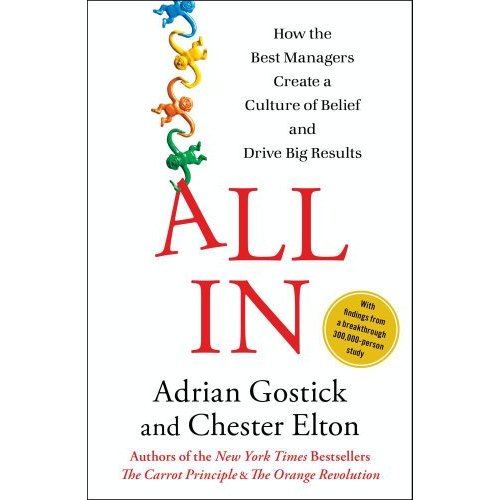
All In is a book about culture, but more than that it is the story of how great leaders create unique, inviting, and rewarding places to work – or serve.
What about you – are you ready to lead all in?

How to Be Like Walt, Part 2

Walt Disney had a burning desire for excellence in everything he did. He was always thinking, ‘We can do it better.’ That’s a common trait of all successful people.

Royal Clark, former treasurer of WED Enterprises

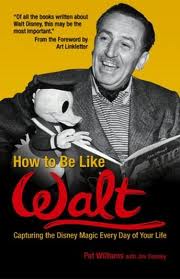
Walt Disney’s life provides powerful lessons that can be applied in any leadership position. Author Pat Williams recognized this, and went behind the legend to discover a man every bit as fascinating as the world he created.

How to Be Like Walt is the result of thousands of hours of interviews of the people who knew Walt best. In addition to being a fascinating life story of one of our nation’s most creative minds, the author has distilled Walt’s life into 17 lessons – lessons that we all could learn from. I introduced the topic yesterday; here are a few more:

Plus Every Experience: Sometime during the 1940s, Walt coined the term “plussing.” Normally, the word “plus” is a conjunction, as in “two plus two equals four.” But Walt used the word as a verb – an action word. To “plus” something is to improve it. “Plussing” means giving your guests more than they paid for, more than they expect, more than you have to give them. No matter what “business” you are in, your success depends on your commitment to excellence and attention to detail. If you deliver more than people expect, you will turn people into fans. Pursue excellence in everything you do.

Be a Person of Stick-to-it-ivity: Today we look at Disneyland and say, “Of course! Just what the world needed. How could it miss?” But in 1955, Disneyland was the biggest gamble in the history of American business. The risk paid off – not because Walt was lucky or favored or a genius. It paid off because Walt wouldn’t quit. The success of Disneyland is, first and foremost, the result of sheer dogged determination and persistence in the face of obstacles and opposition. In his own words, “Get a good idea and stay with it. Dog it, and work at it until it’s done, and done right.”

Become Like a Sponge for Ideas: Walt continually fed his mind with information and ideas. He absorbed inspiration wherever he went. If you want to be like Walt – more creative, more imaginative, and more successful – then keep your eyes and ears open. Read. Watch. Travel. Talk to people wherever you go. Ask questions. Invite opinions. Become a sponge for ideas.

Ask Yourself “How About Tomorrow?”: Walt embraced the future and put the stamp of his own personality on tomorrow. If we want to help shape a better tomorrow, then we need to continually ask ourselves the same question Walt asked Ray Bradbury: “How about tomorrow?” The difference between today and tomorrow is something called change. It takes courage to embrace the future, because the future is about change, and change brings uncertainty and anxiety. We fear change; we prefer the comfort of the familiar. But change is inevitable. If we do not become future-focused, we are doomed to obsolescence when tomorrow arrives. There are so many possible futures – which one will you choose?

Here are the rest of the author’s “How to Be Like Walt” lessons:

  • Become an Animated Leader
  • Take a Risk
  • Dealing with Loss
  • Live for the Next Generation
  • Build Complementary Partnerships
  • Stay Focused
  • Accept Your Mortality
  • Make Your Family Your Top Priority
  • Be the Person God Made You to Be

Each of the 17 lessons in the book are richly illustrated with stories by and about Walt Disney. I encourage you to get a copy and prepare to be delighted – and challenged.

Walt’s life challenges us to dream bigger, reach higher, work harder, risk more, and persevere as long as it takes. That is the rich legacy Walt Disney left us. That is the supreme lesson of his endlessly instructive life. The riches of an incredible, adventure-filled life are within our grasp – if we will dare to be like Walt.

Pat Williams

If you liked these two posts, here a few more select Disney-related posts:

The Secret of Disney World

Top Ten Takeaways from Our Disney World Adventure

Understanding Guests Like Disney

2 Questions for Your Consideration

Alan Webber, co-founder of Fast Company magazine and author of the book “Rules of Thumb“, thinks every leader needs to keep 2 lists:

  • What gets you up in the morning?
  • What keeps you up at night?

There is a lot for leaders to think about in those two sentences. Here is a summary of  Webber’s challenges:

Some people just have jobs. Others have something they really work at.

Some people are just occupied. Others have something that preoccupies them.

It makes all the difference in the world.

Consider this: you spend at least eight hours a day working, five days a week. A minimum of forty hours a week for at least forty-eight to fifty weeks a year. That’s a minimum of 1,920 hours a year. For how many years? You do the math.

What gets you up in the morning?

The level of energy put out by an organization’s people is one of the things that you are aware of as soon as you enter their space. There’s a buzz in the air (sometimes literally) created by people who are working  hard and working together. They want to be there – they came in ready to go.

What keeps you up at night?

This is a chance to be honest with yourself. Many times leaders rarely get a chance to reflect on the things that really matter to the organization’s goals. Most of the time, day-to-day urgent concerns crowd out broader issues that are the really important ones. The things that often keep leaders up are the things that never seem to find the time or place for serious engagement in the course of an ordinary workday.

We all want to do work that excites us. We want to care about things that concern us. So, about that list…

Take out a stack of three-by-five cards. Use one to write down the answer to the question “What gets you up in the morning?” Keep it to one sentence. If you don’t like your answer, throw away the card and start over – it’s only a card. Keep doing it until you’ve got an answer you can live with.

Now repeat the exercise for the question “What keeps you up at night?” Work at it until you’ve got an honest answer.

Now read your answers out loud to yourself. If you like them – if they give you a sense of purpose and direction – congratulations! Use them as a compass, checking from time to time to see if they’re still true.

If you don’t like one or both of your answers, you have a new question to consider: What are you going to do about it?

Whatever your answers are, you’re spending almost two thousand hours a year of your life doing it.

That makes it worthwhile to come up with answers you can not only live with but also live for.

Curating the Exponential Conference

Yesterday, the ever-churning machine that is the Internet pumped out more unfiltered digital data.

Yesterday, 250 million photos were uploaded to Facebook, 864,000 hours of video were uploaded to YouTube, and 294 BILLION emails were sent. And that’s not counting all the check-ins, friend requests, Yelp reviews and Amazon posts, and pins on Pintrest.

The volume of information being created is growing faster than your software is able to sort it out. As a result, you’re often unable to determine the difference between a fake LinkedIn friend request, and a picture from your best friend in college of his new baby. Even with good metadata, it’s still all “data”–whether raw unfiltered, or tagged and sourced, it’s all treated like another input to your digital inbox.

What’s happened is the web has gotten better at making data. Way better, as it turns out. And while algorithms have gotten better at detecting spam, they aren’t keeping up with the massive tide of real-time data.

While devices struggle to separate spam from friends, critical information from nonsense, and signal from noise, the amount of data coming at us is increasingly mind-boggling.

In 2010 we frolicked, Googled, waded, and drowned in 1.2 zettabytes of digital bits and bytes. A year later volume was on an exponential growth curve toward 1.8 zettabytes. (A zettabyte is a trillion gigabytes; that’s a 1 with 21 zeros trailing behind it.)

Which means it’s time to enlist the web’s secret power–humans.

– from a Fast Company online article

That’s why Auxano created the role of Vision Room Curator, and that’s my new job.

Today I dive headlong into that role, leaving for Orlando and the Exponential Conference – a gathering of 5,000 church planters from around the world. If you’re attending the event, I hope you will check out Auxano. If you’re not attending, but would be interested in a live simulcast of the event, get more information here.

Auxano has a key role in the conference: founder and Clarity Evangelist Will Mancini is hosting the Intentional Leadership Track; along with Will, Navigators Jeff Harris, Jim Randall, Dave Saathoff, and Bryan Rose are leading breakout sessions.

My role? Curating learning opportunities for ChurchWorld leaders…

Join the party! Follow all the Auxano team activity here.


Four Disciplines of Organizational Health

An organization doesn’t become healthy in a linear, tidy fashion.

– Patrick Lencioni, The Advantage

Patrick Lencioni’s latest book The Advantage is a comprehensive, practical guide, covering many of the topics introduced in one of his eight business fable books. But don’t make the mistake of thinking that this is just a repackaging – The Advantage goes far beyond that. In it you will find some very practical, hands-on tools to help your organization become healthy.

Previous posts here and here introduced the book. The central theme of the book is today’s topic: The Four Disciplines Model. Here is Lencioni’s overview of the Four Disciplines.

Discipline 1: Build a Cohesive Leadership Team

An organization simply cannot be healthy if the people who are chartered with running it are not behaviorally cohesive in five fundamental ways. In any kind of organization, from a corporation to a department within that corporation, from a small, entrepreneurial company to a church or a school, dysfunction and lack of cohesion at the top inevitably lead to a lack of health throughout.

Discipline 2: Create Clarity

In addition to being behaviorlly cohesive, the leadership team of a healthy organization must be intellectually aligned and committed to the same answers to six simple but critical questions. There can be no daylight between leaders around these fundamental issues.

Discipline 3: Overcommunicate Clarity

Once a leadership team has established behavioral cohesion and created clarity around the answers to those questions, it must then communicate those answers to the rest of the organization clearly, repeatedly, enthusiastically, and repeatedly (that’s no typo). When it comes to reinforcing clarity, there is no such thing as too much communication.

Discipline 4: Reinforce Clarity

Finally, in order for an organization to remain healthy over time, its leaders must establish a few critical, non-bureaucratic systems to reinforce clarity in every process that involves people. Every policy, every program, every activity should be designed to remind your team what is really most important.

I hope today’s post and the previous two have enticed you to get The Advantage. The book certainly stands alone, but there is also a great deal of web content available on organizational health.

What are you waiting on?

The health of your organization is at stake!

Smart vs. Healthy

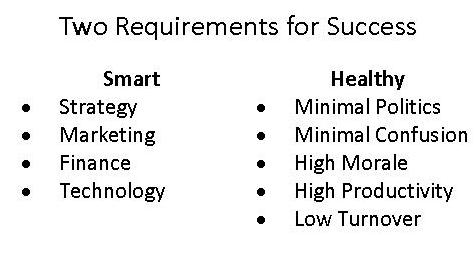
Being smart is only half the equation in a successful organization. Yet it somehow occupies almost all the time, energy, and attention of most leaders. The other half of the equation, the one that is largely neglected, is about being healthy.

– Patrick Lencioni, The Advantage

In Patrick Lencioni’s latest book The Advantage, you will find the following chart:

Lencioni comments: “Whenever I list the qualities for leaders, I usually get one of the following reactions, and sometimes both. Often they laugh quietly, in a nervous. almost guilty kind of way. Or they barely sigh, like parents do when they hear about a family where the kids do what they’re told the first time they’re asked. In either case, it’s as thought they’re thinking, ‘Wouldn’t that be nice?’ or, ‘Can you imagine?’

None of the leaders – even the most cynical ones – deny that their organizations would be transformed if they could achieve the characteristics fo a healthy organization. Yet they almost always gravitate to the left side of the chart above, retreating to the safe, measurable “smart” side of the equation.

Why?

Because it’s relatively safe and predictable, which most leaders prefer. That’s how they’ve been trained, and that’s where they’re comfortable.

It takes discipline to move beyond the safe and predictable, into the sometimes awkward and messy area of organizational health.

Tomorrow: Four Disciplines of Organizational Health

Adapted from The Advantage, by Patrick Lencioni

The Case for Organizational Health

The single greatest advantage any company can achieve is organizational health. Yet it is ignored by most leaders even though it is simple, free, and available to anyone who wants it.

– Patrick Lencioni, The Advantage

With that bold statement, Patrick Lencioni delivers perhaps his finest work to date – no mean feat considering that his eight business fables remain required reading for leaders in any organization – especially ChurchWorld.

Instead of trying to become smarter, Lencioni asserts that leaders and organizations need to shift their focus to becoming healthier, allowing them to tap into the more-than-sufficient intelligence and expertise they  already have.

What’s the secret to discovering organizational health? Or to put it more bluntly, why do leaders struggle to embrace it?

According to Lencioni, it’s because too many leaders quietly believe they are too sophisticated, too busy, or too analytical to bother with it. In other words, they think it’s beneath them. Before leaders can tap into the power of organizational health, they must humble themselves enough to overcome the three biases that prevent them from embracing it:

  • The Sophistication Bias: organization health is so simple and accessible that many leaders have a hard time seeing it as a real opportunity for meaningful advantage. It doesn’t require great intelligence or sophistication – just uncommon levels of discipline, courage, persistence, and common sense.
  • The Adrenaline Bias: becoming a healthy organization takes a little time; unfortunately, too many leaders suffer from adrenaline addiction, hooked on the daily rush of activity and firefighting within their own organizations.
  • The Quantification Bias: the benefits of becoming a healthy organization are difficult to accurately quantify. It requires a level of conviction and intuition that many overly analytical leaders have a hard time accepting.

To close this post, possibly one of the boldest, most audacious quotes you will ever hear or read:

Once organizational health is properly understood and placed into the right context, it will surpass all other disciplines in business as the greatest opportunity for improvement and competitive advantage. Really.

Tomorrow: Would you rather be smart or healthy?

Level 5: Lead from the Pinnacle

Definition of a Level 5 Leader: People follow you because of who you are and what you represent

Leadership at Level 5 lifts the entire organization and creates an environment that benefits everyone in it, contributing to their success.

          John Maxwell, The 5 Levels of Leadership

Today’s post is the final in a series of five that takes a closer look at John Maxwell’s latest book, The 5 Levels of Leadership. As indicated in the introduction to this series, “5 Levels” has been five years in the making. I’ve been in leadership development in ChurchWorld for over 30 years – and I’ve been looking for a resource like this.

To whet your appetite and convince you to drop everything and get your own copy today, over this series I’m going to quote Maxwell’s top 3 points in each of five sections for each of the 5 Levels. In math shorthand, that’s 3 x 5 x 5. The product of that equation is a leadership development gold mine for you!

 Level 5– The Pinnacle

The Upside of the Pinnacle

  1. Pinnacle leadership creates a Level 5 organization
  2. Pinnacle leadership creates a legacy within the organization
  3. Pinnacle leadership provides an extended platform for leading

The Downside of the Pinnacle

  1. Being on the pinnacle can make you think you’ve arrived
  2. Being on the pinnacle can lead you to believe your own press
  3. Being on the pinnacle can make you lose focus

Best Behaviors on Level 5

  1. Make room for others at the top
  2. Continually mentor potential Level 5 leaders
  3. Create an inner circle that will keep you grounded

Help Others Move Up to Levels 4 and 5

  1. Identify and create the crucial leadership lessons they must learn
  2. Look for unexpected crucible moments they can learn from
  3. Use your own crucible moments as guidelines to teach others

Guide to Being Your Best at Level 5

  1. Remain and humble and teachable
  2. Maintain your core focus
  3. Create the right inner circle to keep you grounded

Developing leaders to the point where they are able and willing to develop other leaders is the most difficult leadership task of all. But here are the payoffs: Level 5 leaders develop Level 5 organizations. They create opportunities that other leaders don’t. They create legacy in what they do. People follow them because of who they are and what they represent. In other words, their leadership gains a positive reputation. As a result, Level 5 leaders often transcend their position, their organization, and sometimes their field.

If you are a leader in ChurchWorld asking “How can I develop leaders?”, then John Maxwell’s book The 5 Levels of Leadership will certainly provide you with proven steps to answer that question.


Level 4: Lead by People Development

Definition of a Level 4 Leader: People follow you because of what you have done for them personally

Leaders become great, not because of their power, but because of their ability to empower others.

          John Maxwell, The 5 Levels of Leadership

Today’s post is the fourth of a series of five that takes a closer look at John Maxwell’s latest book, The 5 Levels of Leadership. As indicated in the introduction to this series, “5 Levels” has been five years in the making. I’ve been in leadership development in ChurchWorld for over 30 years – and I’ve been looking for a resource like this.

To whet your appetite and convince you to drop everything and get your own copy today, over this series I’m going to quote Maxwell’s top 3 points in each of five sections for each of the 5 Levels. In math shorthand, that’s 3 x 5 x 5. The product of that equation is a leadership development gold mine for you!

 Level 4 – People Development

 The Upside of People Development

  1. People development sets you apart from most leaders
  2. People development assures that growth can be sustained
  3. People development empowers others to fulfill their leadership responsibilities

 The Downside of People Development

  1. Self-centeredness can cause leaders to neglect people development
  2. Insecurity can make leaders feel threatened by people development
  3. Shortsightedness can keep leaders from seeing the need for people development

Best Behaviors on Level 4

  1. Recruiting – find the best people possible
  2. Positioning – placing the right people in the right position
  3. Modeling – showing others how to lead

Beliefs that Help a Leader Move Up to Level 5

  1. The highest goal of leadership is to develop leaders, not gain followers or do work
  2. To develop leaders, you must create a leadership culture
  3. Developing leaders is a life commitment, not a job commitment

 Guide to Growing Through Level 4

  1. Be willing to keep growing yourself
  2. Decide that people are worth the effort
  3. Work through your insecurities

 Good leaders on Level 4 invest their time, energy, money, and thinking into growing others as leaders. They look at every person and try to gauge his or her potential to grow and lead – regardless of the individual’s title, position, age, or experience. Every person is a potential candidate for development.

Tomorrow: Level 5 – The Pinnacle


Level 3: Lead by Production

Definition of a Level 3 Leader: People follow you because of what you have done for the organization

…good leaders don’t just create a pleasant working environment. They get things done! That’s why they must move up to Level 3, which is based on results.

          John Maxwell, The 5 Levels of Leadership

Today’s post is the third of a series of five that takes a closer look at John Maxwell’s latest book, The 5 Levels of Leadership. As indicated in the introduction to this series, “5 Levels” has been five years in the making. I’ve been in leadership development in ChurchWorld for over 30 years – and I’ve been looking for a resource like this. 

To whet your appetite and convince you to drop everything and get your own copy today, over this series I’m going to quote Maxwell’s top 3 points in each of five sections for each of the 5 Levels. In math shorthand, that’s 3 x 5 x 5. The product of that equation is a leadership development gold mine for you!

 Level 3 – Production

 The Upside of Production

  1. Leadership production gives credibility to the leader
  2. Leadership production models and sets the standard for others visually
  3. Leadership production brings clarity and reality to vision

 The Downside of Production

  1. Being productive can make you think you’re a leader when you’re not
  2. Productive leaders feel a heavy weight of responsibility for results
  3. Production leadership requires making difficult decisions

 Best Behaviors on Level 3

  1. Understand how our personal giftedness contributes to the vision
  2. Cast vision for what needs to be accomplished
  3. Begin to develop your people into a team

 Beliefs That Help a Leader Move Up to Level 4

  1. Production is not enough
  2. People are an organization’s most appreciable asset
  3. Growing leaders is the most effective way to accomplish the vision

 Guide to Growing Though Level 3

  1. Be the team member you want on your team
  2. Translate personal productivity into leadership
  3. Understand everyone productivity niche

Leading and influencing others becomes fun on this level. Success and productivity have been known to solve a lot of problems. On Level 3, leaders can become change agents. They can tackle tough problems and face thorny issues. They can make difficult decisions that will make a difference. They can take their people to another level of effectiveness. 

Tomorrow: Level 4 – People Development