Where Did the Creativity Go?

Consider the talents of the following two groups who were asked these three questions:

  • How many of you are good singers?
  • How many of you are good dancers?
  • How many of you are good artists?

About 2 percent of the first group responded positively to each of these three questions. That’s a typical response of most business teams. But it’s possible to find a second group in almost any community who would give nearly 100 percent positive responses. Surprised?

Ask any group of first graders these three questions, and the children will respond with an enthusiastic “Yes!” to each one.

All children are creative – they’re born that way!

What happened to the creative gene that was so alive in our childhoods?

Authors and consultants Bill Capodagli and Lynn Jackson have answered that question in their book Innovate the Pixar Way. Subtitled “Business lessons from the world’s most creative corporate playground,” the book details how Pixar provides a working environment that encourages imagination, inventiveness, and joyful collaboration.

The book asks, and then answers, these questions:

  • How do you build an organization that embraces change and delivers an innovative, high-quality service or product?
  • How do you establish a culture of creativity in which the talents and abilities of all are nurtured and honed with great care?
  • How do you unleash the creative genius within your team and still meet budgets and deadlines?
  • How do you establish an environment that awakens dreams?

Going behind the screen at Pixar, Capodagli and Jackson answer these questions and more. Here’s a sample:

Pixar goes to great lengths to hire people who are interested in working together as a network in solving problems, building and supporting each other. Four common proficiencies are vital to making art a team sport.

  • Depth – demonstrating mastery in a subject or a principal skill such as drawing or programming; having the discipline to chase dreams all the way to the finish line
  • Breadth – possessing a vast array of experiences and interests; having the ability to explore insights from many different perspectives; being able to effectively generate new ideas by collaborating with an entire team
  • Communication – focusing on the receiver; receiving feedback to ascertain whether the message sent was truly understood; only the listener can say, “I understand”
  • Collaboration – bringing together the skills, ideas, and personality styles of an entire team to achieve a shared vision; fostering collective creativity and keeping the vibe and energy in the room upbeat and alive

Wouldn’t you want to work on a team in an environment like that?

Maybe the better question is,  Wouldn’t you want to lead your team in an environment like that?

Tomorrow: How to Think Like a Director

Other Posts You Might Be Interested In:

The Creative Process at Pixar

The Secret of Disney World

My Top Ten Takeaways From Disney World

The Disney Job Description

The Power of a Word

The immediate reaction is the only reaction that matters.

When we meet someone new, when we introduce a new thought into a conversation, when we send a text, we are making a first impression.

As soon as we do that, people begin to make judgments about us – the same way we are making judgments about them. We may not intend to and they are mostly subconscious, but we are making them nevertheless.

You’ve probably heard the saying – “you don’t get a second chance to make a first impression”.

It’s right.

What will your “first impression” be today? To your spouse, children, or other family members? To your boss, employees, or co-workers? To the neighbors walking the dog? To the barista at the coffee shop? To the checkout person in a long line at the store? And so on…

Make your first impression your best impression.

It may be the only one you will ever make with that person – and it may be a life-changing one.

What Weeding a Flower Bed Reminded Me About Leadership

I have been in Nashville TN for the last several days on a business trip. Though I wrapped up late yesterday afternoon, I planned some extra time with my mother, who lives about 20 miles from Nashville. We went out for dinner last night and I asked her what she needed doing around the house.

This is the first time I have been back “home” since my father passed away and was buried in early March. Though my mother and I talk several times each week, I knew that there were things to do for her.

Consequently, by mid-morning I found myself pulling weeds in the numerous flower gardens around the house. Both my parents liked flowers and the wildlife they attracted. My dad in particular, was what you might call a natural gardener when it came to flowers. He didn’t believe in formal landscapes and flower beds “just so.” His method was more “that looks like a good place for a few flowers.”

As I was working in around the flower beds all morning, I was reminded of the countless times I had seen my dad as he was going from one place to another in our yard just stop and pull a weed out and toss it on the ground – to be chopped up by the mower later. There wasn’t a rhyme or reason to his actions; it was just something he did.

Small consistent actions over time make a big difference.

My dad had been in declining health since late last year, and had not been able to be out in the yard, there was a lot to do. By noon I was ready for a break. Sitting and drinking several glasses of water I thought about my Dad and how his constant weeding meant that the flower gardens looked pretty good all of the time; now, they looked overgrown.

I’m certainly nowhere near the gardener my Dad was. My several hours of work will make them look good for a few weeks maybe, and then they will have to be weeded again.

But once again, my Dad is my teacher.

Leaders need to understand that consistent, small actions invested in your team will pay big dividends along the journey.

Thanks, Dad.

Simplicity Never Stands Still

To achieve great things, two things are needed: a plan, and not quite enough time.

– Leonard Bernstein

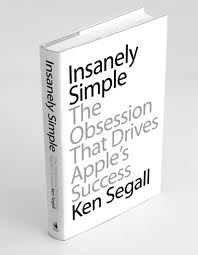
Former ad agency creative director Ken Segall’s new book Insanely Simple is written from a unique perspective: developing marketing campaigns for technology giants like IBM, Dell, Intel, – and Apple. It was the stark contrast of Apple’s ways that made Segall appreciate the power of Simplicity – and inspired him to help others benefit from it.

In the chapter entitled “Think Motion,” Segall refers to Apple’s practices of fast-tracking project and marketing development.  Apple has grown to point where it does a tremendous number of things at once, and in doing so has built one of the world’s greatest juggling acts. Apple:

  • lives in constant motion
  • never stops thrilling its audience
  • never lets things get old

The best illustration of this comes from an example of Segall’s work with both Dell and Apple on similar ventures – developing a new branding campaign.

Apple set out to create a brand campaign in 1997.

   Dell set out to create a brand campaign in 2008.

Apple wanted to start its campaign immediately.

   Dell pondered a schedule that would take months.

Apple’s brand team was led by its CEO.

   Dell’s brand team was led by a committee.

Apple trusted a small group of smart people.

   Dell trusted a small group of incompatible people.

Apple knew exactly who it was.

   Dell need to figure out who it was.

Steve Jobs was an active participant.

   Michael Dell would look in when the project was complete.

Apple’s brand team required only the CEO’s approval.

   Dell’s brand team required each division’s approval.

Apple took a month to conceive and create a campaign.

   Dell required a month just to talk about strategies.

Apple ended up with the Think Different campaign.

   Dell ended up with a stack of presentation boards stored neatly in a dark closet.

Simplicity – represented in the above example by Apple’s actions – is a fundamental requirement when you’re trying to achieve lofty goals. As Dell discovered, a fractured, leaderless group without an urgent mandate is Simplicity-proof.

Will you walk the straight path of Simplicity or choose the dark, winding road of Complexity?

Small is the Ultimate Efficiency

When process is king, ideas will never be. It takes only Common Sense to recognize that the more layers you add to a process, the more watered down the final work will become.

– Ken Segall, Insanely Simple

Ken Segall was the creative director at several ad agencies, working for big-name tech companies like IBM, Intel, and Dell. However, it was his work with Apple over a period of years that gives him a unique perspective of the stark contrast of Apple’s ways that made him appreciate the power of Simplicity. Segall recently released a book about these lessons – Insanely Simple. More than just another repetition of Apple lore, it chronicles an outsider’s long relationship with Apple and Steve Jobs that will provide leaders in any organization with the powerful tools of Simplicity.

Simplicity’s Best Friend: Small Groups of Smart People

While working with Apple, Segall often experienced the strict enforcement of one of Simplicity’s most important rules: Start with small groups of smart people – and keep them small. Every time the body count in a meeting or working on a project goes higher, you’re simply inviting Complexity to take a seat at the table.

This small-group principle is a key to Apple’s ongoing success and key to any organization that wants to nurture quality thinking. The idea is pretty basic: Everyone in the room should be there for a reason. Segall distilled years of observing and practicing this idea down into two “Laws of Small.”

The quality of work resulting from a project is inversely proportional to the number of people involved in the project.

The quality of work resulting from a project increases in direct proportion to the degree of involvement by the ultimate decision maker.

To even speak of putting process before creativity did not happen in an environment like Apple’s. A better idea is a better idea – no matter where it fell in the process. The high value placed on ideas is one of the things that Steve Jobs burned into the Apple culture and it will likely continue to guide the company into the future.

How would small groups of smart people work in your organization?

Blunt is Simplicity. Meandering is Complexity.

Clarity propels an organization. Not occasional clarity but pervasive, twenty-four-hour, in-your-face, take-no-prisoners clarity.

– Ken Segall, Insanely Simple

Ken Segall is a former ad agency creative director who worked for Apple during Steve Jobs’ return to the helm of the iconic tech company. He also worked for many of the largest tech companies around: IBM, Dell, and Intel among others. He’s seen both sides of the fence, so to speak, and it’s not a pretty sight.

Insanely Simple: The Obsession That Drives Apple’s Success is an amazing book detailing Apple’s return to brilliance under Steve Jobs. It’s loaded with personal stories and practical applications that your organization will find both fascinating and useful.

Like the necessity of being brutally honest in your communications.

According to Segall, Steve Jobs told you what was on his mind and he couldn’t care less how you might feel about it. Despite a general perception that Jobs was the nasty tyrant who demanded allegiance, barked commands, and instilled fear in those around him, this was an incomplete portrait. He could also be funny, warm, and even charming.

There is a huge difference between being brutally honest and simply being brutal.

Simplicity at Apple is the name of the game, and it requires that you be honest and never hold back. If you demand the same from those you work with, everyone will know where they stand.

One hundred percent of your group’s time will be focused on forward progress – and there will be no need to decode what people are really saying.

Learn the Powerful Lessons of Simplicity

Simplicity isn’t just a design principle at Apple – it’s a value that permeates every level of the organization.

-Ken Segall, Insanely Simple

Ken Segall was the creative director at several ad agencies, working for big-name tech companies like IBM, Intel, and Dell. However, it was his work with Apple over a period of years that gives him a unique perspective of the stark contrast of Apple’s ways that made Segall appreciate the power of Simplicity.

The obsession with Simplicity is what separates Apple from other technology companies. Led by Steve Jobs’ uncompromising ways, you can see Simplicity in everything Apple does: the way it’s structured, the way it innovates, and the way it speaks to its customers.

Insanely Simple gives you a true insider’s perspective on Apple’s obsession with Simplicity. Here are just a few of the topics covered:

  • Think Small – swearing allegiance to the concept of “small groups of smart people” raises both morale and productivity
  • Think Minimal – distilling choices to a minimum brings clarity to a company and its customers – as Jobs proved when he replaced over twenty product models with a lineup of four
  • Think Motion – keeping project teams in constant motion focuses creative thinking on well-defined goals and minimizes distractions
  • Think Iconic – using a simple, profound image to symbolize the benefits of a product or idea creates a deeper impression in the minds of customers

Segall introduces the book with the concept of The Simple Stick – a core value within Apple. Sometimes it’s held up as inspiration; other times it’s wielded like a club. In all cases, it’s a reminder of what sets Apple apart from other technology companies and what makes Apple stand out in a complicated world: a deep, almost religious belief in the power of Simplicity.

If you are a leader in ChurchWorld, you know about and fight the battle of Simplicity every day. It may seem like a losing battle, but you need to know that the results are worth the effort.

The simpler way isn’t always the easiest. Often it requires more time, more money, and more energy. It may require you to step on a few toes along the way. But more often than not, Simplicity leads to better results.

Simplicity needs a champion – someone who’s willing to stand up for its principles and strong enough to resist the overtures of Simplicity’s evil twin, Complexity.

Simplicity needs a leader who is willing to guide the process with both head and heart…

…someone like you?

To read more about Insanely Simple, go to the top of the page and click on the orange title of tomorrow’s post.

Curating the Exponential Conference

Yesterday, the ever-churning machine that is the Internet pumped out more unfiltered digital data.

Yesterday, 250 million photos were uploaded to Facebook, 864,000 hours of video were uploaded to YouTube, and 294 BILLION emails were sent. And that’s not counting all the check-ins, friend requests, Yelp reviews and Amazon posts, and pins on Pintrest.

The volume of information being created is growing faster than your software is able to sort it out. As a result, you’re often unable to determine the difference between a fake LinkedIn friend request, and a picture from your best friend in college of his new baby. Even with good metadata, it’s still all “data”–whether raw unfiltered, or tagged and sourced, it’s all treated like another input to your digital inbox.

What’s happened is the web has gotten better at making data. Way better, as it turns out. And while algorithms have gotten better at detecting spam, they aren’t keeping up with the massive tide of real-time data.

While devices struggle to separate spam from friends, critical information from nonsense, and signal from noise, the amount of data coming at us is increasingly mind-boggling.

In 2010 we frolicked, Googled, waded, and drowned in 1.2 zettabytes of digital bits and bytes. A year later volume was on an exponential growth curve toward 1.8 zettabytes. (A zettabyte is a trillion gigabytes; that’s a 1 with 21 zeros trailing behind it.)

Which means it’s time to enlist the web’s secret power–humans.

– from a Fast Company online article

That’s why Auxano created the role of Vision Room Curator, and that’s my new job.

Today I dive headlong into that role, leaving for Orlando and the Exponential Conference – a gathering of 5,000 church planters from around the world. If you’re attending the event, I hope you will check out Auxano. If you’re not attending, but would be interested in a live simulcast of the event, get more information here.

Auxano has a key role in the conference: founder and Clarity Evangelist Will Mancini is hosting the Intentional Leadership Track; along with Will, Navigators Jeff Harris, Jim Randall, Dave Saathoff, and Bryan Rose are leading breakout sessions.

My role? Curating learning opportunities for ChurchWorld leaders…

Join the party! Follow all the Auxano team activity here.


Four Disciplines of Organizational Health

An organization doesn’t become healthy in a linear, tidy fashion.

– Patrick Lencioni, The Advantage

Patrick Lencioni’s latest book The Advantage is a comprehensive, practical guide, covering many of the topics introduced in one of his eight business fable books. But don’t make the mistake of thinking that this is just a repackaging – The Advantage goes far beyond that. In it you will find some very practical, hands-on tools to help your organization become healthy.

Previous posts here and here introduced the book. The central theme of the book is today’s topic: The Four Disciplines Model. Here is Lencioni’s overview of the Four Disciplines.

Discipline 1: Build a Cohesive Leadership Team

An organization simply cannot be healthy if the people who are chartered with running it are not behaviorally cohesive in five fundamental ways. In any kind of organization, from a corporation to a department within that corporation, from a small, entrepreneurial company to a church or a school, dysfunction and lack of cohesion at the top inevitably lead to a lack of health throughout.

Discipline 2: Create Clarity

In addition to being behaviorlly cohesive, the leadership team of a healthy organization must be intellectually aligned and committed to the same answers to six simple but critical questions. There can be no daylight between leaders around these fundamental issues.

Discipline 3: Overcommunicate Clarity

Once a leadership team has established behavioral cohesion and created clarity around the answers to those questions, it must then communicate those answers to the rest of the organization clearly, repeatedly, enthusiastically, and repeatedly (that’s no typo). When it comes to reinforcing clarity, there is no such thing as too much communication.

Discipline 4: Reinforce Clarity

Finally, in order for an organization to remain healthy over time, its leaders must establish a few critical, non-bureaucratic systems to reinforce clarity in every process that involves people. Every policy, every program, every activity should be designed to remind your team what is really most important.

I hope today’s post and the previous two have enticed you to get The Advantage. The book certainly stands alone, but there is also a great deal of web content available on organizational health.

What are you waiting on?

The health of your organization is at stake!

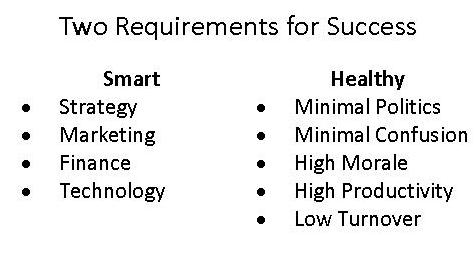
Smart vs. Healthy

Being smart is only half the equation in a successful organization. Yet it somehow occupies almost all the time, energy, and attention of most leaders. The other half of the equation, the one that is largely neglected, is about being healthy.

– Patrick Lencioni, The Advantage

In Patrick Lencioni’s latest book The Advantage, you will find the following chart:

Lencioni comments: “Whenever I list the qualities for leaders, I usually get one of the following reactions, and sometimes both. Often they laugh quietly, in a nervous. almost guilty kind of way. Or they barely sigh, like parents do when they hear about a family where the kids do what they’re told the first time they’re asked. In either case, it’s as thought they’re thinking, ‘Wouldn’t that be nice?’ or, ‘Can you imagine?’

None of the leaders – even the most cynical ones – deny that their organizations would be transformed if they could achieve the characteristics fo a healthy organization. Yet they almost always gravitate to the left side of the chart above, retreating to the safe, measurable “smart” side of the equation.

Why?

Because it’s relatively safe and predictable, which most leaders prefer. That’s how they’ve been trained, and that’s where they’re comfortable.

It takes discipline to move beyond the safe and predictable, into the sometimes awkward and messy area of organizational health.

Tomorrow: Four Disciplines of Organizational Health

Adapted from The Advantage, by Patrick Lencioni