Prayerful Dependence

Part 5 of a series on the book “Transformational Church

The second transformational loop described by Ed Stetzer and Thom Rainer is labeled Embrace. It contains three elements; the first two have been covered in previous posts here and here. Today, a look at Prayerful Dependence.

Prayer is our link to receive understanding from God about His church and move forward in obedience to His mission.

Prayer is done with expectancy rather than out of repetitive behavior

Strategies, excellence, methods, or even commitment cannot substitute for humble dependence on God

Prayer Priorities of Christ

  • The proper use of His house
  • The accessibility of “all people” to a relationship with Him
  • The response to His praying people

Transformational Prayer Practices

  • Praying churches experience breakthroughs
  • Praying churches have praying leaders
  • Praying churches commonly experience answers to prayer
  • Praying churches pray for members by name
  • Praying churches have systems and processes
  • Praying churches have corporate prayer
  • Praying churches engage their communities through prayer
  • Praying churches have praying events 

Prayer is the engine of Transformational Churches.

The excerpts above are from the book “Transformational Church” by Ed Stetzer and Thom Rainer. Transformational Church is the result of a comprehensive study of thousands of churches where truly changing lives is the standard set for ministry.

Next: EngageWorship: Actively Embrace Jesus

Previous posts in the series:

Relational Intentionality

Part 4 of a series on the book “Transformational Church

The second transformational loop described by Ed Stetzer and Thom Rainer is labeled Engage. It contains three elements, the first of which, Vibrant Leadership, was covered here. Today, a look at Relational Intentionality.

A relational approach to reaching and developing people is woven throughout every ministry and practice. Relationships are the substance of the church culture.

We Are a Friendly Church

  • Transformational Churches intentionally build platforms to create relationships
  • The purpose of relationships in the Transformational Church is to see lives changed through the power of Christ

The Look of a Relationally Intentional Environment

What are the challenges within your church environment to cultivate relationships, and how can you address them?

What are the challenges in your church environment to intentionality, and how can you address them?

  • Produce family
  • Practice one-on-one relationships
  • Provide space for difficult people

Every member must be willing to minister because when God really moves, broken and hurting people show up. The outcast and marginalized need the compassion of Christ.

Systems and processes are present and must be aligned

  • A system is an environment, a way of doing things, providing the “how”
  • A process is a path with a purpose, a destination, providing the “where”

God’s delivery system for the gospel is relationships with people who have met Him

The excerpts above are from the book “Transformational Church” by Ed Stetzer and Thom Rainer. TC is the result of a comprehensive study of thousands of churches where truly changing lives is the standard set for ministry.

Other posts in the series:

Next: EmbracePrayerful Dependence

Vibrant Leadership

Part 3 of a series on the book “Transformational Church

The second transformational loop described by Ed Stetzer and Thom Rainer is labeled Embrace. It contains three elements, the first of which is Vibrant Leadership.

Transformational leaders let God shape their church. The Transformational Church is Christ being presented to the community. Transformational Churches are tenacious about the vision and are people focused.

Understanding Transformational Leadership

  • Transformational Leadership understands that the church exists for the mission of God, and God gives leaders to help churches focus on the mission
  • Transformational Leadership focuses on leveraging every life for the kingdom of God around the world
  • Transformational Leadership is focused on the outside of the leader’s world
  • Transformational Leadership is missional in perspective and action-oriented in decision

Shift in Thinking

  • From one to many leaders
  • From “me” to “we”
  • From personal power to people empowerment
  • From church to the kingdom of God

Whether from bricks and mortar, programs, or just the inward pull of self, the church can become distracted from the mission of the kingdom. It did not take long in the early church for the epicenter of God’s activity to move away from house to house and life to life. With the advent of church buildings, the temptation was to become building-focused, inward, self-absorbed congregations. People became spectators. Scattering throughout the community as the church was replaced with the sacred, passive gathering in one place. When church is reduced to that place on the corner where we go on Sunday, we reduce the church and kingdom to something smaller than God intended.

The Leadership Structure of Transformational Churches

  • Traditional committees gave way to affinity-based teams
  • Membership is encouraged to discover strengths, spiritual gifts, and talents
  • Churches had less structure as opposed to more structure
  • Structures reflect confidence in their pastor and positional leaders
  • Congregational members did not vote on every issue
  • Small advisory teams and accountability groups worked alongside the pastor and staff

Jesus, Leading Transformation

  • Jesus invested in people
  • Jesus saw long and far
  • Jesus sent people away from Him on mission
  • Jesus grieved for communities
  • Jesus led a balanced life
  • Jesus embraced other cultures
  • Jesus gave up His will
  • Jesus surrounded Himself with lost people
  • Jesus’ harvest vision was leveraged by prayer
  • Jesus felt the needs of the people

Transformational Leadership Environments

  • Value a team approach to ministry
  • Values a sharper mission focus
  • Values new leadership priorities

Transitional Leaders advance through the following steps:

  • I join Him on mission or the “encounter” level
  • I lead others to join Him on mission or the “influence” level
  • I lead others to lead others, to join Him on mission, or the “leading leaders” level
  • I lead others to lead others to lead others to join Him on mission, or the “movement” level

The excerpts above are from the book “Transformational Church” by Ed Stetzer and Thom Rainer. Transformational Church is the result of a comprehensive study of thousands of churches where truly changing lives is the standard set for ministry.

Next: EmbraceRelational Intentionality

Previous posts in this series:


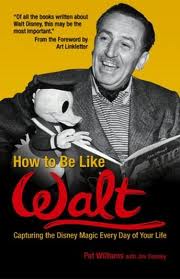
How to Be Like Walt, Part 2

Walt Disney had a burning desire for excellence in everything he did. He was always thinking, ‘We can do it better.’ That’s a common trait of all successful people.

Royal Clark, former treasurer of WED Enterprises

Walt Disney’s life provides powerful lessons that can be applied in any leadership position. Author Pat Williams recognized this, and went behind the legend to discover a man every bit as fascinating as the world he created.

How to Be Like Walt is the result of thousands of hours of interviews of the people who knew Walt best. In addition to being a fascinating life story of one of our nation’s most creative minds, the author has distilled Walt’s life into 17 lessons – lessons that we all could learn from. I introduced the topic yesterday; here are a few more:

Plus Every Experience: Sometime during the 1940s, Walt coined the term “plussing.” Normally, the word “plus” is a conjunction, as in “two plus two equals four.” But Walt used the word as a verb – an action word. To “plus” something is to improve it. “Plussing” means giving your guests more than they paid for, more than they expect, more than you have to give them. No matter what “business” you are in, your success depends on your commitment to excellence and attention to detail. If you deliver more than people expect, you will turn people into fans. Pursue excellence in everything you do.

Be a Person of Stick-to-it-ivity: Today we look at Disneyland and say, “Of course! Just what the world needed. How could it miss?” But in 1955, Disneyland was the biggest gamble in the history of American business. The risk paid off – not because Walt was lucky or favored or a genius. It paid off because Walt wouldn’t quit. The success of Disneyland is, first and foremost, the result of sheer dogged determination and persistence in the face of obstacles and opposition. In his own words, “Get a good idea and stay with it. Dog it, and work at it until it’s done, and done right.”

Become Like a Sponge for Ideas: Walt continually fed his mind with information and ideas. He absorbed inspiration wherever he went. If you want to be like Walt – more creative, more imaginative, and more successful – then keep your eyes and ears open. Read. Watch. Travel. Talk to people wherever you go. Ask questions. Invite opinions. Become a sponge for ideas.

Ask Yourself “How About Tomorrow?”: Walt embraced the future and put the stamp of his own personality on tomorrow. If we want to help shape a better tomorrow, then we need to continually ask ourselves the same question Walt asked Ray Bradbury: “How about tomorrow?” The difference between today and tomorrow is something called change. It takes courage to embrace the future, because the future is about change, and change brings uncertainty and anxiety. We fear change; we prefer the comfort of the familiar. But change is inevitable. If we do not become future-focused, we are doomed to obsolescence when tomorrow arrives. There are so many possible futures – which one will you choose?

Here are the rest of the author’s “How to Be Like Walt” lessons:

  • Become an Animated Leader
  • Take a Risk
  • Dealing with Loss
  • Live for the Next Generation
  • Build Complementary Partnerships
  • Stay Focused
  • Accept Your Mortality
  • Make Your Family Your Top Priority
  • Be the Person God Made You to Be

Each of the 17 lessons in the book are richly illustrated with stories by and about Walt Disney. I encourage you to get a copy and prepare to be delighted – and challenged.

Walt’s life challenges us to dream bigger, reach higher, work harder, risk more, and persevere as long as it takes. That is the rich legacy Walt Disney left us. That is the supreme lesson of his endlessly instructive life. The riches of an incredible, adventure-filled life are within our grasp – if we will dare to be like Walt.

Pat Williams

If you liked these two posts, here a few more select Disney-related posts:

The Secret of Disney World

Top Ten Takeaways from Our Disney World Adventure

Understanding Guests Like Disney

Four Disciplines of Organizational Health

An organization doesn’t become healthy in a linear, tidy fashion.

– Patrick Lencioni, The Advantage

Patrick Lencioni’s latest book The Advantage is a comprehensive, practical guide, covering many of the topics introduced in one of his eight business fable books. But don’t make the mistake of thinking that this is just a repackaging – The Advantage goes far beyond that. In it you will find some very practical, hands-on tools to help your organization become healthy.

Previous posts here and here introduced the book. The central theme of the book is today’s topic: The Four Disciplines Model. Here is Lencioni’s overview of the Four Disciplines.

Discipline 1: Build a Cohesive Leadership Team

An organization simply cannot be healthy if the people who are chartered with running it are not behaviorally cohesive in five fundamental ways. In any kind of organization, from a corporation to a department within that corporation, from a small, entrepreneurial company to a church or a school, dysfunction and lack of cohesion at the top inevitably lead to a lack of health throughout.

Discipline 2: Create Clarity

In addition to being behaviorlly cohesive, the leadership team of a healthy organization must be intellectually aligned and committed to the same answers to six simple but critical questions. There can be no daylight between leaders around these fundamental issues.

Discipline 3: Overcommunicate Clarity

Once a leadership team has established behavioral cohesion and created clarity around the answers to those questions, it must then communicate those answers to the rest of the organization clearly, repeatedly, enthusiastically, and repeatedly (that’s no typo). When it comes to reinforcing clarity, there is no such thing as too much communication.

Discipline 4: Reinforce Clarity

Finally, in order for an organization to remain healthy over time, its leaders must establish a few critical, non-bureaucratic systems to reinforce clarity in every process that involves people. Every policy, every program, every activity should be designed to remind your team what is really most important.

I hope today’s post and the previous two have enticed you to get The Advantage. The book certainly stands alone, but there is also a great deal of web content available on organizational health.

What are you waiting on?

The health of your organization is at stake!

The Case for Organizational Health

The single greatest advantage any company can achieve is organizational health. Yet it is ignored by most leaders even though it is simple, free, and available to anyone who wants it.

– Patrick Lencioni, The Advantage

With that bold statement, Patrick Lencioni delivers perhaps his finest work to date – no mean feat considering that his eight business fables remain required reading for leaders in any organization – especially ChurchWorld.

Instead of trying to become smarter, Lencioni asserts that leaders and organizations need to shift their focus to becoming healthier, allowing them to tap into the more-than-sufficient intelligence and expertise they  already have.

What’s the secret to discovering organizational health? Or to put it more bluntly, why do leaders struggle to embrace it?

According to Lencioni, it’s because too many leaders quietly believe they are too sophisticated, too busy, or too analytical to bother with it. In other words, they think it’s beneath them. Before leaders can tap into the power of organizational health, they must humble themselves enough to overcome the three biases that prevent them from embracing it:

  • The Sophistication Bias: organization health is so simple and accessible that many leaders have a hard time seeing it as a real opportunity for meaningful advantage. It doesn’t require great intelligence or sophistication – just uncommon levels of discipline, courage, persistence, and common sense.
  • The Adrenaline Bias: becoming a healthy organization takes a little time; unfortunately, too many leaders suffer from adrenaline addiction, hooked on the daily rush of activity and firefighting within their own organizations.
  • The Quantification Bias: the benefits of becoming a healthy organization are difficult to accurately quantify. It requires a level of conviction and intuition that many overly analytical leaders have a hard time accepting.

To close this post, possibly one of the boldest, most audacious quotes you will ever hear or read:

Once organizational health is properly understood and placed into the right context, it will surpass all other disciplines in business as the greatest opportunity for improvement and competitive advantage. Really.

Tomorrow: Would you rather be smart or healthy?

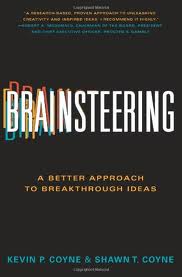
Brainsteering

Part of the “BookNotes” series – highlights from interesting books I’ve recently read

Brainsteering: A Better Approach to Breakthrough Ideas, by Kevin Coyne and Shawn Coyne

Brainsteering – taking all the creative energy normally associated with brainstorming and steering it in a more productive direction

2 Secrets to Brainsteering:

  1. If you ask the right questions, answers and good ideas will follow
  2. The right process for generating breakthrough ideas looks very different from what you’ve been taught

4 Criteria for the Right Question

  1. Forces you to take a perspective you haven’t taken before
  2. Limits the conceptual space you can explore
  3. Must still provide lots of highly attractive possibilities
  4. Just plain succeeds

5 Patterns of Right Questions

  1. Identifying unsolved customer questions
  2. “De-averaging” users and activities
  3. Exporing unexpected successes
  4. Imagining perfection
  5. Discovering unexpected headroom

Brainsteering Workshop

  • Understand the criteria that will be used to make decisions about the workshop ideas
  • Select the right questions
  • Choose the right people
  • Separate the group into small subgroups
  • Match the question to the subgroup
  • Isolate the idea crushers into one group (the Boss, the Bigmouth, the subject matter Expert)
  • Orient the participants
  • Conduct each ideation session according to a strict formula

Be a Curator

You don’t make a great museum by putting all the art in the world into a single room. 

That’s a warehouse

What makes a museum great is the stuff that’s not on the walls. Someone says no. A curator is involved, making conscious decisions about what should stay and what should go. There’s an editing process. There’s a lot more stuff off the walls than on the walls. The best is a sub-sub-subset of all the possibilities.

It’s the stuff you leave out that matters.

So constantly look for things to remove, simplify, and streamline. Be a curator. Stick to what’s truly essential. Pare things down until you’re left with only the most important stuff. Then do it again. You can always add stuff back in later if you need to.

What will you curate today?

The inspirational words above come from the book Rework by Jason Fried and David Heinemeier, the founders of 37signals.

If you don’t own it, you should.

The artwork is by illustrator Mike Rohde.


11 Best Books of 2011

Continuing an annual tradition, the final posts of the year are devoted to the importance of reading (covered in yesterday’s post) and my best book list for the year.

Making a “Best of” list is always hard – it’s a very subjective process, driven by my personal tastes, professional needs, and plain curiosity. It’s also hard to narrow it down: in 2011, I checked out 107 books from my local library, purchased 91 print books, and downloaded 37 on my Kindle. I also perused dozens of bookstores on my travels, writing down 77 titles for future acquisition. There were also a lot of late releases that I just didn’t have time to take a look at. Be that as it may, here is my list of favorite books published in 2011.

The Zappos Experience, Joseph Michelli

Onward: How Starbucks Fought for Its Life Without Losing Its Soul, Howard Schultz

Great by Choice: Uncertainty, Chaos, and Luck – Why Some Thrive Despite Them All, Jim Collins and Morten Hansen

Be Our Guest: Perfecting the Art of Customer Service, 2nd Edition, Disney Institute

Brilliance by Design: Creating Learning Experiences that Connect, Inspire, and Engage,

Vicki Halsey

The Orange Revolution, Adrian Gostick and Chester Elton


The Experience Economy, 2nd Ed, Joseph Pine and James Gilmore

Blah, Blah, Blah, Dan Roam


Missional Communities: The Rise of the Post-Congregational Church, Reggie McNeal

For the City: Proclaiming and Living Out the Gospel, Matt Carter and Darrin Patrick

Practically Radical, William C. Taylor

That’s my list for 2011 – if you are unfamiliar with any of the books listed above, I encourage you to check them out.

The new year is just around the corner, and the book releases are lining up already – I wonder what the Best of 2012 list will look like a year from now?

Drowning in Data?

How frequently does data overload affect you?

courtesy searchengineland.com

courtesy searchengineland.com

Christopher Frank and Paul Magnone, authors of Drinking from the Fire Hose, want you to take a short quiz. Answer each question with either “frequently” or “infrequently.” Give yourself one point for each time you answer “frequently.” If you score a 5 or higher, you probably want to come back tomorrow to look at some excerpts of their solution to drowning in data.

  • How often do you sit through a meeting that’s more about reporting the numbers than about learning from them?
  • How often do you leave a meeting with more questions than answers?
  • How often do your colleagues spend more time presenting the data than they do discussing the implications?
  • How often do you feel that preexisting beliefs affect the way data is interpreted?
  • Once the results are reported, how often does the conversation end up going down the dame old path instead of developing any new insights?
  • How often do you see data cited to confirm a point of view instead of to spark fresh insight?
  • How often do you learn nothing actionable from a data set?
  • How often do you feel you have to make a decisions before you’ve been able to review all the data at hand?
  • How often do you feel that you could make better decision for the organization if you just had a little more time?

Tomorrow: How to find truly essential nuggets of information and use them with confidence.