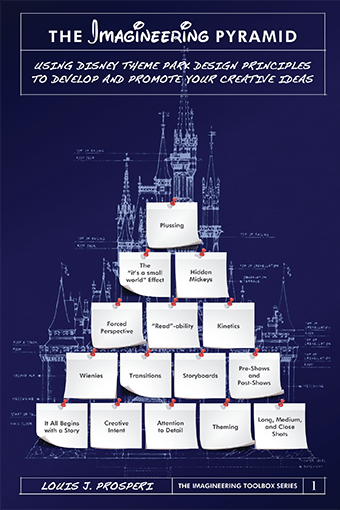
Honoring Walt Disney and His Legacy of Organizational Culture

Great leaders lead, teach, and develop organizational culture by being onsite and visible to their team.

When it came to learning about Disney culture and how things should be done at the park, we learned it all through Walt being there and watching what he did and said. He was there almost every weekend and he was there every Wednesday for the Park Operating Committee. We built what is known today as the Disney Culture through association with Walt.
– William “Sully” Sullivan, in his book “From Jungle Cruise Skipper to Disney Legend”

WaltDisney4

Walter Elias Disney was born on this date – December 5 –  in 1901.

Focus on the Ultimate to Make Your Vision Sharp

What does it take to gain the focus required to become a truly effective leader?

The Apostle Paul had absolute focus on his mission – a focus that enabled him to let go of everything that was not critical to his mission. In Philippians 3:5-9, Paul willingly discarded his heritage, his lineage, his former legalism, and his past zeal in order to advance his mission.

Paul’s focus was so sharp that he discarded everything he once counted gain. But he goes beyond that: he counted everything as garbage for the sake of obtaining Christ.

Leaders who want to change the world need to have this same kind of sharp focus. The keys are priorities and concentration. A leader who knows his priorities but lacks concentration knows what to do, but never gets it done. A leader with concentration but no priorities has excellence without progress. But when leaders harness both, they gain the potential to achieve great things.

John Maxwell, writing in The 21 Indispensable Qualities of a Leader says that leaders base their decisions on a variety of things:

  • The Ultimate – First things first
  • The Urgent – Loud things first
  • The Unpleasant – Hard things first
  • The Unfinished – Last things first
  • The Unfulfilling – Dull things first

Paul exemplifies a leader who focused on the ultimate every day. How about you? To get back on track with your focus, work on these items:

  • Work on yourself: you are your greatest asset or worst liability
  • Work on your priorities: fight for the important ones
  • Work in your strengths: you can reach your potential if you do
  • Work with your colleagues: you can’t be effective alone

Focus on the ultimate, and your vision will become sharper.


inspired by and adapted from The 21 Indispensable Qualities of a Leader by John Maxwell

The 21 Indispensable Qualities of a Leader

Will You Just Answer the Question Already?

The same question, coming from 3 different conversations with 3 different pastors over the course of 3 different days prompted this series of posts.

Q: How do you put together a team of leaders to guide a church through a new ministry initiative or project?

My reply is that you don’t just want a team, you need a high-performing team. The foundational work that I have used for several years is based on what Pat MacMillan, author of The Performance Factor, has described as the six characteristics of a high-performing team. 

The first characteristic was a common purpose. The second was crystal clear roles.

Here are the remaining four characteristics:

  • High performance teams need – no, demand – accepted leadership capable of calling out the levels of initiative and creativity that motivate exceptional levels of both individual and collective performance.
  •  High performance teams have effective processes. They identify, map, and then master their key team processes. They constantly evaluate the effectiveness of key processes, asking: How are we doing? What are we learning? How can we do it better?
  • High performance teams must work out of a foundation of solid relationships. The relational qualities of trust, acceptance, respect, courtesy, and a liberal dose of understanding are needed for high levels of team effectiveness.
  • High performance teams have excellent communication. No team can move faster than it communicates; fast, clear, and accurate communication is the key to thinking and acting collectively.
courtesy triaxiapartners.com

courtesy triaxiapartners.com

It’s a short list – only six characteristics. But each characteristic plays a specific and vital role in making the team effective. Notice the arrangement of the characteristics – a wheel shape. In a sense, each one is equal and necessary. If one of these six characteristics is missing or inadequate, the team is limping at best. Think of the wheel on your car: if it is out of balance or alignment, the performance is affected. What starts out as a distraction can turn into a disaster.

By the way, if you click on the image above, the link will take you to the website of author Pat MacMillan’s company for detailed explanations of each of the 6 characteristics, along with a wealth of other resources.

Back to your car’s alignment – the same is true for your team: if two or three of these characteristics are missing, your group is probably not a team at all.

Here’s my quick answer for the question above.

A: You start by bringing together a group of people who effectively demonstrate the six characteristics of a high-performing team. Once the team is together, the work begins.

TEAM + WORK = TEAMWORK

Now the fun begins…

inspired by and adapted from The Performance Factor by Pat MacMillan

The Performance Factor 

Still Answering the Question of the Week…

A continuing discussion coming from 3 different conversations with 3 different pastors over the course of 3 different days, but all having the same question:

Q: How do you put together a team of leaders to guide a church through a new ministry initiative or project? 

Pat MacMillan, author of The Performance Factor, and Seth Godin, author of Tribes, have been a great resource for me in working with church teams. Here is the second of several posts on the topic.

The first characteristic was a common purpose.

High performance teams are also characterized by crystal clear roles.

Every team member is clear about his or her particular role, as well as those of other team members. Roles are about how we design, divide, and deploy the work of the team. While the concept is compellingly logical, many teams find it very challenging to implement in practice. When they get it right, though, team members discover that making their combination more effective and leveraging their collective efforts is an important part to synergistic results.

Broadly speaking, there are three types of team roles:

  • Functional (technical) expertise team roles – qualities and knowledge each member brings to the team
  • Formal team roles – skills needed for a specific role like team leader or facilitator
  • General team roles – the expectations placed on any member of the team so that objectives are met

Role Design Criteria

  • Clear – everyone must have role clarity or you will have role confusion
  • Complete – cover the whole task – no gaps
  • Compatible – match tasks to individual strengths and skills
  • Complementary – configure roles so that one person’s accomplishment doesn’t hinder or block someone else from their task
  • Consensual – agree on who is to do what and how

This is my part of our job and no one is done until everyone is done

A: Defining the common purpose of the team is the first step of creating a team; that common purpose is the reason for cooperation. Following that, the church must develop an appropriate division of labor and create clear roles for team members. This is the strategy for cooperation.

 
inspired by and adapted from The Performance Factor by Pat MacMillan and Tribes by Seth Godin
The Performance FactorTribes

The Question of the Week is…

How do you put together a team of leaders to guide a church through a new ministry initiative or project?

3 different conversations with 3 different pastors over the course of 3 different days, but all having the same question!

As with all great questions, the answer begins with another question. One of the first I would ask is Why does this group exist? How that question is answered will determine, to a great measure, the success of the team. Pat MacMillan, author of The Performance Factor, and Seth Godin, author of Tribes, have been a great resource for me in working with church leadership teams.

The single most important ingredient in a team’s success is a clear, common, compelling task.

The power of a team flows out of each team member’s alignment to its purpose. The task of any team is to accomplish an objective and to do so at exceptional levels of performance. Teams are not ends in themselves, but rather a means to an end.

The power of teamwork flows out of alignment between the interests of individual team members and the mission of the team. MacMillan found that to achieve such alignment, team members must see the task as:

  • Clear – I see it.
  • Relevant – I want it.
  • Significant – It’s worth it.
  • Urgent – I want it…now!
  • Achievable – I believe it.

So you want to put together a leadership team for a specific project?

NEWS FLASH: There really is an “I” in team – if the individual members aren’t committed to a clear, common, and compelling task as individuals first, then you really won’t have much of a team.

So, the first answer to the question above?

A: First, the church needs to have a clear understanding of what the team is expected to accomplish. That clear purpose will serve as a guide to seeking individuals who will bring their collective wisdom together to form, over time, a team to accomplish the task.

inspired by and adapted from The Performance Factor by Pat MacMillan and Tribes by Seth Godin

The Performance FactorTribes

Book Summaries Strengthen Reading as a Discipline for Critical Thinking

Underneath the surface of every successful leader is a reader.

Reading provides the best regimen for establishing and nurturing the information necessary to lead others. Reading provides a constant stream of intelligence, ideas, and information that enables the leader to act from a foundation of knowledge.

A survey of the typical leader’s desk, workspace, or briefcase includes a stack of books, a pile of magazines, and at least one personal electronic device with access to a vast digital library of resources.

Having the right information is not as big a problem as much as having too much information!

Enter SUMS.

Screen Shot 2014-01-02 at 6.58.32 AM

For years Auxano Founder & Team Leader Will Mancini dreamed of providing a best of class and totally free book summary service to church leaders. In the fall of 2012, Mancini and his team launched just such a service, called SUMS – a biweekly book summary service.  

>Why Auxano created SUMS

Like many church leaders, Will loves reading, and appreciates book summaries. But he took it to the next level by creating a team who was serious about selection of books for church leaders, designed something great to look at, and created applications for the world church leaders live in every day. As Vision Room Curator, I get the privilege of leading that team – and I love it!

After a two-year run, SUMS underwent changes, including moving to a subscription-based platform which launched last January.

Beginning in 2015, we took the SUMS tool to a whole new level. Every other week subscribers receive not ONE, but THREE book “summaries” all focused around solving a practical church leadership problem. It’s called SUMS Remix.

SUMSRemixCovers

That’s 26 issues of SUMS Remix – addressing the ministry problems you encounter at your church – delivered to your inbox every two weeks.

In a nutshell why is SUMS Remix better?

  • You need content that solves the challenges you face every day
  • You want to scan more information in less time to find the best content
  • You will to achieve more with more credibility as well-read leader
  • You have ready-to-use staff action steps in each issue

For example, the first of four free introductory SUMS Remix focused on the problem, “We want leadership development to be happening all of the time, not just at special events.” To solve this problem we looked at Noel Tichey’s Leadership Engine, Aubrey Malphur’s book (co-authored with Auxano founder Will Mancini), Building Leaders, and Dave & Jon Ferguson’s book, Exponential.

Check it out for yourself and see if you would agree that this is an incredibly innovative content tool for the church. Here are the first four free introductory issues of SUMS Remix:

SUMS Remix 1 We want leadership development to be happening all the time, not just at special events.

SUMS Remix 2 It’s difficult inspiring my team to be more productive.

SUMS Remix 3 I communicate a lot, but don’t consider myself a great storyteller.

SUMS Remix 4 My stomach goes into knots when I think about preaching on the subject of giving.

Click here to subscribe to SUMS Remix. Imagine – an entire year of the gift of insight, delivered to the your inbox – for the low price of $48. 

Think of it as creating a personal leadership and innovation literacy program.

What If Leaders Thought Like Designers?

Then they would be familiar with these three words: Empathy, Invention, and Iteration.

Empathy –  design must start with establishing a deep understanding of those we are designing for. Leaders who thought like designers would put themselves in the shoes of their team or client. More than just “customer-centered” (that’s internal and external customers), the idea here is to know the “customer” as real people with real problems, not seeing them as statistics or targets or a cog in the machine. It involves understanding both their emotional and “rational” needs and wants. Great designs inspire – they grab us at an emotional level. Yet we often don’t even attempt to engage our customer or team at an emotional level – let alone inspire them.

courtesy annetteleach.com

courtesy annetteleach.com

Consider one of my favorite metaphors – the bridge. Now go to New York City with me and look at the bridges there: the Manhattan, the George Washington, the Williamsburg, and others – and then there is the Brooklyn Bridge. The others offer a route across the water. The Brooklyn Bridge does that too, but it also sweeps, symbolizes, and enthralls. It has, like other design icons such as the Sydney Opera House, become a symbol of the land it occupies and an inspiration to generations. Translate that same feeling to leading people, and you can begin to grasp empathy.

Invention – design is also a process of invention. Leaders who thought like designers would think of themselves of creators. Many people have talked about the “art and science” of leadership, but to be honest we focus mostly on the science aspect. All to often leaders play the role of scientist, investigating today to discover explanations for what has already happened, trying to understand it better. Designers invent tomorrow – they create something that isn’t. To get to growth, it is necessary to create something in the future that is different from the present. Powerful futures are rarely discovered primarily through analytics. Analysis is an important role, but it must be subordinate to the process of invention when the goal is growth.

Great design occurs at the intersection of constraint, contingency, and possibility

– Richard Buchanan, former Dean of Carnegie Mellon’s School of Design

 When leaders start the growth conversation with the constraints of budget and the hard road to success, we get designs for tomorrow that merely tweak today. Great design starts with the question “What if anything were possible?

courtesy en.structurae.de

courtesy en.structurae.de

To illustrate, let’s go back to New York City, this time to Central Park, one of America’s great public spaces. In 1857, the country’s first public landscape design competition was held to select the plans for this park. Only one plan – prepared by Frederick Law Olmstead and Calvert Vaux – fulfilled all the design requirements. Others were stymied by the requirement that crosstown vehicular traffic had to be permitted without marring the pastoral feel of the park. Olmstead and Vaux succeeded by eliminating the assumption that the park was a two-dimensional space. Instead, they imagined the park in three dimensions and sank four roads eight feet below the surface.

Iterate – Leaders who thought like designers would see themselves as learners. Leaders often default to a straightforward linear problem-solving methodology: define a problem, identify various solutions, analyze each, and choose one – the right one. Designers aren’t nearly so impatient,or optimistic. They understand that the successful invention takes experimentation and that empathy is hard won. So is the task of learning.

courtesy ikeainalmhult.com

courtesy ikeainalmhult.com

The IKEA way of business we know (and love!) today didn’t originally start out that way. Almost every element of IKEA’s legendary business model – showrooms and catalogs in tandem, knockdown furniture in flat parcels, and customer pick-up and assembly – emerged over time from experimental response to urgent problems. “Regard every problem as a possibility,” was IKEA founder Ingvar Kamprad’s mantra. He focused less on control and “getting it right” the first time and more on learning and on seeing and responding to  opportunities as they emerged.

A bridge, a park, and a business model – they share fundamental design principles:

  1. Aim to connect deeply with those you serve
  2. Don’t let your imagined constraints limit your possibilities
  3. Seek opportunities, not perfection

Is there a way for ChurchWorld leaders to think like designers?

inspired by and adapted from Designing for Growth by Jeanne Liedtka and Tim Ogilvie to fit ChurchWorld realities

updated from an earlier post

Seeing With Your Brain

We live in a culture rich with images. My generation (Boomers) grew up with television – maybe only 3 channels, but what a difference from our parents’ primary information – the radio and the spoken word only.

My kids (2 Gen X, 5 Gen Y) expanded on the basic television, first with cable, then videotapes, then the Internet, and then DVDs.

My 4 grandchildren? They are digital natives, taking visual communication to new – and participatory – levels with social media, smart phones, tablets, apps, streaming video of all types on many different devices, and who knows what’s around the corner.

We can’t escape the power of the visual image – and most of us don’t want to.

Most of us are visual learners. We like to see a picture, not just hear a word. Len Sweet has said that images are the language of the 21st Century, not words. Why?

Pictures stick. We remember pictures long after words have left us. Pictures communicate far more than mere words. There’s a simple reason:

We see with our brain.

Vision trumps all the senses. Half of the brain’s resources are dedicated to seeing and interpreting what we see. What our eyes physically perceive is only one part of the story. The images coming into our brain are changed and interpreted. So it’s really our brains that are “seeing.”

If we are on an increasing visual trend in our culture and we understand the importance of vision in our lives, then it follows that leaders should be leading the visual revolution, not just observing (pun intended) it.

With that in mind, I wanted to introduce you to a trio of resources that will help you know how to use visual tools, manage visual practitioners and their work, and understand how to help your entire organization be visually literate – especially if you don’t think of yourself as being skillful visually.

Visual Leaders

Visual Leaders will help you and your organization take advantage of the visualization revolution. Visualization is transforming the world of work and the role of leaders in an age of global communication and complexity. The book is a guide to increasing your own visual literacy and your ability to help others with theirs. (Download a free summary of this book here.)

Visual Meetings

Visual Meetings supports a group’s cycle of learning. Visual Meetings explains how you can use graphic recording, sticky notes, and idea mapping when imagining, engaging, thinking, or enacting in meetings. It is loaded with very practical and detailed descriptions of how to conduct different visualization activities. It also reviews the Group Graphics Keyboard and the seven archetypal choices for organizing displays.

Visual Teams

Visual Teams explains how to create and sustain team performance with visuals. Visual Teams builds on Visual Meetings and shows how to use these methods across the whole arc of a team process, including the parts in between meetings. It also provides a graphical user interface to thinking about team dynamics with the Team Performance Model. The seven challenges of high-performing teams are explained in detail and linked to tools that help meet them.

Got a pen?


You might also like:

Every Element in Your Presentation Has a Single Purpose…

…to make a change happen.

A presentation is a precious opportunity. It’s a powerful arrangement…one speaker, an attentive audience, all in their seats, all paying attention (at least at first).   – Seth Godin

Don’t waste it.

courtesy of Justin S. Campbell

courtesy of Justin S. Campbell

The purpose of a presentation is to change minds.

  • If all you’re hoping to do is survive the ordeal because of lack of preparation, you’re wasting people’s time.
  • If all you’re hoping to do is amuse and delight the crowd, you’re simply an entertainer.
  • If all you’re hoping to do is pass along information, put it in a document and email it to your audience.

But if you really want to make a change, to move from informing someone to influencing them, ask yourself these two questions:

  • Who will be changed by this presentation?
  • What is the change I seek?

The answers can range from simple to subtle to dramatic.

Once you have the answers, though, dive into it with all you’ve got.

Every element of your presentation – the room, the attendees, the length, the tone, any visual elements, the technology – exists for just one reason: to make it more likely that you will achieve the change you seek. If an element doesn’t do that, replace it with something that does, or throw it out.

If you fail to make a change, you’ve failed. If you do make change, you’ve opened the possibility you’ll be responsible for a bad decision or part of a project that doesn’t work. No wonder it’s frightening and far easier to just do a lousy presentation.   – Seth Godin

A presentation isn’t an obligation – it’s a privilege.

inspired by Seth Godin, Bert Decker, Garr Reynolds, Nancy Duarte, and Andy Stanley

Where Does Your Guest Experience Start?

When a Guest pulls into your parking lot for your weekend worship experience, do you consider that the beginning of your Guest Experience process?

Elevation Parking 2

I hope not.

How you answer the question asked in the title of this post may very well be one of the most important determining factors of the success of your Guest Experiences.

Your Guest’s Experience with your organization begins well in advance of pulling into your parking lot and finishes long after leaving.

How so?

Consider that many first time Guests to your church “check you out” online in advance of coming. For many, your “digital doorway” is their first impression. How’s that working for you?

Another, less obvious connection is with your physical facility – owned, leased, whatever. Everyone driving buy 24/7 gets a subtle – but sometimes very overt – message about you from your facility. What do your Guests see Monday – Friday? What about the weekend?

Any kind of communication – print, digital, verbal – is also making an impression on your Guests. Are you intentional in your communication? When your Guest arrives, will their experience in reality match up with the expectations created by your communications?

There are other examples, but I think you get the point: your Guest Experience starts long before – and continues well after – you Guest is physically present.

So where does your Guest Experience actually begin?

  • Is it a thought process triggered by events in a Guest’s life (good or bad)? People undergoing life change will often instinctively reach out to the church for comfort or growth opportunities.
  • Is it when your regular attenders verbally ask their friends and neighbors to join them for the new series you’re starting next week?
  •  Is it a more direct contact, like a print piece or other form of marketing that landed in their mailbox, or their inbox?
  • Is it the story your facility tells – one that invites people into a place, expecting something positive and uplifting to occur?
  • Is it when your church is seen out and about in the community, serving others in a visible and noticeable way?

All of the above – and many more you can think of – occur before a Guest physically comes onto your property.

For whatever reason, a Guest is thinking about, or has decided, to come to your place.

For them, the Guest Experience has already begun.