Conduct Visual Meetings to Boost Productivity

Do your meetings tend to suck the wind out of your team, instead of filling its sails?

There’s nothing more annoying than a meeting that goes on and on and on – except maybe a meeting that goes on and on and on AND doesn’t accomplish anything.

Many ministry teams fritter away precious time during meetings on unfocused, inconclusive discussion rather than rapid, well-informed decision making. The consequences are delayed decisions that lead to wasted resources, missed opportunities, and poor long-range planning.

Want more successful meetings? Try the following solution and your team will look forward to meetings instead of avoiding them.

Conduct visual meetings to boost productivity.

remix8-2fb1

THE QUICK SUMMARY – Visual Meetings, David Sibbett

Visual Meetings explains how anyone can implement powerful visual tools to facilitate both face-to-face and virtual group work. This dynamic and richly illustrated resource gives meeting leaders, presenters, and consultants a slew of exciting tricks and tools to unlock creativity, collaboration, and breakthrough thinking.

Using techniques like graphic recording, visual planning, story boarding, graphic templates, idea mapping and more, Visual Meetings will help you and your team communicate ideas more effectively and engagingly.

A SIMPLE SOLUTION

Used properly, a simple drawing is more powerful than any data spreadsheet or software presentation platform. It can help us crystalize ideas, think outside the box, and communicate in a way that other people simply “get.”

Over the last decade, the concept of utilizing visualization techniques has moved beyond a few talented practitioners to become available to – and useful for – any leader.

Anyone can clarify a problem or sell an idea by visually breaking it down using a simple set of visual-thinking tools. Thinking with pictures can help you discover and develop new ideas, solve problems in unexpected ways, and dramatically improve your ability to share your insights.

In my experience, visualizing meeting purposes and objectives is one of the most helpful things you can do to make a meeting work. And getting people involved early in talking about expectations and hoped-for outcomes is even more effective. Because people are free to imagine whatever they want and often do, this investment is the first step in focusing group intelligence.

The Power of Visual Meetings

Participation – Engagement explodes in meetings when people are listened to and acknowledged by having what they say recorded in an interactive, graphic way.

Big Picture Thinking – Groups get much smarter when they can think in big picture formats that allow for comparisons, pattern finding, and idea mapping.

Group Memory – Creating memorable media greatly increases group memory and follow-through – a key to productivity.

Benefits of Visualization

  • Visual recording in a meeting immediately acknowledges that someone was heard and how they were heard in ways that verbal communication alone does not.
  • Working visually is deeply integrative – it combines both visual (right brain) and verbal (left brain) ways of operating with interaction and physical movement.
  • Graphic displays can contain contradictory information on the same sheet of paper, softening the either/or thinking that our spoken language reinforces.
  • Working with graphic metaphors allows people to talk directly about how they are making sense of things.
  • Working with visual imagery taps people’s imagined realms, making the stuff of hopes and dreams, intentions, and visions more accessible.
  • Arranging information on pages or wall displays addresses not only the individual words and symbols, but also their overall interconnections and organization.
  • Translating from spoken word to visual representation forces everyone to become conscious of the patterns in both.

David Sibbet, Visual Meetings

A NEXT STEP

In order to start your team thinking about a visual meeting, you have to begin before the meeting. Consider taking these actions in advance of your next team meeting:

  • Create a poster with a catchy title and simple graphic image and place it at eye level outside your meeting room door.
  • Using a chart tablet or white board, have meeting participants sign in with their first name and a pressing issue or question related to your meeting.
  • Prior to the meeting, visually list your agenda on a chart tablet or white board.
  • Using a chart tablet, create a scorecard listing decisions made, action items agreed on, and individual responsible. During successive meetings update and add to this scorecard as needed.
  • During the meeting, ask participants to visually illustrate the conversation and decisions of the meeting. Build in time at the end of the meeting for each participant to briefly share his or her “visual notes” with the rest of the team.

After one month of following the above actions, schedule one hour to review, evaluate, and revise your team’s use of visual meeting practices.

Many church leaders view meetings as a necessary evil to accomplish ministry assignments and tasks. The solution presented above demonstrates that not all meetings are necessary, and the right kind of meeting doesn’t have to be evil.


Part of a weekly series on 27gen, entitled Wednesday Weekly Reader

Regular daily reading of books is an important part of my life. It even extends to my vocation, where as Vision Room Curator for Auxano I am responsible for publishing SUMS Remix, a biweekly book “summary” for church leaders. I’m going to peruse back issues of both SUMS and SUMS Remix and publish excerpts each Wednesday.

You can find out more information about SUMS Remix here. Subscribe to SUMS Remix here.
Leaders Know How to Say “No” Gracefully

Does your organization try to do too much?

Every day ministry leaders spend too much time, managing too much church stuff, for too little life-change. It is safe to say that the church in North America is over-programmed and under-discipled.

Behind this reality is a super-irony: The result of our gospel work is limited, not by our lack of ministry activity, but by our excess.

  • We get too little not because of lacking motivation.
  • We get too little not because we need a better toolbox.
  • We get too little, and money is not the problem.

The gospel-centered, life-change impact of church is actually inhibited by the preponderance of offerings at church. We get too little precisely because we have too much.

It’s time to learn the power of “no.”

remix6-2fb1

THE QUICK SUMMARY – Essentialism, by Greg McKeown

The Way of the Essentialist isn’t about getting more done in less time. It’s about getting only the right things done.  It is not a time management strategy, or a productivity technique. It is a systematic discipline for discerning what is absolutely essential, then eliminating everything that is not, so we can make the highest possible contribution towards the things that really matter.

By forcing us to apply a more selective criteria for what is Essential, the disciplined pursuit of less empowers us to reclaim control of our own choices about where to spend our precious time and energy – instead of giving others the implicit permission to choose for us.

Essentialism is not one more thing – it’s a whole new way of doing everything. A must-read for any leader, manager, or individual who wants to learn who to do less, but better, in every area of their lives, Essentialism is a movement whose time has come.

A SIMPLE SOLUTION

Leaders today often feel like they should load up their calendars to the max, doing everything they possibly can to expand their horizons and improve their organizations. In this age of abundant information and easy access to knowledge, leaders are often driven to have and do it all. However, this mindset soon runs headlong into an unfortunate fact: we can’t do everything.

Instead, we should be focusing on what we should do, thinking instead about what is essential to our lives.

Remember that anytime you fail to say “no” to a nonessential, you are really saying “yes” by default.

Without courage, the disciplined pursuit of less is just lip service. Anyone can talk about the importance of focusing on the things that matter most – and many people do – but to see people who dare to live it is rare.

Once you have sufficiently explored your options, the question you should be asking yourself is not: “What, of my list of competing priorities, should I say yes to?” Instead, ask the essential question: “What will you say no to?”

This is the question that will uncover your true priorities. It is the question that will reveal the best path forward for your team. It is the question that will uncover your true purpose and help you make the highest level of contribution not only to your own goals but to the mission of your organization. It is that question that can deliver the rare and precious clarity necessary to achieve game-changing breakthroughs in your life.

Greg McKeown, Essentialism

A NEXT STEP

Daring to say no doesn’t mean saying no to all requests. It’s important to learn to say no to the nonessentials so we can say yes to the things that really matter. Leaders need to learn to say no – frequently and gracefully – to everything but what is truly vital.

How do you learn to say no gracefully? Here are some general guidelines for delivering a graceful “no.”

  • Separate the decision from the relationship
  • Saying “no” doesn’t have to mean using the word “no”
  • Focus on the trade-off
  • Remind yourself that everyone is selling something
  • Make peace with the fact that saying “no” often requires trading popularity for respect
  • Remember that a clear “no” can be more graceful than a vague or noncommittal “yes”

Saying no is its own leadership skill and follows any skill development path. You start out with little experience, and then learn basic techniques. As you make mistakes, you learn from them. You keep developing more skills and practicing them. In time, you will learn a whole new skill set.

In this case, it’s the skill of saying “no.”

Sometimes abandoning what’s been around for years is the right move, even if you’ve put a lot of time, effort, and other resources into it.

Doing less will actually make your ministry better in the long run.


Part of a new series on 27gen, entitled Wednesday Weekly Reader

Regular daily reading of books is an important part of my life. It even extends to my vocation, where as Vision Room Curator for Auxano I am responsible for publishing SUMS Remix, as biweekly book “summary” for church leaders. I’m going to peruse back issues of both SUMS and SUMS Remix and publish excerpts each Wednesday.

You can find out more information about SUMS Remix here. Subscribe to SUMS Remix here.

Do You Communicate a Lot, But Don’t Consider Yourself a Great Storyteller?

Have your eyes ever glazed over as a speaker drones on and one, spouting statistics and facts? Do you even remember anything an hour later? What about the next day?

Now it’s your turn to be in front of your team. How are you going to reach and connect with them?

Do you communicate a lot, but don’t consider yourself a great storyteller?

It’s time to reach back in human history, and turn to the power of the story.

Storytelling has existed as the primary means of communicating among people even long before writing was developed. Success was measured by how much the audience remembered and a high value was placed on techniques that helped people remember things.

In spite of all the technological marvels available to leaders today, the simple but powerful use of a story often translates your ideas into realities in the listener’s minds. Stories are effective when they lodge in the heart of the listener, and are then acted on.

Solution #3 Make the listener, not you, the hero of your story

THE QUICK SUMMARY – Resonate, by Nancy Duarte

sums-remix-3Resonate leverages techniques normally reserved for cinema and literature, revealing how to transform any story into an engaging journey. Using the techniques in Resonate, you’ll be able to:

  • Leverage the hidden story structures inherent in great communication
  • Connect with your audience empathetically
  • Create captivating content
  • Craft ideas that get repeated
  • Inspire enthusiasm and support for your vision

Stories are the most powerful delivery tool for information, more powerful and enduring than any other art form.

A Simple Solution

Wouldn’t you like to have your audience leaning forward in their seats, anticipating the next few words you will be saying? A great story has that effect on listeners, and it begins with making the listener the hero of your story.

When trying to connect with someone while telling a story, you have to remember that it’s not all about you.

You are not the hero who will save the audience; the audience is your hero.

You need to defer to your audience because if they don’t engage and believe in your message, you are the one who loses. Without their help, your idea will fail.

Leaders need to take this to heart, place the people in the audience at the center of the action, and make them feel that the presentation is addressing them personally.

So what’s your role, then? You are the mentor. The audience is the one who’ll do all the heavy lifting to help you reach your objectives. You’re simply one voice helping them get unstuck in their journey.

When you change your stance from thinking you’re the hero to acknowledging your role as a mentor, you will find your viewpoint altered. A mentor has a selfless nature and is willing to make a personal sacrifice so that the hero can reach the reward. Audience insights and resonance can only occur when a presenter takes a stance of humility.

Nancy Duarte, Resonate

A NEXT STEP

Changing your stance from that of the hero to one of the storyteller will connect the listeners to your idea and make them the hero. When listeners become the hero and connect to your idea, they will change.

Good church leaders are telling stories all the time. As you prepare for your next leadership speaking opportunity it’s easy to become the center of the story. Remember to make the listener the hero instead of you.

By offering a clear choice of what is (their present situation) with what could be (a better future), the people you lead become the hero. As you preach, are you making members of the congregation the hero? When you lead your church in a capital campaign, they are the heroes. As a team leader, your team should be the hero. In a small group, the group members are the hero.

Of course, every story related to the Gospel makes Jesus the hero.

Ultimately, you need to make your story about Jesus.

How will you know if you are becoming more effective with your stories? It’s simple: you will be accomplishing whatever you had hoped to accomplish by telling the story in the first place.

It’s time for you to step out and lead through your stories!


Part of a new series on 27gen, entitled Wednesday Weekly Reader

Regular daily reading of books is an important part of my life. It even extends to my vocation, where as Vision Room Curator for Auxano I am responsible for publishing SUMS Remix, as biweekly book “summary” for church leaders. I’m going to peruse back issues of both SUMS and SUMS Remix and publish excerpts each Wednesday.

You can find out more information about SUMS Remix here. Subscribe to SUMS Remix here.

Book Summaries Strengthen Reading as a Discipline for Critical Thinking

Underneath the surface of every successful leader is a reader.

Reading provides the best regimen for establishing and nurturing the information necessary to lead others. Reading provides a constant stream of intelligence, ideas, and information that enables the leader to act from a foundation of knowledge.

A survey of the typical leader’s desk, workspace, or briefcase includes a stack of books, a pile of magazines, and at least one personal electronic device with access to a vast digital library of resources.

Having the right information is not as big a problem as much as having too much information!

Enter SUMS.

Screen Shot 2014-01-02 at 6.58.32 AM

For years Auxano Founder & Team Leader Will Mancini dreamed of providing a best of class and totally free book summary service to church leaders. In the fall of 2012, Mancini and his team launched just such a service, called SUMS – a biweekly book summary service.  

>Why Auxano created SUMS

Like many church leaders, Will loves reading, and appreciates book summaries. But he took it to the next level by creating a team who was serious about selection of books for church leaders, designed something great to look at, and created applications for the world church leaders live in every day. As Vision Room Curator, I get the privilege of leading that team – and I love it!

After a two-year run, SUMS underwent changes, including moving to a subscription-based platform which launched last January.

Beginning in 2015, we took the SUMS tool to a whole new level. Every other week subscribers receive not ONE, but THREE book “summaries” all focused around solving a practical church leadership problem. It’s called SUMS Remix.

SUMSRemixCovers

That’s 26 issues of SUMS Remix – addressing the ministry problems you encounter at your church – delivered to your inbox every two weeks.

In a nutshell why is SUMS Remix better?

  • You need content that solves the challenges you face every day
  • You want to scan more information in less time to find the best content
  • You will to achieve more with more credibility as well-read leader
  • You have ready-to-use staff action steps in each issue

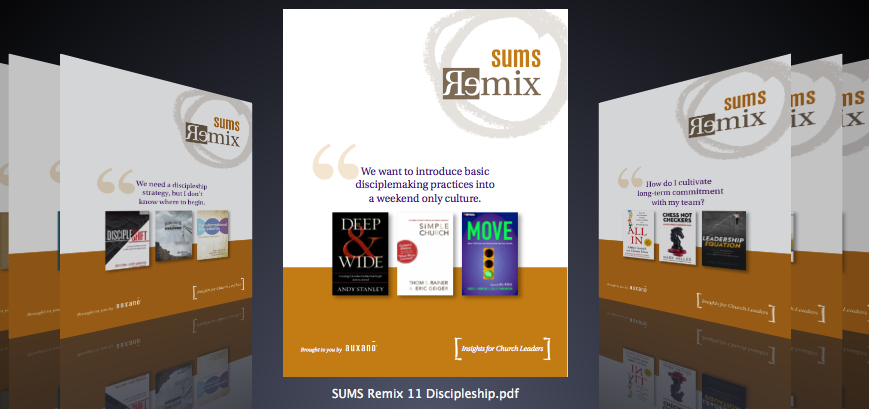
For example, the first of four free introductory SUMS Remix focused on the problem, “We want leadership development to be happening all of the time, not just at special events.” To solve this problem we looked at Noel Tichey’s Leadership Engine, Aubrey Malphur’s book (co-authored with Auxano founder Will Mancini), Building Leaders, and Dave & Jon Ferguson’s book, Exponential.

Check it out for yourself and see if you would agree that this is an incredibly innovative content tool for the church. Here are the first four free introductory issues of SUMS Remix:

SUMS Remix 1 We want leadership development to be happening all the time, not just at special events.

SUMS Remix 2 It’s difficult inspiring my team to be more productive.

SUMS Remix 3 I communicate a lot, but don’t consider myself a great storyteller.

SUMS Remix 4 My stomach goes into knots when I think about preaching on the subject of giving.

Click here to subscribe to SUMS Remix. Imagine – an entire year of the gift of insight, delivered to the your inbox – for the low price of $48. 

Think of it as creating a personal leadership and innovation literacy program.

Is It True Collaboration… or Is It a Team?

At Auxano, we practice what we preach.

Editing

Our primary tool for working with organizations is the Vision Frame, consisting of Mission, Values, Strategy, Measures, and Vision Proper. Before we led the first client through the process over 11 years ago, the original team of Will Mancini, Jim Randall, and Cheryl Marting worked out Auxano’s Vision Frame – which we still follow today.

One of our Values is Collaborative Genius, which is accomplished partly by the fact that we are a virtual company of over 20 team members living in 15 cities across 4 time zones.

I only thought I knew what collaboration meant!

In my adult work career, I have served as the accountant in an office setting for a food services company, an audiovisual technician as part of a team of 7 for a seminary, various roles on 3 church staff teams, a church consultant for a design-build company, and as the Vision Room Curator for Auxano.

That’s 36+ years in an environment of multiple team members, ostensibly working together for the good of the organization.

Was I collaborating with others, or merely part of a team?

Collaboration is not the same thing as teamwork. Teamwork is simply doing your part. Collaboration involves leveraging the power of every individual to bring out each other’s strengths and differences.  – Greg Cox, COO, Dale Carnegie, Chicago

At Auxano, we don’t just do our part, we collaborate to deliver excellence in all we do. Here’s a great example: our book summaries for leaders, called SUMS Remix.

The original concept of SUMS was dreamed up by our founder, Will Mancini. When I joined Auxano as Vision Room Curator, it was natural that the SUMS project fall under my guidance. Working from a curated list of books with a focus on the Vision Frame, I read the designated book and wrote the draft summary with recommended resources. I then oversaw the following process:

  • Proofing by Mike Gammill, a scholar and grammatical genius
  • Navigator Applications written by 4 of our full-time Navigators, applying the concepts to the local church leadership context thru their unique lenspowered by auxano
  • Editing by Cheryl Marting, who has eagle eyes
  • Review editing by Angela Reed, a production editor at our parent company, LifeWay
  • Design by James Bethany and our Creative Team, who produce a visual masterpiece every time
  • Final review and approval by Will

Beginning in the fall of 2012, every two weeks, a SUMS was distributed to the SUMS subscriber list. Practically every day of that two weeks, some of the actions above were taking place within our team as we work on multiple books at the same time.

That’s collaboration.

As we neared the end of our second year of SUMS, Will and I refined a concept that came to be called SUMS Remix. Instead of a single summary of one book, SUMS Remix consists of brief excerpts from three books, focused on providing simple solutions to a common problem statement that ministry leaders are facing every week in their churches.

SUMS Remix launched in November of 2014, and we release an issue every two weeks. And a similar collaboration process described above is still taking place.

The collaboration process for SUMS Remix is very similar to the one above, but on steroids! Because SUMS Remix involves 3 books for every issue, and we have a 5 week production cycle, and we release an issue every two weeks – well, without collaboration, it just wouldn’t – no, couldn’t – happen.

At any given time during that 5-week cycle, books are being read, notes are being taken, drafts are being written, drafts are being revised, additional research is being conducted, finished drafts are being designed, proofs are being reviewed, and the final SUMS Remix issue is being delivered.

That’s collaboration!

Want to see the end product of that collaboration? You can learn more about SUMS Remix here.

Midnight LunchI’m indebted to Sara Miller Caldicott, great grandniece of Thomas Edison and author of the book Midnight Lunch, for translating Edison’s world-changing innovation methods for use in the 21st century. Here are some of her thoughts on collaboration:

True collaboration embraces:

  • A discovery learning mindset versus a pure task orientation
  • A belief in anticipating and creating rather than merely reacting and responding
  • Presence of inspiration across multiple facets of both individual and team endeavors
  • Coherence of purpose
  • A dedication to elevating the performance of every team member
  • Connections to human and social networks of influence

Do these qualities sound different from the ones valued by your team? Do they draw upon ideas that feel new or seem broader than your current concept of what teamwork embraces?

Based on my experience, the answer would be yes.

So what are you going to do about it?