Life on the road allows you to separate yourself from the comforts of the familiar, meet people you might never encounter otherwise, embrace the process of self-discovery, and return home transformed. Invariably, the rejuvenated sense of life purpose that flows out of the journey comes with the realization that creating purpose is itself a lifelong endeavor.
In the first half of the 18th century, the city of Philadelphia, Pennsylvania, stood as the primary entry point for a monumental demographic shift – the mass emigration of German-speaking peoples from the beleaguered territories of the Holy Roman Empire. This was not a trickle, but a flood of humanity, seeking refuge and opportunity under William Penn’s promise of religious liberty and fertile land. The generational journey of the Adam family, originating in the German state of Baden, serves as a powerful microcosm of this vast, complex movement that would ultimately shape the cultural and geographic contours of colonial America, from the Quaker city to the Carolina frontier.
The forces driving this exodus were profound: the incessant warfare and economic devastation plaguing regions like the Palatinate, coupled with religious tensions. For families like that of Johannes Nicholas Adam, born in Eichtersheim, Cannstatt, Baden, in 1695, the New World offered the only viable hope for the future. After marrying Juliana Bernadina Schweikhardt in 1719, Johannes made the life-altering decision to emigrate. Their specific journey illustrates the mid-stream pace of this migration: they arrived in Philadelphia on the ship William and Sarah on September 18, 1727. This single date marks their transition from subjects of the German Empire to newcomers in British Colonial America.
From Philadelphia’s Docks to Lancaster’s Fields
While Philadelphia’s docks offered the initial welcome, the city itself was merely a temporary staging ground. The true goal for the majority of German immigrants was land, a resource that had become increasingly scarce in their homeland. The journey inland from the Delaware River port was arduous, but the reward was the deep, rich topsoil of the rolling countryside to the west. This territory would coalesce into Lancaster County, Pennsylvania.
The “Palatines,” as the immigrants were generically known, quickly established themselves as meticulous and industrious farmers, introducing techniques like crop rotation and the construction of sturdy, stone barns that became the signature of the Pennsylvania German landscape. Johannes Adam’s successful transition from immigrant to landowner is documented in the colonial records: he received a substantial 200-acre land grant in Lancaster County on February 28, 1734. This acquisition was the culmination of the original journey, securing a foundation for the family’s immediate future in agriculture and community building. For the second generation, Lancaster became their homeland, characterized by the use of the Pennsylvania German dialect and the strong social structure centered around Lutheran and German Reformed churches.
The Great Wagon Road and the Southern Push
Within a few short generations, the success and burgeoning population of the Pennsylvania German communities created a new challenge: land saturation. As land prices rose in Lancaster, the younger generations began to look southward, hearing reports of cheaper, equally fertile territory in the interior of the southern colonies. This second, internal migration followed a pivotal colonial thoroughfare known as the Great Wagon Road. This rough-hewn path, also called the Carolina Road or the Philadelphia Wagon Road, originated in Pennsylvania, followed the path of the Great Valley of Virginia, and descended into the backcountry of North and South Carolina.
The book details the history of the Great Wagon Road, the more than 800-mile artery that began in Philadelphia, passed through Pennsylvania towns like Lancaster and York, and stretched southwest through the Shenandoah Valley into the backcountry of Maryland, Virginia, North Carolina, and ultimately Augusta, Georgia.
Rouse emphasizes that the road, which often followed ancient Native American trails, was the primary pathway for the mass settlement of the Southern backcountry in the 18th century. Tens of thousands of European immigrants – most notably Scots-Irish and German (Palatine) settlers noted above – traveled this rugged route from the congested areas of Pennsylvania to find inexpensive farmland and economic opportunity in the South.
The book showcases how this colonial “superhighway” was instrumental in promoting trade, aiding military movements during the French and Indian War and the American Revolution, and establishing the unique culture and communities of the inland Southern colonies. It frames the Great Wagon Road as an essential part of the nation’s formative years and its original immigrant highway.
The Great Wagon Road was the conduit for the (now) Adams family’s next crucial move. In the 1750s, John Adams (son of Johannes Nicholas Adam) left the established prosperity of Lancaster County and made the weeks-long trek south. His destination was the emerging settlement of Salisbury in Rowan County, North Carolina. This region, far from the coastal elite, offered the space and opportunity John sought.
The Conestoga Wagon: Engine of the Southward Migration
The very mechanism that made the multi-generational journey of the German immigrants possible was the Conestoga wagon (see image above), a heavy, durable freight vehicle developed specifically in Lancaster County. Named for the Conestoga Valley where it originated, this “ship of the inland commerce” was perfectly adapted to the rugged colonial roads. Its distinctive curved bed prevented the cargo – the families’ entire worldly possessions, tools, and provisions – from shifting or falling out on steep grades. Pulled by a team of four to six strong horses, the Conestoga wagon became the essential engine of migration, carrying thousands of Pennsylvania German families, including those like the Adams family, down the treacherous, rutted path of the Great Wagon Road. Its development was a crucial innovation that tied the prosperous Pennsylvania German settlements to the newly opening lands of the South.
A Legacy of Skill: From Farm to Pottery Kiln
Upon arriving in Rowan County, John Adams and his son did not merely replicate the agricultural existence of their Lancaster forebears. They carried with them, or quickly established, a vital trade that catered to the nascent frontier economy: pottery. John Adams, who purchased a lot in 1755, is recognized as the first documented potter of European descent in Salisbury. Most pottery was lead-glazed earthenware, and reflects the German earthenware traditions of Central Europe. Salisbury’s pottery tradition is part of North Carolina’s rich ceramic history, influenced by the Quaker community in the Piedmont region, as well as the Moravian settlement in Salem.
This occupational shift highlights the diverse skills German immigrants contributed to the American frontier. While farming provided sustenance, skilled trades like pottery provided essential goods and economic diversification. They utilized the local clays and the knowledge of European glazing and firing techniques to produce necessary stoneware and earthenware, establishing a lineage of artisans.
My Adams family’s journey – from the Baden homeland to the Philadelphia port, to the agricultural heartland of Lancaster, and finally, to the pioneering industrial craft of Rowan County – perfectly encapsulates a three-part epic of early German immigration. Their story is a powerful testament to the resilience and enduring impact of a people whose search for freedom and better fortune indelibly marked the cultural landscape of the American South.
Part of a regular series on 27gen, entitled Wednesday Weekly Reader.
During my elementary school years one of the things I looked forward to the most was the delivery of “My Weekly Reader,” a weekly educational magazine designed for children and containing news-based current events.
It became a regular part of my love for reading, and helped develop my curiosity about the world around us.
Photo Credits: Philadelphia Water Department, Explore Pennsylvania History
In today’s diverse environments, the ability to communicate effectively across generations is a crucial skill for Modern Elders. As seasoned professionals with a wealth of experience, Modern Elders are uniquely positioned to bridge generational divides, fostering understanding and collaboration. This article explores the art of intergenerational communication, focusing on connecting with people of all ages and understanding different generational perspectives and values.
The Multigenerational Workplace
Today’s workplace can span five generations:
Traditionalists (born before 1946)
Baby Boomers (born 1946-1964)
Generation X (born 1965-1980)
Millennials (born 1981-1996)
Generation Z (born 1997-2010)
Alpha (born 2011-2025 est.) Not a “working” generation yet, but still important!
Each generation brings its own set of experiences, values, and communication styles to the table. For Modern Elders, typically from the Baby Boomer or early Gen X cohorts, understanding and navigating these differences is key to effective leadership and collaboration.
In today’s multigenerational workplace, Modern Elders play a crucial role in bridging age gaps and fostering collaboration. By employing specific strategies, these experienced professionals can effectively connect with colleagues of all ages, creating a harmonious and productive work environment. The following tips offer practical guidance for Modern Elders seeking to enhance their intergenerational communication skills and build stronger relationships across age groups.
To connect with people of all ages, Modern Elders can employ several strategies:
Practice Active Listening: Give your full attention to speakers of all ages, demonstrating that you value their input regardless of their years of experience.
Avoid Assumptions: Don’t assume that younger colleagues are inexperienced or that older ones are out of touch. Approach each individual with an open mind.
Find Common Ground: Look for shared interests or experiences that can serve as a foundation for building relationships across age groups.
Embrace Technology: Be open to using communication tools preferred by younger generations, such as instant messaging or video calls.
Share Your Experience Judiciously: Offer your insights when relevant, but avoid constantly referencing “the way things used to be done.”
Be a Mentor and a Mentee: Offer guidance to younger colleagues while also being open to learning from them in areas where they excel.
Understanding Generational Perspectives and Values
Generational differences in the workplace can present both challenges and opportunities for Modern Elders. By understanding the unique perspectives and preferences of each generation, shaped by their distinct historical and cultural experiences, these seasoned professionals can adapt their communication and leadership styles to bridge generational gaps effectively. This overview explores the characteristics of different generations and provides strategies for fostering cross-generational understanding and collaboration.
Each generation’s worldview is shaped by the events, technologies, and social norms of their formative years. Understanding these influences can help Modern Elders communicate more effectively:
Traditionalists and Baby Boomers: Often value hard work, respect for authority, and face-to-face communication. They may prefer more formal communication styles.
Generation X: Tends to value work-life balance, independence, and adaptability. They often appreciate direct, efficient communication.
Millennials: Often prioritize purpose-driven work, collaboration, and work-life integration. They typically prefer frequent feedback and digital communication.
Generation Z: Tends to value diversity, entrepreneurship, and social responsibility. They often prefer brief, visual forms of communication and are highly tech-savvy.
To bridge these differences:
Adapt Your Communication Style: Flex between formal and casual styles as appropriate for your audience.
Explain the “Why“: Younger generations often want to understand the reasoning behind decisions or processes.
Be Open to New Ideas: Show willingness to consider alternative approaches suggested by colleagues of different generations.
Address Generational Stereotypes: Help dispel misconceptions different generations may have about each other.
Highlight Shared Goals: Focus on common objectives to unite team members across generational lines.
Challenges and Opportunities
In today’s diverse environments, intergenerational communication presents both challenges and opportunities. While differences in work styles, communication preferences, and career expectations can create friction, they also offer potential for growth and innovation. Modern Elders are uniquely positioned to navigate these dynamics, serving as bridge-builders who can harness the power of generational diversity to drive organizational success. Their role encompasses several key areas that contribute to a thriving, multigenerational work environment.
Intergenerational communication can present challenges, such as differing expectations about work habits, communication preferences, and career trajectories. However, these challenges also offer opportunities for growth and innovation. Modern Elders can play a crucial role in:
Facilitating Knowledge Transfer: Bridge the gap between institutional knowledge and fresh perspectives.
Fostering Innovation: Combine experienced insights with new ideas to drive creative solutions.
Building Strong Teams: Create cohesive teams that leverage the strengths of each generation.
Developing Future Leaders: Mentor younger colleagues while learning from their unique skills and viewpoints.
Continuous Learning and Adaptation
Effective intergenerational communication is a skill that requires ongoing development and refinement. For Modern Elders to truly excel in this area, they must embrace a mindset of continuous learning and adaptation. By actively engaging with diverse perspectives and staying attuned to evolving workplace dynamics, these seasoned professionals can enhance their ability to bridge generational gaps and foster a more inclusive, collaborative environment. The following strategies offer practical ways for Modern Elders to hone their intergenerational communication skills.
To excel in intergenerational communication, Modern Elders must commit to continuous learning and adaptation:
Stay Informed: Keep up with current events, pop culture, and technological trends to relate to younger colleagues.
Seek Feedback: Regularly ask for input on your communication style and effectiveness from colleagues of various ages.
Attend Diversity Training: Participate in workshops focused on generational diversity and inclusion.
Practice Empathy: Try to understand the unique challenges and perspectives of each generation.
Lead by Example: Demonstrate openness, respect, and adaptability in your own communication style.
Mastering intergenerational communication is a powerful skill for Modern Elders. By connecting with people of all ages and understanding diverse generational perspectives, Modern Elders can become invaluable bridges in the multigenerational workplace. This ability not only enhances team cohesion and productivity but also ensures that the Modern Elder remains a relevant, respected, and influential figure in today’s dynamic professional landscape.
As you navigate the complexities of intergenerational communication, remember that at its core, effective communication is about respect, empathy, and openness. By embodying these qualities and continuously adapting your approach, you can leverage your experience to foster understanding, collaboration, and innovation across generations.
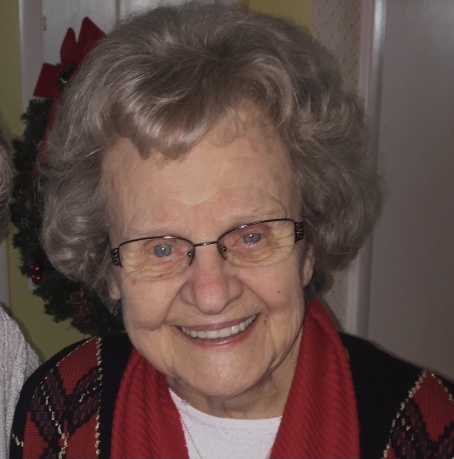
In the all-too brief period from December 11, 2020, to January 2, 2021, my mother-in-law Mary Grey Randolph went from living at home with a full-time caregiver to the hospital for surgery back to home for recovery, and then back to the hospital briefly, before moving to hospice care for two days, before passing on 1/2/21.
We shared a birthdate, and she often joked and wondered if I would ever catch up with her – and oh, by the way, she was planning on living to be 100.
Though she didn’t quite make it to her 100th birthday, she was living in her 100th year, so she gets full credit for that!
Mimmie, as she was affectionally known to our family, was the last of her generation in our extended family. Her husband passed away in 2015.
They were the Greatest Generation.
Much more than the titles of the great books by Tom Brokaw, Doc and Mary Grey nevertheless were the Greatest Generation, the likes of one which we have not seen since, and are likely not to see again – at least for awhile.
Mary Grey’s long life was marked by devotion to her God and church; love and nourishing her family; and compassion for others.
Mary Grey and W.L. “Doc” Randolph were married in 1943, lived apart for most of the war years, and began their family life in Goodlettsville, TN following the end of WW II.
Her vocational career included office management and bookkeeping responsibilities in several companies for over five decades. After retirement, her full-time occupation was keeping Doc in line, and as beloved “Mimmie” to her grandchildren.
Mary Grey was a long-time member at her church, and was involved in many activities and responsibilities over the years.
She and Doc, along with four other couples, personified friendship, care, and affection through the Sunday Night Bunch, which gathered weekly for over six decades.
She was devoted to her large family, and always took joy in hosting family gatherings from a single grandchild to dozens of family members for all occasions.
To me, that’s a pretty good definition of “greatest.”
The G.I. Generation, born 1901-1924, developed a special and good-kid reputation as the beneficiaries of new playgrounds, scouting clubs, vitamins, and child-labor restrictions. They came of age with the sharpest rise in schooling ever recorded. As young adults, their uniformed corps patiently endured the depression and heroically conquered foreign enemies. In a mid-life subsidized by the G.I. Bill, the build gleaming suburbs, invented miracle vaccines, plugged missile gaps, and launched moon rockets. Their unprecedented grip on the presidency began with a New Frontier, a Great Society, and Model Cities, but wore down through Vietnam, Watergate, deficits, and problems with “the vision thing.” As senior citizens, they safeguarded their own “entitlements” but had little influence over culture and values. Representatives of this generation include John Kennedy, Ronald Reagan, Walt Disney, Judy Garland, John Wayne, and Walter Cronkite.
William Strauss and Neil Howe, Generations
The event that not only named my in-laws’ generation, but shaped their character as young adults, was World War II. As recounted by Tom Brokaw, “There may never be again be a time when all the layers of our complex society are so completely absorbed in a monumental challenge as they were during WW II.”
Everyone had a role; everyone understood that the successful outcome of the war was critical to the continuing evolution of political and personal freedom.
The nation was infused with a sense of purpose and patriotism. Political leaders, the popular culture, advertising, newspapers, and radio cheered on the war effort once the fighting began. For many young men and women, that call to duty and the constant reminders of its importance in their lives and to the whole country marked their lives during the war and long after.
As I have written about a great deal on this site, I believe that our generations revolve in cycles. Interestingly, the premier researchers in this field, William Strauss and Neil Howe, believed that the generation that will most closely mimic the Greatest Generation in life events and achievements, is the Millennial generation.
The Millennials, those born 1982-2004, are the new “Greatest Generation” – not in name but in deed?
We face a much different type of “battle” today; one not against a named nation or group of nations, but against ourselves.
This cartoon, taken from decades of display on Mimmie’s fridge door, reflects both her life and attitude.
When two different groups view our objectives with a short-sighted and selfish nature, no one will be happy and we will both become quickly frustrated. We will tug and strain, and ultimately fail.
But if we come together and reason, give of ourselves and give up our selfish motives, we will succeed beyond our wildest dreams.
May it be so with the Millennials (Mimmie’s grandchildren), as it was with her Greatest Generation.
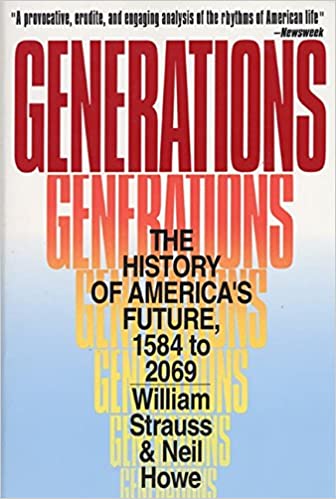
Today is a follow on post to The History of America’s Future, which looked at Generations, a 1992 book by William Strauss and Neil Howe. Generations is a speculation by the authors that the history of America can be seen as a succession of generational cycles.
The Fourth Turning is one of their follow-up books, taking a DEEP dive into what the next “turning” could look like. Keep in mind that this was written in 1997, and uses past history to project a possible future.
A few quotes from the opening chapter sets the tone:
America feel’s like it’s unraveling.
Though we live in an era of relative peace and comfort, we have settled into a mood of pessimism about the long-term future, fearful that our superpower nation is somehow rotting from within.
Not long ago, America was more than the some of its parts. Now, it is less. Where we once through ourselves collectively strong, we now regard ourselves as individually entitled.
Yet even while we exalt our own personal growth, we realize that millions of self-actualized persons don’t add up to an actualized society. Popular trust in virtually every American institution – from businesses and governments to churches and newspapers – keeps falling to new lows. Public debts soar, the middle class shrinks, welfare dependencies deepen, and cultural arguments worsen by the year.
Wherever we’re headed, America is evolving in ways most of us don’t like or understand. Individually focused yet collectively adrift, we wonder if we’re headed toward a waterfall.
I first read these words when the book was released, and readily identified with them. Over the 20+ years since, I think they are even more prophetic.
Here is how Strauss and Howe set up this book:
At the core of modern history lies this remarkable pattern: Over the past five centuries, Anglo-American society has entered a new era – a new turning – every two decades or so. At the start of each turning, people change how they feel about themselves, the culture, the nation, and the future. Turnings come in cycles of four. Each cycle spans the length of a long human life, roughly eighty to one hundred years, a unit of time the ancients called the speculum. Together, the four turnings of the speculum comprise history’s seasonal rhythm of growth, maturation, entropy, and destruction:
The First Turning is a High, an upbeat era of strengthening institutions and weakening individualism, when a new civic order implants and the old values regime decays.
The Second Turning is an Awakening, a passionate era of spiritual upheaval, when the civil order comes under attack from a new values regime.
The Third Turning is an Unraveling, a downcast er a strengthening individualism and weakening institutions, when the old civic order decays and the new values regime implants.
The Fourth Turning is a Crisis, a decisive era of secular upheaval, when the new values regime propels the replacement of the old civic order with a new one.
Each turning comes with its own identifiable mood. Always, these mood shifts catch people by surprise.
Strauss and Howe label The Fourth Turning as a book that turns history into prophecy, taking you on a journey through the confluence of social time and human life.
Part One – Seasons – Acquiring new tools for understanding self, life, family, society, and civilization. Learn about the cycles of life, generational archetypes, turnings, and history.
Part Two – Turnings – Revisit post-World War II American history from the perspective of turnings and archetypes. Gain new insight about why the first three turnings of the current Millennial Saeculum have evolved as they have. Read why this saecular journey must culminate in a Fourth Turning and what is likely to happen when it does.
Part Three – Preparations – Explore what you and the nation can do to brace for the coming Crisis. Learn how, by applying the principles of seasonality, we can steer our destiny.
An appreciation for history is never more important than at times when a saecular winter is forecast. In the Fourth Turning, we can expect to encounter personal and public choices akin to the harshest ever faced by ancestral generations. We would do well to learn from their experience, viewed through the prism of cyclical time. Through much of the Third Turning, we have managed to postpone the reckoning. But history warns that we can’t defer it beyond the next bend in time.
Part of a series looking at history and future through the lens of generations
Sometime in the early 1990s, I became aware of a new book by William Strauss and Neil Howe, entitled Generations: The History of America’s Future, from 1584 to 2069. As a student of history, I eagerly dove into the book, studied it, and have revisited it often in the thirty years since.
In Generations, the authors speculate the history of America as a succession of generational biographies, beginning in 1584 and encompassing everyone through the children of today. Their bold theory is that each generation belongs to one of four types, and that these types repeat sequentially in a fixed pattern. The vision of Generations allows us to plot a recurring cycle in American history – a cycle of spiritual awakenings and secular crises – from the founding colonists through today and well into this middle of this century.
Generations come in cycles.Just as history produces generations, so too do generations produce history.
William Strauss and Neil Howe
From the book, a brief description of the four cycles:
Strauss and Howe labeled the four generational types Prophet, Nomad, Hero, and Artist. With one exception, they have always recurred in a fixed order. During a spiritual awakening, Prophets are moving into rising adulthood while Nomads are appearing as children; during a secular crisis, Heroes are moving into rising adulthood while Artists are appearing as children. Later in life, these generations trigger another social moment and thus keep the cycle turning.
The first and third types are what we call “dominant” in public life – Prophets through redefining the inner world of values and culture, and Heroes through rebuilding the outer world of technology and institutions. The other two types are “recessive” in public life, checking the excesses of their more powerful neighbors – Nomads as pragmatists, Artists as ameliorators.
The passage of four generations, Prophets through Artists, completes one full generational cycle over the course of four, twenty-two year phases of life (a total duration of roughly ninety years). From the 1584 Puritan birth year forward, the authors traced five such cycles through American history – of which three (Colonial, Revolutionary, and Civil War) are fully ancestral, a waning fourth (Great Power) comprises the eldest 28 percent of the American population at the beginning of 1991 (when the book was released), and an emerging fifth (Millennial – the name of the cycle, not the name of the generational cohort) includes the youngest 72 percent. Within these cycles, we identify eighteen generations, from John Winthrop’s Puritans to Jessica McClure’s Millennials – and a recurring pattern of awakenings and crises.
Keep in mind that this was written in 1991.
So, here we are in late 2020, and what does the history of America’s future look like?
From above: during a secular crisis, Heroes are moving into rising adulthood while Artists are appearing as children.
That would be today’s Millennials moving into rising adulthood, and Gen Z appearing as children and teenagers.
So, according to Strauss and Howe, a secular crisis looms.
That pretty much describes 2020, don’t you think?
Here is where the life cycle can help. The story of civilization seldom moves in a straight line, but is rich with curves, oscillations, and mood shifts. The ebb and flow of history often reflect the ebb and flow of generations, each with a different age location, peer personality, and lifecycle story. By viewing history along the generational diagonal, by searching the cycle for behavioral clues, we can apply the mirror of recurring human experience to gaze around the corner of current trends and say something instructive about the decades to come.
William Strauss and Neil Howe
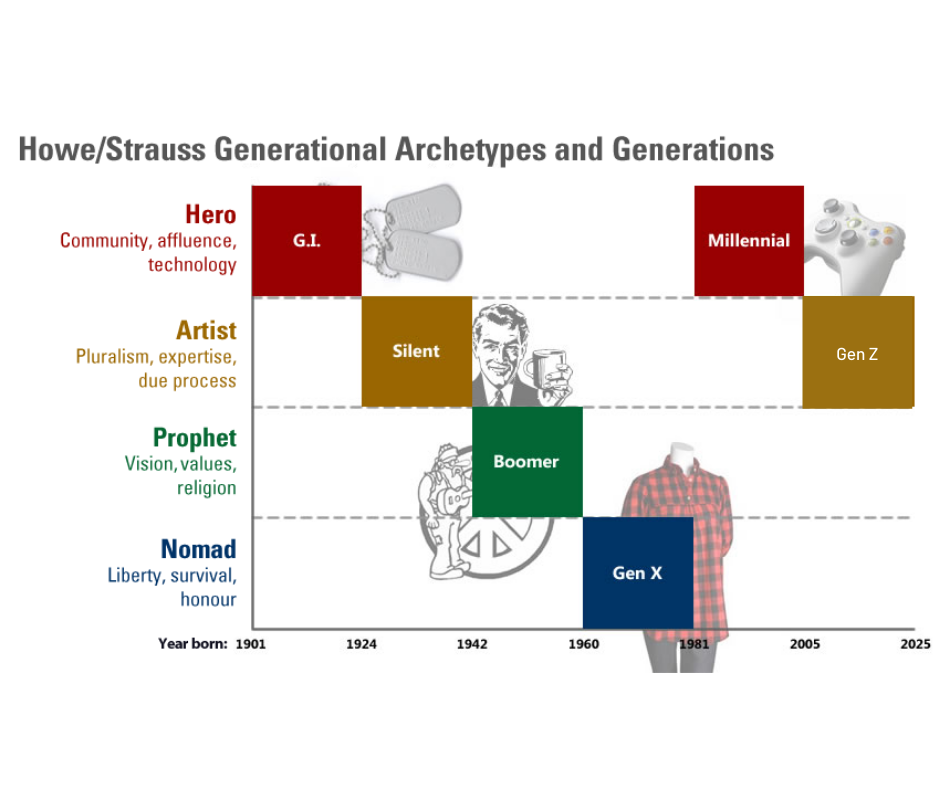
Here’s a timeline visualization of the generational cohorts:
A Lesson in Culture Transfer from One Generation to the Next
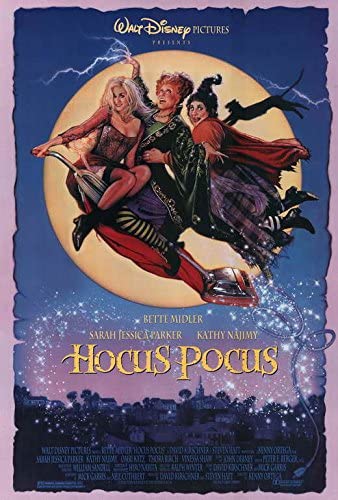
When it first hit theaters in 1993, Hocus Pocus performed poorly at the box office and with critics. However, thanks to annual replays on cable and strong video/DVD sales, a core fan group kept it alive over the years.
When the Disney Halloween classic was released to theaters earlier this month, it quickly rose through the ranks to become 2020’s biggest box office. Granted, the numbers are tiny compared to pre-COVID box office totals, but people are still going to theaters and strange things are happening.
Which is totally appropriate for Hocus Pocus, a bonafide 90s classic that children of that decade – now parents – are introducing to their children.
And by the way, that last sentence describes my two older kids – born in 1981 and 1984.
They first saw Hocus Pocus in theaters when released, later on VHS, and for a few years now, rewatch it every year on DVD or streaming.
Now, they are introducing it to a new generation – my grandchildren.
The movie’s unexpected success at the box office is impressive since it is widely available for fans to rent or buy and stream on various platforms; it’s free on Disney+; and it has aired on Disney’s “Freeform” as well.
There’s even a book about it – Hocus Pocus in Focus, by Aaron Wallace. My daughter and her husband – born in the late 80’s – devoured it when it came out, talked about it with their friends, and now viewing the film on Disney+ is evidently a big deal among their friends.
Of course, with Disney involved, you know what comes next – a sequel.
Bette Midler, who played Winnie Sanderson in the original, recently confirmed that she, along with co-stars Sarah Jessica Parker (Sarah Sanderson) and Kathy Najimy (Mary Sanderson) will all be returning as the Sanderson sisters for the second Hocus Pocus movie.
The sequel will be coming to Disney+ at an undesignated date in the future.
As I was researching different sources for this post, it occurred to me that I have stumbled upon a whole new thread of generational research – the transfer of culture from one generation to the next.
Immediately, I thought of the Disney Company. Certainly, my Disney fanaticism was fully developed in the last couple of decades – but I was introduced to it by my parents. First, through movies: my first movie seen in a theater (1964), and my favorite Disney movie even today, is Mary Poppins. Then, my father, as a Gulf gas station owner, was part of a Gulf-Disney marketing campaign throughout the mid to late 60s. We received regular promotional items, like magazines and record albums (which I still have!), which his customers eagerly snatched up.
When my wife and I became parents (four times, from 1981 – 1992), the introduction of Disney movies through first theaters then VHS tapes was a regular part of family entertainment. It continued with the shift from a cable channel to DVDs then streaming services.
As our children became parents, they did (and are doing) the same: Disney entertainment is a regular part of their lives, especially with the advent of the Disney+ streaming service.
In 2016, my wife and I brought this to a new level: a week-long family vacation for all 15 members of our family to Walt Disney World.
From viewing movies to visiting theme parks to sharing our Disney-related gifts across birthdays and other times, the Adams family culture had been deeply imbedded with a Disney imprint.
In my childhood, that meant one thing: Disney. To my children and grandchildren, though, it’s much more:
Walt Disney (movies, cable channel, TV shows, theme parks, cruise line)
ABC
ESPN
The Muppets
Pixar
Marvel
Lucasfilm
21st Century Fox
Disney+ (I list this separately because of the HUGE impact it will have in the future).
and many more!
Here’s a graphical representation of the above:
You want to talk about the transfer of culture from one generation to the next and the next?
One of the consistent lenses I use to view life through is that of generations.
It comes as a natural part of my curiosity of life, as I am interacting with 5 generational cohorts in my family: my parents and in-laws are from the GI Generation; I am a Baby Boomer; my oldest son and one daughter-in-law are Gen Xers; my other three children, two daughters-in-law and one son-in-law are Millennials; and my 6 grandchildren are Gen Zers. Even though we are spread out across three states (and occasionally, around the world) and do not get to interact as much as we would like, the personal level of generational differences is obvious.
Take the same dynamics as above – 5 generations – and move them into the institutional world, say a church setting, and it won’t be long till you have a generational collision.
If you are a leader in ChurchWorld, how do you deal with the fact that, for the first time in our history, we can have five separate and distinct generations working alongside each other in our churches? The 5th generation, born since the mid-2000’s, is not far behind in taking up a leadership role.
Generational differences are important, but it is all too easy to stereotype these differences. The only way we’ll ever build bridges between generations is to stop stereotyping and get to know who these generations really are and why they are that way.
For the first time in history, we have four different generations in the workplace (and five in families). These generations might as well be from different countries, so different are their cultural styles and preferences. Of the four approaches organizations can take to blending the generations, only one of them works today. Focusing on the “what” escalates tensions, while focusing on the “why” pulls teams together. Knowing the twelve sticking points can allow teams to label tension points and work through them—even anticipate and preempt them. Implementing the five steps to cross-generational leadership can lead to empowering, not losing, key people.
How many different generations do you regularly interact with?
In 2020, 25 percent of the labor force will be over the age of 55 – and they’re not retiring anytime soon. These projections from the Bureau of Labor Statistics at the US Department of Labor indicate that not only will Baby Boomers continue to work alongside their current Generation X and Millennial colleagues, but that they will still be around when Generation Z joins the workforce.
The result? A clash of cultures that will require a new management approach.
Gone are the days when people entered the workforce as young adults, worked until their late 50s, and then moved off into retirement while younger generations took their place. Instead, the average retirement age has steadily been creeping up in recent decades as older employees – in particular, the Baby Boomers – stay in the workforce either by choice or by necessity.
Of course, the implications of the COVID-19 pandemic are still reverberating across home, work, and church settings, so everything is up for grabs!
Before we dive into the discussion, here’s a brief recap of just who comprises the generational cohorts mentioned above. While there’s no set standard, the following descriptions are generally accepted:
Baby Boomers – born in the years 1946-1964, numbering about 76 million people
Generation Xers – born in the years 1965-1980, numbering about 66 million people
Millennials – born in the years 1981-1997, numbering just over 83 million people
Generation Zers – born in the years 1998-present, numbering over 80 million and still growing
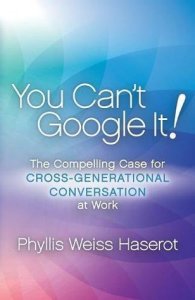
Much of the learning, skills and perspective people of all ages need to succeed long-term in their careers is not found in data on the Internet, but rather in conversations and personal relationships with the people they work with.
Tech tools have trained us to search the Internet for answers to everything, but we can’t find most of the non-technical or non-data-based answers we seek there. Learning about perspectives, relationships and experiences comes best from conversations.
In most organizations there are three, four, or even five generations working together with differing expectations about how things are done and by whom. People of different generations are increasingly isolated physically, functionally, or emotionally from each other both by communication styles and media and lack of the perspective that would help them understand why people think and act as they do. You Can’t Google It! facilitates action to promote and foster cross-generational conversation in organizations on both the parts of management and the multi-generational teams that are increasingly the key to productivity, profitability and sustainability.
You Can’t Google It! is a tool to help organizations and individuals remove the stress, frustration, and negative energy that often arises from working with people of different generations, so they understand and are able to accomplish their common goals―faster and profitably. It is about the implications of different generations, and how to move towards closing that gap.
A SIMPLE SOLUTION
Author Phyllis Weiss Haserot pulls no punches in establishing the issue of cross-generational conversations:
As an established professional, do you question the work ethics of young employees and co-workers?
As a young professional, how do you deal with resistance to your ideas from Baby Boomers who think their experience and seniority mean they know it all?
Will your organization be threatened because key personnel will soon reach traditional retirement age?
Are you wondering how to transform intergenerational challenges into an asset for your organization?
Much of the learnings, skills, and perspectives that people of all ages need to succeed – especially in working with each other – are not found in data on the Internet but rather in conversations and personal relationships with the people they work with. The new multigenerational paradigm is meaningful cross-generational conversation.
GENgagementTM can be defined as the state of achieving harmony, mutual involvement and cooperation, flow, and ongoing absorption in work with people of different generations.
GENgagement means getting all of the generations to understand each other, their influences, and their worldview so they can work collaboratively, loyally, and productively.
It is integral to the mission of transforming workplaces into engaged and productive environments for solving problems and being great places to work. Equally important, it helps individuals and organizations develop closer rapport and loyalty bonds with clients and other external stakeholders – the bedrock of any mission-driven organization.
A satisfying and perennial recipe for GENgagement contains these ingredients as integral to the experience for all personnel:
Defining the big picture for everyone
Having a clear purpose and mission
Visioning – what achieving the mission and purpose will look like
Communicating the importance of each person’s role
Living a culture that respects the values of and promises to employees, clients, donors, alumni, etc. every day
Enabling multigenerational input to organization and and market strategy and service delivery
Distribute the following questions from author Phyllis Haserot to your team in advance. After they have had time to read through them, gather the team for an extended conversation about each question.
Help me understand your perspective on work and the marketplace outside of our organization. What factors influence your worldview, the attitude you bring to your work, and your interactions with colleagues?
What would you like to see changed about how our work is done, and how can you help make it more effective? How important is hierarch to you? When is years of experience very important in your role, and when are other factors equally or more important?
What is getting in the way of a more productive and satisfying working relationship? How can I as your teammate help you learn how best to work with me?
What would you say are your core values? Do you think they are significantly different from my generation’s core values? How can we jointly overcome intergenerational tensions?
What strategies for impact and influence at work can we learn from each other?
Use these conversations as a springboard to ongoing cross-generational conversations as a regular part of the leadership development process in your organization.
Excerpt taken from SUMS Remix 127-3, released September 2019.
Part of a weekly series on 27gen, entitled Wednesday Weekly Reader
Regular daily reading of books is an important part of my life. It even extends to my vocation, where as Vision Room Curator for Auxano I am responsible for publishing SUMS Remix, a biweekly book “excerpt” for church leaders. Each Wednesday on 27gen I will be taking a look back at previous issues of SUMS Remix and publishing an excerpt.
The Mindset List® has delighted millions for over a decade about what has “always” or “never” been true for entering college students. It was created at Beloit College in 1998 to reflect the world view of entering first year students, and started with the members of the class of 2002, born in 1980.
What started as a witty way of saying to faculty colleagues “watch your references,” has turned into a globally reported and utilized guide to the intelligent if unprepared adolescent consciousness. It is requested by thousands of readers, reprinted in hundreds of print and electronic publications, and used for a wide variety of purposes. It immediately caught the imagination of the public, and in the ensuing years, has drawn responses from around the world. This site now gets more than a million hits a year.
The Mindset List®, an annual compilation of what has always and never been true for new college freshmen, has changed hands from founder Beloit College to Marist College.
Recently, the Mindset List of the Class of 2023 was released.
This fall’s college class of 2023, now arriving on campuses, learned of the attack on New York’s Twin Towers from parents and grandparents once they were old enough to handle it. Born in 2001, they have lived in a world in which shedding shoes at airport security; capturing news from crawling headlines on the TV screen; flying Jet Blue; and recognizing that blackboards, pens, and watches are sometimes smarter than we are have all been routine occurrences.
Nief and co-editor Tom McBride, and list co-author Beloit Professor of Sociology Charles Westerberg have been working with Marist during the transition. “This annual list is a cultural touchstone,” noted Marist’s Executive Vice President Geoffrey Brackett. “Every year Ron, Tom, and Charles have done the remarkable work of encapsulating a changing world into a cohesive list. The list has served as a reminder to the wider community of colleges and universities of the importance of understanding the constantly altering landscape outside of higher education. Marist hopes to continue that service by taking on The Mindset List and strategically expanding its capabilities and reach.”
Leaders – of all ages – need to understand what has shaped the lives of today’s entering college freshman class, those 18 year olds characterized by the following:
Like Pearl Harbor for their grandparents, and the Kennedy assassination for their parents, 9/11 is an historical event.
The primary use of a phone has always been to take pictures.
YouTube has become the video version of Wikipedia.
According to Westerberg,
With half of this generation composed of people of color, they are among the most demographically significant cohorts in American history. American politics today is hard to comprehend without taking account of this major trend since, within a year, their generation will represent 25% of the U.S. population.
Here’s a few more characteristics to whet your appetite:
They have grown up with Big Data and ubiquitous algorithms that know what they want before they do.
Apple iPods have always been nostalgic.
Most of them will rent, not buy, their textbooks.
The Tech Big Four – Apple, Facebook, Amazon, and Google – are to them what the Big Three automakers were to their grandparents.
“The Mindset List helps put into context the growing interest high school and college students have in social issues,” noted Martin Shaffer, Dean of Marist’s School of Liberal Arts. “We’re seeing a more engaged, more deeply involved student body on campus.”
With contributions from parents and academics around the world, the List has tracked cultural change, stimulated intergenerational conversation, and just made older people feel even older.
Each August since 1998, Beloit College has released the Beloit College Mindset List, providing a look at the cultural touchstones that shape the lives of students entering college this fall.
Recently, the Mindset List of the Class of 2022 was released.
Leaders – of all ages – need to understand what has shaped the lives of today’s entering college freshman class, those 18 year olds characterized by the following:
They are the first class born in the new millennium, escaping the dreaded label of “Millennial,” though their new designation—iGen, GenZ, etc. — has not yet been agreed upon by them.
People loudly conversing with themselves in public are no longer thought to be talking to imaginary friends.
The Prius has always been on the road in the U.S.
According to McBride,
Students come to college with particular assumptions based on the horizons of their lived experience. All teachers need to monitor their references, while students need to appreciate that without a sound education they will never get beyond the cave of their own limited personal experiences.
Here’s a few more characteristics to whet your appetite:
Films have always been distributed on the Internet.
The original authors have moved on to new projects in their retirement but will continue their battle against “hardening of the references” at their website, themindsetlist.com.
With contributions from parents and academics around the world, the List has tracked cultural change, stimulated intergenerational conversation, and just made older people feel even older.





 THE QUICK SUMMARY –


 27gen.com