Use Storytelling Principles and Structure to Engage Your Audience

Stories are the currency of human contact.  – Robert McKee

Award-winning author and presentation expert Nancy Duarte has a new book out: HBR Guide to Persuasive Presentations. Over the next few days, I will be posting an outline of each of the book’s sections as well as zeroing in on a specific topic.

Section 3: Story

  • Apply Storytelling Principles – make your presentation stick
  • Create a Solid Structure – storytelling principles provide a framework
  • Craft the Beginning – Establish the gap between what is and what could be
  • Develop the Middle – build tension between what is and what could be
  • Make the Ending Powerful – describe the new bliss
  • Add Emotional Texture – decisions are not made by facts alone
  • Use Metaphors as Your Guide – memorable themes help rally an audience
  • Create Something They’ll Always Remember – drive your big idea home

Create Something They’ll Always Remember

According to Duarte, placing a climactic S.T.A.R. moment in your presentation will drive your big idea home. That moment is what the audience will tweet or chat about after your talk. Use it to make people uncomfortable with what is or to draw them toward what could be.

Here are four ways to create a S.T.A.R. moment that captivates your audience and generates buzz:

  • Shocking statistics – if statistics are shocking, don’t glide over them, amplify them
  • Evocative visuals – audiences connect with emotionally potent visuals
  • Memorable dramatization – bring your message to life by dramatizing it
  • Emotive anecdote – use gripping personal stories

The presentations that are repeated have memorable moments in them. These moments don’t happen on their own; they are rehearsed and planned to have just the right amount of analytical and emotional appeal to engage both the hearts and minds of an audience.

Captivate your audience by planning a moment in your presentation that gives them something they’ll always remember.

Next: Media


This is Part 4 of a series looking at Nancy Duarte’s new book HBR Guide to Persuasive Presentations, highly recommended for all leaders.

Part 1

Part 2

Part 3

Develop Persuasive Content in Your Message

Are ideas born interesting or made interesting? Chip and Dan Heath, authors of Switch: How To Change Things When Change is Hard

Award-winning author and presentation expert Nancy Duarte has a new book out: HBR Guide to Persuasive Presentations. Over the next few days, I will be posting an outline of each of the book’s sections as well as zeroing in on a specific topic.

Section 2: Message

  • Define Your Big Idea – clearly state your point of view
  • Generate Content to Support the Big Idea – when you’re brainstorming, more is more
  • Anticipate Resistance – think through opposing perspectives
  • Amplify Your Message Through Contrasts – create and resolve tension
  • Build an Effective Call to Action – get things done
  • Choose Your Best Ideas – sort and filter
  • Organize Your Thoughts – outline your presentation by writing clear, active slide titles that hang together
  • Balance Analytical and Emotional Appeal – stay credible while you reel people in
  • Lose the Jargon – is your language clear enough to pass the “grandmother test”

Build an Effective Call to Action

Presentations should move people to act – but only if you explicitly state what actions you want them to take, and when.

Are you asking them to be doers, suppliers, influencers, or innovators?

Doers instigate activities. They are the worker bees. Once they know what needs to be done, they’ll take on the tasks. They also recruit and motivate others to complete important activities.

Suppliers get resources. They are the people with resources – financial, human, or material. They have the means to get what you need to move forward.

Influencers change perceptions. They can sway individuals or groups, large or small, mobilizing them to adopt and evangelize your idea.

Innovators generate ideas. They think outside the box for new ways to add value to and spread your idea. They create strategies, perspectives, and products.

(Duarte, p 39)

Whether your audience is corporate, political, scientific, academic, or religious, the people you’re addressing should fall into one of these categories.

Be explicit in your request – and about how it will benefit your audience.

Next: Story

This is Part 3 of a series looking at Nancy Duarte’s new book HBR Guide to Persuasive Presentations, highly recommended for all leaders.
Part 1

Part 2

Know Your Audience and Build Empathy

Designing a presentation without an audience in mind is like writing a love letter and addressing it “to whom it may concern.”  Ken Haemer, Presentation Research Manager, AT&T

Award-winning author and presentation expert Nancy Duarte has a new book out: HBR Guide to Persuasive Presentations. Over the next few days, I will be posting an outline of the book’s 7 sections as well as zeroing in on a specific topic each day.

Section 1: Audience

  • Understand the Audience’s Power – your idea’s fate is in their hands
  • Segment the Audience – Focus on who matters most
  • Present Clearly and Concisely to Senior Executives – help them make big decisions on a tight schedule
  • Get to Know Your Audience – it’s easier to convince someone you know
  • Define How You’ll Change the Audience – what do you want people to believe? How do you want them to behave?
  • Find Common Ground – resonate through empathy

Get to Know Your Audience

Knowing people – really knowing them – makes it easier to influence them.

You are trying to influence them, right? If you’re not, forget the speech and just send a memo.

But if you’re really trying to influence them, you’ve got to connect with them. To connect with them, you’ve got to know something about them.

  • What are they like?
  • Why are they here?
  • What keeps them up at night?
  • What gets them up in the morning?
  • How can you solve their problems?
  • What do you want them to do?
  • How might they resist?
  • How can you best reach them?

When you know you are doing a presentation – whether a weekly sermon, new initiative, or a committee report, do your people homework before you begin preparing your words. Only when you know WHO can you began to think about the WHAT.

People don’t fall asleep during conversations, but they often do during presentations – and that’s because many presentations don’t feel conversational.

When you really know your audience, you are engaging them in a conversation even if it seems one-sided. Knowing your audience well helps you feel warmly toward the people in the room, speak sincerely to them and help them want to listen to you.

Next: Message

This is Part 2 of a series looking at Nancy Duarte’s new book HBR Guide to Persuasive Presentations

Part 1


Engage Your Audience, Sell Your Ideas, and Inspire People to Act

If I am to speak for ten minutes, I need a week for preparation; if fifteen minutes, three days; if half an hour, two days; if an hour, I am ready now. – Woodrow T. Wilson

There are typically very few – if any – leadership positions in which the leader is a lone ranger with no teams to work with or report to, no organizational support, and no larger group to speak to on occasions.

On the other end of the spectrum, there are few leadership positions where the leader is constantly working with teams of all sizes, being supported by a few – or a few dozen – individuals, and is regularly speaking to a larger group.

One of those positions is a pastor.

When a pastor steps to the pulpit – in a 100 member church or a 10,000 member church, and everywhere in between – it would be easy to feel as if he were in a position of power. After all, he is up in front of the crowd, maybe even elevated on a stage, and people have come to hear him speak. The speaker is the star of the show, right?

Wrong. The audience is.

I would pause just to say that God is our ultimate audience, and everything we do as a believer is first to an audience of One. That, to me, is a given.

The speaker is not the star of the presentation – the audience is, because they will determine whether your idea spreads or dies, simply by embracing or rejecting it. You need them more than they need you. They have the control, and the speaker needs to be humble in his approach to speaking to them.

How, then, do you become an excellent presenter?

Nancy Duarte is CEO of Duarte, Inc. She teaches workshops on the art of presenting and is the author of two award-winning books: Slide:ology and Resonate. Wait a minute – better make that three!

Harvard Business Review has just published Duarte’s newest book, HBR Guide to Persuasive Presentations, and once again she has delivered a valuable tool for speakers everywhere – but especially pastors who stand up every week and deliver a presentation – a sermon – to their congregations.

Duarte’s Guide is broken into 7 sections as follows:

We live and work in a first-draft culture. Type a text or email – send. Write a blog entry – post. Throw some images together – speak.

According to Duarte, though, it’s in crafting and recrafting, in iteration and rehearsal that excellence emerges.

But, you say, I have so many other things to do and I can’t worry about becoming an excellent communicator. Guess what? Becoming an excellent communicator will help you get those things done.

Ready to start?

Next: Audience: Know your audience and build empathy

Want to read more by Nancy Duarte? Click here to read her “10 Steps in Preparing a Powerful Presentation” and also download a free summary of her book Resonate.

Attic Memories

It is better to dwell in a corner of the housetop, than with a brawling woman in a wide house. Prov 21:9 KJV

I’m nearing the end of a week of traveling that has taken me through 6 airports on 4 airlines in order to: observe and document the weekend worship experiences of one of the pioneer multisite churches in the US; participate in a 3 day conference; launch Auxano’s Vision Room; and take part in a training initiative. The last event ended up in Nashville, where I joined the rest of the Auxano team for a daylong Navigator learning opportunity.

I was able to take advantage of my schedule and spend the night at my mother’s house, working on a few projects around the house before heading back to Charlotte later today.

One of those projects required me to go up into the attic of our house to bring something down. Once I climbed the folding stairs, a rush of memories flooded me. This wasn’t your normal attic – this was my teenage bedroom.

A little more about information is necessary. In the late 60’s, as my older brother was beginning high school and I was beginning to start junior high, my father thought it would be a good idea if my brother and I had separate rooms – we had been sharing a room since I was born. My dad asked if I would work with him and convert our attic into a bedroom for me.

What an adventure! Over the course of several months, we spent time putting in floors and walls, carpet, an air conditioner, and shelving. It worked great! During the remaining years of junior high then into high school I enjoyed using the initial bedroom plus an expansion that more than doubled the size of the original room.

Walking into that space this morning, my eyes fell on this:

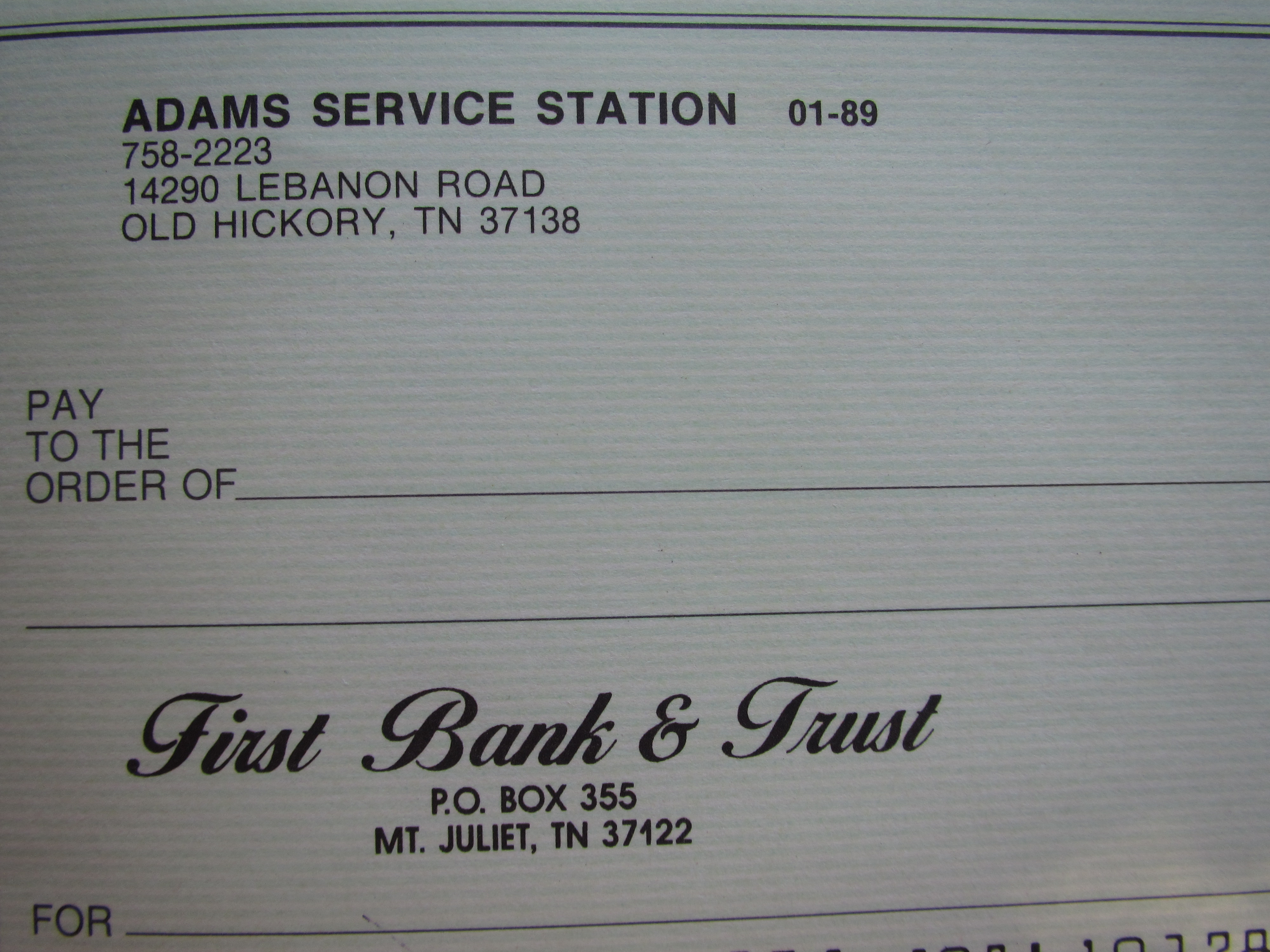
It was my dad’s business checkbook, with the last check written to close out the account when he retired in 1994 after 44 years of operating a Gulf gas station.

That visual took me back in an instant to the years I spent in, around, and all over the gas station. Over the next few minutes, as I finished my work in the attic-turned-bedroom-turned into a storage room, I was transported back in time.

I won’t bore you with those stories (at least not now), but my point is this:

Images convey stories that touch the heart

How are you using images in your church?

Communicate to Influence…

…write to inform.

Communication is about getting others to adopt your point of view, to help them understand why you’re excited (or sad, or optimistic or whatever else you are.) If all you want to do is create a file of facts and figures, then cancel the presentation and send in a report.

– Seth Godin

I’m headed to Atlanta GA today for the 2012 Worship Facilities Expo (WFX). I have been very fortunate and honored to have been a part of every WFX since it began in Nashville TN in 2005. Because WFX held two events in some years, this will be the 10th time I have made a presentation (or two – or three) at the event.

I would like to think I’ve come a long way in my communication style.

When I look back at that first presentation, I cringe. Not because of the topic or content – it was well received. I just remember it being a very dense verbal communication that was all one way – a classic data dump. Coupled with my rapid-fire delivery, (I was born in Nashville TN, but must have been vaccinated with a phonograph needle set at 78 rpm. Note – anyone under 30 reading this will have to check Wikipedia for the scoop on that) I’m surprised the audience remained upright.

But they did (I actually have proof – two of the participants that day were on the leadership team at Alliance Bible Fellowship, and we started a conversation that day that eventually led the church to pick me and my company (at the time) for a $5.6 million dollar, multi-phase construction project that is in its third phase at this writing). But I digress.

Our brains have two sides – an emotional right side and a logical left side. When you show up to speak to an audience, you can be sure they are showing up with both sides of their brains ready to be engaged. If you aren’t aware of the way you talk, the way you dress, your body language, and by the way, your content, you may be tuned out by the second slide of your PowerPoint or Keynote or Prezi.

You can wreck a communication process with lousy logic or unsupported facts, but you can’t complete it without emotion. Logic is not enough.

According to Seth Godin, a home run presentation is easy to describe: You put up a slide. It triggers an emotional reaction in the audience. They sit up and want to know what you’re going to say that fits with that image. Then, if you do it right, every time they think of what you said, they’ll see that image (and vice versa).

A presentation isn’t an obligation – it’s a privilege.

If you’re in Atlanta attending WFX, drop in on one of my presentations Wednesday 9/19 at 11 AM (The Servant Blueprint) in A313 or 3 PM (Selling Change) in A314.

As Andy Stanly says, I’d love the chance to challenge your mind in order to change your life.

Social Media and the Divinity School Student

100 years ago when I was in graduate school at The Southern Baptist Theological Seminary…

Okay, it wasn’t 100 years ago, only 31. The pace of change just makes it seem like 100 years.

Anyway, my version of Facebook was a hardcopy directory of all students, printed the first few weeks of each school year (we called it the Funny Book, for obvious reasons). Mail (including tests and papers) was hand-delivered in post office boxes. Research was done in a physical place (library) using objects (books) resulting in papers (typed on a typewriter). GASP!

Today, it’s a little different.

My daughter is beginning her final year of the M Div program at Campbell University Divinity School. She also works part-time as Communications Coordinator for the North Carolina WMU. She is also beginning her second year as a Resident Chaplain for a couple of freshmen girl’s dorms. She loves her life!

Because of my past history at a divinity school and serving on a church staff, and now in a consulting role to church leaders, we often have interesting conversations.

Like the one that followed this question: “How are students at the Div School and in your circle of influence using social media?” Here is her reply:

The divinity school uses it to post pictures of what’s going on during the week at school, serious stuff and fun stuff too, like birthdays’ of professors and when the staff and students are goofing off, or there is a social event, like today, there is a div school tailgating thing after class before the football game. They use Facebook and twitter. Admissions has their own Facebook page along with the Div school itself. They also use it when they go to conferences to announce they are there and if other Campbell people are there, they use it to find them at those conferences and places and such. They post lots of pictures.

Personally, each of the dorms I work with have a Facebook group page so I am a part of that to keep up with events and announcements (keep up with issues in the dorm that the residence life staff have to address) and what official events and unofficial events are going on to go to and get to know the residents. The residents that I am friends with, I keep an eye on their statuses and stuff and if I notice something is wrong and there seems to be a hint of something not right, I make sure to check on them and see how they are doing. Sometimes, Facebook statuses are more informational than just talking with them casually in the hallways and stuff on campus!

One of my dorms LOVES Twitter. The RAs, RD, and residents tweet ALL the time and have conversations with each other. That’s another way I keep up with what’s going on and stay connected. In fact, this dorm is having a program event this semester that is a twitter scavenger hunt. They will have a list of stuff to find and instead of just taking pictures and showing everybody, they will tweet the pics with a hashtag. Whoever finishes with the most items on the list wins, and if there is a tie, then the earliest timestamp on tweet wins! I thought this was an interesting way to use social media to have a dorm event

Ironically, each dorm program has to fit into a certain category and this one is a physical event, because it’s making them get out and walk around campus even though they are using technology and  the Internet to show it!

Just a snapshot of how social media is used in my life! 🙂

Absolutely fascinating.

Okay ChurchWorld leaders, are you paying attention?


If you liked this post, you might also be interested in these:

Does Word of Mouth Suit You to a T?

More great stuff from Andy Sernovitz’s book “Word of Mouth Marketing“:

The Five Ts of Word of Mouth Marketing

  • Talkers – Find people who will talk about you
  • Topics – Give people a reason to talk
  • Tools – Help the message spread faster
  • Taking Part – Join the conversation
  • Tracking – Measure and understand what people are saying

Here’s your homework assignment: go here and download the 5 Ts worksheet. Now complete it for your church.

What are you waiting for? Dive into the Ts and turn them loose!

UPDATE

If you are doing something worth talking about, it’s time to put a plan together to help the conversations happen. Here’s a great worksheet to do just that, by Andy Sernovitz who is the author of the 5 T Worksheet above. The action plan will help you think about:

  • Who to assign what
  • How to start with the basics
  • How to experiment with different WOM techniques

Remember, everyone’s talking – why not help them talk about your organization?

Everybody’s Talking…

Why not give them a reason to talk about you?

Word of mouth marketing has been defined as ” a) giving people a reason to talk about you and b) making it easier for the conversation to take place”.

Andy Sernovitz, author of “Word of Mouth Marketing”, has compiled some great ideas about how to use Word of Mouth: check them out here.

What’s the lesson for ChurchWorld?

Sernovitz lists 4 Rules for Word of Mouth Marketing. I’ve listed them here, along with my interpretation of how a church might apply them:

  • Rule # 1: Be Interesting. Nobody listens to boring, and that goes for churches, too. Do you communicate with passion and energy in all you do?
  • Rule # 2: Surprise People – Make Them Happy. Do you do everything with excellence? Do people leave your campus excited about what they’ve experienced, and ready to tell others about it?
  • Rule # 3: Earn Trust and Respect. Nobody talks about an organization they don’t trust or don’t like. Welcome your guests, then listen to them. Fulfill their needs, and work constantly to make the best impression you can.
  • Rule # 4: Make It Easy. Work hard on your vision so it’s easy to remember and repeat. What can people tell a friend about your church in one sentence?

In today’s hyper-connected world, word of mouth is more important than ever – even when the “word” is digitally transmitted.