How to Recognize – and Avoid – Problem Blindness as a Leader

What’s at stake if teams do a poor job of solving problems? From a long list of potential answers, four stand out:

  • Lost time: Poor team problem solving simply burns more time. It may be more time in a meeting itself, because there were no collaboration guidelines. Perhaps it’s lost time outside of the meeting in hallway conversations, because ideas weren’t fully explored or vetted.
  • Dissipated energy: Poor team problem solving leaves questions unanswered and half-baked solutions in the atmosphere. We don’t know exactly where we stand or what we’ve decided. The thought of revisiting an unfinished conversation itself is an unwelcome burden.
  • Mediocre ideas: Poor team problem solving fortifies our weakest thinking. Innovation is something we read about but never experience. We cut-and-paste the ideas of others, because we don’t know how to generate our own. We traffic in good ideas and miss great ones.
  • Competing visions: Poor team problem solving invites an unhealthy drift toward independence. No one has the conscious thought that they have a competing vision. But in reality, there are differences to each person’s picture of their future. It’s impossible for this divergence not to happen if there is no dialogue.

So, how do you start to create the dynamic of collaborative problem solving?

SOLUTION #1: Avoid problem blindness

THE QUICK SUMMARY – Upstream: The Quest to Solve Problems Before They Happen by Dan Heath

So often in life, we get stuck in a cycle of response. We put out fires. We deal with emergencies. We stay downstream, handling one problem after another, but we never make our way upstream to fix the systems that caused the problems. Cops chase robbers, doctors treat patients with chronic illnesses, and call-center reps address customer complaints. But many crimes, chronic illnesses, and customer complaints are preventable. So why do our efforts skew so heavily toward reaction rather than prevention?

Upstream probes the psychological forces that push us downstream—including “problem blindness,” which can leave us oblivious to serious problems in our midst. And Heath introduces us to the thinkers who have overcome these obstacles and scored massive victories by switching to an upstream mindset. One online travel website prevented twenty million customer service calls every year by making some simple tweaks to its booking system. A major urban school district cut its dropout rate in half after it figured out that it could predict which students would drop out—as early as the ninth grade. A European nation almost eliminated teenage alcohol and drug abuse by deliberately changing the nation’s culture. And one EMS system accelerated the emergency-response time of its ambulances by using data to predict where 911 calls would emerge—and forward-deploying its ambulances to stand by in those areas.

Upstream delivers practical solutions for preventing problems rather than reacting to them. How many problems in our lives and in society are we tolerating simply because we’ve forgotten that we can fix them?

A SIMPLE SOLUTION

Author Dan Heath believes that with some foresight, we can prevent problems before they happen, and even when we can’t stop them entirely, we can often blunt their impact.

Of course, there are barriers to this line of thinking, and the first of those barriers is profoundly simple: you can’t solve a problem you don’t see, or one that you perceive to be a regrettable but inevitable condition of life.

Problem blindness is the first barrier to upstream thinking. When we don’t see a problem, we can’t solve it. And that blindness can create passivity even in the face of enormous harm. To move upstream, we must first overcome problem blindness.

Problem blindness, also know as inattentional blindness, is a phenomenon in which our careful attention to one task leads us to miss important information that’s unrelated to that task.

Inattentional blindness leads to a lack of peripheral vision. When it’s coupled with time pressure, it can create a lack of curiosity. I’ve got to stay focused on what I’m doing. 

The escape from problem blindness begins with the shock of awareness that you’ve come to treat the abnormal as normal.

Next comes a search for community: Do other people feel this way? And with that recognition – that this phenomenon is a problem and we see it the same way – comes strength.

Something remarkable often happens next: People voluntarily hold themselves responsible for fixing problems they did not create. The upstream advocate concludes: I was not the one who created this problem. But I will be the one to fix it.

Dan Heath, Upstream: The Quest to Solve Problems Before They Happen

A NEXT STEP

How can you, personally, move upstream? Consider your own problem blindness, Which problems have you come to accept as inevitable that are, in fact, nothing of the kind?

A hallmark of work by both author Dan Heath as well as his brother Chip is the excellent resources they provide. One of those is a book club guide.

Here are a few questions drawn from that guide, relating to the topic of problem blindness. Set aside some time to both reflect and act on them,

  1. Problem blindness is the belief that negative outcomes are natural or inevitable. Do you think your organization suffers from problem blindness? If so, in what areas?
  2. “Every system is perfectly designed to get the results it gets” is a quote often used in leadership circles. Does this idea resonate with you? What examples do you see in your organization?
  3. When people reflect on our society 50 years from now, what areas do you think they will be shocked by, areas that we are suffering from problem blindness?

Part of a regular series on 27gen, entitled Wednesday Weekly Reader.

During my elementary school years one of the things I looked forward to the most was the delivery of “My Weekly Reader,” a weekly educational magazine designed for children and containing news-based current events.

It became a regular part of my love for reading, and helped develop my curiosity about the world around us.

Successful Leaders Learn How to Ditch the Multitasking Myth

Every leader realizes that the world around them has changed – and is changing at an ever-increasing pace. The demands on a leader’s time and energy are on an upward trend, and show no signs of leveling off.

What’s worse, it may even seem that the skills and perspectives that were effective for past success may now have become a liability for future productivity. With so much going on, it’s almost  impossible to stay focused.

It’s time for new strategies and tactics to cope with the shifting ground of missed opportunities and unexpected threats in today’s ever-changing environment. 

 Somewhere along the way, we got distracted. As much as we multitask, love our devices and feel like we’re in control, deep down we know that something is off. Shortened attention spans, declines in critical thinking, lack of sleep, self-doubt and decreased creativity are just some of the effects coming to light in an age of digital distraction.

It’s time to reclaim our lives. It’s time to take control.

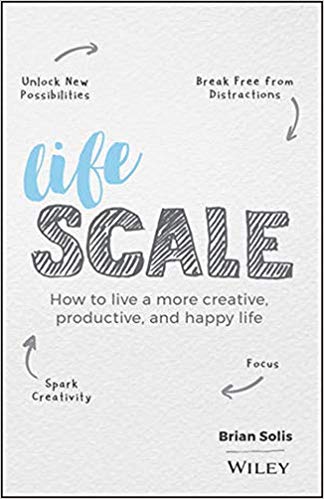
THE QUICK SUMMARY – Life Scale: How to Live a More Creative, Productive, and Happy Life by Brian Solis

Lifescale is a journey of self-discovery and growth. It’s about getting back into balance and remastering our destinies. Author Brian Solis knows first-hand. He struggled with distraction and all of its ill effects. To get his life back, he developed a set of techniques, exercises, and thought experiments designed to tame the chaos, and positively and productively navigate our day-to-day lives. Instead of falling victim to the never-ending cycle of newsfeeds, Likes, addictive apps, and boredom scrolling (aka the endless scroll), we can learn to manage our time and inspire our own lives in a way that will bring meaning back―without sacrificing the benefits that our devices bring us.

In Lifescale, Brian has done the legwork to pull together scientific findings and practical tools into one book. Readers―especially those who are distracted―will connect with the humor, pathos, and inspiration inside. 

With the renewed perspective Lifescale offers, we can finally learn to prioritize what matters, and live our digital and physical lives with intention and true happiness.

A SIMPLE SOLUTION

Have you ever come to a realization that you couldn’t focus the way you used to? It may have been exhibited when you couldn’t complete that project in the time you used to. It may have been reflected in the icy stares of spouse and family as you look over your phone at them during dinner. It may have been the thirty minutes lost as you scrolled through your social media platforms with no purpose.

The worst part may be the illusion of getting things done, checking off to-do lists, producing, meeting deadlines (albeit with much more effort required).

When did we get so busy?

Every day we struggle to balance every personal and professional responsibility, resorting to dividing our attention constantly among multiple demands.

That’s called “multitasking,” and it’s a myth.

Doing so many tasks at once leaves us with insufficient attentional energy to do any of them really well.

With all this multitasking, are we actually learning how to work more efficiently? Science says no.

The corrosive effects of multitasking include:

Wastes time, attention, and energy – While you may manage to produce some output, productivity, engagement, and value are usually compromised.

Attacks output quality – Reports show that working on two or more projects simultaneously takes longer than if you worked on each one individually.

Makes you mistake prone – From typos to unexplained lapses in logic, random errors appear in everything you produce, because you’re overwhelming the frontal cortex and not giving yourself enough depth and space for critical thinking

Hinders intellectual and affective processes – By compromising our intellectual and affective processes, we impair our internalized knowledge, our comprehension and ability to grasp complexity, and critical analysis.

Causes stress – When you are switching between tasks, you place yourself in a mode of high alert, or on the edge – and your true creativity is not kindled.

Makes you miss out on life – If you’re multitasking, the inattentional blindness that results prevents your brain from processing experiences that inspire thinking and creativity.

Affects your memory – Switching between talks disrupts short-term memory, causing you to miss or forget details in the moment.

Leads to increased distractibility – Researchers have found that multitaskers exhibit increased behavioral distractibility.

Hurts your relationships – At the most basic level, whether you’re with loved ones, friends, colleagues, and so on, if you break moments of engagement to mindlessly multitask, your actions, maybe not your words, say, “I’m only partially in this moment right now with you.”

Saps your energy – Cognitive costs are just one of the many assets you’ll spend by multitasking – there are also biological and emotional costs. You’re expending exorbitant energy, exhausting the oxygenated glucose in our brain.

Brian Solis, Life Scale: How to Live a More Creative, Productive, and Happy Life

A NEXT STEP 

Think you can multitask?  Try this exercise from Fast Company magazine:

Time yourself doing the following two actions:

1) Spell aloud, letter by letter, “Jewelry is shiny” at the same time as you write your full name.

2) Spell aloud, letter-by-letter, “Jewelry is shiny” and then, after you are done with that, write your name.

It will probably take you at least twice as long to do number one as number two. However, if you practice spelling “Jewelry is shiny” aloud for a couple minutes, it’ll become automatic. You’ll no longer have to think to do it, and you’ll be able to complete the two tasks at the same time without incurring the switching cost.

This simple exercise demonstrates the practical difficulty of attempting to multitask.

For another measurement of both the futility and costs of multitasking, review the ten corrosive effects of multitasking above.

For each, recall an example of a time when you attempted to multitask. How did you feel? As an honest assessment, did you really think you were accomplishing more by multitasking?

What do you need to change in order to avoid multitasking? Make a stop doing list and review it regularly with someone you trust.

Excerpt taken from SUMS Remix 139-2, released February 2020.


Part of a weekly series on 27gen, entitled Wednesday Weekly Reader

Regular daily reading of books is an important part of my life. It even extends to my vocation, where as Vision Room Curator for Auxano I am responsible for publishing SUMS Remix, a biweekly book “excerpt” for church leaders. Each Wednesday on 27gen I will be taking a look back at previous issues of SUMS Remix and publishing an excerpt.

>> Learn about and purchase SUMS Remix here<<

>> Learn about and purchase prior issues of SUMS Remix here <<

Recognizing the Paradoxes Facing the Second Chair Leader

Editor’s Note: While we will use “Executive Pastor,” “XP,” “second-in-command,” or “second chair” language throughout this issue of SUMS Remix, the content – and intent – is to help any leader who reports to a senior team member.

It has been said that an institution is the lengthening shadow of a visionary leader. What rarely is said is that in the shadow of that visionary leader was another leader who executed the primary leader’s ideas, monitored the budgets, built the infrastructure and systems, and along the way, cleaned up a few of the messes. Such is the life of a leader who is “second-in-command.”

Bruce Hornsby

The second-in-command leader – many times with the title of Executive Pastor or XP – is the person who picks up where the lead pastor leaves off. By nature of the role even if not reflected in the title, this person has to be a pastor as well – someone who will see ahead three moves to the pastoral needs that will be created by the unveiling of the church’s vision as led by the senior pastor. This is the role of the leader who comes alongside of a visionary senior pastor and says, “I’m with you – I’m ready to go to battle for what God has called you to do in and through this church.” (Phil Taylor)

Unlike almost any other job in the church, the definition of a second-in-command leader or Executive Pastor often inherently lacks definition. It is consistently changing.

This is the hallmark of a good XP: the ability to jump into just about any role and do it moderately well. Is there someone better for the job? Probably, and that’s why you will ultimately hand it off to someone else. But sometimes the best person for the job is the person who has both the time and the drive to call something new into existence couples with a deep understanding and commitment to the Lead Pastor’s vision. You may be the only person in your church that fits that definition. Executive Pastors are like utility players. The best right hand men or women are actually ambidextrous.

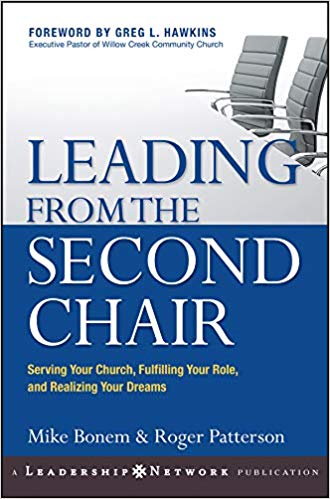
THE QUICK SUMMARY – Leading from the Second Chair by Mike Bonem and Roger Patterson

Leading from the Second Chair will raise awareness of the need for strong leaders in secondary positions. It will describe the value they can bring to their organization and to primary leaders when they are serving at their full potential. It will reshape the way they view their role, with an emphasis on their own responsibility as leaders. It recognizes the unique challenges and frustrations of serving in a subordinate position and equips these leaders with the attitudes and skills that they will need to survive and thrive in this new paradigm.

Because of the scarcity of resources for second chair leaders, particularly those in the church, this book will offer a practical way to improve the performance of any organization.

A SIMPLE SOLUTION

According to authors Mike Bonem and Roger Patterson, “not only is it lonely at the top, it can be even lonelier when you’re almost at the top.”

Of course, they are referring to “second chair leaders.” Church leaders who hold second chair (or third or fourth) positions are under tremendous pressure. They are expected to do their jobs and provide leadership but defer to the top leader, too.

How can you lead effectively while serving under someone else’s leadership?

The answer can be found by looking to the engineering principle of tension. Whether a small manufactured component like a spring or the huge arches of a suspension bridge, the tension of being able to handle opposite pulling forces makes a successful machine work or a bridge span great distances.

For a second chair leader, these tensions develop because the expectations may appear to be incompatible or even contradictory. 

The second chair requires a special leadership lens that brings clarity to the challenges of three paradoxes. The lens must be trifocal, allowing you to focus on how you manage your relationships (subordinate-leader paradox), your work habits (deep-wide paradox), and your emotions (contentment-dreaming paradox). 

Subordinate-Leader Paradox – Effective second chair leaders do not have a zero-sum view of organizational responsibility. They know that two heads are better than one, and that the first chair is not an adversary. They are able to lead with being at the top of the pyramid. Most importantly, they understand that their authority and effectiveness as a second chair stem from a healthy, subordinate relationship with their first chair.

Deep-Wide Paradox – Second chair leaders have specific roles that are narrower and deeper in scope than those of the first chair, yet they need to have a broad, organization-wide perspective. Some who struggle with this paradox resent the restrictions of their role as being too narrow, or they see the more detailed dirty work as being beneath them. At the other extreme, some excel at their specific tasks but fail to see the big picture. If an issue arises, they always see if from the viewpoint of how it affects their ministry. Narrow leaders may have trouble negotiating the informal relational networks that are leveraged by second chairs who seek to have a broader impact on the organization. Effective second chair leaders develop the skills to be both deep and wide.

Contentment-Dreaming Paradox – Being the second chair does not mean giving up on individual or corporate dreams. But a dream cannot be allowed to become shortsighted ambition, nor can it be positioned in competition with the plans of the first chair. Second chair leaders intentionally seek to shape the organization’s directions and mesh their individual dreams with the broader vision. They understand that an apparent detour from their dream may be short-term and even a catalyst to fulfilling their God-given potential. Successful second chair leaders are able to maintain contentment with the present without losing their sense of God-given calling for their future.

Mike Bonem and Roger Patterson, Leading from the Second Chair

A NEXT STEP

Bonem and Patterson note that the three paradoxes listed above represent daily tensions for a second chair leader; not tensions leaders would choose but the reality of the position and the temperament of the leaders involved.

To better understand these paradoxes, schedule some reflection time with the “first-chair” leader you report to. As preparation, share this issue of SUMS Remix with them, asking them to read it ahead of your time together.

Write each one of the paradoxes at the top of a chart tablet, and spend at least thirty minutes discussing it. Use the following questions as jump-starters for your discussion:

  1. What do you love to do?
  2. What kind of projects do you look forward to digging into?
  3. Do you look forward to a day of non-stop appointments or do you simply endure it?
  4. Do you tend to hand new things off to other people fairly quickly once you are done building them or do you hold on for a long time?
  5. When you think of your ideal workday or workweek, what does it look like?
  6. Do you find yourself saying on a regular basis, “Man, this church would run so more smoothly if it weren’t for all these people?”

Close your discussion time by considering this comment by Eric Geiger:

There is tension embedded in the “executive pastor” title. Sometimes what an “executive” would do in a situation and what a “pastor” must do contradict each other. In those moments, “pastor” must trump “executive.”


Excerpt taken from SUMS Remix 141-1, released February 2020.


Part of a weekly series on 27gen, entitled Wednesday Weekly Reader

Regular daily reading of books is an important part of my life. It even extends to my vocation, where as Vision Room Curator for Auxano I am responsible for publishing SUMS Remix, a biweekly book “excerpt” for church leaders. Each Wednesday on 27gen I will be taking a look back at previous issues of SUMS Remix and publishing an excerpt.

>> Learn about and purchase SUMS Remix here<<

>> Learn about and purchase prior issues of SUMS Remix here <<

Successful Leaders Create Remarkable Results from Tiny Changes

Every leader realizes that the world around them has changed – and is changing at an ever-increasing pace. The demands on a leader’s time and energy are on an upward trend, and show no signs of leveling off.

What’s worse, it may even seem that the skills and perspectives that were effective for past success may now have become a liability for future productivity. With so much going on, it’s almost  impossible to stay focused.

It’s time for new strategies and tactics to cope with the shifting ground of missed opportunities and unexpected threats in today’s ever-changing environment. 

THE QUICK SUMMARY – Atomic Habits, by James Clear

No matter your goals, Atomic Habits offers a proven framework for improving–every day. James Clear, one of the world’s leading experts on habit formation, reveals practical strategies that will teach you exactly how to form good habits, break bad ones, and master the tiny behaviors that lead to remarkable results.

If you’re having trouble changing your habits, the problem isn’t you. The problem is your system. Bad habits repeat themselves again and again not because you don’t want to change, but because you have the wrong system for change. You do not rise to the level of your goals. You fall to the level of your systems. Here, you’ll get a proven system that can take you to new heights.

Clear is known for his ability to distill complex topics into simple behaviors that can be easily applied to daily life and work. Here, he draws on the most proven ideas from biology, psychology, and neuroscience to create an easy-to-understand guide for making good habits inevitable and bad habits impossible. Along the way, readers will be inspired and entertained with true stories from Olympic gold medalists, award-winning artists, business leaders, life-saving physicians, and star comedians who have used the science of small habits to master their craft and vault to the top of their field.

Atomic Habits will reshape the way you think about progress and success, and give you the tools and strategies you need to transform your habits–whether you are a team looking to win a championship, an organization hoping to redefine an industry, or simply an individual who wishes to quit smoking, lose weight, reduce stress, or achieve any other goal.

A SIMPLE SOLUTION 

According to author James Clear, it is easy to overestimate the importance of one defining moment and underestimate the value of making small improvements on a daily basis. Too often, we convince ourselves that massive success requires massive action.

On the other side of that thought are tiny improvements done consistently over time – habits.

Habits are the compound interest of self-improvement. In the same way that money multiplies through compound interest, the effects of your habits multiply as you repeat them. They seem to make little difference on any given day and yet the impact they deliver over the months and years can be enormous.

While Clear believes there is no one right way to create better habits, he suggests his four-step approach – based on personal experiences and research – can be effective regardless of where you are or what you’re trying to change.

The process of building a habit can be divided into four simple steps: cue, craving, response, and reward. Breaking it down into these fundamental parts can help us understand what a habit is, how it works, and how to improve it.

This four-step pattern is the backbone of every habit, and your brain runs through these steps in the same order each time.

First, there is the cue. The cue triggers your brain to initiate a behavior. It is a bit of information that produces a reward. Your mind is continuously analyzing your internal an external environment for hints of where rewards are located. Because the cue is the first indication that we’re close to a reward, it naturally leads to a craving.

Cravings are the second step, and they are the motivational force behind every habit. Without some level of motivation or desire – without craving a change – we have no reason to act. What you crave is not the habit itself but the change in state it delivers. Every craving is linked to a desire to change your internal state.

The third step is the response. The response is the actual habit you perform, which can take the form of a thought or an action. Whether a response occurs depends on how motivate you are and how much friction is associated with the behavior. If a particular action requires more physical or mental effort than you are willing to expend, then you won’t do it.

Finally, the response delivers a reward. Rewards are the end goal of every habit. The cue is about noticing the reward. The carving is about wanting the reward. The response is about obtaining the reward. We chase rewards because they serve two purposes: 1) they satisfy us and 2) they teach us.

If a behavior is insufficient in any of the for stages, it will not become a habit. Eliminate the cue and your habit will never start. Reduce the craving and you won’t experience enough motivation to act. Make the behavior difficult and you won’t be able to do it. And if the reward fails to satisfy your desire, then you’ll have no reason to do it again in the future.

James Clear, Atomic Habits

A NEXT STEP

In Atomic Habits, author James Clear introduced a four-step model for human behavior (above). Set aside some time this Sunday night for personal reflection, after the business of the day is gone and everyone else is asleep. Use the following insights and lessons as a guideline for developing a plan to work on removing an old habit or installing a new habit this week.

Awareness comes before desire. A craving can only occur after you have noticed an opportunity.

Happiness is simply the absence of desire. When you observe a cue, but do not desire to change your state, you are content with the current situation.

It is the idea of pleasure that we chase. The feeling of satisfaction only comes after we act; before, we are only seeking the image of pleasure generated in our minds.

With a big enough why you can overcome any how. If your motivation and desire are great enough (why you are acting), you’ll take action even when it is quite difficult.

Your actions reveal how badly you want something. If you keep saying something is a priority but you never act on it, then you don’t really want it.

Which insight is most relevant to you this week? Write down what you will do about it and place it in a repeatedly visible place like your computer monitor, bathroom mirror or automobile dashboard. 
Repeat this exercise every week and after 90 days celebrate all that God has done!

Excerpt taken from SUMS Remix 139, released February 2020.


Part of a weekly series on 27gen, entitled Wednesday Weekly Reader

Regular daily reading of books is an important part of my life. It even extends to my vocation, where as Vision Room Curator for Auxano I am responsible for publishing SUMS Remix, a biweekly book “excerpt” for church leaders. Each Wednesday on 27gen I will be taking a look back at previous issues of SUMS Remix and publishing an excerpt.

>> Learn about and purchase SUMS Remix here<<

>> Learn about and purchase prior issues of SUMS Remix here <<

Understanding the Challenges of the Second Chair Leader

Editor’s Note: While we will use “Executive Pastor,” “XP,” “second-in-command,” or “second chair” language throughout this issue of SUMS Remix, the content – and intent – is to help any leader who reports to a senior team member.

It has been said that an institution is the lengthening shadow of a visionary leader. What rarely is said is that in the shadow of that visionary leader was another leader who executed the primary leader’s ideas, monitored the budgets, built the infrastructure and systems, and along the way, cleaned up a few of the messes. Such is the life of a leader who is “second-in-command.”

Bruce Hornsby

The second-in-command leader – many times with the title of Executive Pastor or XP – is the person who picks up where the lead pastor leaves off. By nature of the role even if not reflected in the title, this person has to be a pastor as well – someone who will see ahead three moves to the pastoral needs that will be created by the unveiling of the church’s vision as led by the senior pastor. This is the role of the leader who comes alongside of a visionary senior pastor and says, “I’m with you – I’m ready to go to battle for what God has called you to do in and through this church.” (Phil Taylor)

Unlike almost any other job in the church, the definition of a second-in-command leader or Executive Pastor often inherently lacks definition. It is consistently changing.

This is the hallmark of a good XP: the ability to jump into just about any role and do it moderately well. Is there someone better for the job? Probably, and that’s why you will ultimately hand it off to someone else. But sometimes the best person for the job is the person who has both the time and the drive to call something new into existence couples with a deep understanding and commitment to the Lead Pastor’s vision. You may be the only person in your church that fits that definition. Executive Pastors are like utility players. The best right hand men or women are actually ambidextrous.

 THE QUICK SUMMARY – Second in Command by Dutch Sheets and Chris Jackson

Being a leader means more than a fancy title, a big office and people who obey orders. A leader is responsible for setting an example of integrity in his organization. But what is the role of leaders who serve other leaders? 

Second in Command is written to strengthen those in the position of “right-hand man.” For some, being “number two” is a training ground for an eventual promotion into top leadership, but for others it is a calling. Whether you pastor a church or are a “marketplace minister,” Second in Command teaches you how to become a next generation leader of excellence.

A SIMPLE SOLUTION

The second-in-command leader has a very unique and challenging leadership position. By nature of their role, they have earned trust both from those they serve and those they lead, even while often under great pressure from each of these groups. That pressure can even often result in being pulled from both directions, feeling as if you may be torn in two.

The answer to this dilemma is found in a single word: serve. To be the most effective second-in-command leader, you must learn to serve up and down. Serve up to the senior leader, and serve down to your team.

But as we all know, servanthood has its own challenges, no matter the direction.

There is tremendous value within the second-in-command leader – and tremendous challenges as well. The leader who serves another leader needs to have great wisdom in order to navigate the challenges.

The Challenges of the Second-Chair Leader

You’re in charge but you’re not in charge.

You can wonder if your calling is on hold while you serve another man’s vision.

Sometimes you can be tempted to disloyalty.

How do you prepare for the day that you are transitioned into a senior leadership role?

What do you do if you are more gifted than your senior leader?

What if you follow a nationally known leader who carries a great following of respect, love, and admiration?

How can you carry all of your never-ending responsibilities while still maintaining a commitment to personal growth? 

How do you relate to visionary leaders? 

How do you resist the demonic attacks that are leveled at you as the right-hand person? 

How do you lead and preserve the health of your family?

How can you discern the Lord’s master plan in the midst of your leadership development? 

And above all, how can you honor the Lord in your current position?

Dutch Sheets and Chris Jackson, Second in Command

A NEXT STEP

Being second-in-command is not an easy role to fill. Famed conductor Leonard Bernstein, when asked the most difficult instrument to play in an orchestra, responded, “second fiddle.” He went on, “It’s easy to find people who want to play the lead, but to find someone who is content to play second fiddle with excellence and enthusiasm, now that is a rare find.”

You, too, are a rare find. 

In order to validate this comment, set aside at least two hours of personal reflection time, away from your normal routines, schedules, and digital distractions.

Read each of the statements and questions above, and prayerfully work through them, journaling how you are currently living with these challenges. Be sure to note all areas, not just the ones you are doing well in.

After you have completed them all, go back through and circle areas that you feel good about. Underline areas where you need improvement.

As you review the underlined areas, write out on a separate journal page how you plan to address them.


Excerpt taken from SUMS Remix 141-1, released February 2020.


Part of a weekly series on 27gen, entitled Wednesday Weekly Reader

Regular daily reading of books is an important part of my life. It even extends to my vocation, where as Vision Room Curator for Auxano I am responsible for publishing SUMS Remix, a biweekly book “excerpt” for church leaders. Each Wednesday on 27gen I will be taking a look back at previous issues of SUMS Remix and publishing an excerpt.

>> Learn about and purchase SUMS Remix here<<

>> Learn about and purchase prior issues of SUMS Remix here <<

Successful Leaders Shed Their Bias for Action

Every leader realizes that the world around them has changed – and is changing at an ever-increasing pace. The demands on a leader’s time and energy are on an upward trend, and show no signs of leveling off.

What’s worse, it may even seem that the skills and perspectives that were effective for past success may now have become a liability for future productivity. With so much going on, it’s almost  impossible to stay focused.

It’s time for new strategies and tactics to cope with the shifting ground of missed opportunities and unexpected threats in today’s ever-changing environment. 

 What if the leadership practices we’ve worked so hard to master are now getting in the way? In fact, what if they are actually holding us down and preventing us from leading for growth and innovation? Forget “what if.” It’s happening

THE QUICK SUMMARY – Leadership Unchained by Sarah Canaday

In Leadership Unchained, Sara Canaday offers a unique perspective that helps modern leaders break free from the chains of conventional wisdom and blaze new trails toward even greater success. If you’re a current or future leader, this book can become your game-changing guide to the new era of evolutionary leadership – the kind that’s no longer tethered to standard operating procedures in our chaotic, digitally overwhelmed world. You’ll learn when to apply classic principles. And when to boldly defy them.

Don’t allow the thoughts and habits that were pivotal in your past to become the chains that hold you down in the future. Let go of your dependence on the old rules, and break free. Leadership Unchained can show you how.

A SIMPLE SOLUTION

We humans are wired to get things done. The natural bias for action is in our DNA, strongly valued by our society, and heavily reinforced by prominent leaders.

This perception tells the story. People who take action are seen as strong, disciplined, respected, and successful. Those who don’t are quickly classified as lazy or lacking in drive and ambition.

The message comes through, loud and clear: If we want to succeed, we need to act.

This natural tendency for action has been unnaturally elevated in today’s fast-paced environment at home, work, and even in our “play” spaces.

However, action for the sake of action doesn’t produce results. While constant motion might look like success on the outside, it could actually be undermining our leadership efforts in enormous ways.

Successful leaders in the modern era seem to have adopted a new habit – an unexpected one that involves pushing back against the deeply rooted bias for action.

Modern leaders have perfected the strategic pause.

Instead of making action the default for every challenge, these leaders are pairing that alternative with an opposite response. It’s not about replacing action, which we know is a necessary leadership ingredient. We still need to reach our goals, meet deadlines, and produces results. This is different.

They think of it as developing a companion habit that celebrates BEING rather than DOING. It involves a strategic pause. A mental time-out. Space for their brains to percolate. Whatever we call it, this new habit requires consistently taking some time away form the chaos of business to let ourselves think.

We need time to mentally breathe. To plan and reflect. To give our brains a chance to process all of the knowledge we’ve been packing in. Pausing allows us to connect the dots between information in different ways and look at challenged from a fresh angle that we simply can’t do when we’re in constant motion.

Sarah Canaday, Leadership Unchained

A NEXT STEP

According to author Sarah Canaday, leaders who can shake off the age-old bias for action and perfect the unconventional art of the strategic pause will reap a multitude of benefits.

Try the following suggestions by Canaday:

Deliberately hit “pause.”

Set time every day (or at least every week) to give yourself the mental space you need to become more productive. Allow time for creativity. For the neurons in your brain to connect in unusual ways. It can help you gain remarkable clarity and think about challenges on a bigger, broader level.

Model this practice.

You already know that “doing nothing” has developed a bad reputation, so you can become one of the trailblazers who changes that perception. Remember: your team members are closely watching how you act and react to every situation.

Encourage your team to pause.

As a leader, you have the power and influence to help your team members develop new habits that can make them more productive. Make sure they also have time in their schedules to stop and think. That’s tricky when deadlines are tight, but the long-time benefits will be worth it. Give them the calendar space that encourages them to give it a try, then find a way to reward them for doing so. After all, what is rewarded gets repeated!

Excerpt taken from SUMS Remix 139, released February 2020.


Part of a weekly series on 27gen, entitled Wednesday Weekly Reader

Regular daily reading of books is an important part of my life. It even extends to my vocation, where as Vision Room Curator for Auxano I am responsible for publishing SUMS Remix, a biweekly book “excerpt” for church leaders. Each Wednesday on 27gen I will be taking a look back at previous issues of SUMS Remix and publishing an excerpt.

>> Learn about and purchase SUMS Remix here<<

>> Learn about and purchase prior issues of SUMS Remix here <<

Leadership Lessons from Visionaries, Part Four: Steve Jobs

January 1, 2020.

It was the beginning of a new year, and most would say, a new decade.

Many people, and certainly most leaders, look at the beginning of a new year to look ahead to what might be – to dream.

Since it was a new year, many of those dreams might even be worded as “resolutions” – or goals – for 2020.

Of course, looking back to January 2020 from the vantage point of early 2021, no one on earth could have predicted what the year was going to turn out like.

In spite of that, no, even BECAUSE of the way the year went, the team at Auxano would like you to focus instead on clarity.

Clarity isn’t everything, but it changes everything.

To help you understand clarity from a different perspective, this issue of SUMS Remix departs from our usual format of a common problem statement, with solutions from three books and accompanying action steps.

Instead, we invite you to take a brief look into the lives of two of the most brilliant, creative, and clarity-practicing geniuses: Walt Disney and Steve Jobs.

Though born in different generations, and living vastly different lives, Disney and Jobs have influenced millions of people through the respective outputs of the companies they founded, the Walt Disney Company and Apple.

The first installment was a look at Walt Disney. The second installment of the four-part series is a brief excerpt from a select biography of Steve Jobs, giving you background on his excellent of use of “vision” and “communication.” The third installment, along with this one, will give you a brief excerpt from other books that illustrate these two concepts from each man, each with action steps to help you do the same.

As you look at some specific events of their lives through the lens of “vision” and “communication,” it is my hope that you will be inspired to live and lead 2021 with clarity.

THE QUICK SUMMARY – The Presentation Secrets of Steve Jobs by Carmine Gallo

Former Apple CEO Steve Jobs’ wildly popular presentations have set a new global gold standard―and now this step-by-step guide shows you exactly how to use his crowd-pleasing techniques in your own presentations.

The Presentation Secrets of Steve Jobs is as close as you’ll ever get to having the master presenter himself speak directly in your ear. Communications expert Carmine Gallo has studied and analyzed the very best of Jobs’ performances, offering point-by-point examples, tried-and-true techniques, and proven presentation secrets in 18 “scenes.”

With this revolutionary approach, you’ll be surprised at how easy it is to sell your ideas, share your enthusiasm, and wow your audience the Steve Jobs way.


A SIMPLE SOLUTION

According to author Carmine Gallo, if you want to utilize the techniques he writes about that Steve Jobs used so successfully, you must also understand and practice another quality of Jobs: a profound sense of mission.

If you are passionate about your topic, you’re 80 percent closer to developing the magnetism that Jobs had. Steve Jobs didn’t just lead a company to develop and build computers, music players, phones, and pads – he fell in love with the vision of how personal computing would change society, education, and entertainment.

He then translated that vision with a passion that was contagious, infecting everyone in his presence.  It was that passion that comes across in every presentation, and can serve as a model for you.

The most inspiring communicators share the ability to create something meaningful out of something esoteric or everyday products.

In keeping with Jobs’ metaphor of a presentation as a classic story, here are three acts, along with the respective “scenes” that flesh the acts out.

Act One: Create the Story. These seven scenes will give you practical tools to craft an exciting story behind your brand. A strong story will give you the confidence and ability to win over your audience.

  1. Plan in Analog – Visualize, plan, and create ideas before you open the presentation program.
  2. Answer the One Question that Matters Most – Why should I care?
  3. Develop a Messianic Sense of Purpose – What is the foundation of your charisma?
  4. Create Twitter-like Headlines – Be persuasive in fewer words.
  5. Draw a Road Map – The rule of three.
  6. Introduce the Antagonist – What is the common villain of your audience?
  7. Reveal the Conquering Hero – Who will offer your audience a better way?

Act Two: Deliver the Experience. In these six scenes, you will lean practical tips to turn your presentations into visually appealing and “must-have” experience.

  1. Channel Their Inner Zen – Be simple, visual, and engaging.
  2. Dress Up Your Numbers – Data is meaningless without context.
  3. Use “Amazingly Zippy” Words – Discover and use words that work.
  4. Share the Stage – Treat your presentations as a symphony.
  5. Stage Your Presentation with Props – Deliver demonstrations with pizzazz.
  6. Reveal a “Holy Cow” Moment – Plan surprises for maximum impact.

Act Three: Refine and Rehearse. The remaining five scenes will take topics such as body language, verbal delivery, and making “scripted” presentations sound natural and conversational.

  1. Master Stage Presence – Understand and utilize body language.
  2. Make It Look Effortless – Perfect practice makes perfect.
  3. Wear the Appropriate Costume – Know your audience and dress accordingly.
  4. Toss the Script – Talk to the audience with strong eye contact.
  5. Have Fun – Even when things don’t go according to plans.

Carmine Gallo, The Presentation Secrets of Steve Jobs

A NEXT STEP

If you haven’t already, check out samples of Steve Job’s product presentation events listed below. Even if you have already viewed them, rewatch them with the 18 “scenes” above handy for reference.

Watch videos of Steve Jobs conducting select product launches:

How can you improve your presentations with these guidelines?

Excerpt taken from SUMS Remix 135, released January 2020.


Part of a weekly series on 27gen, entitled Wednesday Weekly Reader

Regular daily reading of books is an important part of my life. It even extends to my vocation, where as Vision Room Curator for Auxano I am responsible for publishing SUMS Remix, a biweekly book “excerpt” for church leaders. Each Wednesday on 27gen I will be taking a look back at previous issues of SUMS Remix and publishing an excerpt.

>>Purchase SUMS Remix here<<

>> Purchase prior issues of SUMS Remix here<<

Revisiting the Worlds of Star Wars

I’m one of the original Star Wars fans (as in, I saw the first movie as soon as it showed up in Nashville, TN in early June 1977). It was the summer break after my freshman year of college, and I was working the factory line at Aladdin Industries, making Thermos bottles. My first “real” job, according to my father (after working at our family-owned gas station since age 6). Working the second shift, I was able to catch a late showing the day it came out.

The first time I saw it, I knew it was a game changer in so many ways. The next day, I came back and “watched” it with my eyes closed, just to listen to the music. A long-time lover of classical music, I was building a classical record library courtesy of a Columbia Music classical record subscription (remember those?). 

Then I watched it five more times in the next week. And saw it again in theaters over the years. And bought it on VHS – then DVD, finally on Blu Ray. And I’ve watched it a bunch (cue eye roll by the wife) on Disney+ since November 2019.

The love of Star Wars runs deep in my family, from me to my children to my grandchildren. I have a 10-year old granddaughter I would put up against anyone in Star Wars trivia.

Oddly enough, though, I’ve only read two books with Star Wars stories. Those happened to be the first two, “Star Wars” and “Splinter of the Mind’s Eye,” both written by Alan Dean Foster (even though the first had George Lucas’ name on the cover), which I bought when they came out. And in the 44 years since…

Nada.

Of the hundreds of books available in the Star Wars universe, I’ve really only read those two. Which, given my family fandom, love of movies in general, and Star Wars fascination, is unusual.

To say nothing of my love of reading in general.

That changed this week, with the book “Light of the Jedi.” I preordered it for my Star Wars-loving, book-collecting son when it came out January 5. At the time, I told him I was also putting it on reserve at my library, and would read it when it came in so we could talk about it.

Which it did yesterday.

And which I’m now reading…

Leadership Lessons from Visionaries, Part Three: Walt Disney

January 1, 2020.

It was the beginning of a new year, and most would say, a new decade.

Many people, and certainly most leaders, look at the beginning of a new year to look ahead to what might be – to dream.

Since it was a new year, many of those dreams might even be worded as “resolutions” – or goals – for 2020.

Of course, looking back to January 2020 from the vantage point of early 2021, no one on earth could have predicted what the year was going to turn out like.

In spite of that, no, even BECAUSE of the way the year went, the team at Auxano would like you to focus instead on clarity.

Clarity isn’t everything, but it changes everything.

To help you understand clarity from a different perspective, this issue of SUMS Remix departs from our usual format of a common problem statement, with solutions from three books and accompanying action steps.

Instead, we invite you to take a brief look into the lives of two of the most brilliant, creative, and clarity-practicing geniuses: Walt Disney and Steve Jobs.

Though born in different generations, and living vastly different lives, Disney and Jobs have influenced millions of people through the respective outputs of the companies they founded, the Walt Disney Company and Apple.

The first installment was a look at Walt Disney. The second installment of the four-part series is a brief excerpt from a select biography of Steve Jobs, giving you background on his excellent of use of “vision” and “communication.” The third and fourth installments will give you a brief excerpt from other books that illustrate these two concepts from each man, each with action steps to help you do the same.

As you look at some specific events of their lives through the lens of “vision” and “communication,” it is my hope that you will be inspired to live and lead 2021 with clarity.

When we think of Imagineering, we think of Disney theme parks. But Imagineering is a creative process that can be used for nearly any project, once you know how it works. Lou Prosperi distills years of research into a practical how-to guide for budding “Imagineers” everywhere.

The Imagineering Process is a revolutionary creative methodology that anyone can use in their daily lives, whether at home or on the job. Prosperi will teach you first how Disney uses the Imagineering Process to build theme parks and theme park attractions, and then he’ll show you how to apply it to your own projects, “beyond the berm.”

You’ll learn how to begin as the Imagineers begin, with an evaluation of needs, requirements, and constraints, and then you’ll delve into the six stages of the Imagineering Process: blue sky, concept development, design, construction, models, and the “epilogue,” where you hold your “grand opening” and assess the effectiveness of what you’ve built.

From there you’ll see the process in action through a selection of interesting case studies drawn from game design, instructional design, and managerial leadership.

At the end of your master class, you may not be a bona-fide Imagineer, but you’ll be thinking like one.

VISION APPLICATION

Before the launch of the Disney+ streaming service, the inner workings of the Imagineers of the Walt Disney Company were considered industry secrets, guarded closely, with only glimpses available from the occasional book by a retired Imagineer.

The Imagineering Story, a six-part “behind-the-scenes” series produced by Leslie Iwerks, the granddaughter of Walt Disney’s first partner and creative genius Ub Iwerks, leads the viewer on a journey behind the curtains of Walt Disney Imagineering, the little-known design and development center of The Walt Disney Company, to discover what it takes to create, design, and build the magic of Disney around the world.

For leaders who might have seen this series, or even just heard about it, there are additional resources that help apply the principles of the Imagineers to real-world challenges found in organizations just like yours.

I think for many of us the challenge lies in finding the right model of how creativity and the creative process work so we can apply it in our own fields.

There are seven pieces or stages in the Imagineering process. Five stages form the core of the process, while the other two serve as its Prologue and Epilogue.

Prologue: The goal of the Prologue is to define your overall objective, including what you can do, can’t do, and must do when developing and building your project.

Blue Sky: The goal of the Blue Sky stage is to create a vision with enough detail to be able to explain, present, and sell it to others.

Concept Development: The goal of the Concept Development stage is to develop and flesh-out your vision with enough additional detail to explain what needs to be designed and built.

Design: The goal of the Design stage is develop the plans and documents that describe and explain how your vision will be brought to life.

Construction: The goal of the Construction stage is to build the actual project, based on the design developed in the previous stages.

Models: The goal of creating models and prototypes is test and validate your design at each stage to help solve and/or prevent problems that may arise during the design and construction process.

Epilogue: The goal of the Epilogue is to present your project to your audience, allow them to experience it, and evaluate its success and effectiveness over time.

Louis J. Prosperi, The Imagineering Process

A NEXT STEP

Author Louis Prosperi has provided an Imagineering Process Checklist for leaders to use as a guide in applying the principles listed above in their organizations. Listed below are a few examples for you to consider.

Prologue: Does your team really know what they need to create?

Blue Sky: How can you help your team define their story (vision) and creative intent?

Concept Development: What don’t you and your teams know about your project yet?

Design: Are team members collaborating and communicating as they work on separate parts of the project?

Construction: How can you help your team as they “build” the pieces and components of the project?

Models: How can you help test your team’s design?

Epilogue: How will you evaluate the success of your project?

Using these examples as a guide, continue to develop a checklist to guide the development and implementation of your project.

Excerpt taken from SUMS Remix 135, released January 2020.


Part of a weekly series on 27gen, entitled Wednesday Weekly Reader

Regular daily reading of books is an important part of my life. It even extends to my vocation, where as Vision Room Curator for Auxano I am responsible for publishing SUMS Remix, a biweekly book “excerpt” for church leaders. Each Wednesday on 27gen I will be taking a look back at previous issues of SUMS Remix and publishing an excerpt.

>>Purchase SUMS Remix here<<

>> Purchase prior issues of SUMS Remix here<<

Listen to One Person During Conversations

Communication skills – of all types and to all sizes of groups – are one of the leaders’ most important skill sets.

Successful leaders are able to constructively communicate with others.

However, some situations give even veteran leaders pause:

  • Nervousness when speaking to groups
  • Dominating (unintentionally) conversations
  • Arguments and disagreements

When it comes to these situations, leaders must be the “one” to make improvements.

THE QUICK SUMMARY – Think on Your Feet by Jen Oleniczak Brown

Most people react to the unexpected with anxiety and unease. We get rattled, stumble over our words, and overthink the situation. Others, though, handle it with self-assurance and aplomb. They gain a sense of empowerment and energy when the pressure is on.

Like great improv actors, they’re able to think on their feet.

The great thing is, improv isn’t about winging it or flying by the seat of your pants; improv at its core is about listening and responding. It’s based on rules and techniques, and it taps directly into your soft communication skills. By incorporating it into your prep work for professional situations, you’ll learn how to retrain your brain for the unexpected and get out of your own way in those unexpected―and expected―professional situations. Practicing improv isn’t about being funny. Instead, it’s about developing the mental agility to spin any surprise in your favor and to communicate with confidence.

Filled with engaging improv activities, this interactive guide will ensure you never come away from a tough moment pondering the woulda, coulda, shoulda! again. You’ll learn how to nurture your personal style for communicating in every professional situation. From effective listening in the office, giving presentations, and leading meetings to negotiating a raise, acing an interview, and more, you’ll start communicating with confidence and stop letting the unexpected hold you back. Take your workplace communication―and your career―to the next level by mastering the art of Thinking on Your Feet.

A SIMPLE SOLUTION

Many leaders are either too busy to listen or are more interested in speaking. As a result, listening intently, regularly, and respectfully to team members separates the great leader from the good one.

According to author Jen Oleniczak Brown, everyday personal conversations are the hardest form of communication. After all, when you are preparing a sermon or presentation, you usually have a structure to follow, and most times, you are going to be rehearsing it prior to delivery.

Interpersonal communication, on the other hand, is all improvisation. You can plan and plan and plan, and you’ll still have no clue how the person you’re talking to will respond to anything you’re saying.

While interpersonal communication is one of the most unexpected parts of professional communication, it can be the most rewarding. It’s not every day you give a massive presentation or lead group meetings. Chances are, it is every day you talk to people in your office. That makes it something you can almost immediately work on and improve, with just a little nudge.

There are ways to practice and prep for this type of communication, especially when you spend time on active listening.

If you haven’t tapped into a basic foundation element like listening, you can’t get into the back and forth of exchanging information, giving feedback, or asking questions.

To improve our interpersonal communication, we need to understand how we listen. Taking note of the ways you show your active listening forces you to pay closer attention to how well you listen.

There are many different ways to listen, and the most common types of listening in professional communication are information listening (listening to learn), critical listening (listening to evaluate and analyze), and therapeutic or empathetic listening (listening to understand feeling and emotion).

Informational listening is what we might do in a meeting that we don’t really care about. We’re just attending to the information, taking it in and often taking notes we might look at later.

Critical listening involves thinking about what the person is trying to say – you’re thinking beyond just the words you’re hearing. You’re digesting the information and digging into it, whether with verbal reflection or internal thought.

Empathetic listening happens more in our home and personal life. You’re thinking about feelings and emotions. Empathetic listening should be used to understand how the speaker might feel or the circumstances around what they are saying.

Jen Oleniczak Brown, Think on Your Feet

A NEXT STEP

Author Oleniczak Brown suggests the following exercises to help you begin to identify and improve your active listening skills in the three areas mentioned above.

First, how do you show you’re listening? Take a moment and think about a recent conversation. If you can’t remember one, immediately following your next conversation, show that you’re listening. Maybe it’s smiling or nodding – or maybe it’s another way. Jot a few physical and mental actions down before you forget – and don’t spend so much time paying attention to yourself that you forget to listen.

Next, turn on the TV, a podcast, or a video. First, listen for the three different types of listening skills, and write them down as you hear them.

Now listen to learn for two minutes, and then listen to evaluate and analyze for another two, and if appropriate, listen to understand feeling for another two minutes. Write down a few similarities and differences for each type.

Excerpt taken from SUMS Remix 137, released January 2020.


Part of a weekly series on 27gen, entitled Wednesday Weekly Reader

Regular daily reading of books is an important part of my life. It even extends to my vocation, where as Vision Room Curator for Auxano I am responsible for publishing SUMS Remix, a biweekly book “excerpt” for church leaders. Each Wednesday on 27gen I will be taking a look back at previous issues of SUMS Remix and publishing an excerpt.

>>Purchase SUMS Remix here<<

>> Purchase prior issues of SUMS Remix here<<