Tuesday is my “Lunch and Learn” day, typically involving a trip to my local library to drop off books I’ve completed and pick up new ones that are available on my hold list. As a long-time user of library facilities, it’s not a surprise that I would read a book about libraries!
Famed across the known world, jealously guarded by private collectors, built up over centuries, destroyed in a single day, ornamented with gold leaf and frescoes, or filled with bean bags and children’s drawings – the history of the library is rich, varied, and stuffed full of incident.
In The Library; A Fragile History, historians Andrew Pettegree and Arthur der Weduwen introduce us to the antiquarians and philanthropists who shaped the world’s great collections, trace the rise and fall of literary tastes, and reveal the high crimes and misdemeanors committed in pursuit of rare manuscripts. In doing so, they reveal that while collections themselves are fragile, often falling into ruin within a few decades, the idea of the library has been remarkably resilient as each generation makes- and remakes -the institution anew.
Beautifully written and deeply researched, The Library is essential reading for book lovers, collectors, and anyone who has ever gotten blissfully lost in the stacks.
The Library: A Fragile History by Andrew Pettegree delves into the rich and complex evolution of libraries throughout history. Pettegree skillfully navigates the cultural, social, and technological shifts that have shaped these institutions. The book explores the profound impact of libraries on societies, emphasizing their role as repositories of knowledge and catalysts for intellectual progress.
Pettegree traces the origins of libraries from ancient civilizations to the present day, highlighting key moments of transformation and adaptation. The narrative captures the challenges libraries faced, such as political upheavals, wars, and technological advancements, and how they managed to survive and thrive amidst these changes.
One notable aspect of the book is its attention to the people behind the libraries, from dedicated librarians to visionary leaders who shaped the destiny of these institutions. Pettegree effectively weaves together historical anecdotes, providing a comprehensive and engaging account of the library’s journey.
As a voracious reader with a keen interest in history, I really appreciated the detailed exploration of the evolution of libraries and their pivotal role in preserving and disseminating knowledge. Pettegree’s thorough research and insightful analysis provided detailed explanations and appreciation for good arguments.
Overall, The Library: A Fragile History offers a compelling narrative that aligns with my interests in history and books. It serves as a valuable addition to my reading list, providing a nuanced perspective on the enduring significance of libraries across different eras.
Part of a regular series on 27gen, entitled Wednesday Weekly Reader.
During my elementary school years one of the things I looked forward to the most was the delivery of “My Weekly Reader,” a weekly educational magazine designed for children and containing news-based, current events.
It became a regular part of my love for reading, and helped develop my curiosity about the world around us.
A recent experience by my wife and I highlighted the always present question when you need to go to a new place – how do I get there from here?
Going to the hospital – as a patient, family member, or even just to visit someone – is almost always guaranteed to make you uneasy when it comes to finding your way to your destination. Hospitals are typically complex, multilevel facilities – often built over a span of decades, which means they may have multiple entrances, building styles, and floor levels.
How do you help people find their way in a hospital – or in any other place – or in YOUR place?
People throughout history have gravitated to town centers, market squares, and public places to buy and sell products. Even houses of worship, once set apart as a literal sanctuary from the fray, now sit side by side with busy commercial centers, libraries, schools, restaurants, and residential complexes.
Over time, cities, spaces, complexes and buildings fill up with information, markers, and symbols. Sometimes the results are helpful, but the effect can also be ugly or chaotic, or both. The challenge is to enhance a space – public, commercial, or private – by finding order in chaos without destroying character.
Enter wayfinding.
Great wayfinding systems employ explicit signs and information as well as implicit symbols and landmarks that together communicate with accuracy and immediacy. Over the last thirty years, wayfinding design has matured to become an essential component of buildings and spaces, helping make sense of a sometimes overwhelming task: getting from here to there.
Wayfinding design provides guidance and the means to help people feel at ease in their surroundings.
David Gibson, The Wayfinding Handbook
Where am I? What can I do here? Where can I go from here? How do I get out of here?
Consciously or not, we ask such questions every day as we navigate the places and spaces of our lives.
Whether we find ourselves in a museum, hospital, airport, mall, or street in an unfamiliar city, we depend on systems of visual, audible, and tactile cues not only to lead the way, but also to keep us safe. They are the fundamental questions of wayfinding – a process that encompasses both the experience of choosing a path within a built environment and the set of design elements that aid in such a decision.
Not long ago, the professional practice of wayfinding design simply involved devising sign systems. Today, the field is much broader and continues to expand to address technological developments – kinetic media, GPS systems, web connectivity, smart materials – as well as cultural changes in areas such as branding and environmental awareness. Similarly, a cross-disciplinary familiarity with graphic, architectural, landscape, interior, industrial, and information design has become an essential requirement of twenty-first-century wayfinding design.
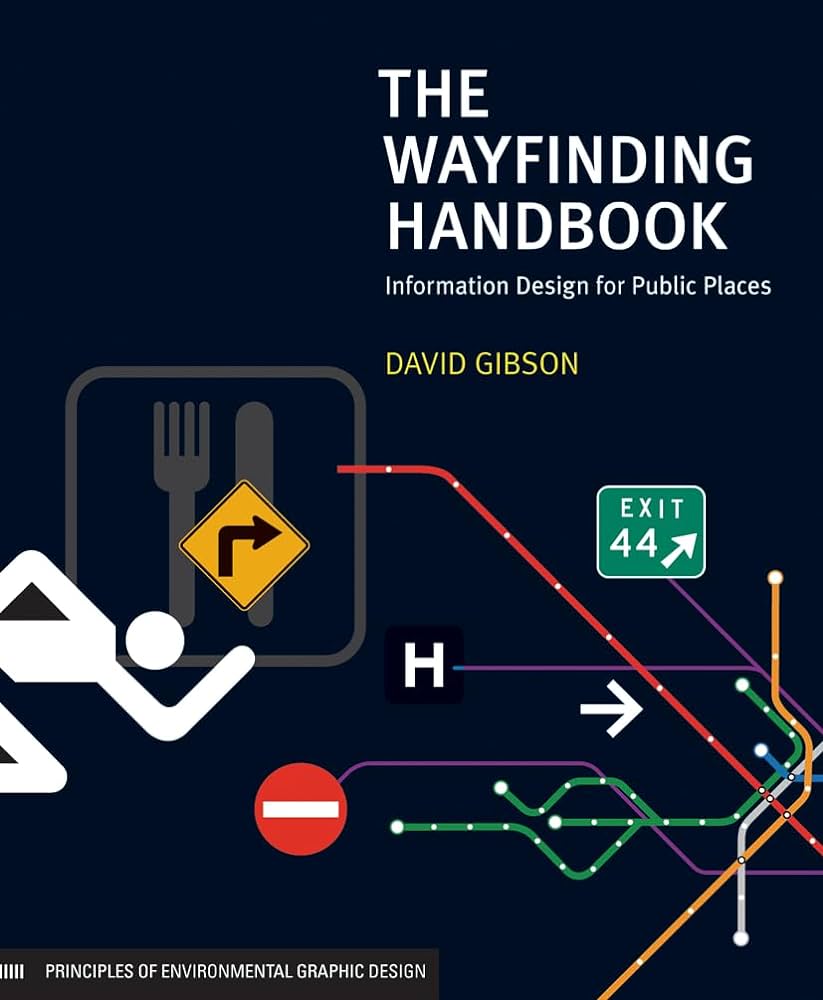
The Wayfinding Handbook by professional wayfinding designer David Gibson draws on more than thirty years of experience collaborating with architects, planners, developers, managers, and civic leaders to offer an insider’s view of this rapidly evolving discipline. Using real-life examples, Gibson illustrates the way type, color, mapmaking, dimensional forms, material selection, and new media are used to create effective wayfinding systems.
The Wayfinding Handbook is a complete guide to the discipline, from planning and design to practical considerations, such as setting up teams and managing projects. “Other Voices” sidebars, presented throughout the book, reveal the opinions of experts who plan, manage, and shape wayfinding projects. A comprehensive bibliography and gallery of resources round out what is likely to become the go-to resource for students, professionals, or anyone charged with designing peoplefriendly, universally accessible environments.
The Wayfinding Handbook by David Gibson is a comprehensive guide that delves into the intricate art of wayfinding – the science and design of helping people navigate through spaces efficiently. The book covers various aspects of this field, providing insights into signage, environmental cues, and user experience.
Gibson starts by exploring the historical evolution of wayfinding, tracing its roots and development over time. He then delves into the psychology of navigation, emphasizing the importance of understanding how individuals perceive and interpret spatial information. The author skillfully combines theory with practical applications, offering a well-rounded approach suitable for both novices and professionals in design, architecture, and urban planning.
One notable strength of the book lies in its inclusion of case studies and real-world examples, illustrating successful wayfinding solutions and analyzing their effectiveness. This practical dimension enhances the reader’s understanding and provides valuable insights for implementing similar strategies in diverse contexts.
Gibson’s writing style is accessible, making complex concepts in wayfinding easily understandable. The book is highly organized, progressing logically from foundational principles to advanced topics. Each chapter builds upon the previous, creating a cohesive learning experience.
As someone deeply interested in hospitality and the user experience, I appreciated how The Wayfinding Handbook aligned with my passion for creating welcoming environments. The book not only addresses the functional aspects of wayfinding but also recognizes its role in enhancing the overall experience of spaces, especially with respect to all things hospitality.
In conclusion, The Wayfinding Handbook by David Gibson is a valuable resource for anyone involved in the design and use of physical spaces. Its blend of theory, practical examples, and a user-centric approach makes it a recommended read for professionals and enthusiasts alike.
Part of a regular series on 27gen, entitled Wednesday Weekly Reader.
During my elementary school years one of the things I looked forward to the most was the delivery of “My Weekly Reader,” a weekly educational magazine designed for children and containing news-based, current events.
It became a regular part of my love for reading, and helped develop my curiosity about the world around us.
Envision a world where bridges do not exist. Picture major cities like London, Paris, and Rome without convenient pathways across the Thames, the Seine, and the Tiber. Visualize Manhattan as an isolated island, lacking solid connections over the Hudson and East rivers.
Consider San Francisco without road access across the gate to the north and the bay to the east. Imagine Pittsburgh without any bridges spanning the Allegheny and the Monongahela rivers. Picture Chicago without its substantial lift – and drawbridges, or Amsterdam without its more modest canal crossings. Envision Seattle without its lengthy, low floating bridges, or St. Petersburg without its soaring cable-stayed structure stretching over Tampa Bay.
The association between bridges and cities is profound, particularly because many of our greatest cities emerged where they are due to their proximity to water. Settlements along rivers and bays, often at crucial river crossings, have played a significant role in the growth of cities. Cambridge, an ancient English city dating back to Roman times, owes its existence to a bridge over the navigable River Cam. Oxford, another venerable English city, derived its name from being a crossing point of the Thames.
Reflect on the prevalence of water-related words like “port,” “bay,” and “haven” in the names of many cities and towns. Additionally, numerous states share names with the rivers that either border or bisect them.
Now, think about iconic landmarks like the Golden Gate Bridge spanning anything other than the Golden Gate itself. The location, design, proportions, scale, and color of the bridge seem perfectly suited for the site. Can you even imagine any other bridge between San Francisco and Marin County? Could a replica of the Brooklyn Bridge or a smaller version of the Golden Gate Bridge have been envisioned for different locations? Engineers must engage in this type of questioning and imagination before constructing any bridge. Early proposals for bridges in New York and San Francisco looked drastically different from the familiar structures we know today.
Bridges define the entrances to cities, and crossing or passing under some of the world’s great spans is an unforgettable experience. They serve as landmarks and guideposts for travelers, shaping first impressions of cities. Even small, anonymous highway bridges, though less famous, are crucial to local traffic. The engineers who design monumental bridges often begin by working on smaller ones, making them training grounds for ambitious dreams. Every bridge, regardless of size, is not just a functional structure but also an aesthetic and environmental statement.
Despite their significance, our thoughts about bridges often fade once they are open, taken for granted after grand celebrations. However, bridges, like people, are affected by their environment and face wear and tear from traffic, pollution, neglect, and aging. Regular maintenance, inspections, and a recognition of their limits are essential. Unfortunately, neglecting these aspects has led to approximately one in five American bridges being labeled structurally deficient.
Understanding the stories behind our bridges not only fosters a deeper appreciation for their rich history but also provides insight into the humanity of engineers and the field of engineering. It encourages greater pride in the contribution of bridges to our physical and cultural infrastructure and emphasizes the responsibility to maintain them. Imagine a world without bridges, and you’ll realize the immense impact these structures have on our lives.
In Engineers of Dreams, Henry Petroski reveals the science and engineering – not to mention the politics, egotism, and sheer magic – behind America’s great bridges, particularly those constructed during the great bridge-building era starting in the 1870s and continuing through the 1930s. It is the story of the men and women who built the St. Louis, the George Washington, and the Golden Gate bridges, drawing not only on their mastery of numbers but on their gifts for persuasion and self-promotion. It is an account of triumphs and ignominious disasters (including the Tacoma Narrows Bridge, which literally twisted itself apart in a high wind). And throughout this grandly engaging book, Petroski lets us see how bridges became the “symbols and souls” of our civilization, as well as testaments to their builders’ vision, ingenuity, and perseverance.
When you delve into the rich tapestry of bridges, it’s essential to appreciate their multifaceted significance throughout history and their tangible impact on human connectivity. Bridges, both literal and metaphorical, have stood as testaments to human ingenuity, overcoming physical barriers and fostering connections. From ancient structures like the Roman arch bridges to modern engineering marvels such as suspension bridges and cable-stayed spans, each iteration tells a story of innovation and the human desire to traverse obstacles. However, the essence of bridges extends beyond their structural prowess. Metaphorically, the concept of bridges has woven itself into the fabric of our language, serving as a symbol for forging connections, overcoming challenges, and navigating transitions. Let’s explore the myriad ways in which the metaphorical resonance of “bridges” enriches our understanding of relationships, communication, and personal growth across various domains.
The metaphor of “bridges” is widely used across various contexts, symbolizing connections, transitions, and relationships. Here’s a brief listing of the use of “bridges” as a metaphor:
Connecting Generations: The term “bridging the generation gap” is often used to describe efforts to foster understanding and collaboration between different age groups.
Building Relationships: “Building bridges” is a metaphor for establishing and strengthening connections between individuals or groups, emphasizing the importance of communication and understanding.
Navigating Transitions: “Crossing a bridge” is a metaphor for going through a transition or overcoming challenges. It represents a journey from one state to another.
Overcoming Obstacles: “Bridging obstacles” signifies finding solutions and overcoming difficulties, emphasizing resilience and problem-solving.
Cultural Integration: In multicultural contexts, “bridging cultures” refers to efforts to promote understanding and harmony between different cultural groups.
Career Development:”Building a career bridge” is a metaphor for strategic planning and actions taken to advance one’s professional life, moving from one stage to another.
Knowledge Transfer: In the context of mentoring, the term “knowledge bridge” is used to describe the transfer of expertise from experienced individuals to those seeking to learn.
Communication: “Bridging the communication gap” is a common phrase used to highlight efforts to improve understanding and convey messages effectively.
Innovation and Technology: “Bridging innovation” is a metaphor for connecting existing technologies or ideas to create something new and groundbreaking.
Emotional Connections: “Building emotional bridges” is used to describe efforts to establish and maintain meaningful connections on an emotional level.
Mind-Body Connection: “Bridging the mind and body” is a metaphor for achieving harmony and balance between mental and physical well-being.
Education and Learning: ”Bridging knowledge gaps” signifies efforts to enhance learning and understanding, especially in educational settings.
Final Action: “Burning your bridges” forces you to continue with a particular course of action, and makes it impossible for you to return to an earlier situation or relationship.
Drastic Act: Going a “bridge too far” is to pursue something difficult to achieve, often with serious consequences.
These metaphors illustrate the versatility of the “bridge” concept, showcasing its relevance in diverse areas of life and thought.
What use of a “bridge” metaphor would you add to this short (and incomplete) list?
A brief note about this article:
Perhaps the most challenging of all types of reading is syntopical reading, which applies the analytical skills across a multitude of texts. Syntopical reading aims to compare books and authors to one another, to model dialogues between authors that may not be in any one of the books.
The ultimate aim is to understand all the conflicting viewpoints relating to a subject. It’s not to devise your own synthetic answer, as this would merely be an entry into the literature, rather than an understanding of what already exists.
I’m a big proponent of syntopical reading, and at any given time I have a half-dozen or more syntopical collections in progress. The concepts of Bridges in both reality and metaphor is one of my long-standing ones, and one that I will continue to revisit from time to time.
Long-time readers of this site will undoubtably recognize a few more: Modern Elderhood, Disney history, hospitality, and culinary history and practices, for example.
Part of a regular series on 27gen, entitled Wednesday Weekly Reader.
During my elementary school years one of the things I looked forward to the most was the delivery of “My Weekly Reader,” a weekly educational magazine designed for children and containing news-based, current events.
It became a regular part of my love for reading, and helped develop my curiosity about the world around us.
Look again at your neighborhood, not just as the place you happen to live but as an important context for spirituality and mission.
Simon Carey Holt
What if God lived next door? Would you recognize him? Would you talk to him at the fence or avoid catching his eye? Would you love him as you love yourself?
Simon Carey Holt listened to the experiences of numerous men and women of faith – people who live in neighborhoods of all shapes and sizes – and concluded that though they are a largely forgotten resource when it comes to matters of faith, neighborhoods are places rich with the most inspiring stories and exciting possibilities for mission.
According to author Simon Carey Holt, we all live in neighborhoods. Yours may be as different to mine as the proverbial chalk is to cheese. Your closest neighbor may be far away, hidden behind a high wooden fence, or close enough to hear as she walks overhead. Every neighborhood is unique. Yours will have a look and feel of its own; they all do. No matter where it’s located or how old it is, each neighborhood has its own history, atmosphere and personality; each one its distinctive blend of housing types, commercial and community facilities, and public places. Yet every neighborhood – from the trendy city highrise to the ever expanding housing developments on the urban fringe and anything else in between – is a variation on the same basic principle: people living in close proximity to other people.
And yet increasingly, some of us struggle to simply name those who live next door, let alone know the details of their lives.
At the heart of the Christian story lie the two commands Jesus identified as the essence of living, the heart of spirituality: ‘You shall love the Lord your God with all of your heart, soul, mind and strength;’ and ‘You shall love your neighbour as yourself.’ As I struggle with these two directives and how to make them alive in my everyday experience, there are some questions that beg for answers, questions like these:
What does it mean to love God where I live?
What does the command, ‘You shall love your neighbor as yourself’ mean for the people who live next door?
How do the realities of contemporary urban and suburban life impact upon my experience of faith and community?
What has my spirituality got to do with the neighbors?
The desire to close the door on the world and create a haven of self-sufficiency, identity and security is strong.
But Holt believes the neighborhood remains a fundamentally important context of life and deserves to be taken more seriously by those who live in one. He believes that in ignoring the health and wellbeing of our local neighborhood, we’re ignoring the glue that binds the wider city together and makes it a genuinely human environment. And perhaps most importantly, he believes a spirituality that does not nurture our connections with the daily places of life fails to reflect the life-transforming nature of the Christian faith.
For decades now, Adam Gopnik has been one of our most beloved writers, a brilliantly perceptive critic of art, food, France, and more. But recently, he became obsessed by a more fundamental matter, one he had often meditated on in The New Yorker: How do masters learn their miraculous skill, whether it was drawing museum-ready art or baking a perfect sourdough loaf? How could anyone become so good at anything? There seemed to be a fundamental mystery to mastery. Was it possible to unravel it?
In The Real Work – the term magicians use for the accumulated craft that makes for a great trick – Gopnik becomes a dedicated student of several masters of their craft: a classical painter, a boxer, a dancing instructor, a driving instructor, and others. Rejecting self-help bromides and bullet points, he nevertheless shows that the top people in any field share a set of common qualities and methods. For one, their mastery is always a process of breaking down and building up – of identifying and perfecting the small constituent parts of a skill and the combining them for an overall effect greater than the sum of those parts. For another, mastery almost always involves intentional imperfection – as in music, where vibrato, a way of not quite landing on the right note, carries maximum expressiveness. Gopnik’s simplest and most invigorating lesson, however, is that we are surrounded by mastery. Far from rare, mastery is commonplace, if we only know where to look: from the parent who can whip up a professional strudel to the social worker who – in one of the most personally revealing passages Gopnik has ever written – helps him master his own demons.
Spirited and profound, The Real Work will help you understand how mastery can happen in your own life – and, significantly, why each of us relentlessly seeks to better ourselves in the first place.
Adam Gopnik explores the concept of mastery across various skills such as drawing, dancing, and driving. Using the term “real work” from stage magicians, Gopnik delves into the meticulous craftsmanship and technical expertise required to make a great magic trick truly outstanding. He emphasizes that the one credited with achieving the “real work” isn’t necessarily the inventor but the one who masters every detail of its execution.
Structured around Gopnik’s interactions with practitioners of different crafts, the book unfolds as a celebration of human flaws. Three key themes emerge:
Mastery is the gradual assembly of fragments into a harmonious whole.
Mastery is about humanity, not perfection, appreciating the vulnerability within virtuosity.
Mastery is found in real lives, not abstract life rules.
Gopnik becomes an apprentice in various disciplines, from drawing to driving, to grasp the essence of mastery. He discusses the slow process of carpentering fragments, emphasizing the importance of learning each small step. Mastery, he argues, is not about impressing the public but about a democratic achievement that we all can attain.
The author explores drawing with a realist artist, magic with renowned magicians, and driving with an instructor who emphasizes relaxation. Through these experiences, Gopnik weaves in reflections on representational art, childhood, aging, and the intricate balance between learned virtuosity and unique vulnerability.
The book takes a poignant turn as Gopnik addresses the limited time we have on Earth, emphasizing that mastery is not transcendent but deeply personal. He contends that what truly matters is not impressing the masses but achieving mastery for ourselves and a few close individuals. In Gopnik’s view, mastery is democratic and attainable by all, a reflection of our varied and capable selves.
Part of a regular series on 27gen, entitled Wednesday Weekly Reader.
During my elementary school years one of the things I looked forward to the most was the delivery of “My Weekly Reader,” a weekly educational magazine designed for children and containing news-based, current events.
It became a regular part of my love for reading, and helped develop my curiosity about the world around us.
Modern elders initiate something new. How do we best start something?What are the things that have traditionally held us back from new learning, new exploration, and new adventure? What can we change to make better?
We all harbor desires for change. Sales and marketing professionals aspire to reshape their prospects’ perspectives, employees yearn to influence their bosses, business leaders strive to transform their organizations, and parents seek to mold their children’s behavior. Yet, the formidable challenge of change often stems from inertia – a force that leads families to revisit the same vacation spot annually and compels companies to cling to established practices while resisting new initiatives.
Renowned author Jonah Berger, writing in The Catalyst, sheds light on our natural inclination to combat inertia aggressively. When met with resistance, individuals tend to inundate clients or superiors with facts and lengthy explanations. However, negotiators at the FBI, exemplified by figures like Greg Vecchi, adopt a more effective strategy – one that focuses on dismantling barriers rather than battling against them.
Embark on a brief journey and delve into the art of instigating change by embracing the role of a Catalyst – a superior approach inspired by the world of chemistry. Chemists employ specific substances to catalyze transformations, expediting processes that might otherwise take years. Similarly, becoming a catalyst in human interactions involves removing roadblocks and lowering barriers to initiate change.
In The Catalyst, author Jonah Berger employs the metaphor of catalysis throughout the entire book, emphasizing that the most efficient way to induce change in any scenario is by adopting the role of a catalyst. By identifying and eliminating the obstacles preventing individuals from taking action, meaningful change is achievable.
The approach begins with a fundamental question: What impediments hinder the person from changing? Understanding these barriers is key to the success of the catalyst method. For example, success in negotiating with criminals without violence hinges on this principle – sometimes, all that is needed is to locate and release the metaphorical parking brake.
Our exploration will unfold through Berger’s five strategies encapsulated in the acronym REDUCE: reduce Reactance, ease Endowment, shrink Distance, alleviate Uncertainty, and find Corroborating Evidence. These tactics serve as a guide to becoming a catalyst, facilitating positive and transformative change in various situations.
Have something you want to change? Want to change someone’s mind or how an organization works? It’s not about pushing harder, or being more persuasive, it’s about removing the barriers to change. REDUCE these five key roadblocks and you can change anything.
Reactance
When pushed, people push back. So rather than telling people what to do, or trying to persuade, catalysts allow for agency and encourage people to convince themselves. How can we allow for agency, provide a menu, or highlight a gap?
Endowment
People are wedded to what they’re already doing. The status quo. To ease endowment, we need to surface the costs of inaction, burn the ships, and frame new things as regaining a loss.
Distance
Perspectives that are too far away fall in the region of rejection and get discounted. So start by asking for less. Find an unsticking point and use it to switch the field.
Uncertainty
Change almost always involves uncertainty, and this ambiguity makes people hit the pause button, stemming action. To get people to un-pause, increase trialability. Harness freemium, reduce upfront costs, and drive discovery.
Corroborating Evidence
Sometimes one person, isn’t enough. Some things need more proof. So find reinforcement. Use multiple sources, concentrate them close in time, and figure out whether you need a firehose or a sprinkler.
Creating change is hard, but it’s possible. The key, Jonah Berger teaches us, is to become a catalyst and remove barriers to action rather than trying to create it by force.
More often than not, things don’t budge. And by focusing so much on ourselves and what we want, we forget the most important part of change: Understanding our audience.
Jonah Berger
You can do that by remembering and utilizing the five ways you can become a catalyst, forming the handy acronym REDUCE: reduce Reactance, ease Endowment, shrink Distance, alleviate Uncertainty, and find CorroboratingEvidence.
Discover the secret to flourishing in an age of division: belonging. In a world filled with discord and loneliness, finding harmony and happiness can be difficult. But what if the key to unlocking our potential lies in this deceptively simple concept? Belonging is the feeling of being a part of a group that values, respects, and cares for us―a feeling that we can all cultivate in even the smallest corners of social life.
In Belonging: The Science of Creating Connection and Bridging Divides, Stanford University professor Geoffrey L. Cohen draws on his own and others’ groundbreaking scientific research to offer simple, concrete solutions for fostering a sense of belonging. These solutions can generate surprisingly significant and long-lasting benefits.
Small but powerful actions can bolster belonging―actions such as encouraging people to reflect on their core values before they face a challenge or expressing belief in someone’s capacity to reach a higher standard. A wide range of innovative approaches have been found to boost achievement at work and at school, bridge political divides, reduce prejudice, and even contribute to overall health. Rigorously tested in diverse arenas―from classrooms to disadvantaged neighborhoods to iconic Silicon Valley companies―these methods offer a path forward in these demanding times.
Belonging is a compelling read for all who yearn for a more connected world, whether you’re a manager or employee, an educator or student, a parent or caregiver, or simply someone seeking to make the most out of every moment you spend with others. Packed with actionable insights and specific strategies, this book offers hope and practical guidance, serving as both an inspiration and a roadmap to creating a world of inclusion, understanding, and empathy.
The science of situation-crafting provides valuable insights into our ability to cultivate a sense of connection and belonging in our lives. This situational literacy empowers us to face challenges that may threaten our sense of belonging. Here’s a core set of practices derived from Belonging that will provide insights to actively build belonging in our daily interactions.
1. Ask Questions and Listen: Appreciating the depth of individuals’ experiences through genuine curiosity is a powerful bond builder. By actively seeking perspectives and understanding people’s circumstances, we can provide more meaningful support and strengthen connections.
2. Give Your Perspective: Sharing our own stories and perspectives complements the need to understand others. Articulating the reasons behind our views can prevent stereotyping. Expressing dissent should be done with courtesy, signaling intent and allowing others the space to accommodate diverse viewpoints.
3. Be Polite: Politeness, a universal protocol, signifies respect for others. Simple acts like not interrupting, using “please” and “thank you,” and apologizing when necessary contribute to recognizing the belonging of others.
4. Affirmation: Creating opportunities for individuals to express themselves and feel valued is crucial. Affirmation goes beyond vapid praise, focusing on allowing people to share their commitments and values, reinforcing their sense of self.
5. Avoid Authoritarian Language: Acknowledging diverse perspectives by expressing ambivalence and actively learning about opposing views builds rapport. Signaling intentions before giving critical feedback fosters an atmosphere of concern and respect instead of dictation.
6. Use the Nonverbal Channel: Nonverbal cues such as nodding, smiling, and making eye contact convey interest and respect. However, authenticity is key, as coming across as fake can be counterproductive. Genuine nonverbal expressions enhance bonding.
7. Handle Yourself with Care: Being in the right mental and emotional state is crucial for meaningful interactions. Cultivating personal belonging allows us to navigate social situations thoughtfully, especially in challenging times, avoiding conformity to harmful stereotypes and norms.
8. Craft Your Situations with Care: Recognizing the entanglement of our identity with our environment, we can actively self-craft by situation-crafting. Acting as gatekeepers for social influences, cultivating a rich social life, and staying true to our values contribute to fostering belonging.
Conclusion
Building belonging is an ongoing practice that requires awareness and dedication. By incorporating these core practices into our daily lives, we can create positive interactions and strengthen connections. Small gestures and moments of connection have lasting effects, inspiring and empowering both ourselves and others. Let us embrace the magic of situation-crafting to make every situation a little better for everyone involved.
Part of a regular series on 27gen, entitled Wednesday Weekly Reader.
During my elementary school years one of the things I looked forward to the most was the delivery of “My Weekly Reader,” a weekly educational magazine designed for children and containing news-based, current events.
It became a regular part of my love for reading, and helped develop my curiosity about the world around us.
As a leader, you are not out to create followers, but to discover, disciple, and distribute more and better leaders throughout your organization.
Let’s take the simple but accurate path of dividing people into two groups – leaders and followers. Followers don’t develop leaders – they follow them. Only leaders can develop more leaders.
The odds are high that you have someone on your team that is now only a follower – but you recognize potential in them. You want them to become the leader you already see in them.
In this new edition of their classic business fable, Ken Blanchard and Mark Miller get at the heart of what makes a leader successful. Newly promoted but struggling young executive Debbie Brewster asks her mentor the one question she desperately needs answered: “What is the secret of great leaders?” His reply—“great leaders serve”—flummoxes her, but over time he reveals the five fundamental ways that leaders succeed through service. Along the way she learns:
• Why great leaders seem preoccupied with the future • How people on the team ultimately determine your success or failure • What three arenas require continuous improvement • Why true success in leadership has two essential components • How to knowingly strengthen—or unwittingly destroy—leadership credibility
The tenth anniversary edition includes a leadership self-assessment so readers can measure to what extent they lead by serving and where they can improve. The authors also have added answers to the most frequently asked questions about how to apply the SERVE model in the real world.
As practical as it is uplifting, The Secret shares Blanchard’s and Miller’s wisdom about leadership in a form that anyone can easily understand and implement. This book will benefit not only those who read it but also the people who look to them for guidance and the organizations they serve.
A SIMPLE SOLUTION
If you are looking for the latest techniques to help you coerce people to do what you say, you will not find any such techniques in the broad category of servant leadership.
Servant leadership is not a strategy or shortcut to success. Servant leadership is a long journey, leading with people as you add value to them by putting their interests ahead of your own.
Creating culture always starts with the organization leader, and it is no different in your church. If you are going to create a culture in which leaders SERVE, you are going to have to demonstrate these five principles first.
A person can serve without leading, but a leader can’t lead well without serving.
Five Strategic Ways Great Leaders SERVE
See and shape the future. Leadership always begins with a picture of the future. Leaders who cannot paint a compelling picture of a preferred future are in jeopardy of forfeiting their leadership. Clarity will often come in the midst of activity. If you are stuck, get moving. When the vision is clear and compelling, it will create life, energy, and momentum.
Engage and develop others. Engagement is about creating the context for people to thrive. Low engagement of your teams is not an indictment of the workers; it is the leaders who need to make a change. We believe leaders who are not proactively developing others are missing a vital aspect of their role.
Reinvent continuously. To make progress, to move forward, to accomplish bigger and better, something has to change. There are three arenas of change:
Self – How are you reinventing yourself?
Systems – Which work processes need to change to generate better results?
Structure – What structural changes could you make to better enable the accomplishments of your goals?
Value results and relationships. Virtual every leader has a natural bias toward one or the other of these. While not bad, that bias can limit your effectiveness. The best leaders value both and manage the tension between them.
Embody the values. People watch leaders, looking for clues regarding what’s important to the leaders. They are also trying to determine if the leader is trustworthy.
At your next team meeting, write the five SERVE statements from above on separate chart tablets.
On a scale of 1 (I don’t do this at all) to 5 (I consistently do this), ask your team to individually (and privately) to rate themselves.
Next, have a group discussion, asking for a consensus rating using the same scale above on how your team is taking these actions.
Next, list as many specific and concrete actions that demonstrate each particular action. After you have completed this action, ask the group for a consensus decision on the top three in each category, and circle them.
Finally, ask what actions are missing from each list. Discuss how these actions can become a part of your team’s regular practices.
In our cities, we stand in silence at the pharmacy and in check-out lines at the grocery store, distracted by our phones, barely acknowledging one another, even as rates of loneliness skyrocket. Online, we retreat into ideological silos reinforced by algorithms designed to serve us only familiar ideas and like-minded users. In our politics, we are increasingly consumed by a fear of people we’ve never met. But what if strangers—so often blamed for our most pressing political, social, and personal problems—are actually the solution?
In The Power of Strangers, Joe Keohane sets out on a journey to discover what happens when we bridge the distance between us and people we don’t know. He learns that while we’re wired to sometimes fear, distrust, and even hate strangers, people and societies that have learned to connect with strangers benefit immensely. Digging into a growing body of cutting-edge research on the surprising social and psychological benefits that come from talking to strangers, Keohane finds that even passing interactions can enhance empathy, happiness, and cognitive development, ease loneliness and isolation, and root us in the world, deepening our sense of belonging. And all the while, Keohane gathers practical tips from experts on how to talk to strangers, and tries them out himself in the wild, to awkward, entertaining, and frequently poignant effect.
The Power of Strangersby Joe Keohane is a thought-provoking exploration of the impact that interactions with strangers can have on our lives. Keohane delves into the psychology of how we perceive and connect with people we don’t know, emphasizing the influence strangers have on our decision-making and behavior.
The book takes readers on a journey through various aspects of human connection, from the significance of chance encounters to the role of strangers in shaping our opinions and beliefs. Keohane skillfully weaves together anecdotes, scientific research, and real-world examples to illustrate the profound ways in which strangers shape our experiences.
One of the strengths of the book is its ability to challenge preconceived notions about strangers, highlighting both the positive and negative aspects of these interactions. Keohane argues that embracing the power of strangers can lead to personal growth, expanded perspectives, and unexpected opportunities.
The writing is engaging and accessible, making complex psychological concepts accessible to a broad audience. Keohane’s exploration of the subject matter is both thorough and detailed, aligning with your preference for detailed explanations.
In summary, The Power of Strangers offers a compelling perspective on the often-overlooked influence that strangers have on our lives. It encourages readers to reevaluate their perceptions and appreciate the richness that comes from engaging with those outside our immediate circles.
Part of a regular series on 27gen, entitled Wednesday Weekly Reader.
During my elementary school years one of the things I looked forward to the most was the delivery of “My Weekly Reader,” a weekly educational magazine designed for children and containing news-based, current events.
It became a regular part of my love for reading, and helped develop my curiosity about the world around us.
Party develops and sustains the communal life of the community and it is the foundation of spiritual movement. If people find friends, great conversations, a safe place to be themselves and to bring others to, then you have the makings of a kingdom movement. If someone finds you through the party, then finding God will be much easier for them because they will already have a community of people to walk with.
Hugh Halter
All good missionaries know the power of social engagement.
Whether you are called to Spain, Italy, Iceland, or Portland, Oregon, we now live in a pure mission field, and people won’t move spiritually until they are connected socially. In other words, the Gospel will not be heard until our front doors open, our tables are set, and we practice the art of hospitality, celebration, and party.
Why has this ancient art of party been lost?
Because the church has defined holiness as “exclusion” from the world, abstinence from food and drink and separation from real people. In Jesus, we get to be holy as He was holy. Our inward commitments to Him remain intact while at th same time we are deeply entrenched in the life and customs of those around us.
Party is sacrament and we must relearn and reorient our lives around friends, food, and celebration if we are going to have any influence upon the culture right next door.
In Happy Hour, Hugh will unpack the theology of party as well as give you practical etiquette and ideas for making merriment a way of life and a way of mission.
According to author Hugh Halter, the one skill every believer must develop is the discipleship skill of throwing a great party.
No, it’s not just about outreach to lost friends. It’s really about our discipleship after Jesus. If He did it, and we claim to follow Him, then we must stretch past church attendance and Bible studies to learn how to be great human beings like He was.
Happy Hour is a book for missionaries in a missionary context.
Which is all believers.
inspired and adapted from Happy Hour: Etiquette and Advice on Holy Merriment, by Hugh Halter



















 27gen.com