The virtue of neighborliness is not only something I want for my neighborhood, but is something I want deeply for every residential area. I can practice neighborliness in my context while advocating for a return to neighborliness in every context.
Eric O. Jacobsen
Christians often talk about claiming our cities for Christ and the need to address urban concerns. But according to Eric Jacobsen, this discussion has remained far too abstract. Sidewalks in the Kingdom challenges Christians to gain an informed vision for the physical layout and structure of the city.
Jacobsen emphasizes the need to preserve the nourishing characteristics of traditional city life, including shared public spaces, thriving neighborhoods, and a well-supported local economy. He explains how urban settings create unexpected and natural opportunities to initiate friendship and share faith in Christ.
Helpful features include a glossary, a bibliography, and a description of New Urbanism. Pastors, city-dwellers, and those interested in urban ministry and development will be encouraged by Sidewalks in the Kingdom.
According to author Eric O. Jacobsen, the most meaningful way to define a city he has found is to say that you tend to know when you are in one. While it may sound like a cop-out, this is one area where our intuition might really be our most reliable guide.
To be more specific, there are six general features that would indicate to a visitor that he or she is in a city. These features can be understood as six distinct markers of the city.
Public spaces
Mixed-use zoning
Local economy
Beauty and quality in the built environment
Critical Mass
Presence of strangers
Jacobsen believes that a familiarity with these makers gives us handles upon which to hang our impressions of the communities in which we live, whether or not they qualify as cities. They also help focus and clarify our discussion about the merits of city life.
Almost everything we do involves words. Words are how we persuade, communicate, and connect. They’re how leaders lead, salespeople sell, and parents parent. They’re how teachers teach, policymakers govern, and doctors explain. Even our private thoughts rely on language.
But certain words are more impactful than others. They’re better at changing minds, engaging audiences, and driving action. What are these magic words, and how can we take advantage of their power?
In Magic Words, internationally bestselling author Jonah Berger gives you an inside look at the new science of language and how you can use it. Technological advances in machine learning, computational linguistics, and natural language processing, combined with the digitization of everything from cover letters to conversations, have yielded unprecedented insights.
Learn how salespeople convince clients, lawyers persuade juries, and storytellers captivate audiences; how teachers get kids to help and service representatives increase customer satisfaction; how startup founders secure funding, musicians make hits, and psychologists identified a Shakespearean manuscript without ever reading a play.
This book is designed for anyone who wants to increase their impact. It provides a powerful toolkit and actionable techniques that can lead to extraordinary results. Whether you’re trying to persuade a client, motivate a team, or get a whole organization to see things differently, this book will show you how to leverage the power of magic words.
Magic Words, authored by Jonah Berger, delves into the concealed mechanisms governing language and, more significantly, delineates strategies for employing it more persuasively, nurturing relationships, and achieving success in both personal and professional realms.
The book explores six categories of influential words, devoting a chapter to each of these areas:
Activating Identity and Agency: Words that delineate authority, responsibility, and engagement in actions. This chapter delves into the profound impact subtle alterations in language can have, such as the efficacy of using nouns over verbs in persuasion, mastering the art of refusing to advance towards goals, and adopting specific interrogative phrases to enhance creativity and problem-solving. Furthermore, it discusses how speaking in the third person can mitigate anxiety and enhance communication, along with the nuanced effects of pronouns like “you” on social interactions and empathy.
Conveying Confidence: Language not only communicates information but also conveys the speaker’s confidence, thereby influencing perceptions and sway. This chapter explores how eliminating certain words transformed an underperforming salesperson into a top achiever, the significance of linguistic style in legal discourse, and linguistic cues that enhance credibility and authority. It also delves into the allure of certainty and the strategic use of uncertainty in communication to foster trust and receptivity.
Asking the Right Questions: This chapter delves into the science behind effective questioning, revealing why seeking advice enhances perceived intelligence and increases the likelihood of securing subsequent dates. It elucidates the types and timing of questions for optimal outcomes, strategies for deflecting challenging inquiries, and techniques for fostering deeper social connections through inquiry.
Leveraging Concreteness: Highlighting the potency of concrete language, this chapter reveals how specific words convey attentive listening and why emphasizing “fixing” rather than “solving” problems enhances customer satisfaction. It explores instances where abstract language may be advantageous, signaling authority and leadership, and discusses its role in fundraising for startups.
Employing Emotion: Exploring the emotive dimension of language, this chapter unveils how emotional language enhances engagement across various contexts. It narrates anecdotes, such as the success story of a young intern who built a podcasting empire by mastering storytelling principles. Additionally, it delves into the interplay between negative and positive emotions in enhancing enjoyment and boosting sales, offering insights into captivating audience attention and managing emotional responses.
Harnessing Similarity and Difference: This section explains the significance of linguistic similarity in interpersonal dynamics, explaining its impact on social connections, promotions, and friendships. It also explores scenarios where embracing difference proves advantageous, citing examples from music popularity trends and artificial intelligence research.
The book concludes by emphasizing the universal role of language in everyday communication, whether through written correspondence or oral discourse. It underscores the importance of mastering language for effective communication, persuasion, and relationship-building, positing that linguistic proficiency is a skill that can be learned and honed over time, empowering individuals to achieve their communication goals effectively.
Part of a regular series on 27gen, entitled Wednesday Weekly Reader.
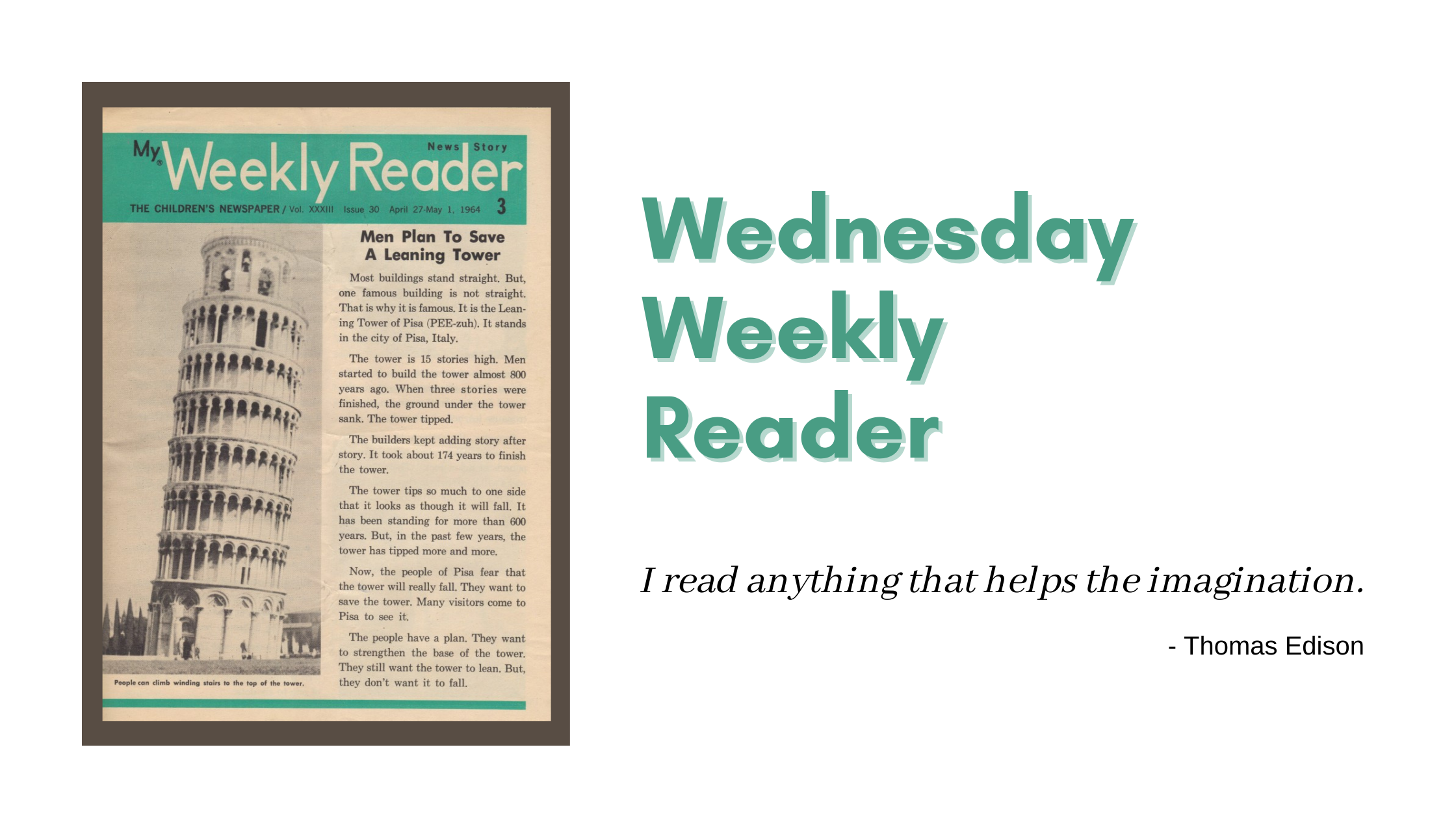
During my elementary school years one of the things I looked forward to the most was the delivery of “My Weekly Reader,” a weekly educational magazine designed for children and containing news-based, current events.
It became a regular part of my love for reading, and helped develop my curiosity about the world around us.
This mini-series about books started off with the history of the library, then went to books at war, and now comes down to the book itself – or rather, how important the design of a book is to the reader.
Design is central to the appeal, messaging, and usefulness of books, but to most readers, it’s mysterious or even invisible. Through interiors as well as covers, designers provide structure and information that shape the meaning and experience of books. In The Design of Books, Debbie Berne shines a light on the conventions and processes of her profession, revealing both the aesthetic and market-driven decisions designers consider to make books readable and beautiful. In clear, unstuffy language, Berne reveals how books are put together, with discussions of production considerations, typography and fonts, page layouts, use of images and color, special issues for ebooks, and the very face of each book: the cover.
The Design of Books speaks to readers and directly to books’ creators—authors, editors, and other publishing professionals—helping them to become more informed partners in the design of their projects. Berne lays out the practical steps at each stage of the design process, providing insight into who does what when and offering advice for authors on how to be effective advocates for their ideas while also letting go and trusting their manuscripts with teams of professionals. She includes guidance as well for self-publishing authors, including where to find a designer, what to expect from that relationship, and how to art direct your own book.
Throughout, Berne teaches how understanding the whats, hows, and whys of book design heightens our appreciation of these cherished objects and helps everyone involved in the process to create more functional, desirable, and wonderful books.
Berne embarked on the journey of writing this book because she sensed a gap in understanding among the authors and editors she collaborated with regarding book design. It seemed there was a lack of accessible resources for them to grasp the intricacies of design. Traditional books on design target designers themselves, while online explanations often offer fragmented and bewildering information, focusing on the “what” rather than the “why.” Berne’s aim was to equip those on the editorial side with not only the vocabulary and techniques of design but also the underlying rationale behind design decisions. This endeavor wasn’t solely for enjoyment, although design can indeed be enjoyable, but rather to facilitate more meaningful discussions, enriched experiences, and ultimately, better books.
The Design of Books provides the reader with insights into the mechanics of typography and the significance of factors like line length. It will heighten your awareness of the nuances of headings and how the choice of words influences cover design. Above all, it will enhance your perception of design and its contributions.
As a book designer turned author, Berne advocates for the importance of design in publishing and emphasizes the significance of incorporating the voice and ideas of the designer early in the process. Often, design is an afterthought, introduced late in the game, leading to a discord between the materials provided and the expectations for their presentation. Authors should consider how the design will complement the content from the outset, including collaboration with designers during the developmental stages. Effective design should intertwine seamlessly with the content; attempting to apply it as an afterthought overlooks its essence.
Design inside a book creates order and bestows authority. Reading a badly designed book is like driving over a crumbling road, potholes everywhere.
Debbie Berne
Part of a regular series on 27gen, entitled Wednesday Weekly Reader.
During my elementary school years one of the things I looked forward to the most was the delivery of “My Weekly Reader,” a weekly educational magazine designed for children and containing news-based, current events.
It became a regular part of my love for reading, and helped develop my curiosity about the world around us.
How Social Infrastructure Can Help People Fight Inequality, Polarization, and the Decline of Civic Life
The social and physical environment shapes our behavior in ways we’ve failed to recognize; it helps make us who we are and determines how we live.
Eric Klinenberg
We are living in a time of deep divisions. Americans are sorting themselves along racial, religious, and cultural lines, leading to a level of polarization that the country hasn’t seen since the Civil War. Pundits and politicians are calling for us to come together and find common purpose. But how, exactly, can this be done?
In Palaces for the People, Eric Klinenberg suggests a way forward. He believes that the future of democratic societies rests not simply on shared values but on shared spaces: the libraries, childcare centers, churches, and parks where crucial connections are formed. Interweaving his own research with examples from around the globe, Klinenberg shows how “social infrastructure” is helping to solve some of our most pressing societal challenges. Richly reported and ultimately uplifting, Palaces for the People offers a blueprint for bridging our seemingly unbridgeable divides.
According to author Eric Klinenberg, social infrastructure is not “social capital” – a concept commonly used to measure people’s relationships and interpersonal networks – but the physical conditions that determine whether social capital develops.
When social infrastructure is robust, it fosters contact, mutual support, and collaboration among friends and neighbors; when degraded, it inhibits social activity, leaving families and individuals to fend for themselves.
Social infrastructure is crucially important, because local, face-to-face interactions – at the school, the playground, and the corner diner – are the building blocks of all public life.
People forge bonds in places that have healthy social infrastructures – not because they set out to build community, but because when people engage in sustained, recurrent interaction, particularly while doing things they enjoy, relationships inevitably grow.
In a follow-up to last week’s look at the history of the library, a companion post: the role of books in both shaping conflict and being shaped by conflict (the very appropriate subtitle of the book).
Print, in all its rich variety, will continue to play a part in human interactions through the globe, in war as in peacetime… When books go to war, others stay behind, a reminder of the better times when conflict can be banished to the edge of our consciousness, if never wholly eradicated.
Andrew Pettegree
We tend not to talk about books and war in the same breath – one ranks among humanity’s greatest inventions, the other among its most terrible. But as esteemed literary historian Andrew Pettegree demonstrates, the two are deeply intertwined.
The Book at Warexplores the various roles that books have played in conflicts throughout the globe. Winston Churchill used a travel guide to plan the invasion of Norway, lonely families turned to libraries while their loved ones were fighting in the trenches, and during the Cold War both sides used books to spread their visions of how the world should be run. As solace or instruction manual, as critique or propaganda, books have shaped modern military history – for both good and ill.
With precise historical analysis and sparkling prose, The Book at War accounts for the power – and the ambivalence – of words at war.
In May 1933, news of widespread book burnings orchestrated by the Nazis in Germany triggered a swift and impassioned response in the United States. Almost 200,000 people took to the streets in cities across the country to protest this censorship. Authors, some of whose works had been burned, strongly condemned the actions. President Franklin D. Roosevelt incorporated the imagery of the smoldering pyres into his speeches, emphasizing the importance of preserving freedom and civil liberties.
Nearly a century later, book burnings during the Nazi era remain a powerful symbol, partly due to their impact at the time. Many Americans saw them as emblematic of the German regime, serving as a forewarning of future atrocities. However, Andrew Pettegree’s extensive cultural history, The Book at War: How Reading Shaped Conflict and Conflict Shaped Reading, reveals a surprising twist. Less than two decades before the Nazi book burnings, during periods of wartime chauvinism, Americans themselves fervently burned German books, with librarians leading the way.
Pettegree, a professor of modern history at Scotland’s University of St Andrews, delves into the intricate relationship between printed media, books, and war. He argues that books have played a crucial role in conditioning readers to expect and support conflicts, serving as carriers of ideology and spoils for victors. Yet, they have also provided solace and solidarity during times of combat, offering comfort to civilians in hiding and soldiers on the front lines.
While Pettegree’s depth of knowledge and skillful storytelling are evident throughout, he reaches a high-water mark when detailing the literary toll of war, providing acute actuarial insights into the destruction of books during World War II. The loss of over 500 million books in Europe, including the ransacking of Jewish libraries and the devastation in Poland, underscores the profound impact on cultural heritage.
A fascinating thread weaves through what Pettegree calls “warrior authors” – the great leaders of the world powers who found themselves in opposition not only on the battlefield, but also on the written page. Here are a few examples:
Winston Churchill – Writing was in his blood; his first autobiography “My Early Life” was from his adventures in India and Africa during Britain’s various wars in the region. Prior to his ascendancy to become Prime Minister, writing and journalism kept him ahead of his mounting debts. After WWII, he would win the Nobel Prize for Literature, for his oratory and historical writing.
Adolf Hitler – The most notorious text of the twentieth century, “Mein Kampf” laid out in remarkable detail his program for Germany and the fate that awaited its enemies. He was also a discerning reader and collector, particularly of architectural and history books, appropriated by American soldiers in 1945 and now in the Library of Congress.
Joseph Stalin – Belying his reputation as crude and uneducated, he was a deeply literate and thoughtful reader and lover of books. His carefully curated library of over 15,000 volumes carried over into his involvement with some of the major writing projects of the Soviet state, influencing a war of ideas in Communist countries around the world.
Charles de Gaulle – A lonely symbol of French defiance during most of WWII, he first came to prominence as an author of aa widely admired text on armored warfare that crossed international boundaries and was quickly translated into both German and Russian.
The Book at War not only examines the destructive power of war on literature but also highlights how books have provided comfort to individuals enduring conflict. The accounts of Allied soldiers receiving cartons of paperbacks after storming Normandy’s beaches and Anne Frank finding solace in books while hiding from the Germans in Amsterdam are particularly poignant. These stories prompt reflection on how books continue to influence those facing conflict today.
On a personal note, my father was a WWII veteran who loved to read. Much later in life – his early 80s – he shared with me both stories and a few books that he had saved from his time in service. In addition, he had a highly curated selection of books by and about some of the great leaders of that generation, particularly Dwight Eisenhower. Upon is passing, I was fortunate to bring several of those into my personal library.
Part of a regular series on 27gen, entitled Wednesday Weekly Reader.
During my elementary school years one of the things I looked forward to the most was the delivery of “My Weekly Reader,” a weekly educational magazine designed for children and containing news-based, current events.
It became a regular part of my love for reading, and helped develop my curiosity about the world around us.
When I was young, I wanted to be knowledgeable, but as I got older, I wanted to be wise. Wise people don’t just possess information; they possess a compassionate understanding of other people. They know about life.
David Brooks
Along the journey of becoming a Modern Elder, I want to become more present with people, have bigger conversations, and find deep pleasure in human connection.
As a textbook introvert, I struggle with the previous sentence, but there’s always hope…
David Brooks observes, “There is one skill that lies at the heart of any healthy person, family, school, community organization, or society: the ability to see someone else deeply and make them feel seen – to accurately know another person, to let them feel valued, heard, and understood.”
And yet we humans don’t do this well. All around us are people who feel invisible, unseen, misunderstood. In How to Know a Person, Brooks sets out to help us do better, posing questions that are essential for all of us: If you want to know a person, what kind of attention should you cast on them? What kind of conversations should you have? What parts of a person’s story should you pay attention to?
Driven by his trademark sense of curiosity and his determination to grow as a person, Brooks draws from the fields of psychology and neuroscience and from the worlds of theater, philosophy, history, and education to present a welcoming, hopeful, integrated approach to human connection. How to Know a Person helps readers become more understanding and considerate toward others, and to find the joy that comes from being seen. Along the way it offers a possible remedy for a society that is riven by fragmentation, hostility, and misperception.
The act of seeing another person, Brooks argues, is profoundly creative: How can we look somebody in the eye and see something large in them, and in turn, see something larger in ourselves? How to Know a Person is for anyone searching for connection, and yearning to be understood.
Building meaningful relationships and fostering a sense of community boils down to mastering a series of small, tangible social skills. It’s about navigating disagreements without damaging connections, gradually unveiling vulnerability, being an attentive listener, gracefully concluding conversations, seeking forgiveness when needed, gently turning down others without causing heartbreak, comforting those in distress, and hosting gatherings where everyone feels embraced. It’s also about the ability to empathize and see things from another’s perspective.
Within any group, there are two types of individuals: Diminishers and illuminators. Diminishers focus on themselves, making others feel insignificant through stereotypes and assumptions. On the flip side, illuminators exhibit a persistent curiosity about others, asking the right questions to understand different viewpoints. They shine a light on people, making them feel respected and valued.
Despite being crucial life skills, these aren’t typically taught in schools, leaving a gap in practical knowledge about offering the rich attention we all crave. At the core of a healthy person, family, school, organization, or society lies a fundamental skill: the ability to deeply see and make others feel seen, to understand and value them.
This goes beyond mastering a set of techniques; it’s a way of life. To truly know someone, you need to grasp how they perceive the world, experiencing it through their eyes. Building relationships is an ongoing effort to understand others on a profound level and let them feel heard, valued, and comprehended. It’s about knowing how they know you.
Some people are much better at seeing people than others are. In any collection of humans, there are diminishers and there are illuminators. Diminishers are so into themselves, they make others feel insignificant. They stereotype and label. If they learn one thing about you, they proceed to make a series of assumptions about who you must be. Illuminators, on the other hand, have a persistent curiosity about other people. They have been trained or have trained themselves in the craft of understanding others. They know how to ask the right questions at the right times — so that they can see things, at least a bit, from another’s point of view. They shine the brightness of their care on people and make them feel bigger, respected, lit up.
David Brooks
Take a look at some of the following characteristics of Diminishers and Illuminators as developed by Brooks. Do you recognize yourself in any of them?
Diminisher Tactics
First Impressions: It’s that quick sizing-up moment when you meet someone, where you open your eyes, direct your gaze, and take them in.
Egotism: Some folks struggle to step outside their own viewpoints. They just aren’t curious about others.
Anxiety: Ever met someone drowning in the noise of their thoughts? It’s like they’ve got a whole party in their head, and they can’t quite tune into what’s happening in yours.
Naïve Realism: Ever thought your perspective was the one true reality, assuming everyone sees the world just as you do? That’s naive realism in action.
The Lesser-Minds Problem: While we’re privy to our thoughts, we only catch a snippet of what’s happening in other minds. This leads to the perception that our inner world is far more intricate than theirs.
Objectivism: Picture someone adopting a detached, dispassionate stance to understand entire populations but missing the individual stories.
Essentialism: Ever grouped people together, thinking they’re more similar than they really are? Or believed others from different groups are fundamentally different from “us”? That’s essentialism.
The Static Mindset: Imagine forming fixed perceptions of people, maybe based on past encounters, and not bothering to update them to reflect who they are now. That’s the static mindset in action.
The Illuminator’s Look
Gentleness: It’s about having a genuine emotional concern for others, recognizing the ties that bind us and the commonalities we share.
Openness: Pushing aside insecurities and self-absorption to fully engage in the experience of someone else.
Curiosity in Action: Cultivating the spirit of an explorer and honing the skill of imagining to truly see others.
Warmth: While some treat understanding as an intellectual exercise, for many, it’s a whole-body experience filled with emotion and affection.
Kindness: A generous spirit that looks for the best in people.
A Complete View: It’s easy to misjudge when you only see a fragment of someone rather than their whole being.
Striving to cast an illuminating gaze that is tender, generous, and open, we set ourselves on the right path. This approach helps us move beyond the clichéd character types we often lazily assign to people, ultimately enhancing how we present ourselves to the world.
The real process of, say, building a friendship or creating a community involves performing a series of small, concrete actions well: being curious about other people; disagreeing without poisoning relationships; revealing vulnerability at an appropriate pace; being a good listener; knowing how to ask for and offer forgiveness; knowing how to host a gathering where everyone feels embraced; knowing how to see things from another’s point of view.
Tuesday is my “Lunch and Learn” day, typically involving a trip to my local library to drop off books I’ve completed and pick up new ones that are available on my hold list. As a long-time user of library facilities, it’s not a surprise that I would read a book about libraries!
Famed across the known world, jealously guarded by private collectors, built up over centuries, destroyed in a single day, ornamented with gold leaf and frescoes, or filled with bean bags and children’s drawings – the history of the library is rich, varied, and stuffed full of incident.
In The Library; A Fragile History, historians Andrew Pettegree and Arthur der Weduwen introduce us to the antiquarians and philanthropists who shaped the world’s great collections, trace the rise and fall of literary tastes, and reveal the high crimes and misdemeanors committed in pursuit of rare manuscripts. In doing so, they reveal that while collections themselves are fragile, often falling into ruin within a few decades, the idea of the library has been remarkably resilient as each generation makes- and remakes -the institution anew.
Beautifully written and deeply researched, The Library is essential reading for book lovers, collectors, and anyone who has ever gotten blissfully lost in the stacks.
The Library: A Fragile History by Andrew Pettegree delves into the rich and complex evolution of libraries throughout history. Pettegree skillfully navigates the cultural, social, and technological shifts that have shaped these institutions. The book explores the profound impact of libraries on societies, emphasizing their role as repositories of knowledge and catalysts for intellectual progress.
Pettegree traces the origins of libraries from ancient civilizations to the present day, highlighting key moments of transformation and adaptation. The narrative captures the challenges libraries faced, such as political upheavals, wars, and technological advancements, and how they managed to survive and thrive amidst these changes.
One notable aspect of the book is its attention to the people behind the libraries, from dedicated librarians to visionary leaders who shaped the destiny of these institutions. Pettegree effectively weaves together historical anecdotes, providing a comprehensive and engaging account of the library’s journey.
As a voracious reader with a keen interest in history, I really appreciated the detailed exploration of the evolution of libraries and their pivotal role in preserving and disseminating knowledge. Pettegree’s thorough research and insightful analysis provided detailed explanations and appreciation for good arguments.
Overall, The Library: A Fragile History offers a compelling narrative that aligns with my interests in history and books. It serves as a valuable addition to my reading list, providing a nuanced perspective on the enduring significance of libraries across different eras.
Part of a regular series on 27gen, entitled Wednesday Weekly Reader.
During my elementary school years one of the things I looked forward to the most was the delivery of “My Weekly Reader,” a weekly educational magazine designed for children and containing news-based, current events.
It became a regular part of my love for reading, and helped develop my curiosity about the world around us.
A recent experience by my wife and I highlighted the always present question when you need to go to a new place – how do I get there from here?
Going to the hospital – as a patient, family member, or even just to visit someone – is almost always guaranteed to make you uneasy when it comes to finding your way to your destination. Hospitals are typically complex, multilevel facilities – often built over a span of decades, which means they may have multiple entrances, building styles, and floor levels.
How do you help people find their way in a hospital – or in any other place – or in YOUR place?
People throughout history have gravitated to town centers, market squares, and public places to buy and sell products. Even houses of worship, once set apart as a literal sanctuary from the fray, now sit side by side with busy commercial centers, libraries, schools, restaurants, and residential complexes.
Over time, cities, spaces, complexes and buildings fill up with information, markers, and symbols. Sometimes the results are helpful, but the effect can also be ugly or chaotic, or both. The challenge is to enhance a space – public, commercial, or private – by finding order in chaos without destroying character.
Enter wayfinding.
Great wayfinding systems employ explicit signs and information as well as implicit symbols and landmarks that together communicate with accuracy and immediacy. Over the last thirty years, wayfinding design has matured to become an essential component of buildings and spaces, helping make sense of a sometimes overwhelming task: getting from here to there.
Wayfinding design provides guidance and the means to help people feel at ease in their surroundings.
David Gibson, The Wayfinding Handbook
Where am I? What can I do here? Where can I go from here? How do I get out of here?
Consciously or not, we ask such questions every day as we navigate the places and spaces of our lives.
Whether we find ourselves in a museum, hospital, airport, mall, or street in an unfamiliar city, we depend on systems of visual, audible, and tactile cues not only to lead the way, but also to keep us safe. They are the fundamental questions of wayfinding – a process that encompasses both the experience of choosing a path within a built environment and the set of design elements that aid in such a decision.
Not long ago, the professional practice of wayfinding design simply involved devising sign systems. Today, the field is much broader and continues to expand to address technological developments – kinetic media, GPS systems, web connectivity, smart materials – as well as cultural changes in areas such as branding and environmental awareness. Similarly, a cross-disciplinary familiarity with graphic, architectural, landscape, interior, industrial, and information design has become an essential requirement of twenty-first-century wayfinding design.
The Wayfinding Handbook by professional wayfinding designer David Gibson draws on more than thirty years of experience collaborating with architects, planners, developers, managers, and civic leaders to offer an insider’s view of this rapidly evolving discipline. Using real-life examples, Gibson illustrates the way type, color, mapmaking, dimensional forms, material selection, and new media are used to create effective wayfinding systems.
The Wayfinding Handbook is a complete guide to the discipline, from planning and design to practical considerations, such as setting up teams and managing projects. “Other Voices” sidebars, presented throughout the book, reveal the opinions of experts who plan, manage, and shape wayfinding projects. A comprehensive bibliography and gallery of resources round out what is likely to become the go-to resource for students, professionals, or anyone charged with designing peoplefriendly, universally accessible environments.
The Wayfinding Handbook by David Gibson is a comprehensive guide that delves into the intricate art of wayfinding – the science and design of helping people navigate through spaces efficiently. The book covers various aspects of this field, providing insights into signage, environmental cues, and user experience.
Gibson starts by exploring the historical evolution of wayfinding, tracing its roots and development over time. He then delves into the psychology of navigation, emphasizing the importance of understanding how individuals perceive and interpret spatial information. The author skillfully combines theory with practical applications, offering a well-rounded approach suitable for both novices and professionals in design, architecture, and urban planning.
One notable strength of the book lies in its inclusion of case studies and real-world examples, illustrating successful wayfinding solutions and analyzing their effectiveness. This practical dimension enhances the reader’s understanding and provides valuable insights for implementing similar strategies in diverse contexts.
Gibson’s writing style is accessible, making complex concepts in wayfinding easily understandable. The book is highly organized, progressing logically from foundational principles to advanced topics. Each chapter builds upon the previous, creating a cohesive learning experience.
As someone deeply interested in hospitality and the user experience, I appreciated how The Wayfinding Handbook aligned with my passion for creating welcoming environments. The book not only addresses the functional aspects of wayfinding but also recognizes its role in enhancing the overall experience of spaces, especially with respect to all things hospitality.
In conclusion, The Wayfinding Handbook by David Gibson is a valuable resource for anyone involved in the design and use of physical spaces. Its blend of theory, practical examples, and a user-centric approach makes it a recommended read for professionals and enthusiasts alike.
Part of a regular series on 27gen, entitled Wednesday Weekly Reader.
During my elementary school years one of the things I looked forward to the most was the delivery of “My Weekly Reader,” a weekly educational magazine designed for children and containing news-based, current events.
It became a regular part of my love for reading, and helped develop my curiosity about the world around us.
Envision a world where bridges do not exist. Picture major cities like London, Paris, and Rome without convenient pathways across the Thames, the Seine, and the Tiber. Visualize Manhattan as an isolated island, lacking solid connections over the Hudson and East rivers.
Consider San Francisco without road access across the gate to the north and the bay to the east. Imagine Pittsburgh without any bridges spanning the Allegheny and the Monongahela rivers. Picture Chicago without its substantial lift – and drawbridges, or Amsterdam without its more modest canal crossings. Envision Seattle without its lengthy, low floating bridges, or St. Petersburg without its soaring cable-stayed structure stretching over Tampa Bay.
The association between bridges and cities is profound, particularly because many of our greatest cities emerged where they are due to their proximity to water. Settlements along rivers and bays, often at crucial river crossings, have played a significant role in the growth of cities. Cambridge, an ancient English city dating back to Roman times, owes its existence to a bridge over the navigable River Cam. Oxford, another venerable English city, derived its name from being a crossing point of the Thames.
Reflect on the prevalence of water-related words like “port,” “bay,” and “haven” in the names of many cities and towns. Additionally, numerous states share names with the rivers that either border or bisect them.
Now, think about iconic landmarks like the Golden Gate Bridge spanning anything other than the Golden Gate itself. The location, design, proportions, scale, and color of the bridge seem perfectly suited for the site. Can you even imagine any other bridge between San Francisco and Marin County? Could a replica of the Brooklyn Bridge or a smaller version of the Golden Gate Bridge have been envisioned for different locations? Engineers must engage in this type of questioning and imagination before constructing any bridge. Early proposals for bridges in New York and San Francisco looked drastically different from the familiar structures we know today.
Bridges define the entrances to cities, and crossing or passing under some of the world’s great spans is an unforgettable experience. They serve as landmarks and guideposts for travelers, shaping first impressions of cities. Even small, anonymous highway bridges, though less famous, are crucial to local traffic. The engineers who design monumental bridges often begin by working on smaller ones, making them training grounds for ambitious dreams. Every bridge, regardless of size, is not just a functional structure but also an aesthetic and environmental statement.
Despite their significance, our thoughts about bridges often fade once they are open, taken for granted after grand celebrations. However, bridges, like people, are affected by their environment and face wear and tear from traffic, pollution, neglect, and aging. Regular maintenance, inspections, and a recognition of their limits are essential. Unfortunately, neglecting these aspects has led to approximately one in five American bridges being labeled structurally deficient.
Understanding the stories behind our bridges not only fosters a deeper appreciation for their rich history but also provides insight into the humanity of engineers and the field of engineering. It encourages greater pride in the contribution of bridges to our physical and cultural infrastructure and emphasizes the responsibility to maintain them. Imagine a world without bridges, and you’ll realize the immense impact these structures have on our lives.
In Engineers of Dreams, Henry Petroski reveals the science and engineering – not to mention the politics, egotism, and sheer magic – behind America’s great bridges, particularly those constructed during the great bridge-building era starting in the 1870s and continuing through the 1930s. It is the story of the men and women who built the St. Louis, the George Washington, and the Golden Gate bridges, drawing not only on their mastery of numbers but on their gifts for persuasion and self-promotion. It is an account of triumphs and ignominious disasters (including the Tacoma Narrows Bridge, which literally twisted itself apart in a high wind). And throughout this grandly engaging book, Petroski lets us see how bridges became the “symbols and souls” of our civilization, as well as testaments to their builders’ vision, ingenuity, and perseverance.
When you delve into the rich tapestry of bridges, it’s essential to appreciate their multifaceted significance throughout history and their tangible impact on human connectivity. Bridges, both literal and metaphorical, have stood as testaments to human ingenuity, overcoming physical barriers and fostering connections. From ancient structures like the Roman arch bridges to modern engineering marvels such as suspension bridges and cable-stayed spans, each iteration tells a story of innovation and the human desire to traverse obstacles. However, the essence of bridges extends beyond their structural prowess. Metaphorically, the concept of bridges has woven itself into the fabric of our language, serving as a symbol for forging connections, overcoming challenges, and navigating transitions. Let’s explore the myriad ways in which the metaphorical resonance of “bridges” enriches our understanding of relationships, communication, and personal growth across various domains.
The metaphor of “bridges” is widely used across various contexts, symbolizing connections, transitions, and relationships. Here’s a brief listing of the use of “bridges” as a metaphor:
Connecting Generations: The term “bridging the generation gap” is often used to describe efforts to foster understanding and collaboration between different age groups.
Building Relationships: “Building bridges” is a metaphor for establishing and strengthening connections between individuals or groups, emphasizing the importance of communication and understanding.
Navigating Transitions: “Crossing a bridge” is a metaphor for going through a transition or overcoming challenges. It represents a journey from one state to another.
Overcoming Obstacles: “Bridging obstacles” signifies finding solutions and overcoming difficulties, emphasizing resilience and problem-solving.
Cultural Integration: In multicultural contexts, “bridging cultures” refers to efforts to promote understanding and harmony between different cultural groups.
Career Development:”Building a career bridge” is a metaphor for strategic planning and actions taken to advance one’s professional life, moving from one stage to another.
Knowledge Transfer: In the context of mentoring, the term “knowledge bridge” is used to describe the transfer of expertise from experienced individuals to those seeking to learn.
Communication: “Bridging the communication gap” is a common phrase used to highlight efforts to improve understanding and convey messages effectively.
Innovation and Technology: “Bridging innovation” is a metaphor for connecting existing technologies or ideas to create something new and groundbreaking.
Emotional Connections: “Building emotional bridges” is used to describe efforts to establish and maintain meaningful connections on an emotional level.
Mind-Body Connection: “Bridging the mind and body” is a metaphor for achieving harmony and balance between mental and physical well-being.
Education and Learning: ”Bridging knowledge gaps” signifies efforts to enhance learning and understanding, especially in educational settings.
Final Action: “Burning your bridges” forces you to continue with a particular course of action, and makes it impossible for you to return to an earlier situation or relationship.
Drastic Act: Going a “bridge too far” is to pursue something difficult to achieve, often with serious consequences.
These metaphors illustrate the versatility of the “bridge” concept, showcasing its relevance in diverse areas of life and thought.
What use of a “bridge” metaphor would you add to this short (and incomplete) list?
A brief note about this article:
Perhaps the most challenging of all types of reading is syntopical reading, which applies the analytical skills across a multitude of texts. Syntopical reading aims to compare books and authors to one another, to model dialogues between authors that may not be in any one of the books.
The ultimate aim is to understand all the conflicting viewpoints relating to a subject. It’s not to devise your own synthetic answer, as this would merely be an entry into the literature, rather than an understanding of what already exists.
I’m a big proponent of syntopical reading, and at any given time I have a half-dozen or more syntopical collections in progress. The concepts of Bridges in both reality and metaphor is one of my long-standing ones, and one that I will continue to revisit from time to time.
Long-time readers of this site will undoubtably recognize a few more: Modern Elderhood, Disney history, hospitality, and culinary history and practices, for example.
Part of a regular series on 27gen, entitled Wednesday Weekly Reader.
During my elementary school years one of the things I looked forward to the most was the delivery of “My Weekly Reader,” a weekly educational magazine designed for children and containing news-based, current events.
It became a regular part of my love for reading, and helped develop my curiosity about the world around us.
Look again at your neighborhood, not just as the place you happen to live but as an important context for spirituality and mission.
Simon Carey Holt
What if God lived next door? Would you recognize him? Would you talk to him at the fence or avoid catching his eye? Would you love him as you love yourself?
Simon Carey Holt listened to the experiences of numerous men and women of faith – people who live in neighborhoods of all shapes and sizes – and concluded that though they are a largely forgotten resource when it comes to matters of faith, neighborhoods are places rich with the most inspiring stories and exciting possibilities for mission.
According to author Simon Carey Holt, we all live in neighborhoods. Yours may be as different to mine as the proverbial chalk is to cheese. Your closest neighbor may be far away, hidden behind a high wooden fence, or close enough to hear as she walks overhead. Every neighborhood is unique. Yours will have a look and feel of its own; they all do. No matter where it’s located or how old it is, each neighborhood has its own history, atmosphere and personality; each one its distinctive blend of housing types, commercial and community facilities, and public places. Yet every neighborhood – from the trendy city highrise to the ever expanding housing developments on the urban fringe and anything else in between – is a variation on the same basic principle: people living in close proximity to other people.
And yet increasingly, some of us struggle to simply name those who live next door, let alone know the details of their lives.
At the heart of the Christian story lie the two commands Jesus identified as the essence of living, the heart of spirituality: ‘You shall love the Lord your God with all of your heart, soul, mind and strength;’ and ‘You shall love your neighbour as yourself.’ As I struggle with these two directives and how to make them alive in my everyday experience, there are some questions that beg for answers, questions like these:
What does it mean to love God where I live?
What does the command, ‘You shall love your neighbor as yourself’ mean for the people who live next door?
How do the realities of contemporary urban and suburban life impact upon my experience of faith and community?
What has my spirituality got to do with the neighbors?
The desire to close the door on the world and create a haven of self-sufficiency, identity and security is strong.
But Holt believes the neighborhood remains a fundamentally important context of life and deserves to be taken more seriously by those who live in one. He believes that in ignoring the health and wellbeing of our local neighborhood, we’re ignoring the glue that binds the wider city together and makes it a genuinely human environment. And perhaps most importantly, he believes a spirituality that does not nurture our connections with the daily places of life fails to reflect the life-transforming nature of the Christian faith.