Details Are Important Because Guests Feel Perfection

Walt Disney had the idea that Guests could feel perfection.

As I’ve written before, the secret to Disney “magic” is simple: it’s attention to detail.

Easier said than done in any organization, but the Disney organization certainly leads the way for others to follow.

In this post, I displayed 3 close-up image and asked if anyone could identify them. If you haven’t guessed yet, here are the images, with identifying details below.


DSC_0276

DSC_0263

IMG_9216

The more important question is, “What do these details have to do with anything?”

Disney Imagineers excel at transforming a space into a story place. Every element they design works together to create an identity that supports the story of that place – structures, entrances and exits, walkways, landscaping, water elements, and modes of transportation. Every element in its form and color must engage the Guests’ imagination and appeal to their emotions.

The minute details that produce the visual experience are really the true art of the Disney themed show, its greatest source of strength. The details corroborate every story point, immersing Guests in the story idea. Walt Disney knew that if details are missing or incorrect, Guests won’t believe in the story, and that if one detail contradicts another, Guests will feel let down or even deceived.

TangledApplesWDWinfo

courtesy wdwinfo

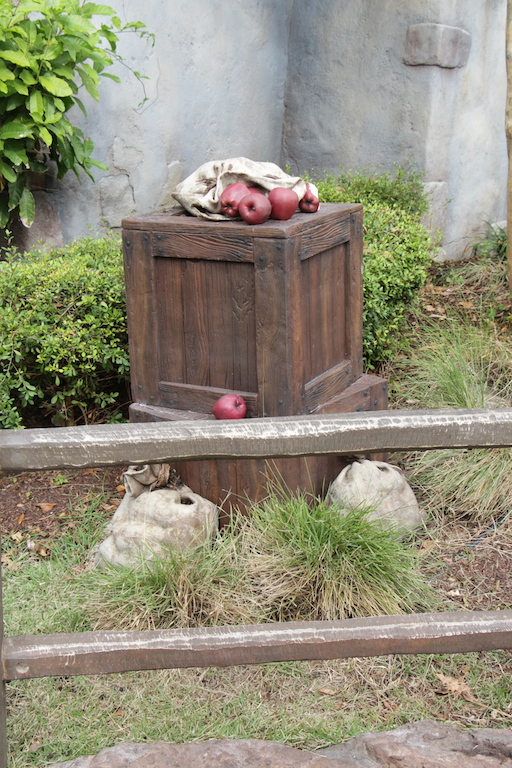
The apple is part of a larger display holding a bag of apples. It is found in what was originally known as Kingdom Crossing, but almost everyone now calls it the “Tangled bathrooms.” There are an amazing number of details all around this area, all having to do with the movie Tangled. The apples? They were a favorite snack of Maximus, the horse of the palace guard (a lovable sidekick throughout the movie, and one of the co-stars of the “sequel” Tangled Ever After.)

courtesy chipandco

courtesy chipandco

The window contains two lanterns, and can be found on the second story just around the entrance to The Hall of Presidents in Liberty Square. Liberty Square is a small place but packed with dozens of details that highlight our country’s early history. The lanterns? Well, let’s just say Paul Revere would have known what to make of them!

RoseGardenHM

The withered and dying roses can be found in the rose garden outside the Haunted Mansion, near the queue line. Nowhere else on Walt Disney Property will you find plants allowed to exist in such a condition – but that’s part of the mystique of the Haunted Mansion. It’s filled with 999 ghosts, and no one wants to work anywhere near such a “haunted” place! The general run-down look of the whole area is also augmented by the dour, unsmiling faces of all the Cast Members – one of only two places in Walt Disney World where smiles are forbidden!

These three examples are representative of the genius of Walt Disney, now carried out by Imagineers and Cast Members. This is why Walt insisted that even details others thought no Guest would notice – like dying roses – were important.

Inappropriate details confuse a story’s meaning.

Appropriate details immerse the Guest in the story.

How do you pay attention to the details in your organization?


Details Make the Difference

Organizations that create exceptional experiences for their Guests know that details make the difference.

Can you identify these three images taken on a recent field trip to the Magic Kingdom? Reply in the comments section!

DSC_0276

DSC_0263

IMG_9216

What makes these so important to the story in the larger scene being depicted?

The secret to providing an amazing Guest Experience is simple: pay attention to the details.


Getting there, now that’s another story all together.


The Patient Experience – Up Close and Personal

In the past three weeks, I have had two medical procedures where I encountered first hand, an amazing Patient Experience.

In the past, I have written about the Patient Experience from an outsider’s perspective, but this time, it was up close and personal.

If you like details, read on. If you want the bottom line, go to the bottom of this post.

During my annual physical earlier this year, my long-time personal physician, Dr. Michael Sherrill, reminded me that, as someone above the age 50, I really needed to schedule a colonoscopy. After 7 years of reminders, I gave in and scheduled it for the last week of May.

About the same time, an umbilical hernia that had developed several years earlier became larger – and painful. Once again, my PCP said it was time to correct that, as it would only get larger and more painful. Following a quick referral to a surgeon, I scheduled the surgery for June 12.

CGHColonoscopy 

Even though the process of scheduling my colonoscopy took longer than expected, at every step of the way I was both amazed and pleased at the outcome:

  • My initial consult with the doctor performing the procedure was very informative and thorough. More importantly, I felt genuine care and concern from my doctor, not just part of the day’s schedule to be rushed through.
  • After leaving the doctor, I went to the scheduler, who also was very thorough in explaining the preparation I would need to go through, the options for the meds needed, and a personal connection to someone in the office should I have any questions in the meantime.
  • At the checkout, I was given information from the office of my insurance verification and coverage for the procedure
  • Four days prior to the procedure, I received a call from the office, asking if I had any questions about the procedure, the preparation for it, and the diet adjustments.
  • Having had a sigmoidoscopy 30 years ago, I recalled the preparation to be unpleasant, consuming over a gallon of foul-tasting liquid to cleanse the colon. It worked, but the taste of strawberry medicine to this day gags me. This time around, two sixteen glasses of a water/solution mix, followed by a glass of water was much more pleasant.
  • On the day of the procedure, I checked in with a very pleasant receptionist, who had everything ready to go, pointed out a comfortable waiting room for my wife, and ushered me back to the prep nurse, who led me through the final forms (digitally signed and stored).
  • I was then escorted to my prep room, where the prep nurse went over briefly what would occur over the next few hours, and laid out a packet pulled from a metal cabinet. The packet contained my robe and a blanket. What I didn’t know until I put the robe on was the fact that it was a heated robe, which felt really comfortable in a chilly room!
  • Next, I was introduced to the nurse anesthetist, who explained what her part of the procedure was, and helped the nurse get me ready with an IV. With that in place, I was wheeled into the procedure room.
  • There I met my doctor, who introduced me to the tech who would be assisting her, and asked if I had any questions. Having none, I was asked to scoot a little over to one side, and after that I remembered nothing till I woke up in a recovery room.
  • The nurses checked on me as soon as I was awake, bringing some juice and water to drink. Shortly after that, the doctor came in with a preliminary report – all good, with one biopsy report to follow.
  • My wife (whom the doctor had already visited with) was ushered in to sit with me for a little while to make sure I was steady enough to dress. While we were both there, the nurse came by with discharge information, and again, a personal connection should I have any questions over the next few days.
  • Another nurse brought a wheel chair in, helped me into it, and wheeled me out to our car.
  • The next day, I received a call from the office, asking if everything was going okay, and a reminder to call immediately if I had any concerns.

My routine colonoscopy at Charlotte Gastroenterology & Hepatology was flawless throughout the whole process. Dr. Cullen and the whole team assisting her – Tawni, Deb, Brenda, Monica, and Joy – provided first class, personal care throughout the whole process – from beginning to end (pun intended).

NovantHealthlogoUmbilical Hernia Repair

Just two weeks later, I was preparing for my first surgical experience. Unlike the initial steps of the colonoscopy, this went very quickly.

  • Two days after the visit to my personal physician and his referral, I received a call from the surgeon’s office to schedule the initial consult with the surgeon – which was set up for the following week.
  • At the initial consultation, the receptionist gave me the traditional form set with a twist – they were set up with a special pen and paper so they would be transferred digitally and available for me, my PCP, and the surgeon as needed.
  • A nurse called me back, took the preliminary information needed, and said the surgeon would be in shortly.
  • Within 10 minutes, the surgeon walked in, introduced himself, reviewed my complete medical history (sent over by my PCP), and asked if there were any changes. When I informed him about the upcoming colonoscopy, he suggested that we schedule the hernia surgery following the colonoscopy, as there was a small chance that the gas used to inflate the colon could damage the hernia repair incision. If that had not been the case, I would have been able to have the surgery the next week – less than two weeks after the initial consult.
  • Warning me that the exam would be a little painful (after all, I had a tear in my abdominal muscle) the surgeon proceeded to determine what was needed. After the exam, his initial recommendation was laparoscopic surgery to repair a golf-ball sized tear. He also told me while this was a routine operation for him (he has done over 200), he assured me that he and his team would treat it with the utmost care possible. After answering a couple of questions, he escorted me to the scheduler’s office to set it up. Thanking me for coming to him, and saying he would send a note to my PCP, he said he would see me in a few weeks.
  • The scheduler was very pleasant and efficient to work with – she was obviously very familiar with the process. Noting that it would be several weeks out, she recommended a Friday time slot because it allowed for the least disruption to my schedule. With that all set up, she walked me to back to the front office.
  • During the time I had been in the exam, the office staff had printed all the forms, contacted and verified my insurance, along with an estimate of my out-of-pocket costs. Answering one question, she gave me all the information and I was on my way out in, the total visit less than one hour.
  • One week before the surgery, the hospital called to verify my information and get any changes in my condition since the visit to the surgeon. The caller was very friendly and had a sense a humor – when asked if I had any recent weight loss, I asked if the colonoscopy prep counted, she laughed and said I didn’t have to tell her anymore. At the conclusion of the call, she informed where to park, which door to enter, and wished me well.
  • Two days prior to the surgery, the surgeon’s office called with a reminder of the date and time, as well as the night-before preparation. Again, the caller was very cordial, seemed in no hurry and wished me well.
  • On the day of the surgery, my wife and I drove to the hospital, where the parking was as noted, and convenient to the entrance. There was an option for Valet Parking, but I didn’t want to do that. The receptionist greeted us with a smile, asked for my name, and escorted me back to the surgery area.
  • There my information was verified, my wife was given a code to follow the surgery process on a screen on the wall, asked if she needed anything, and then we went back to the prep area.
  • In a small but comfortable room, a nurse met us, reviewed my information, and gave me a kit which included a bag for my clothes, a robe, socks, and a heated blanket. Once I changed out, she returned to place the IV for the antibiotics and anesthesia.
  • A surgical nurse came by to review my information and the procedure, asking if I had any questions. While talking with her, the anesthesiologist came by – possibly the funniest medical conversation I have ever had. While talking with me, the other anesthesiologist stuck his head in the door and was cracking jokes with the nurses, me, and his partner about an ongoing completion they were having.
  • My surgeon was next, stopping by to update me on the morning’s schedule, reviewed the procedure, and asked if I had any questions. He told my wife he would be out to talk with her as soon as the surgery was over.
  • After about an hour’s comfortable wait, a flurry of activity began with the preliminary anesthesia, leg circulation pads, and a final review of my vitals.
  • Telling my wife goodbye, I was wheeled to the surgical suite. The nurse transporting me joked about her speed and being in NASCAR country, said she would try to keep me out of the wall.
  • In the operating room, I was asked a final time about my information, and saw a mask coming down over my face. The next thing I remember I was in the recovery room.
  • Evidently I had spent about an hour in a step-down recovery room, where everything was monitored.
  • As I slowly awoke in a recovery room, the nurses constantly checked on the process of coming out of anesthesia, and removed my IV. When I was alert enough to know who and where I was, my wife was escorted in. The surgeon had met with her in a conference room, and reviewed the entire procedure with her, explaining the repair was more extensive than he originally thought, but that he was fully confident of the success – if I followed the post-op procedures and follow-up visit instructions.
  • After about 30 minutes in the recovery room, the nursing staff felt I was ready to dress and go home.
  • The nurse came in and reviewed my discharge papers, asked if there were any questions, and then reminded me of the contact numbers if needed over the weekend.
  • A transport tech came, helped me into the wheelchair, and wheeled me to the entrance, where my wife was waiting to take me home.
  • I was under the affects of the anesthesia for the rest of the day, and also a 72-hour painkiller in the incision. I was given additional painkillers to begin when the anesthesia wore off.
  • Under the care of Dr. Mom, I am following the post-operative instructions with minimal discomfort (thanks to the meds, I’m sure).

The entire process, while seemingly routine to the surgeon, and hospital staff, was handled with excellent care at every step. Of course, with my Guest Services passion, I was looking for signs of a process designed with the patient in mind, and this certainly was the case. Dr. Ike Bhasin of Surgical Specialists of Charlotte, and the staff of Huntersville Medical Center provided excellent care, from initial consult to the surgery itself.

Of course, this was not really a surprise to me, as in the first room I went to, there was a prominent poster displayed:

At Huntersville Medical Center, our goal is providing you with Excellent Care. If you receive anything less, please contact us immediately.

Following that statement were two names and contact numbers.

This was not just a statement on the wall; it was backed up by the care shown to me every step of the way.


Bottom Line – Excellence of Patient Care Demonstrated

  • I was always treated with courtesy and respect
  • I was always treated as an individual – not a number or a case
  • I was followed up with post-procedure phone calls
  • Both organizations worked as teams, but individuals on the teams made the great impressions
  • Non-verbal communication skills were utilized by the staff
  • I was always asked if I had any questions
  • Staff always demonstrated careful and active listening
  • Understandable explanations were always given
  • Discharge information was clearly presented and confirmed

Bottom – Bottom Line

  • The reality was that medical procedures I had were considered routine by the medical profession. The impression I received, though, made me feel anything but routine.

Bottom – Bottom – Bottom Line

  • I am not just a satisfied customer; I am now a loyal patient of the 3 organizations and staffs I have encountered over the last few weeks – and I am telling friends and family of the courteous, respectful treatment I received.

What could your organization learn from my recent patient experiences?

The Most Important List You Can Make Today

Jim Collins, teacher to companies around the world and best-selling author (Good to Great, Built to Last, How the Mighty Fall, and Great by Choice) speaks and writes about it frequently.

Tom Peters, consummate speaker and game-changing author (The Search for Excellence, Re-imagine, The Pursuit of WOW!, and The Little Big Things) doesn’t just speak on the subject – he rants about it.

Steven Covey, business consultant, professor, and author (The Seven Habits of Highly Effective People, First Things First, and Principle-Centered Leadership) made it the foundation of his time management principles.

Richard Swenson, physician-futurist, award-winning educator, and best-selling author (Margin, The Overload Syndrome, and In Search of Balance) thinks it is one of the keys to restoring balance in our lives.

Maybe you’re getting the idea it’s a big deal. It is…

…especially for such an innocuous thing.

Here it is:

“To-Don’ts” are more important than “To-Dos”


NotToDoList2

A little elaboration:

  • What you decide not to do is probably more important than what you decide to do
  • You probably can’t work on “to-don’t” alone – you need a sounding board/mentor/advisor/nag that you trust to act as a drill sergeant who will march you to the wood-shed when you stray and start doing those time-draining “to-don’ts.”

With only a little tongue-in-cheek:

The top of your “to-do” list for today is to immediately begin working on your “to-don’t” list!

Making Dough: Secret Ingredients to Krispy Kreme’s Success

KrispyKreme2015

It’s National Doughnut Day – I’ve got to write about Krispy Kreme, the most wonderful doughnut in the world, especially when it comes right off the line when the Hot Light is on and they hand you one on a wooden stick and it just melts in your mouth, and oh by the way Krispy Kreme started in Winston-Salem North Carolina so I have to support local business and…

I digress.

Making DoughIn 2004 authors Kirk Kazanjian and Amy Joyner went behind the scenes to look at the six decade history of one of the world’s premier brands and most admired companies. Making Dough tells the compelling true story of a company that has managed to maintain a wholesome, small-town image, while achieving phenomenal success through a mixture of customer loyalty, high product standards, technological advancements, and community involvement.

The book is full of great ideas, insider interviews, and colorful stories that show how this phenomenal organization has successfully evolved and grown through the years. Each chapter thoroughly examines one key technique the company uses to stay successful.

Here’s a dozen to go, right off the line!

  1. Mix good taste with show business
  2. Be picky about your partners
  3. Make good use of your time and resources
  4. Expand and protect your brand
  5. Think big, but grow carefully
  6. Be a guerrilla marketer with a soft touch
  7. Maintain high standards
  8. Harness the power of technology
  9. Give back to the community
  10. Select, train, and treat your employees well
  11. Build on your success
  12. Keep them coming back

Making Dough shows you how Krispy Kreme’s delectable delights rose to the top and continue to tempt the world.

KK Hot Light


Pick up a copy of Making Dough, grab a dozen or two glazed, and you’ll soon find yourself with some “sweet” ideas to help your organization stay fresh – and in demand!

If you liked this post, here’s a throwback you’ll probably like too: Celebrating National Doughnut Day.

Today in the Magic Kingdom – A Field Trip for Guest Experiences

Greetings from Magic Kingdom!

courtesy John Skodak, CC 3343087934

courtesy John Skodak, CC 3343087934

When the rope drops this morning, I will already be inside the park, participating in the “Keys of the Kingdom” tour. Later in the day, I will be doing some “field work” for a Guest Experiences project – you’ll be hearing about it soon!

In the meantime, enjoy these Top Ten Takeaways from a Disney World Immersion from a previous visit.

Disney Expects Guests – What About You?

The Experience Begins in the Parking Lot

Excellence is Never Finished

Vision for the Future

Pay Attention to Details Others Ignore

Engaging All 5 Senses Creates Memory Links

Making Dreams Come True Requires Resources

Everybody Picks Up the Trash

Team Members Who Dream Together Create Fantastic Results

Everything Begins with a Story

It’s Hard to Forget the Fireworks at the End of the Day

Yes, you counted right – there were 11 Takeaways – but it’s about Disney, where they always exceed your expectations!

Follow me on Twitter, Facebook, or Instagram for live updates throughout the day. I’ll be there from before it opens, till after it closes, with the Kiss Goodnight

photo by Tom Brickman

photo by Tom Brickman


Marking Milestones

It‘s a week for marking educational milestones at the Adams’ house.

ADA-JWU2

Our youngest son graduates from college this week, and that marks the end of “school” for our children. Anita and I have four children, who were born four years apart. From the beginning of kindergarten for our oldest son to graduation from college for our youngest, we have been in “school” for 29 years.

That’s a lot of school!

By the numbers:

Elementary and Secondary Schools

  • 25 years of public schools
  • 11 different schools in 3 states
  • Shortest – ½ year at kindergarten in KY
  • Longest – 16 years (all 4 kids) at North Mecklenburg High School in Huntersville

University and Graduate School

  • 16 years of college
  • 5 different universities in one state
  • 1 graduate school
  • Shortest – 1 semester at UNCC
  • Longest – 11 years (2 kids) at Campbell University, including 3 years of graduate school

When we started our parenting journey in 1981, we didn’t set out to achieve these milestones. We didn’t know what was in store for us. Milestones are reached with small, consistent achievements that, when added up over a 29-year span, equal something big.

Our oldest son, now 34 and a father of 2 himself, started kindergarten in the fall of 1986. That was the first milestone in a long line. Parents and child alike look forward to those first days of school.

Now fast-forward to May 23, 2015. Our youngest son, now 22, will be graduating from college. In between were another son (now 30 and married with a 2 daughters) and a daughter (now 26 and married), who graduated from divinity school last year. Add it all together and you have consistent work along the way and before you know it – a milestone.

Milestones are accomplished over time from achievement after achievement. Showing up every day for class. Homework papers turned in. Quizzes and tests to study for. Projects, big and small, completed on time (most of the time).

If you’re going to reach a milestone, think one day at a time, not 29 years of days.

I’m proud of all my kids. They finished school; now their education really begins.

Bring the Heat

The ability to control the temperature of food involves a set of kitchen skills and food knowledge that, more than anything else, defines the excellence of the cook. An expertise in temperature control won’t turn poor ingredients into good ones, but it will determine much of what follows once the ingredients are in your house.

The Elements of Cooking, by Michael Ruhlman

 In other words, it’s all about heat.

courtesy aventarte.wordpress.com

courtesy aventarte.wordpress.com

 Bill Hybels, writing in axiom, has exactly this process in mind when he writes:

Anytime you see God-honoring values being lived out genuinely and consistently, it’s fair to assume that a leader decided to identify a handful of values and turn up the burner under them.

When you heat up a value, you help people change states.

  • Want to jolt people out of business as usual? Heat up innovation.
  • Want to untangle confusion? Heat up clarity.
  • Want to eradicate miserliness? Heat up generosity.

New “states” elicit new attitudes, new aptitudes, and new actions. It’s not rocket science – it’s just plain chemistry. Which is a lot about heat.

Leaders must determine what values they believe should be manifested in their organizations. And then put them over the flame of a burner by teaching on those values, underscoring them with Scripture, enforcing them, and making heroes out of the people who are living them out.

Over time, sufficiently hot values will utterly define your culture.

It’s time to bring the heat.

Customer Service is Never Out of Date – or Out of Place

Epiphany at the Gas Pump

Regular readers of this blog know of my borderline fanaticism in the area of Guest Services related to ChurchWorld. Some leaders cringe at those words, but the fact is people who come to church are consumers, and leaders in ChurchWorld can learn a lot from good customer service practices wherever they find them – even in a 1946 training manual for Gulf Dealers.

In a recent conversation with a friend, I was asked the question, “Where does your passion for Guest Experiences come from?”

The answer to that question became a little clearer in the last week.

My father.

My father passed away in 2012, and recent changes in my mother’s health required that she move out of the house in which she and my father had started their family in 1954. Over the last week, as my brother and I were going through the process of moving her from her home of 61 years, I took great delight in looking through some of the items my dad had saved and stored over his life. When I found this manual pictured below, I knew it would become a special part of my Guest Services resources.

After my father was discharged from the Army Air Corps following WWII, he worked at several jobs before he and his brotherGulf Service Plan 1 built a Gulf Service Station outside of Nashville TN. My father operated it for 44 years, closing it when he retired in 1993. Growing up in that gas station (literally – our house was about 100 feet away) I learned a lot about how to deal with people by watching my father interact with his “customers.” What I didn’t realize until recently was that his natural, easygoing style was augmented by customer service training materials supplied by the Gulf Oil Company.

It seems that good service is never out of date.

Notice the red dotted line around the vehicle – that’s the suggested travel path for the service man – or two – to take when a customer pulled up to the gas pumps to have gasoline put into his tank (I realize many readers have no clue nor experience of this, but it did happen!). Starting by engaging the driver, here are a few of the suggestions for engaging the customer:

  • Always be prompt – the service plan starts when you see a customer driving into your station. Whenever possible, be alert and at his side when his car stops, ready to greet him.
  • Greet the customer – your greeting is your first important step in showing courtesy to the customer, and it should be friendly, cheerful, and always in your own words.
  • Acknowledge the other customer – when a second car drives in, you should immediately recognize the other customer and saying you’ll be right with him. This kind of greeting pays off because you not only please the customer who is waiting but you also please the customer you are waiting on, who notices that you are courteous to others.
  • Improve the rear view – while you are at the rear of the vehicle putting gas in, wipe the rear window and tail lights. Should a light be out, call it to the attention to your customer at the proper time.
  • Look at those tires – while you are back there, take a look at both rear tires for cuts, blisters under inflation, etc. and make a mental note to tell your customer before he leaves your station.
  • Work to the front end – walk around the right side, cleaning the right windshield, checking the wiper blades, and inspecting the front tires.
  • Under the hood – check the oil and water levels; it’s your responsibility to protect your customer’s car. If any is needed, ask him if you may bring the levels up to the correct level.
  • Keep alert under the hood – while you have the hood open, keep alert for other service needs. Train yourself to quickly observe all needs, informing the customer as appropriate.
  • Collect for the sale – it is important to give the customer the right change, so count the change back into his hand. If he is using a credit card (yes, they had those in 1946!), learn to fill out the invoice quickly and accurately.
  • Courtesy is pleasant – before your customer leaves the station thank him and ask him to come in again. By this time you should have learned his name, so make it personal.
  • Help him safely on his way – if your station is on a busy street where it’s difficult to get into traffic, give your customer a hand. Guide him into the moving traffic safely. He may not expect this added courtesy, but he’ll be glad to get it and remember it. Every courteous act will be appreciated by your customers, and make them regular patrons of your station.

And a closing reminder:

With the Gulf Service Plan, every time you do some little service for the customer, it makes him realize that you know your business, and that you’re looking after his welfare. These services keep your customer coming back again and again. Good will – the tendency of the motorist to return to a place where he has been well-treated – is being created every time you give him not only what he wants, but what he needs. He remembers you are the man who looks after his best interests by taking good care of one of his most prized possessions – his car.

To all of us who live in 24/7, always-connected world, the actions above probably seem like a throwback or an anachronism of the good old days.

I happen to think they are a timeless reminder that service still matters – especially in ChurchWorld, where there is no “product” per se, but the outcome of the interactions with our Guests may be eternal.

Thanks Dad, for the lessons you taught me even when I didn’t realize it, and for the lessons you still teach me after you’re gone.


It’s Your Move

In the easy-reading but powerfully-impacting style he is known for, Mark Miller has released his newest book Chess Not Checkers.

And he’s not playing around…

Well, actually he is – and that’s the part leaders everywhere will enjoy. Miller tells the story of Blake Underwood, newly appointed CEO of a company troubled by poor performance and low morale. Nothing seems to work – especially trying to do what he’s always done before.

The problem, his new mentor points out, is that Blake is playing the wrong game.

ChessNotCheckers

Here’s a couple of quotes that set the whole book up:

Most of us began our leadership journey utilizing an approach with striking similarities to the game of checkers, a fun, highly reactionary game often played at a frantic pace. Any strategies we employed in this style of leadership were limited, if not rudimentary.

The game today for most leaders can be better compared to chess – a game in which strategy matters; a game in which individual pieces have unique abilities that drive unique contributions; a game in which heightened focus and a deeper level of thinking are required to win.

Chess Not Checkers is an enjoyable read that leaders in all organizations will want to put into practice quickly. Here are the “4 Winning Moves” Miller develops in the book:

  • Bet on Leadership – Growing leaders grow organizations
  • Act as One – Alignment multiplies impact
  • Win the Heart – Engagement energizes effort
  • Excel at Execution – Greatness hinges on execution

It’s your move…

ChessNotCheckers