A Round Look at the Hole History: The Donut’s Journey Through America

From their simple beginnings to their status as a beloved treat, donuts have an undeniably sweet spot in American history. These delicious rings of fried dough have evolved from a simple snack to an icon of comfort food culture. As we embark on this sugary journey in anticipation of the upcoming National Donut Day on Friday, June 7, let’s explore the fascinating history of donuts in America.

A quick note: the spelling of doughnut and donut will be used interchangeably depending on the use from the source. No matter how you spell it, the taste is what matters!

Early Beginnings: Dutch Influence and the “Olykoek”

The story of the doughnut in America begins with Dutch settlers in the early 18th century. They brought with them recipes for “olykoeks,” which translates to “oil cakes”—a simple concoction of dough balls fried in pork fat. These early versions were not the perfect rings we know today but rather crude, often heavy balls of dough with a slightly raw center. 

In Glazed America: A History of the Doughnut, author Paul R. Mullins notes that these early doughnuts were enjoyed by families and communities during social gatherings, highlighting their role as a communal treat long before they became a commercial product.

The Invention of the Hole: A Delicious Innovation

The iconic donut hole was purportedly invented in 1847 by a young American sailor named Hanson Gregory. Frustrated with the undercooked centers of traditional donuts, Gregory had the brilliant idea of punching a hole in the middle, ensuring even cooking throughout. This simple yet revolutionary change transformed the donut into the perfect ring-shaped confection we love today.

In his book Donuts: An American Passion, author John T. Edge explores this anecdote, emphasizing how Gregory’s practical solution paved the way for the modern donut. The innovation allowed for consistent texture and easier mass production, which would become crucial as donuts entered the commercial sphere.

World War I: Donuts on the Front Lines

Donuts gained further prominence during World War I, thanks to the Salvation Army “Doughnut Lassies.” These brave women served donuts to soldiers on the front lines, providing a taste of home and boosting morale. The simple pleasure of a fresh donut offered comfort amidst the chaos of war.

A look at the history of the Salvation Army delves into this period, illustrating how the Doughnut Lassies not only fed the troops but also solidified the donut’s place in American culture. The soldiers returned home with a newfound appreciation for the treat, sparking a nationwide craving.

The Rise of the Donut Shop: Krispy Kreme, Dunkin’ and Beyond

The post-war era saw a boom in donut shops across America. Adolph Levitt began selling fried doughnuts from his bakery in 1920. Unable to keep up with the demand, he created a mechanical gadget in which the dough rings travelled along a channel overflowing with boiling oil and then once cooked, ascended a moving ramp before falling into a basket. In 1934, the World’s Fair in Chicago proclaimed donuts “the hit food of the Century of Progress,” propelling them into the culinary spotlight. Donuts were celebrated for their affordability, convenience, and deliciousness.

In 1937, in a rustic clapboard building on South Main Street in Winston-Salem, NC, Vernon Rudolph fried up the first original glazed Krispy Kreme doughnut. What began as a hole-in-the wall has blossomed into one of the world’s premier doughnut companies, a global cult icon and intriguing brand.  In March of this year, McDonald’s and Krispy Kreme announced a sweet update for doughnut fans everywhere: Fans will begin spotting Krispy Kreme doughnuts in their local McDonalds’s restaurants as part of a phased market rollout across the country.

Dunkin’ Donuts, founded in 1950 by William Rosenberg, played a pivotal role in popularizing donuts. With its focus on freshness and variety, Dunkin’ Donuts transformed the humble treat into a ubiquitous American staple. The brand’s catchy slogan, “America Runs on Dunkin’,” reinforced the donut’s role in daily life.

Modern Day: Gourmet Trends and Timeless Classics

Today, the donut landscape is more diverse than ever. Artisanal donut shops offer gourmet creations with unique flavors and high-quality ingredients, appealing to foodies and traditionalists alike. From bacon maple bars to matcha-glazed rings, modern donuts cater to a wide range of tastes and preferences.

Yet, despite these innovations, the classic glazed donut remains a favorite. Its simplicity and nostalgia evoke the essence of what makes donuts special: comfort, joy, and a touch of indulgence.

The history of donuts in America is a testament to their enduring appeal. From Dutch settlers to modern-day gourmet bakers, each era has contributed to the rich tapestry of donut lore. So next time you savor a donut, remember that you’re partaking in a delicious slice of American history.

In anticipation of National Donut Day coming up on Friday, June 7, here’s a baker’s dozen books from my library that will be a great addition to accompany your next sugary sweet donut snack:


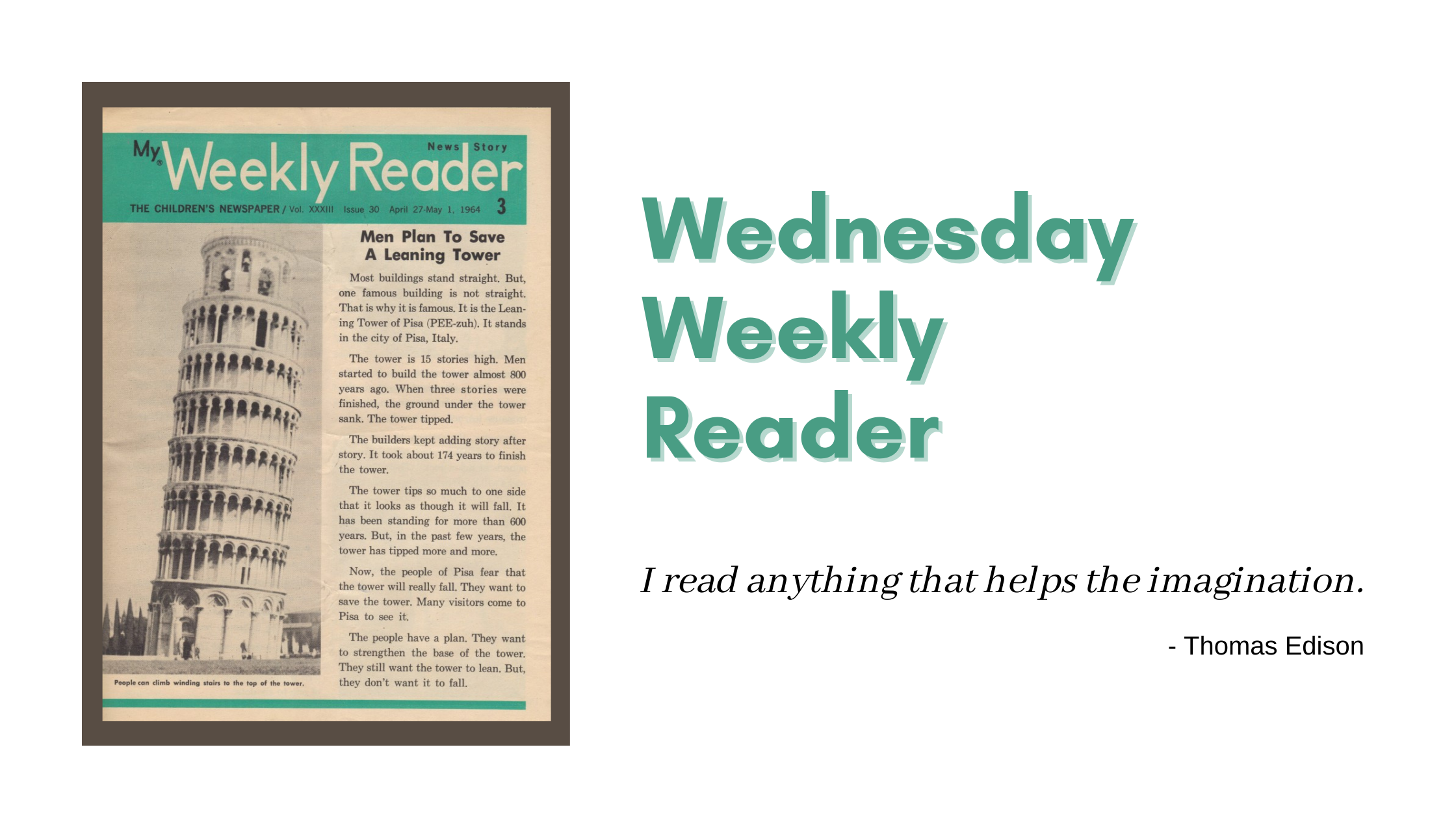
Part of a regular series on 27gen, entitled Wednesday Weekly Reader.

During my elementary school years one of the things I looked forward to the most was the delivery of “My Weekly Reader,” a weekly educational magazine designed for children and containing news-based current events.

It became a regular part of my love for reading, and helped develop my curiosity about the world around us.
#BobsBurgersandBooksBirthdayBash

If you’re looking to connect with me during the latter morning through early afternoon hours today, I’m on an extended lunch break…


Expressing the joys and delights of reading is a challenging endeavor. How can one adequately convey the multitude of pleasures that arise from the seemingly simple act of opening a book and immersing oneself in its pages? Many have tried to capture this experience over the centuries, with varying levels of success.

Here’s a couple of volumes that speak to that issue:

…and a few more:

Reading has been described in many ways – a selfish yet serene lifelong indulgence, a great gift, a moral enlightenment, more sweet, gracious, elevating and fortifying than any other activity. It has been called an intimate conversation with people across unseen generations, a home, a sustenance, an invincible companion, a pleasure beyond compare.

Ultimately, the pleasure each individual derives from reading is a highly personal experience. Despite the efforts of those who have attempted to define it for us, we must discover and understand the joys of reading for ourselves.

So, during my extended birthday lunch hour today, I’m stepping away from my recent successes in eating more healthy by enjoying the best burger in Charlotte with Anita (here we come, Brooks’ Sandwich House), followed by dropping in on two of my favorite independent bookstores, Julia’s Café & Books and Book Buyers.

When to Read
Mine is a simple system: I read from morning till bedtime, with breaks for my job, family, meetings with friends, exercise, household chores and periodic review of my life’s greatest blunders. On the days I don’t read, I write. As I say, it’s a simple system. Many people complain that they have no time for books, yet somehow they manage to spend three or more hours a day watching television or scrolling through social media on their phones. You pays your money and you takes your choice.


Michael Dirda, Washington Post, “10 Rules for Reading from Someone Who Does It for a Living”

Part of a regular series on 27gen, entitled Wednesday Weekly Reader.

During my elementary school years one of the things I looked forward to the most was the delivery of “My Weekly Reader,” a weekly educational magazine designed for children and containing news-based, current events.

It became a regular part of my love for reading, and helped develop my curiosity about the world around us.

From Cocoa Beans to Cookie Jars: A Journey Through Chocolate Chip History

Which came first – the chocolate chip or the chocolate chip cookie?


Have you ever wondered how a single ingredient would change a recipe? If it weren’t for one curious baker, it would be hard to imagine where we would be without the invention of chocolate chips.

In 1937, Ruth Graves Wakefield of Whitman, Massachusetts must have been curious about what a little bit of chocolate would add to her cookies. While working at the Toll House Inn, she added cut-up chunks of a semi-sweet Nestle chocolate bar to a cookie recipe. The cookies were a huge success and in 1939 Wakefield signed an agreement with Nestle to add her recipe to the chocolate bar’s packaging. In exchange for the recipe, Wakefield received a lifetime supply of chocolateThe Nestle brand Toll House cookies were named for the Inn.

Nestle initially included a small chopping tool with the chocolate bars, too. Starting in 1941, Nestle and other competitors started selling the chocolate in chip or morsel form. For the first time, bakers began making chocolate chip cookies without chopping up the chocolate bar first. 

Chocolate chips originally came in semi-sweet. Later, chocolate producers began offering bittersweet, semi-sweet, mint, white chocolate, dark chocolate, milk chocolate, and white and dark swirled. Today, chips also come in a variety of other flavors that bakers and candy makers use creatively in their kitchens.

While cookies may be the first treat to come to mind, imagination is really the only thing limiting how chocolate chips can be used in baking and candy making. Even savory dishes feature chocolate chips in a variety of ways, too. Had Ruth Graves Wakefield never wondered what a few chopped up chunks of chocolate would be like in her baking, we wouldn’t even have chocolate chip cookies.  


And since it is Wednesday Weekly Reader, here’s a few books on the subject to whet your appetite…


Since Ruth Wakefield’s culinary breakthrough, chocolate chips have undergone a remarkable evolution. Manufacturers capitalized on the growing demand for chocolate chips, introducing standardized, mass-produced morsels available in an array of sizes, shapes, and flavors. Today, consumers can choose from a plethora of options, including milk chocolate, dark chocolate, and even vegan and allergen-free varieties.

Chocolate chips continue to play a versatile role in modern culinary landscapes, transcending traditional boundaries and finding their way into an array of sweet and savory dishes. From classic chocolate chip cookies and brownies to innovative creations like savory mole sauces and gourmet cheese plates, chocolate chips inspire creativity and experimentation in kitchens around the world.

The cultural significance of chocolate chips extends far beyond their practical use in recipes. These tiny morsels have permeated popular culture, appearing in literature, film, television, and advertising as symbols of joy, indulgence, and shared experiences. Furthermore, chocolate chips serve as ambassadors of culinary fusion, inspiring adaptations and variations in cuisines around the world.

The chocolate chip stands as a testament to the enduring power of culinary creativity and cultural exchange. From its humble beginnings to its current status as a beloved culinary staple, the chocolate chip has captured the hearts and taste buds of people around the world. As we savor each delicious bite, let us celebrate the timeless allure of the chocolate chip and the sweet pleasures it brings to our lives.


What is the best chocolate chip cookie you’ve ever had?

For me: my wife Anita has been tinkering over the years with a basic chocolate chip cookie recipe not far off the classic Toll House one, but using white chocolate chips, dried cherries, and almond flavoring, along with slight changes to the other ingredients and altering the cooking time (depending on whether they are primarily for our family, or for others).

I, of course, have the distinguished role of Official Cookie Taste Tester for every batch. When they are still warm from the oven, resting on the cooling racks, and accompanied by an ice-cold glass of milk…

Perfection.


Part of a regular series on 27gen, entitled Wednesday Weekly Reader.

During my elementary school years one of the things I looked forward to the most was the delivery of “My Weekly Reader,” a weekly educational magazine designed for children and containing news-based, current events.

It became a regular part of my love for reading, and helped develop my curiosity about the world around us.

Diving into the Culinary ABCs: A Whimsical Journey through America’s Food History

I’m always up for a refresher course on my ABCs and a history lesson, especially when food is involved…


An illustrated journey through the lore and little-known history behind ambrosia, Ipswich clams, Buffalo hot wings, and more.

This captivating and surprising tour of America’s culinary canon celebrates the variety, charm, and occasionally dubious lore of the foods we love to eat, as well as the under-sung heroes who made them. Every chapter, organized from A to Z, delves into the history of a classic dish or ingredient, most so common – like ketchup – that we take them for granted.

These distinctly American foods, from Blueberries and Fortune Cookies to Pepperoni, Hot Wings, Shrimp and Grits, Queso, and yes, even Xanthan Gum, have rich and complex back stories that are often hidden in plain sight, lost to urban myth and misinformation.

American Food: A Not-So-Serious History by Rachel Wharton (and illustrated by Kimberly Ellen Hall) digs deep to tell the compelling tales of some of our most ordinary foods and what they say about who we are – and who, perhaps, we are becoming.

Here’s an appetizer sampler of the delightful stories you will discover:

  • The likely African American origin of the original Buffalo wing, during a time when black restaurants received no mainstream press coverage.
  • The Native American roots of New Mexican green and red chile enchiladas, one of the earliest iconic dishes in the United States.
  • The spread of hero, hoagie, and submarine sandwiches along the eastern seaboard, facilitated by Italian longshoremen and black jazz players.
  • The intertwined history of fortune cookies with the internment of Japanese Americans in WWII, evidenced by a 70-year-old set of steam ovens in San Francisco.
  • The Mexican origin of queso, influenced by the fact that South Texas was once part of Mexico.
  • The likely contribution of an enslaved North Carolina cook named Ellen to the creation of ambrosia, a dish associated with the head of the Confederacy.
  • The roots of shrimp and grits in the cuisine of the Gullah-Geechee people of the Low Country’s barrier islands, rather than in Charleston.

As with many origin stories, you’ll have to take them with a grain of salt, as there are often competing (and unverifiable) versions to the birth of a beloved dish. But that’s part of the fun of food history – you can enjoy the results while happily disagreeing on the merits of the origins of the dish!


Part of a regular series on 27gen, entitled Wednesday Weekly Reader.

During my elementary school years one of the things I looked forward to the most was the delivery of “My Weekly Reader,” a weekly educational magazine designed for children and containing news-based, current events.

It became a regular part of my love for reading, and helped develop my curiosity about the world around us.

From Confusion to Clarity: Unlocking True Productivity with Slow Methods

Our current definition of “productivity” is broken. It pushes us to treat busyness as a proxy for useful effort, leading to impossibly lengthy task lists and ceaseless meetings. We’re overwhelmed by all we have to do and on the edge of burnout, left to decide between giving into soul-sapping hustle culture or rejecting ambition altogether. But are these really our only choices?

Long before the arrival of pinging inboxes and clogged schedules, history’s most creative and impactful philosophers, scientists, artists, and writers mastered the art of producing valuable work with staying power.

In this timely and provocative book, Cal Newport harnesses the wisdom of these traditional knowledge workers to radically transform our modern jobs.

Drawing from deep research on the habits and mindsets of a varied cast of storied thinkers – from Galileo and Isaac Newton, to Jane Austen and Georgia O’Keefe – Newport lays out the key principles of “slow productivity,” a more sustainable alternative to the aimless overwhelm that defines our current moment. Combining cultural criticism with systematic pragmatism, Newport deconstructs the absurdities inherent in standard notions of productivity, and then provides step-by-step advice for cultivating a slower, more humane alternative.

From the aggressive rethinking of workload management, to introducing seasonal variation, to shifting your performance toward long-term quality, Slow Productivity provides a roadmap for escaping overload and arriving instead at a more timeless approach to pursuing meaningful accomplishment. The world of work is due for a new revolution. Slow productivity is exactly what we need.


Newport’s initial research evolved into the central theme explored in his book: that the problem faced by knowledge workers may not lie in productivity per se, but rather in a flawed definition of productivity that has become prevalent in recent decades.

The overwhelming burden we experience stems from the belief that “good” work demands increasing busyness – swift responses to emails and chats, more meetings, tasks, and hours. However, upon closer examination, this premise lacks a solid foundation. It led him to consider that alternative productivity approaches could be equally valid, such as prioritizing intentionality over constant activity.

It became evident that the practices of traditional knowledge workers (the writer John McPhee is Newport’s ongoing example) were not only inspiring but could, with adjustments for contemporary job realities, offer valuable insights into reshaping our understanding of professional achievement in the modern era.

These insights prompted a reevaluation of how we approach work, culminating in an alternative to the prevailing norms of exhaustion:

Slow Productivity

A philosophy for organizing knowledge work efforts in a sustainable and meaningful manner, based on the following three principles:


This philosophy rejects busyness, viewing overload as a hindrance to meaningful results rather than a badge of honor. It advocates for a more balanced and humane pace, emphasizing quality over performative busyness.

In the latter part of the book, Newport elaborates on the core principles of this philosophy, providing both theoretical justification and practical advice for implementing them in various professional contexts.

Newport’s aim is not merely to offer tips for alleviating job exhaustion or to vent frustrations about exploitative work cultures, though he addresses these issues. Instead, he proposes a new paradigm for individuals and organizations to rethink productivity and accomplishment, aiming to rescue knowledge work from unsustainable freneticism and foster a more sustainable approach.

While not every workplace may immediately embrace this intentional rhythm, Newport argues that it is more universally applicable than commonly assumed. He seeks to demonstrate that achieving without burnout is not only achievable but should be the standard.

To embark on this journey, Newport encourages readers to first understand how the knowledge sector arrived at its current dysfunctional relationship with productivity. By grasping the haphazardness of its formation, rejecting the status quo becomes more feasible.


Part of a regular series on 27gen, entitled Wednesday Weekly Reader.

During my elementary school years one of the things I looked forward to the most was the delivery of “My Weekly Reader,” a weekly educational magazine designed for children and containing news-based, current events.

It became a regular part of my love for reading, and helped develop my curiosity about the world around us.

The Ripple Effect of Generosity: Transforming Individuals, Communities, and Beyond

Let’s face it: Recent years have been tough on optimists.

Hopes that the Internet might bring people together have been crushed by the ills of social media. Is there a way back?

As head of TED, Chris Anderson has had a ringside view of the world’s boldest thinkers sharing their most uplifting ideas. Inspired by them, he believes that it’s within our grasp to turn outrage back into optimism. It all comes down to reimagining one of the most fundamental human virtues: generosity.

What if generosity could become infectious generosity? Consider:

• how a London barber began offering haircuts to people experiencing homelessness—and catalyzed a movement

• how two anonymous donors gave $10,000 each to two hundred strangers and discovered that most recipients wanted to “pay it forward” with their own generous acts

• how TED itself transformed from a niche annual summit into a global beacon of ideas by giving away talks online, allowing millions access to free learning

In telling these inspiring stories in his book Infectious Generosity, Anderson has given us “the first page-turner ever written about human generosity” (Elizabeth Dunn). More important, he offers a playbook for how to embark on our own generous acts – whether gifts of money, time, talent, connection, or kindness – and to prime them, thanks to the Internet, to have self-replicating, even world-changing, impact.

Imagine if we cracked the code on making generosity contagious. It could shift the balance away from the rising divisions in our world, ushering in a fresh era of optimism.

Generosity? Seriously?!

It’s an unusual concept, no doubt. Maybe even a bit outdated. At first glance, it might seem too gentle to confront the formidable challenges we’re up against. You, as an individual, could be as generous as you want, but can your well-meaning gestures and sacrifices really make a difference?

Yet, therein lies the crux. They can. Every act of generosity, no matter how small, has the potential for extraordinary impact if it can spread from isolated incidents to becoming infectious. By tweaking their form just a bit, acts of generosity can become immensely powerful. Infectious Generosity is dedicated to unveiling how.

The infectious potential of generosity stems from two main factors: human nature and the interconnectedness of our modern world. In the book, Anderson delves into how overlooked qualities innate to every human can combine to set off cascades of generous behavior. Moreover, he explains how these ripple effects can be amplified by the Internet for monumental, world-changing effects.

The Internet is renowned for facilitating various contagions, from social media trends to viral marketing. Similar to a virus, humans serve as carriers for the Internet’s contagiousness. Instead of replicating in our respiratory systems, ideas and visuals spark in our minds, prompting us to hit “Like” or “Share.”

Regrettably, many of the contagions proliferating online are harmful.

Driven by advertisement-based revenue models that aim to keep users glued to their screens, social media platforms have morphed the web into a machine for generating outrage. Instead of showcasing the best in each other, we often encounter the worst, driving us further apart.

This book revolves around two intertwined themes: The Internet can supercharge generosity, and Generosity can revolutionize the Internet. Each theme fuels the other. If we view the Internet as a daunting, impersonal realm teeming with strangers poised to judge and exploit us, it becomes challenging to trust it with our altruistic intentions. However, without individuals endeavoring to engage with others online in a spirit of generosity, the Internet cannot fulfill its potential as a force for good. It’s tempting to dismiss the Internet as a cesspool of toxicity. What we urgently need is to initiate an upward spiral wherein the growing visibility of a more generous humanity inspires individuals to contribute to the greater good.

Anderson feels a pressing sense of urgency about this because we are witnessing the early stages of our world being reshaped by artificial intelligence.

And guess what fuels the power of AI? The Internet. Essentially, the most potent AI systems are designed to process the vast expanse of human online activity and formulate predictive models. Do we want to rely on AI trained with today’s Internet? Absolutely not. It poses the risk of amplifying many dangers. If we can steer the Internet toward a kinder, more generous, and more positive direction, it could have an immeasurable impact on our future, both directly and by providing a healthier basis for AI.

It might seem far-fetched to envision us, imperfect humans, overcoming the Internet’s issues: polarization, misinformation, data surveillance, addiction, social media-induced insecurity, and more. Anderson understands that skepticism, but encourages the reader to withhold judgment, at least temporarily. Beneath the surface, remarkable developments are underway.

They’re worth exploring.

Infectious Generosity comprises three sections: “Why,” “How,” and “What If?”

Part 1 delves into why the time is ripe for infectious generosity. Anderson recounts the extraordinary events at TED that convinced him of the Internet’s profound impact on generosity, along with three fundamental principles derived from those events. Subsequently, he delves into newfound insights into human nature and how the call of generosity can yield surprising outcomes and deep happiness. Anderson also unveils the inner workings of the “Mystery Experiment,” the largest social science study to date demonstrating how kindness begets kindness.

Part 2 explores how to translate this theory into action. Anderson examines what it entails to cultivate a generous mindset, the various forms of giving that can snowball into something greater, and how we can share stories of generosity with one another. An essential chapter focuses on financial giving, including strategies to leverage resources to significantly magnify the impact of our contributions.

Part 3 contemplates what would happen if generosity were more deeply ingrained in our world. Anderson envisions reclaiming the Internet to fulfill the dream many people once held: aiding humanity in being both humane and kind. He examines how companies and organizations might be reshaped by generosity and ponders ways to empower our most influential change makers to embark on ambitious plans for transformation. He also explores the case for a global pledge that could unite us all on a journey of generosity. The section closes with a reflection on how we might instill a mindset of generosity in our future selves.

Wherever you are and whoever you may be, Anderson invites you to join him on this journey. There’s a good chance you’ll be touched by something profound, something capable of influencing how you allocate your future time, resources, and creativity. And this something might just end up inspiring others.

But this is a positive infection. A beautiful, hopeful, positive infection.

You may find yourself hoping you never recover.

Every human has the potential to give. The urge to do this is built deep inside each of us, and can be stirred just by our being open to the needs of others. When we share our time, our money, or our creativity, those acts can spark responses in kind.
So, once it gets started, generosity can spread like wildfire. As it passes from one person to the next, many lives can be touched. And our collective witnessing of what humans are capable of can overcome today’s prevailing cynicism, bringing people together in common causes.
And for you personally, this is all about that most elusive, inspiring, and beautiful thing: the quest for meaning. We were born to be connected. So give in any way that you feel able. Give creatively. Give courageously. Give collaboratively. And let the magic of generosity ripple out into the universe.
If you do that, don’t be surprised if one day you wake up and hear a whisper from inside: “I have never felt so happy.”

Chris Anderson, Infectious Generosity

Part of a regular series on 27gen, entitled Wednesday Weekly Reader.

During my elementary school years one of the things I looked forward to the most was the delivery of “My Weekly Reader,” a weekly educational magazine designed for children and containing news-based, current events.

It became a regular part of my love for reading, and helped develop my curiosity about the world around us.

Learn How to Use the Power of Mise-en-place in Your Place

Despite how it may feel, competition for the spiritual attention and Sunday attendance of today’s family is not with the growing church down the road. Church leadership must redirect energy from being “bigger and better” than other churches, and instead see those places that provide “WOW! Experiences” as the real points of comparison among first time guests.

While that may seem impossible to achieve, this present reality can also be turned into a positive. Churches must start LEARNING from those top-notch places and their leaders.

Eating out at one-of-a-kind experiences has never been more popular or accessible. Celebrity chefs and buzz-creating restaurants are literally popping up in cities across the country, large and small. In the world of hospitality, the culinary segment has unique applications to the Guest Experience ministries of a church. The dining experience at a four-star restaurant provides excellent lessons for welcoming ministries in your church.

With input from one son who began making pizzas in high school working his way up to general manager and regional trainer of a national fast casual franchise location and another with a culinary and food service degree who is now an events planner at a university, today’s post explores what leaders can learn from the food industry.

Develop the art of mise-en-place.

THE QUICK SUMMARYWork Clean, by Dan Charnas

The first organizational book inspired by the culinary world, taking mise-en-place outside the kitchen.

Every day, chefs across the globe churn out enormous amounts of high-quality work with efficiency using a system called mise-en-place―a French culinary term that means “putting in place” and signifies an entire lifestyle of readiness and engagement. In “Work Clean,” Dan Charnas reveals how to apply mise-en-place outside the kitchen, in any kind of work.

Culled from dozens of interviews with culinary professionals and executives, including world-renowned chefs like Thomas Keller and Alfred Portale, this essential guide offers a simple system to focus your actions and accomplish your work. Charnas spells out the 10 major principles of mise-en-place for chefs and non chefs alike: (1) planning is prime; (2) arranging spaces and perfecting movements; (3) cleaning as you go; (4) making first moves; (5) finishing actions; (6) slowing down to speed up; (7) call and callback; (8) open ears and eyes; (9) inspect and correct; (10) total utilization.

This journey into the world of chefs and cooks shows you how each principle works in the kitchen, office, home, and virtually any other setting.

A SIMPLE SOLUTION

Every day, chefs across the globe put out enormous amounts of high quality work with efficiency using a system called mise-en-place – a French culinary term that means “putting in place” and signifies an entire lifestyle of readiness and engagement.

For the culinary student, it is usually the beginning point of their career. But it is a beginning point that is repeated every day of their career – it’s the first thing they will do at the start of each day’s work.

Mise-en-place means far more than simply assembling all the ingredients, pots and pans, plates, and serving pieces needed for a particular period. Mise-en-place is also a state of mind. Someone who has truly grasped the concept is able to keep many tasks in mind simultaneously, weighing and assigning each its proper value and priority. This assures that the chef has anticipated and prepared for every situation that could logically occur during a service period.

Mise-en-place as a simple guide to focusing your actions and accomplishing your work is a necessary first step on the way to an exceptional guest experience.

Mise-en-place comprises three central values: preparation, process, and presence. When practiced by great chefs, these three mundane words become profound. The byproduct of these values may be wealth or productivity, but the true goal is excellence.

Preparation Chefs commit to a life where preparation is central, not an add-on or an afterthought. To become a chef is to accept the fact that you will always have to think ahead, and to be a chef means that thinking and preparation are as integral to the job as cooking. For the chef, cooking comes second. Cooking can’t happen without prep coming first. Embracing preparation also means jettisoning the notion that prep work is somehow menial, beneath us. Your preparation – and its intellectual cousin, planning – thus becomes a kind of spiritual practice: humble, tireless, and nonnegotiable.

Process Preparation and planning along are not enough to create excellence. Chefs must also execute that prepared plan in an excellent way. S they ensure excellent execution by tenacious pursuit of the bet process to do just about everything. A commitment to process doesn’t mean following tedious procedures and guidelines for their own sake. It’s not about turning humans into hyper-efficient robots. Process is, quite the contrary, about becoming a high-functioning human being and being happier for it. Excellence arises from refining good process – how can I do this better or easier, or with less waste? It’s a job, like preparation, that never ends.

Presence Chefs commit to being present in ways from the mundane to the sublime. After months and years of repeated prep and process, the cook acquires a deeper kind of presence – becoming one with the work, and the work becoming kind of meditation. “Kitchen awareness” demands that one not only be “with” the work, but also “with” your comrades and their work at the same time. This kind of awareness isn’t scatteredness. It is, quite the contrary, something closer to what the Eastern traditions call mindfulness. Presence in all its forms – getting there, staying there, being focused, being open, and cultivating boundaries – helps us adjust our preparation and process as the circumstances shift around us.

Dan Charnas, Work Clean – What Great Chefs Can Teach Us About Organization

A NEXT STEP

The three values listed above – preparation, process, and presence– aren’t ideals to admire and applaud. They must be practiced – and can be, by anyone, anywhere.

To apply the values listed above to your hospitality ministry, begin by creating three chart tablets, writing the values above, one word per page.

Read the descriptions listed for each value.

In a discussion with your team, walk through your Guest Experience from beginning to end, and list each action on the appropriate page. If it fits on more than one page, put it on the page it makes most sense, or is strongest.

Review the lists with your team.

  • What’s missing? Write it in, and assign it to a leader, along with a timeline, for development.
  • What needs to be made stronger? Write it in, and assign it to a leader, along with a timeline, for strengthening.
  • What’s unnecessary? Remove it from the list, and your regular activities.

Discovering the Joy of Reading: Insights from “Why We Read”

Most weeks on Wednesday you’ll find posts about books here, part of an ongoing series entitled Wednesday Weekly Reader.

I often post about books on Instagram, and from time to time I will write on the topic of books about reading and books. For example:

Here’s a view of my “books about books” bookshelf:

You are probably getting the picture that books and reading are not just pastimes for me – they are my passion.

Today’s post is about a book that beautifully captures the passion of reading.

We read to escape, to learn, to find love, to feel seen. We read to encounter new worlds, to discover new recipes, to find connection across difference, or simply to pass a rainy afternoon. No matter the reason, books have the power to keep us safe, to challenge us, and perhaps most importantly, to make us more fully human.

Shannon Reed, a longtime teacher, lifelong reader, and New Yorker contributor, gets it. With one simple goal in mind, she makes the case that we should read for pleasure above all else.

In this whip-smart, laugh-out-loud-funny collection entitled Why We Read, Reed shares surprising stories from her life as a reader and the poignant ways in which books have impacted her students. From the varied novels she cherishes (Gone GirlTheir Eyes Were Watching God) to the ones she didn’t (Tess of the d’Urbervilles), Reed takes us on a rollicking tour through the comforting world of literature, celebrating the books we love, the readers who love them, and the ways in which literature can transform us for the better.

Listen to Reed’s passion for reading:

I have never lost my affection for and dependency on books. This is where I pull away from the pack of fellow bookworms, I sense. Much as I like videos and reels and whatever new thing has been invented by the time this goes to print, I’m always reaching back to the OG form, the book, looking for what I can read to help me understand.

Reading a book is quiet, clear, and organized. It’s not hard.

It waits until I am ready, pauses when I need a break, and is still happy to repeat. Reading absolutely never says “Just forget it” when I need clarification. It doesn’t care how I pronounce the words in my head (or aloud, for that matter). It never makes me feel worse and rarely makes me feel lonely.

Reading gives me the world.

And that, friends, is why I read.

If you are fortunate to be inspired to buy and read Shannon’s book, you will enjoy the closing chapter as she pays homage to the amazing literary journey she is on. I won’t spoil your reading pleasure by quoting any of it – except the last two sentences:

Without ever really experiencing any of it, I know it all.

Because books taught me.


Part of a regular series on 27gen, entitled Wednesday Weekly Reader.

During my elementary school years one of the things I looked forward to the most was the delivery of “My Weekly Reader,” a weekly educational magazine designed for children and containing news-based, current events.

It became a regular part of my love for reading, and helped develop my curiosity about the world around us.

Words That Work: Unlocking the Science of Persuasion and Effective Communication

In the final post of a four-part mini-series revolving around books, there was a look at the history of the library, the role of books in both shaping conflict and being shaped by conflict, how book design impacts the reading experience, and now some closing thoughts on words themselves.

Almost everything we do involves words. Words are how we persuade, communicate, and connect. They’re how leaders lead, salespeople sell, and parents parent. They’re how teachers teach, policymakers govern, and doctors explain. Even our private thoughts rely on language.

But certain words are more impactful than others. They’re better at changing minds, engaging audiences, and driving action. What are these magic words, and how can we take advantage of their power?

In Magic Words, internationally bestselling author Jonah Berger gives you an inside look at the new science of language and how you can use it. Technological advances in machine learning, computational linguistics, and natural language processing, combined with the digitization of everything from cover letters to conversations, have yielded unprecedented insights.

Learn how salespeople convince clients, lawyers persuade juries, and storytellers captivate audiences; how teachers get kids to help and service representatives increase customer satisfaction; how startup founders secure funding, musicians make hits, and psychologists identified a Shakespearean manuscript without ever reading a play.

This book is designed for anyone who wants to increase their impact. It provides a powerful toolkit and actionable techniques that can lead to extraordinary results. Whether you’re trying to persuade a client, motivate a team, or get a whole organization to see things differently, this book will show you how to leverage the power of magic words.

Magic Words, authored by Jonah Berger, delves into the concealed mechanisms governing language and, more significantly, delineates strategies for employing it more persuasively, nurturing relationships, and achieving success in both personal and professional realms.

The book explores six categories of influential words, devoting a chapter to each of these areas:

Activating Identity and Agency: Words that delineate authority, responsibility, and engagement in actions. This chapter delves into the profound impact subtle alterations in language can have, such as the efficacy of using nouns over verbs in persuasion, mastering the art of refusing to advance towards goals, and adopting specific interrogative phrases to enhance creativity and problem-solving. Furthermore, it discusses how speaking in the third person can mitigate anxiety and enhance communication, along with the nuanced effects of pronouns like “you” on social interactions and empathy.

Conveying Confidence: Language not only communicates information but also conveys the speaker’s confidence, thereby influencing perceptions and sway. This chapter explores how eliminating certain words transformed an underperforming salesperson into a top achiever, the significance of linguistic style in legal discourse, and linguistic cues that enhance credibility and authority. It also delves into the allure of certainty and the strategic use of uncertainty in communication to foster trust and receptivity.

Asking the Right Questions: This chapter delves into the science behind effective questioning, revealing why seeking advice enhances perceived intelligence and increases the likelihood of securing subsequent dates. It elucidates the types and timing of questions for optimal outcomes, strategies for deflecting challenging inquiries, and techniques for fostering deeper social connections through inquiry.

Leveraging Concreteness: Highlighting the potency of concrete language, this chapter reveals how specific words convey attentive listening and why emphasizing “fixing” rather than “solving” problems enhances customer satisfaction. It explores instances where abstract language may be advantageous, signaling authority and leadership, and discusses its role in fundraising for startups.

Employing Emotion: Exploring the emotive dimension of language, this chapter unveils how emotional language enhances engagement across various contexts. It narrates anecdotes, such as the success story of a young intern who built a podcasting empire by mastering storytelling principles. Additionally, it delves into the interplay between negative and positive emotions in enhancing enjoyment and boosting sales, offering insights into captivating audience attention and managing emotional responses.

Harnessing Similarity and Difference: This section explains the significance of linguistic similarity in interpersonal dynamics, explaining its impact on social connections, promotions, and friendships. It also explores scenarios where embracing difference proves advantageous, citing examples from music popularity trends and artificial intelligence research.

The book concludes by emphasizing the universal role of language in everyday communication, whether through written correspondence or oral discourse. It underscores the importance of mastering language for effective communication, persuasion, and relationship-building, positing that linguistic proficiency is a skill that can be learned and honed over time, empowering individuals to achieve their communication goals effectively.


Part of a regular series on 27gen, entitled Wednesday Weekly Reader.

During my elementary school years one of the things I looked forward to the most was the delivery of “My Weekly Reader,” a weekly educational magazine designed for children and containing news-based, current events.

It became a regular part of my love for reading, and helped develop my curiosity about the world around us.

From Concept to Cover: Navigating the Design Journey of Books

This mini-series about books started off with the history of the library, then went to books at war, and now comes down to the book itself – or rather, how important the design of a book is to the reader.


Design is central to the appeal, messaging, and usefulness of books, but to most readers, it’s mysterious or even invisible. Through interiors as well as covers, designers provide structure and information that shape the meaning and experience of books. In The Design of Books, Debbie Berne shines a light on the conventions and processes of her profession, revealing both the aesthetic and market-driven decisions designers consider to make books readable and beautiful. In clear, unstuffy language, Berne reveals how books are put together, with discussions of production considerations, typography and fonts, page layouts, use of images and color, special issues for ebooks, and the very face of each book: the cover.  

The Design of Books speaks to readers and directly to books’ creators—authors, editors, and other publishing professionals—helping them to become more informed partners in the design of their projects. Berne lays out the practical steps at each stage of the design process, providing insight into who does what when and offering advice for authors on how to be effective advocates for their ideas while also letting go and trusting their manuscripts with teams of professionals. She includes guidance as well for self-publishing authors, including where to find a designer, what to expect from that relationship, and how to art direct your own book.

Throughout, Berne teaches how understanding the whats, hows, and whys of book design heightens our appreciation of these cherished objects and helps everyone involved in the process to create more functional, desirable, and wonderful books.

Berne embarked on the journey of writing this book because she sensed a gap in understanding among the authors and editors she collaborated with regarding book design. It seemed there was a lack of accessible resources for them to grasp the intricacies of design. Traditional books on design target designers themselves, while online explanations often offer fragmented and bewildering information, focusing on the “what” rather than the “why.” Berne’s aim was to equip those on the editorial side with not only the vocabulary and techniques of design but also the underlying rationale behind design decisions. This endeavor wasn’t solely for enjoyment, although design can indeed be enjoyable, but rather to facilitate more meaningful discussions, enriched experiences, and ultimately, better books.

The Design of Books provides the reader with insights into the mechanics of typography and the significance of factors like line length. It will heighten your awareness of the nuances of headings and how the choice of words influences cover design. Above all, it will enhance your perception of design and its contributions.

As a book designer turned author, Berne advocates for the importance of design in publishing and emphasizes the significance of incorporating the voice and ideas of the designer early in the process. Often, design is an afterthought, introduced late in the game, leading to a discord between the materials provided and the expectations for their presentation. Authors should consider how the design will complement the content from the outset, including collaboration with designers during the developmental stages. Effective design should intertwine seamlessly with the content; attempting to apply it as an afterthought overlooks its essence.

Design inside a book creates order and bestows authority. Reading a badly designed book is like driving over a crumbling road, potholes everywhere.

Debbie Berne

Part of a regular series on 27gen, entitled Wednesday Weekly Reader.

During my elementary school years one of the things I looked forward to the most was the delivery of “My Weekly Reader,” a weekly educational magazine designed for children and containing news-based, current events.

It became a regular part of my love for reading, and helped develop my curiosity about the world around us.