In a world obsessed with scrolling through TikTok and binging Netflix, who even thinks about libraries anymore? Well, Susan Orlean does, and her book, The Library Book, is basically a love letter to these amazing places. It’s not just about some dusty old books; it’s a deep dive into why libraries, even in our digital age, are still important.
The whole story kicks off with a bang – literally. Orlean starts by throwing us right into the chaos of the 1986 fire at the Los Angeles Central Library. Imagine a million books going up in smoke! It’s an intense scene, and Orlean makes you feel like you’re right there, watching the flames and the desperate efforts to save anything they could. But here’s the kicker: was it an accident, or did someone actually start this fire? This question leads Orlean down a wild path, introducing us to Harry Peak, a charming but unreliable guy who ended up being the prime suspect. It’s like OnlyMurders in the Building in book form, keeping you hooked while also showing how tricky it can be to figure out the real story.
But don’t think this book is just about a fire and a suspect. Orlean, who is well-known for this kind of deep-dive reporting, uses the fire as a jumping-off point to explore the whole history of libraries, especially the L.A. public system. She introduces us to a bunch of quirky characters who helped shape these places, from early librarians like Charles Lummis (who literally walked across the country to get a job there!) to the awesome folks keeping libraries going today. She shows us how libraries evolved from exclusive clubs where you had to pay to get in, to the open-to-everyone, democratic spaces we know today. It’s a fascinating look at how these places have always adapted to what people needed, whether it was a quiet place to read or a community hub.
Orlean also sprinkles in her own story, which makes the whole thing feel personal. She talks about going to the library with her mom as a kid, which totally sparked her lifelong love for books. This personal touch makes the facts and history feel more real and relatable. As she’s digging into the fire and the library’s past, you can feel her own connection to these places and the power of stories. Of course, her story tapped into mine, with lots of similar recollections and feelings.
Beyond all the history and personal tales, The Library Book makes a really strong case for why libraries still matter in our super-connected, digital world. Orlean doesn’t shy away from the challenges, like budget cuts and everyone just Googling everything. But she argues powerfully that libraries aren’t just about books anymore. They’ve become vibrant community centers, offering everything from help finding a job and getting immigration advice to cultural events and tech classes. They’re one of the last truly free and open spaces for everyone, no matter who you are or how much money you make. Think about it: where else can you just hang out, learn something new, and not have to pay a dime?
Orlean’s writing is captivating – she has this amazing way of making even the smallest details fascinating. She brings the library’s physical spaces to life: the smell of old paper, the quiet buzz of people studying, the passionate librarians. The Library Book isn’t just a list of facts; it’s an experience, pulling you into the heart of what makes libraries so incredibly special.
This book is basically a big love letter for knowledge, community, and bouncing back from tough times. It reminds us that libraries aren’t just buildings full of books; they’re living, breathing places that are constantly changing, reflecting our human need to learn, connect, and keep our stories alive. In a world drowning in info, Orlean’s awesome book is a perfect reminder of how valuable these quiet, yet powerful, treasures really are.
Part of a regular series on 27gen, entitled Wednesday Weekly Reader.
During my elementary school years one of the things I looked forward to the most was the delivery of “My Weekly Reader,” a weekly educational magazine designed for children and containing news-based current events.
It became a regular part of my love for reading, and helped develop my curiosity about the world around us.
Nick Groom’s Tolkien in the Twenty-First Century is a great read at just the right time. The world today looks nothing like it did when J.R.R. Tolkien first dreamed up Middle-earth, but Groom’s book makes a compelling case that Tolkien’s stories still have a lot to say. Rather than just praising the author, Groom dives deep into how Tolkien’s work continues to evolve and speak to us today – especially in a world shaped by social change, digital technology, and global uncertainty.
This isn’t just a book for hardcore Tolkien fans (though they’ll love it); it’s also great for anyone who’s curious about how classic stories can remain so relevant in our modern lives.
A Myth That Bends Without Breaking
At the heart of Groom’s analysis is the idea that Tolkien’s world is surprisingly flexible. Over the years, The Hobbit and The Lord of the Rings have been reinterpreted in all sorts of ways – sometimes in ways that Tolkien himself might not have anticipated or even approved of. Groom digs into how people have taken Tolkien’s stories and run with them: in pop culture, politics, online communities, and even in extremist ideologies. Some of that’s uncomfortable, but Groom doesn’t shy away from it. He balances the darker misuses with the universal themes that keep people coming back: friendship, bravery, hope in the face of darkness.
Enter the Age of the Internet
One of the freshest parts of the book looks at how Tolkien has exploded in the digital age. Groom takes a thoughtful look at online fandoms, fan fiction, streaming series, and video games. He argues that today’s fans aren’t just consuming Tolkien – they’re actively shaping how his stories are understood. This two-way relationship between creator and community makes Middle-earth more alive than ever. According to Groom, it’s this new level of participation – powered by the internet – that has transformed Tolkien’s legacy into something communal and constantly evolving.
Middle-earth and Modern Issues
But Groom doesn’t stop at fandom. He takes a hard look at how Tolkien’s work interacts with today’s big debates – things like environmental destruction, nationalism, identity, and the abuse of power. Groom handles these topics with care, pointing out how Tolkien’s deep love for nature, for example, resonates in today’s climate crisis. He also tackles the tricky subject of race and “otherness” in Tolkien’s portrayal of creatures like the Orcs, asking important questions without offering oversimplified answers.
Allegory: It’s Complicated
Tolkien always said he didn’t write allegories, but Groom revisits this with a nuanced take. Instead of trying to prove whether Tolkien meant to create allegories, Groom focuses on how readers naturally find meaning in myths. People see themselves – and their world – in these stories, whether Tolkien intended it or not. That’s part of what makes Middle-earth so timeless: it invites us to find new layers of meaning as the world around us changes.
Why This Book Matters
In the end, Tolkien in the Twenty-First Century is a powerful reminder that good stories never go out of style. Groom’s writing is smart and deeply researched, but it’s also passionate and clear. He shows that Tolkien’s work is more than a nostalgic trip to a fantasy world. It’s a living, breathing myth that continues to shape how we think, feel, and dream – especially in a world that often feels as chaotic and perilous as Mordor.
This book doesn’t just celebrate Tolkien; it challenges us to look closer, ask better questions, and embrace the ways stories can help us navigate our modern lives. Whether you’re a scholar, a fan, or just someone who loves a good tale, Groom’s work is a must-read.
Part of a regular series on 27gen, entitled Wednesday Weekly Reader.
During my elementary school years one of the things I looked forward to the most was the delivery of “My Weekly Reader,” a weekly educational magazine designed for children and containing news-based current events.
It became a regular part of my love for reading, and helped develop my curiosity about the world around us.
In Love Your Enemies, Arthur C. Brooks offers a bold diagnosis and antidote to America’s bitter polarization, the “culture of contempt.” Drawing from behavioral science, ancient moral teachings, and his own tenure as president of the American Enterprise Institute (AEI), Brooks crafts a compelling argument that we can disagree without despising one another – and in fact, we must.
The Problem: America’s “Culture of Contempt”
Brooks opens the book by framing the moment: political polarization is no longer just about disagreement; it’s about disdain. People on opposite sides of the political spectrum often don’t believe their opponents are merely wrong – they believe they are evil, stupid, or dangerous. Brooks calls this the culture of contempt – a toxic blend of anger and disgust.
Quoting behavioral research from scholars like John Gottman, Brooks highlights that contempt is the most corrosive emotion in human relationships. Gottman’s work, originally focused on marriages, shows that contempt – not conflict – is the most accurate predictor of divorce. Transposing this insight to the public square, Brooks argues that contempt is driving our civic divorce. “When people treat each other with contempt,” he writes, “they can’t persuade each other; they can’t even listen.”
The issue, according to Brooks, is not disagreement itself. In fact, as a former classical musician turned economist and social scientist, Brooks thrives on healthy debate. What’s killing us is the way we disagree.
A Personal Pivot: From Conflict to Connection
As the long-time leader of AEI, a free-market think tank known for its conservative bent, Brooks spent years speaking on contentious topics in deeply liberal environments. He recounts a turning point: after a lecture, a progressive protester confronted him, saying, “I came here to hate you.” But she didn’t. After hearing Brooks talk about “moral consensus” rather than ideological conquest, she admitted surprise.
Moments like this seeded the central thesis of the book: we can stand for what we believe without hating those who believe differently. Brooks’s leadership at AEI was marked by his insistence that ideological diversity not devolve into tribal warfare. He championed policies he believed in – school choice, market-based reforms, opportunity for the marginalized – but insisted they be articulated with respect and humility.
This tone – firm on convictions, gentle in posture – is the very “radical kindness” Brooks urges readers to adopt.
Five Rules to Subvert the Culture of Contempt
Brooks structures the core of the book around five rules for fighting back against contempt:
Stand Up to the Man, Join a Countercultural Movement Brooks encourages readers to reject the media and political class that profit from outrage. He draws on research showing that conflict-driven media creates dopamine loops similar to addiction. The solution is to become a “happy warrior” – someone who stands firm in beliefs but refuses to be baited by negativity.
Escape the Bubble Drawing from Robert Cialdini’s principles of influence, Brooks shows how homogenous social networks create ideological echo chambers that amplify contempt. He urges intentional friendship across divides and warns against “motive attribution asymmetry” – the belief that our side is driven by love and their side by hate.
Say No to Contempt This section integrates both science and Stoicism. Brooks cites psychologist Paul Bloom’s work on empathy and explains how controlling emotional responses is essential to civic virtue. He then invokes Epictetus and Marcus Aurelius to illustrate that we don’t have to be slaves to our reactions. “You always have the power,” he writes, “to choose your response.”
Disagree Better, Not Less Rather than avoid conflict, Brooks argues for better conflict – constructive disagreement that sharpens minds and broadens perspectives. He borrows from behavioral economics to show how people are more persuadable when treated with dignity. Citing economist Jonathan Haidt, he explains how moral foundations theory helps people understand why others believe what they believe.
Tune Out: Disconnect More from Unhealthy Media and Social Media In this rule, Brooks is practical. He critiques the monetization of outrage and the algorithmic addiction of social platforms. Quoting studies from the Pew Research Center and MIT, he shows how false information spreads faster than truth – especially when it stokes tribal emotion. His advice: take regular “media fasts” to recalibrate your emotional baseline.
Ancient Wisdom Meets Modern Neuroscience
One of the book’s distinctive features is how seamlessly Brooks blends ancient wisdom with contemporary science. He draws heavily from Christian teachings – especially the Sermon on the Mount and Jesus’ injunction to “love your enemies” – but also from Buddhist compassion practices and Jewish ethics.
He also relies on modern cognitive science to reinforce those insights. For example, research from UCLA’s Matthew Lieberman on social pain shows that rejection and contempt light up the same brain regions as physical injury. In other words, contempt hurts in a neurological sense.
The implication: if we care about human dignity, we must reject contempt – even when it’s fashionable.
A Joyful Revolution
The next-to-last chapter is among the most hopeful. In it, Brooks explores the relationship between friendship and disagreement, and illustrates it with the unlikely friendship of two Princeton University professors whose similarities end there. Their friendship is not predicated on finding ares of agreement or avoiding conflict – “it requires disagreement, based on a shared quest for what is good and true and lifts up others.”
Brooks wants to build a movement of people who model persuasive disagreement without moral grandstanding. He knows this is hard – it requires spiritual and emotional maturity. But he believes it’s possible, and indeed, urgent.
Evaluation: Why It Matters Now
Love Your Enemies is a timely, cogent, and personally vulnerable call to rehumanize our public discourse. It’s not a treatise on centrism or a plea for milquetoast moderation. Brooks argues for passionate conviction – rooted in dignity rather than disdain.
The book’s strength lies in its multi-dimensionality. It is part memoir, part social science, part moral philosophy. For readers fatigued by the venom of the culture wars, Brooks offers a roadmap to principled civility. He never asks readers to give up their values; he challenges them to live those values in a way that actually changes minds.
Brooks writes as a former insider to ideological power, but now sees that love – not victory – as the more transformative goal.
Part of a regular series on 27gen, entitled Wednesday Weekly Reader.
During my elementary school years one of the things I looked forward to the most was the delivery of “My Weekly Reader,” a weekly educational magazine designed for children and containing news-based current events.
It became a regular part of my love for reading, and helped develop my curiosity about the world around us.
People of a certain age – myself included – may equate “Julia Child” with a certain Saturday Night Live sketch entitled “The French Chef” from December 1978. Others – like my Millennial kids – equate the name with the movie Julia and Julia from 2009.
But for those of us for whom cooking is a joy – regardless of age – know Julia Child as a groundbreaking American chef, author, and television personality who profoundly transformed the culinary landscape of the United States. Initially finding her passion for cooking later in life while living in France, she embarked on a mission to demystify sophisticated French cuisine for the American home cook.
Her monumental 1961 cookbook, Mastering the Art of French Cooking, co-authored with Simone Beck and Louisette Bertholle, became an instant bestseller, offering clear, precise instructions that empowered a generation to move beyond convenience foods and embrace the joy of creating delicious meals from scratch. This success led to her iconic television show, The French Chef, which premiered in 1963.
With her distinctive, enthusiastic voice, infectious laugh, and approachable demeanor, Child became a beloved cultural figure, inspiring millions to experiment in the kitchen and cultivate a deeper appreciation for fresh ingredients, classic techniques, and the sheer pleasure of good food.
Later in her career, she even filmed several of her popular series, including In Julia’s Kitchen with Master Chefs, Baking with Julia, and Julia & Jacques Cooking at Home, directly from her own home kitchen in Cambridge, Massachusetts, further inviting viewers into her personal culinary world.
Julia Child’s kitchen, as meticulously preserved and displayed at the Smithsonian’s National Museum of American History, is more than just a collection of culinary tools and appliances; it’s a vibrant, tangible testament to a life lived with passion, purpose, and an unyielding dedication to the art of French cooking.
Paula Johnson’s insightful book, Julia Child’s Kitchen, delves deep into the significance of this iconic space, revealing how it served not only as a functional workspace but also as a crucible of culinary innovation, a stage for television magic, and a deeply personal reflection of Julia Child herself.
It also pays tribute to Julia’s husband Paul, a lifelong fan of her cooking and “behind-the-scenes” partner in her culinary career. He helped design and build the kitchen according to Julia’s requirements, and photo-documented much of the history we have of it.
Johnson’s narrative effectively transports the reader into the heart of Julia’s home, where the kitchen reigned supreme. The book emphasizes that this wasn’t a pristine, show-off kitchen, but rather a lived-in, well-used, and highly organized hub of activity. Every pot, pan, and utensil had its designated place, a testament to Julia’s practical approach and her belief that an efficient kitchen was key to successful cooking. Johnson highlights specific features, such as the pegboard walls from which hung an array of copper pots and specialized tools, each chosen for its utility rather than its aesthetic appeal. This pragmatic organization allowed Julia to move seamlessly from one task to another, a necessity given the often complex nature of French cuisine.
Beyond its physical layout, Johnson explores the kitchen’s evolution, mirroring Julia’s own journey as a culinary icon. Initially, it was a testing ground for recipes, a space where she and her co-authors painstakingly perfected the techniques and measurements that would form the bedrock of Mastering the Art of French Cooking. The book underscores the sheer dedication and experimentation that took place within these walls, with countless hours spent refining dishes, adapting French traditions for American home cooks, and meticulously documenting every step. This early period was about mastering the fundamentals, and the kitchen bore witness to both triumphs and occasional culinary missteps, each contributing to Julia’s vast knowledge and confident approach.
The transition from a private test kitchen to a public television set is another fascinating aspect explored by Johnson. When The French Chef began filming in 1963, Julia’s kitchen became a stage, transforming into an extension of her warm and inviting personality. Johnson vividly describes how the camera angles often highlighted the well-worn surfaces, the practical tools, and Julia’s unpretentious approach to cooking. The kitchen’s unassuming nature made it relatable to viewers, dispelling the myth that French cooking was exclusive or overly complicated. It was in this space that Julia demystified classic dishes, encouraging millions to embrace butter, cream, and the joy of creating delicious food from scratch. The book subtly argues that the authenticity of the kitchen itself played a crucial role in Julia’s on-screen success, reinforcing her genuine passion and approachability.
Johnson also dedicates significant attention to the smaller, more personal details of the kitchen, revealing Julia’s character through her everyday objects. The worn wooden cutting board, the collection of well-loved cookbooks, and even the simple handwritten notes tacked to the walls offer glimpses into her methodical nature, her continuous pursuit of knowledge, and her deep respect for culinary traditions. These personal touches humanize the larger-than-life figure, reminding readers that behind the booming voice and theatrical flair was a meticulous chef who cherished her craft. The kitchen, in this sense, becomes a biographical artifact, telling stories not just of cooking, but of a life dedicated to learning and sharing.
Furthermore, Julia Child’s Kitchen goes beyond the physical space to consider the broader cultural impact of Julia Child and her culinary philosophy, which was so intrinsically linked to her kitchen. Johnson emphasizes how Julia, through her television show and cookbooks, revolutionized American home cooking. She made French cuisine accessible and enjoyable, inspiring a generation to venture beyond convenience foods and embrace the pleasure of cooking from scratch. The kitchen, as the epicenter of this revolution, became a symbol of culinary empowerment and a testament to the belief that good food, prepared with care, is a source of immense joy and connection.
Paula Johnson’s Julia Child’s Kitchen offers a rich and multifaceted exploration of an iconic space. It’s a compelling narrative that moves beyond a simple inventory of objects to reveal the deeper significance of Julia Child’s culinary sanctuary. The book illuminates how the kitchen was a dynamic environment that evolved with Julia’s career, serving as a laboratory for innovation, a television set for groundbreaking programming, and a deeply personal reflection of her unwavering commitment to the art of cooking. Ultimately, Johnson successfully portrays Julia’s kitchen not just as a room, but as a living monument to a culinary legend who taught America to savor the process of cooking as much as the meal itself.
Part of a regular series on 27gen, entitled Wednesday Weekly Reader.
During my elementary school years one of the things I looked forward to the most was the delivery of “My Weekly Reader,” a weekly educational magazine designed for children and containing news-based current events.
It became a regular part of my love for reading, and helped develop my curiosity about the world around us.
Social sector innovators are discovering the power of design thinking to address challenges of all scales, from fighting hunger and promoting sustainability to streamlining administrative tasks and enhancing healthcare outcomes. In a shift towards action, design thinking is bringing together those who seek solutions, rather than just another meeting. Today, design thinking is being implemented across various organizations and professions. As illustrated by its success in diverse scenarios – from aiding farmers in Mexico to improving mental health services in Australia – design thinking offers a common thread and perhaps even represents a movement towards a new way of problem-solving.
Facing especially wicked problems, social sector organizations are searching for powerful new methods to understand and address them. Design Thinking for the Greater Good goes in depth on both the how of using new tools and the why. As a way to reframe problems, ideate solutions, and iterate toward better answers, design thinking is already well established in the commercial world. Through ten stories of struggles and successes in fields such as health care, education, agriculture, transportation, social services, and security, the authors show how collaborative creativity can shake up even the most entrenched bureaucracies―and provide a practical roadmap for readers to implement these tools.
Design thinkers Jeanne Liedtka, Randy Salzman, and Daisy Azer explore how major agencies like the Department of Health and Human Services and the Transportation and Security Administration in the United States, as well as organizations in Canada, Australia, and the United Kingdom, have instituted principles of design thinking. In each case, these groups have used the tools of design thinking to reduce risk, manage change, use resources more effectively, bridge the communication gap between parties, and manage the competing demands of diverse stakeholders. Along the way, they have improved the quality of their products and enhanced the experiences of those they serve. These strategies are accessible to analytical and creative types alike, and their benefits extend throughout an organization. This book will help today’s leaders and thinkers implement these practices in their own pursuit of creative solutions that are both innovative and achievable.
Design Thinking for the Greater Good isn’t just another addition to the growing design thinking literature. It carves out a distinct and crucial space by focusing on how the principles and practices of design thinking can be powerfully applied to address complex social challenges and drive positive societal impact.
At its core, Design Thinking for the Greater Good argues that the human-centered, iterative, and creative problem-solving approach of design thinking is uniquely suited to tackle the often messy and multifaceted issues faced by non-profits, social enterprises, government agencies, and even socially conscious businesses. The authors move beyond the traditional business applications of design thinking, demonstrating its transformative potential in areas like poverty reduction, healthcare access, environmental sustainability, and education reform.
One of the key ideas emphasized throughout the book is the paramount importance of deep empathy. The authors stress that understanding the needs, motivations, and contexts of the people being served is not just a preliminary step but an ongoing and integral part of the design thinking process. They illustrate this with compelling examples, such as the work of IDEO.org in developing affordable and culturally appropriate sanitation solutions in developing countries. By immersing themselves in the lives of the communities they were trying to help, the designers gained invaluable insights into the real barriers and opportunities, leading to solutions that were not only functional but also sustainable and embraced by the users. This went beyond simply asking users what they wanted; it involved observing their daily routines, understanding their cultural norms, and feeling their frustrations firsthand.
The book also highlights the power of prototyping and experimentation in the social sector. Often, organizations working for the greater good face significant constraints in terms of resources and risk tolerance. However, the authors persuasively argue that low-fidelity prototyping – creating quick and inexpensive versions of potential solutions – allows organizations to test assumptions, gather feedback, and learn rapidly without committing significant resources upfront. For example, consider a non-profit developing a new program to support at-risk youth. Instead of launching a full-scale initiative, they might first pilot a smaller version with a select group, using simple tools like storyboards and role-playing to get feedback from both the youth and the staff. This iterative approach allows for course correction and ensures that the final solution is more likely to be effective and impactful.
Another crucial concept explored is the need for systems thinking. Social problems are rarely isolated; they are often deeply embedded within complex systems of interconnected factors. The book emphasizes the importance of understanding these systems, identifying leverage points, and designing interventions that address the root causes rather than just the symptoms. For instance, when tackling food insecurity, a design thinking approach might not just focus on providing food aid but also explore the underlying issues of access, affordability, and agricultural practices within the broader food system. This holistic perspective allows for the development of more sustainable and long-term solutions.
The authors also delve into the challenges and nuances of applying design thinking in the context of social impact. They acknowledge that unlike purely market-driven contexts, measuring success in the social sector can be more complex and require different metrics. They discuss the importance of defining clear goals, identifying relevant indicators, and using both qualitative and quantitative data to assess the impact of design-led interventions. They share examples of organizations that have successfully used design thinking to not only create innovative solutions but also to develop robust evaluation frameworks to demonstrate their effectiveness to funders and stakeholders.
Furthermore, Design Thinking for the Greater Good underscores the importance of collaboration and co-creation. Addressing complex social issues often requires bringing together diverse perspectives and expertise. The book showcases examples of successful design thinking projects that involved not only designers and organizational staff but also the beneficiaries themselves, community leaders, policymakers, and other stakeholders. This collaborative approach fosters a sense of ownership, ensures that solutions are relevant and culturally appropriate, and builds stronger, more resilient initiatives. For example, a project aimed at improving maternal healthcare in a rural community might involve healthcare providers, community health workers, pregnant women, and their families in the design process to ensure that the proposed solutions address their specific needs and concerns.
The book is rich with case studies that bring these key ideas to life. From initiatives aimed at improving access to clean water and sanitation to programs designed to empower marginalized communities and foster economic development, the examples illustrate the tangible impact that design thinking can have on real-world problems. These case studies are not just anecdotal; they provide practical insights into the methods and tools used, the challenges faced, and the lessons learned.
Design Thinking for the Greater Good offers a compelling and practical framework for leveraging the power of design thinking to address pressing social challenges. It moves beyond the theoretical and provides actionable guidance, supported by real-world examples, for individuals and organizations seeking to create positive change. The book’s emphasis on empathy, experimentation, systems thinking, collaboration, and rigorous evaluation provides a roadmap for applying design thinking principles effectively in the social sector. It serves as an inspiring call to action, demonstrating that by embracing a human-centered and iterative approach, we can unlock innovative solutions and build a more just and sustainable world for all.
Design thinking is not just for designers; it’s for anyone who is passionate about tackling complex problems and creating meaningful impact in their communities and beyond. It empowers readers to see the world through a different lens and to approach social challenges with creativity, empathy, and a relentless focus on the needs of the people they serve.
Part of a regular series on 27gen, entitled Wednesday Weekly Reader.
During my elementary school years one of the things I looked forward to the most was the delivery of “My Weekly Reader,” a weekly educational magazine depicted above, designed for children and containing news-based current events.
It became a regular part of my love for reading, and helped develop my curiosity about the world around us.
The literary world gifted us Ove, and cinema, Otto – both initially presented as curmudgeonly figures, their exteriors hardened by life’s inevitable knocks. Yet, beneath their gruff façades lay reservoirs of profound wisdom and a deep capacity for compassion, often revealed through unexpected connections with those younger and more vibrant. These characters, while fictional, serve as potent reminders of the multifaceted experience of growing older, a journey often unfairly shadowed by societal stigma.
One of the most poignant aspects of aging, as depicted in these narratives, is the accumulation of wisdom. Life, with its inherent joys and sorrows, etches lessons onto the hearts and minds of those who have traversed its many seasons. Ove’s meticulous nature and Otto’s adherence to rules weren’t simply quirks; they were often rooted in a lifetime of experience, a deep understanding of how things work, and a desire for order in a world that can feel increasingly chaotic. This wisdom manifests not just in practical skills – fixing a leaky pipe, understanding the intricacies of a neighborhood – but also in a deeper understanding of human nature, resilience in the face of adversity, and the cyclical nature of life itself.
Illustration of Wisdom
Imagine a young couple struggling to assemble flat-pack furniture, their frustration mounting with each misaligned piece. An older neighbor, perhaps initially seen as out-of-touch, steps in with a calm demeanor, having assembled countless such items over the years. Seasoned eyes spot the crucial missing step, experienced hands work with an efficiency born of practice, turning a moment of stress into one of quiet accomplishment. This isn’t just about putting together furniture; it’s about the transfer of practical knowledge, a tangible link between generations.
Beyond wisdom, the elderly often possess a wellspring of compassion, often masked by a seemingly stern exterior. Ove’s gruff interventions in his neighborhood, while appearing critical, often stemmed from a deep-seated sense of responsibility and a genuine care for the well-being of his community. Similarly, Otto’s initial resistance to his new, boisterous neighbors eventually melts away, revealing a man capable of profound empathy and unexpected acts of kindness. This compassion isn’t always expressed through grand gestures but often through small, everyday acts of support, a listening ear, or a comforting presence in times of need.
Compassionate Example
Picture an elderly woman noticing a young single parent struggling with groceries and a crying child. Instead of simply observing, she offers a helping hand, carrying a bag or distracting the child with a gentle smile and a kind word. This simple act of empathy, born from years of navigating her own challenges and witnessing the struggles of others, can have a significant impact, offering a moment of respite and connection in an otherwise demanding day.
Despite the potential for wisdom and compassion, growing older is often accompanied by a pervasive societal stigma. The elderly can be made to feel invisible, their contributions undervalued, their opinions dismissed as outdated. They might face ageist stereotypes that portray them as frail, incompetent, or out of touch. This marginalization can lead to feelings of isolation, loneliness, and a diminished sense of self-worth. The initial perceptions of Ove and Otto as simply “grumpy old men” exemplify this stigma, overlooking the rich inner lives and valuable experiences they held.
The Heartaches That Shape Us
It’s crucial not to gloss over the heartaches that often accompany aging. The loss of loved ones, declining health, and the feeling of being left behind by a rapidly changing world are very real and deeply felt. Ove’s gruffness was, in part, a shield against the immense grief of losing his beloved wife. Otto’s initial despair stemmed from a similar loss and a feeling of purposelessness. These heartaches can shape an individual, sometimes leading to a seemingly prickly exterior. However, it is often through these very experiences that a deeper capacity for empathy and understanding is forged. Having weathered their own storms, the elderly can offer a unique form of solace and support to those facing their own challenges.
A Shift in Perspective
The stories of Ove and Otto, while tinged with sadness, ultimately offer a positive message. They highlight the importance of looking beyond superficial judgments and recognizing the inherent value and potential that resides within every individual, regardless of age. They encourage us to dismantle the stigma associated with growing older and to instead foster communities that value the wisdom, cherish the compassion, and embrace the unique contributions of our elders.
By shifting our perspective, we can move away from seeing aging as a period of decline and instead recognize it as a continuation of life, rich with experience and the potential for meaningful connection. Just as the seemingly rigid exteriors of Ove and Otto eventually cracked to reveal the warmth within, so too can our societal perceptions evolve to fully appreciate the enduring wisdom and boundless compassion of our aging population.
Recognizing their value enriches not only their lives but the very fabric of our communities.
Part of a regular series on 27gen, entitled Wednesday Weekly Reader.
During my elementary school years one of the things I looked forward to the most was the delivery of “My Weekly Reader,” a weekly educational magazine designed for children and containing news-based current events.
It became a regular part of my love for reading, and helped develop my curiosity about the world around us.
Christopher Snyder’s The Making of Middle-earth: A New Look Inside the World of J.R.R. Tolkien offers readers a richly detailed exploration of the inspirations, influences, and intellectual foundations that shaped J.R.R. Tolkien’s legendary fictional world. This scholarly yet accessible work (revised edition 2022) stands as an essential companion for anyone seeking to understand the complex tapestry of mythological, linguistic, and historical threads that Tolkien masterfully wove into his literary creation.
The Scholar Behind the Story
Snyder, a medieval historian and professor at Mississippi State University, brings impressive academic credentials to his analysis of Tolkien’s world-building. Unlike many Tolkien scholars who approach the material primarily through literary criticism, Snyder’s background allows him to contextualize Tolkien’s creation within the historical and mythological traditions that influenced it. This perspective proves invaluable throughout the book, as Snyder meticulously connects Tolkien’s fictional elements to their real-world inspirations.
Structure and Content
The book is thoughtfully organized into thematic chapters that methodically examine different aspects of Tolkien’s creative process and influences. Beginning with biographical context, Snyder traces Tolkien’s early life, academic career, and the formative experiences that would later shape his fictional world. Particular attention is given to Tolkien’s traumatic experiences during World War I and how they informed his depiction of good versus evil in Middle-earth.
From there, Snyder delves into the linguistic foundations of Tolkien’s world – arguably the primary building block from which all other elements developed. As a philologist, Tolkien’s creation of Elvish languages preceded much of his mythology, and Snyder effectively demonstrates how these invented languages shaped the cultures, histories, and even geographies of Middle-earth. For Tolkien, language was not merely a tool for storytelling but the very essence from which his stories emerged.
The heart of the book explores the mythological, literary, and historical influences that informed Tolkien’s world-building. Snyder expertly analyzes connections between Middle-earth and Nordic mythology, Celtic legends, Arthurian romance, and Anglo-Saxon literature. Particularly strong is his examination of how “Beowulf” – a text Tolkien studied extensively throughout his academic career – provided crucial inspiration for elements ranging from Smaug the dragon to the cultures of Rohan.
What distinguishes Snyder’s analysis is his refusal to oversimplify. While identifying clear parallels between Tolkien’s creation and its influences, he also acknowledges the transformative nature of Tolkien’s imagination. Middle-earth was not merely a pastiche of borrowed elements but a cohesive secondary world that transcended its inspirations to create something genuinely original.
Visual Enrichment
The book is enhanced by thoughtful visual elements that complement the text. Maps, illustrations, and photographs help readers visualize both Tolkien’s world and its real-world inspirations. Particularly effective are comparisons of Middle-earth locations with their potential real-world counterparts, and illustrations of mythological figures that may have influenced Tolkien’s characters.
Scholarly Yet Accessible
One of the book’s greatest strengths is its balance between academic rigor and readability. Snyder writes with scholarly precision, grounding his analysis in thorough research and careful consideration of evidence. Yet his prose remains engaging and clear, making complex concepts accessible to general readers. This delicate balance allows the book to serve both as an introduction for newcomers to Tolkien scholarship and as a valuable resource for more experienced readers.
Snyder is careful to distinguish between documented influences and speculative connections, maintaining intellectual honesty throughout. When suggesting potential influences without direct evidence from Tolkien’s writings, he clearly frames these as possibilities rather than certainties – a refreshing approach in a field sometimes prone to overstatement.
Beyond the Movies
For readers whose primary experience with Middle-earth comes through Peter Jackson’s film adaptations, Snyder’s book offers a valuable broadening of perspective. While acknowledging the films’ importance in popularizing Tolkien’s work, Snyder maintains focus on the literary creation and its deeper meanings. This approach encourages readers to engage directly with Tolkien’s texts and the rich cultural traditions they draw upon.
Minor Shortcomings
If the book has a weakness, it lies in occasional repetition of certain themes across chapters. Some connections between Tolkien’s work and its inspirations are revisited multiple times, which can feel redundant to attentive readers. Additionally, while Snyder thoroughly examines the influences on Tolkien’s work, he devotes somewhat less attention to Tolkien’s own influence on subsequent fantasy literature and popular culture – an aspect that might have provided valuable context for understanding Middle-earth’s lasting significance.
Theological Dimensions
One particularly insightful aspect of Snyder’s analysis is his treatment of the religious and theological dimensions of Tolkien’s work. As a devout Catholic, Tolkien incorporated Christian themes into his mythology in subtle but profound ways. Snyder examines how Tolkien’s faith informed his conception of good and evil, his views on mortality and immortality, and his understanding of creation itself. This analysis helps explain the moral depth that distinguishes Tolkien’s work from many of its imitators.
The Making of Middle-earthstands as an essential contribution to Tolkien scholarship that simultaneously serves as an accessible entry point for general readers. Snyder’s expertise as a medieval historian brings fresh perspective to familiar material, illuminating connections that might escape notice in more narrowly literary analyses.
For serious Tolkien enthusiasts, the book provides a deeper understanding of the vast cultural heritage that informed Middle-earth’s creation. For casual fans, it offers an engaging introduction to the complex foundations underlying a beloved fictional world. And for those interested in creative processes more generally, it demonstrates how a singular imagination can transform diverse influences into something entirely new.
At a time when fantasy literature and media continue to dominate popular culture, Snyder’s book reminds us of the exceptional depth and thoughtfulness behind Tolkien’s pioneering work. By revealing the scholarly foundations of Middle-earth, Snyder helps us appreciate anew the remarkable achievement that continues to captivate readers nearly a century after Bilbo Baggins first stepped out of his comfortable hobbit-hole and into adventure.
Whether you’re a longtime Tolkien scholar or simply curious about how Middle-earth came to be, Snyder’s illuminating study deserves a place on your bookshelf – ideally right beside the dog-eared copies of The Hobbit and The Lord of the Rings that inspired your journey into Tolkien’s world in the first place.
Part of a regular series on 27gen, entitled Wednesday Weekly Reader.
During my elementary school years one of the things I looked forward to the most was the delivery of “My Weekly Reader,” a weekly educational magazine designed for children and containing news-based current events.
It became a regular part of my love for reading, and helped develop my curiosity about the world around us.
In some corner or horizontal space of nearly every book lover’s home sits a tower of possibilities – a stack of unread books that grows with each passing week, defying gravity and good intentions alike. This is the TBR pile: “To Be Read,” a physical manifestation of literary ambition that stands as both promise and gentle rebuke.
Since I’m an overachiever – if only in this area – in my house, particularly my office, there are multiple TBR piles.
The Anatomy of a TBR Pile
The typical TBR pile is a fascinating ecosystem of its own. At its foundation rests the ambitious purchases – perhaps a weighty classic one has been meaning to tackle for years, or the award-winner your friends are talking about. The middle section often contains gifts from well-meaning friends and relatives who correctly identified the recipient as a reader but perhaps missed the mark on genre preferences. The middle section for me also contains my spur-of-the-moment volumes from the new section at my library. Finishing out my TBR pile are the “Top of the Stack” – either impulse buys, those books acquired during moments of weakness at bookstore sales or the latest weekly “holds” from my library searches.
What makes a TBR pile unique to each reader is not just its content but its organization – or delightful lack thereof. Some bibliophiles maintain meticulously categorized stacks sorted by genre, publication date, or reading priority. Others embrace chaos theory, allowing their collection to exist as a jumbled monument to literary possibility where the next read might be determined by whichever volume happens to be most accessible when the current book is finished.
As a firm adherent to the “both/and” philosophy, I utilize both of the above: some TBR piles have definite themes and organization; others are a haphazard collection at best.
The Weekly TBR Pilgrimage
As a dedicated reader, my local Charlotte Mecklenburg library branch serves as both sanctuary and hunting ground. Weekly visits become ritual, a sacred appointment kept regardless of weather or competing engagements. Long written in stone in my calendar is a weekly “Lunch & Learn” – an early morning library visit followed by lunch at Big Bitez Grill. These excursions follow predictable patterns: the return of last week’s borrows, the browsing of new arrivals, and finally, the inevitable checkout of more volumes than one could reasonably expect to finish before their due date. Luckily, on almost all checkouts, up to three renewals take place automatically. Best of all, there are no overdue fines!
An example would be last week’s library visit, when I picked up seven books about J.R.R. Tolkien’s works about Middle-earth. As depicted in the image below, they are this week’s “Top of the Stack” which I am reading through at the moment. Most likely, all of these books will eventually be acquired and become part of my Tolkien library.
While I have a long history of library visits going back to my childhood, library visits have evolved beyond merely walking the physical stacks. I arrive with a carefully curated hold list of titles gleaned from topic-specific searches, online reading groups, literary podcasts, and social media recommendations. The library’s computer system becomes a treasure map, leading to searching online and then reserving volumes I want to check out.
TBR and the Quest for Synoptical Reading
Among the most ambitious readers exists a practice known as synoptical reading – the art of reading multiple books on the same subject to develop a more comprehensive understanding. This approach transforms the solitary act of reading into something resembling academic research, with books in conversation with one another through the mind of their reader. Of the four types of reading, this is by far my favorite.
A TBR pile built around synoptical reading takes on a different character. Instead of random accumulation, these collections grow with purpose. One might find three biographies of the same historical figure, offering different perspectives on a single life. Or perhaps a stack of novels from the same literary movement, each illuminating different facets of a shared aesthetic. Science books examining competing theories, philosophy texts in direct dialogue with one another – the synoptical TBR pile becomes a curated symposium waiting to happen.
Library visits for the synoptical reader involve strategic searches through subject headings and cross-references. What began as interest in a single volume often expands into the exploration of an entire subject area, with each new discovery adding another title to the ever-growing list.
Truth be told, several of my TBR piles contribute to my individual libraries. Largest, of course, is my Disney library – 500+ volumes and growing. Beyond that are several that have origins and applications in my former work: Guest Experiences (315 ); First Place Hospitality (203 ); and SUMS Remix (576 ). Other examples of my smaller synoptic libraries include Bridges (14), Shepherding (17 ), author Stephen Hunter (26), and the Burger Quest (24 ). There are more, but you get the point: for me, TBR is almost equivalent to synoptical reading.
The Psychology of the Unread
There’s a particular joy in acquiring books that exists independently from the pleasure of reading them. The Japanese term tsundoku describes the habit of buying books and letting them pile up unread, and many bibliophiles recognize themselves in this gentle accusation. This has been wrongly applied to me – if I buy it, or even check it out from the library, it’s going to be read.
A healthy TBR pile serves as a buffer against the unthinkable – the prospect of having nothing new to read. It stands as a promise of adventures yet to come, of knowledge not yet acquired but tantalizingly within reach. Each unread book represents potential rather than failure, a conversation waiting to happen between author and reader.
Yet there’s also the guilt. The reproachful spines of books purchased with enthusiasm but subsequently neglected. The nagging awareness that at current reading speeds, one might need several lifetimes to complete even the existing collection, let alone new additions.
Finding Peace with the Pile
I would like to think that I am becoming a wise bibliophile, having made peace with my TBR piles, understanding that some books may remain a long-delayed read, and that’s perfectly acceptable to me. The pile serves purposes beyond mere pre-reading storage: it’s a physical manifestation of intellectual curiosity, a declaration of reading intentions, and sometimes simply office decor that accurately reflects my personality and interests.
Weekly library visits continue regardless, new books are still acquired, and synoptical reading projects are still planned with enthusiasm. The TBR pile grows and occasionally contracts, but never disappears entirely. And in this constant state of literary potential energy waits the true joy of the book lover’s life – not just in the reading, but in the anticipation of all those worlds waiting to be explored, one opened cover at a time.
Part of a regular series on 27gen, entitled Wednesday Weekly Reader.
During my elementary school years one of the things I looked forward to the most was the delivery of “My Weekly Reader,” a weekly educational magazine designed for children and containing news-based current events.
It became a regular part of my love for reading, and helped develop my curiosity about the world around us.
From the humble beginnings of a whistling steamboat to the sprawling, immersive worlds of modern theme parks, the Walt Disney Company has masterfully woven music into the very fabric of its storytelling. As an amateur Disney historian dedicated to understanding all the many facets of the enduring legacy of Walt Disney as well as a music lover, I can attest that music has been far more than a mere accompaniment; it’s the very heartbeat of the Disney brand, a powerful tool for emotional connection and brand building that has resonated across generations.
My personal connection to Walt Disney and music go back to Mary Poppins, the first Walt Disney movie I can remember seeing in a theater in 1964. An amazing visual feast, it also contains the earliest Walt Disney music from my memories.
Mary Poppins was produced as a full-scale musical, and the musical talents of the lyric and song writers (Bob and Dick Sherman) and the arranger (Irwin Kostal) paired beautifully with the voice of actress Julie Andrews to become the quintessential Walt Disney film. Critic Leonard Maltin commented that “Every song in the film suits its context perfectly and conveys emotions and ideas otherwise unexpressed in the dialogue.”
From my perspective even 61 years later, Mary Poppins represents the best of what Walt Disney and the entire Disney studio create with its magical blend of story, animation, live action, and of course, music.
What made the music of Disney’s movies so magical?
In this Wednesday Weekly Reader, I’m going to look at the magic of Disney music through the pages of three books:
The Musical World of Walt Disney presents the stories behind the music of Disney films, television productions, and other entertainment projects – how the songs were composed, why certain songs were created, the role that music played within the films, and a look at the people responsible for the classic words and music.
Whether you have played, sung, whistled, or even hummed any of the memorable Disney songs, you’ll enjoy takin a trip through Disney’s musical world.
The colorful illustrations and photographs of classic Disney characters included in the book will take on new meaning as the evolution of the music is traced throughout the years of Disney film production.
Here’s your ticket to the magical kingdom of Disney music; – a book that why entire family will enjoy as you explore the fascinating Musical World of Walt Disney.
In Music in Disney’s Animated Features James Bohn investigates how music functions in Disney animated films and identifies several vanguard techniques used in them. In addition, he also presents a history of music in Disney animated films, as well as biographical information on several of the Walt Disney Studios’ seminal composers.
The popularity and critical acclaim of Disney animated features truly is built as much on music as it is on animation. Beginning with Steamboat Willie and continuing through all of the animated features created under Disney’s personal supervision, music was the organizing element of Disney’s animation. Songs establish character, aid in narrative, and fashion the backbone of the Studios’ movies from Snow White and the Seven Dwarfs through The Jungle Book and beyond.
Bohn underscores these points while presenting a detailed history of music in Disney’s animated films. The book includes research done at the Walt Disney Archives as well as materials gathered from numerous other facilities. In his research of the Studios’ notable composers, Bohn includes perspectives from family members, thus lending a personal dimension to his presentation of the magical Studios’ musical history. The volume’s numerous musical examples demonstrate techniques used throughout the Studios’ animated classics.
Songs written for Disney productions over the decades have become a potent part of American popular culture. Since most Americans first discovered these songs in their youth, they hold a special place in one’s consciousness.
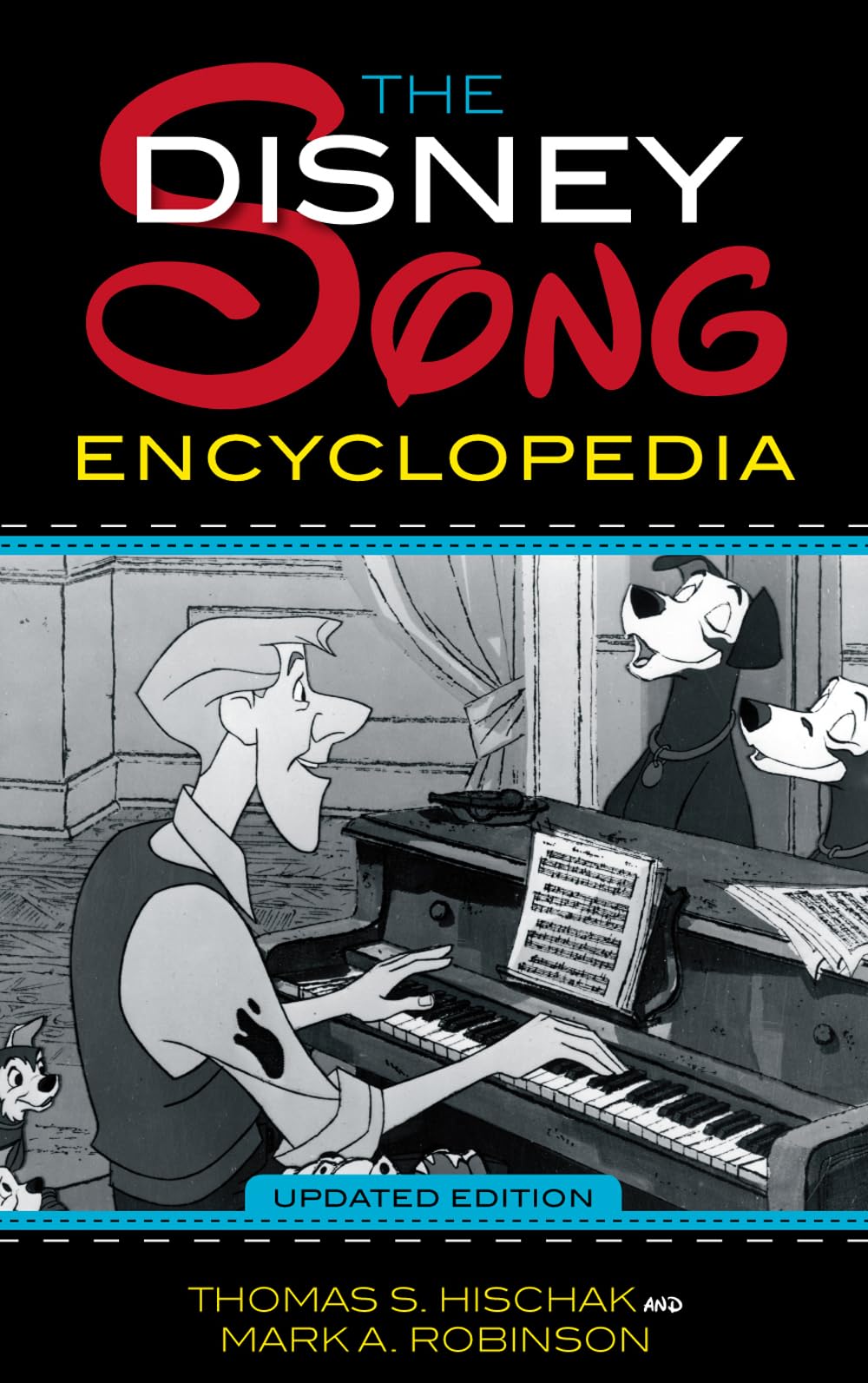
The Disney Song Encyclopedia describes and discusses hundreds of famous and not-so-famous songs from Disney films, television, Broadway, and theme parks from the 1930s to the present day. Over 900 songs are given individual entries and presented in alphabetical order. The songwriters and original singers are identified, as well as the source of the song and other venues in which it might have been used over the years. Notable recordings of the song are also listed.
But most important, the song is described and what makes it memorable is discussed. This is not a reference list but a true encyclopedia of Disney songs. The book also contains a preface describing the criteria for selecting the songs, a glossary of song terms, a list of all the Disney songs and their sources, a songwriter’s directory in which every song by each composer/lyricist is listed, a bibliography, a guide to recordings and DVDs of Disney productions, and an index of people and titles.
Walt Disney, a man of profound intuition and artistic vision, understood the transformative power of sound. In Steamboat Willie (1928), the synchronized clanging and jaunty melodies weren’t just a novelty; they were a revelation. They imbued the animated world with a sense of life and immediacy, forging a direct emotional link with the audience. This early innovation set the stage for Disney’s unwavering commitment tomusical excellence, a commitment that has consistently placed music at the forefront of its creative endeavors.
Interestingly, Walt Disney had no formal musical training. He was primarily a cartoonist and filmmaker who recognized something profound: music could breathe life into animation. “There’s a terrific power to music,” Disney once told his staff “You can run these pictures and they’d be dragging and boring, but the minute you put music behind them, they have life and vitality they don’t get in any other way.” This understanding led him to devote significant attention to the musical aspects of his productions, despite his lack of technical musical knowledge.
Walt Disney possessed an uncanny ability to know exactly what style of music would enhance a particular scene. He encouraged his animators to study music, recognizing its natural rhythms as fundamental to creating compelling animation. Two of his legendary “nine old men,” Frank Thomas and Ollie Johnston, noted that music was “undoubtedly the most important addition” to any production, giving it “integrity, style, emphasis, meaning and unity.”
Music is undoubtedly the most important addition that will be made to the picture. It can do more to bring a production to life, to give it integrity, style, emphasis, meaning and unity, than any other single ingredient. With the surge of a full orchestra, there will be bigness and majesty and soaring spirits; with a nervous, fluttering melody line on a single instrument, or pulsating drumbeats, there will be agitation, apprehension, suspicion. Music can build tension in commonplace scenes or ease it in ones that have become visually too frightening.
Frank Thomas and Ollie Johnston, “Disney Animation: Illusion of Life”
Walt’s appreciation for music was so complete that he built entire films around it. Fantasia stands as perhaps his most ambitious musical project, challenging his animators to create visual interpretations of classical masterpieces. Under his guidance, Disney composers and songwriters continually pushed boundaries, developing innovative techniques for synchronizing music with animation – methods still used throughout the film industry today.
This pioneering spirit extended beyond mere technical achievements. Disney’s music typically carried messages of hope and touched universal human emotions. As one Disney songwriter observed, Walt’s most successful films “had heart” and “would reach out and touch one of our human emotions.” This emotional resonance helped ensure that Disney films weren’t just for children but rather touched the child in everyone.
The Disney musical tradition has continued to evolve long after Walt’s time. In the 1990s, the company successfully transitioned to Broadway, beginning with Beauty and the Beast and followed by critical successes like The Lion King. Simultaneously, home video and DVD releases brought Disney music directly into households worldwide, further cementing these songs in popular culture.
Even rival animators acknowledged Disney’s musical innovations. Chuck Jones of Warner Brothers fame noted that “practically every tool we use today was originated at the Disney studio.” Disney films didn’t simply evolve gradually – they made quantum leaps that took both animation and film music to new heights.
Walt Disney once wrote, “I cannot think of the pictorial story without thinking about the complementary music which will fulfill it.” As film historian Leonard Maltin observed, music wasn’t merely “a key ingredient” of Walt Disney’s success – it was “the foundation” of it. Though he couldn’t read music or play an instrument, Disney possessed an innate musicality and understood intuitively how music could enhance storytelling.
This emotional resonance is a cornerstone of the Disney brand. By tapping into universal emotions like love, loss, joy, and hope, Disney music creates a shared experience that transcends cultural and linguistic barriers. When a child hears “A Whole New World” from Aladdin, they are not simply listening to a song; they are transported to a realm of wonder and possibility. This emotional connection fosters a sense of loyalty and affection for the Disney brand, creating lifelong fans who carry these cherished memories with them.
The strategic use of music in live-action films further reinforces this brand identity. While the transition from animation required a more nuanced approach, Disney successfully adapted its musical legacy for a new medium. The live-action Beauty and the Beast (2017) not only honored the beloved animated score but also expanded upon it, creating a richer, more immersive musical experience. The power of these musical revivals is immense, each song an emotional touchstone to preexisting beloved works, therefore enforcing brand loyalty, and the emotional response.
In the theme parks, music becomes an integral part of the immersive experience. From the nostalgic melodies of Main Street, U.S.A., to the adventurous themes of Adventureland, music is carefully curated to transport guests to different worlds. Attractions like “it’s a small world” rely on music to create a sense of unity and shared experience, while the “Grim Grinning Ghosts” theme from “The Haunted Mansion” adds a playful layer of spookiness to the ride. This careful orchestration of sound enhances the storytelling, creating a sense of wonder and excitement that leaves a lasting impression.
The reach of Disney music extends beyond the confines of its films and parks, permeating popular culture. Iconic songs have been covered by countless artists, featured in numerous films and television shows, and used to evoke emotions in countless everyday moments. This ubiquity reinforces the Disney brand as a cultural touchstone, a symbol of magic and emotional resonance.
In essence, music is the emotional glue that binds the Disney experience together. It’s the key that unlocks the door to imagination, the force that amplifies the joy, and the language that speaks to the heart. This unwavering commitment to musical excellence has been instrumental in building the Disney brand into a global icon, a symbol of magic and emotional connection that will continue to resonate for generations to come.
This musical magic continues to resonate today, providing an experience that’s accessible to people of all ages around the world. To experience Disney is, fundamentally, to experience music.
Part of a regular series on 27gen, entitled Wednesday Weekly Reader.
During my elementary school years one of the things I looked forward to the most was the delivery of “My Weekly Reader,” a weekly educational magazine designed for children and containing news-based current events.
It became a regular part of my love for reading, and helped develop my curiosity about the world around us.
A friend once asked me to define a true reader. Of course, I answered with a quote from a book:
I went on to share the source of the book, The Reading Life, by C.S. Lewis, and I want to share it here.
The revered teacher and bestselling author reflects on the power, importance, and joy of a life dedicated to reading books in this delightful collection drawn from his wide body of writings.
More than fifty years after his death, intellectual and teacher C. S. Lewis continues to speak to readers, thanks not only to his intellectual insights on Christianity but also his wondrous creative works and deep reflections on the literature that influenced his life. Beloved for his instructive novels including The Screwtape Letters, The Great Divorce, and The Chronicles of Narnia as well as his philosophical books that explored theology and Christian life, Lewis was a life-long writer and book lover.
Cultivated from his many essays, articles, and letters, as well as his classic works, The Reading Life provides guidance and reflections on the love and enjoyment of books. Engaging and enlightening, this well-rounded collection includes Lewis’ reflections on science fiction, why children’s literature is for readers of all ages, and why we should read two old books for every new one.
A window into the thoughts of one of the greatest public intellectuals of our time, this collection reveals not only why Lewis loved the written word, but what it means to learn through literature from one of our wisest and most enduring teachers.
C.S. Lewis’ The Reading Life is a carefully curated collection of his thoughts, essays, and correspondence about the art and joy of reading. Compiled posthumously from various sources, including letters, lectures, and previously published works, this volume offers readers a glimpse into the literary mind of one of the 20th century’s most influential Christian thinkers and writers.
The collection opens by establishing Lewis’s deeply personal relationship with books from childhood. Far from presenting reading as merely educational, Lewis reveals it as transformative and essential to his intellectual and spiritual formation. He recounts being “baptized” into the world of Norse mythology as a child, describing the profound way certain texts awakened his imagination and shaped his worldview.
Lewis distinguishes between different types of reading experiences throughout the collection. He contrasts what he calls “literary” reading – where one engages with a text for its inherent aesthetic qualities and transformative potential – with reading merely for information or distraction. Lewis argues passionately that the former holds greater value, allowing books to change us rather than merely entertaining or informing us.
One of the collection’s strengths is Lewis’s discussion of how to approach literature. He advocates for reading with receptivity and openness, suggesting that truly experiencing a book requires temporarily setting aside our own prejudices and assumptions. Lewis emphasizes that good reading involves surrender – allowing ourselves to be led by the author rather than imposing our interpretations from the outset.
Lewis also explores the relationship between reading and moral development. While he rejects the simplistic notion that reading “good” books automatically makes one virtuous, he acknowledges literature’s capacity to expand our moral imagination and help us understand perspectives beyond our own limited experience. His nuanced view recognizes literature’s power without overstating its moral effects.
The collection addresses practical aspects of reading as well. Lewis offers insights on rereading, suggesting that revisiting books is essential to truly understanding them. He discusses the value of reading older works, arguing that they provide necessary perspective to counter the cultural blindness of our own era. Lewis also tackles the sometimes intimidating prospect of reading “the classics,” providing encouraging advice for approaching difficult texts.
What makes The Reading Life particularly compelling is Lewis’s voice – erudite but accessible, passionate but reasoned. His writing exudes both intellectual rigor and childlike wonder. Whether discussing medieval literature or children’s stories, Lewis conveys the same infectious enthusiasm for the written word.
The collection’s most profound sections explore reading as a spiritual practice. Lewis suggests that literature can prepare us for divine encounters by awakening longing and helping us recognize beauty. While never suggesting that books replace religious experience, he positions them as potential conduits for transcendence.
Lewis’ Christian worldview and his literary preferences tend toward the classical and medieval. As such, some may find his perspectives on modern literature limited by his own historical context and personal taste. Additionally, the collection’s posthumous assembly means some thematic repetition occurs across selections.
The Reading Life is ultimately a celebration of literature’s capacity to expand our consciousness. Lewis portrays reading not as escapism but as a means of encountering reality more fully. Through books, he suggests, we can transcend the limitations of our individual perspective and experience the world through different eyes.
For those who already appreciate Lewis’s work, this collection provides valuable insights into the literary influences that shaped his thought. For newcomers, it offers an accessible introduction to Lewis’s brilliant mind and his approach to literature. For all readers, it serves as a compelling reminder of why we read and how books can transform our lives.
In an age of digital distraction and superficial content consumption, Lewis’s reflections on deep, attentive reading feel especially relevant. The Reading Life invites us to reconsider our relationship with books and challenges us to read not merely for information or entertainment but for transformation. It reminds us that the true value of reading lies not in the quantity of books we consume but in how deeply we allow them to shape us.
We want to see with other eyes, to imagine with other imaginations, to feel with other hearts, as well as with our own.
C.S. Lewis
Part of a regular series on 27gen, entitled Wednesday Weekly Reader.
During my elementary school years one of the things I looked forward to the most was the delivery of “My Weekly Reader,” a weekly educational magazine designed for children and containing news-based current events.
It became a regular part of my love for reading, and helped develop my curiosity about the world around us.