Busy is Not Better: Finding Peace in a Culture of Speed

In a world that increasingly celebrates busyness and equates worth with productivity, John Mark Comer’s The Ruthless Elimination of Hurry is a timely and profound counterargument. This spiritual formation book, published in 2019, challenges the modern obsession with speed and efficiency by proposing a radical yet simple solution: slow down.

Through personal anecdotes, theological insights, and practical wisdom, Comer explores how the contemporary culture of hurry is not just exhausting us physically but impoverishing us spiritually. His work serves as both a cultural critique and a practical guide for those seeking to escape the crushing weight of an overcommitted, overscheduled life.

Is it possible that our productivity could actually be increased by first slowing down?

The Quick Summary – The Ruthless Elimination of Hurry by John Mark Comer

 “Who am I becoming?”

That was the question nagging pastor and author John Mark Comer. Outwardly, he appeared successful. But inwardly, things weren’t pretty. So he turned to a trusted mentor for guidance and heard these words:

“Ruthlessly eliminate hurry from your life. Hurry is the great enemy of the spiritual life.”

It wasn’t the response he expected, but it was – and continues to be – the answer he needs. Too often we treat the symptoms of toxicity in our modern world instead of trying to pinpoint the cause. A growing number of voices are pointing at hurry, or busyness, as a root of much evil.

Within the pages of this book, you’ll find a fascinating roadmap to staying emotionally healthy and spiritually alive in the chaos of the modern world.

A SIMPLE SOLUTION

According to author John Mark Comer, the new normal of hurried digital distraction is robbing us of the ability to be present:

  • Present to God.
  • Present to other people.
  • Present to all that is good, beautiful, and true in our world.
  • Even present to our own souls.

The noise of the modern world makes us deaf to the voice of God, drowning out the one input we most need.

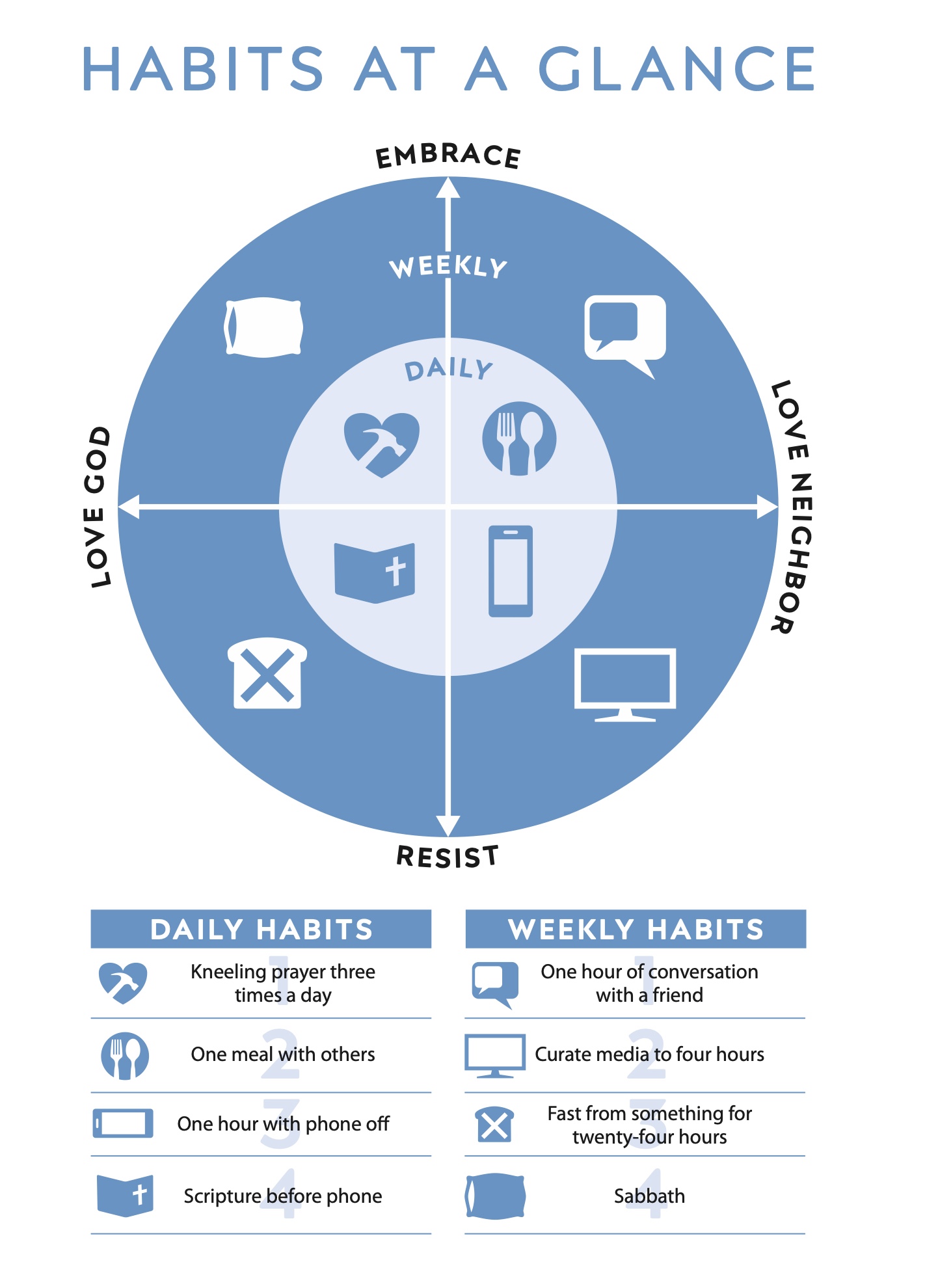
Whatever you call them: habits, practices, or spiritual disciplines are how we follow Jesus. How we adopt His lifestyle. How we create space for emotional health and spiritual life.

John Mark Comer

And like all habits, they are a means to an end. The end is life to the full with Jesus. The end is to spend every waking moment in the conscious enjoyment of Jesus’ company, to spend our entire lives with the most loving, joyful, peaceful person to ever live.

Silence and solitude

Here’s to tomorrow morning, six o’clock. Coffee, the chair by the window, the window by the tree. Time to breathe. A psalm and story from the Gospels. Hearing the Father’s voice. Pouring out my own. Or just sitting, resting. Maybe I’ll hear a word from God that will alter my destiny; maybe I’ll just process my anger over something that’s bothering me. Maybe I’ll feel my mind settle like untouched water; maybe my mind will ricochet from thought to thought, and never come to rest. If so, that’s fine. I’ll be back, same time tomorrow. Starting my day in the quiet place.

Sabbath

If your story is anything like mine, Sabbath will take you a little while to master. After all, Shabbat is a verb. It’s something you do. A practice, a skill you hone. To begin, just set aside a day. Clear your schedule. Turn off your phone! Say a prayer to invite the Holy Spirit to pastor you into His presence. And then? Rest and worship. In whatever way is life giving for your soul. And something happens about halfway through the day, something hard to put language to. It’s like my should catches up to my body. Like some deep part of me that got beat up and drowned out by meetings and email and Twitter and relational conflict and the difficulty of life comes back to the surface of my heat. I feel free. And at the end of the day when I turn my phone back on and reenter the modern world, I do so slowly. And, wow, does that ever feel good.

Simplicity

The goal isn’t just to declutter your closet or garage but to declutter your life. To clear away the myriad of distractions that ratchet up our anxiety, feed us an endless stream of mind-numbing drivel, and anesthetize us to what really matters. To follow Jesus, especially in the Western world, is to live in that same tension between grateful, happy enjoyment of nice, beautiful things, and simplicity. And when to err on the side of generous, simple living. The truth is you can be happy right here, right now, “through Christ who strengthens me,” meaning through investing your resources in ongoing relational connections to Jesus. Right now you have everything you need to live a happy, content life; you have access to the Father. To His loving attention.

Slowing

The basic idea behind the practice of slowing is this: slow down your body, slow down your life. If we can slow down both our minds and bodies – the pace at which we think and the pace at which we move our bodies through the world – maybe we can slow down our souls to a pace at which they can “taste and see the the Lord is good.” John Ortberg and Richard Foster both label this emerging practice the spiritual discipline of “slowing.” Ortberg defined it as “cultivating patience by deliberately choosing to place ourselves in positions where we have to wait. There’s more to life than an increase in speed. Life is right under our noses, waiting to be enjoyed.

John Mark Comer, The Ruthless Elimination of Hurry

Comer’s writing style is engaging and relatable, blending historical Christian wisdom with contemporary cultural analysis. He draws from diverse sources, including the Desert Fathers, Eugene Peterson, and modern psychology, while maintaining an accessible tone that feels like a conversation with a wise friend.

The book’s strengths lie in its practical applications and Comer’s vulnerability about his own struggles. He doesn’t just theorize about slowing down; he provides concrete steps and real-world examples. His insights about how technology and social media contribute to our collective hurry sickness are particularly astute.

What makes this book stand out is its timing and relevance. In an era where burnout is endemic and anxiety levels are soaring, Comer’s message feels prophetic. He’s not just addressing individual wellness but diagnosing a broader cultural malady.

The book succeeds in making a compelling case that hurry is not just a scheduling problem but a spiritual one. It challenges readers to consider how their pace of life affects their spiritual and emotional wellbeing, relationships, and overall quality of life.

For those feeling overwhelmed by the pace of modern life, “The Ruthless Elimination of Hurry” offers both a theoretical framework for understanding their condition and practical tools for making changes. While the solutions Comer proposes are radical by modern standards, he makes a convincing argument that such radical measures are exactly what we need.

The book is ultimately a call to countercultural living, suggesting that the path to a meaningful life might not be found in doing more faster, but in doing less slower.

A NEXT STEP

John Mark Comer believes that unlike other types of habits, the practices of Jesus aren’t just exercises for your mind and body to grow their willpower muscle and cultivate character. They are far more: they are how we open our minds and bodies to a power far beyond our own and effect change.

The four disciplines listed above may seem like a strange way to become more productive, but in the sugar-rush of the busy lives we are leading, slowing down will actually help you become better at what you do.

For excellent guidance on these disciplines, be sure to download the author’s workbook to accompany his book.

Toward which of the four disciplines are you feeling led by the Holy Spirit? What is one step to take today?


Part of a regular series on 27gen, entitled Wednesday Weekly Reader

During my elementary school years one of the things I looked forward to the most was the delivery of “My Weekly Reader,” a weekly educational magazine designed for children and containing news-based, current events.

It became a regular part of my love for reading, and helped develop my curiosity about the world around us.

Along with early and ongoing encouragement from my parents – especially my father – reading was established as a passion in my life that I was happy to continually learn from, share with my children, and watch them share with their children.

Reading keeps our minds alive and growing.

The Timeless Appeal of LEGO®: Engineering, Creativity, and Play

Few toys have captured the imagination of generations quite like LEGO®. What began as a small Danish company’s venture into wooden toys in the 1930s transformed into one of the most iconic and beloved building systems in history. In 1958, the modern LEGO® brick was patented, introducing an interlocking system that allowed for limitless creativity and construction. Over the decades, LEGO® has expanded beyond simple bricks, incorporating robotics, architecture, and even real-world engineering principles – making it a staple in both childhood playrooms and professional design studios.

But LEGO® isn’t just for kids. The fascination with these small, colorful bricks extends to adults, engineers, artists, and educators alike. From intricate cityscapes to working mechanical models, LEGO® serves as both a creative outlet and an educational tool, encouraging problem-solving, spatial reasoning, and hands-on learning. The act of “playing” with LEGO® fosters patience, perseverance, and the ability to see failure as a step toward success—valuable lessons in any field, especially engineering.

This brings us to The LEGO® Engineer, a book that dives into the real-world applications of LEGO® as a tool for understanding complex engineering concepts. Whether you’re a lifelong LEGO® enthusiast (like our entire family!) or someone curious about the mechanics behind structures and machines, this book explores how LEGO® models can demonstrate principles of physics, architecture, and design in an accessible, engaging way. Take a closer look at The LEGO® Engineer, its key insights, and what it can teach us about the intersection of creativity and engineering.

In The LEGO® Engineer, you’ll explore how some of humanity’s greatest feats of engineering work, from towering skyscrapers to powerful rockets to speeding bullet trains. Then follow step-by-step instructions to build these marvels with LEGO® bricks as you experience the world of engineering in a fun new way.

How do diesel and electric engines work together to drive massive freight trains? How does a container ship’s bow shape contribute to its fuel efficiency? How do cable-stayed bridges distribute weight differently than suspension bridges? You’ll learn the answers to these engineering questions and more as you build your way through over 30 models, all designed by LEGO® expert Jeff Friesen. Understanding the engineering principles behind these structures will not only help you better appreciate the world around you, but will also help you make your own LEGO® builds more realistic.


The LEGO® Engineer by Jeff Friesen is an engaging and visually captivating exploration of engineering principles through the lens of LEGO® building. Friesen, a renowned LEGO® artist and photographer, takes readers on a journey through real-world engineering marvels, breaking down complex mechanical and structural concepts into stunning LEGO® models. The book features step-by-step instructions for building a variety of engineering-inspired LEGO® creations, from bridges and skyscrapers to locomotives and futuristic vehicles. Each model is accompanied by explanations of the engineering principles that make these structures work in real life, making the book an educational resource as well as an inspiration for builders of all ages.

Divided into sections based on different fields of engineering – including civil, mechanical, and aerospace engineering – The LEGO® Engineer blends creativity with technical insight. Whether showcasing the suspension systems of trains or the aerodynamics of high-speed transport, the book presents each topic with clear visuals and concise, engaging explanations.

The LEGO® Engineer is a fantastic addition to the world of LEGO® books, especially for those interested in the intersection of creativity and STEM (Science, Technology, Engineering, and Mathematics). Friesen masterfully balances fun and education, making engineering concepts accessible to LEGO® enthusiasts, students, and even professional engineers looking for a unique way to visualize mechanics.

Here are a few things that stand out in the book:

  • Stunning Visuals: The photography in this book is exceptional, making it a pleasure to browse even if you don’t plan to build every model.
  • Clear Explanations: Engineering principles are broken down in an easy-to-understand manner, making the book suitable for beginners while still offering depth for more advanced readers.
  • Step-by-Step Instructions: The book includes detailed guides for building various LEGO® models, encouraging hands-on learning.
  • Inspiration for Creativity: Even beyond the provided models, the book sparks ideas for custom LEGO® creations based on real-world engineering challenges.

A couple of items that only the nerdiest LEGO® builder might take issue with:

  • Limited to Smaller Builds: While the models are impressive, they are relatively small in scale. Readers looking for large, intricate builds may need to expand on Friesen’s concepts themselves.
  • Not a Deep Engineering Textbook: While the explanations are insightful, this book is more of an introduction to engineering principles rather than an in-depth technical guide.

The LEGO® Engineer is a must-read for LEGO® fans, aspiring engineers, and educators looking to make STEM topics more engaging. Jeff Friesen has crafted a book that is both visually stunning and intellectually stimulating, proving that LEGO® is much more than a toy – it’s a tool for learning, innovation, and creativity. Whether you’re a seasoned builder or a newcomer looking to expand your skills, this book is an inspiring addition to any LEGO® library.


For Baby Boomers who grew up with simple LEGO® brick sets (like me), Gen Xers who marveled at the first themed sets and minifigures, and Millennials who witnessed the rise of LEGO® Technic, Mindstorms, and epic licensed collections (our four kids and their spouses), LEGO® has been a constant source of creativity and connection across generations. Now, as Gen Z and Generation Alpha (our 11 grandchildren) discover the endless possibilities of LEGO® play, families have the opportunity to share not just a toy, but a legacy of imagination, problem-solving, and innovation.

The LEGO® Engineer is a testament to this enduring magic – bridging the past, present, and future by showing how something as simple as interlocking plastic bricks can teach complex engineering concepts, fuel curiosity, and bring generations together in the shared joy of building. Whether you’re revisiting LEGO® as an adult or introducing your grandchildren to its wonders, this book serves as a reminder that LEGO® is more than just a pastime – it’s a gateway to creativity, learning, and lifelong discovery.


Part of a regular series on 27gen, entitled Wednesday Weekly Reader.

During my elementary school years one of the things I looked forward to the most was the delivery of “My Weekly Reader,” a weekly educational magazine designed for children and containing news-based current events.

It became a regular part of my love for reading, and helped develop my curiosity about the world around us.

Breaking Free from Stagnation: The Art of Strategic Reset

Organizations around the world are plagued by staff burnout, high turnover, and low morale.

How do you turn this around? How do you make things better?

Changing how we work can feel overwhelming. Like trying to budge an enormous boulder, we’re stifled by the gravity of the way we’ve always done things. And we spend so much time fighting fires -and fighting colleagues – that we lack the energy to shift direction.

But with the right strategy, we can move the boulder.

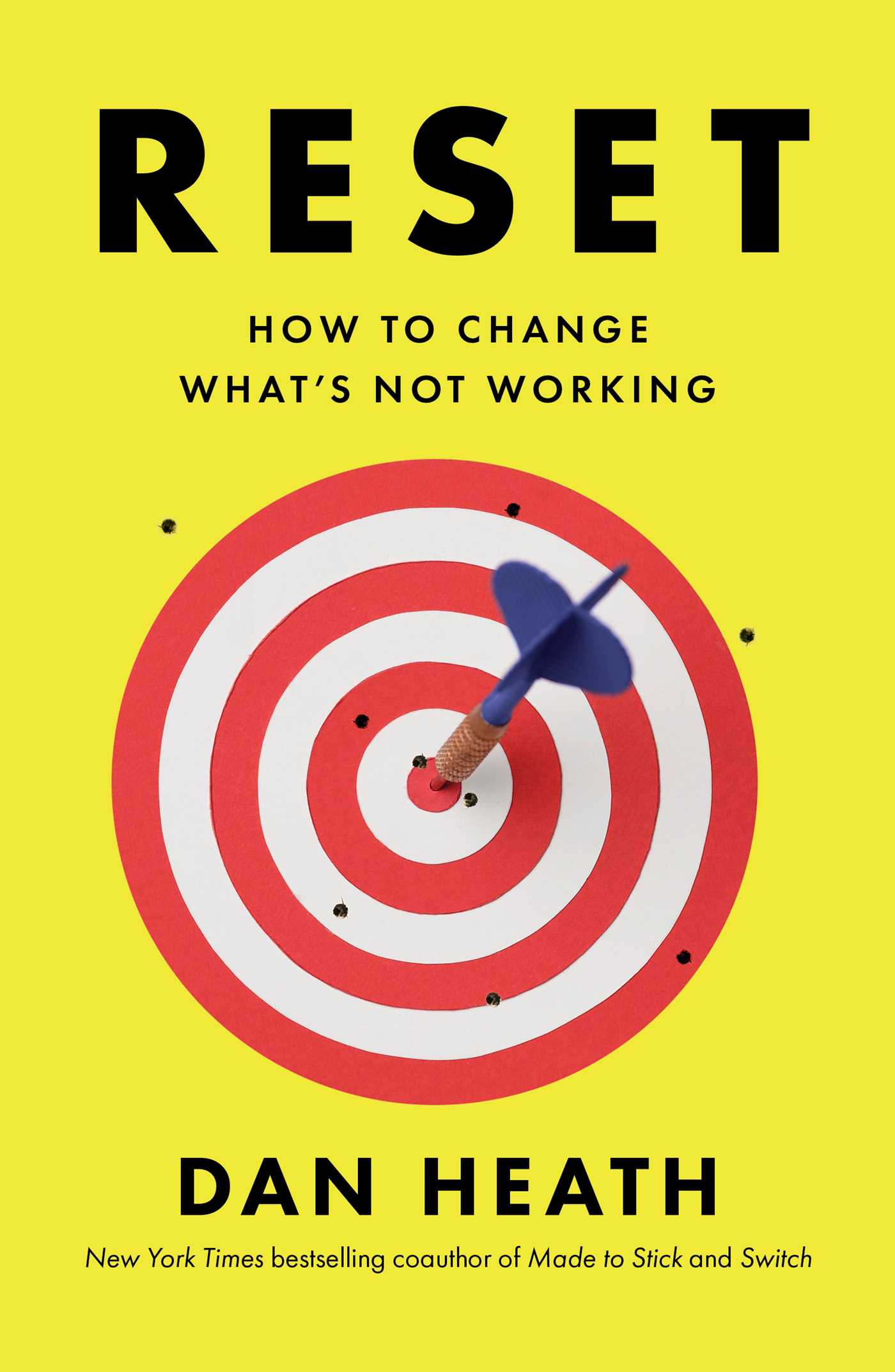
In Reset, Dan Heath explores a framework for getting unstuck and making the changes that matter. The secret is to find “leverage points”: places where a little bit of effort can yield a disproportionate return. Then, we can thoughtfully rearrange our resources to push on those points.

Heath weaves together fascinating examples, ranging from a freakishly effective fast-food drive-thru to a simple trick from couples therapy to an inspirational campaign that saved a million cats.

In Reset, you’ll learn:

-Why the feeling of progress can be your secret weapon in accelerating change

-How leaders can uncover and stop wasteful activities

-Why your team’s motivation is often squandered—and how to avoid that mistake

-How you can jumpstart your change efforts by beginning with a “burst”

The book investigates mysteries: Why the middle is the roughest part of a change effort. Why inefficiency can sometimes accelerate progress. Why getting “buy-in” is the wrong way to think about change.

What if we could unlock forward movement – achieving progress on what matters most – without the need for more resources? The same people, the same assets…but dramatically better results. Yesterday, we were stuck. Today, we reset.


When organizations and individuals find themselves stuck in unsatisfactory situations, the natural instinct is often to push harder or work longer hours. However, as revealed in Reset from Heath’s extensive research spanning over two and a half years, meaningful change requires a more nuanced approach than simply applying more force to existing problems.

Through 240 interviews across various industries, combined with insights from psychology and successful transformation methodologies, Heath developed a clear framework for breaking free from stagnation. The key lies not in working harder, but in working smarter through strategic intervention points.

Think of being stuck as facing a massive boulder blocking your path. No amount of direct force will move it – you need leverage. This metaphor captures the essence of the reset process: identifying precise points where minimal effort can yield maximum results, known as Leverage Points.

However, finding these Leverage Points requires methodical investigation. There are five primary methods for uncovering them. 

  1. Direct observation of work processes can reveal inefficiencies that aren’t apparent from a distance. 
  2. Examining alternative routes to your ultimate goal might uncover easier paths forward.
  3. Studying your own success stories can highlight replicable winning strategies.
  4. Identifying the primary constraint holding you back helps focus efforts where they matter most. 
  5. Taking a holistic view of the system often reveals unexpected opportunities for intervention.

But identifying Leverage Points is only half the battle. The other crucial element is Restacking Resources – redirecting your existing assets, time, and energy toward these strategic pressure points. This process isn’t about finding additional resources; it’s about making smart trade-offs with what you already have.

The challenge lies in the fact that most resources are already committed to ongoing operations. No team member believes their current work is pointless, making it difficult to redirect efforts elsewhere. 

This is where six specific strategies come into play: 

  1. Beginning with an intense focused burst of effort.
  2. Eliminating wasteful activities.
  3. Shifting resources from low-value to high-value work.
  4. Tapping into intrinsic motivation.
  5. Empowering team members to lead change.
  6. Accelerating feedback loops for faster learning.

What makes this approach particularly powerful is its alignment with human psychology. Research by Teresa Amabile and Steven Kramer, involving over 12,000 diary entries from 238 employees across seven companies, revealed a fascinating insight: the single most powerful motivator in the workplace is making progress on meaningful work. On employees’ best days, 76% involved achieving progress, while only 13% involved setbacks. Surprisingly, only 5% of managers recognized progress as a primary motivator, ranking it last among potential motivational factors.

This “progress principle” becomes a powerful ally in the reset process. Once you start moving the boulder – even slightly – the psychological boost from that progress creates positive momentum that can help sustain the change effort. It transforms the daunting task of organizational change from an exhausting push against resistance into a more natural flow of continuous improvement.

As with his previous books (see here, here, and here), Heath uses real-world examples to demonstrate the effectiveness of this approach across diverse situations: from turning around struggling libraries and companies to revitalizing hospital operations and even improving personal relationships. The framework has proven adaptable to various contexts, whether addressing operational inefficiencies, customer satisfaction, employee engagement, or strategic direction.

The process challenges several common assumptions about organizational change. It suggests that seeking “buy-in” might be the wrong approach to change management. It reveals that inefficiency can sometimes accelerate progress, and that people often overestimate their understanding of the systems they work within. Perhaps most importantly, it demonstrates that the middle phase of any change effort is typically the most challenging – a insight that helps teams prepare for and push through the inevitable rough patches.

The beauty of this Reset framework lies in its simplicity: find the right leverage points and realign resources to apply pressure there. While the concept is straightforward, the execution requires careful analysis, strategic thinking, and willingness to make difficult trade-offs. However, the rewards are worth the effort: breaking free from unproductive patterns, experiencing forward momentum where there was once stagnation, and regaining a sense of agency over seemingly intractable situations.

This approach offers hope to anyone feeling stuck in a rut, whether personally or professionally. It provides a practical pathway to change that doesn’t rely on heroic efforts or unlimited resources, but rather on smart targeting of effort and strategic reallocation of existing assets. By understanding and applying these principles, individuals and organizations can transform themselves from spinning their wheels to moving purposefully toward their goals.


In a future post, I will be unpacking Reset in terms of how I am applying it in my personal life. Stay tuned!


Part of a regular series on 27gen, entitled Wednesday Weekly Reader.

During my elementary school years one of the things I looked forward to the most was the delivery of “My Weekly Reader,” a weekly educational magazine designed for children and containing news-based current events.

It became a regular part of my love for reading, and helped develop my curiosity about the world around us.

The Heart and Science of Nursing

A Personal Story

You know that nurse who helped you or your loved one during a hospital stay? The one who really saw you, heard you, and knew exactly what you needed? That’s not a coincidence – it’s what great nursing is all about. Whether we realize it or not, nurses are often there for many of life’s biggest moments, from our first breath to our last, the birth and growing pains of our children, and then the reality of aging adults – first our parents, then ourselves.

In a continuation of a recent post, I want to give you “the rest of the story.”

After 10 days in the hospital, spread over 2 stays, I was looking forward to going home – and I did, for 3 uneventful days. Then the pain returned with a vengeance, and so did I – back to the hospital. Imaging soon revealed that while the ruptured ulcer was continuing to heal, the aftereffects of the perforation had inflamed the gallbladder, and a stone lodged in a duct was causing the intense pain. Surgery was scheduled for the next day, and I was discharged two days later.

The pain was gone, and it was time to continue healing at home. I couldn’t do anything except lay in bed, and for those of you who know me, you know what’s coming next:

Reading.

In this case, I wanted to know more about that wonderful team of women (mostly) and men we call nurses who had provided care for me. A quick search of my local library and a pickup by Anita delivered this marvelous book that reflects so much of what I experienced over a two-week plus stay in the hospital, all under the care of the PSC-3 Nursing team at Atrium Cabarrus.


Nurses have always been vital to human existence. A nurse was likely there when you were born and a nurse might well be there when you die. Familiar in hospitals and doctors’ offices, these dedicated health professionals can also be found in schools, prisons, and people’s homes; at summer camps; on cruise ships, and at workplaces. Yet despite being celebrated during the Covid-19 epidemic, nurses are often undermined and undervalued in ways that reflect misogyny and racism, and that extend to their working conditions – and affect the care available to everyone. But the potential power of nursing to create a healthier, more just world endures.

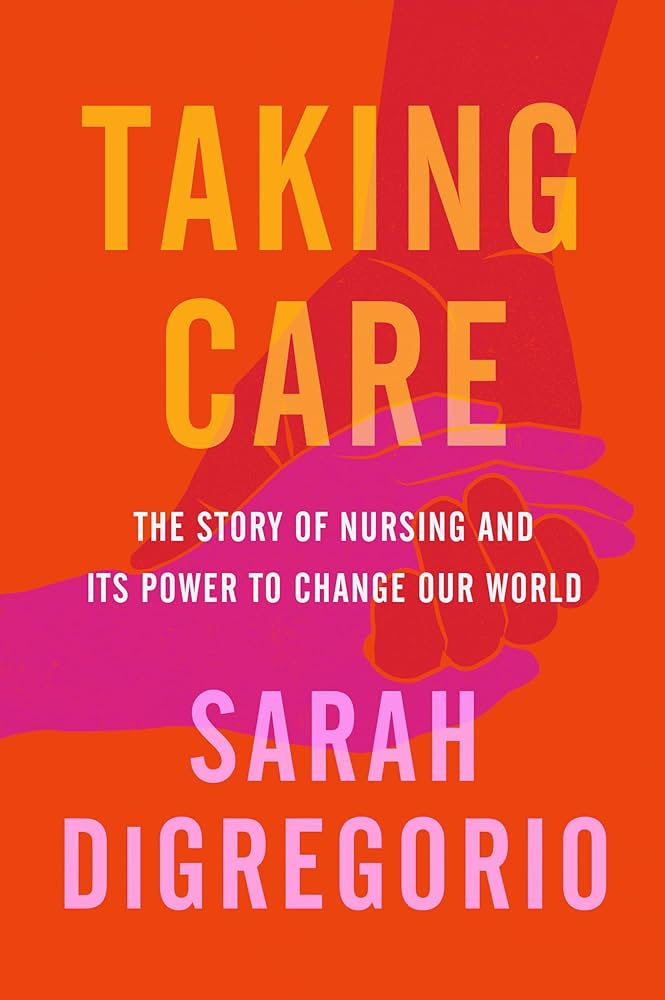
The story of nursing is complicated. It is woven into war, plague, religion, the economy, and our individual lives in myriad ways. In Taking Care, journalist Sarah DiGregorio chronicles the lives of nurses past and tells the stories of those today – caregivers at the vital intersection of health care and community who are actively changing the world, often invisibly. An absorbing and empathetic work that combines storytelling with nuanced reporting, Taking Care examines how we have always tried to care for each other – the incredible ways we have succeeded and the ways in which we have failed. Fascinating, empowering and significant, it is a call for change and a love letter to the nurses of yesterday, today, and tomorrow.


Think about what comes to mind when you hear the word “nurse.” Maybe you remember clapping during the early days of COVID, or you picture Florence Nightingale with her lamp. Perhaps you think of TV shows like M*A*S*H or countless others.. But the reality of nursing goes much deeper than any of these images suggest.

Here’s something that might surprise you: nursing is actually one of the biggest professions in the world, with over 27 million nurses and midwives globally. In the U.S. alone, there are three times as many nurses as doctors! Without nurses, our healthcare system would basically grind to a halt.

And nurses? They’re everywhere! They’re not just in hospitals – they’re on cruise ships managing outbreaks, in libraries doing free blood pressure checks, at NASA monitoring astronauts (how cool is that?), and even in state legislatures writing healthcare policies. They’re the ultimate healthcare multitaskers.

But what exactly do nurses do? Well, it’s way more than just following doctors’ orders. While doctors typically focus deeply on specific medical conditions, nurses take care of the whole picture. Think of it this way: if you’re leaving the hospital, your doctor might prescribe your medications, but your nurse is the one making sure you understand how to take them, checking if you can handle the stairs at home, and figuring out if you have someone to help with cooking.

Here’s my real-world example: imagine you need gallbladder removal surgery. Sure, the hepato-pancreato-biliary surgeon does the actual operation, but nurses are there every step of the way. They’re prepping you, putting in your IV, checking your vitals, and acting like healthcare air traffic controllers – making sure everyone from social workers to anesthesiologists to radiology staff is in the right place at the right time. After surgery, they’re watching your pain levels, managing your medications, preventing infections, and teaching your family how to care for you at home.

One nurse quoted in Taking Care put it perfectly: “Doctors figure out where the patient is and where they need to be. Nurses are the ones who actually get you there.” It’s like doctors draw the map, but nurses help you navigate the journey.

And get this – nursing isn’t just about medical procedures and medications. It’s about building relationships and understanding people in their full context – their family situation, their community, their environment. As nurse researcher Monica McLemore explained in the book, “Everyone thinks it’s just skills and tasks, like putting in IVs or reading monitors. But that’s just one part. Our real job is helping people through transitions, whether that’s recovering from illness or adapting to a new health reality.”

Think about it: nurses are often the first ones to notice when something’s off. Maybe it’s a subtle change in someone’s mental state that could signal a stroke, or maybe it’s spotting a pattern of heat-related health issues in farm workers. They’re like healthcare detectives, constantly putting together pieces of the puzzle.

The cool thing about nursing is that it’s both super scientific and deeply human. Nurses need to understand complex biology and medical procedures, but they also need to be great communicators and problem-solvers. They’re the ones asking the practical questions that doctors might not think of: “Do you feel safe walking in your neighborhood?” “Is there anyone at home who can help you?” “Do you need assistance getting food?”

And here’s something that often gets overlooked: nurses work with doctors, not for them. They’re separate but complementary professions, like two sides of the same healthcare coin. While doctors might focus on curing a specific condition, nurses focus on healing the whole person – and yes, there’s a difference!

So next time you’re in a healthcare setting, remember that the nurse caring for you is part of this amazing tradition that combines scientific knowledge, practical skills, and deep human connection. They’re not just there to take your temperature or give you medicine – they’re there to help guide you through whatever health journey you’re on, making sure you have what you need every step of the way.

After all, sooner or later, we all need someone to nurse us through tough times. And when that time comes, it’s pretty amazing to have someone who knows both the science of healing and the art of caring on your side.

With grateful appreciation to all the nursing team of PSC-3; you are caring professionals to the core.

Thank you.


Part of a regular series on 27gen, entitled Wednesday Weekly Reader.

During my elementary school years one of the things I looked forward to the most was the delivery of “My Weekly Reader,” a weekly educational magazine designed for children and containing news-based current events.

It became a regular part of my love for reading, and helped develop my curiosity about the world around us.

Charcoal Mellowed and History Forgotten: The Legacy of Nearest Green and Jack Daniel

As a Native Tennesseean, specifically Middle Tennessee, I have long been aware of the person of Jack Daniel and the distillery that bears his name.

Interestingly enough, other than name recognition, my first extended exposure to Jack Daniel was through music.

When Jack Daniel opened saloons in Lynchburg in 1892, he thought of a novel way to attract people to the town square. Mr. Jack formed The Silver Cornet Band with musically inclined locals – a bank clerk, grocer, policeman, and even a local lawyer. Like his whiskey, music brought folks together from every walk of life. Mr. Jack’s band played together for another 20 years. Even when the Distillery was closed due to various state and local Prohibition laws, the band kept Jack’s spirit alive.

Mr. Jack Daniel’s Original Silver Cornet Band is an affectionate re-creation of a small town band that existed in Lynchburg, Tennessee from 1892 until about 1914.

The “modern” version of this band was the creation of David Fulmer in the mid-1970s, who wrote the show and performed as the “Professor” for many years.

The band began touring in 1978, performing in concert halls throughout the United States and Canada and delighting audiences at music festivals, music educator conferences, and for civic and private events with its joyful style and expert musicianship.

More than just a band concert, a performance by the Silver Cornet Band was a time traveling excursion to an era when life moved at a less hurried pace; when a warm summer evening was spent with a picnic supper in the park, the fellowship of friends and neighbors, and the sound of band music in the air.

I knew several of the band members over the years, as several came from the music program at my college, Tennessee Technological University. Although known primarily as an engineering school, it also had an outstanding low-brass music program, and the attraction of a “brass band” from a turn-of-the-century time period captured the imagination and participation of students.

I was fortunate to attend several concerts over the years, and have all of their music that has been released on CDs. I suppose it was my fondness for the music and the generosity of the man who inspired it, Jack Daniel, who lead me to take the next step in learning more.

Several years after the 100th anniversary of the founding of the distillery, I took part in a tour, fascinated by the stacks of hardwood burning to make the charcoal to filter the liquid, curious about the cave spring that supplied the water, impressed by the craftsmanship needed to create the barrels, and amazed at the huge gallons of mash as it begin the fermentation process that ultimately produced the golden amber liquid that was a part the southern culture of my teenage and college years.

Though not a partaker of alcohol, I was fascinated by the story of Jack Daniel and his life. Over the years, I would read and/or see articles about Jack Daniel and its contribution to culture – particularly the Southern culture from which it arose.

Then, in 2016, a story began to come out: Jack Daniel did own and operate the first registered distillery in the U.S. – but the secret of his charcoal-filtered whiskey came from the knowledge and expertise of a former slave (not owned by Jack Daniel) named Nearest Green who taught a young Jack Daniel all about distilling whiskey…

…and that brings us to today’s Wednesday Weekly reader.


New York Times bestselling author Fawn Weaver unveils the hidden narrative behind one of America’s most iconic whiskey brands. This book is a vibrant exploration set in the present day, delving into the life and legacy of Nearest Green, the African American distilling genius who played a pivotal role in the creation of the whiskey that bears Jack Daniel’s name.

Set against the backdrop of Lynchburg, Tennessee, Love & Whisky weaves together a thrilling blend of personal discovery, historical investigation, and the revelation of a story long overshadowed by time. Through extensive research, personal interviews, and the uncovering of long-buried documents, Weaver brings to light not only the remarkable bond between Nearest Green and Jack Daniel but also Daniel’s concerted efforts during his lifetime to ensure Green’s legacy would not be forgotten. This deep respect for his teacher, mentor, and friend was mirrored in Jack’s dedication to ensuring that the stories and achievements of Nearest Green’s descendants, who continued the tradition of working side by side with Jack and his descendants, would also not be forgotten.

Love & Whiskey is more than just a recounting of historical facts; it’s a live journey into the heart of storytelling, where every discovery adds a layer to the rich tapestry of American history. Weaver’s pursuit highlights the importance of acknowledging those who have shaped our cultural landscape; yet remained in the shadows.

As Weaver intertwines her present-day quest with the historical threads of Green and Daniel’s lives, she not only pays homage to their legacy but also spearheads the creation of Uncle Nearest Premium Whiskey. This endeavor has not only brought Nearest Green’s name to the forefront of the whiskey industry but has also set new records, symbolizing a step forward in recognizing and celebrating African American contributions to the spirit world.

Love & Whiskey invites readers to witness a story of enduring friendship, resilience, and the impact of giving credit where it’s long overdue. It’s an inspiring tale of how uncovering the past can forge new paths and how the spirit of whiskey has connected lives across generations. Join Fawn Weaver on this extraordinary adventure, as she navigates through the layers of history, friendship, and the unbreakable bonds formed by the legacy of America’s native spirit, ensuring the stories of Nearest Green and his descendants live on in the heart of American culture.


The story of Nearest Green, one of the most remarkable yet long-forgotten figures in American whiskey history, has become an essential narrative in understanding the origins of Jack Daniel’s whiskey. Nathan “Nearest” Green was not only the first known African American master distiller, but he was also instrumental in teaching Jack Daniel the craft of whiskey making. His story, rediscovered after more than a century of obscurity, has profoundly reshaped how we view the birth of one of the world’s most famous whiskey brands.

The Early Life of Nearest Green

Nathan Green, commonly known as “Uncle Nearest,” was born into slavery in the early 1800s in Maryland. Like many enslaved people of that time, his skills were not limited to manual labor. Green had an exceptional talent for distilling whiskey, a process that was complex and labor-intensive, requiring a mastery of both art and science. While little is known about his early life, it is likely that he learned the distillation process from earlier generations of enslaved African Americans or European settlers who practiced whiskey-making techniques brought over from Ireland and Scotland.

By the mid-1800s, Green was enslaved on a farm owned by the Reverend Dan Call, a preacher and distiller in Lynchburg, Tennessee. It was at Call’s distillery that Green’s talents in whiskey production would shape history.

Meeting Jack Daniel

Jack Daniel, born Jasper Newton Daniel in 1846, grew up in a world where whiskey was an essential part of southern life. After losing his mother at a young age and suffering from a strained relationship with his father, young Jack left home as a teenager. It was during this period that he was introduced to Reverend Dan Call, who not only took him under his wing but also introduced him to the art of whiskey making. However, it wasn’t Call who would provide Jack with the most important lessons in distilling; that honor belonged to Nearest Green.

Recognizing Green’s unmatched skill, Call entrusted him with teaching Jack Daniel how to make whiskey. Green became Daniel’s mentor, passing on the essential techniques of distillation, including the critical process of charcoal mellowing – an important step in what would later become the defining feature of Tennessee whiskey. The charcoal mellowing technique, also known as the “Lincoln County Process,” involves filtering the whiskey through charcoal to remove impurities and smooth out the flavor. This unique process differentiates Tennessee whiskey from other American whiskeys like bourbon, and it was Green who mastered and shared this process with Jack Daniel.

The Role of Nearest Green in Shaping Jack Daniel’s Whiskey

Nearest Green’s contribution to the Jack Daniel’s whiskey brand goes far beyond simply passing down techniques. His expertise was fundamental to the product’s flavor, consistency, and quality, and his influence is seen in the principles that would guide Jack Daniel’s whiskey production for generations.

Green’s mastery of the charcoal mellowing process allowed Jack Daniel’s whiskey to stand out from competitors. This filtration method gave the whiskey its distinctive smoothness and refinement, creating the signature taste that would make Jack Daniel’s a household name. Green’s influence is not just in the technique but in the philosophy that great whiskey is a product of attention to detail, patience, and craftsmanship.

Even after the end of slavery following the Civil War, Nearest Green remained an integral part of the Jack Daniel’s distillery. When Jack Daniel formally established his distillery in 1866 (which today is considered the oldest registered distillery in the United States), Nearest Green continued to work alongside him, this time as a free man. In fact, records show that Green was one of the distillery’s first employees, making him not only one of the first African American master distillers but also an important partner in the founding of the brand. Later, Green’s two sons continued their father’s legacy at Jack Daniel’s distillery.

The Lost Legacy of Nearest Green

Despite his undeniable contributions, Nearest Green’s role in the creation of Jack Daniel’s whiskey faded from history over the decades. Whiskey production in the 19th century was dominated by white narratives, and the contributions of African Americans were often overlooked or erased altogether. As a result, Nearest Green’s name was not mentioned in the official Jack Daniel’s company history for over 150 years.

It wasn’t until the 21st century that Green’s role began to be rediscovered. In 2016, author and historian Fawn Weaver embarked on a mission to uncover the true history behind the origins of Jack Daniel’s whiskey. Through meticulous research, Weaver uncovered documentation and oral histories that confirmed Nearest Green’s integral role in teaching Jack Daniel how to make whiskey.

Her efforts led to a groundbreaking realization: that Nearest Green was not only Jack Daniel’s teacher but also a key figure in the establishment of one of the most iconic whiskey brands in the world. This discovery marked a turning point in the narrative of American whiskey history and forced a reexamination of the often-overlooked contributions of African Americans to the industry.

Restoring Green’s Place in History

The rediscovery of Nearest Green’s legacy has led to a concerted effort to ensure his contributions are recognized and celebrated. In 2017, Jack Daniel’s officially acknowledged Nearest Green as the first master distiller for the brand. The company has since made efforts to honor his memory, including creating a dedicated section on the distillery’s tour that focuses on Green’s contributions.

Fawn Weaver also founded the Nearest Green Foundation, which aims to preserve Green’s legacy and provide scholarships for his descendants. Additionally, in 2017, a new whiskey brand, Uncle Nearest Premium Whiskey, was launched in his honor. Uncle Nearest Whiskey has quickly gained popularity, and its success serves as a fitting tribute to the man whose expertise and craftsmanship shaped the early days of Jack Daniel’s whiskey.

The Legacy of Nearest Green

Nearest Green’s story is not just one of whiskey-making brilliance; it’s a story about how the contributions of African Americans were often sidelined or forgotten in history. The rediscovery of his legacy offers a fuller, more accurate picture of the origins of Jack Daniel’s whiskey and highlights the crucial role African Americans played in shaping the American whiskey industry.

Nearest Green’s influence endures in every bottle of Jack Daniel’s whiskey, a testament to his mastery of distilling and the indelible mark he left on the industry. Today, his legacy is being restored and celebrated, reminding us of the rich and complex history behind one of the world’s most beloved spirits.


Part of a regular series on 27gen, entitled Wednesday Weekly Reader.

During my elementary school years one of the things I looked forward to the most was the delivery of “My Weekly Reader,” a weekly educational magazine designed for children and containing news-based current events.

It became a regular part of my love for reading, and helped develop my curiosity about the world around us.

Breaking Free from Aimless Wandering: The Call to Follow


It is into this deeply tired world of ours that God sends Jesus to speak the voice of love. Jesus says, “Follow me. Don’t keep running around. Follow me. Don’t just sit there. Follow me.”

Henri Nouwen

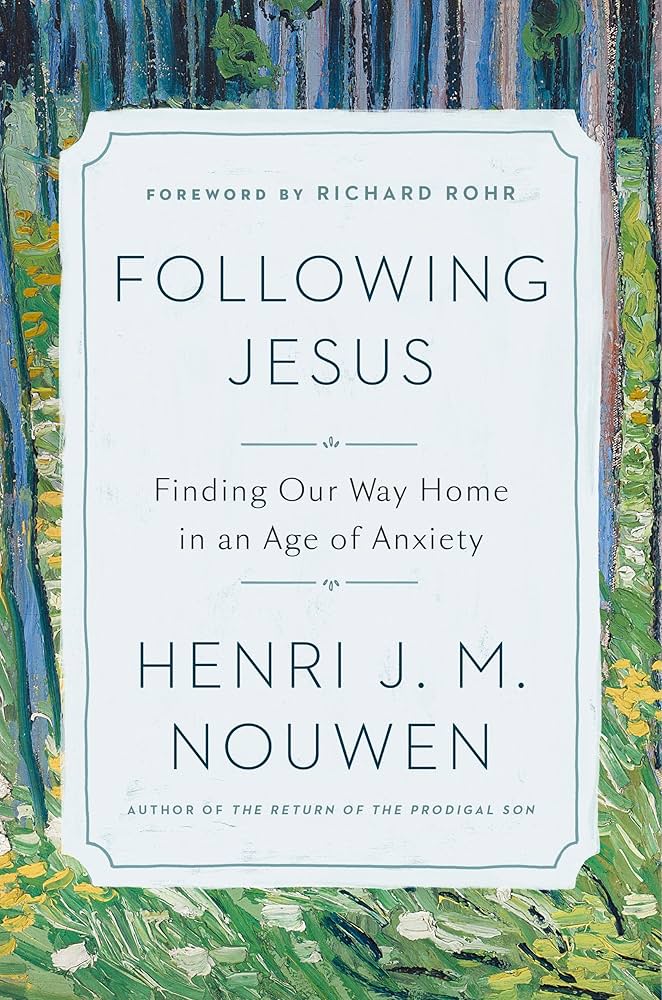
Following Jesus explores the spiritual concept of truly following Jesus, addressing a common human tendency to either be constantly busy or completely inactive. The author observes that many people live life in two extreme modes: perpetual restlessness or complete disengagement.

In the first mode, individuals are constantly moving, doing numerous activities, attending events, and meeting people, yet feeling a profound sense of meaninglessness. They’re exhausted by their own busyness, often unable to articulate what they’re actually accomplishing. This restless wandering leads to deep fatigue and a sense of being lived, rather than living purposefully.

The alternative state is total passivity, where people give up on their pursuits and sink into a state of apathy. They lose interest in life, spending time watching television, sleeping, or engaging in mindless activities. Some might seek escape through substances or other distractions, but fundamentally, they feel empty and unmotivated.

The core message is that Jesus offers a transformative alternative to these states through a gentle, loving call to “follow me.” This invitation isn’t forceful but is a sensitive, quiet voice that can reshape one’s entire existence. When people hear and respond to this call, their lives gain focus, purpose, and meaning. The wandering and listlessness are replaced by a clear direction and renewed excitement.

Author Henri Nouwen encourages readers to quiet themselves and listen for this voice of love, which speaks personally and intimately, calling each individual by name and offering a path out of spiritual exhaustion into a meaningful, directed life.


Henri Nouwen’s Following Jesus is a tender meditation on Christian discipleship that invites readers into a deeply personal and transformative journey of faith. At its core, the book is less a theological treatise and more a compassionate invitation to experience Christ’s love in the most intimate ways possible.

Nouwen begins by challenging the conventional understanding of following Jesus. It’s not about rigid adherence to rules or performing grand religious gestures, but about cultivating a profound, personal relationship with Christ. He emphasizes that discipleship is fundamentally about love – a love that transforms, heals, and provides radical hope.

Throughout the book, Nouwen explores several key themes of Christian discipleship. He speaks eloquently about vulnerability, suggesting that true following of Jesus means embracing our own brokenness and weakness. Instead of seeing our limitations as obstacles, Nouwen encourages readers to view them as sacred spaces where God’s grace can most powerfully manifest.

The spiritual journey, as Nouwen describes it, is not a linear path but a continuous process of surrender and discovery. He draws beautiful parallels between Jesus’s own life and the challenges believers face, highlighting that following Christ means walking a path of both profound joy and deep suffering. This isn’t a journey of achievement, but of continuous becoming – allowing oneself to be shaped by divine love.

Nouwen also delves into the importance of community and compassion. Following Jesus, he argues, isn’t a solitary endeavor but a collective experience of transformation. We grow closer to Christ not by isolating ourselves, but by opening our hearts to others, especially those who are marginalized or suffering. He challenges readers to see Christ in every person, particularly those society often overlooks.

Prayer and contemplation are central to Nouwen’s understanding of discipleship. He doesn’t present them as dutiful practices, but as intimate conversations with a loving God. These moments of stillness, he suggests, are where we truly learn to listen and align our hearts with divine purpose.

Another profound aspect of the book is Nouwen’s exploration of spiritual poverty. He suggests that truly following Jesus means letting go of our need for control, status, and self-sufficiency. It’s about creating space within ourselves for God’s grace to work – a radical act of trust and surrender.

Nouwen’s writing is characteristically gentle and deeply personal. He doesn’t lecture but invites readers into a reflective journey, sharing his own struggles and insights with remarkable honesty. His words feel like a compassionate conversation with a wise, loving spiritual mentor who understands the complexities of human faith.

The book ultimately presents following Jesus as a dynamic, living relationship rather than a static set of beliefs. It’s an ongoing dialogue of love, transformation, and grace. Nouwen reminds us that discipleship isn’t about perfection, but about persistent, humble openness to God’s transformative power.

For anyone seeking a more intimate, authentic understanding of Christian faith, Following Jesus offers a profoundly moving roadmap. It’s an invitation to experience divine love not as a distant concept, but as a lived, breathed reality that can reshape our entire existence.


Part of a regular series on 27gen, entitled Wednesday Weekly Reader.

During my elementary school years one of the things I looked forward to the most was the delivery of “My Weekly Reader,” a weekly educational magazine designed for children and containing news-based current events.

It became a regular part of my love for reading, and helped develop my curiosity about the world around us.

The Great American Grid: Jefferson’s Mathematical Vision of Liberty

Seen from an airplane, much of the United States appears to be a gridded land of startling uniformity. Perpendicular streets and rectangular fields, all precisely measured and perfectly aligned, turn both urban and rural America into a checkerboard landscape that stretches from horizon to horizon. In evidence throughout the country, but especially the West, the pattern is a hallmark of American life. One might consider it an administrative convenience – an easy way to divide land and lay down streets – but it is not. The colossal grid carved into the North American continent, argues historian and writer Amir Alexander, is a plan redolent with philosophical and political meaning.

In 1784 Thomas Jefferson presented Congress with an audacious scheme to reshape the territory of the young United States. All western lands, he proposed, would be inscribed with a single rectilinear grid, transforming the natural landscape into a mathematical one. Following Isaac Newton and John Locke, he viewed mathematical space as a blank slate on which anything is possible and where new Americans, acting freely, could find liberty. And if the real America, with its diverse landscapes and rich human history, did not match his vision, then it must be made to match it.

From the halls of Congress to the open prairies, and from the fight against George III to the Trail of Tears, Liberty’s Grid tells the story of the battle between grid makers and their opponents. When Congress endorsed Jefferson’s plan, it set off a struggle over American space that has not subsided. Transcendentalists, urban reformers, and conservationists saw the grid not as a place of possibility but as an artificial imposition that crushed the human spirit. Today, the ideas Jefferson associated with the grid still echo through political rhetoric about the country’s founding, and competing visions for the nation are visible from Manhattan avenues and Kansan pastures to Yosemite’s cliffs and suburbia’s cul-de-sacs. An engrossing read, Liberty’s Grid offers a powerful look at the ideological conflict written on the landscape.


From the window of a commercial jetliner flying over the western United States, a striking pattern emerges: an endless succession of square fields, perfectly aligned with the compass points, stretching from horizon to horizon. This geometric tapestry covers two-thirds of the continental United States, imposing a uniform mathematical design upon the natural landscape. Mountains, valleys, rivers, and even cities bend to its will, creating a sight that is both awe-inspiring and perplexing.

This vast checkerboard is known as the Great American Grid, a unique feature of the American landscape that sets it apart from the rest of the world. While rectilinear patterns in agricultural land can be found in other parts of the globe, none match the scale, uniformity, and sheer ambition of the American grid. It is a single, unified network that redefines space itself, transforming a diverse continent into a uniform mathematical plane.

The origins of this grand design can be traced back to one of America’s founding fathers: Thomas Jefferson. The same man who penned the Declaration of Independence also conceived of and championed the idea of dividing the entire continent into regular squares. Far from being a mere practical convenience for land transactions, the grid was a bold ideological statement, embodying Jefferson’s vision of America as a land of unconstrained freedom and infinite opportunity.

Jefferson’s grid was not implemented without resistance. Even George Washington opposed the plan, arguing that it would hinder rather than facilitate settlement and expansion. The technical challenges of imposing a single Cartesian grid over such a vast landmass were immense, requiring a multigenerational effort by a dedicated government bureaucracy. This herculean task, conducted at the frontiers of technical feasibility, lasted nearly two centuries.

The grid’s implementation was driven by Jefferson’s belief in an “Empire of Liberty.” In his vision, the vacant and uniform mathematical terrain would provide a blank slate for enterprising settlers to build their fortunes and forge a nation, unconstrained by history, tradition, or geography. The grid became a physical manifestation of the American dream, promising limitless opportunity to all who ventured westward.

However, Jefferson’s vision was not universally embraced. As the grid spread across the western landscape, it faced opposition from those who viewed it with profound skepticism. Transcendentalists like Henry David Thoreau, urban reformers such as Frederick Law Olmsted, and conservationists like John Muir saw the rectilinear terrain not as a land of freedom, but as an oppressive artificial imposition.

These critics argued that the unchecked settlement of the West led not only to opportunities for settlers but also to the destruction of the natural environment and the displacement of indigenous peoples. They viewed the grid as a soulless mathematical construct that crushed the human spirit and set people on a path to social and moral degradation. Their solution was to check the spread of the Cartesian terrain by circumscribing it with naturalistic landscapes.

This ideological conflict between the grid and the “anti-grid” has shaped the American landscape into a terrain of contrasts. The rigid rectilinear cities give birth to naturalistic parks at their centers and curvilinear suburbs at their outskirts. The vast gridded expanse of the West is punctuated by protected natural wonders. The streets of Manhattan and the cornfields of Kansas stand in stark contrast to the winding paths of Central Park and the rugged cliffs of Yosemite Valley.

The battle between these competing visions continues to this day, with each side leaving its mark on the American landscape. The grid, with its promise of freedom and opportunity, remains a powerful symbol of the American dream. Yet the anti-grid, with its emphasis on harmony with nature and preservation of wilderness, serves as a constant reminder of the costs of unchecked expansion.

This ongoing conflict is more than just a matter of landscape design; it reflects fundamental tensions in the American psyche. The grid embodies the belief in progress, individualism, and the power of human ingenuity to shape the world. The anti-grid, on the other hand, represents a reverence for nature, a recognition of human limitations, and a desire for organic community.

As America continues to evolve, the interplay between these competing visions will undoubtedly shape its future. The great American grid, born from Jefferson’s mathematical mind and ideological convictions, remains a testament to the power of ideas to transform the physical world. It stands as a bold statement of what America aspires to be: a land of boundless opportunity where individuals can forge their own destinies.

Yet the presence of the anti-grid serves as a crucial counterbalance, reminding us of the importance of preserving natural beauty, respecting ecological limits, and maintaining a sense of humility in the face of nature’s grandeur. The tension between these two visions – the mathematical and the organic, the planned and the wild – continues to define the American landscape and the American character.

As we look to the future, the challenge lies in finding a balance between these competing ideals. Can we preserve the spirit of opportunity and innovation embodied by the grid while also respecting the natural world and the diverse communities that call this land home? The answer to this question will shape not only the American landscape but also the nation’s identity for generations to come.


Part of a regular series on 27gen, entitled Wednesday Weekly Reader.

During my elementary school years one of the things I looked forward to the most was the delivery of “My Weekly Reader,” a weekly educational magazine designed for children and containing news-based current events.

It became a regular part of my love for reading, and helped develop my curiosity about the world around us.
The Power of Imagination: How ‘Imaginable’ Reshapes Our View of the Future

The COVID-19 pandemic, increasingly frequent climate disasters, a new war – events we might have called “unimaginable” or “unthinkable” in the past are now reality. Today it feels more challenging than ever to feel unafraid, hopeful, and equipped to face the future with optimism. How do we map out our lives when it seems impossible to predict what the world will be like next week, let alone next year or next decade? What we need now are strategies to help us recover our confidence and creativity in facing uncertain futures.

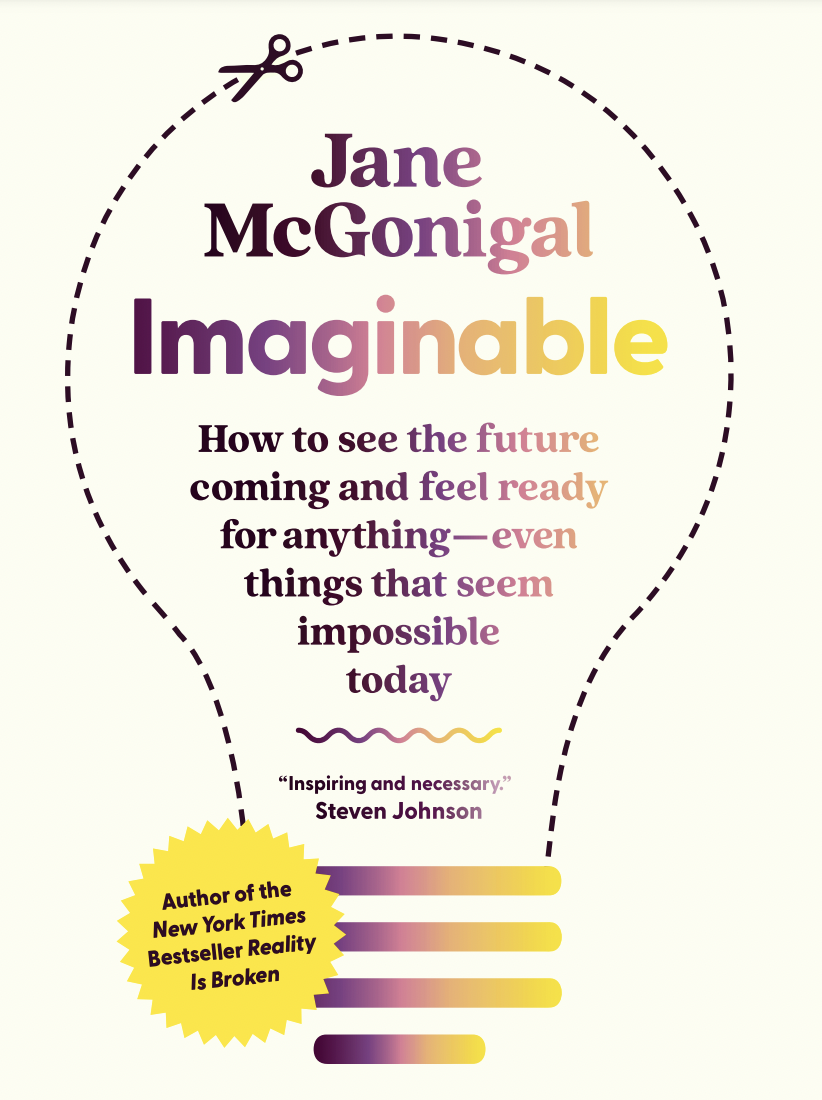
In Imaginable, Jane McGonigal draws on the latest scientific research in psychology and neuroscience to show us how to train our minds to think the unthinkable and imagine the unimaginable. She invites us to play with the provocative thought experiments and future simulations she’s designed exclusively for this book, with the goal to: 

  1. Build our collective imagination so that we can dive into the future and envision, in surprising detail, what our lives will look like ten years from now
  2. Develop the courage and vision to solve problems creatively
  3. Take actions and make decisions that will help shape the future we desire
  4. Access “urgent optimism,” an unstoppable force within each of us that activates our sense of agency

Imaginable teaches us to be fearless, resilient, and bold in realizing a world with possibilities we cannot yet imagine—until reading this transformative, inspiring, and necessary book.


In Imaginable: How to See the Future Coming and Feel Ready for Anything―Even Things That Seem Impossible Today, futurist and game designer Jane McGonigal presents a compelling case for the power of imagination in preparing for and shaping the future. Published in 2022, the book draws on McGonigal’s extensive experience in future forecasting and game design to offer readers practical tools and strategies for envisioning and adapting to potential future scenarios.

McGonigal’s central argument is that by actively imagining various future possibilities, we can better prepare ourselves mentally and emotionally for change, increase our resilience, and even influence the direction of future events. She contends that many seemingly “unimaginable” events are actually quite predictable if we learn to look for the right signals and think more expansively about potential outcomes.

The book is divided into three main sections:

  1. Why we need to imagine the unimaginable
  2. How to imagine the unimaginable
  3. What to do with our imagination

Throughout these sections, McGonigal introduces readers to various futuring techniques, including scenario planning, signal spotting, and her own “urgent optimism” approach. She also shares numerous examples of how these techniques have been applied in real-world situations, from pandemic preparedness to climate change adaptation.

Key Concepts and Takeaways

Urgent Optimism: McGonigal introduces this concept as a mindset that combines a sense of agency with hope for the future. By imagining potential challenges and opportunities, we can feel more motivated and capable of taking action in the present.

10-year Future Thinking: The author emphasizes the importance of thinking on a 10-year time scale, arguing that this timeframe is long enough to envision significant changes but short enough to feel personally relevant.

Scenario Planning: McGonigal details various methods for creating and exploring future scenarios, encouraging readers to consider both positive and negative possibilities.

Signal Spotting: The book teaches readers how to identify early indicators of future trends and potential disruptions, enhancing their ability to anticipate and prepare for change.

Collective Intelligence: McGonigal highlights the value of diverse perspectives and collaborative imagination in futuring exercises.

Simulations and Games: Drawing on her background in game design, the author illustrates how simulations and games can be powerful tools for exploring future scenarios and building adaptive skills.

Strengths of the Book

  • Accessibility: McGonigal’s writing style is engaging and accessible, making complex futuring concepts approachable for a general audience.
  • Practical Exercises: The book includes numerous exercises and thought experiments that readers can use to develop their own futuring skills.
  • Real-World Examples: McGonigal provides a wealth of case studies and examples that illustrate the practical applications of futuring techniques.
  • Interdisciplinary Approach: The author draws on insights from psychology, sociology, economics, and other fields to provide a well-rounded perspective on future thinking.
  • Optimistic Outlook: While acknowledging potential challenges and risks, the book maintains an overall optimistic tone that empowers readers to take an active role in shaping the future.

Potential Weaknesses

  • Bias Towards Technological Solutions: Some critics may argue that the book places too much emphasis on technological solutions to future challenges, potentially overlooking other important factors.
  • Western-Centric Perspective: While McGonigal does include some global examples, the book’s perspective is primarily rooted in Western, developed-world contexts.
  • Overwhelm Factor: The sheer number of potential future scenarios and techniques presented may be overwhelming for some readers, potentially leading to analysis paralysis rather than action.

Imaginable is a thought-provoking and empowering book that challenges readers to expand their thinking about the future. Jane McGonigal successfully demystifies the process of future forecasting and provides practical tools for individuals and organizations to enhance their adaptive capacity.

The book’s strengths lie in its accessible presentation of complex ideas, its wealth of practical exercises, and its optimistic yet grounded approach to future thinking. McGonigal’s expertise in game design and simulations adds a unique perspective to the field of futurism, offering innovative ways to engage with potential future scenarios.

While the book may at times feel overwhelmingly comprehensive or skew towards technological solutions, these minor drawbacks are outweighed by the valuable insights and actionable strategies it provides. “Imaginable” is particularly relevant in our rapidly changing world, where the ability to anticipate and adapt to new challenges is increasingly crucial.

For readers interested in personal development, organizational strategy, or simply expanding their cognitive horizons, Imaginable offers a compelling roadmap for navigating an uncertain future. By encouraging us to exercise our “imagination muscles,” McGonigal ultimately empowers us to become active participants in shaping the world of tomorrow.

Whether you’re a business leader, policy maker, educator, or simply an individual curious about what the future might hold, Imaginable provides valuable tools and perspectives for envisioning and preparing for the challenges and opportunities that lie ahead. In a world where change is the only constant, McGonigal’s work serves as a guide to not just surviving, but thriving in the face of uncertainty.


Part of a regular series on 27gen, entitled Wednesday Weekly Reader.

During my elementary school years one of the things I looked forward to the most was the delivery of “My Weekly Reader,” a weekly educational magazine designed for children and containing news-based current events.

It became a regular part of my love for reading, and helped develop my curiosity about the world around us.
The Laws of Connection: A Deep Dive into Human Relationships

Social connection is as essential for our health and happiness as a balanced diet and regular exercise. It reduces our risk of stroke, heart disease, and Alzheimer’s. It enhances our creativity and adds years to our life span. Yet many of us struggle to form strong and meaningful bonds – and the problem lies not with our personalities but with a series of cognitive biases that stop us from fulfilling our social potential.

In The Laws of Connection, award-winning science writer David Robson describes the psychological barriers that lead us to keep others at a distance and offers evidence-based strategies to overcome them.

Drawing on philosophy, neuroscience, and cutting-edge psychology, Robson introduces readers to new concepts such as the liking gap, the novelty penalty, the fast-friendship procedure, the beautiful mess effect, and the Japanese art of amae (a Japanese term used to describe acting like a spoiled child). Whether we are shy or confident, introvert or extrovert, we can all build deeper relationships. The Laws of Connection shows us how.


David Robson’s The Laws of Connection is a captivating exploration of the science behind human relationships. Drawing on a wealth of psychological research, Robson delves into the cognitive biases and social barriers that can hinder our ability to connect with others. The book offers a compelling argument that strong social connections are essential for our well-being, challenging the notion that our personality traits are fixed determinants of our social success.

At the heart of Robson’s argument is the idea that our thought processes and behaviors play a crucial role in shaping our relationships. He introduces various cognitive biases that can inadvertently sabotage our social interactions. For instance, the “liking gap” refers to our tendency to underestimate how much others like us, while the “novelty penalty” suggests that we may be less likely to form bonds with people who are too similar to us.

The book also explores the concept of the “beautiful mess effect,” which highlights the importance of embracing imperfections in our relationships. Rather than striving for idealized connections, Robson argues that it is often the messy, imperfect moments that strengthen our bonds.

In addition to cognitive biases, Robson discusses the social barriers that can hinder our ability to connect with others. These barriers include fear of rejection, lack of self-confidence, and cultural differences. The book provides practical strategies for overcoming these challenges and fostering deeper connections.

One of the key themes in The Laws of Connection is the power of intentional connection. Robson emphasizes that building strong relationships requires effort and conscious attention. He introduces techniques such as the “fast-friendship procedure” and the “disclosure reciprocity effect” to help readers forge deeper bonds with others.

The fast-friendship procedure involves asking a series of personal questions to create a sense of intimacy and connection. The disclosure reciprocity effect suggests that we are more likely to open up to others if they first share personal information with us.

Throughout the book, Robson provides compelling examples and anecdotes to illustrate his points. He draws on research from various fields, including psychology, sociology, and neuroscience, to support his arguments.

Here are Robson’s Laws of Connection:

  1. Be consistent in your treatment of others. Avoid becoming a stressful frenemy.
  2. Create a mural understanding with the people you met.
  3. Ignore superficial similarities and instead focus on your internal world, and the peculiar ways that your thoughts and feelings coincide. Trust that others, on average, will like you as much as you like them, and be prepared to practice your social skills to build your social confidence.
  4. Check your assumptions; engage in ‘perspective/getting rather than ‘perspective-taking’ to avoid egocentric thinking and misunderstandings.
  5. In conversation, demonstrate active attention, engage in self-disclosure, and avoid the novelty penalty, to build mutual understanding and contribute to the merging of our minds.
  6. Praise people generously, but be highly specific in your words of appreciation.
  7. Be open about your vulnerabilities, and value honesty over kindness (but practice both, if possible).
  8. Do not fear envy. Disclose your successes but be accurate in your statements and avoid comparing yourself to others. Enjoy ‘confelicity’.
  9. Ask for help when you need it, in the expectation that your pleas for support can build a stronger long-term bond.
  10. Offer emotional support to those in need, but do not force it upon them. Validate their feelings while providing an alternative perspective on their problems.
  11. Be civil and curious in disagreements; show interest in the other side’s viewpoint; share personal experiences; and translate your opinions into their moral language.
  12. For your wellbeing, choose forgiveness over spite. Look at the big picture in arguments. Ensure your apologies define the offense, take responsibility for your actions, and express regret. Have faith that people can change for the better.
  13. Reach out to the people who are missing in your life. Let them know that they are still a part of your thoughts.

Overall, The Laws of Connection is a thought-provoking and informative book that provides valuable insights into the science of human connection. It is a must-read for anyone interested in improving their relationships and understanding the psychological factors that influence our social interactions.

Beyond its practical applications, the book also offers a deeper understanding of the human condition. Robson’s exploration of the science of connection sheds light on the fundamental need for social connection and the ways in which we can cultivate meaningful relationships.

The Laws of Connection is a valuable resource for anyone seeking to improve their social lives and build stronger relationships. It offers practical strategies, thought-provoking insights, and a deeper understanding of the science behind human connection


Part of a regular series on 27gen, entitled Wednesday Weekly Reader.

During my elementary school years one of the things I looked forward to the most was the delivery of “My Weekly Reader,” a weekly educational magazine designed for children and containing news-based current events.

It became a regular part of my love for reading, and helped develop my curiosity about the world around us.

Connections that Heal: Exploring the Power of Social Health

Exercise. Eat a balanced diet. Go to therapy. Most wellness advice is focused on achieving and maintaining good physical and mental health. But Harvard-trained social scientist and pioneering social health expert Kasley Killam reveals that this approach is missing a vital component: human connection.

Relationships not only make us happier, but also are critical to our overall health and longevity. Research shows that people with a strong sense of belonging are 2.6 times more likely to report good or excellent health. Perhaps even more astonishingly, people who lack social support are up to 53% more likely to die from any cause. Yet social health has been overlooked and under-appreciated – until now.

Just as we exercise our physical muscles, we can strengthen our social muscles. Weaving together cutting-edge science, mindset shifts, and practical wisdom, Killam offers the first methodology for how to be socially healthy. An antidote to the loneliness epidemic and an inspiring manifesto for seeing wellbeing as not only physical and mental, but also social, The Art and Science of Connection is a handbook for thriving.


The Art and Science of Connection will transform the way you think about each interaction with a friend, family member, coworker, or neighbor, and give you the tools you need to live a more connected and healthy life – whether you are an introvert or extrovert, if you feel stretched thin, and no matter your age or background. Along the way, Killam will reveal how a university student, a newlywed, a working professional, and a retired widow overcame challenges to thrive through connection – and how you can, too.


In our quest for optimal health, we often focus on physical fitness and mental wellbeing. We diligently count our steps, monitor our sleep, eat nutritious foods, and practice mindfulness. While these practices are undoubtedly beneficial, they overlook a crucial component of our overall health: social connection. This often-neglected aspect, known as social health, is emerging as a vital factor in our longevity, happiness, and overall quality of life.

What is Social Health?

Social health refers to the dimension of our wellbeing that stems from our relationships and interactions with others. It encompasses our ability to form and maintain meaningful connections, feel supported and valued within our communities, and navigate social institutions effectively. Unlike physical and mental health, which have long been recognized as essential components of wellbeing, social health has remained largely under-explored and under-appreciated.

The Alarming Decline in Social Connections

Recent decades have witnessed a concerning trend in social health across many societies. In the United States, for instance:

  • The percentage of people with ten or more close friends has dropped by 20% over the past 30 years.
  • Time spent alone has increased by an average of 24 hours per month over the past two decades.
  • Participation in community activities has fallen by nearly 20% in the last ten years.
  • A 2019 national survey revealed that about half of adults felt that no one knew them well.

This trend isn’t limited to the US. Globally, hundreds of millions of adults go for weeks without speaking to family or friends, and a significant portion of the world’s population lacks anyone to turn to for help.

The Health Implications of Social Disconnection

The consequences of this social disconnection are far-reaching and severe. Research has shown that lack of social connection can:

  • Increase the risk of stroke by 32%
  • Raise the risk of dementia by 50%
  • Elevate the risk of early death by 29%

These statistics underscore the critical role that social connections play in our physical and mental health. In fact, strong social ties are as essential to our wellbeing as proper nutrition and regular exercise.

The Balance of Social Health

It’s important to note that social health isn’t just about quantity; quality matters too. An overwhelming amount of social interaction or unfulfilling connections can be equally detrimental. Many people struggle with finding the right balance, whether they’re introverts drained by excessive social obligations, extroverts spread too thin, or individuals grappling with the pressures of social media.

Recognizing the Crisis

The decline in social health, coupled with rising hate crimes, escalating polarization, and eroding trust between individuals, amounts to nothing less than a public health emergency. Recognizing this crisis, some governments and international organizations are taking action. The UK and Japan have appointed ministers for loneliness, while the World Health Organization has established a global Commission on Social Connection.

The Path Forward: Understanding and Improving Social Health

Author Kasley Killam has spent over a decade studying the concept of social health, building on the foundational work of scholar Robert D. Russell. In her book, The Art and Science of Connection, Killam offers a comprehensive exploration of social health and provides practical strategies for improvement.

The book is structured in three parts:

  1. Evaluating personal social health and understanding its importance
  2. Practical steps to enhance social health and navigate challenges
  3. Examining social health in various contexts, from neighborhoods to national policies

Killam’s work serves as both a guide for individuals seeking to improve their social wellbeing and a call to action for society to prioritize connection and community.

Practical Steps to Improve Social Health

While the concept of social health may seem abstract, there are concrete steps we can take to improve it:

  • Evaluate your current social connections and identify areas for improvement.
  • Make a conscious effort to maintain and deepen existing relationships.
  • Seek out new connections through community activities, shared interests, or volunteer work.
  • Practice active listening and empathy in your interactions.
  • Balance your social interactions with alone time for self-reflection and recharging.
  • Limit excessive or unfulfilling social media use in favor of more meaningful in-person interactions.
  • Address conflicts and misunderstandings promptly and constructively.
  • Cultivate a sense of belonging within your community.

A Call for a Social Health Movement

Killam’s book is more than just a self-help guide; it’s a manifesto for a movement centered on the practice of social health. The author argues that this concept should not be confined to academic discussions but should be embraced and experienced by everyone, woven into the fabric of our society.

By recognizing social health as an essential component of overall wellbeing, alongside physical and mental health, we can work towards creating a more connected, resilient, and healthy society. This shift in perspective has the potential to not only improve individual lives but also address broader societal issues such as loneliness, polarization, and community breakdown.

As we continue to navigate an increasingly complex and often isolating world, prioritizing our social health becomes more crucial than ever. By fostering meaningful connections, building supportive communities, and recognizing the profound impact of our social ties, we can unlock a powerful tool for enhancing our overall health, happiness, and longevity. It’s time to bring social health to the forefront of our personal and collective wellbeing strategies.


Part of a regular series on 27gen, entitled Wednesday Weekly Reader.

During my elementary school years one of the things I looked forward to the most was the delivery of “My Weekly Reader,” a weekly educational magazine designed for children and containing news-based current events.

It became a regular part of my love for reading, and helped develop my curiosity about the world around us.