It’s Time to Stop Setting Goals

They are too alive to die, and too dead to live.

This haunting observation of most people in the Western world was made by the Korean philosopher Byung-Chu Han.

We all have our own stories of trying to stay sane in the day and age of mobile phones, connected watches, a twenty-four-hour news cycle blaring from our devices, unceasing demands from family, church members, and our team, and …

Do you feel weary?

Do you feel burdened?

You’re not alone.

The most common answer to the question, “How are you?” is, “I’m good – just busy.”

That answer comes from everywhere, bridging gaps of gender, age, ethnicity, and class. Empty-nesters working from home are busy, even with their kids and grandkids spread across the country. New parents are busy, with a new mom headed back to work while the new dad begins the first week of parental leave. Even middle-schoolers are busy trying to juggle three different platforms of distance learning while helping around the home while trying to stay connected with their best friend in the neighborhood two streets over.

You feel over-worked, over-booked, and over-connected – how can you reclaim your health and wellness again?

THE QUICK SUMMARY – To Hell With the Hustle: Reclaiming Your Life in an Overworked, Overspent, and Overconnected World by Jefferson Bethke

Our culture makes constant demands of us: Do more. Accomplish more. Buy more. Post more. Be more.

In following these demands, we have indeed become more: More anxious. More tired. More hurt. More depressed. More frantic.

What we are doing isn’t working!

In a society where hustle is the expectation, busyness is the norm and information is king, we have forgotten the fundamentals that make us human, anchor our lives, and provide meaning.

Jefferson Bethke, New York Times bestselling author and popular YouTuber, has lived the hustle and knows we need to stop doing and start becoming.   

After reading this book, you will discover:

  • How to proactively set boundaries in your life
  • How to get comfortable with obscurity
  • The best way to push back against the demands of contemporary life
  • The importance of embracing silence and solitude
  • How to handle the stressors that life throws at us

Join Bethke as he discovers that the very things the world teaches us to avoid at all costs–silence, obscurity, solitude, and vulnerability–are the very things that can give us the meaning, and the richness we are truly looking for.

A SIMPLE SOLUTION

According to author Jefferson Bethke, after only a decade or two of living up to the unrealistic cultural expectations of our times, many of us turn around and realize we can’t find the meaning we thought we were striving for.

We’ve been hustling, but hustling toward an empty grave.

It’s as if millions of us are on a treadmill, believing we’re going somewhere when we’re actually going nowhere. All that work, energy, and effort – yet we’re running for nothing.

Only those who are anchored in a richer and deeper and more meaningful experience than the one our culture is currently offering won’t get sucked away.

I’ve began to understand that we are created for formation, not goal-setting.

Jefferson Bethke

In general, goals are usually about a finish line. Something you can reach for and then be done once you accomplish it. It’s about doing something.

Formations, on the other hand, aren’t about doing something but about being someone. One is usually about activity, while the other is about identity. 

Goals are linear and resemble a straight line. Formations look more like a circle, where you are constantly coming back to the same place to seek renewal and refreshment in a particular practice. One is about a result, the other is about a process.

Why does this distinction matter so much? I think because Scripture doesn’t talk much about goals. But it is deeply focused on our identity. On who we are becoming.

Are we becoming more like Jesus by the practices and formations we are doing?

Here’s a quick way to think about it. Traditional goals are like an arrow aiming for a bull’s-eye. Formations, through are less like a bull’s-eye and more like an arrow bent in a circle.

One is linear and final. Once is circular and forever.

One doesn’t really change you. One can transform your life.

Jefferson Bethke, To Hell With the Hustle: Reclaiming Your Life in an Overworked, Overspent, and Overconnected World

A NEXT STEP 

Author Jefferson Bethke says that we are becoming someone and something. We are being formed. We are an image that is reflecting.

Reflecting what?

Our society has long had a pattern of considering something new as invigorating and exciting, adopting it at full scale and with full embrace without questioning the consequences. Then, thirty or fifty years later, the negative impact begins to show, and regulations begin to pop up.

Consider your current use of social media platforms. Where do you find yourself in the following list?

  1. This is cool and exciting.
  2. The is actually the best thing ever created. How did people even live without it before?
  3. The is still the best thing ever, and I can’t imagine my life without it, but it seems to be hurting me also.
  4. It’s definitely hurting me and I probably need to live without it in some way.

If we are honest, many people would answer somewhere between “2” and “3” – and heading quickly toward “4.”

While this is not a diatribe or condemnation of social media, it is an accurate observation of how dangerous something like social media usage is to becoming more like Jesus.

Here’s a strategy suggested by Deep Work author Cal Newport to reducing some of the complexity in deciding whether a social media tool is useful to you in “being formed.”

The first step of this strategy is to identify the main high-level areas in your personal and professional life. When you’re done you should have a small number of areas for both the professional and personal areas of your life.

Once you’ve identified these areas, list for each the two or three most important activities that help you achieve that area of your life.

The final step in this strategy is to consider the social media tools you currently use. For each such tool, go through the key activities you identified and ask whether the use of the tool has a substantially positive impact, a substantially negative impact, or little impact on your regular and successful participation in the activity.

Now comes the important decision: Keep using this tool only if you concluded that it has substantial positive impacts and that these outweigh the negative impacts.


Part of a regular series on 27gen, entitled Wednesday Weekly Reader

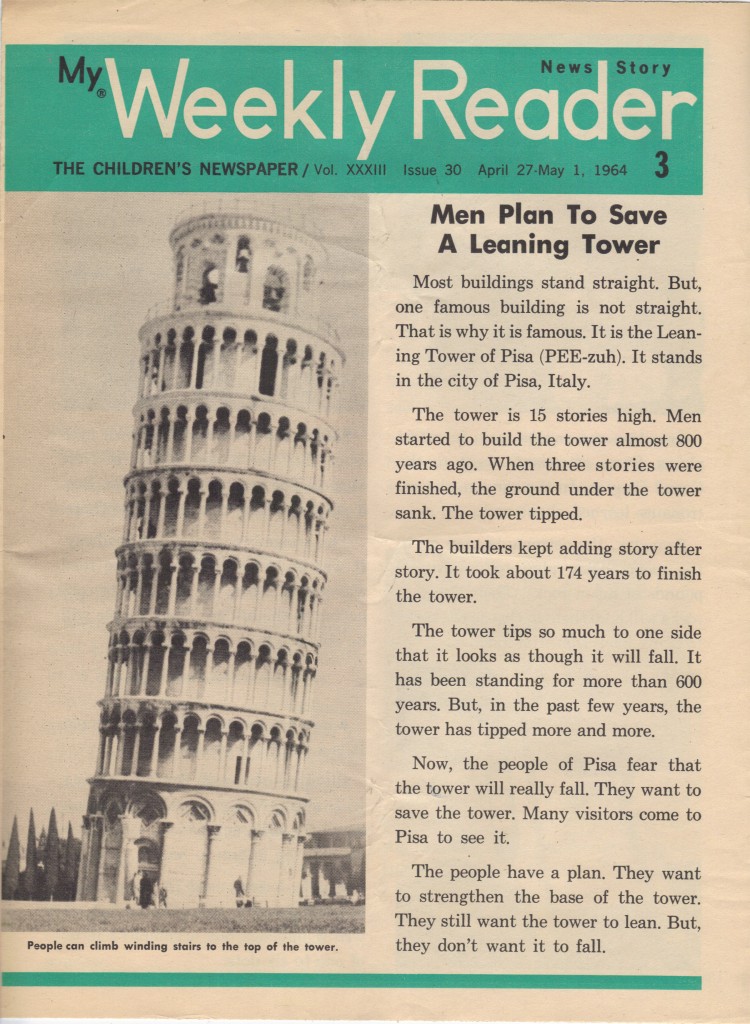
During my elementary school years one of the things I looked forward to the most was the delivery of “My Weekly Reader,” a weekly educational magazine designed for children and containing news-based, current events.

It became a regular part of my love for reading, and helped develop my curiosity about the world around us.

How to Lead with Vujá Dé

We are living in an age of disruption. According to Fast Company co-founder William C. Taylor, you can’t do big things anymore if you are content with doing things a little better than everyone else, or a little differently from how you’ve done them in the past. The most effective leaders don’t just rally their teams to outrace the “competition” or outpace prior results. They strive to redefine the terms of competition by embracing one-of-a-kind ideas in a world filled with copy-cat thinking. 

What sets truly innovative organizations apart often comes down to one simple question: What can we see that others cannot?

If you believe that what you see shapes how you change, then the question for change-minded leaders in times of disruption becomes: How do you look at your organization as if you are seeing it for the first time?

The question is not what you look at, but what you see. 

– Henry David Thoreau

When you learn to see with fresh eyes, you’re able to differentiate your organization from the competition (and your “competition” isn’t the church down the street). You’re able to change the way your organization sees all the different types of environments around it, and the way your others see your organization.

This mentality is the ability to keep shifting opinion and perception. We live in a world that is less black and white and more shades of gray world, not a black and while one. Seeing in this way means shifting your focus from objects or patterns that are in the foreground to those in the background. It means thinking of things that are usually assumed to be negative as positive, and vice versa. It can mean reversing assumptions about cause and effect, or what matters most versus least.

In a season filled with uncertainty, how can you cultivate a sense of confidence about what lies ahead?

SOLUTION #1: Seeing with Vujá Dé

THE QUICK SUMMARY

The Vujá Dé Moment is the reverse of the French saying – Déjà vu which means “already seen it.” Compelling thought catalyst, Simon T. Bailey defines The Vuja’ De’ Moment by saying “you’ve never seen it” but you intend to flip the status quo and create it. 

The Vuja’ dD’ Moment – Shift from Average to Brilliant, is a call to action that invites readers to shift their thinking, creating a disruption from the norm that ignites innovation, increasing accountability and profitability in life and business. 

The ultimate “GameChanger,” the Vujá Dé Moment equips you to shift from average to brilliant, guiding you to personal and professional success. By harnessing the power of Vuja’ De’ and regaining control of your inner steering wheel, you put yourself in gear and move forward. The book outlines substantive “how to” steps on how to ignite a fresh vision and turn a moment into a movement.

A SIMPLE SOLUTION

In so much uncertainty, how can you feel a sense of confidence about what lies ahead?

According to author Simon T. Bailey, it’s working towards Vujá Dé moments, moments that are about the future. It is about envisioning and believing in the possibilities – believing in the future so strongly that those possibilities become probable.

Vujá Dé is seeing – and living – your future as if it’s happening now.

Vujá Dé is a twist on conventional wisdom.

Vujá Dé implies seeing everything as if for the first time or better still, seeing everything everyone else sees, but understanding it differently.

Simon T. Bailey

There are ways to instill Vujá Dé in your life. Start by looking for the uncommon in the common, for the meaning behind the actions and the words, for the new in the old.

Vujá Dé is all about shifting. It’s when you have confirmation in your gut about making important changes without having to have external validation. It’s the ability to see and believe in your own potential and the potential of the team around you. Vujá dé is realizing there will come a time when you will have to break with the old to embrace the new, to let go of what is comfortable and convenient in order to grow and expand.

It’s about moving in a new direction without a map, GPS, or support from your Facebook friends. It’s doing the exact opposite of what you’ve always done in order to ignite a creative spark of new possibility. Because it’s a promise of greater things ahead. Vujá dé is the moment when everything clicks and you decide to resist the gravitational pull that keeps you from being brilliant.

Vujá Dé is the big idea. It’s the breakthrough. It’s the disruption from your normal routine. If you intend to live brilliantly, then disruption is your future. In fact, look at your calendar: disruption is your next appointment.

Simon T. Bailey, The Vujá Dé Moment! Shift from Average to Brilliant

A NEXT STEP

According to author Simon T. Bailey, the reality is everything around us – and everything we once knew – has shifted.

Bailey developed these questions to help you begin to see with Vujá Dé:

  • What could a personal shift do for you?
  • Are you holding on to what worked yesterday?
  • Are you suppressing your inner voice that is telling you to step out of your comfort zone?
  • What mysterious voice or vision are you ignoring?
  • Can you immerse yourself or your work in your relationships in a more significant way?

He sees Vujá Dé as the catalyst to your future and developed SHIFTER as a tool to get you there. Follow these seven actions, then schedule the personal retreat described below to get moving:

See differently

What does it mean to see differently? It means to change your mindset. When you begin to see things differently, the opportunities before you change. To shift, you must be willing to examine everything you do and ask yourself if you are creating the tomorrow you want. Even as you are reading this, stop and record as much of your day as you can. Shoot for blocks of at least 30 minutes and then capture the rest of your day.

Harness the power of You, Inc.

Draw confidence from your personal gifts and talents by doing a quarterly assessment of your career/business portfolio. Examine your personal productivity, relationship currency, and skills inventory. What do you do well, or have you been gifted with? Make a list of how this impacts how you see your organization. 

Ignite a fresh vision

Challenge yourself to try new ways of doing routine things. Challenge your team to live a fresh vision in their hearts and minds. If your vision is to stand the test of time, it will do so because each individual feels a significant sense of ownership. Collaborate together on a theme for the next three months of your work. Leverage the gifts and talents of each member to express that theme in unique and creative ways around the office. 

Fuel your mind

Take responsibility for your own growth and development and for the unleashing of your potential. Keep your intellectual tank full by committing to become a lifelong learner. Identify three books from three different genres that will challenge your growth – one biography, one marketplace leadership book, and one work of classic fiction.

Take the wheel

To change what’s outside, look inside to see who’s at the wheel. You hold the keys to your destiny. Instead of letting tomorrow come to you, go get it. Own your future – don’t let fear of failure and the changes that are happening at full speed around you keep you in neutral. In what area can you model faith-full obedience to God’s calling? What would you do if you knew you couldn’t fail?

Engage your gears

Sometimes, when we attempt to shift, we can either grind a gear or slip out of gear. Consider what will give you the energy and the discipline to get in gear and stay in gear. Make a list of what most motivates you to do great work. How can you use these things to encourage and focus your work?

Restart your engine

There are seasons in our lives which require us to restart our own internal batteries or restart our engines. If you are in a situation you can’t change, what you can change is how you choose to view it. Use your retreat time as a time of intense Bible study and prayer. Consider making fasting a part of this season of listening to the Lord.

Before moving on, which of the above seven actions are most needed in your life and ministry right now? Calendar a 3-4 hour personal retreat in the next 14 days to work on only one of the above actions. In that retreat, journal what God reveals through times of prayer and Bible study. Ask the questions from author Simon Bailey above and make a plan to enact what you are now seeing.


Part of a regular series on 27gen, entitled Wednesday Weekly Reader

During my elementary school years one of the things I looked forward to the most was the delivery of “My Weekly Reader,” a weekly educational magazine designed for children and containing news-based, current events.

It became a regular part of my love for reading, and helped develop my curiosity about the world around us.

Along with early and ongoing encouragement from my parents – especially my father – reading was established as a passion in my life that I was happy to continually learn from, share with my children, and watch them share with their children.

How to Practice the One-Minute Pause

They are too alive to die, and too dead to live.

This haunting observation of most people in the Western world was made by the Korean philosopher Byung-Chu Han.

We all have our own stories of trying to stay sane in the day and age of mobile phones, connected watches, a twenty-four-hour news cycle blaring from our devices, unceasing demands from family, church members, and our team, and …

Do you feel weary?

Do you feel burdened?

You’re not alone.

The most common answer to the question, “How are you?” is, “I’m good – just busy.”

That answer comes from everywhere, bridging gaps of gender, age, ethnicity, and class. Empty-nesters working from home are busy, even with their kids and grandkids spread across the country. New parents are busy, with a new mom headed back to work while the new dad begins the first week of parental leave. Even middle-schoolers are busy trying to juggle three different platforms of distance learning while helping around the home while trying to stay connected with their best friend in the neighborhood two streets over.

You feel over-worked, over-booked, and over-connected – how can you reclaim your health and wellness again?

THE QUICK SUMMARY – Get Your Life Back: Everyday Practices for a World Gone Mad by John Eldredge

In Get Your Life Back, New York Times bestselling author John Eldredge provides a practical, simple, and refreshing guide to taking your life back.After reading this book you will… 

  • Learn how to insert the One Minute Pause into your day
  • Begin practicing “benevolent detachment” and truly let it all go
  • Offer kindness toward yourself in the choices you make
  • Drink in the simple beauty available to you every day
  • Take realistic steps to unplug from technology overload

These simple practices and others are ready for the taking. You don’t need to abandon your life to get it back. Begin restoring your life here and now. Your soul will thank you for it.


A SIMPLE SOLUTION 

According to author John Eldredge, there’s a madness to our moment, and we need to name it for the lunacy it is.

We’re being swept into the gravitational field of a digital black hole that is sucking our lives from us.

Email felt so efficient when it replaced the letter; texting seemed like rocket fuel when it came along. But it didn’t make our lives more spacious; we simply had to keep up.

Now we’re living at the speed of the swipe and the “like,” moving so fast through our days that typing a single sentence feels cumbersome.

We’re losing our ability to focus and pay attention longer than a few moments. This isn’t just an intellectual problem; it’s a spiritual crisis.

God wants to come to us and restore our lives. But if our soul is not well, it’s almost impossible to receive Him.

The One Minute Pause is an absolute lifesaver: Simply take sixty seconds to be still and let everything go.

John Eldredge

As I enter the pause, I begin with release. I let it all go – the meetings, what I know is coming next, the fact I’m behind on everything, all of it. I simply let it go. I pray, Jesus – I give everyone and everything to you. I keep repeating it until I feel like I’m actually releasing and detaching. 

I give everything to you, God.

All I’m trying to accomplish right now is a little bit of soul-space. I’m not trying to fix anything or figure anything out. I’m not trying to relax everyone perfectly or permanently. That takes a level of maturity most of us haven’t found.

Them I ask for more of God: Jesus – I need more of you; fill me with more of you, God. Restore our union; fill me with your life.

I’ve seized the One Minute Pause as my sword against the madness. It sounds almost too simple to be a practice that brings me more of God, but it’s very effective. Because what it does is open up soul space, breathing room. And God is right there. Over time, the cumulative effect is even better. It’s reshaping the pace of my day. It’s training my soul to find God as an experience more common than rare.

John Eldredge, Get Your Life Back: Everyday Practices for a World Gone Mad

A NEXT STEP

According to author John Eldredge, the One Minute Pause can be used in many ways: for prayer or silence, to find your heart again, or to enjoy a moment of  beauty.

He suggests trying this for starters:

Pick one or two moments in your day when you know you are least likely to be interrupted. Maybe it’s the end of the day when you pull into your driveway. Don’t leap from the car; take a moment to pause. Turn off the engine, lean back, close your eyes, and just breathe. Try to let go of the day.

You can also set a phone alarm to remind you to take the One Minute Pause. Make sure the alarm notification is quiet and smooth, not jarring! You are not really sounding an alarm; you are inviting your soul to a gracious pause.

The One Minute Pause is the beginning of a new way of living, one simple practice that opens the door to many others.


Part of a regular series on 27gen, entitled Wednesday Weekly Reader

During my elementary school years one of the things I looked forward to the most was the delivery of “My Weekly Reader,” a weekly educational magazine designed for children and containing news-based, current events.

It became a regular part of my love for reading, and helped develop my curiosity about the world around us.

Along with early and ongoing encouragement from my parents – especially my father – reading was established as a passion in my life that I was happy to continually learn from, share with my children, and watch them share with their children.

Are You a Confident Leader?

In the months leading up to the year 2020, there was no shortage of social media posts, articles, sermons, and more talking about a “2020 Vision.” For many pastors, it was a dream topic to build a sermon series around – and many did.

A sampling of sermon topics in January 2020 would have shown an intentional look forward into a future of a year or two, or maybe even five years or more.

But when March 2020 rolled around, and the realities of the COVID-19 pandemic began to sink in, the lofty visions of 2020 evaporated. Church leaders around the country and the world began to shrink their vision from the lofty goals of just a few months earlier to, “What are we going to do this weekend?”

Fifteen months later, though that immediacy has lessened somewhat, only to be replaced with even more troubling questions like these:

  • How long is this pandemic going to last?
  • Will we be able to return to normal?
  • What if normal never returns?

In just a few weeks, future thoughts became present realties, and many leaders find themselves stuck there today.

Even when treading water in reality, leaders can get mired in a flood of information and answers about what to do next.

The world around us is evolving at dizzying speed. Tomorrow refuses to cooperate with our best-laid plans—the future routinely pulls the rug from underneath us.

Although people yearn for a return to “normal,” or try to predict the “new normal,” there is no such thing as normal. There is only change. Never-ending, constant change. Sometimes slow, sometimes fast, but constant nonetheless.

Answers to vexing problems are no longer a scarce commodity, and knowledge has never been cheaper. By the time we’ve figured out the facts – by the time Google, Alexa, or Siri can spit out the answer – the world has moved on.

Obviously, answers aren’t irrelevant. You must know some answers before you can begin asking the right questions. But the answers simply serve as a launch pad to discovery. They’re the beginning, not the end.

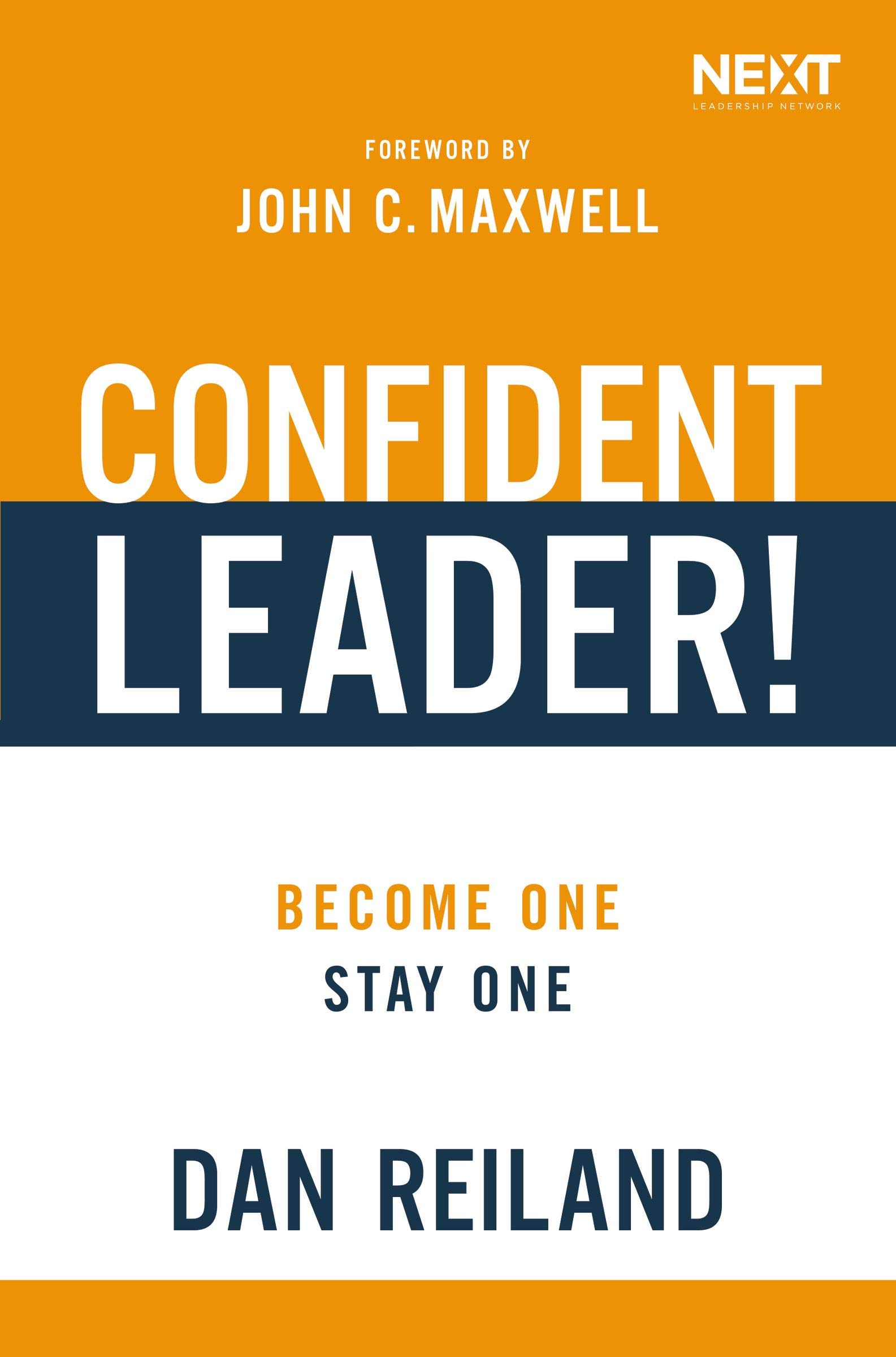
THE QUICK SUMMARY – Confident Leader! Become One, Stay One by Dan Reiland

You’re a good leader, but leadership is challenging and can rattle your confidence. Setbacks, challenges, and problems can cause you to second-guess yourself, doubt, or pull back. Your confidence may be stretched thin, but there is a way to strengthen it.

In Confident Leader!, Dan Reiland draws from his 39 years of leadership experience to share a practical, workable, and transformational process that results in your ability to become a more self-assured leader and achieve maximum success. Building unshakable confidence will positively impact your personal work performance, your belief in self, your support and approval from others, and your trust and reliance on God.

In this book you will learn how to:

  • Make deep foundational decisions about your core identity
  • Implement practical steps for deliberate character development
  • Incorporate daily, practical disciplines that transform your leadership ability

Together these essentials present a step-by-step plan to greater confidence, increased influence, less uncertainty, and more significant accomplishments. Learn how to become the most confident version of yourself today.

A SIMPLE SOLUTION

Leadership expert John Maxwell says that, in over fifty years of developing leaders, he has learned that very few leaders are naturally confident, and even less are consistently confident.

Author Dan Reiland believes that every leader struggles with confidence at some level.

On the other side of that struggle is cockiness at the worst, or over-confidence at best. Finding the right balance of confidence on this continuum is tricky, but essential in today’s climate.

The majority of leaders do not maintain a consistent quality of confidence. Their confidence goes up and down too easily, impacted by a wide variety of factors, such as personal performance, size of church, belief in self, support from others, approval from others, mistakes made, and trust and reliance on God.

Dan Reiland

There is a process, a road map, by which you can develop a more consistent and authentic confidence that will serve you as a leader.

Deep Foundational Decisions – There are specific decisions you can make that establish stability and certainty in knowing who you are and how you were designed to lead at your best. These five decisions set the foundation of your confidence.

  • Ownership – Take charge of your leadership confidence
  • Belief – Overcome the great confidence breakers
  • Identity – Value first who you are, then what you can do
  • Attentiveness – Hear and heed God’s voice
  • Soul – Embrace five core qualities of confident leaders

Deliberate Character Development – Your character is at the core of your confidence. Here are the five specific areas of your character that will strengthen your confidence.

  • Consistency – Lead yourself well before leading others
  • Authority – Accept it, develop it, and use it wisely
  • Adaptability – Look for ways to become the best version of you
  • Improvement – Aim for better, not bigger
  • Resilience – Handle pressure well and bounce back

Daily Practice Disciplines – There is a direct connection between competence and confidence. However, you can be competent, yet not confident. And you can be confident, yet not competent. Both are needed together. Here are five essentials that you will need to become and effective leader and increase your confidence.

  • Direction – Know where you are going and lead others
  • Focus – Stick to the game plan
  • Heart – Care genuinely about those you lead
  • Communication – Live and convey and optimistic message
  • Mentoring – Develop other leaders intentionally

Dan Reiland, Confident Leader! Become One, Stay One

A NEXT STEP

Select a single idea from each of the three areas listed above, one that you would like to improve on. In other words, your greatest area of challenge in each of the three areas.

Using a chart tablet, write the idea across the top of the page. 

Viewing this idea as your destination on a journey, imagine you are moving toward it but encounter roadblocks on your journey. These represent the primary obstacles to completing your journey.

Identify at least three roadblocks you are facing on your journey to obtaining the idea at the top of the chart tablet. Use the following questions to help you identify the roadblock:

  1. What do the roadblocks look like?
  2. Who put them there, or keeps them there?
  3. What does the road ahead look like, with the roadblock gone?

Develop a plan to dismantle the obstacles. When you do, you will have cleared the way to complete your journey to achieving the idea.

Repeat this with the other two ideas.


Part of a regular series on 27gen, entitled Wednesday Weekly Reader

During my elementary school years one of the things I looked forward to the most was the delivery of “My Weekly Reader,” a weekly educational magazine designed for children and containing news-based, current events.

It became a regular part of my love for reading, and helped develop my curiosity about the world around us.

Along with early and ongoing encouragement from my parents – especially my father – reading was established as a passion in my life that I was happy to continually learn from, share with my children, and watch them share with their children.

How to Practice Improv Leadership to Become a Better Leader

It’s easy to talk about enhancing performance, improving efficiency and being a more influential leader. So why don’t we do it more?

Maybe it is because leadership books often feel stale. It’s often a same-idea, different-author experience. Leadership is a set of abilities, and it can be learned and improved on a regular basis. But we have to seek that improvement.

Does boredom keep you from scheduling time on a regular basis to grow your leadership skills?

THE QUICK SUMMARY

Anyone who’s learned the basics of an instrument can follow a chord chart or play from sheet music, but only musicians who have carefully developed their talent can improvise. Instead of being limited to the notes on the page, great improvisers draw on the theory and techniques they’ve learned in the past to create something original in the present.

The same is true of great leaders. Anyone can read a few books and apply the lessons, but only the best leaders can bring out the best in any person, in any situation. These improvisational leaders understand the key principles of connecting, coaching, and communicating and use these ideas to build strong teams.

In Improv Leadership, Stan L. Endicott and David A. Miller share five leadership competencies which allow IMPROV leaders to initiate powerful conversations, create memorable moments, and craft personal coaching strategies that help people grow. Improv Leadership cultivates teams of people who love their work (and each other), who perform at a high level, and who stop the disruptive carousel of staff turnover.

Stan L. Endicott and David A. Miller have worked together to identify the overarching competencies of effective leadership and develop concrete tools to help every reader become a leader who understands how to grow teams one moment and one relationship at a time. The five competencies of IMPROV Leadership are not rigid sequential steps, nor do they apply only to specific industries or fields. Instead, this book will meet the felt need for leadership growth with “evergreen” principles that can be successfully introduced into any situation.

You can’t predict every challenge you’ll face. There’s no playbook that covers every decision. But with practice in Improv Leadership you can lead well in every situation.


A SIMPLE SOLUTION 

According to authors Stan Endicott and David Miller, improv is not making something up on the spot. Improv is bringing together many basic, well-known elements to form a complex whole that fits with the moment.

Your first thought when you hear “improv” may be in terms of music, but did you ever think that everyone improvises hundreds of times a day? It is called language.

The simplest, most routine sentence we utter rests on thousands of hours of experience learning words, grammar, and syntax. It comes by a little instruction and a lot of trial and error.

As a leader, your words have power with others. We have more responsibility for what happens and does not happen as a result of what we say.

No matter what problem you might encounter in your organization, you have a better chance of navigating it successfully with IMPOV leadership.

Stan Endicott and David Miller

The five leadership competencies of IMPROV leadership are:

Story Mining – Thoughtfully uncovering a person’s story and letting it shape the way you lead them. It is not about making people better. It is about making people known.

Precision Praising – Carefully crafting praise to inspire, motivate and even course-correct your team. It refers to the right words of affirmation given to the right person at the right place and time.

Metaphor Cementing – Using concrete illustrations to “cement” an idea in someone’s mind.

Lobbing Forward – Creatively challenging people to look beyond today to what might be in the future.

Going North – Using indirect influence to redirect a person’s perspective.

Stan Endicott and David Miller, with Cory Hartman, Improv Leadership

A NEXT STEP

Use the following ideas and exercises by the authors to begin practicing the five leadership competencies of IMPROV leadership.

Story Mining

Answer the following for each person who reports to you directly.

  1. What are your team member’s children’s names? Grandchildren’s? (For bonus points, how old are they, or what grade are they in?)
  2. Where and how did your team member meet his/her spouse?
  3. Where did your team member grow up? How often do they go back there?
  4. Where else has your team member lived that had a significant impact on their life story?
  5. What is your team member’s most prized possession?
  6. What (outside of work) does your team member enjoy doing?
  7. What is your team member’s idea of a great vacation?

How did you do?

Precision Praising

Think about a time when someone praised you such that it changed the course of your story. With the help of the tool below, think about what was going on that made that moment of pride impactive, and look for clues of how you can create a similar moment for the people on your team.

  1. What precisely were you praised for? What were the details and specifics of the praise?
  2. How well did the person know you at the time? What was the scope and depth of your relationship with the person who praised you?
  3. Was there something unique about the timing of the praise? If so, what?
  4. Was there something special about the context or location of the praise? If so, what?
  5. Did anyone else hear the praise? If so, how did the presence of others influence the dynamics of the praise?
  6. What was the immediate impact of the praise in your life?
  7. How often have you remembered that moment in your life? What has been the long-term impact?
  8. Do you think the person would be surprised that you are talking about their praise now? Why or why not?

Metaphor Cementing

The greatest communicators use metaphors as a painter uses a brush. If we as leaders want to touch our people with a message that they cannot misunderstand and cannot ignore, we must learn to use the tool too.

As you think through the metaphors you are going to use in your next meeting, presentation, or one-on-one with a team member, use these three guardrails to stay inside of and make the most of those opportunities.

  1. Stand on Common Ground – Use a metaphor that both you and your audience understand.
  2. Line Up Your Shot – Make sure you have your words just right.
  3. Don’t Paint a Picture; Build a Gallery – Use a variety of metaphors over time so as to work the same concept from different angles.

Lobbing Forward

Committing to practice Lobbing Forward initiates a change in the leader before there is a change in the people being led.

  1. Lobbing Forward requires a leader to be humble.
  2. An established pattern of Precision Praising sets up Lobbing Forward well.
  3. You have to know your people well.
  4. Lobbing Forward is more often done in private.
  5. Use tried-and-true word choices.
  6. You can Lob Forward with entire teams as well as individuals.

Going North

Here are five fundamentals for Going North:

  1. Reveal common ground.
  2. Surprise with a gift.
  3. Disrupt the setting.
  4. Teach using story.
  5. Create a shared experience. 

Part of a regular series on 27gen, entitled Wednesday Weekly Reader

During my elementary school years one of the things I looked forward to the most was the delivery of “My Weekly Reader,” a weekly educational magazine designed for children and containing news-based, current events.

It became a regular part of my love for reading, and helped develop my curiosity about the world around us.
Along with early and ongoing encouragement from my parents – especially my father – reading was established as a passion in my life that I was happy to continually learn from, share with my children, and watch them share with their children.

How Clarity Helps You Move from Present Realities to Future Focus

In the months leading up to the year 2020, there was no shortage of social media posts, articles, sermons, and more talking about a “2020 Vision.” For many pastors, it was a dream topic to build a sermon series around – and many did.

A sampling of sermon topics in January 2020 would have shown an intentional look forward into a future of a year or two, or maybe even five years or more.

But when March 2020 rolled around, and the realities of the COVID-19 pandemic began to sink in, the lofty visions of 2020 evaporated. Church leaders around the country and the world began to shrink their vision from the lofty goals of just a few months earlier to, “What are we going to do this weekend?”

Fifteen months later, though that immediacy has lessened somewhat, only to be replaced with even more troubling questions like these:

  • How long is this pandemic going to last?
  • Will we be able to return to normal?
  • What if normal never returns?

In just a few weeks, future thoughts became present realties, and many leaders find themselves stuck there today.

Even when treading water in reality, leaders can get mired in a flood of information and answers about what to do next.

The world around us is evolving at dizzying speed. Tomorrow refuses to cooperate with our best-laid plans—the future routinely pulls the rug from underneath us.

Although people yearn for a return to “normal,” or try to predict the “new normal,” there is no such thing as normal. There is only change. Never-ending, constant change. Sometimes slow, sometimes fast, but constant nonetheless.

Answers to vexing problems are no longer a scarce commodity, and knowledge has never been cheaper. By the time we’ve figured out the facts – by the time Google, Alexa, or Siri can spit out the answer – the world has moved on.

Obviously, answers aren’t irrelevant. You must know some answers before you can begin asking the right questions. But the answers simply serve as a launch pad to discovery. They’re the beginning, not the end.

Our ability to make the most out of uncertainty is what creates the most potential value. We should be fueled not by a desire for a quick catharsis but by intrigue. Where certainty ends, progress begins.

Ozan Varol

THE QUICK SUMMARY – Full-Spectrum Thinking by Bob Johansen

The future will get even more perplexing over the next decade, and we are not ready. The dilemma is that we’re restricted by rigid categorical thinking that freezes people and organizations in neatly defined boxes that often are inaccurate or obsolete. Categories lead us toward certainty but away from clarity, and categorical thinking moves us away from understanding the bigger picture. Sticking with this old way of thinking and seeing isn’t just foolish, it’s dangerous.

Full-spectrum thinking is the ability to seek patterns and clarity outside, across, beyond, or maybe even without any boxes or categories while resisting false certainty and simplistic binary choices. It reveals our commonalities that are hidden in plain view.

Bob Johansen lays out the core concepts of full-spectrum thinking and reveals the role that digital media – including gameful engagement, big-data analytics, visualization, blockchain, and machine learning – will play in facilitating and enhancing it. He offers examples of broader spectrums and new applications in a wide range of areas that will become possible first, then mandatory. This visionary book provides powerful ways to make sense of new opportunities and see the world as it really is.

A SIMPLE SOLUTION

According to author Bob Johansen, in a future loaded with dilemmas, disruption will be rampant, and clarity will be scarce. In his book, The New Leadership Literacies, Johansen wrote that the disruptions of the next decade will be beyond what many people can cope with.

Written in 2017, his words are a clarion call for leaders today. Leaders in 2021, in the midst of the ongoing pandemic, will need to provide enough clarity to make disruption tolerable – even motivational. They will also need to communicate realistic hope through their own stories of clarity.

The best way to lead in a disruptive world is to be very clear where you’re going, tell a great story about it, and then be very flexible about how you bring that future to life.

Clarity emerges in the space between insight and action. Clarity is the ability to see through messes and contradictions to a future that others cannot yet see.

When facing a highly uncertain future, you need to use strategic foresight to think like this:

Now – FUTURE – Next

It is completely appropriate to spend most of your time on the Now, the Action. That is where your organization is, and where you should focus. Incremental innovation is great, as long as it keeps getting results. If you invest in Future – not just Next – you will be able to achieve much greater clarity. Clarity emerges in the space between insight and action.

The future is not always incremental, and it is often disruptive. Trends are patterns of change you can anticipate with confidence, but disruptions are breaks in the pattern of change. Looking long can help you get a better view of where things are going.

Bob Johansen, Full-Spectrum Thinking

A NEXT STEP

When your team is stuck and can’t decide on moving forward, try the following exercise to evaluate ideas according to their level of innovation, their desirability, and feasibility.

  1. Write the idea or decision to be made on a chart tablet, and divide your team into three groups. Here’s the kicker: As leader of the team, try your best to place members of your team into groups that would not be their first choice. Give them 30 minutes to do their group work.
  2. The first group evaluates innovation – is the idea new? The group should evaluate the idea as:
    1. Disruptively new (might cause major consequences)
    2. Totally new (people might become familiar without major consequences)
    3. Improvement (improves something in a way people haven’t noticed before)
  3. The second group evaluates the desirability. Do people want this idea? What kind of needs are fulfilled? Evaluate the ideas as:
    1. Proof of need and desire – there is evidence of need and desire
    2. Assumed need and desire – there are high chances of need and desire
    3. Unknown need and desire
  4. The third group will evaluate the feasibility. How will the idea be developed? Evaluate the idea as:
    1. Highly feasible
    2. Moderately feasible
    3. Not feasible
  5. At the conclusion of the group discussion period, bring everyone together and have each group report the highlights of their discussion, listing them on the chart tablet in the three areas of innovation, desirability, and feasibility.
  6. Utilize the newly discovered information to move forward with your idea or action.

The above exercise was adapted from 75 Tools for Creative Thinking, Booreiland


Part of a regular series on 27gen, entitled Wednesday Weekly Reader

During my elementary school years one of the things I looked forward to the most was the delivery of “My Weekly Reader,” a weekly educational magazine designed for children and containing news-based, current events.

It became a regular part of my love for reading, and helped develop my curiosity about the world around us.
Along with early and ongoing encouragement from my parents – especially my father – reading was established as a passion in my life that I was happy to continually learn from, share with my children, and watch them share with their children.

How to Build Your Leadership Dream

It’s easy to talk about enhancing performance, improving efficiency and being a more influential leader. So why don’t we do it more?

Maybe it is because leadership books often feel stale. It’s often a same-idea, different-author experience. Leadership is a set of abilities, and it can be learned and improved on a regular basis. But we have to seek that improvement.

Does boredom keep you from scheduling time on a regular basis to grow your leadership skills?

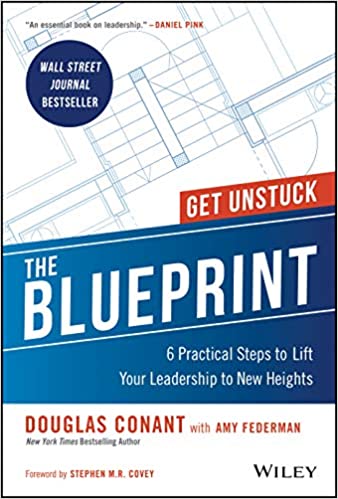
THE QUICK SUMMARY – The Blueprint: 6 Practical Steps to Lift Your Leadership to New Heights by Douglas Conant with Amy Federman

In 1984, Doug Conant was fired without warning and with barely an explanation. He felt hopeless and stuck but, surprisingly, this defeating turn of events turned out to be the best thing that ever happened to him. Doug began to consider what might be holding him back from realizing his potential, fulfilling his dreams, and making a bigger impact on the world around him

Embarking on a journey of self-reflection and discovery, he forged a path to revolutionize his leadership and transform his career trajectory. Ultimately, Doug was able to condense his remarkable leadership story into six practical steps. It wasn’t until Doug worked through these six steps that he was able to lift his leadership to heights that ultimately brought him career success, joy, and fulfillment.

In The Blueprint, part leadership manifesto, part practical manual, Doug teaches leaders how to work through the same six steps that he used to transform his journey. The six steps are manageable and incremental, designed to fit practically within the pace of busy modern life. Knowing how daunting the prospect of change can be, Doug arms readers with exercises and practices to realistically bring their foundation to life in every situation. Now, today’s leaders who feel stuck and overwhelmed finally have a blueprint for lifting their leadership to make meaningful change in their organizations and in the world.

A SIMPLE SOLUTION

The work of personal leadership is hard, inner work. And it isn’t just for those who want to lead people and teams; it’s for all who want to lead a life of meaning and purpose – a life that earns the trust of others.

Becoming an effective leader who lifts your organization to new heights may seem challenging, but it doesn’t need to be complicated. Strong leadership is rooted in basic principles. No matter the specifics of the organizations you may work for throughout your career, the essential foundations you must build will remain constant.

The tough problems organizations face today can best be solved by wise, principled leaders built on solid foundations.

The blueprint is a tool for bringing to life the dreams of leaders. You’re not manufacturing a building; you will be manifesting your leadership dreams.

Douglas Conant

To build your foundation, and get where you want to go, there are six steps.

Step 1 – Envision: Reach High

First, you have to set the intention to do better and Envision what success looks like to you – to reach high. It is in this sep that you will take your fist crack at articulating your Leadership Purpose.

Step 2 – Reflect: Dig Deep

Next, you will Reflect on our experiences to uncover your leadership beliefs, to dig deep into what makes you, you; in this step, you will uncover the life lessons that anchor your leadership, and develop a deeper understanding of your unique personality, motivations, temperament, and skill set.

Step 3 – Study: Lay the Groundwork

In the third step, you will Study, to fill in all the cracks from your dig, laying the groundwork with all the learnings and insights from the world that exists beyond your own personal experiences.

Step 4 – Plan: Design

Using design thinking techniques, you get to conceive your Plan – an exquisite design for the exact Leadership Model you envision, derived from your Leadership Purpose and your Leadership Beliefs.

Step 5 – Practice: Build

In this step you will build Practice into your change process. You’ll brainstorm small steps you can take – little, actionable practices – that you can begin to fold into your habits.

Step 6 – Improve: Reinforce

Finally, you Improve, continually learning from what you did right, and what you could have done better, reinforcing the strength of your Foundation in perpetuity.

Douglas Conant with Amy Federman, The Blueprint: 6 Practical Steps to Lift Your Leadership to New Heights

A NEXT STEP

Use the following ideas, suggestions, and exercises by author Douglas Conant to help begin the process of building a solid foundation for your leadership dream.

Envision

  • Given your unique purpose and motivations, what do you want your future to look like? If there were not limitations, what would you want to do? What is possible?

Reflect

  • Develop a leadership vocabulary which will ultimately help you communicate your vision to others and bring your dreams to life in your leadership model. It will also help you articulate the traits you admire in others.

Study

  • Develop a list of five to ten of the top practices you’ve observed in the best leaders you’ve known or studied. These “best practices” will help connect the reflection you have done so far to upcoming actions.

Plan

  • Create a visual model to anchor your thinking and express the unique approach of your leadership model. This will provide a way to grasp something seemingly complex in a simple and easy-to-understand way.

Practice

  • Extracting specific actions from your recollections, write down one distinct and actionable practice for each area of your evolving leadership model.

Improve

  • Taking a look at the work you have done so far, think about three things you care deeply about and that you will be able to pursue with a joy that comes from doing the things you are good at. Thinking back to the first step, Envision, what did your boldest dreams of success look like. What do you have to improve to get there?

Part of a regular series on 27gen, entitled Wednesday Weekly Reader

During my elementary school years one of the things I looked forward to the most was the delivery of “My Weekly Reader,” a weekly educational magazine designed for children and containing news-based, current events.

It became a regular part of my love for reading, and helped develop my curiosity about the world around us.

Along with early and ongoing encouragement from my parents – especially my father – reading was established as a passion in my life that I was happy to continually learn from, share with my children, and watch them share with their children.

Do You Understand the Nature of YOUR Crisis?

There are few certainties in ministry today. Unfortunately, one of them is the inevitability of a potential crisis occurring in our country, your community or even your church that could have a major effect on your congregation and even your reputation.

A crisis is an event, precipitated by a specific incident, natural or man-made, that attracts critical media attention and lasts for a definite period of time. Certainly, the COVID-19 pandemic qualifies.

But life is full of other types of disruptions, some seemingly minor in nature and others truly of a global scale. In between those two bookends are countless events that require leaders to be at the forefront in communicating to their organizations, the community, and the greater public.

When your church finds itself in the midst of a crisis, the ripple effects can disrupt lives and operations for the foreseeable future if public opinion is not properly addressed and stewarded.

Skillfully managing the perception of the crisis can determine the difference between an organization’s life or death. In the pitched battle between perception and reality, perception always wins.

There is a solution – you can prepare for the inevitable crisis by proactive actions that will help in preempting potential crises or help make them shorter in duration. Finding yourself in a crisis situation is bad; not being prepared when a crisis occurs is devastatingly worse.

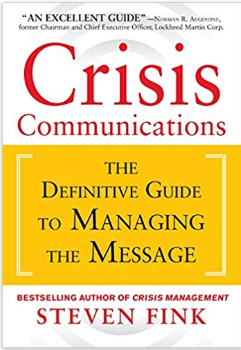
THE QUICK SUMMARY – Crisis Communications: The Definitive Guide to Managing the Message by Steven Fink

Skillfully managing the perception of the crisis determines the difference between a company’s life or death. Because in the pitched battle between perception and reality, perception always wins.

The inevitability of a crisis having a potentially major effect on your business and your reputation – at some point – is almost a guarantee. When your company finds itself in the midst of a crisis, the ripple effects can disrupt lives and business for the foreseeable future if public opinion is not properly shaped and managed.

Fortunately, there is a solution. Crisis communications and crisis management legend Steven Fink gives you everything you need to prepare for the inevitable—whether it’s in the form of human error, industrial accidents, criminal behavior, or natural disasters.

In this groundbreaking guide, Fink provides a complete toolkit for ensuring smooth communications and lasting business success through any crisis. Crisis Communications offers proactive and preventive methods for preempting potential crises. The book reveals proven strategies for recognizing and averting damaging crisis communications issues before it’s too late. The book also offers ways to deal with mainstream and social media, use them to your advantage, and neutralize and turn around a hostile media environment.

A SIMPLE SOLUTION

According to author Steven Fink, a good working definition of a crisis is any situation, that if left unattended, has the potential to:

  • Escalate the intensity
  • Damage the reputation or positive public opinion of the organization or its leadership
  • Interfere with the normal operations
  • Fall under close government or media scrutiny
  • Impact the organization’s financial well-being

Using the five-step list above as a pragmatic guide, the responsible leader will realize that what may not qualify as a minor crisis in one situation may actually threaten the existence of the organization in another.

So the question becomes, do you know what YOUR crisis is?

Before you can even begin to think about communicating during a crisis, there are three absolute imperatives that must be undertaken in any crisis situation.

Steven Fink

Identify your crisis

Isolate your crisis

Manage your crisis

IDENTIFY

How hard can it be to identify a crisis when it’s happening to your organization? Actually, it’s harder than you might think. Focus on identifying your crisis – the one with which you have to deal, the one over which you have some measure of control. Try to avoid distracting scenarios, of which there will be many.

In a crisis, especially a crisis with competing interests, the only person who is looking out for your organization’s reputation is you.

ISOLATE

Isolation might very well mean designating a crisis management team to deal exclusively with the crisis, with its members temporarily delegating their normal duties and responsibilities to others for the duration of the crisis. Ideally, this team would be isolated from the rest of the company, and hopefully, keep quiet about its progress until the appropriate time.

MANAGE

If you have properly identified and then successfully isolated the crisis, the actual management of the crisis is the easiest part (assuming you are a good manager to begin with). That’s because you will now be laser-focused on the specific task at hand, and once you’ve cleared away the distracting brush, your mission becomes crystal clear. When that occurs, making vigilant decisions – the epitome of good crisis management – is well within your grasp.

Steven Fink, Crisis Communications: The Definitive Guide to Managing the Message

A NEXT STEP 

While the COVID-19 crisis is certainly on everyone’s mind, it is truly a once-in-a-lifetime event, and “understanding” it in terms of the discussion above is beyond the scope of this exercise.

However, your organization likely has faced a crisis within the last year – a physical event, a natural disaster, or a personnel issue. No matter what the crisis, it was a disruption to your normal activities.

Using a past crisis, have your team walk through the three steps listed above. You are actually doing a post-mortem or after-action report: using a past event, evaluated through a new lens (the three steps above) to help prepare you for the next time you have a crisis.

Taking note of any actions you should have done, but didn’t, develop an action plan to make sure you do it the next time.


Part of a regular series on 27gen, entitled Wednesday Weekly Reader

During my elementary school years one of the things I looked forward to the most was the delivery of “My Weekly Reader,” a weekly educational magazine designed for children and containing news-based, current events.

It became a regular part of my love for reading, and helped develop my curiosity about the world around us.

Along with early and ongoing encouragement from my parents – especially my father – reading was established as a passion in my life that I was happy to continually learn from, share with my children, and watch them share with their children.

Reading keeps our minds alive and growing.

Look Back and Learn: Investing in Wisdom Equity

In researching and working on some leadership development material for an ongoing writing project, I came across the following:

Christianity is a religion of change. Jesus’ call in Mark 1:15 (the kingdom of God is at hand) was a call to change – change of mind and heart, of conduct and character, of self and society. By its very nature Christianity is a religion for a changing world and has always had its greatest opportunity during times of upheaval.

The Christian leader has no option; he must face a changing world. If the leader is to render maximum service, he must both adjust himself to the phenomena of change and address himself passionately to the business of producing and guiding change. Here are some elements that constitute the changed world in which the Christian leader today is called to fulfill his ministry.

Changed world outlook

Changed economic philosophy

Changed social consciousness

Changed family life

Changed community conditions

Changed moral standards

Changed religious viewpoints

Changed conceptions of the church

Changed media for molding public opinion

Changed demands made upon the leader

Pretty good list, right? Dead on. Taken from today’s headlines.

Nope.

courtesy the Southern Baptist Theological Seminary

courtesy the Southern Baptist Theological Seminary

The author was Gaines S. Dobbins, distinguished professor of Religious Education at my alma mater, The Southern Baptist Theological Seminary, in Louisville KY.

Written in 1947.

As the introduction to the book “Building Better Churches: A Guide to Pastoral Ministry.”

Dr. Dobbins retired before I was born, but while in seminary in the early eighties I had the privilege of sitting under a couple of professors who were students of Dr. Dobbins and spoke of his great influence on their development and career. There is a chair named for him at SBTS, and of course I recognized his name and influence. When I came across this book in a used bookstore, I bought it on impulse. After flipping through it, I realized it was a treasure of leadership wisdom.

At Auxano, we talk about a concept called “vision equity.” It’s realizing that the history of a church is a rich resource for helping rediscover what kinds of vision language past generations have used. That language is very useful for anticipating and illustrating God’s better intermediate future.

As I read Dr. Dobbin’s book, I think there is also a concept called “wisdom equity.” It’s realizing that there have been some great leaders and deep thinkers over the past decades and centuries whose collective wisdom would be a great place to start as we struggle with the new realities that face us every day.

It’s why I love history – I see it not as an anchor that holds us to the past, but as a foundation to build a bridge to the future.

History is not just books and information stored about the past. It can also be found in living beings – those around us, family and friends, who have lived through events and learned lessons my generation – and the ones following me – need so desperately to learn.

Go ahead – look back and learn.

How to Grow Mentally as a Leader

It doesn’t matter if you pastor a church, work in a high-pressure corporate environment, sell real estate, or toil as a full-time parent: the pace of our information-driven, globally-connected, twenty-first-century society forces us to accelerate down the tracks of modern life – and many of us feel dangerously close to flying off the rails.

We are multitasking ourselves into oblivion just to keep up. We push, we strive, and we overcome!

And then we collapse.

Can we keep this up?

Since the outward forces that exert stress on us are unlikely to disappear, our only choice is to look inward at ways we can better adapt to our environment.

Is it possible that we can “grow” to deal with the pressures we find ourselves in?

There is a short but powerful scripture passage that can give us guidelines in this area. Luke 2:52 says, “Jesus grew in wisdom and stature, and in favor with God and men.” (NIV)

THE QUICK SUMMARY – Unstoppable You by Patricia A. McLagan

The ticket to a successful and fulfilling life is a significant upgrade to everyone’s ability to learn. Visionary teacher and lifelong learner Patricia McLagan views learning ability as software for processing daily life. And like all software, learn­ing software requires upgrades – and regular reboots!

In Unstoppable You: Adopt the New Learning 4.0 Mindset and Change Your Life, McLagan shares her method for keeping learning powers sharp, ensuring that we can continuously advance and adapt in a nonstop world. We’re born with basic programming, which is learning 1.0. We then evolve and upgrade as we make our way through the education system in learning 2.0, and we start to self-manage how we learn as we integrate our diverse experi­ences and master skills in learning 3.0. That brings us to learning 4.0 – learning mastery. This final upgrade equips us with survival skills for the 21st century – skills essential to meeting our goals in a world that’s always in motion.

Discover McLagan’s seven practices for effective lifelong learning – from hearing and heeding calls to learn, to taking steps to translate new skills into action. Unstoppable You also includes a complete toolkit of supporting tem­plates, guides, and tips.

A SIMPLE SOLUTION

You began an amazing learning journey the day you were born, and it continues to this day. While you may associate “learning” with your younger self, learning continues all throughout your life – or at least, it should.

In today’s fast-changing world, your learning skills need to be constantly “upgraded” in order to survive and thrive. If you think of how you learn as “software” you use in your daily life, you would recognize the need for upgrades just like the software and applications for your devices.

Imagine three learning software upgrades that have occurred so far in human history.

  • Learning 1.0 is the basic program you were born with. It consisted primarily of trial and error learning by watching and imitating others.
  • Learning 2.0 is the upgrade that took place in your school years. It consisted of learning how to study and directed learning toward goals others set.
  • Learning 3.0 supports your continued growth in multiple areas of life by self-managed learning and helping skills.

Learning 4.0 is a necessary upgrade for surviving and thriving in our nonstop world. It is based on new knowledge of how our brains work, the new dynamics of a nonstop world, and an exploding information field.

Are you ready to become a 4.0 learner?

Think of yourself on a lifelong learning journey where you periodically upgrade your learning skills and approach. Are you ready to become a 4.0 learner?

Learning 4.0 is a necessary upgrade for surviving and thriving in our nonstop world. It is based on new knowledge of how our brains work, appreciation of the subjective, the new dynamics of a nonstop world, and an exploding information field.

Learning 4.0 is the upgrade that will keep you in charge of, rather than becoming a servant to, increasingly intelligent technologies as they emerge. Some of the special qualities of learning 4.0 include:

Imagination

Whole brain and whole body

Self-transformation

Deep learning

Anywhere and anytime

Smart use of information

Resource versatility

Change agency

Co-evolution with technology

Shared experiences

Patricia A. McLagan, Unstoppable You

A NEXT STEP

Imagine yourself being a 4.0 learner. See yourself using and directing your amazing brain, learning while awake and while you sleep, and keeping up with and a bit ahead of the changes in your work and life in general.

Unstoppable You author Patricia McLagan has developed seven practices of 4.0 Learners. Use the brief outline below to chart a new course to your learning journey.

Hear the Call to Learn – to make your need or interest explicit and be sure your learning motivation is clear.

  • What is calling you or your team to learn?
  • What change or development is it asking for?

Create Future-Pull – to create a learning direction that energizes and focuses your learning, creating a tension between the now and the future.

  • What is the setting or situation?
  • What are you feeling, seeing, thinking, hearing, sensing?

Search Far and Wide – to be sure that the information, resources, and experiences you use for learning are the best for you.

  • Scan the information fields available for you to learn from.
  • Keep a list of the learning experiences and resources you think will best help you move toward your future vision.

Connect the Dots – to provide the best structure for your learning so you stay focused on your future vision while remaining open to new calls to learning.

  • Using the resources from the previous step, lay them out on a path leading toward your future vision.
  • Add checkpoints to the journey to review your journey, revise your vision, appreciate progress, and solve problems.

Mine for Gold – to bring useful information into your brain’s short-term memory.

  • Set up your learning environment so that it will be conducive to success.
  • Be present to learn, managing your energy and motivations.

Learn to Last – to convert what you are learning into long-term capabilities including remembered knowledge and creative outcomes.

  • Retain what you want to remember.
  • Develop skills and habits.
  • Shift beliefs and attitudes.
  • Learn for creative insights.

Transfer to Life – to take extra steps to bring your learning to life and sustain it for the longer-term.

  • Set up for success.
  • Get allies.
  • Celebrate success.

Excerpt taken from SUMS Remix 105-1, released November 2018.


Part of a weekly series on 27gen, entitled Wednesday Weekly Reader

Regular daily reading of books is an important part of my life. It even extends to my vocation, where as Vision Room Curator for Auxano I am responsible for publishing SUMS Remix, a biweekly book “excerpt” for church leaders. Each Wednesday on 27gen I will be taking a look back at previous issues of SUMS Remix and publishing an excerpt.

>>Purchase SUMS Remix here<<