Do You Feel Like You’ve Been Run Over by Change?

Note: During the current “stay-at-home” mandates and other restrictions in place across the country, I am diving back into 11 years of posts, articles, and reviews across my different websites to bring back timely information for today.


In the hyperactive world we live in today, you’re either going forward or going backwards – but you’re never standing still.

Based on that premise, a lot of organizations, churches included, are going backwards. 

Historically, organizational leaders didn’t have to worry about fundamental paradigm shifts. They could safely assume that their basic business model, their way of doing things, would last forever. Over the last few decades, that thought has not only gone by the wayside, it’s been blown to the side of the road by in increased speed of, well, life.

In the case of the church, the paradigm was loyal pew-warmers who showed up each week, sat passively through the same unvarying service, dropped five dollars into the offering plate as it passed, and politely shook the pastor’s hand as they headed off for Sunday lunch.

Repeat next week.

But as we have found out over the last few decades weeks, organizational models aren’t eternal. Increasingly, we have witnessed profound paradigm shifts in the world of business, where rigid adherence to one particular model causes the organization to atrophy when its model no longer works – or at least, works well.

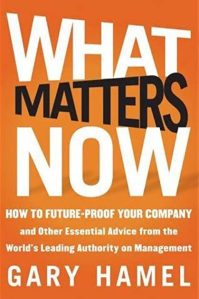
What’s true for the world of physics works in the world of organizations as well – over time, entropy increases. As Gary Hamel writes in What Matters Now:

Visionary leaders pass the baton to steadfast administrators who milk the legacy business but fail to reinvent it. The bureaucrats extrapolate but they don’t rejuvenate. As the years pass, the mainspring of foresight and passion slowly unwinds. The organization gets better but it doesn’t get different, and little by little it surrenders its relevance.

Recognize the Church anywhere in that statement? Better yet, do you recognize your church in that statement?

As Christianity has become institutionalized it has become encrusted with elaborate hierarchies, top-heavy bureaucracies, highly specialized roles, and reflexive routines.

Your church won’t regain its relevance until leaders chip off those calcified layers and rediscover its sense of mission.


Inspired by Gary Hamel’s What Matters Now as part of my research in preparation for a presentation at WFX Atlanta 09/19/12

Launch Change by Replacing Complacency with Urgency

It has become almost a cliché that the only constant today is change.

What moves it from a cliché to a truism is that the Greek philosopher Heraclitus said the same thing – 2,500 years ago.

In spite of that historical background, we all feel that change is different today: it is without end, and increasingly complex. We talk not of a single change, but of change as an ongoing phenomenon. It’s a collage, not a single simple image; one change overlaps with another, and it’s all change as far as the eye can see.

To some degree, the downside of change is inevitable. Whenever human communities are forced to adjust to shifting conditions, pain is ever present. But a significant amount of the waste and anguish we’ve witnessed in change management is avoidable.

The typical church has not operated well in a rapidly changing environment. Structure, systems, and culture have often been a drag on change rather than a facilitator.

The failure to sustain significant change recurs again and again despite substantial resources committed to the change effort, talented and committed people “driving the change,” and high stakes. In fact, leaders feeling an urgent need for change end up right: organizations that fail to sustain significant change end up facing crises.

This isn’t the sort of challenge you take on because it sounds good.

Adapting to and mastering change is not a choice. A significant part of a leader’s responsibility deals with being a change agent in the organization’s culture. In a time when changes come so fast and from so many unexpected angles, change is no longer a luxury but an imperative.

Even though change is a must for your organization, the “how-to’s” can often prove a problem. Many people lunge into change with no idea of its rules, its guiding principles, its nuances – and its dangers. Quite often disaster is the result. The only thing worse than ignoring change is leaping into it willy-nilly.

THE QUICK SUMMARY – A Sense of Urgency, by John Kotter

Most organizational change initiatives fail spectacularly (at worst) or deliver lukewarm results (at best). In his international bestseller Leading Change, John Kotter revealed why change is so hard, and provided an actionable, eight-step process for implementing successful transformations. The book became the change bible for managers worldwide.

Now, in A Sense of Urgency, Kotter shines the spotlight on the crucial first step in his framework: creating a sense of urgency by getting people to actually see and feel the need for change.

Why focus on urgency? Without it, any change effort is doomed. Kotter reveals the insidious nature of complacency in all its forms and guises.

In this exciting book, Kotter explains:

· How to go beyond “the business case” for change to overcome the fear and anger that can suppress urgency

· Ways to ensure that your actions and behaviors — not just your words — communicate the need for change

· How to keep fanning the flames of urgency even after your transformation effort has scored some early successes

Written in Kotter’s signature no-nonsense style, this concise and authoritative guide helps you set the stage for leading a successful transformation in your company.

A SIMPLE SOLUTION

You know your organization needs to change.

You may even know what the change needs to be: a new strategy, new personnel, new technology, or a significant change in direction.

But somehow, change comes too slowly, or it feels like you are pushing a boulder uphill, or that the implementation of that great new idea has stalled – again.

What’s missing, and is needed in almost all organizations today, is a real sense of urgency – a distinctive attitude and gut-level feeling that leads people to grab opportunities and avoid hazards, to make something important happen today, and constantly shed low-priority activities to move faster and smarter, now.

The real solution to the complacency problem is a true sense of urgency. Real urgency is an essential asset that must be created and re-created.

This set of thoughts, feelings, and actions is never associated with an endless list of exhausting activities. It has nothing to do with anxious running from meeting to meeting. It’s not supported by an adrenalin rush that cannot be sustained over time.

True urgency focuses on critical issues, not agendas overstuffed with the important and the trivial. True urgency is driven by a deep determination to win, not anxiety about losing. With an attitude of true urgency, you try to accomplish something important each day, never leaving yourself with a heart-attack-producing task of running one thousand miles in the last week of the race.

Increasing a True Sense of Urgency

Strategy

Create action that is exceptionally alert, externally oriented, relentlessly aimed at winning, making some progress each and every day, and constantly purging low value-added activities – all by always focusing on the heart and not just the mind.

Tactics

  • Bring the Outside In
    • Reconnect internal reality with external opportunities and hazards
    • Bring in emotionally compelling data, people, video, sites, and sounds
  • Behave with Urgency Every Day
    • Never act content, anxious, or angry
    • Demonstrate your own sense of urgency always in meetings, one-on-one interactions, memos, and email and do so as visibly as possible to as many people as possible.
  • Find Opportunity in Crises
    • Always be alert to see if crises can be a friend, not just a dreadful enemy, in order to destroy complacency.
    • Proceed with caution, and never be naïve, since crises can be deadly.
  • Deal with the NoNos
    • Remove or neutralize all the relentless urgency-killers, people who are not skeptics but are determined to keep a group complacent or, if needed, to create destructive urgency.

John Kotter, A Sense of Urgency

A NEXT STEP

Author Jon Kotter has developed a set of useful questions to consider when facing complacency and false urgency.

Discuss the following questions with your team, and identify – and eliminate – sources of complacency and false urgency.

  • Are critical issues delegated to consultants or task forces with little involvement of key people?
  • Do people have trouble scheduling meetings on important initiatives?
  • Is candor lacking in confronting the bureaucracy and politics that are slowing down important initiatives?
  • Do meetings on key issues end with no decisions about what must happen immediately (except the scheduling of another meeting)?
  • Do people run from meeting to meeting, exhausting themselves and rarely if ever focusing on the most critical hazards or opportunities?
  • Do people regularly blame others for any significant problems instead of taking responsibility and changing?
  • Are failures in the past discussed not to learn but to stop or stall new initiatives?

Excerpt taken from SUMS Remix 102-1, issued September 2018.


Part of a weekly series on 27gen, entitled Wednesday Weekly Reader

Regular daily reading of books is an important part of my life. It even extends to my vocation, where as Vision Room Curator for Auxano I am responsible for publishing SUMS Remix, a biweekly book “excerpt” for church leaders. Each Wednesday on 27gen I will be taking a look back at previous issues of SUMS Remix and publishing an excerpt.

>>Purchase SUMS Remix here<<

Success Brings Unintended Consequences

During a recent Auxano All-Staff call, founder Will Mancini brought up a conversation that he, Auxano Managing Officer Jim Randall, and noted church consultant George Bullard had that revolved around a book by Jim Collins – How the Mighty Falland its relevance to church and denominational settings today. This post from 2011 came to mind, so I’m reposting it.


Starbucks’ battle back from mediocrity is well documented in CEO Howard Schultz’s 2011 book Onward. Pairing it with Jim Collins’ 2009 book How the Mighty Fall gives ChurchWorld leaders a sobering lesson in how to handle success.

Collins’ 5 Stages of Decline begin with “Hubris Born of Success.” He describes it in a short paragraph:

Great enterprises can become insulated by success; accumulated momentum can carry an enterprise forward, for a while, even if its leaders make poor decisions or lose discipline. Stage 1 kicks in when people become arrogant, regarding success virtually as an entitlement, and they lose sight of the true underlying factors that created success in the first place. When the rhetoric of success (“We’re successful because we do the specific things”) replaces penetrating understanding and insight (“We’re successful because we understand why we do the specific things and under what condition they would no longer work”), decline will likely follow.

Here’s what Starbucks’ Schultz had to say in looking back to early 2008:

If not checked, success has a way of covering up small failures, and when many of us at Starbucks became swept up in the company’s success, it had unintended effects. We ignored, or maybe we just failed to notice, shortcomings.

We were so intent upon building more stores fast to meet each quarter’s projected sales growth that, too often, we picked bad locations or didn’t adequately train newly hired baristas. Sometimes we transferred a good store manager to oversee a new store, but filled the old post by promoting a barista before he or she was properly trained.

courtesy sodahead.com

courtesy sodahead.com

As the years passed, enthusiasm morphed into a sense of entitlement, at least from my perspective. Confidence became arrogance and, as some point, confusion as some of our people stepped back and began to scratch their heads, wondering what Starbucks stood for.

In the early years at Starbucks, I liked to say that a partner’s job at Starbucks was to “deliver on the unexpected” for customers. Now, many partners’ energies seemed to be focused on trying to deliver the expected – mostly for Wall Street.

Great organizations foster a productive tension between continuity and change. On the one hand, they adhere to the principles that produce success in the first place, yet on the other hand, they continually evolve, modifying their approach with creative improvements and intelligent adaptation.

When organizations fail to distinguish between current practices and the enduring principles of their success, and mistakenly fossilize around their practices, they’ve set themselves up for decline.

By confusing what and why, Starbucks found itself at a dangerous crossroads. Which direction would they go?

Questions for ChurchWorld Leaders:

  • Is your organization locked in on your vision, core values, purpose, and culture?
  • Or do you move in first this direction, then that, just to have “success”?

Beware the unintended consequences of success.

an updated post on a series reviewing Onward, by Howard Shultz

Onward

preparation for a new series coming soon on Leading the Starbucks Way, by Joseph Michelli

Print

Transformation Hurts

If you are comfortable where you are, or if things are okay as they are, you wouldn’t go through transformation.

Only when the pain of changing things overcomes the pain of status quo would you ever consider transformation.

That’s where Starbucks found itself in early 2008. Chronicled in CEO Howard Schultz’s 2011 book Onward, Starbucks – at the apparent height of its success – was declining inwardly, and on the edge of declining outwardly. Onward details the transformation Starbucks went through in 2008-2010, utilizing a Transformation Agenda developed by the senior leadership team at Starbucks as the primary guide.

The Transformation Agenda featured 7 “Big Moves” – innovations and advancements designed to return Starbucks to its core practices. The Big Moves also contained one final, painful set of actions designed to reverse sales trends and bolster stock value.

600 stores closed.

12,000 partner positions eliminated in these stores.

1,000 non-store positions eliminated.

Schultz called it the most painful decision he has ever made. Only the certainty that closing the stores would keep Starbucks operational in the long run allowed him to make the decision. He understood the reasoning, but it was impossible to take the emotion out of the equation:

For all the flak about Starbucks’ ubiquity, almost every store maintained a devoted following inside and out. A soul. With each closing, we would be erasing a fingerprint, and that was a reality I could not possibly ignore.

Fast forward to the fall of 2010: Starbucks regained a healthy balance with a culture that celebrates creativity and discipline, entrepreneurship and process, as well as rigorous innovation. Their fiscal 2010 operating margin was the highest consolidated one in their 40-year history. The transformation worked.

But according to Schultz,

…perhaps the most valuable thing that came out of the two-year transformation was the confidence we gained knowing that we could preserve our values despite the hardships we faced. Holding fast to those values steadied us throughout the tumultuous journey, and the ways in which we conduct our business will continue to bring our partners pride and fuel their engagement as we continue to grow.

Success is not sustainable if it’s defined by how big you become. Large numbers are not what matter. The only number that matters is “one.”

brewed coffee in cup

One cup.

SB customer

One customer.

barista handing drink over counter

One partner.

SB interior

One experience at a time.


Question for ChurchWorld leaders:

What’s your “one”?

an updated post from a series reviewing Onward, by Howard Shultz

Onward

preparation for a new series coming soon on Leading the Starbucks Way, by Joseph Michelli

Print

Transformation Initiatives at Starbucks

A previous post was a brief look at the bold Transformation Agenda that Starbucks put into place early in 2008 to overcome their decline. The Agenda contained a mission statement and 7 Big Moves designed to return Starbucks to success.

Within a few months, at their April 2008 shareholders meeting, Starbucks rolled out the following six transformation initiatives:

  • The Mastrena – a finely crafted, Swiss made espresso machine that would provide baristas with the ability to give customers a high-quality consistent shot of espresso second to none, transforming the espresso experience in their stores. By the end of 2008 the machine was in 30% of stores, and by 2010 a majority of Starbucks had the Mastrena.
  • Conservation International – a partnership with CI, begun in 1998, was expanded so that Starbucks could buy fair-trade coffee, produced in shade-grown conditions with fair compensation and safe working conditions for coffee farm workers. By 2009, all Starbucks espresso beans and espresso-based products would qualify for a new marking designed to articulate their practices: Responsibly Grown. Ethically Traded. Proudly Served.
  • The Rewards Card – designed to recognize their most loyal customers with freebies, the Card addressed an emerging need for value. Existing Starbucks Card holders could register their cards online, instantly turning it into a Rewards Card.
  • MyStarbucksIdea.com – an interactive website designed to listen to customers suggestions, rants, and comments. Moderated by 50 veteran Starbucks employees, the website was launched live by uploading ideas submitted by shareholders that morning. Within minutes, more ideas came streaming in from people listening to the meeting’s broadcast or following rolling blog posts. In the next 24 hours, over 7,000 ideas were posted.
  • Pike Place Roast – announcing that Starbucks would once again grind whole beans in their stores, two master baristas introduced Pike Place Roast, a smooth, well-balanced, lighter blend of coffee, designed to give full flavor while not being as bold as traditional blends.
  • Clover – a commercially viable way to replicate the benefits of the French Press method of brewed coffee, Clover was a local invention acquired by Starbucks early in 2008. It created a fantastic cup of coffee at a pace designed to keep up with the demand of most Starbucks stores.

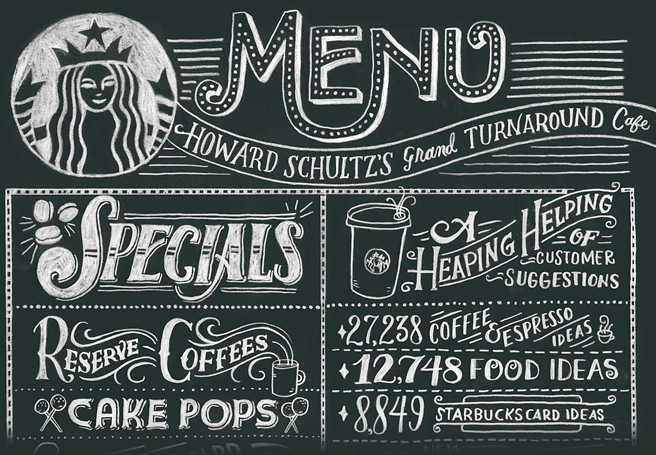
SB turnaround menu fastcompany.com

Seven Big Moves.

Six Transformation Initiatives.

All of these engaging tools that helped Starbucks navigate through a very unpredictable journey, one milestone at a time.

The initiatives introduced at that meeting each heralded a return to the core values of Starbucks – coffee, customers, innovation, and values – but they weren’t enough by themselves to bring the company back from the brink.

Painfully personal decisions were the final step in the transformation.

Lessons for ChurchWorld

  • Take a look at the initiatives above, and translate them into your world. What actions can you dream up – and then put into action – that would help you accomplish your transformation agenda?
  • Are you secure enough in your core values to put anything – and everything – on the table?
  • Transformation is not just about nuts and bolts, about systems and processes. Is your vision lived out in the lives of your people?

an updated post from a series reviewing Onward, by Howard Shultz

Onward

preparation for a new series coming soon on Leading the Starbucks Way, by Joseph Michelli

Print


Ones Add Up

Starbucks’ CEO Howard Schultz’s 2011 book Onward details the amazing comeback story of Starbucks: after more than three decades of success, in 2008 they found themselves with sales sliding at a distressing rate, a falling stock value, and relentless competition. Compounding the problem, the world’s economy was in a tailspin.

With aggressive, sometimes painful moves and a powerful transformation agenda to guide them, they were able to reverse their decline, and by the end of 2010 were once again on top of their game.

What happened?

Here’s an excerpt from the book that gives you a big clue:

Like a doctor who measures a patient’s height and weight every year without checking blood pressure or heart rate, Starbucks was not diagnosing itself at a level of detail that would help ensure its long-term health. We predicated future success on how many stores we opened during a quarter instead of taking the time to determine whether each of those stores, would, in fact, be profitable. We though in terms of millions of customers and thousands of stores instead of one customer, one partner, and one cup of coffee at a time.

With such a mind-set, many little things dangerously slipped by unnoticed, or at least went unacknowledged. How could one imperfect cup of coffee, one unqualified manager, or one poorly located store matter when millions of cups of coffee were being served in tens of thousands of stores?

We forgot that “ones” add up.

courtesy freemarketmediagroup.com

courtesy freemarketmediagroup.com

Lessons for ChurchWorld:

  1. What “business” are you in?
  2. What are the roots of that business?
  3. It’s okay to have a 30,000 foot view, but eventually you’ve got to land the plane.
  4. You’ve got to produce results.
  5. You may see the crowds, but never forget the “ones“.

an updated post from a series reviewing Onward, by Howard Shultz

Onward

preparation for a new series coming soon on Leading the Starbucks Way, by Joseph Michelli

Print


Change is…

Healthy.

Organizations are not alive in a literal sense – but they have to change and adapt in order to stay alive.

Nancy Duarte, writing in “Resonate,” talks about the life cycle of organizations – start-up, growth, maturity, and eventually decline. But it doesn’t have to be that way.

An organization should make continual shifts and improvements to stay healthy.

In order to do that well, leaders must excel at persuasion.

Movements are started, products are purchased, philosophies are adopted, subject matter is mastered – all with the help of persuasive presentations.

Presentations create a catalyst for meaningful change by using human contact in a way that no other medium can.

Go ahead – change the world.

Defying Gravity

The “rocket ride” comment in yesterday’s post reminded me of some remarks by Andy Stanley when he came to Elevation Church in Charlotte NC for one of our leader training sessions. They are an appropriate reminder as we consider changing change.

Recalling the dispute in Antioch and the resulting Jerusalem Council in Acts 15, Stanley developed the following thoughts about what the church should be vs. gravitational pull of culture.

1. There’s always a gravitational pull toward insiders and away from outsiders

  • You must continue to create empty seats at optimal worship times for the unchurched

People who were nothing like Jesus liked Jesus

2. There’s always a gravitational pull toward law and away from grace

  • Have as few policies as possible and as many conversations as possible

With conversations you can always extend grace

3. There’s always a gravitational pull toward complexity and away from simplicity

  • Do what you do well and do it better than anyone else

Complexity always slows things down, is expensive, and makes you lose distinctiveness in the community

4. There’s always a gravitational pull toward preserving and away from advancing

  • When you start preserving, you are building walls instead of bridges

Back when we had nothing, what would we have done?

If you want to defy gravity:

  • You must be a raving fan publicly
  • You must be an honest critic privately with the right people in the right environment for the right reason
  • You have to be extraordinarily generous

That’s how you keep the church in orbit.

Introducing the Scrum to ChurchWorld

During the course of the past week’s posts I have journeyed from Generation Flux to Adaptability to Nostalgia to Agile Development to a new destination: the Scrum.

It’s actually all part of the same journey: 1) realizing tomorrow is not going to be like yesterday, and 2) What am I as a leader going to do about it?

Back to the Scrum. As a parent of four children, I have been involved in many sports, some for fun, more that were in a league setting. About three years ago, my youngest son-at that time a junior in high school-came home and said he had signed up for the rugby team at school.


Okay. New experience, new opportunity for learning.


In rugby, a scrum is a formalized contest for possession of the ball during a rugby game between the two sets of forwards who each assemble in a tight-knit formation with bodies bent and arms clasped around each other and push forward together against their opponents.

Hold that thought.

Yesterday I suggested that an Agile Manifesto for ChurchWorld needs to be developed. In my research to do just that, what do I encounter but a Scrum – but with a new definition:

In the agile world a scrum is a process framework within which people can address complex adaptive problems, while productively and creatively delivering products of the highest possible value.

I think it’s time to go back to the drawing board.

Learning from the World of Business Bankruptcy and Software Development

Kodak, the iconic company that was synonymous with pictures, has declared bankruptcy.

When that news came out last week, I knew I would be getting around to connecting it to ChurchWorld. James Emery White, pastor of Mecklenburg Community Church in Charlotte, NC, already has: What Business Are You In? is a great post that every ChurchWorld leader needs to read.

As soon as I had finished reading it, my thoughts went back to the Generation Flux cover story from Fast Company that I posted here, here, and here last week. There were several topics that I had marked in it for future research, and one of them ties in nicely to the bankruptcy announcement by Kodak and White’s post.

It’s about being agile.

I’m not talking exclusively about physical agility, the ability to move quickly and with suppleness, skill, and control; I’m not talking only about mental agility, the ability to be able to think quickly and intelligently. It’s really a combination of the two, and more.

Software development used to be developed by what chaos expert DJ Patil called the “waterfall” process:

One group develops the product, another builds visual mockups…and finally a set of engineers builds it to some specification document.

Think Microsoft and their practice of having a designated schedule of issuing large, finished releases of their products (Windows 95, Windows 2000, etc.). Today that process has given way to “agile” development, what Patil calls “the ability to adapt and iterate quickly throughout the product life cycle.” In today’s software world, that concept follows the precepts of “The Agile Manifesto,” a 2001 document written by a group of developers who stated a preference for:

  • individuals and interactions over processes and tools
  • working software over comprehensive documentation
  • responding to change over following a plan

Maybe it’s time for an Agile Manifesto for ChurchWorld.