Designing Elevation Church’s Volunteer Culture with the Excellence of Nordstrom’s – Team Leaders

Reaction and comments from yesterday’s post and the correlation to the Ritz Carlton brings to mind another iconic retail establishment known for its customer service: Nordstrom’s.

Last fall, I was privileged to speak at the Worship Facility Conference and Expo on the topic of “Servant Leadership.” I had been doing research on Nordstrom’s customer service principles, and found that they were easy to translate into the volunteer culture at my church, Elevation Church in Charlotte NC.

Taking the same 3-tier approach at Nordstrom’s, you can read a quick summary of the first tier here. Here’s a quick summary of the second tier:

Part Two: What eLeaders Can Do to Create a Culture of Servants

#1 Strategy: Recruit the Smile

  1. It’s not the role for everyone
  2. 4 reasons volunteers choose your eTeam
  3. Recruit the smile, train the skill
  4. Invest in your team

That’s My Job: Empower Teams to Act Like Entrepreneurs

  1. Trust your team
  2. Give them freedom to make decisions on the spot
  3. Push decision-making responsibility and authority down to the lowest level possible
  4. Encourage your team every step of the way
  5. Use mistakes as tools for learning

Dump the Rules: Tear Down the Barriers to Exceptional Volunteer Service

  1. Trust your team’s judgment
  2. Simplify the process
  3. Do what’s right
  4. Promote one rule: The Golden Rule

This is How We Do It: Manage, Mentor, and Maintain Great Teams

  1. Find ways to motivate your team
  2. Treat the team with dignity and respect
  3. Encourage new team members to find mentors
  4. Promote a culture where team members mentor unselfishly
  5. Provide coaching tools
  6. Promote a culture of loyalty and ownership

Recognition, Competition, & Praise: Create a Sustainable, Emotional Bond with Your Team

  1. Always find ways to praise team members for great acts of GS
  2. Recognize and reward
  3. Provide team members with information on how they are doing
  4. Send notes, emails, phone calls to team members regularly

Staff and coordinators may create the atmosphere and culture, but it is up to the people on the front lines to put it into practice. Team Leaders at Elevation have experienced the front lines – that’s where they came from! Because of this, they know what to look for in a new volunteer, how to empower people, mentor them, train them, and praise them for a job well done.

Next: Team Members

The Lineup at Elevation Uptown

It’s one thing to have a Credo, Three Steps of Service, and 12 Service Values like the Ritz-Carlton (see the post here for more details). Many businesses go through the exercise of defining key values or composing mission statements. They might even display them in their literature, or in imposing art displays on the corporate walls.

How many organizational leaders understand the importance of regular and repetitive presentation of the core aspects of their business – not only to management, but to their front-line staff?

Enter the “lineup” at Ritz-Carlton.

To truly appreciate the Ritz-Carlton leadership approach to repeated dissemination of the “Gold Standard” mentioned here, you would have to drop in on a section of the housekeeping staff as they prepare for their days work – or at the corporate headquarters – or in the kitchen of the fine restaurants that serve the hotel chain – or anywhere, and everywhere, throughout the entire organization.

You would observe that a meeting is taking place at the beginning of each shift. Not just any meeting, though: the leader in each group starts by sharing the Credo and talking about the importance of creating a unique guest experience. Another team member might share a guest story from a Ritz-Carlton hotel in another country. Another team member shares how what they do in their department helps create memorable guest experiences. Then a few quick announcements, special recognitions are given, and the meeting is closed with a motivational quote by another team member.

All in about 20 minutes.

Every day.

On every shift.

In every Ritz-Carlton hotel and office around the world.

The magic of the lineup involves the following:

  • Repetition of values – the core belief that values need to be discussed daily, and that values can’t be discussed enough
  • Common language – shared phrases across all tasks binds the team together
  • Visual symbols – The Credo is printed on a card that all team members carry at all times
  • Oral traditions – Personal, direct, and face-to-face communication makes a huge impact in a world increasingly dominated by e-mail, text, and voice messages
  • Positive storytelling – stories communicate life in a powerful and memorable way
  • Modeling by leaders – the active, daily presence of the leaders communicates the importance of the time together

What would “lineup” for each of your teams do to preserve the core values, communicate the importance of everyone on the team, and provide momentum for the day’s activities?

At Elevation Uptown, here’s what our ‘lineup’ looks like on Sunday mornings at 7:45 AM:

 Elevation Uptown 012013
Or how about this word for the process? Alignment.

That’s how we roll Uptown!

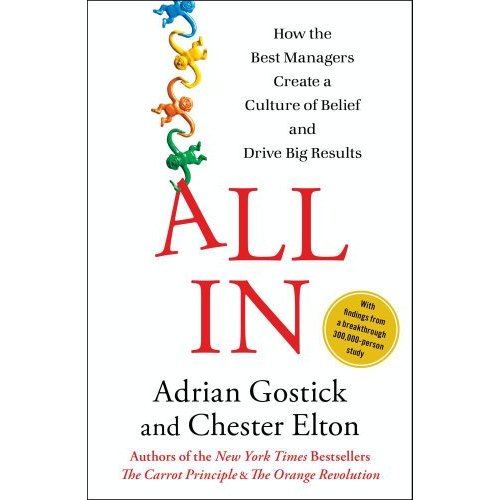
The 7 Step Road Map to Being All In

To have any hope of succeeding as a leader you need to get your team “all in.”

No matter the size of your team, few things will have a bigger impact on your performance than getting your people to buy into your ideas, your cause, and to believe what matters.

– All In, Adrian Gostick & Chester Elton

Best-selling authors of The Carrot Principle and The Orange Revolution, Adrian Gostick and Chester Elton’s new book All In answers one of the most overlooked leadership questions of the day: Why are some leaders able to get their employees to commit wholeheartedly to their culture and give that extra push that leads to outstanding results?

As with their previous works, a huge (in this case, 300,000 person) study led to a groundbreaking finding: leaders of the highest performing groups create a “culture of belief.” In these distinctive organizations, people believe in their leaders and in the organization’s vision, values, and goals. Team members are engaged, enabled, and energized (the authors use the term Three Es).

Based on the extensive interview process and combined with their years of experience, the authors created a seven-step road map for creating a culture of belief:

  • Define Your Burning Platform – define the mission with great clarity and instill a sense of urgency
  • Create a Customer Focus – focus on customers and mandate a pro-customer orientation
  • Develop Agility – learn to see the future and position your team to meet both seen and unseen challenges
  • Share Everything – create a culture that is a place of truth, has constant communication, and exhibits marked transparency
  • Partner with Your Talent – success is direct result of your teams’ unique ingenuity and talent
  • Root for Each Other – high levels of appreciation and camaraderie create a tangible esprit de corps
  • Establish Clear Accountability – teams must be held accountable for goals, but have the responsibility and tools to ensure their success, with appropriate rewards at completion

All In is a book about culture, but more than that it is the story of how great leaders create unique, inviting, and rewarding places to work – or serve.

What about you – are you ready to lead all in?

A New Way to Play Follow the Leader

Walt Disney’s unique definition of leadership:

The ability to establish and manage a creative climate in which individuals and teams are self-motivated to the successful achievement of long-term goals in an environment of mutual respect and trust.

Today’s post continues excerpts from Innovate the Pixar Way by Bill Capodagli and Lynn Jackson. The authors contend that Pixar has reawakened the innovative spirit of Walt Disney and set new standards for commercial and critical achievement. The book explores how Pixar has built an organization on the simple philosophy that quality is the best business plan. With a track record of 13 for 13 smash feature animation films, it’s hard to argue!

Walt Disney didn’t ascribe to the childhood playbook for “follow the leader” – instead, he created an environment of self-motivated creative thinkers who worked together to deliver a magical, magnetic, enchanting experience for his audience.

Pixar understands leadership the same way.


  • Establishment of a Clear Vision – Pixar has a clear vision and communicates that vision to its team. The best leaders are excellent communicators, engaging their teams by providing them with the tools and information needed for success – and then trusting them to do their jobs.
  • Creative Climate – Creative climates need leadership and a management style that helps them to develop and grow and allows them to have fun in the process. Pixar is in the people development business, going to great lengths to nourish and support its team members. They invest in people, creating a culture of learning, filled with lifelong learners.
  • Individuals and Teams – Pixar thrives on teamwork, but each person on the team is given creative ownership of even the smallest task. This level of autonomy and accountability is practically unheard of in the movie business, where a top-down fear-driven culture is the norm.
  • Self-Motivated Personnel – great leaders know that self-motivated people are essential to developing a creative culture. Pixar is continually on the lookout for new talent that can blossom with their unique culture. The team at Pixar is 100 percent self-motivated to being as creative as they can be and to making movies the best they can. Period.
  • Long-Term Goals – It’s always been about creating for the long-term at Pixar. Their definition of “long-term” speaks volumes about its culture. They go to great lengths to ensure that its culture can support new ventures and still remains true to their values.
  • Mutual Respect and Trust – Pixar team members have embarked on a journey together, nurturing one another in an environment of mutual respect and trust. When leaders exhibit a high level of respect and trust, earned over time, that’s exactly what they will get in return.

There’s no “follow the leader” game at Pixar. Their playbook simply calls for an open playground where leadership serves as a catalyst in the pursuit of big dreams.

If you were to hold up the “magic mirror on the wall” to your leadership style, what would you see?

13 for 13

This is not a post about triskaidekaphobia, but today would be a good day for one. No, it’s a simple question:

What if Pixar came to your church?

This is Pixar Animation Studio’s track record: 13 for 13.

That’s thirteen films since the studio’s launch in 1995, every one of them a smashing success. What’s their secret?

Their unusual creative process.

Unlike the typical studio that gathers all the necessary personnel to produce a film and then releases them after it is finished, Pixar’s staff of writers, directors, animators, and technicians moves from project to project.

The result: a team of moviemakers who know and trust one another in ways unimaginable on most sets.

My wife and I saw “Brave” recently, and it reminded me of an article in Wired magazine from a couple of years ago on how Pixar does it, using “Toy Story 3” as the example. You can read the whole article here, but take a look at their step-by-step process in a nutshell:

Inspiration

  • Day 1 – coming up with a great story. The creative team leaves the campus for an off site retreat, and knocks out a quick storyline – which they promptly discard.
  • Day 3 – working from a series of plot points, screenwriter Michael Arndt begins drafting the script. Director Lee Unkrich and the story artists start sketching storyboards. The storyboards allow the filmmakers to begin imagining the look and feel of each scene.

Presentation

  • Day 36 – character design begins. Working in digital images, sketches, and clay figures, each character comes to life in a process called simulation – a constant negotiation between the artistic and technical teams.
  • Day 123 – the storyboards are turned into a story reel that can be projected, much like an elaborate flip book. This allows the team to watch along with an audience and determine what works and what doesn’t.

Characterization

  • Day 380 – actors come into the studio to record all the lines – dozens of times. The actors are also being filmed, so the animators can watch the actor’s expressions and use them as reference points when they animate the characters’ faces.
  • Day 400 – shaders began to add color and texture to character’s’ bodies and other surfaces that appear in the film. Complex algorithms are used to simulate the effect of light and shadow on different toy surfaces like plastic, cloth, or wood.

Animation

  • Day 533 – the pictures are moving, defined by up to 1,000 points of possible movement that animators can manipulate like strings on a puppet. Each day the team starts by reviewing the previous day’s work, ripping it apart to make each scene more expressive.
  • Day 806 – technical challenges pile up. The studio’s design which places essential facilities in the center allows the team to have unplanned creative conversations while on the way for a cup of coffee or walking to the bathroom.
  • Day 898 – the animators hit high gear, working late into the night in customized and personalized offices.
  • Day 907 – rendering, the process of using computer algorithms to generate a final frame, is well under way. The average frame (a move has 24 frames per second) takes about seven hours to render, though complex frames can take nearly 39 hours of computer time. The Pixar building has two massive render farms, each of which contains hundreds of servers running 24 hours a day.

Resolution

  • Day 1,070 – the movie is mostly done. the team has completed 25 of the film’s sequences and is finishing the most complicated scene of the move. It has taken 27 technical artists four months to perfect that single scene.
  • Day 1,084 – Only weeks away from release, the audio mixers at Skywalker Sound combine dialog, music, and sound effects. Every nuance is adjusted and readjusted. Director Unkrich: “We don’t ever finish a film – I could keep on making it better. We’re just forced to release it.”

And you thought getting a sermon ready for Sunday was difficult!

The process depicted above can be highly constructive for you and your team. Granted, you don’t have either the budget or the time to produce a film like Toy Story 3, but you can take the principles above and apply them in your context, resources, and time frame.

So, how about it? What Pixar creative magic can you put to use this week?

Lessons in Teamwork

…courtesy of the Miami Heat

Here’s a repost from last year I thought was appropriate since the Miami Heat won the NBA Championship last night.

I’m not really a fan of pro basketball, but I must say that the free-agent talent raid pulled off by the Miami Heat has made for interesting conversations since last summer. From marketing hype at it’s most annoying (LeBron James’ announcement –“The Decision” – that he was going to the Heat) to instant pundits proclaiming them the next dynasty to a chorus of “I told you so”, it’s been more like a three-ring circus than a basketball team.

But leave it to Fast Company magazine’s Chuck Salter to find some great lessons in teambuilding from, well building a team. You need to read the whole story here, but for a quick taste read the following:

6 Steps Required to Create a Dream Team (in any setting)

  1. The Ego Equation: start with sacrifice. High-priced talent doesn’t ensure success. Think New  York Yankees – or the Knicks. Sports not your thing? Remember when Steven  Spielberg, Jeffrey Katzenberg, and David Geffen looked like a can’t-miss  team at DreamWorks? Turns out, no one bothered to account for the polarity  of their personalities. Teaming up has its trade-offs. Where once Wade had the spotlight, now he has to share it. No more entourage traveling with James. All three have seen less of the basketball. In other words, the team’s leaders have done what stars need to do when they merge: show a  willingness to sacrifice. It’s a necessary start.
  2. The Rule of Many: stars  can’t go it alone. New hires perform better when they bring a former colleague with them. Miami brought over a player who had been with James for seven seasons. The team also kept a longtime buddy of Wades who had been on the team eight years. All told, Miami added six new players in a span of 21 days: three-point specialists, guys to do the grunt work of rebounding, setting picks, and feeding the ball to the “Big 3.”
  3. The Platoon Principle: adversity is an asset. Nothing brings a team together like a common enemy. Google needs Facebook. Under Armour  needs Nike. The Heat need everybody who’s not the Heat. Coach Erik Spoelstra hoped to turn the vitriol to his advantage. The real bonding didn’t occur until the team began to lose – and badly. Said Spoelstra: “When it’s raw, when you don’t get along, that’s when there’s the most opportunity for growth.” Under duress, Miami found its identity.
  4. The Trust Theorem: when  the going gets tough, turn to one another. Watching the three  superstars at practice, it’s obvious these guys get along. But camaraderie  doesn’t necessarily translate into collaboration. When you assemble a team of experts, it’s better to have complementary, not competing, specialties.
  5. The Credibility Conundrum: manage from the inside out. Coach  Spoelstra’s position is like any manager operating between the CEO and the  in-the-trenches talent. Spoelstra needs to tread carefully, balancing his obligations to his boss and his commitments to his players, all in his  quest to build his own credibility for leadership. The coach must wrestle when to coddle and when to push, trying to master the sleight of hand that allows the young millionaires to feel they have ownership of the team even as he calls the shots.
  6. The Law of Patience: beware the blame game. Everyone remembers the six NBA titles the Chicago Bulls won with Jordan, Pippen, and a cast of specialists to support them. What we tend to forget is how long it took the Bulls to put all those pieces together. They didn’t win the first year. Or the second. Or even  the third. It took the team four years. Chemistry takes time. The playersrespect one another’s individual skills and even learn from one another. But those patterns don’t emerge right away. Chemistry isn’t something you create and then ignore. It’s a reflection of the bonds between members, and those bonds are fragile and needy – and constantly changing.

This is what any team aspires to: passion, unity, and absolute conviction that you can achieve whatever you want as a group.

What teamwork lessons can you learn from the Heat and apply to your team?

What Weeding a Flower Bed Reminded Me About Leadership

I have been in Nashville TN for the last several days on a business trip. Though I wrapped up late yesterday afternoon, I planned some extra time with my mother, who lives about 20 miles from Nashville. We went out for dinner last night and I asked her what she needed doing around the house.

This is the first time I have been back “home” since my father passed away and was buried in early March. Though my mother and I talk several times each week, I knew that there were things to do for her.

Consequently, by mid-morning I found myself pulling weeds in the numerous flower gardens around the house. Both my parents liked flowers and the wildlife they attracted. My dad in particular, was what you might call a natural gardener when it came to flowers. He didn’t believe in formal landscapes and flower beds “just so.” His method was more “that looks like a good place for a few flowers.”

As I was working in around the flower beds all morning, I was reminded of the countless times I had seen my dad as he was going from one place to another in our yard just stop and pull a weed out and toss it on the ground – to be chopped up by the mower later. There wasn’t a rhyme or reason to his actions; it was just something he did.

Small consistent actions over time make a big difference.

My dad had been in declining health since late last year, and had not been able to be out in the yard, there was a lot to do. By noon I was ready for a break. Sitting and drinking several glasses of water I thought about my Dad and how his constant weeding meant that the flower gardens looked pretty good all of the time; now, they looked overgrown.

I’m certainly nowhere near the gardener my Dad was. My several hours of work will make them look good for a few weeks maybe, and then they will have to be weeded again.

But once again, my Dad is my teacher.

Leaders need to understand that consistent, small actions invested in your team will pay big dividends along the journey.

Thanks, Dad.

Simplicity Never Stands Still

To achieve great things, two things are needed: a plan, and not quite enough time.

– Leonard Bernstein

Former ad agency creative director Ken Segall’s new book Insanely Simple is written from a unique perspective: developing marketing campaigns for technology giants like IBM, Dell, Intel, – and Apple. It was the stark contrast of Apple’s ways that made Segall appreciate the power of Simplicity – and inspired him to help others benefit from it.

In the chapter entitled “Think Motion,” Segall refers to Apple’s practices of fast-tracking project and marketing development.  Apple has grown to point where it does a tremendous number of things at once, and in doing so has built one of the world’s greatest juggling acts. Apple:

  • lives in constant motion
  • never stops thrilling its audience
  • never lets things get old

The best illustration of this comes from an example of Segall’s work with both Dell and Apple on similar ventures – developing a new branding campaign.

Apple set out to create a brand campaign in 1997.

   Dell set out to create a brand campaign in 2008.

Apple wanted to start its campaign immediately.

   Dell pondered a schedule that would take months.

Apple’s brand team was led by its CEO.

   Dell’s brand team was led by a committee.

Apple trusted a small group of smart people.

   Dell trusted a small group of incompatible people.

Apple knew exactly who it was.

   Dell need to figure out who it was.

Steve Jobs was an active participant.

   Michael Dell would look in when the project was complete.

Apple’s brand team required only the CEO’s approval.

   Dell’s brand team required each division’s approval.

Apple took a month to conceive and create a campaign.

   Dell required a month just to talk about strategies.

Apple ended up with the Think Different campaign.

   Dell ended up with a stack of presentation boards stored neatly in a dark closet.

Simplicity – represented in the above example by Apple’s actions – is a fundamental requirement when you’re trying to achieve lofty goals. As Dell discovered, a fractured, leaderless group without an urgent mandate is Simplicity-proof.

Will you walk the straight path of Simplicity or choose the dark, winding road of Complexity?

Small is the Ultimate Efficiency

When process is king, ideas will never be. It takes only Common Sense to recognize that the more layers you add to a process, the more watered down the final work will become.

– Ken Segall, Insanely Simple

Ken Segall was the creative director at several ad agencies, working for big-name tech companies like IBM, Intel, and Dell. However, it was his work with Apple over a period of years that gives him a unique perspective of the stark contrast of Apple’s ways that made him appreciate the power of Simplicity. Segall recently released a book about these lessons – Insanely Simple. More than just another repetition of Apple lore, it chronicles an outsider’s long relationship with Apple and Steve Jobs that will provide leaders in any organization with the powerful tools of Simplicity.

Simplicity’s Best Friend: Small Groups of Smart People

While working with Apple, Segall often experienced the strict enforcement of one of Simplicity’s most important rules: Start with small groups of smart people – and keep them small. Every time the body count in a meeting or working on a project goes higher, you’re simply inviting Complexity to take a seat at the table.

This small-group principle is a key to Apple’s ongoing success and key to any organization that wants to nurture quality thinking. The idea is pretty basic: Everyone in the room should be there for a reason. Segall distilled years of observing and practicing this idea down into two “Laws of Small.”

The quality of work resulting from a project is inversely proportional to the number of people involved in the project.

The quality of work resulting from a project increases in direct proportion to the degree of involvement by the ultimate decision maker.

To even speak of putting process before creativity did not happen in an environment like Apple’s. A better idea is a better idea – no matter where it fell in the process. The high value placed on ideas is one of the things that Steve Jobs burned into the Apple culture and it will likely continue to guide the company into the future.

How would small groups of smart people work in your organization?

Four Disciplines of Organizational Health

An organization doesn’t become healthy in a linear, tidy fashion.

– Patrick Lencioni, The Advantage

Patrick Lencioni’s latest book The Advantage is a comprehensive, practical guide, covering many of the topics introduced in one of his eight business fable books. But don’t make the mistake of thinking that this is just a repackaging – The Advantage goes far beyond that. In it you will find some very practical, hands-on tools to help your organization become healthy.

Previous posts here and here introduced the book. The central theme of the book is today’s topic: The Four Disciplines Model. Here is Lencioni’s overview of the Four Disciplines.

Discipline 1: Build a Cohesive Leadership Team

An organization simply cannot be healthy if the people who are chartered with running it are not behaviorally cohesive in five fundamental ways. In any kind of organization, from a corporation to a department within that corporation, from a small, entrepreneurial company to a church or a school, dysfunction and lack of cohesion at the top inevitably lead to a lack of health throughout.

Discipline 2: Create Clarity

In addition to being behaviorlly cohesive, the leadership team of a healthy organization must be intellectually aligned and committed to the same answers to six simple but critical questions. There can be no daylight between leaders around these fundamental issues.

Discipline 3: Overcommunicate Clarity

Once a leadership team has established behavioral cohesion and created clarity around the answers to those questions, it must then communicate those answers to the rest of the organization clearly, repeatedly, enthusiastically, and repeatedly (that’s no typo). When it comes to reinforcing clarity, there is no such thing as too much communication.

Discipline 4: Reinforce Clarity

Finally, in order for an organization to remain healthy over time, its leaders must establish a few critical, non-bureaucratic systems to reinforce clarity in every process that involves people. Every policy, every program, every activity should be designed to remind your team what is really most important.

I hope today’s post and the previous two have enticed you to get The Advantage. The book certainly stands alone, but there is also a great deal of web content available on organizational health.

What are you waiting on?

The health of your organization is at stake!