72 years ago this month, two scientists walked into their neighborhood pub in Cambridge, England, ordered their drinks, and one of them announced to the patrons “We have found the secret to life.”
This was no lie – that morning, Cambridge University scientists James D. Watson and Frances H.C. Crick had discovered the double-helix structure of DNA, the biological material that carries life’s genetic information.
On the fiftieth anniversary of that discovery, Watson took part in an interview inquiring about the aspects of their work that had led them to solve the problem ahead of an array of other highly accomplished and recognized rival scientists.
Along with the expected answers – they identified the most important part of the problem, they were passionate about their work, they devoted themselves single-mindedly to the task, they were willing to attempt approaches outside their area of familiarity – came this surprise:
Watson said that he and Crick had cracked the elusive code for DNA primarily because they were not the most intelligent scientists pursuing the answer.
Watson went on to explain that the most intelligent person working on the project in those days was Rosalind Franklin, a British scientist working in Paris at the time. According to Watson, Rosalind was so intelligent that she rarely sought advice. And if you’re the brightest person in the room, then you’re in trouble.
Watson’s comment describes exactly the error that many leaders in today’s organizations make: they believe that they are the best-informed, most-experienced, or most-skilled person in the group. They may be, but studies have repeatedly shown that the approaches and outcomes of groups who cooperate in seeking a solution are not just better than the average member working along, they are even better than the group’s best problem solver working alone.
Far too often, leaders – who by virtue of greater experience, skill, and wisdom, deem themselves the ablest problem solver in the group – fail to ask for input from team members.
Lone decision makers can’t match the diversity of knowledge and perspectives of a team
Input from others can stimulate thinking processes that wouldn’t develop on their own
Individual thinkers can’t parallel process – dividing parts of the problem among many members
Trying to discover the meaning of life? How about something much simpler, like a new funding initiative to increase service to one of your target groups? Or any problem facing your team?
Don’t forget the danger of being the brightest person in the room.
Like a masterfully executed relay race, the transition of leadership from Moses to Joshua stands as one of history’s most significant passings of the baton. Moses, having led God’s people through the wilderness for forty years, carefully prepared Joshua for the decisive moment when he would take the lead. The baton of leadership, weighted with the responsibilities of guiding over two million Israelites, was transferred with divine precision and purpose.
Joshua grabbed this baton with both faith and fortitude. Where many might have stumbled under the pressure of succeeding such a legendary leader as Moses, Joshua found his stride by keeping his eyes fixed on God’s promises. His leadership style demonstrated that the race wasn’t about filling Moses’ sandals, but about running his own God-ordained course with excellence.
The walls of Jericho became his first major hurdle, where Joshua proved that unconventional divine strategies trump human wisdom. His courage to follow God’s battle plan – marching around walls instead of attacking them – showed that true leadership means trusting God’s playbook over tactical human reasoning.
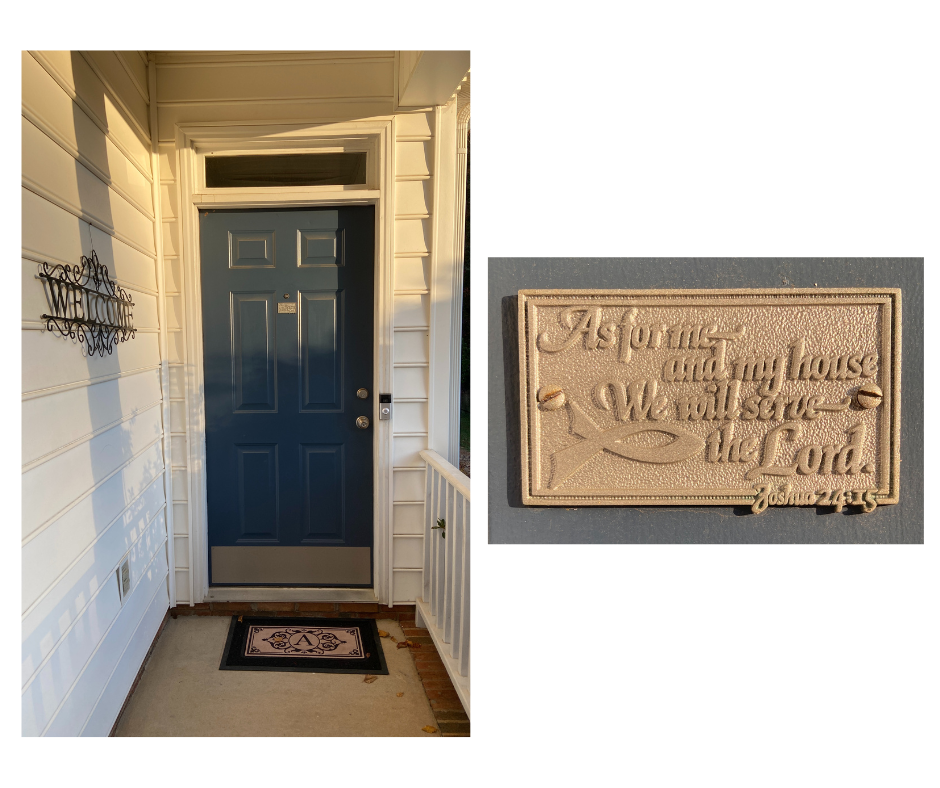
Just as a relay runner must maintain momentum, Joshua’s consistent obedience and dedication to God’s law inspired the Israelites to remain faithful for an entire generation. His timeless declaration, “As for me and my house, we will serve the Lord,” became the victory lap that defined his legacy.
This particular verse has long been a favorite of Anita and me; it’s depicted on our front door above. We brought it from GA almost 30 years ago, and should we ever leave this home, it will go with us.
Courage is the main quality of leadership, in my opinion, no matter where it is exercised. Usually it implies some risk – especially in new undertakings. Courage to initiate something and to keep it going – pioneering and adventurous spirit to blaze new ways.
Walt Disney
Walt Disney was no stranger to adversity and even failure.
The setbacks, tough times, and even failures of Walt Disney are well-documented. In every case, he led the company bearing his name to greater success in spite of adversity.
March 2020 was a sobering, disconcerting time to be a Cast Member of any Disney organization. As the reality of the COVID pandemic set in, I had conversations with both current and former Cast Members, and to a person, there was been one trait that stood out.
Optimism.
Even when it was hard to see in the increasing numbers of Cast Members laid off, the curtailment of operations, the postponement of work in progress, and the likely cancellation of future planning, optimism is the underlying strength of the Walt Disney Company.
Even now, three years later, there have continued to be many ups and downs.
So where does the optimism come from?
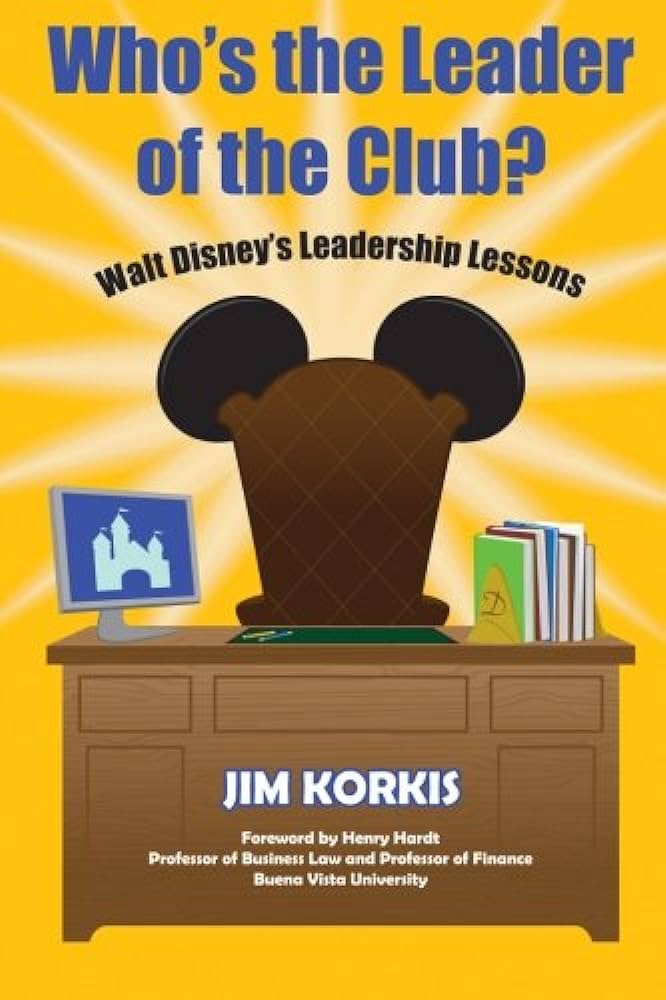
Jim Korkis was a Disney historian and long-time writer and teacher about Walt Disney and the organization he created. Who’s the Leader of the Club: Walt Disney’s Leadership Lessons is a departure for Korkis in that his usual subject matter was about the culture and history of Disney, a topic which he is uniquely qualified to write about.
As a boy, he grew up grew up in Glendale, California, which just happened to be located next to Burbank – the home of the Disney Studios. Korkis was an inquisitive and undaunted fan of Disney who not only watched the weekly Disney television series but took the initiative to write down the names he saw on the end credits.
He matched passion with inquisitiveness and began to look for those names in the local phonebook. Upon finding one, he would call the individual up and ask them about their work. Many were gracious enough to invite Korkis to their homes where he spent hours being enthralled by their stories of their work at the Disney organization.
Fast forward decades, where you will find that Korkis relocated to Orlando FL to take care of aging parents. In his own words,
I got a job at Walt Disney World that included assisting with the professional business programs, where I met many executives who had worked with Walt Disney and been trained by him.
I was often called on to research, design and facilitate customized programs for different Disney clients like Feld Entertainment, Kodak, Toys “R” Us and more that touched on both the connections of the individual companies to Disney history, as well as how Walt did business.
I was tapped to do this work because of my knowledge of Walt Disney and his approach to business.
I got the opportunity to meet with some of Walt’s “original cast.” I was enthralled by their stories and experiences and took detailed notes. Hearing stories about how Walt led and how he expected others to lead with compassion, integrity and common sense made a huge impact on me.
Korkis goes to great lengths to use Walt Disney’s own words, from a variety of published and unpublished interviews, as well as the words of those who personally experienced him in action, to help elaborate and describe the basic concepts.
In doing so, Korkis delivered to us a refreshing breath of fresh air – a business book using the words and actions of a rare genius that are glaringly absent from most organizations today.
68 years after Walt Disney’s death, and on the occasion of the 100th anniversary of the Disney Company, his achievements and legacy continue to inspire new generations.
In my case, it’s actually to re-inspire older generations! As a Baby Boomer, I grew up with “The Wonderful World of Disney” as a weekly television show. As a child, I was taken to see most of the Disney films of the 60’s and early 70’s. As a teenager, I took myself – and then, once I became a father, took my family to see those movies. Though I only visited Walt Disney World once as a teenager, I maintained a fascination with the Disney organization that has continued to grow through the years.
In the early 2000s my vocational role as a consultant with churches took on a specific niche – a focus on guest experiences. That lead to a Disney immersion of research, books, films, on-site visits, and conversations with Disney Cast Members past and present. Over the past decade plus, I have spent over 100 days on Disney properties from coast to coast – and on the oceans. My Disney library numbers over 475+ volumes – the oldest released in 1939; the newest released in the last few weeks.
Vital to that immersion was the work of Jim Korkis – through his books and writings for and about Walt Disney and the Disney organization.
By his own admission, Who’s the Leader of the Club was the most difficult book Korkis has ever written. That may be true from his perspective, but the words and stories flow off the page and into the reader’s conscience in an almost imperceptible manner.
Leaders of any organization would do well to settle in with Who’s the Leader of the Club, and be prepared for a story-filled journey of insight into one of the most creative geniuses of recent history.
Along with the stories the reader will find seven “lessons” about Walt Disney’s leadership. Best of all, Korkis concludes each of the “lesson” chapters with a one page checklist called “What Would Walt Do?” summarizing the key points in the lesson and a space to write notes.
For those who are more curious about the chapters in the book, here is the Table of Contents:
Section One: Disney And Leadership
Who Was Walt Disney?
What Type of Leader was Walt?
Leaders and Managers: Walt and Roy
Roy O. Disney and Manager Skills
Walt Disney and Leadership Skills
Section Two: Leadership Lessons
Lesson One: Know The Story
Lesson Two: Share The Story
Lesson Three: Take a (Calculated) Risk
Lesson Four: Make ‘Em Laugh
Lesson Five: Eager To Learn
Lesson Six: Understand People
Lesson Seven: Live The Story (Integrity)
Section Three: Additional Guidance
Walt’s Bad Leadership Traits
Walt’s Advice to Leaders
Create Leaders
Letting People Go
Walt and Money
Do You Know Your Story?
Remembering Walt’s Leadership (Quotes from those who worked for Walt)
Final Words from Walt (Quotes from Walt not previously used in the book)
Recommended Reading
Quotation Sources
Of course, when Korkis wrote the book, he could not have anticipated the uncertainty caused by the disruption to the Disney “kingdoms” around the world by the pandemic in 2020 and the ongoing uncertainties since then.
Disney emerged from the pandemic a greatly-changed organization – and future generations of families – and leaders – will benefit from it. Recent announcements highlight a 60 billion dollar investment in Disney properties around the world. Only time will tell if they come to fruition.
After all, Walt Disney himself went through countless setbacks, and even failures, before the launch of the Walt Disney Company in 1923…
…and look what that has brought to the world in the 100 years since!
What are you waiting for? It’s time to join the “club!”
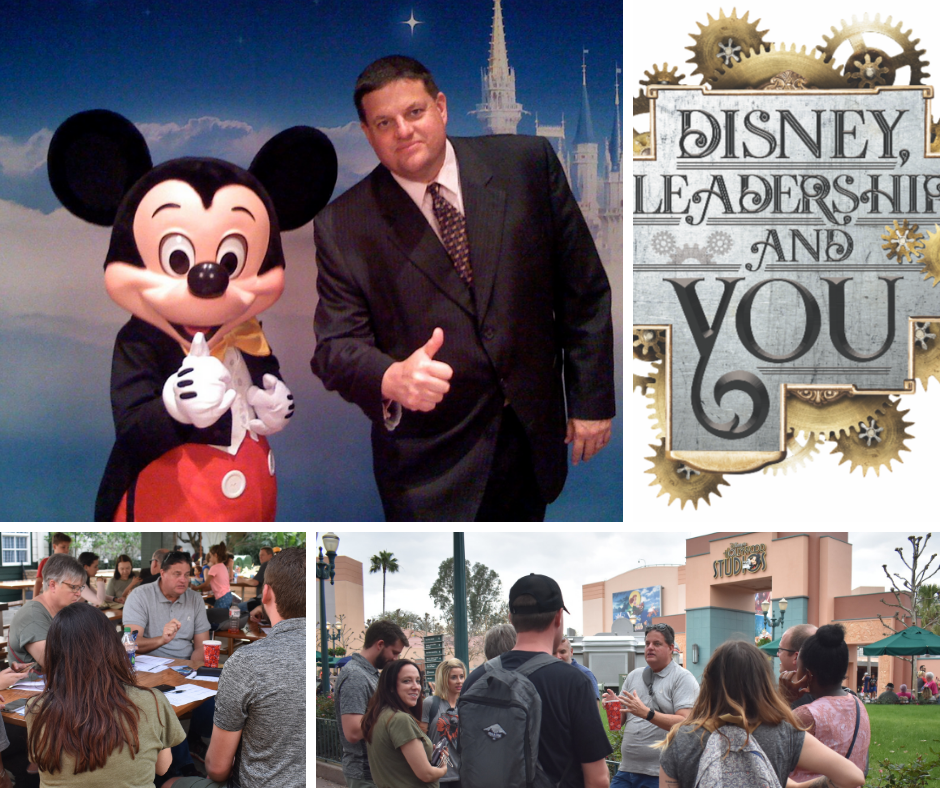
J. Jeff Kober’s book, “Disney, Leadership, and You” is an excellent work that more than delivers on its title.
Drawing from an inquisitive mind and keen insight, Kober has nearly five decades experience with Walt Disney – from both within and without the company – which provide a very readable, practical, and thoroughly enjoyable leadership book that you will find yourself returning to time and again for just the right nugget to use.
I have known of Jeff for years through his writing, and several years ago was grateful to meet him and engage his services for an immersive park experience with a group I was leading. The warmth, wit, and sheer knowledge of Disney, coupled with his ability to instantly link it to practical applications of my group, was one of the highlights of our experience. That same experience has been translated into this book.
If you are a leader in any size or type of organization, the stories Jeff Kober has captured in “Disney, Leadership, and You” should be a valuable addition to your library, a source of personal encouragement, and a wealth of practical training for both you and your team.
The book is divided into four sections:
Defining Leadership
Leaders Attain Results
Leaders Build Relationships
Putting It All Together
In those four sections you will find 18 themed chapters, each chock full of leadership principles illustrated with stories of Disney leaders from all ranks. The principles are solid in themselves, but what makes them memorable is the stories of the Cast Members.
The stories and principles perfectly describe how Disney Cast Members create magic each day through their hard work and respect for Walt Disney’s original vision.
You organization is not Disney, but you can learn from their excellence. “Disney, Leadership, and You” is an extraordinary source of lessons and learning to help you make a dramatic impact on why you do, what you do, and how you do it.
Leadership means that a group, large or small, is willing to entrust authority to a person who has shown judgement, wisdom, personal appeal, and proven competence.
On October 16, 2023, the Walt Disney Company will celebrate its 100th Anniversary. Today kicks off a series in recognition of this event – a series looking into the characteristics that have made the Walt Disney Company a beacon of innovation and imagination, enchanting audiences of all ages with its timeless stories, beloved characters, and groundbreaking achievements.
Some of the articles have existed before and been refreshed for this series; others are brand new. In either case, I hope you will enjoy reading about the dreamers, the believers, and the magic-makers who have brought us a century of enchantment.
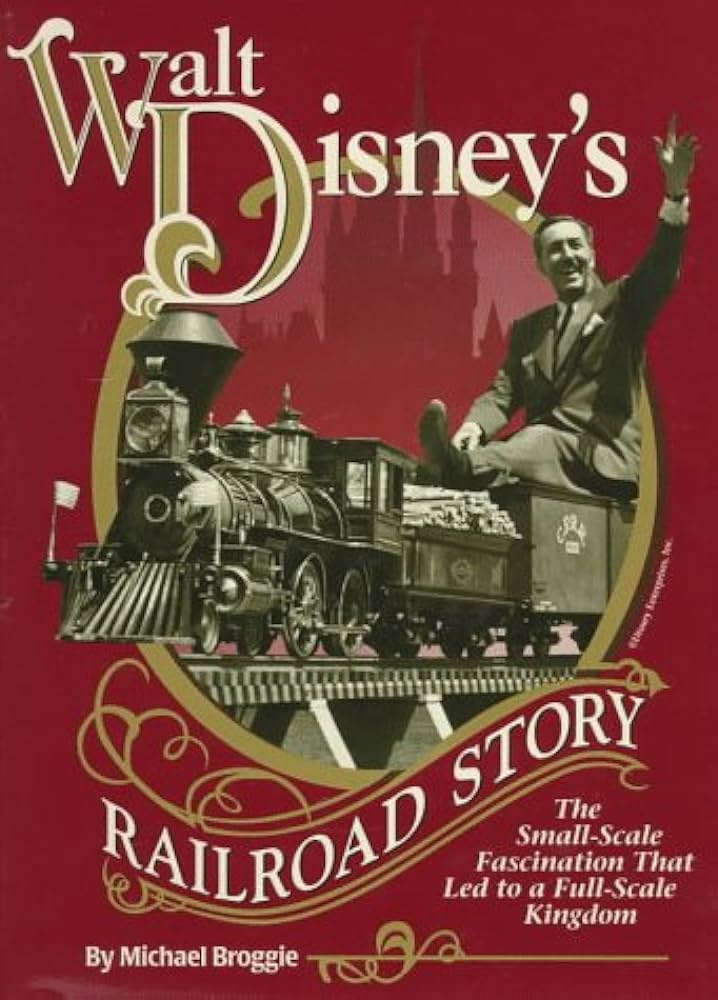
To say that Walt Disney was merely a train enthusiast understates the extent to which his life was intertwined with railroading. In Walt’s case, his small-scale fascination led to a full-scale kingdom.
Michael Broggie, Walt Disney’s Railroad Story
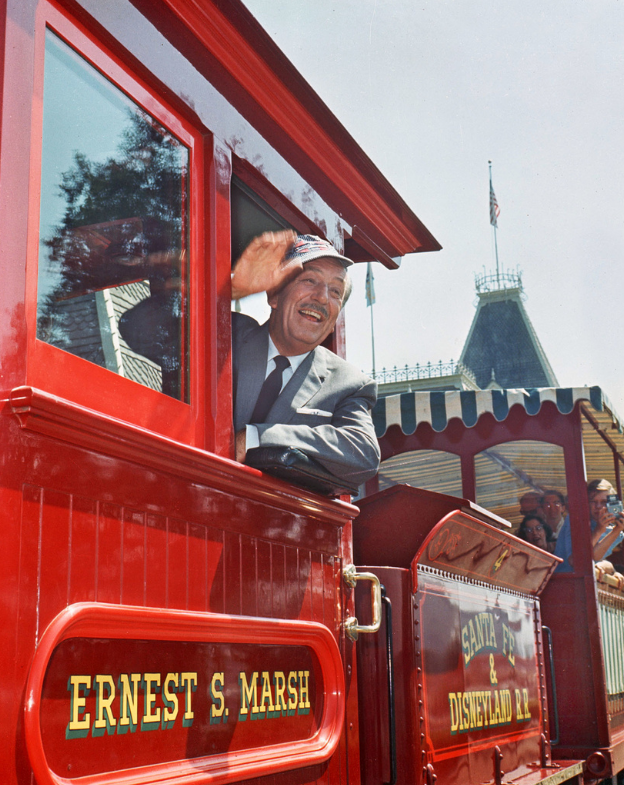
With love of Disney history, I’m always grateful to visit Disney properties and immerse myself in the stories and culture of Walt Disney and the “kingdoms” he began. During one multi-day visit to California, I had the opportunity to visit Disneyland several days, experiencing both the familiar and new perspectives.
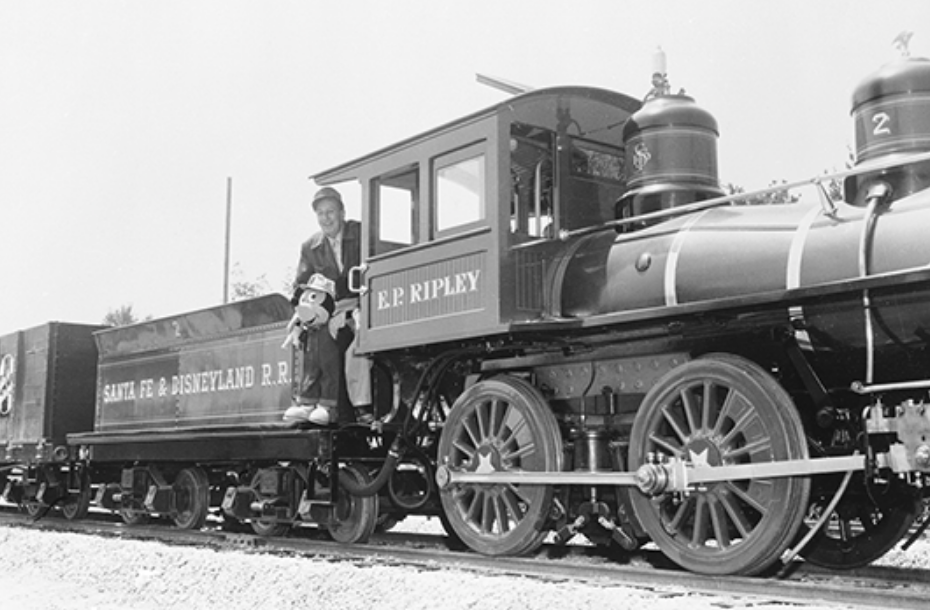
Take this image, for example:
In talking with current Cast Members, Tour Guides, and former Imagineers, various stories were given as to the origin of Disneyland:
It was Walt Disney’s fascination with trains, beginning as a boy, that led him to first create a scale model railroad in his backyard. Not satisfied, he begin to develop an ever-growing park that would include a railroad. When Disneyland opened in 1955, the first object you saw approaching the park was a train station, and a 5/8 scale railroad encircled the park.
Saturday’s were “Daddy’s Day,” and Walt often took his daughters to play in nearby parks. While sitting on a bench in Griffith Park, Walt imagined what a park would look like that would allow both parents and children to be immersed in a story-rich, safe, clean park.
Fascinated by miniatures, Walt began a hobby of crafting extremely detailed miniature items, building entire rooms filled with objects that were not only beautiful to look at, but fully functional. He envisioned a place to display these miniatures so that people from all over the country could enjoy them.
By the late 1940’s-early 1950’s, Walt had grown tired of making animated pictures, and even his recent venture into live-action motion pictures left him dissatisfied. He imagined a place were people could actually be a part of a story, immersed in all the rich details that a “theme park” could provide.
What is the true origin of Disneyland?
I believe that all of the above contributed to the creation of Disneyland. And the common denominator of all of them?
Passion.
I want it to look like nothing else in the world.And it should be surrounded by a train.
Walt Disney
The creation story of Disneyland, the first “theme” park in the world and the model for all Disney parks to follow, is somewhat clouded.
Depending on who is telling it, or even when it is told, the origins of Disneyland can start with a park bench, model making, boredom, or a boyhood fascination with trains.
There is a measure of truth to all of them. It is certain is that all of these influences in the life of Walt Disney contributed to the resulting creation.
Personally, I lean toward Walt’s love of trains as the primary inspiration for Disneyland.
As a bona fide Disney fan, focusing on the history of the man and the company that bears his name (especially from the late 1920s to the mid-1960s), I can trace “railroad” stories from Walt (and about Walt) that reinforce this.
Those railroad stories could (and do) fill several books – the best of which is Walt Disney’s Railroad Story, by Michael Broggie.
It’s a fascinating book, and when the author knew of Walt Disney as “Uncle Walt,” and had the enviable role as a teenager to assist Walt in the operation of the Carolwood Pacific Railroad (Disney’s personal, rideable miniature railroad in the backyard of his home), you know the stories are going to be memorable, filled with detail, and a fascinating read.
You see, Michael Broggie’s father Roger E. Broggie was a precision machinist who joined the Disney Studios in 1939. Broggie’s accomplishments at the studio were wide-ranging, but in the early 1950s he was promoted to the head of the Disney Studios’ Machine Shop, where he became a transportation specialist.
And where did he fine-tune the skills needed to create all the unique transportation vehicles found at Disneyland and later at Walt Disney World?
In building Walt Disney’s backyard railroad…
On the Carolwood Pacific Railroad.
The Carolwood Pacific Railroad (CPRR) was a 7 1/4-inch gauge ridable miniature railroad run by Walt Disney in the backyard of his home in the Holmby Hills neighborhood of Los Angeles, California.
It featured the Lilly Belle, a 1:8-scale live steam locomotive named after Disney’s wife, Lillian Disney, and built by the Walt Disney Studios’ machine shop. The locomotive made its first test run on December 24, 1949. It pulled a set of freight cars, as well as a caboose that was almost entirely built by Disney himself.
It was Disney’s lifelong fascination with trains, as well as his interest in miniature models, that led to the creation of the CPRR. The railroad, which became operational in 1950, was a half-mile long and encircled his house. The backyard railroad attracted visitors to Disney’s home; he invited them to ride and occasionally drive his miniature train.
With the creation of a personal railroad, Disney’s next step could only be designing and building the real thing.
Research into the earliest development of Disney’s “park” reveals a constant: the presence of a railroad with a steam engine pulling cars that people could ride in.
So, any visit to a Disney theme park for me must include a ride on the Disney Railroad.
Unfortunately, on my last visit to Walt Disney World on the occasion of its 50th anniversary on October 1, 2021, the railroad had been out of commission since 2018 for the pandemic-delayed construction of the TRON Lightcycle Run, a new attraction coming to the Magic Kingdom. The train tracks have been rerouted through the Lightcycle attraction inside a tunnel as shown in this concept art.
I knew any surprise announcement that the train would be running on October 1 was unlikely, but it wasn’t until I rode the People Mover early that morning and saw the view of the dismantled train tracks, plainly visible where they would run through the future Lightcycle Run attraction, that the disappointment set in.
In the meantime, the train was available as the perfect backdrop for a memorable photo at different places in the park. Just before Christmas 2022, it began to run again.
For me, “the perfect backdrop” of a static display is a far cry from the swaying motion of the train as it leaves the station and begins to circle the park…
..the way Walt Disney dreamed about it from the time he was a young boy…
In a recent post on walking unplugged, I mentioned that I would be walking the next day with my feet.
I wasn’t trying to be flippant – I was merely stating that your feet can tell you a lot about where you’re walking, and what you’re walking on, and in the process, you can learn a lot.
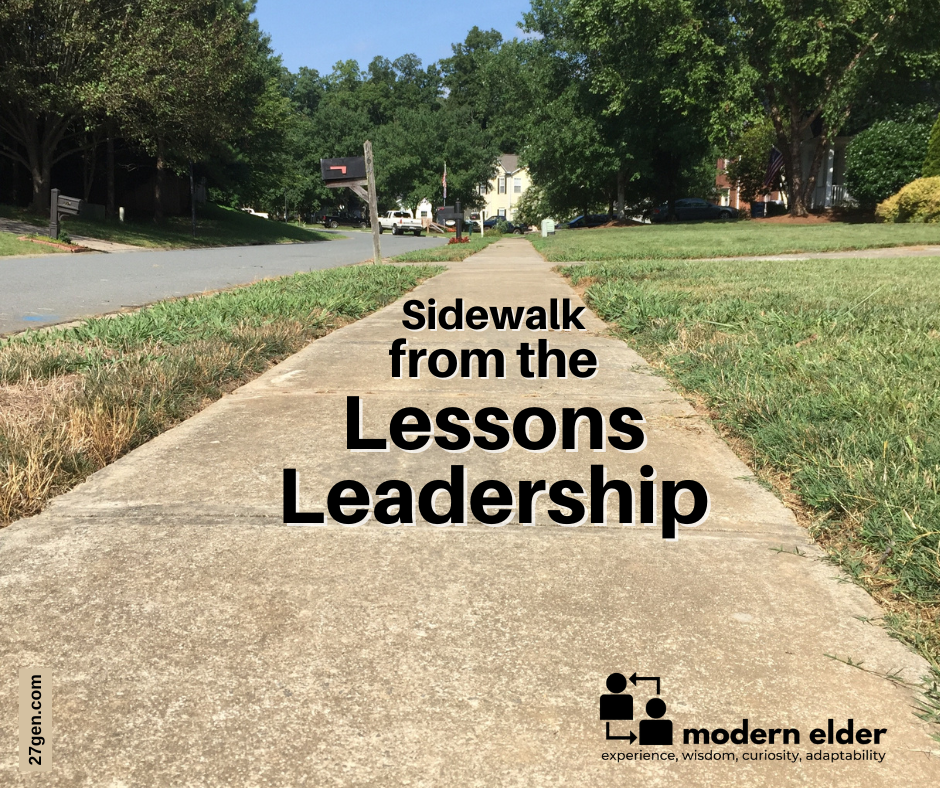
With that going through my head, I began my walk – and it wasn’t long before I realized Leadership Lessons the sidewalk could teach me.
In a short walk through my neighborhood, I felt and observed the following:
Raised Sidewalk – visible, growing tree roots: Leaders should always be looking for obscure things that may trip them up.
Sunken Sidewalk – hidden sources of erosion: Leaders should be cautious of unseen things that will bring them down and stunt their capabilities.
New Sidewalk Section – replacing to make it functional again: As your leadership grows and matures, you can count on learning new ways to do some things better.
Clean Sidewalk – appearances matter: Leaders must present themselves in the best manner possible, which instills confidence.
Dirty, Stained Sidewalk – see above: Conversely, sloppy appearances give others pause.
Cracked Sidewalk – too heavy a load: Leaders aren’t super heroes, and must balance the “load” they carry.
Grass in Sidewalk – maybe lazy, but at least distracted: Leaders who allow interruptions won’t be able to focus.
Grass growing over the Sidewalk – know your boundaries: Leaders know that boundaries help focus attention and align teams.
Sidewalks – take you somewhere: Leaders don’t fly solo; they must take others with them.
Sidewalks – make your journey easier: Well-prepared leaders are in a better position to help others on the journey.
Sidewalks – make your journey safer: Leaders watch out for the safety and welfare of others.
Sidewalks – lift you above the road: Leaders must rise above their surroundings.
In their civic role, sidewalks play a vital purpose in city, town, and suburban life. As conduits for pedestrian movement and access, they enhance connectivity and promote walking. Safe, accessible, and well-maintained sidewalks are a fundamental and necessary investment.
But for me, they provide great leadership lessons.
And of course, I couldn’t resist sharing Shel Silverstein’s most appropriate poem:
“There is a place where the sidewalk ends And before the street begins, And there the grass grows soft and white, And there the sun burns crimson bright, And there the moon-bird rests from his flight To cool in the peppermint wind.
Let us leave this place where the smoke blows black And the dark street winds and bends. Past the pits where the asphalt flowers grow We shall walk with a walk that is measured and slow, And watch where the chalk-white arrows go To the place where the sidewalk ends.
Yes we’ll walk with a walk that is measured and slow, And we’ll go where the chalk-white arrows go, For the children, they mark, and the children, they know The place where the sidewalk ends.”
Tom Peters – Seth Godin – Leonardo da Vinci: a unique trio?
All of us come into the world curious.
I saw it in the birth and development of each of my four children. In different but equally valid ways, I see it in each of my eight grandchildren.
We’ve all got it; the challenge is using and developing it for our own benefit. I think our curiosity is at its highest from birth through our first few years. A baby’s every sense is attuned to exploring and learning – everything is an experiment. They don’t know it yet; to them it’s just survival. Then in a few months, or years, their curiosity becomes vocal:
• Daddy, how do birds fly?
• Mommy, what does a worm eat?
• Why? How? When? What?
It’s easy to lose our curiosity as we grow into adulthood – after all, we think we know it all (or at least everything we need to know.)
Not really.
Great, growing, learning minds go on asking confounding questions with the same intensity as a curious three-year old. A childlike sense of wonder and insatiable curiosity will compel you to always be a learner.
From Seth Godin:
I’ve noticed that people who read a lot of blogs and a lot of books also tend to be intellectually curious, thirsty for knowledge, quicker to adopt new ideas and more likely to do important work. I wonder which comes first, the curiosity or the success?
From Tom Peters:
Swallow your pride, especially if you are a “top” boss. Ask until you understand. The “dumber” the question, the better! Ask! Ask! Ask! (Then ask again!). Above all, sweat the details – the weird, incomprehensible “little” thing that appears in Footnote #7 to Appendix C that doesn’t make sense to you. Probe until you find out what it means.
From Leonardo da Vinci:
Do you not see how many and varied are the actions which are performed by men alone? Do you not see how many different kinds of plants and animals there are? What variety of hilly and level places, and streams and rivers, exist? I roam the countryside searching for answers to things I do not understand. These questions engage my thought throughout my life.
A few questions for you:
• How curious are you?
• When was the last time you sought knowledge simply for the pursuit of truth?
• Do you know curious (really curious) people?
• Do you want to be a lifelong learner?
Without “why?” there can be no “here’s how to make it better.”
A question, thoughtfully conceived, can illuminate a room, a company, a life.
Chip Conley, Wisdom @ Work
Part of a regular series on 27gen, entitled Wednesday Weekly Reader
During my elementary school years one of the things I looked forward to the most was the delivery of “My Weekly Reader,” a weekly educational magazine designed for children and containing news-based, current events.
It became a regular part of my love for reading, and helped develop my curiosity about the world around us.
On this day in 1887, Groundhog Day, featuring a rodent meteorologist, is celebrated for the first time at Gobbler’s Knob in Punxsutawney, Pennsylvania. According to tradition, if a groundhog comes out of its hole on this day and sees its shadow, there will be six more weeks of winter weather; no shadow means an early spring.
Historical background of Groundhog Day includes:
Rooted in the ancient Christian tradition of Candlemas Day, where clergy blessed and distributed candles for winter; the candles represented how long and could winter would be
Germans expanded on the idea by selecting the hedgehog as a means of predicting weather
German settlers to America in Pennsylvania continued the tradition, switching to the groundhogs as hedgehogs weren’t available
Groundhogs do emerge from hibernation in February, but only to look for a mate before going underground again
They come out of hibernation for good in March
In 1887 an enterprising newspaper editor declared that Phil, the Punxsutawney groundhog, was America’s only true weather-forecasting groundhog.
Phil and his descendants might be the most famous, but many towns across North America now have their own meteorology Marmota monax.
The 1993 movie “Groundhog Day” popularized the usage of “groundhog day” to mean something that is repeated over and over.
Unfortunately, there are a lot of scary parallels in the church world:
Do you have ongoing traditions from the past that had original meaning but have now lost that meaning?
Have you adapted your traditions to fit the culture of your community?
Are your traditions based on something that no longer is relevant?
Do you market your traditions on their own merits, or are you exploiting them?
Are your traditions the same as a half-dozen other churches in your town?
Do your traditions have a life of their own, long-ago outliving their original useful purpose?
While you may view this post as “anti-tradition”, neither it nor I am! I love history and tradition – I have minors in history at the graduate and post-graduate levels, study history all the time, and know that it can be a powerful teacher.
Our history should be a bridge to the future, not an anchor to the past.
Churches should be students of their past – but also their present, in order to help write their future.
Can you as a church leader understand and appreciate the history of your church and its traditions? At the same time, are you a cultural anthropologist of your community, understanding what’s going on today? Combining the two will give you and your leadership team a solid foundation for future opportunities!
Part of a recurring series on 27gen: Chef Stories. Stories from the past, present, and future in my personal experience in various parts of the culinary world. This particular story is from a few years ago, when my son was entering his senior year at Johnson & Wales University in pursuit of a degree in Culinary Arts and Food Service Management. It’s the second part of a longer post begun last week.
In the last post, we saw “Poetry in Motion” by looking at efficiency. Today, it’s all about a successful end to whatever you’re doing – by starting with everything in its place.
In the culinary world, it’s called “mis en place.”
French for “put in place”, this is what allows all the actions described yesterday to take place. It is the hours of work that start before the first meal is fired: washing, cutting, peeling, pre-cooking, weighing, portioning, and positioning of all the ingredients that go into the wonderful final product.
courtesy Rooster’s Kitchen
Taken broadly, it is the slow simmering of the soups for the night; the baking and preparation of individual items that comprise the wonderful complexity of desserts. It even goes to the preparation of the wood fires that will later cook the wonderful meats that anchor the meal.
Mise en place doesn’t get any attention in the final review, but you wouldn’t have anything without it. It’s all those things that aren’t noticed till they’re not there. It’s the sauté chef reaching in the cooler knowing that he has all the right ingredients to prepare the dish just called out. It’s the pastry chef preparing 3 different kinds of ice cream for the desserts on the menu. It’s the fry chef making sure the oil is fresh and hot, ready for use. It’s the salad chef having everything ready to assemble a variety of salads from the same few ingredients, differing in presentation and dressing.
courtesy Rooster’s Kitchen
It’s the dishwasher, knowing if he doesn’t get the dirty pans out and clean ones back, the whole kitchen grinds to a halt.
Mise en place is all about the knowing everything that is required to produce the finished meal, and making sure all the ingredients are ready to use when needed. It’s about thinking through things before they happen, so that when they happen, you’re one step ahead.
It’s all about being prepared.
Our evening at Rooster’s Wood-Fired Kitchen was delightful on so many levels. The front of house staff were gracious in working with me to make sure we could have a front row seat to all the action; the wait staff were friendly, knowledgeable, and attentive; the chefs prepared wonderful food while displaying their skills to an audience.
But it was more than just a meal – it was a demonstration of excellence from top to bottom, one that any organization could learn from.
Whatever your end product is – a worship experience, sermon, leadership class, playtime with kids, etc.
…it all starts with making sure you have everything in its place before beginning.
Part of a recurring series on 27gen: Chef Stories. Stories from the past, present, and future in my personal experience in various parts of the culinary world. This particular story is from a few years ago, when my son was entering his senior year at Johnson & Wales University in pursuit of a degree in Culinary Arts and Food Service Management.
Recently my wife, youngest son, and I were treated to absolute poetry in motion. A group of trained professionals were executing their craft, each one knowing his specific responsibilities as well as supporting the rest of his team. Years of practice were evident in their graceful moves, focused intensity, and clarity of purpose. We had front row seats, and the show was excellent.
No, we weren’t watching a ballet or dance company, or an athletic event – we were eating dinner, celebrating a special occasion.
The kitchen is right in the center of the restaurant, and we had reservations in the prime observation spot – the Chef’s Counter – where all the action was just a few feet away.
The food was excellent: fresh ingredients, prepared in such a way to bring out the natural flavors, served by a warm and friendly wait staff. But this isn’t about the food, as good as it was. It’s about two fundamentals of the restaurant business that can be applied to your organization: efficiency and mise en place. Today let’s look at efficiency; next time, mise en place.
Rooster’s doesn’t have a large kitchen, but it is designed to function with efficiency. The sauté station anchors one half of the center; this is where constant motion is an understatement. Sauté is where the chef is juggling eight or ten pans at a time, making flames, making things jump.
Around the corner at the rear of the kitchen is the namesake of the restaurant: a wood fired grill and oven. The chef here grills all the meat dishes called out, sending them to the front to be paired with side dishes – some from the saute’ station, others from the other half of the kitchen center – the salad, soup, and fry station. To call these dishes “sides” is an injustice – any one of them (we had five among the three of us) could stand alone as a signature dish.
The front area is grand central station: here the expediter calls out the orders as they come in, checks on orders in progress, and makes the final touches as they head to the guest. The final touch is important – it may be the finishing touch of sauce, or a garnish, or a quick wipe of an errant splatter on the plate.
The corners of the kitchen: pastry chef, preparing delicacies to finish out a wonder dinner; meat chef, taking larger cuts prepared on the grill and finishing them to order; and the support staff, taking out dirty pans and bringing in clean ones and bowls, plates, cups and saucers for the chefs to cook and plate food.
A picture doesn’t do this justice – you would have to have a video camera to catch all the movement involved above. But I want to drive home the point:
courtesy of Rooster’s Kitchen
It’s all about efficiency: no wasted movement.
Everyone in the kitchen knew what was going on, what their job was, and how they can support the rest of the team as needed. The pastry chef would slip around the sauté station, helping the chef plate items as they came off the stove. Once, she literally held out a plate to her back, out of sight, and the chef plated the dish, while she was moving another one with her other hand.
The sauté chef helped out on the grill; the expediter helped out on saute’; the pastry chef started an item on the grill when that chef had to step away for a moment.
That is more than efficiency – it’s the solid work of a team that knows individual and team roles, to the point that they are one.
Can you say the same about the teams in your organization?
Coming Next Week: Part 2, A Successful End Starts with the Beginning
Like many parents, my coaching career began with my own kids. First it was my oldest son (now 40) and Pee Wee Basketball. After a couple of years, I traded my tennis shoes for a pair of soccer cleats, and began a 10-year run coaching various levels of soccer teams for all 4 of my kids at one time or another, often multiple teams in the same year. When my youngest son (now 28) moved beyond my coaching skills and desires, it was time to retire and become a spectator.
Of the many lessons I learned as a coach, one stands out:
If you want to be a coach, you’d better have a whistle.
Imagine a group of 14 5-year olds, most who have never participated in any kind of organized sports. Add a beautiful spring day, a group of over-eager parents, and the child’s natural tendency to just want to kick the ball. Often jokingly referred to as “herd ball”, that’s what most kids’ introduction to soccer looked like.
Over a 10-year period, I coached 14 different teams, often 2 seasons a year. The teams went from beginning level soccer as 5 year olds to Challenge level for 12 year olds to Classic level for 18 year olds. Coaching both boys and girls of all ages and skill levels, with each one bringing their unique personality to the field, it was often challenging at best to coach.
Enter the whistle.
You may consider it a throwback to a different time, but I found it quite effective for all ages of players (and quite a few parents, too). It may have been unorganized chaos on the field to begin with, but after two sharp and loud blasts on the whistle, the players would stop what they were doing and give me their attention. What I did with their attention is another story, but it’s the sound of the whistle that is important here.
It stopped everyone from what they were doing and turned their attention to the coach.
You may not be a coach, but as a leader you have a room full of team members, often doing all kinds of different activities at once. When you need to get their attention, what do you do? How can you quickly and efficiently get their attention and make the best use of everyone’s time?
Leaders need a whistle, too.
The difference between a great practice session and a good one – and often the difference between a great organization and a good one – is established in systems that allow your productive work to be obsessively efficient.
Great leaders step in with whistles – clear, distinctive signals – to make people’s practices efficient as possible – even in professional settings and even with adults.
How is time wasted in your organization? What can you do differently?











 27gen.com