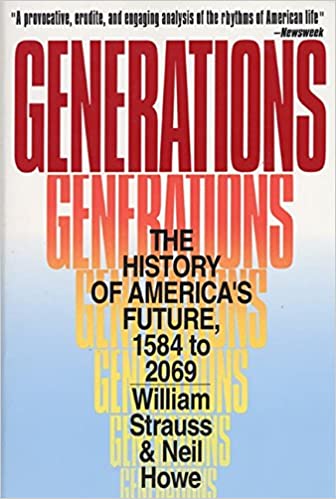
Today is a follow on post to The History of America’s Future, which looked at Generations, a 1992 book by William Strauss and Neil Howe. Generations is a speculation by the authors that the history of America can be seen as a succession of generational cycles.
The Fourth Turning is one of their follow-up books, taking a DEEP dive into what the next “turning” could look like. Keep in mind that this was written in 1997, and uses past history to project a possible future.
A few quotes from the opening chapter sets the tone:
America feel’s like it’s unraveling.
Though we live in an era of relative peace and comfort, we have settled into a mood of pessimism about the long-term future, fearful that our superpower nation is somehow rotting from within.
Not long ago, America was more than the some of its parts. Now, it is less. Where we once through ourselves collectively strong, we now regard ourselves as individually entitled.
Yet even while we exalt our own personal growth, we realize that millions of self-actualized persons don’t add up to an actualized society. Popular trust in virtually every American institution – from businesses and governments to churches and newspapers – keeps falling to new lows. Public debts soar, the middle class shrinks, welfare dependencies deepen, and cultural arguments worsen by the year.
Wherever we’re headed, America is evolving in ways most of us don’t like or understand. Individually focused yet collectively adrift, we wonder if we’re headed toward a waterfall.
I first read these words when the book was released, and readily identified with them. Over the 20+ years since, I think they are even more prophetic.
Here is how Strauss and Howe set up this book:
At the core of modern history lies this remarkable pattern: Over the past five centuries, Anglo-American society has entered a new era – a new turning – every two decades or so. At the start of each turning, people change how they feel about themselves, the culture, the nation, and the future. Turnings come in cycles of four. Each cycle spans the length of a long human life, roughly eighty to one hundred years, a unit of time the ancients called the speculum. Together, the four turnings of the speculum comprise history’s seasonal rhythm of growth, maturation, entropy, and destruction:
The First Turning is a High, an upbeat era of strengthening institutions and weakening individualism, when a new civic order implants and the old values regime decays.
The Second Turning is an Awakening, a passionate era of spiritual upheaval, when the civil order comes under attack from a new values regime.
The Third Turning is an Unraveling, a downcast er a strengthening individualism and weakening institutions, when the old civic order decays and the new values regime implants.
The Fourth Turning is a Crisis, a decisive era of secular upheaval, when the new values regime propels the replacement of the old civic order with a new one.
Each turning comes with its own identifiable mood. Always, these mood shifts catch people by surprise.
Strauss and Howe label The Fourth Turning as a book that turns history into prophecy, taking you on a journey through the confluence of social time and human life.
Part One – Seasons – Acquiring new tools for understanding self, life, family, society, and civilization. Learn about the cycles of life, generational archetypes, turnings, and history.
Part Two – Turnings – Revisit post-World War II American history from the perspective of turnings and archetypes. Gain new insight about why the first three turnings of the current Millennial Saeculum have evolved as they have. Read why this saecular journey must culminate in a Fourth Turning and what is likely to happen when it does.
Part Three – Preparations – Explore what you and the nation can do to brace for the coming Crisis. Learn how, by applying the principles of seasonality, we can steer our destiny.
An appreciation for history is never more important than at times when a saecular winter is forecast. In the Fourth Turning, we can expect to encounter personal and public choices akin to the harshest ever faced by ancestral generations. We would do well to learn from their experience, viewed through the prism of cyclical time. Through much of the Third Turning, we have managed to postpone the reckoning. But history warns that we can’t defer it beyond the next bend in time.
Part of a series looking at history and future through the lens of generations
Sometime in the early 1990s, I became aware of a new book by William Strauss and Neil Howe, entitled Generations: The History of America’s Future, from 1584 to 2069. As a student of history, I eagerly dove into the book, studied it, and have revisited it often in the thirty years since.
In Generations, the authors speculate the history of America as a succession of generational biographies, beginning in 1584 and encompassing everyone through the children of today. Their bold theory is that each generation belongs to one of four types, and that these types repeat sequentially in a fixed pattern. The vision of Generations allows us to plot a recurring cycle in American history – a cycle of spiritual awakenings and secular crises – from the founding colonists through today and well into this middle of this century.
Generations come in cycles.Just as history produces generations, so too do generations produce history.
William Strauss and Neil Howe
From the book, a brief description of the four cycles:
Strauss and Howe labeled the four generational types Prophet, Nomad, Hero, and Artist. With one exception, they have always recurred in a fixed order. During a spiritual awakening, Prophets are moving into rising adulthood while Nomads are appearing as children; during a secular crisis, Heroes are moving into rising adulthood while Artists are appearing as children. Later in life, these generations trigger another social moment and thus keep the cycle turning.
The first and third types are what we call “dominant” in public life – Prophets through redefining the inner world of values and culture, and Heroes through rebuilding the outer world of technology and institutions. The other two types are “recessive” in public life, checking the excesses of their more powerful neighbors – Nomads as pragmatists, Artists as ameliorators.
The passage of four generations, Prophets through Artists, completes one full generational cycle over the course of four, twenty-two year phases of life (a total duration of roughly ninety years). From the 1584 Puritan birth year forward, the authors traced five such cycles through American history – of which three (Colonial, Revolutionary, and Civil War) are fully ancestral, a waning fourth (Great Power) comprises the eldest 28 percent of the American population at the beginning of 1991 (when the book was released), and an emerging fifth (Millennial – the name of the cycle, not the name of the generational cohort) includes the youngest 72 percent. Within these cycles, we identify eighteen generations, from John Winthrop’s Puritans to Jessica McClure’s Millennials – and a recurring pattern of awakenings and crises.
Keep in mind that this was written in 1991.
So, here we are in late 2020, and what does the history of America’s future look like?
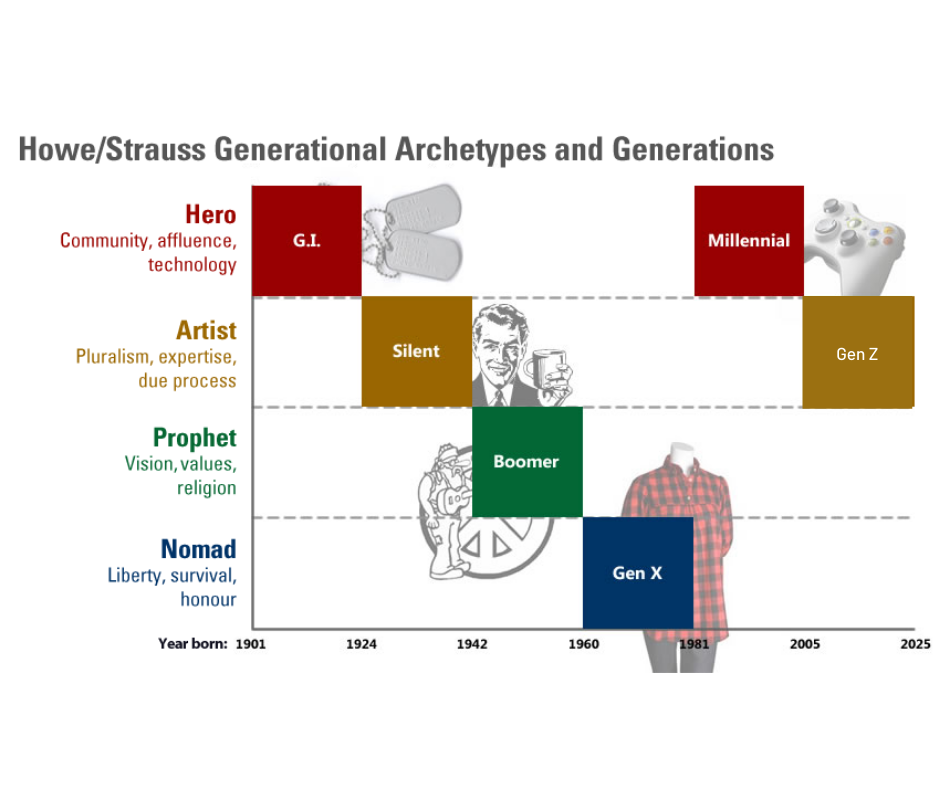
From above: during a secular crisis, Heroes are moving into rising adulthood while Artists are appearing as children.
That would be today’s Millennials moving into rising adulthood, and Gen Z appearing as children and teenagers.
So, according to Strauss and Howe, a secular crisis looms.
That pretty much describes 2020, don’t you think?
Here is where the life cycle can help. The story of civilization seldom moves in a straight line, but is rich with curves, oscillations, and mood shifts. The ebb and flow of history often reflect the ebb and flow of generations, each with a different age location, peer personality, and lifecycle story. By viewing history along the generational diagonal, by searching the cycle for behavioral clues, we can apply the mirror of recurring human experience to gaze around the corner of current trends and say something instructive about the decades to come.
William Strauss and Neil Howe
Here’s a timeline visualization of the generational cohorts:
A Lesson in Culture Transfer from One Generation to the Next
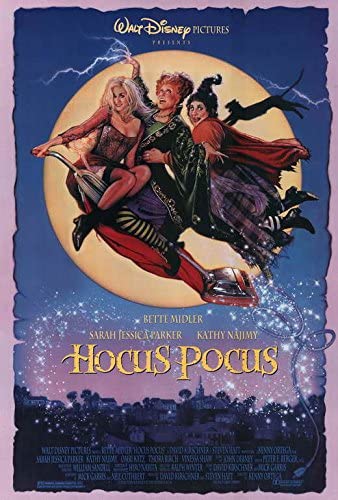
When it first hit theaters in 1993, Hocus Pocus performed poorly at the box office and with critics. However, thanks to annual replays on cable and strong video/DVD sales, a core fan group kept it alive over the years.
When the Disney Halloween classic was released to theaters earlier this month, it quickly rose through the ranks to become 2020’s biggest box office. Granted, the numbers are tiny compared to pre-COVID box office totals, but people are still going to theaters and strange things are happening.
Which is totally appropriate for Hocus Pocus, a bonafide 90s classic that children of that decade – now parents – are introducing to their children.
And by the way, that last sentence describes my two older kids – born in 1981 and 1984.
They first saw Hocus Pocus in theaters when released, later on VHS, and for a few years now, rewatch it every year on DVD or streaming.
Now, they are introducing it to a new generation – my grandchildren.
The movie’s unexpected success at the box office is impressive since it is widely available for fans to rent or buy and stream on various platforms; it’s free on Disney+; and it has aired on Disney’s “Freeform” as well.
There’s even a book about it – Hocus Pocus in Focus, by Aaron Wallace. My daughter and her husband – born in the late 80’s – devoured it when it came out, talked about it with their friends, and now viewing the film on Disney+ is evidently a big deal among their friends.
Of course, with Disney involved, you know what comes next – a sequel.
Bette Midler, who played Winnie Sanderson in the original, recently confirmed that she, along with co-stars Sarah Jessica Parker (Sarah Sanderson) and Kathy Najimy (Mary Sanderson) will all be returning as the Sanderson sisters for the second Hocus Pocus movie.
The sequel will be coming to Disney+ at an undesignated date in the future.
As I was researching different sources for this post, it occurred to me that I have stumbled upon a whole new thread of generational research – the transfer of culture from one generation to the next.
Immediately, I thought of the Disney Company. Certainly, my Disney fanaticism was fully developed in the last couple of decades – but I was introduced to it by my parents. First, through movies: my first movie seen in a theater (1964), and my favorite Disney movie even today, is Mary Poppins. Then, my father, as a Gulf gas station owner, was part of a Gulf-Disney marketing campaign throughout the mid to late 60s. We received regular promotional items, like magazines and record albums (which I still have!), which his customers eagerly snatched up.
When my wife and I became parents (four times, from 1981 – 1992), the introduction of Disney movies through first theaters then VHS tapes was a regular part of family entertainment. It continued with the shift from a cable channel to DVDs then streaming services.
As our children became parents, they did (and are doing) the same: Disney entertainment is a regular part of their lives, especially with the advent of the Disney+ streaming service.
In 2016, my wife and I brought this to a new level: a week-long family vacation for all 15 members of our family to Walt Disney World.
From viewing movies to visiting theme parks to sharing our Disney-related gifts across birthdays and other times, the Adams family culture had been deeply imbedded with a Disney imprint.
In my childhood, that meant one thing: Disney. To my children and grandchildren, though, it’s much more:
Walt Disney (movies, cable channel, TV shows, theme parks, cruise line)
ABC
ESPN
The Muppets
Pixar
Marvel
Lucasfilm
21st Century Fox
Disney+ (I list this separately because of the HUGE impact it will have in the future).
and many more!
Here’s a graphical representation of the above:
You want to talk about the transfer of culture from one generation to the next and the next?
People generally see what they look for, and hear what they listen for.
Judge Taylor in Harper Lee’s To Kill a Mockingbird
People are blind to the unexpected, the unusual, the periphery.
That’s all 2020 has been.
We’re at an unprecedented juncture in history: several generations of relatively similar size are sharing the stage and competing for influence. Generations matter because they behave in specific ways related both to when they came of age and to their situation at the current moment. “The creation of a world view is the work of a generation rather than of an individual,” wrote novelist John Dos Passos. “But we each of us, for better or for worse, add our brick to the edifice.”
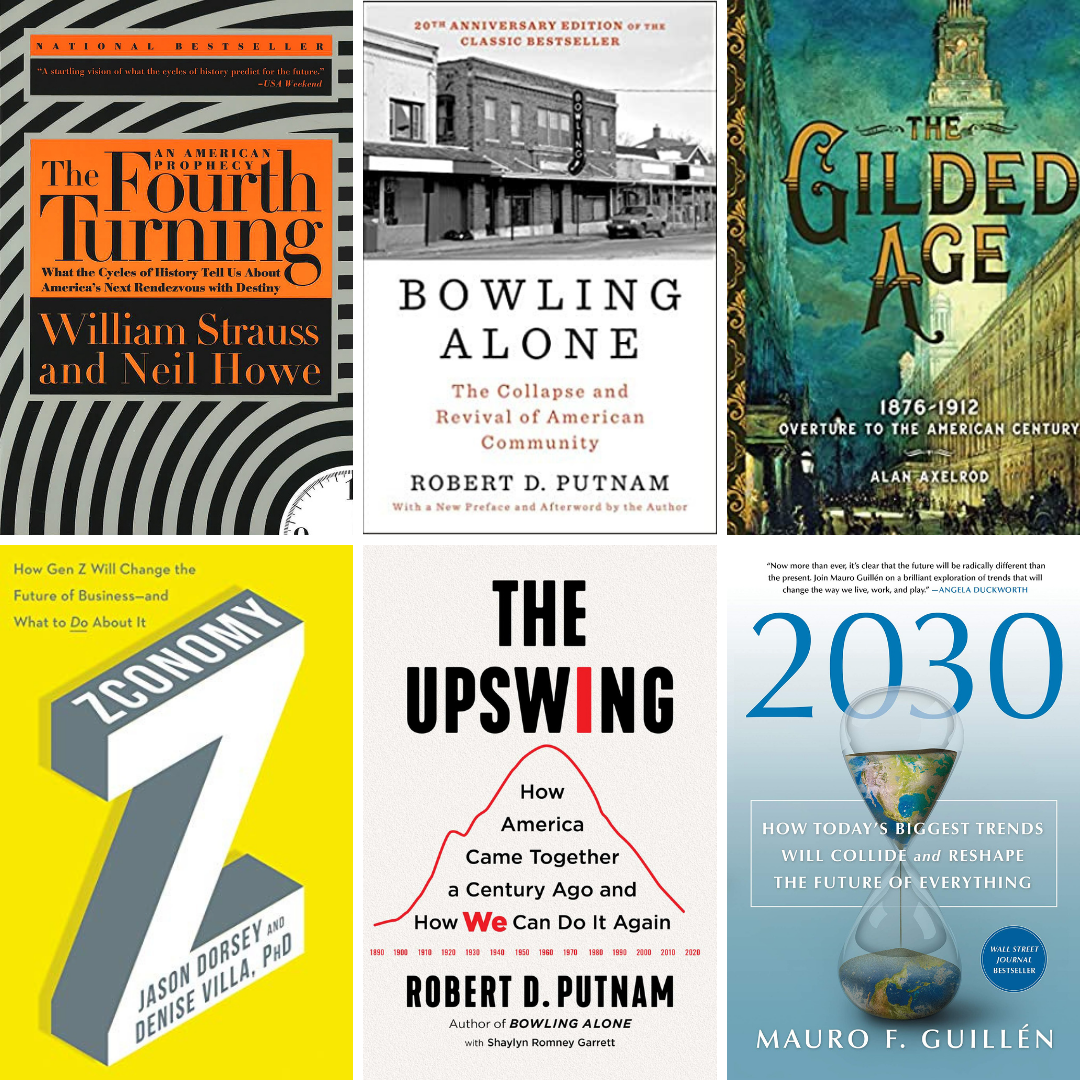
I’m beginning a deep dive into current and future intergenerational dynamics, and the six books below are my starting point.
The Fourth Turning, William Strauss and Neil Howe
William Strauss and Neil Howe will change the way you see the world—and your place in it. With blazing originality, The Fourth Turning illuminates the past, explains the present, and reimagines the future. Most remarkably, it offers an utterly persuasive prophecy about how America’s past will predict its future.
Strauss and Howe base this vision on a provocative theory of American history. The authors look back five hundred years and uncover a distinct pattern: Modern history moves in cycles, each one lasting about the length of a long human life, each composed of four eras—or “turnings”—that last about twenty years and that always arrive in the same order. In The Fourth Turning, the authors illustrate these cycles using a brilliant analysis of the post-World War II period.
First comes a High, a period of confident expansion as a new order takes root after the old has been swept away. Next comes an Awakening, a time of spiritual exploration and rebellion against the now-established order. Then comes an Unraveling, an increasingly troubled era in which individualism triumphs over crumbling institutions. Last comes a Crisis—the Fourth Turning—when society passes through a great and perilous gate in history. Together, the four turnings comprise history’s seasonal rhythm of growth, maturation, entropy, and rebirth.
The Fourth Turning offers bold predictions about how all of us can prepare, individually and collectively, for America’s next rendezvous with destiny.
Bowling Alone, Robert D. Putnam
Twenty years, ago, Robert D. Putnam made a seemingly simple observation: once we bowled in leagues, usually after work; but no longer. This seemingly small phenomenon symbolized a significant social change that became the basis of the acclaimed bestseller, Bowling Alone, which The Washington Post called “a very important book” and Putnam, “the de Tocqueville of our generation.”
Bowling Alone surveyed in detail Americans’ changing behavior over the decades, showing how we had become increasingly disconnected from family, friends, neighbors, and social structures, whether it’s with the PTA, church, clubs, political parties, or bowling leagues. In the revised edition of his classic work, Putnam shows how our shrinking access to the “social capital” that is the reward of communal activity and community sharing still poses a serious threat to our civic and personal health, and how these consequences have a new resonance for our divided country today. He includes critical new material on the pervasive influence of social media and the internet, which has introduced previously unthinkable opportunities for social connection—as well as unprecedented levels of alienation and isolation.
At the time of its publication, Putnam’s then-groundbreaking work showed how social bonds are the most powerful predictor of life satisfaction, and how the loss of social capital is felt in critical ways, acting as a strong predictor of crime rates and other measures of neighborhood quality of life, and affecting our health in other ways. While the ways in which we connect, or become disconnected, have changed over the decades, his central argument remains as powerful and urgent as ever: mending our frayed social capital is key to preserving the very fabric of our society.
The Gilded Age, Alan Axelrod
The Gilded Age—the name coined by Mark Twain to refer to the period of rapid economic growth in America between the 1870s and 1900—offers some intriguing parallels to our own time. Prolific historian Alan Axelrod tackles this subject in a fresh way, exploring “this intense era in all its dimensions. . . . This book will reveal it . . . as, truly, the overture of the ‘American Century.’” He also looks at how it presaged our current era, which many are calling the “Second Gilded Age.” Photographs, political cartoons, engravings, news clippings, and other ephemera help bring this fascinating period into focus.
Zconomy, Jason Dorsey and Denise Villa
Gen Z changes everything. Today’s businesses are not built to sell and market the way Gen Z shops and buys, or to recruit and employ Gen Z the way they find and keep jobs. Leaders need answers now as gen Z is the fastest growing generation of employees and the most important group of consumer trendsetters.
The companies that quickly and comprehensively adapt to Gen Z thinking will be the winners for the next twenty years. Those that don’t will be the losers or become extinct. Zconomy is the comprehensive survival guide on how leaders must understand and embrace Generation Z.
Researched and written by Dr. Denise Villa and Jason Dorsey from The Center for Generational Kinetics, the insights in Zconomy are based on their extensive research, they’ve led more than 60 generational studies, and their work with more than 500 companies around the world.
In Zconomy, Dr. Villa and Dorsey answer: Who is Gen Z? What do employers, marketers, and sales leaders need to know? And, most importantly, what should leaders do now?
This is the critical moment for leaders to understand and adapt to Gen Z or become irrelevant. Gen Z is already reshaping the world of business and this change is only going to accelerate. Zconomy is the definitive manual that will prepare any executive, manager, entrepreneur, HR or marketing professional to successfully unlock the powerful potential of this emerging generation at this pivotal time.
The Upswing, Robert D. Putnam and Shaylyn Romney Garrett
Deep and accelerating inequality; unprecedented political polarization; vitriolic public discourse; a fraying social fabric; public and private narcissism—Americans today seem to agree on only one thing: This is the worst of times.
But we’ve been here before. During the Gilded Age of the late 1800s, America was highly individualistic, starkly unequal, fiercely polarized, and deeply fragmented, just as it is today. However as the twentieth century opened, America became—slowly, unevenly, but steadily—more egalitarian, more cooperative, more generous; a society on the upswing, more focused on our responsibilities to one another and less focused on our narrower self-interest. Sometime during the 1960s, however, these trends reversed, leaving us in today’s disarray.
In a sweeping overview of more than a century of history, drawing on his inimitable combination of statistical analysis and storytelling, Robert Putnam analyzes a remarkable confluence of trends that brought us from an “I” society to a “We” society and then back again. He draws inspiring lessons for our time from an earlier era, when a dedicated group of reformers righted the ship, putting us on a path to becoming a society once again based on community. Engaging, revelatory, and timely, this is Putnam’s most ambitious work yet, a fitting capstone to a brilliant career.
2030, Mauro F. Guillén
Once upon a time, the world was neatly divided into prosperous and backward economies. Babies were plentiful, workers outnumbered retirees, and people aspiring towards the middle class yearned to own homes and cars. Companies didn’t need to see any further than Europe and the United States to do well. Printed money was legal tender for all debts, public and private. We grew up learning how to “play the game,” and we expected the rules to remain the same as we took our first job, started a family, saw our children grow up, and went into retirement with our finances secure.
That world―and those rules―are over.
By 2030, a new reality will take hold, and before you know it:
– There will be more grandparents than grandchildren
– The middle-class in Asia and Sub-Saharan Africa will outnumber the US and Europe combined
– The global economy will be driven by the non-Western consumer for the first time in modern history
– There will be more global wealth owned by women than men
– There will be more robots than workers
– There will be more computers than human brains
– There will be more currencies than countries
All these trends, currently underway, will converge in the year 2030 and change everything you know about culture, the economy, and the world.
According to Mauro F. Guillen, the only way to truly understand the global transformations underway―and their impacts―is to think laterally. That is, using “peripheral vision,” or approaching problems creatively and from unorthodox points of view. Rather than focusing on a single trend―climate-change or the rise of illiberal regimes, for example―Guillen encourages us to consider the dynamic inter-play between a range of forces that will converge on a single tipping point―2030―that will be, for better or worse, the point of no return.
2030 is both a remarkable guide to the coming changes and an exercise in the power of “lateral thinking,” thereby revolutionizing the way you think about cataclysmic change and its consequences.
As a reminder for everyone, the “context” around you affects everything else.
In the case of this post:
My wife and I are Baby Boomers (born in late 50s)
My four children and their spouses are GenXers and Millenials (born between 1981 and 1992)
My six grandchildren are Gen Zers (born between 2008 and 2020)
Generational cohorts (like the above) are a source of never-ending curiosity for me. From being in the largest group (Boomers) to having kids at the end of one cohort (Gen X) to the beginning of the next (Millenials) to having grandchildren born in the middle of the next cohort (Gen Z), just observing and interacting with my immediate family has been fascinating.
Increasingly though, I am being drawn to GenZ; specifically, this generations’s defining moment.
And to no surprise, virtually everyone is pointing to the COVID-19 pandemic as the defining moment of GenZ.
Takes place at the right time in a generation’s coming of age experience. The event or external influence needs to occur at a formative time in a generation’s coming of age experience, which is usually an age range from childhood through early adulthood. The key is the generation needs to be old enough to deeply experience the event while at the same be in a young enough life stage where it can significantly impact their views, beliefs, and attitude toward their world and their future.
Creates a powerful, unforgettable emotional impact, usually tied to fear and uncertainty caused by the event and its aftermath. These moments tend to make a generation feel vulnerable and look at the world differently than they did before, such as the way 9/11 impacted Millennials or how the JFK assassination affected Baby Boomers.
More from CGK:
For Gen Z, COVID-19 has upended almost every aspect of their life. For younger members of Gen Z, they no longer go to school with classmates, see their friends in-person, or work part-time jobs. Instead, they are confined to their home, with a parent or other family members, and trying to continue their education at a time when many schools do not have an effective distance learning program. These same Gen Zers are seeing their parents struggle financially, including job losses, inability to pay rent, and tension between adults within their household as everyone deals with this new reality and the close quarters of being quarantined.
Gen Zers from the class of 2020 in high school saw standardized testing canceled, no graduation ceremony, uncertainty about college options, financial pressure, and no ability to play competitive sports or drive academic achievements or progress that could change their future. These Gen Zers are telling us they worry if college will even take place in the fall. Will they move out of their family’s home this year? If college is all online, how will they have a traditional college experience? While the COVID-19 experience can vary widely based on our interviews with Gen Zers from different socioeconomic, geographic, and other factors, the result continues to be a real question mark about what will happen after their senior year of high school.
At the same time, Gen Zers who are in the workforce are disproportionately in the service industry, hourly workers, in entry-level jobs, or are young professionals as they are typically on the very front end of their careers. These same Gen Zers are often the first to get laid off or furloughed as many industries contract. Gen Z can also suffer from the “last hired, first fired” mantra of years past. Put all this together, and Gen Zers already in the workforce are feeling a massive reset at exactly the time they should be starting to build their independence and self-reliance.
Gen Zers who are in college are often experiencing a hybrid of the newly upended work and education reality. Some colleges and trade schools have moved quickly to cancel all on-campus classes and move to online learning while others are struggling under the weight and scale of the change— as well as the practical limitations of specific learning activities, such as scientific lab access. Add to this mix the unknown about whether or not colleges will refund room and board, whether international students who had to go home will be able to return, and the overnight change of having tremendous freedom taken away as they move back in with their family. There is a lot for Gen Z college students to worry about besides just finishing their classes.
On top of Gen Z’s work and school impacts from COVID-19, add all of these significant stressors: the heavy external influence of daily death counts and mortality rates, fear of losing their parents, grandparents, or friends, and the endless social media echoing how bad the world is around them. It’s easy to see why COVID-19 is a Generation Defining Moment for Gen Z—and the impact gets deeper the longer the event is extended and the more uncertainty, fear, and difficulty it creates.
And yet, I have reason to hope. Reason based on the fact that while we may live in a very tumultuous time, and uncertainty is a constant, all this is not new.
It’s highly likely that some of the best understanding of the future can be gained by studying the past.
And that past reveals – going back hundreds of years, and a couple dozen generational cohorts – is that generations have a cyclical pattern.
What Gen Z is experiencing today – not the specifics, but broad understandings – can be unlocked by looking at a prior generation.
The farther you look back, the farther forward you are likely to see.
Winston Churchill
My grandchildren may well be shaped by circumstances and events like their great-grandparents, born in 1925-1942.
One of the consistent lenses I use to view life through is that of generations.
It comes as a natural part of my curiosity of life, as I am interacting with 5 generational cohorts in my family: my parents and in-laws are from the GI Generation; I am a Baby Boomer; my oldest son and one daughter-in-law are Gen Xers; my other three children, two daughters-in-law and one son-in-law are Millennials; and my 6 grandchildren are Gen Zers. Even though we are spread out across three states (and occasionally, around the world) and do not get to interact as much as we would like, the personal level of generational differences is obvious.
Take the same dynamics as above – 5 generations – and move them into the institutional world, say a church setting, and it won’t be long till you have a generational collision.
If you are a leader in ChurchWorld, how do you deal with the fact that, for the first time in our history, we can have five separate and distinct generations working alongside each other in our churches? The 5th generation, born since the mid-2000’s, is not far behind in taking up a leadership role.
Generational differences are important, but it is all too easy to stereotype these differences. The only way we’ll ever build bridges between generations is to stop stereotyping and get to know who these generations really are and why they are that way.
For the first time in history, we have four different generations in the workplace (and five in families). These generations might as well be from different countries, so different are their cultural styles and preferences. Of the four approaches organizations can take to blending the generations, only one of them works today. Focusing on the “what” escalates tensions, while focusing on the “why” pulls teams together. Knowing the twelve sticking points can allow teams to label tension points and work through them—even anticipate and preempt them. Implementing the five steps to cross-generational leadership can lead to empowering, not losing, key people.
How many different generations do you regularly interact with?
An annual tradition, starting at Beloit College in 1998 and now residing at Marist College, is the mindset list of the incoming freshman class – the graduating class of 2024.
They were born in the aftermath of 9/11 and have entered college during the COVID-19 pandemic. For this year’s incoming group of first-year college students, going to college might even require staying home for remote classes; some may simply be taking a gap year.
While the class of 2024 might be questioning what the future holds, one thing is certain: this group of students is living through an unprecedented start to their college careers and their first 18 years have been bookended by key world events.
For a taste, here’s a couple to think about:
The necessity of personal protection equipment (PPE) will drive fashion trends for the next couple of seasons as young designers in the class of 2024 adapt face masks and other PPE into functional objects of personal expression.
The class of 2024 (and, often, their teachers) expect and embrace a richer diversity of voices in the books they read, and their enthusiasm for young adult (YA) literature has led to the emergence of vibrant new voices such as Angie Thomas (The Hate U Give), Marie Lu (Legend), and Tomi Adeyemi (Children of Blood and Bone). In addition, these students are shaping American literary culture like never before, by contributing commentary and adaptations in online forums such as GoodReads, Reddit, Twitter, and fanfic sites.
The Mindset List was created at Beloit College in 1998 to reflect the world view of entering first year students. Developed by Ron Nief, Director Emeritus of Public Affairs at Beloit College, and Beloit Professor Tom McBride, who later collaborated with Beloit Professor of Sociology Charles Westerberg, the list has garnered national and international media attention. In 2019, the list moved to Marist and became the Marist Mindset List. Read more here.
Each August since 1998, Beloit College has released the Beloit College Mindset List, providing a look at the cultural touchstones that shape the lives of students entering college this fall.
Today, the Mindset List of the Class of 2021 was released.
Leaders – of all ages – need to understand what has shaped the lives of today’s entering college freshman class, those 18 year olds who:
Are the last class to be born in the 1900s, making them the last of the Millennials.
Are the first generation for whom a “phone” has been primarily a video game, direction finder, electronic telegraph, or a research library.
Have always had emojis to cheer them up.
For those who cannot comprehend that it has been 18 years since this year’s entering college students were born, they should recognize that the next four years will go even faster, confirming the authors’ belief that “generation gaps have always needed glue.”
Here are a few nuggets from this year’s Mindset Class for the Class of 2021. You must read the entire list here!
They are the first generation to grow up with Watson outperforming Sherlock.
Amazon has always invited consumers to follow the arrow from A to Z.
They have always been searching for Pokemon.
By the time they entered school, laptops were outselling desktops.
Whatever the subject, there’s always been a blog for it.
Ketchup has always come in green.
The BBC has always had a network in the U.S. where they speak American.
Family Guy is the successor to the Father Knows Best they never knew.
a guest post from Todd McMichen, Auxano’s Chief Campaign Officer
It has been an exciting summer around my house. I have had the privilege of watching my college daughter volunteer at the local children’s hospital as a patient pal. My wife has taken time out of her busy realty business to serve a family that has been through a pretty big crisis. My son, who is about to graduate college, is dreaming of how he can impact the future lives of others and benefit his local church. I’ve texted our family giving to our local church, helped another family meet a need, and touched a few buttons on an APP donating to a local charity. It is just pretty normal stuff, nothing exceptional, just moments of generosity from everyone.
No matter how old we are or how much we earn, everyone can live generously. Let’s look at a few examples in the Bible for inspiration. I am first drawn to the boy with the fishes and loaves. While I am not sure how old he is, he appears to be old enough to travel to town and take care of a chore for his family. He probably knows the value of money and certainly of food. Then Jesus and His disciples come along asking if they can use his resources to help others. I don’t think the boy was wrestled to the ground and had his groceries taken. I think he gave them willingly, but had no clue what was about to happen. I wonder if it turned out to be the best day of his life. He probably got home late, couldn’t wait to tell mom, and bragged to all his friends. I bet it left him pretty eager to go to town again looking forward to his next giving adventure.
Then I want to jump to the other end of the spectrum. It’s the poor widow who gave all she had. I would imagine in the modern church if a poor widow showed up at her pastor’s office wanting to give all she had, her gift may very well be declined. Her pastor wouldn’t want to hurt her feelings, but she needs her resources more than the church does. Actually, the church has a Benevolence Fund she could benefit from. I love that neither Jesus nor the poor widow were concerned about what the future holds regarding her financial needs. Jesus was more than willing to accept her gift and she was more than willing to give it.
Of course, there was the rich young ruler who had more than enough. Jesus asked him to do as the poor widow did and give everything, but he refused. Pretty interesting that a young boy gives all he had one day and a poor widow gives all she has on another day. Evidently generosity is for everyone and it has nothing to do with the amount of resources you possess or how old you are.
Now I am thinking of Zaccheus and Barnabas, two very successful men in the prime of their earning careers. While I am not sure how long Barnabas has been a believer, I do know that he is way ahead of Zaccheus. Zaccheus isn’t even a believer when his story begins, but by the end of it he is living extravagant generosity. Barnabas actually surrenders an entire piece of property he owns, and gives it to the church to distribute the resources no strings attached.
Here are some things we can learn from a few ordinary people from the Bible who on random days decided to be giving:
Giving is for everyone regardless of your age.
Giving is for everyone regardless of your net worth.
Giving is for everyone regardless of how strong your faith is.
Giving is for everyone regardless of what has been previously planned in your life.
Giving is indeed for everyone.
Now, I do know giving can be hard at times. It is not always top of mind. I think everyone would agree that giving is good both personally and for the world at large. Just imagine what life would be like if everyone lived just a little bit more generously everyday?
The Bible also contains real stories of our struggles with being a giving person. You actually do not have to travel very far in the Bible to be captured by the story of Cain and Abel. Both gave. One got it right and the other had some learning to do. We have already mentioned the rich young ruler who just couldn’t do it. Then when I shared about Barnabas, you may have been inclined to think of Annanias and Sapphira. So while giving is for everyone we all struggle with how to be both willing and joyful givers at times. So maybe we should add a few more principles.
Giving is for everyone even though we all fail at it at times.
Everyone can learn to be better at living generously.
The more generous we all are the better our world is.
As you may have already guessed, I am pretty passionate about generosity. If you are interested in learning more then you may want to check out our latest resource. I had the privilege of partnering with the highly skilled curriculum team at LifeWay and we put together Generous Life resources. We took 10 Bible heroes and unpacked five different types of givers helping all ages develop their own growth plan. It contains five sermon outlines, with accompanying small group leader guides for all ages. Yes, all ages are included. There is even a weekly family devotion to do in the home.
The Generous Life is not the stuff of super heroes or mega saints. It is a great way to live for normal people. Generosity is indeed for everyone, so let’s all join the journey of getting a little better at it each day.
At our house, our youngest (of four) is a senior at Johnson and Wales University, where he will finish classwork a semester early. When he graduates next spring, it will be the culmination of a lot of years of school – our oldest started kindergarten in 1986. With four kids, born four years apart, that’s 29 straight years of some form of education: elementary, middle, and high school; undergraduate and graduate school.
Wow – have things changed a lot in those 29 years!
Which brings me to one of my favorite days – and topics – of the year: the release of Beloit College’s Mindset List for this year’s incoming college freshman class, the graduating class of 2018.
courtesy of warningsignshirts.com
Each August since 1998, Beloit College has released the Beloit College Mindset List, providing a look at the cultural touchstones that shape the lives of students entering college this fall. The creation of Beloit’s former Public Affairs Director Ron Nief and Keefer Professor of the Humanities Tom McBride, it was originally created as a reminder to faculty to be aware of dated references, and quickly became a catalog of the rapidly changing worldview of each new generation.
Mindset List websites at Beloit College, themindsetlist.com, and their Facebook page receive more than a million hits annually.
Leaders – of all ages – need to understand what has shaped the lives of today’s entering college freshman class, those 18 year olds who:
arrive on campuses in the coming weeks, coming with a view of the world quite distinct from their mentors. Most born in 1996, they have always had The Daily Show to set them straight, always been able to secure immediate approval and endorsement for their ideas through “likes” on their Facebook pages, and have rarely heard the term “bi-partisan agreement.
Please read the whole list here, but these are my Top Ten:
During their initial weeks of kindergarten, they were upset by endlessly repeated images of planes blasting into the World Trade Center.
Since they binge-watch their favorite TV shows, they might like to binge-watch the video portions of their courses too.
“Press pound” on the phone is now translated as “hit hashtag.”
Celebrity “selfies” are far cooler than autographs.
FOX News and MSNBC have always been duking it out for the hearts and minds of American viewers.
There has always been “TV” designed to be watched exclusively on the web.
While the number of Americans living with HIV has always been going up, American deaths from AIDS have always been going down.
Two-term presidents are routine, but none of them ever won in a landslide.
“Good feedback” means getting 30 likes on your last Facebook post in a single afternoon.
Since Toys R Us created a toy registry for kids, visits to Santa are just a formality.
Behind the light humor of the Mindset List there are always some serious issues about the future of the class and their role in the future of the nation,” notes the List’s editors Ron Nief and Tom McBride. “The digital technology that affords them privacy from their parents robs them of their privacy amid the “big data” of the NSA and Google. How will the absence of instant online approval impact their performance in the classroom and work-place?







 27gen.com