You’ve Planned the Music and the Sermon Well…

…but will your guests even notice?

The Power of a First Impression

Seven minutes is all you get to make a positive First Impression. In the first seven minutes of contact with your church, your first-time guests will know whether or not they are coming back.

That’s before a single worship song is sung and before a single word of the message is uttered.

Nelson Searcy, pastor of Journey Church in New York City, wrote the above words in his book “Fusion.” They’re a timely reminder that we only get to make a first impression once.

Obviously, the First Impression isn’t a logical decision based on theological integrity or staff character or doctrinal character. The power of a First Impression comes from a more rudimentary level – our subconscious.

What is the subconscious of your Guests finding at your place?

How to Avoid Innovation’s Seven Deadly Sins

There are many traps that litter the ground in front of the would be innovator.  Author and business thinker Scott D. Anthony has developed the concept of innovation’s seven deadly sins, introduced in yesterday’s post. He found the idea of the seven deadly sins had very clear parallels in the world of innovation.

7DeadlySins

Here are Anthony’s summaries on how to avoid those deadly sins today.

  • Pride – take an external viewpoint to make sure you understand how the customer measures quality
  • Sloth – release your inner Edison (who said genius is 1 percent inspiration and 99 percent perspiration”)
  • Gluttony – embrace selective scarcity – constrain resources in the early stages of creativity to enable creativity
  • Lust – focus your innovation efforts; remember that destruction often precedes creation
  • Envy – actively celebrate both the core business and new growth efforts
  • Wrath – reward behavior, not outcomes
  • Greed – be patient for growth and impatient for results

How will you avoid falling into one of these traps when faced with it this week?

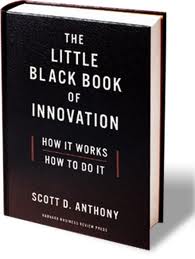
Explore more on this topic in Anthony’s excellent book The Little Black Book of Innovation.

Innovation’s Seven Deadly Sins

Innovation – something different that has impact – is both more important and more accessible than ever before

          Scott D. Anthony, The Little Black Book of Innovation

Something different that has impact.

This simple definition of innovation by author Scott Anthony belies the deep and resonating ideas in The Little Black Book of Innovation. From this simple definition, Anthony breaks down the essential differences between various types of innovation and illuminates its vital role in organizational success and personal growth.

What better way to introduce the topic to ChurchWorld leaders than start off with a list of Innovation’s Seven Deadly Sins:

  • Pride – forcing your view of quality onto your audience; often results in overshooting
  • Sloth – having innovation efforts slow to a crawl
  • Gluttony – suffering from the curse of abundance; leads to overly lows, overly linear innovation efforts
  • Lust – getting distracted by pursuing too many “Bright, shiny objects”
  • Envy – creating an us-versus-them relationship between the core and new growth efforts
  • Wrath – punishing risk takers severely
  • Greed – impatience for growth; leads to prioritizing low-potential markets

Tomorrow: How to Avoid the Seven Deadly Sins

What Color is Your Pen?

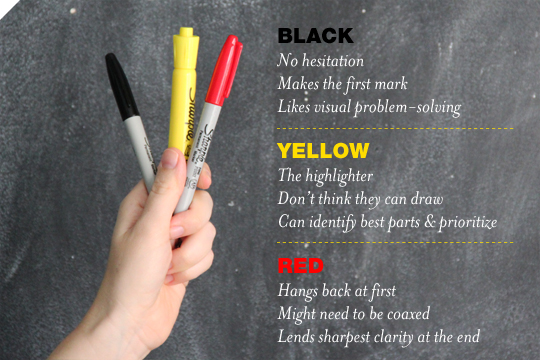
According to author Dan Roam (The Napkin Academy) there are three kinds of visual thinkers:

  • people who can’t wait to start drawing (the Black Pen people)
  • those who are happy to add to someone else’s work (the Yellow Pen people)
  • those who question it all – right up to the moment they pick up the Red Pen and redraw it all.

Which are you?

Hand me the pen! Black pen people show no hesitation in putting the first marks on an empty page. They come across as immediate believers in the power of pictures as a problem-solving tool, and have little concern about their drawing skills – regardless of how primitive their illustrations may turn out to be. They jump at the chance to approach the whiteboard and draw images to describe what they’re thinking. They enjoy visual metaphors and analogies for their ideas, and show great confidence in drawing simple images, both to summarize their ideas and then help work through those ideas.

I can’t draw, but… Yellow Pen people (or highlighters) are often very good at identifying the most important or interesting aspects of what someone else has drawn. These are the people who are happy to watch someone else working at the whiteboard – and after a few minutes will begin to make insightful comments – but who need to be gently prodded to stand and approach the board in order to add to it. Once at the board and with pen tentatively in hand, they always begin by saying “I can’t draw, but…” and then proceed to create conceptual masterworks. These people tend to be more verbal, usually incorporate more words and labels into their sketches, and are more likely to make comparisons to ideas that require supporting verbal descriptions.

I’m not visual Red Pen people are those least comfortable with the use of pictures in a problem-solving context – at least at first. They tend to be quiet while others are sketching away, and when they can be coaxed to comment, most often initially suggest a minor corrections of something already there. Quite often, the Red Pens have the most detailed grasp of the problem at hand – they just need to be coaxed into sharing it. When many images and ideas have been captured on the whiteboard, the Red Pen people will finally take a deep breath, reluctantly pick up the pen, and move to the board – where they redraw everything, often coming up with the clearest picture of them all.

Roam’s conclusion of these different types of people?

Regardless of visual thinking confidence or pen-color preference, everybody already has good visual thinking skills, and everybody can easily improve those skills. Visual thinking is an extraordinarily powerful way to solve problems, and though it may appear to be something new, the fact is that we already know how to do it.

What color is your pen?

Your Visual Thinking Toolkit

Any problem can be made clearer with a picture, and any picture can be made using the same simple set of tools and rules.

–       Dan Roam, The Back of the Napkin

Author, consultant, and visual thinker Dan Roam (The Back of the Napkin, Unfolding the Napkin, and Blah, Blah, Blah) argues that everyone is born with a talent for visual thinking, even those who swear they can’t draw.

Here are the main concepts as covered in his first book The Back of the Napkin and expanded on in the next two books. Using these simply powerful tools, he shows anyone how to clarify a problem or sell an idea by visually breaking it down using a simple set of visual thinking tools.

3 Basic Visual Thinking Tools

  • Our eyes
  • Our mind’s eye
  • Our hand-eye coordination

4 Steps of the Visual Thinking Process

  • Look
  • See
  • Imagine
  • Show

5 Questions to Help Open Your Mind’s Eye

  • Simple or Elaborate
  • Qualitative or quantitative
  • Vision or execution
  • Individual or comparison
  • Change or status quo

6 Ways We See and Show

  • Who/what – portrait
  • How much – chart
  • Where – map
  • When – timeline
  • How – flowchart
  • Why – plot

The Back of the Napkin proves that thinking with pictures can help you discover and develop new ideas, solve problems in unexpected ways, and dramatically improve your ability to share your insights. You will literally begin to see the world in a new way. Ven though the book has been available for several years, if you haven’t got one I encourage you to pick up a copy as soon as possible to fully understand, and implement, these powerful communication tools.

These tools have a new meaning to me as Vision Room Curator at Auxano. To help me better prepare for my new role, I’m starting school today: Dan Roam’s Napkin Academy, the first online school for visual thinking. I’ll be posting more about it later this week.

You should pick up a pen and join me!

Smart vs. Healthy

Being smart is only half the equation in a successful organization. Yet it somehow occupies almost all the time, energy, and attention of most leaders. The other half of the equation, the one that is largely neglected, is about being healthy.

– Patrick Lencioni, The Advantage

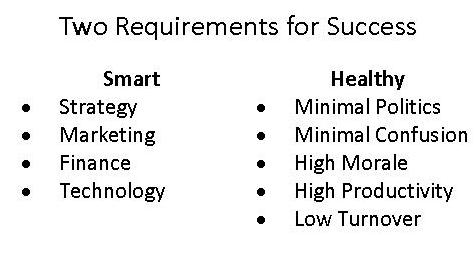
In Patrick Lencioni’s latest book The Advantage, you will find the following chart:

Lencioni comments: “Whenever I list the qualities for leaders, I usually get one of the following reactions, and sometimes both. Often they laugh quietly, in a nervous. almost guilty kind of way. Or they barely sigh, like parents do when they hear about a family where the kids do what they’re told the first time they’re asked. In either case, it’s as thought they’re thinking, ‘Wouldn’t that be nice?’ or, ‘Can you imagine?’

None of the leaders – even the most cynical ones – deny that their organizations would be transformed if they could achieve the characteristics fo a healthy organization. Yet they almost always gravitate to the left side of the chart above, retreating to the safe, measurable “smart” side of the equation.

Why?

Because it’s relatively safe and predictable, which most leaders prefer. That’s how they’ve been trained, and that’s where they’re comfortable.

It takes discipline to move beyond the safe and predictable, into the sometimes awkward and messy area of organizational health.

Tomorrow: Four Disciplines of Organizational Health

Adapted from The Advantage, by Patrick Lencioni

Brainsteering

Part of the “BookNotes” series – highlights from interesting books I’ve recently read

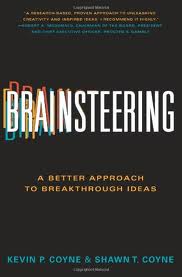
Brainsteering: A Better Approach to Breakthrough Ideas, by Kevin Coyne and Shawn Coyne

Brainsteering – taking all the creative energy normally associated with brainstorming and steering it in a more productive direction

2 Secrets to Brainsteering:

  1. If you ask the right questions, answers and good ideas will follow
  2. The right process for generating breakthrough ideas looks very different from what you’ve been taught

4 Criteria for the Right Question

  1. Forces you to take a perspective you haven’t taken before
  2. Limits the conceptual space you can explore
  3. Must still provide lots of highly attractive possibilities
  4. Just plain succeeds

5 Patterns of Right Questions

  1. Identifying unsolved customer questions
  2. “De-averaging” users and activities
  3. Exporing unexpected successes
  4. Imagining perfection
  5. Discovering unexpected headroom

Brainsteering Workshop

  • Understand the criteria that will be used to make decisions about the workshop ideas
  • Select the right questions
  • Choose the right people
  • Separate the group into small subgroups
  • Match the question to the subgroup
  • Isolate the idea crushers into one group (the Boss, the Bigmouth, the subject matter Expert)
  • Orient the participants
  • Conduct each ideation session according to a strict formula

An Idea Everyone Will Like

There’s no such thing as a truly original idea.
I don’t know who said it first, but it’s something I really believe! I’ve found a fascinating book by creativity expert David Kord Murray that takes that saying to the outer limits.
Over the last month I’ve been working on a project related to innovation and design in ChurchWorld, and this line of thought resonated a lot with me.
Borrowing Brilliance will challenge you as it examines the evolution of a creative idea. It also offers practical advice, taking the reader step-by-step through Murry’s unique thought process. Here are the six steps:
  1. Defining – define the problem you’re trying to solve
  2. Borrowing – Borrow ideas from places with a similar problem
  3. Combining – Connect and combine these borrowed ideas
  4. Incubating – Allow the combinations to incubate into a solution
  5. Judging – Identify the strength and weakness of the solution
  6. Enhancing – Eliminate the weak points while enhancing the strong ones

Read a quick summary of the six steps here. You can also get more information at this website. But don’t stop there – by all means pick up a copy of the book and explore it deeper – and you will find yourself looking at creativity in a whole new light.

Got a challenge staring you in the face, and looking for a solution. Why not follow the steps above by “borrowing some brilliance” and formulate your own unique solution?