The Motivating Process

All communication is selling. People buy on emotion and justify with fact.

– Bert Decker, You’ve Got to be Believed to be Heard

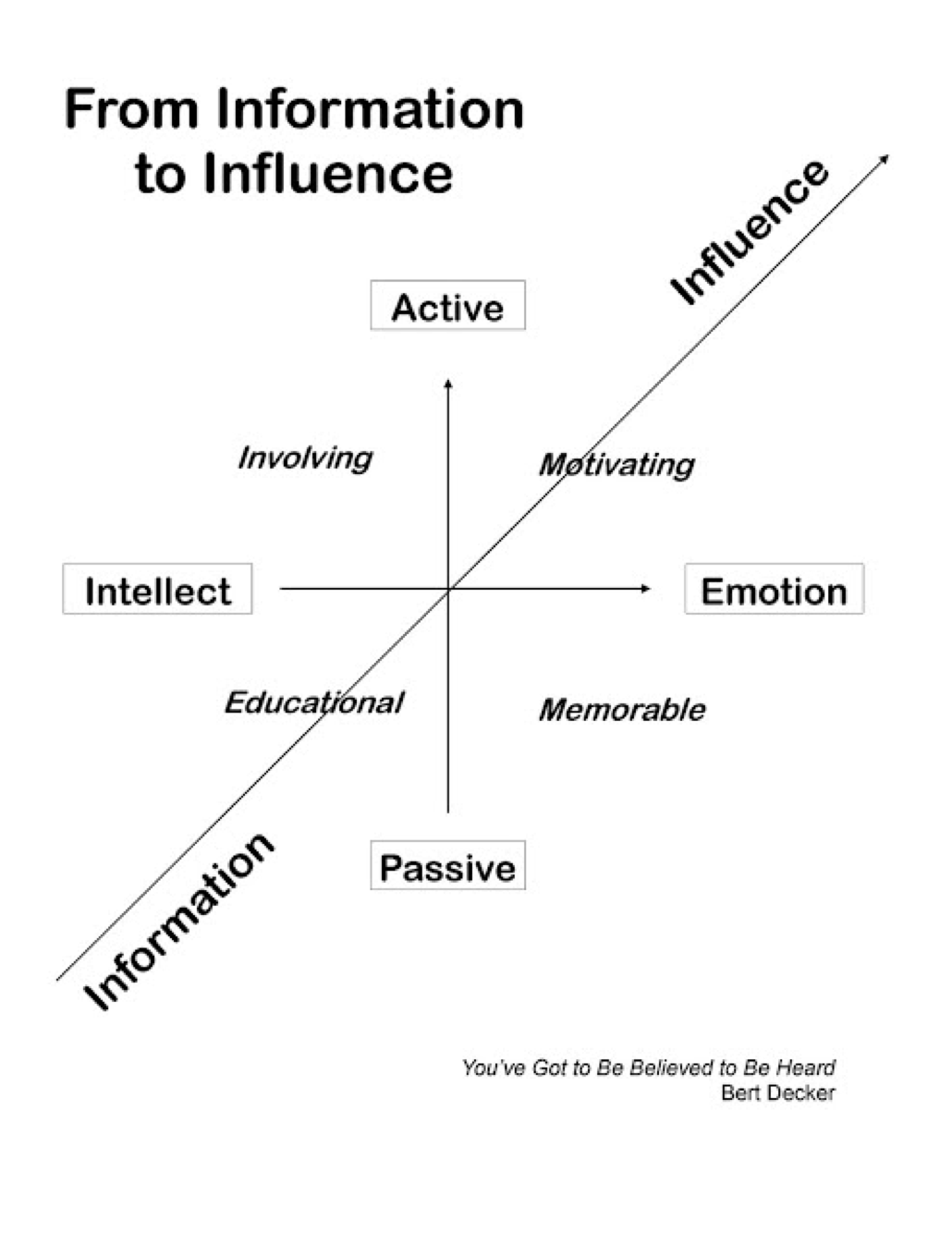
This week I’ve been recapping a section of Bert Decker’s great book on communication, “You’ve Got to Be Believed to Be Heard.” He has created the following chart that shows the path from information to influence.

The end result of the process displayed above (and described in blog posts herehere and here) is that your communication will move from information to influence. You will be able to more effectively persuade your listeners, not just by the power of your person, but by the power of your presentation as well.

As leaders, we often think that if we say words, people will get them. That is not necessarily true. They might get the words and our message if we are enthused and confident – but not if we’re nervous and we block our message by inappropriate behavioral habits.

In the matrix depicted above, your communications reach their maximum effectiveness when they are in the active and emotion quadrant. In Decker’s words, you have moved from merely providing information to a place where you are influencing the listener. You have created a climate for motivation.

John Maxwell has a famous definition of leadership: “Leadership is influence.”

If you believe that, then what are you doing today to make your communications move from information to influence?
The Involving Process, The Memorable Process

Author and communication expert Bert Decker has developed a matrix that shows how to move your communications from information to influence. A previous post was about the educational process; today  a look at the next two quadrants of his matrix: the Involving Process and the Memorable Process.

The Involving Process

To move people from passive to active, there are many options. One of the most important is to convey our energy and enthusiasm, which resonates in the listener. It’s hard to be passive when someone is excited, but it’s easy when someone is uninteresting, low on energy, and monotonous.

There are several things you can do that deal more with content and process. You can ask questions, getting people to think. You can do interactive exercises, or take people through simulated exercise or though processes. How about fill-in-the-blanks in handouts? However you can, get people involved, and move them from passive to active by interacting with them.

The Memorable Process

Moving people from the intellectual to the emotional realm is more difficult. This idea is not about ignoring the intellectual or reasoning processes in the listener, but adding the emotional dimension to your content. This is not something that is taught to us, but it is a very powerful mindset that you can learn quickly and use continuously.

Emotional perspective comes from the energy of our behavior, of course, but it can also be applied in our content. We want to become memorable by using techniques and methods that get us out of the dry and didactic world of facts and figures. We want to use our creativity, to become storytellers and interesting visualizers, to move deeper into the world of ideation and metaphor.

Decker’s book is entitled “You’ve Got to Be Believed to Be Heard.” It’s a great resource for anyone who speaks before a group of people – from 5 to 500. My focus (which ends tomorrow) has only been on one section – From Information to Influence.  There are four other sections that will help you create, organize, and then deliver – powerfully – your message.

Tomorrow: The Motivating Result

The Educational Process

Author and communicator Bert Decker developed a chart that illustrates the path from information to influence. In developing it, he starts with a typical four-quadrant diagram, and then expands it one further step, finally adding a diagonal path.

Step one of the path from information to influence starts with the educational process.

Starting in kindergarten and continuing through college into graduate school, we are mostly taught passively. Basically we sit in chairs and teachers lecture at us. They appeal to our intellect, our cognitive side.

That is our educational system, and it continues into business and into life. It is the world of information. It is on the Passive and Intellectual side of Decker’s chart, Create Your Experience.

Take a journey back to high school or college, and remember your favorite teacher. It probably wasn’t the teacher with the longest tenure, or who was most published, or who had the most degrees. It was probably the person who was the most excited about the subject – and that enthusiasm was contagious.

You caught it, and because of that they influenced you to “get” the information and knowledge.

The journey from information to influence has to start with the Educational Process, but there has to be movement: from passive to active, and from the intellectual to the emotional mental states.

Tomorrow: the Involving Process.

From Information to Influence

Jack Ryan, the historian-CIA-politician hero from author Tom Clancy’s fiction writings of the 1990s is always good for a quote:

Next time Jack, write a #@$!! memo!

He muttered this to himself as he was being lowered in a raging storm from a helicopter to a submarine, on the way to averting WWIII. His research led to an astounding discovery, but it was his willingness in presenting the information first-hand that led to the quote above. It may make for good summertime reading and an action movie, but there is actually an instructive lesson in it for anyone who seeks to become a better communicator.

The written medium is a cognitive, linear, literal, and didactic process that’s great for transferring information.

Speaking is the medium of action and influence. In speaking, we create an experience where people get us and our message together – and the two are inseparable. In speaking, we use information to influence. The power is in the presentation.

The two previous paragraphs come from Bert Decker’s book “You’ve Got to Be Believed to Be Heard.” Whenever I’m working on major presentations I always find myself coming back for a refresher course.

This week I’ll be posting excerpts from this book along with observations for ChurchWorld.

2 Questions for Your Consideration

Alan Webber, co-founder of Fast Company magazine and author of the book “Rules of Thumb“, thinks every leader needs to keep 2 lists:

  • What gets you up in the morning?
  • What keeps you up at night?

There is a lot for leaders to think about in those two sentences. Here is a summary of  Webber’s challenges:

Some people just have jobs. Others have something they really work at.

Some people are just occupied. Others have something that preoccupies them.

It makes all the difference in the world.

Consider this: you spend at least eight hours a day working, five days a week. A minimum of forty hours a week for at least forty-eight to fifty weeks a year. That’s a minimum of 1,920 hours a year. For how many years? You do the math.

What gets you up in the morning?

The level of energy put out by an organization’s people is one of the things that you are aware of as soon as you enter their space. There’s a buzz in the air (sometimes literally) created by people who are working  hard and working together. They want to be there – they came in ready to go.

What keeps you up at night?

This is a chance to be honest with yourself. Many times leaders rarely get a chance to reflect on the things that really matter to the organization’s goals. Most of the time, day-to-day urgent concerns crowd out broader issues that are the really important ones. The things that often keep leaders up are the things that never seem to find the time or place for serious engagement in the course of an ordinary workday.

We all want to do work that excites us. We want to care about things that concern us. So, about that list…

Take out a stack of three-by-five cards. Use one to write down the answer to the question “What gets you up in the morning?” Keep it to one sentence. If you don’t like your answer, throw away the card and start over – it’s only a card. Keep doing it until you’ve got an answer you can live with.

Now repeat the exercise for the question “What keeps you up at night?” Work at it until you’ve got an honest answer.

Now read your answers out loud to yourself. If you like them – if they give you a sense of purpose and direction – congratulations! Use them as a compass, checking from time to time to see if they’re still true.

If you don’t like one or both of your answers, you have a new question to consider: What are you going to do about it?

Whatever your answers are, you’re spending almost two thousand hours a year of your life doing it.

That makes it worthwhile to come up with answers you can not only live with but also live for.

Facts Are Facts…

…stories are how we learn.

Facts are facts, but stories are who we are, how we learn, and what it all means.

-Alan Webber

Why are stories so much more powerful than plain old facts or boring PowerPoint presentations?

  • Stories are about people
  • Stories are about people doing things
  • Stories create meaning
  • Stories are how we learn
  • Stories have always been at the heart of starting and leading organizations
  • Organizations celebrate their great successes and even their heroic failures through stories

The work of leading a great organization is the work of telling stories.

What story will you tell today?


Part of the BookNotes Series – brief excerpts from books I have read, or am currently reading

Rules of Thumb, by Alan Webber, co-founder of Fast Company magazine. A list of rules for the new game we’re in today – a complex, fast-changing, and confusing world.

Simplicity Never Stands Still

To achieve great things, two things are needed: a plan, and not quite enough time.

– Leonard Bernstein

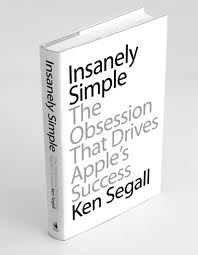
Former ad agency creative director Ken Segall’s new book Insanely Simple is written from a unique perspective: developing marketing campaigns for technology giants like IBM, Dell, Intel, – and Apple. It was the stark contrast of Apple’s ways that made Segall appreciate the power of Simplicity – and inspired him to help others benefit from it.

In the chapter entitled “Think Motion,” Segall refers to Apple’s practices of fast-tracking project and marketing development.  Apple has grown to point where it does a tremendous number of things at once, and in doing so has built one of the world’s greatest juggling acts. Apple:

  • lives in constant motion
  • never stops thrilling its audience
  • never lets things get old

The best illustration of this comes from an example of Segall’s work with both Dell and Apple on similar ventures – developing a new branding campaign.

Apple set out to create a brand campaign in 1997.

   Dell set out to create a brand campaign in 2008.

Apple wanted to start its campaign immediately.

   Dell pondered a schedule that would take months.

Apple’s brand team was led by its CEO.

   Dell’s brand team was led by a committee.

Apple trusted a small group of smart people.

   Dell trusted a small group of incompatible people.

Apple knew exactly who it was.

   Dell need to figure out who it was.

Steve Jobs was an active participant.

   Michael Dell would look in when the project was complete.

Apple’s brand team required only the CEO’s approval.

   Dell’s brand team required each division’s approval.

Apple took a month to conceive and create a campaign.

   Dell required a month just to talk about strategies.

Apple ended up with the Think Different campaign.

   Dell ended up with a stack of presentation boards stored neatly in a dark closet.

Simplicity – represented in the above example by Apple’s actions – is a fundamental requirement when you’re trying to achieve lofty goals. As Dell discovered, a fractured, leaderless group without an urgent mandate is Simplicity-proof.

Will you walk the straight path of Simplicity or choose the dark, winding road of Complexity?

Small is the Ultimate Efficiency

When process is king, ideas will never be. It takes only Common Sense to recognize that the more layers you add to a process, the more watered down the final work will become.

– Ken Segall, Insanely Simple

Ken Segall was the creative director at several ad agencies, working for big-name tech companies like IBM, Intel, and Dell. However, it was his work with Apple over a period of years that gives him a unique perspective of the stark contrast of Apple’s ways that made him appreciate the power of Simplicity. Segall recently released a book about these lessons – Insanely Simple. More than just another repetition of Apple lore, it chronicles an outsider’s long relationship with Apple and Steve Jobs that will provide leaders in any organization with the powerful tools of Simplicity.

Simplicity’s Best Friend: Small Groups of Smart People

While working with Apple, Segall often experienced the strict enforcement of one of Simplicity’s most important rules: Start with small groups of smart people – and keep them small. Every time the body count in a meeting or working on a project goes higher, you’re simply inviting Complexity to take a seat at the table.

This small-group principle is a key to Apple’s ongoing success and key to any organization that wants to nurture quality thinking. The idea is pretty basic: Everyone in the room should be there for a reason. Segall distilled years of observing and practicing this idea down into two “Laws of Small.”

The quality of work resulting from a project is inversely proportional to the number of people involved in the project.

The quality of work resulting from a project increases in direct proportion to the degree of involvement by the ultimate decision maker.

To even speak of putting process before creativity did not happen in an environment like Apple’s. A better idea is a better idea – no matter where it fell in the process. The high value placed on ideas is one of the things that Steve Jobs burned into the Apple culture and it will likely continue to guide the company into the future.

How would small groups of smart people work in your organization?

Blunt is Simplicity. Meandering is Complexity.

Clarity propels an organization. Not occasional clarity but pervasive, twenty-four-hour, in-your-face, take-no-prisoners clarity.

– Ken Segall, Insanely Simple

Ken Segall is a former ad agency creative director who worked for Apple during Steve Jobs’ return to the helm of the iconic tech company. He also worked for many of the largest tech companies around: IBM, Dell, and Intel among others. He’s seen both sides of the fence, so to speak, and it’s not a pretty sight.

Insanely Simple: The Obsession That Drives Apple’s Success is an amazing book detailing Apple’s return to brilliance under Steve Jobs. It’s loaded with personal stories and practical applications that your organization will find both fascinating and useful.

Like the necessity of being brutally honest in your communications.

According to Segall, Steve Jobs told you what was on his mind and he couldn’t care less how you might feel about it. Despite a general perception that Jobs was the nasty tyrant who demanded allegiance, barked commands, and instilled fear in those around him, this was an incomplete portrait. He could also be funny, warm, and even charming.

There is a huge difference between being brutally honest and simply being brutal.

Simplicity at Apple is the name of the game, and it requires that you be honest and never hold back. If you demand the same from those you work with, everyone will know where they stand.

One hundred percent of your group’s time will be focused on forward progress – and there will be no need to decode what people are really saying.

Learn the Powerful Lessons of Simplicity

Simplicity isn’t just a design principle at Apple – it’s a value that permeates every level of the organization.

-Ken Segall, Insanely Simple

Ken Segall was the creative director at several ad agencies, working for big-name tech companies like IBM, Intel, and Dell. However, it was his work with Apple over a period of years that gives him a unique perspective of the stark contrast of Apple’s ways that made Segall appreciate the power of Simplicity.

The obsession with Simplicity is what separates Apple from other technology companies. Led by Steve Jobs’ uncompromising ways, you can see Simplicity in everything Apple does: the way it’s structured, the way it innovates, and the way it speaks to its customers.

Insanely Simple gives you a true insider’s perspective on Apple’s obsession with Simplicity. Here are just a few of the topics covered:

  • Think Small – swearing allegiance to the concept of “small groups of smart people” raises both morale and productivity
  • Think Minimal – distilling choices to a minimum brings clarity to a company and its customers – as Jobs proved when he replaced over twenty product models with a lineup of four
  • Think Motion – keeping project teams in constant motion focuses creative thinking on well-defined goals and minimizes distractions
  • Think Iconic – using a simple, profound image to symbolize the benefits of a product or idea creates a deeper impression in the minds of customers

Segall introduces the book with the concept of The Simple Stick – a core value within Apple. Sometimes it’s held up as inspiration; other times it’s wielded like a club. In all cases, it’s a reminder of what sets Apple apart from other technology companies and what makes Apple stand out in a complicated world: a deep, almost religious belief in the power of Simplicity.

If you are a leader in ChurchWorld, you know about and fight the battle of Simplicity every day. It may seem like a losing battle, but you need to know that the results are worth the effort.

The simpler way isn’t always the easiest. Often it requires more time, more money, and more energy. It may require you to step on a few toes along the way. But more often than not, Simplicity leads to better results.

Simplicity needs a champion – someone who’s willing to stand up for its principles and strong enough to resist the overtures of Simplicity’s evil twin, Complexity.

Simplicity needs a leader who is willing to guide the process with both head and heart…

…someone like you?

To read more about Insanely Simple, go to the top of the page and click on the orange title of tomorrow’s post.