Speed Reading Week, Day 5

Creative Thinkering, Michael Michalko

Have you ever asked yourself “Why didn’t I think of that?”

 If so, this book is for you. Bestselling creativity expert Michael Michalko shows that in every field of endeavor – from business and science to government, the arts, and even day-to-day life – our natural creativity is limited by the prejudices of logic and the structure of accepted categories and concepts. Through step-by-step exercises, illustrated strategies, and inspiring real-world examples, Creative Thinkering will show you how to synthesize dissimilar subjects, think paradoxically, and enlist the help of your subconscious mind. You will liberate your thinking and literally expand your imagination.

Creative Thinkering is filled with innovative exercises to strengthen your intuition. With every chapter you will learn something new – often from a situation or setting that you encounter every day. The book also contains fascinating stories and examples of how people use the power of creative thinkering. One of my favorites is about Walt Disney:

Using his imagination, Walt Disney uncritically explored fantastical ideas. Afterward, he would engineer these fantasies into feasible ideas and then evaluate them. He would shift his perspective three times by playing three separate and distinct roles in relation to them: those of the dreamer, the realist, and the critic.

On the first day, he would play the dreamer and dream up fantasies and wishful visions. He would let his imagination soar without worrying about how to implement his conceptions. The next day, he would bring his fantasies down to earth by playing the realist. As a realist, he would look for ways to work his conceptions into something practical. On the third day, he would play the part of the critic and poke holes in his ideas, asking, “Is this feasible?”

Got an idea or project coming up? Put the power of creative thinkering to work and you will be amazed at the results.

 

Speed Reading Week, Day 4

The Amazement Revolution, Shep Hyken

Customer service isn’t a department – it’s a philosophy that includes every person and aspect of the best and brightest organizations.

Shep Hyken delivers seven powerful strategies that any organization can implement to create greater customer and employee loyalty:

  • Membership: What if you treated the people you serve like members instead of customers?
  • Serious FUN: What if your team felt a sense of fulfillment and enjoyment that made them loyal to you and your customers?
  • Partnership: What if you customers thought of you as a partner rather than just another organization?
  • Hiring: What if you could implement innovative hiring processes to support your customer-service mission?
  • The After-Experience: What if you could create a memorable, positive experience after someone did business with you?
  • Community: What if you could create a community of evangelists – loyal customers who brag about you to their friends and associates?
  • Walking the Walk: What if every person in your company didn’t just deliver, but also lived and breathed your vision for amazing customer service?

Throughout the book, Hyken shares more than one hundred insightful examples from fifty role-model organizations that prove these strategies can and should be implemented immediately – by any organization, large or small.

I first heard Shep Hyken speak on a video talking about an extraordinary cab experience he had on a trip to Dallas. I was hooked – and I think you will be, too.

The Amazement Revolution is not just stories and examples – at the end of the book, Hyken has condensed the seven strategies down into “brainstorm worksheets” that your organization can use to put ideas into action.

How will you amaze your customers today?

Speed Reading Week, Day 3

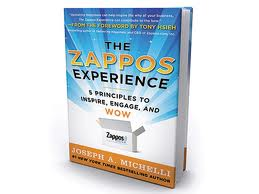
The Zappos Experience: 5 Principles to Inspire, Engage, and WOW, by Joseph Michelli

Zappos – the name has come to stand for a new standard of customer experience, and amazing online shopping experience, and the most impressive transformational business success story of our time. Simply put, Zappos is revolutionizing business and changing lives.

 CEO Tony Hsieh documented the Zappos story in his excellent book Delivering Happiness. I encourage you to read it to get Hsieh’s personal insights on the evolution of Zappos.

Michelli’s book The Zappos Experience takes you through – and beyond – the playful, off-beat company culture Zappos has become famous for. Michelli reveals what occurs behind the scenes at Zappos, showing how employees at all levels operate on a day-to-day basis while providing the “big picture” leadership methods.

Michelli breaks the approach down into five key elements:

Serve a Perfect Fit – create bedrock company values

Make it Effortlessly Swift – deliver a customer experience with ease

Step into the Personal – connect with customers authentically

S T R E T C H – grow people and products

Play to Win – play hard, work harder

When you enhance the customer experience, increase employee engagement, and create an energetic culture, you can’t help but succeed. Zappos has woven these five key components into a seamless strategy that’s the envy of business leaders.

The Zappos Experience is much too detailed to adequately treat in this short post.  Applications for ChurchWorld abound. Here’s one example for you to think about:

Zappos’ customer service is legendary for how it handles the huge volume of merchandise shipments. Members of the Customer Loyalty Team take a huge amount of pride in their customer interactions.

Could you apply the same principles in the Guest Services Team at your church?

  • What are the small and epic acts that make up your service story?
  • What do people remember about the way contact with your organization made them feel?
  • What are the stories circulating about your organization’s guest services practices?
  • How are you capturing and retelling large and small WOWS delivered by your team?

It works for Zappos; it can work at your church, too.

Speed Reading Week, Day 2

The Power of foursquare, Carmine Gallo

Author Carmine Gallo has discovered seven big ideas that will help you CHECK IN to the power of foursquare to unlock your brand’s potential:

Connect Your Brand – Align your foursquare strategy with your brand’s value proposition and your brand story.

Harness New Fans – Use foursquare to attract new customers who otherwise might not know about your business or who don’t keep it top of mind.

Engage Your Followers – Add insights and information to keep your brand in front of your customers and fans wherever they are.

Create Rewards – Leverage foursquare’s powerful and free tools to learn more about your best customers and to create rewards for their loyalty.

Knock Out the Competition – Outsmart your competitors by being a leader in this new space and develop creative campaign. Don’t wait for case studies – be the case study.

Incentivize Your Customers – Give your customers a reason to check in, again and again.

Never Stop Entertaining – Foursquare is a playful platform. Always have fun.

If someone asked you what foursquare is, you would be entirely correct to use any of the following answers:

  • It’s a social, local, and mobile networking tool
  • It’s a location-based social network
  • It’s a geolocation app
  • It’s a game
  • It’s a communications tool
  • It’s a new social-media marketing platform

That’s the business world of foursquare – what about ChurchWorld?

Speed Reading Week, Day 1

Here’s the deal: a book a day, with a few nuggets pulled out for your consideration. Ready?

The End of Business as Usual, Brian Solis

Some of today’s biggest trends – the mobile web, social media, gamification, real-time – have forced us to rewire the way we think about and run our organizations. Consumers are creating a new digital culture, and as they connect with one another, a vast and efficient information network is taking shape and is beginning to steer experiences, decisions, and markets.

The End of Business as Usual will change the way you view the world of business, from sales and marketing to customer service and product development to leadership and culture. Its critical insights include:

  • Shared experiences are redefining brands in digital consumer landscapes, and astute brands can now also create and steer these experiences
  • Consumer influence is growing, and businesses can use this to their advantage
  • Connect with a rising audience (and with audiences of audiences) through new touch points between consumers, brands, and new influencers
  • Create a culture to earn trust, influence, and significance among connected customers

Solis has written a powerful book, deep with implications. Here’s a couple of samples:

The nextwork sends and receives information at blinding speeds, creating an efficient human switchboard and network that in theory and in practice, outperforms telephone, terrestrial, cell, emergency, and web networks for the speed and precision at which relevant experiences are shared and re-shared. News no longer breaks – it tweets. (pp 54-55)

An Audience with an Audience of Audiences

This picture serves as both a time capsule immortalizing this important transition and evidence of the emergence of new information nextworks, a series of audiences with extended audiences. Every single one of these students is a representation of the connected customer. They are each connected to others in the room and around the world, figuratively and literally. They are nodes in the human network, playing an instrumental role in the dissemination of information and also the experiences that unite us online and in real life. Your job is to now influence what they share. (p 61)

Questions for ChurchWorld

  • How has the explosion of social media impacted your ministry – personally or corporately?
  • How are your “consumers” influencing your organization differently today than 3 years ago?
  • How are you harnessing the power and influence of social media technologies to connect with your audience?
  • Is the rate of change greater today than it was a year ago? How comfortable are you with that?
  • On a sliding scale, do you view your organization as rigid, social, connected, adaptive, or predictive?

This is your time to lead, not follow; your time to make a difference.

Looking Sharp in a Leisure Suit…

… too bad they went out of style 30 years ago.

That’s not just a fashion statement – it also applies to ChurchWorld. Yesterday thousands of churches across America and the world met and did things the way they’ve always done them, expecting new results.

That is a classic pop definition of insanity.

Tony Morgan, in his latest free eBook “Hanging Up the Leisure Suit” offers a brief but informative view on how to take the steps to become unstuck from your present situation and get new results.

In his typical easy-to-read style, Morgan (veteran pastor and church consultant) offers the following six steps to help your church get unstuck:

  • Making the necessary changes to bring different results
  • Bridging the space between strategies and systems
  • Following God’s blueprint for accomplishing His purposes
  • Building a solid foundation
  • Avoiding an over-reliance on teaching
  • Creating a healthy system in your church

“Hanging Up the Leisure Suit” serves its purpose well – helping church leaders begin to ask the tough questions about the organization they serve. As a matter of fact, while the six sections mentioned above will certainly help you begin to understand how you need to get unstuck, Morgan’s discussion questions at the end provide the most helpful “fashion guide” to actually make it happen.

Isn’t it time for a new wardrobe at your church?

Download your free copy of “Hanging Up the Leisure Suit” today and take a look at yourself – and your church – in the mirror!


The Bell Curve is Flattening…

Seth Godin is at it again.

Godin’s latest book “We Are All Weird” was just released last week. As one of the most influential thinkers of today, I always eagerly anticipate a new work by him – and I was definitely not disappointed. Here’s a sample:

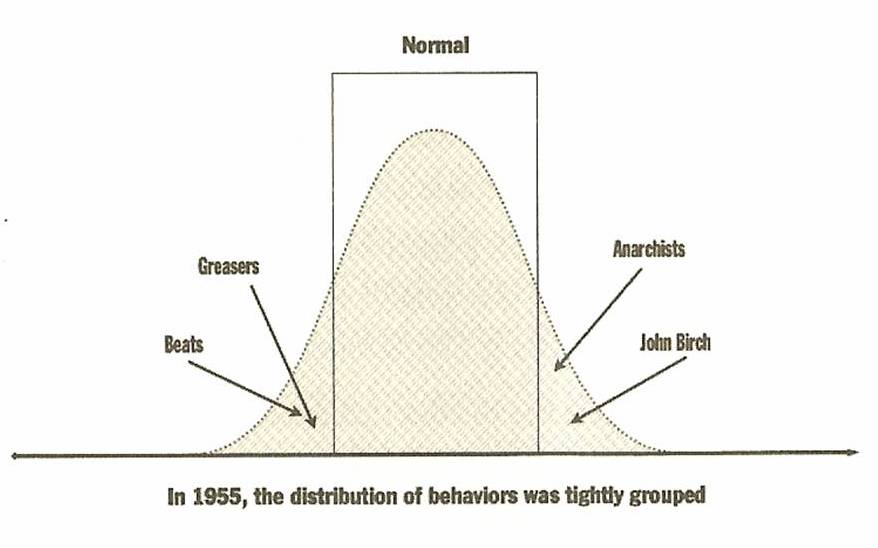
The distribution of a population is often shaped like a bell curve. For example, if you asked all the kids in a school to line up in order of height, the graph of how many kids were of each height would be shaped like the classic bell – you’d have as many 4 foot kids as 6 foot kids, and a whole bunch more in the middle at 5 feet.

Not surprisingly, this curve is called a normal distribution. It’s incredibly common in almost any phenomenon you look at (Internet usage, miles commuted to work, length of hair).

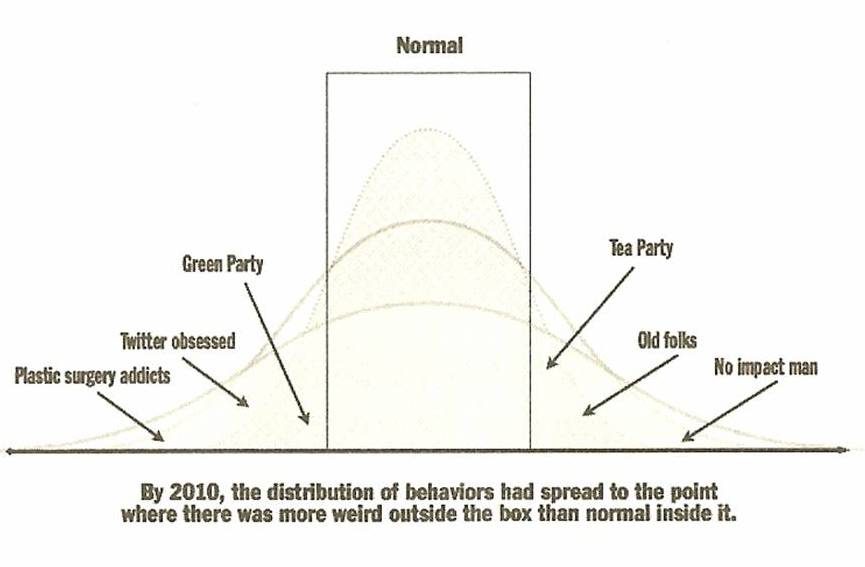
Something surprising is happening, though: the defenders of mass and normalcy and compliance are discovering that many of the bell curves that describe our behavior are flattening out.


Distributions of behavior remain, but as the anchors holding that behavior in place have loosened, the bells have spread, like a thawing ice sculpture.

There are now many bell curves, not just one. We don’t care so much about everyone; we care about us – where us is our people,  our tribe, our interest group, our weirdness – not the anonymous masses.

If you persist in trying to be all things to all people, you will fail. The only alternative then, is to be something important to a few people.


If you cater to the normal, you will disappoint the weird. And as the world gets weirder, that’s a dumb strategy.


Thinking for a Change

I close Thinking Week by presenting the main points of “Thinking for a Change” by John Maxwell. Maxwell is probably my favorite author of pure leadership writings, and I have never been disappointed by his works. In this case, they speak volumes for anyone interested in developing their thinking.

  1. Understand the Value of Good Thinking
  2. Realize the Impact of Changed Thinking
  3. Master the Process of Intentional Thinking
  4. Acquire the Wisdom of BigPicture Thinking
  5. Unleash the Potential of Focused Thinking
  6. Discover the Joy of Creative Thinking
  7. Recognize the Importance of Realistic Thinking
  8. Release the Power of Strategic Thinking
  9. Feel the Energy of Possibility Thinking
  10. Embrace the Lessons of Reflective Thinking
  11. Question the Acceptance of Popular Thinking
  12. Encourage the Participation of Shared Thinking
  13. Experience the Satisfaction of Unselfish Thinking
  14. Enjoy the Return of Bottom-Line Thinking

You can change the way you think.

Whatever things are true…noble…just…pure…lovely…are of good report, if there is any virtue and if there is anything praiseworthy; think on these things Philippians 4:8


Got Your Thinking Hat On?

Thinking is the ultimate human resource. Yet we can never be satisfied with our most important skill. No matter how good we become, we should always want to be better.
-Edward de Bono
 
Dr. de Bono is an internationally acclaimed authority in the teaching of thinking as a skill. I’ve posted on his most famous book, The Six Thinking Hats, here. In this week’s ongoing discussion of thinking, I wanted to revisit his work briefly.
 
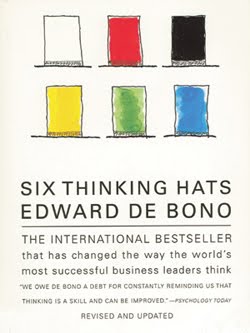
In “Six Thinking Hats” the author presents a simple but effective way to become a better thinker. He separates thinking into six distinct modes, identified with six colored “thinking hats”:
  • White – facts, figures, and objective information
  • Red – emotions and feelings
  • Black – logical negative thoughts
  • Yellow – positive constructive thoughts
  • Green – creativity and new ideas
  • Blue – control of the other hats and thinking steps
“Putting on” a hat focuses thinking; “switching” hats redirects thinking. With the different parts of the thinking process thus clearly defined, discussions can be better focused and more productive.
 
There are two main purposes to the six thinking hats concept. The first purpose is to simplify thinking by allowing a thinker to deal with one thing at a time. Instead of having to take care of emotions, logic, information, hope and creativity all at the same time, the thinker is able to deal with them separately.
 
The second main purpose of the six thinking hats concept is to allow a switch in thinking. If a person at a meeting has been persistently negative, that person can be asked to take off “the black thinking hat.” This signals the person that he has is being persistently negative. A person may be asked to put on “the yellow thinking hat;” this is a direct request to be positive.
 
By referring to the color of the hat instead of the emotion or perceived style, the concept of the hats minimizes the impact on a person’s ego or personality and allow for the possibility of focusing on one thing at a time – instead of trying to do everything at once.


Got a tough meeting coming up?

Make sure you carry six hats in!


The Power of Thinking Without Thinking

Continuing our Thinking Week, let’s move from the structure of Morgan Jones to the adaptive unconscious of the mind as depicted in Malcolm Gladwell’s classic book “blink“.

Gladwell weaves compelling stories as diverse as the uncovering of a fraud in ancient statuary to that of a classical trombonist auditioning for the lead chair in a world-class orchestra. The power of these and other stories in the book is that our mind has an uncanny ability to quickly make decisions that can be every bit as good as decisions made curiously and deliberately. So much for structure and analysis!


The problem is that our unconscious is a powerful force. But it can be fallible. It can be thrown off, distracted, and disabled. Our instinctive reactions often have to compete with all kinds of other interests and emotions and sentiments. Are we then not to trust our instincts?
 
Gladwell does an amazing job of laying out the case that the mind can be educated and controlled when it comes to making snap judgements and first impressions. Gladwell captivates the reader with stories that help us understand the power of instantaneous impressions and conclusions that spontaneously arise whenever we meet a new persons or confront a complex situation or have to make a decision under conditions of stress.
 
What do you think? Can there be as much value in the blink of an eye as in months of rational analysis?