My love of American history began not in a classroom, but at home with a schoolteacher mother and a father who loved to read. My father passed along that love of reading to me. Those early lessons took on special meaning when I graduated from high school in 1976, surrounded by the red, white, and blue pageantry of America’s Bicentennial celebration.
That summer of tall ships and fireworks, of patriotic fervor and historical reflection, and even marching in Disney World’s “America on Parade” planted something deep within me – a conviction that understanding our past is essential to navigating our present and future.
Now 50 years later, as we approach America’s 250th anniversary in 2026, I find myself reflecting once again on the remarkable journey of this imperfect yet extraordinary experiment in self-governance.
This series is my attempt to honor both my parent’s gift and that pivotal Bicentennial year by exploring the moments, movements, and individuals that created the unique country we call the United States of America.
On July 4, 2026, the United States will mark 250 years since fifty-six men affixed their signatures to a document that changed the world. The Declaration of Independence – just 1,320 words in its final form – proclaimed not merely a separation from Britain but articulated principles that would echo through centuries: that all men are created equal, that governments derive their power from the consent of the governed, that people have the right to alter or abolish systems that deny their fundamental freedoms.
But those fifty-six signatures didn’t appear out of nowhere. The Declaration was the culmination of more than a decade of escalating tensions, philosophical debates, violent confrontations, and painful deliberations. It emerged from smoky taverns and elegant parlors, from passionate pamphlets and private letters, from town meetings and colonial assemblies. It was shaped by brilliant minds and ordinary citizens, by idealists and pragmatists, by those who saw its promises and those whom it excluded.
As we approach this momentous anniversary, I want to embark on a year-long exploration of the books that help us understand not just what happened in 1776, but why it happened, who made it happen, and what it has meant across two and a half centuries. This is a journey through the written word about the written word – an examination of how historians, biographers, and interpreters have wrestled with the meaning of American independence.
Why Books? Why Now?
The Revolutionary period is perhaps the most written-about era in American history, and that abundance presents both opportunity and challenge.
Where does one begin?
Which voices matter most?
How do we move beyond the mythology to understand the messy, complicated, human reality of revolution?
Books give us something that isolated facts cannot: context, interpretation, argument, and narrative. A great book about 1776 doesn’t just tell us what happened – it helps us understand the forces that shaped events, the ideas that animated the actors, and the consequences that rippled forward through time. The best books argue with each other, challenge conventional wisdom, recover forgotten voices, and force us to reconsider what we thought we knew.
Over the coming months, I want to invite you to read your way through the Revolution, examining at least a dozen essential works that illuminate different facets of this transformative period. We’ll encounter military campaigns and diplomatic negotiations, philosophical treatises and personal correspondence, grand declarations and intimate doubts. We’ll see the Revolution through the eyes of its famous architects – Adams, Jefferson, Franklin – and through the perspectives often marginalized in traditional histories: women, enslaved people, Native Americans, and ordinary colonists whose names we’ll never know but whose participation made independence possible.
The Books That Await Us
The reading list spans generations of scholarship, from Bernard Bailyn’s revolutionary (in both senses) analysis of colonial ideology to Gary Nash’s recovery of the “unknown” American Revolution. We’ll immerse ourselves in David McCullough’s intimate portraits of the founding generation, experiencing their fears and ambitions as if we’re reading over their shoulders. We’ll grapple with Gordon Wood’s interpretations of just how radical this revolution really was, and we’ll examine the Declaration itself through David Armitage’s global lens, understanding how this American document became a template for independence movements worldwide.
Some of these books will transport us to specific moments – the sweltering Philadelphia summer when delegates debated each phrase of the Declaration, the frozen desperation of Washington’s army in the winter of 1776, the coffeehouse conversations where ideas about natural rights and popular sovereignty crackled through the air. Others will challenge us to think more deeply about contradictions and complexities:
How could men who proclaimed all men equal hold other human beings in bondage?
How could colonists who resented British taxation deny representation to half their population?
What did independence mean to those who didn’t sign the Declaration, who couldn’t sign it, who actively opposed it?
A Conversation Across Centuries
What makes this journey particularly fascinating is that we’re not just reading about the Revolution – we’re reading about how people have understood the Revolution across 250 years. History isn’t static; each generation interprets the past through its own concerns and values. The historians writing in the 1960s asked different questions than those writing today. The documents that seemed important in 1826 differ from those scholars prioritize in 2026.
By reading these books in dialogue with each other, we’ll see how historical understanding evolves. We’ll watch as newer scholarship challenges older narratives, as primary sources get reinterpreted, as forgotten stories get recovered. Bernard Bailyn opened new ways of understanding colonial ideology in the 1960s; Gary Nash, writing decades later, insisted we expand our frame to include those Bailyn’s sources largely ignored. This isn’t about one being “right” and another “wrong” – it’s about the richness that emerges when multiple perspectives illuminate the same transformative moment.
The Path Forward
Beginning this month, we’ll follow a roughly chronological path through the Revolutionary period, though we’ll make deliberate detours along the way. We’ll start with the deep background – the colonial world that made revolution thinkable – before moving through the escalating crisis of the 1760s and 1770s. We’ll live through the pivotal year of 1776 month by month, watching as rebellion became revolution and revolution became a declaration of independence.
A possibility, as summer turns to fall: we’ll step back and ask harder questions.
Whose revolution was this, really?
What about the people whose stories don’t appear in the Declaration, whose freedom wasn’t proclaimed on July 4, 1776?
How have historians with different methods, different politics, different moral concerns made sense of this complicated legacy?
Each month, the focus will be on multiple books, exploring not just their arguments but their artistry – the way great historical writing makes the past come alive, the way a well-chosen anecdote can illuminate broad themes, the way primary sources in the hands of skilled interpreters can still surprise us centuries later. I plan to include key quotes from these works, letting you hear the distinctive voices of different authors, the varied ways historians craft their narratives.
I always want to connect past to present. The questions the founders grappled with – about power and liberty, unity and diversity, ideals and interests – remain our questions. The contradictions they failed to resolve – most devastatingly around slavery – shaped American history for centuries and resonate still. Understanding 1776 means understanding ourselves.
Why This Matters in 2026
A 250th anniversary is more than nostalgia or celebration. It’s an opportunity for national reflection and, perhaps, reckoning.
What has the Declaration’s promise of equality meant across two and a half centuries?
How much of that promise has been fulfilled?
How much remains aspirational? What do we owe to the founders’ courage and vision?
What do we owe to those they excluded, oppressed, or ignored?
The books we’ll read don’t answer these questions definitively – history rarely does. But they give us the tools to think more clearly, to argue more precisely, to understand more fully. They remind us that the Revolution wasn’t inevitable, that independence was chosen by real people facing genuine uncertainty, that ideas have consequences, and that the work of creating a more perfect union didn’t end in 1776 or 1789 or at any point since.
As we prepare to mark this anniversary, there’s no better way to honor the Revolutionary generation than by reading deeply, thinking critically, and engaging seriously with what they created – both its brilliance and its blind spots. The Declaration of Independence changed the world, but understanding how and why requires more than reciting its famous phrases. It requires the kind of sustained attention that only books can provide.
Join the Journey
Over the coming months, I hope these articles will arrive like letters from another time – invitations to walk alongside historians as they piece together the past, to sit with biographers as they bring individuals back to life, to witness through primary sources the anxieties and exhilarations of a world being remade.
Whether you’re a devoted student of American history or someone who vaguely remembers learning about 1776 in school, whether you’ve read everything about the Revolution or nothing at all, this series will meet you where you are. Each article will stand alone, but together they’ll form a mosaic – a complex, nuanced portrait of how the United States came to declare its independence and what that declaration has meant.
The road to independence was long, uncertain, and traveled by countless people whose commitment to an idea transformed thirteen colonies into a new nation. The road to understanding independence is equally long, equally rich with discovery.
Next week: Before the First Shot, There Was the First Sentence: Why the American Revolution Was Written Before It Was Fought
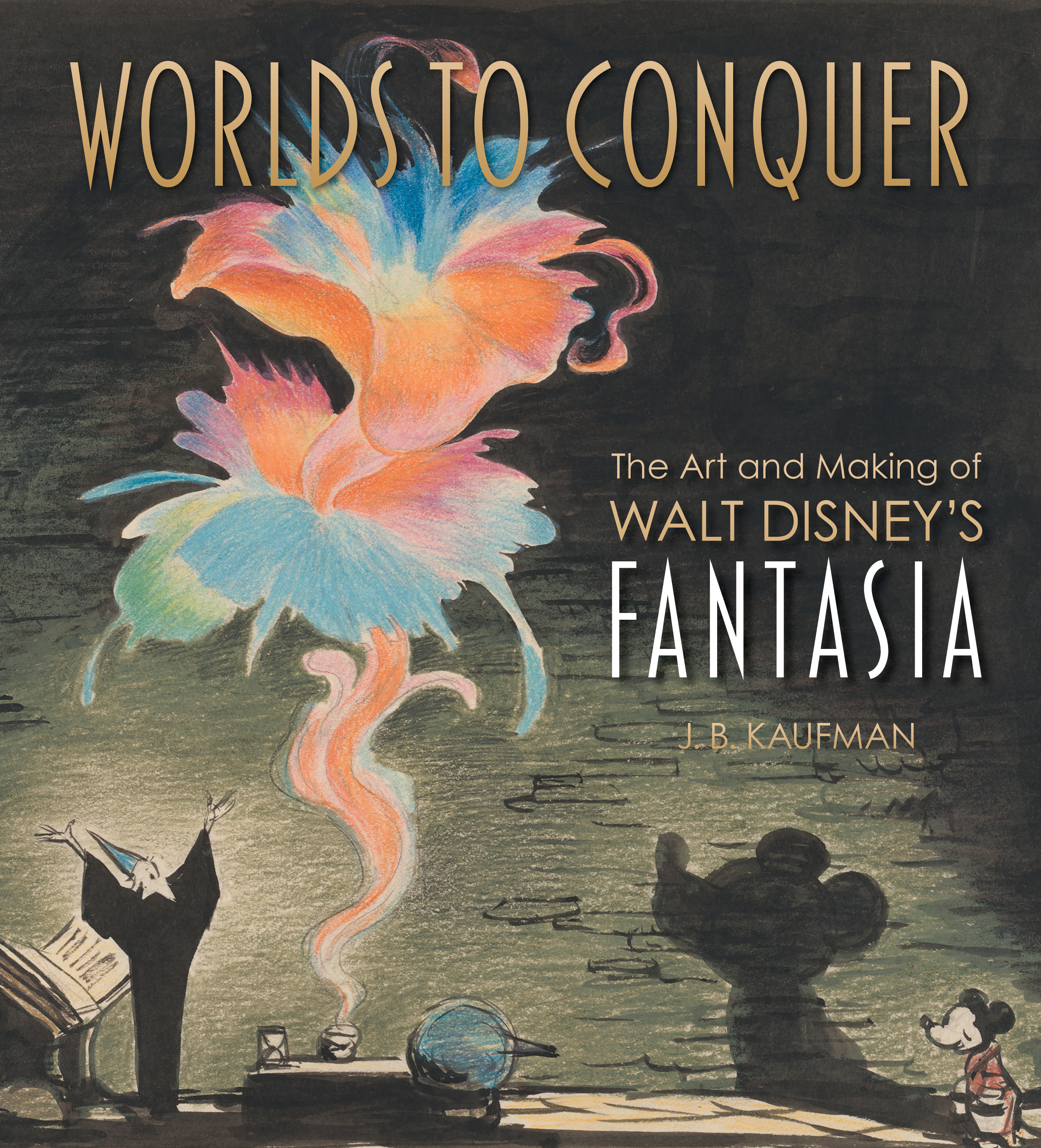
Disney fandom – at least that segment fascinated by the backstories and development of Disney animated classics – eagerly awaited the book’s release as soon as it was announced.
The concept of Fantasia?: The world’s greatest music, presented according to the highest acoustic standard, and illustrated by the brilliance of the Disney studio at the height of its powers. The journey of how Fantasia came to be, beset with almost insurmountable challenges at the time, is one of the most breathtaking in movie history.
Worlds to Conquer: The Art and Making of Walt Disney’s Fantasia by esteemed film and Disney historian J.B. Kaufman is an exhaustively researched and lavishly illustrated deep dive into the creation of Walt Disney’s most ambitious and experimental animated feature, Fantasia (1940).
The book details the remarkable collaboration between Walt Disney and legendary conductor Leopold Stokowski, whose meeting led to the groundbreaking idea of illustrating the world’s greatest classical music with animation. Kaufman chronicles the entire history of the film, originally conceived as The Concert Feature, from its origins in the Sorcerer’s Apprentice short to its audacious, feature-length concept, which was intended to be continually revised and re-released with new segments.
Key elements of the book’s narrative include:
The Genesis of the Idea: Tracing the project from a simple short starring Mickey Mouse to its expansive vision as an animated concert film.
The Creative Process: Providing detailed, segment-by-segment breakdowns of the animation, art, and storytelling, utilizing rare archival materials, including sketches, concept art, and never-before-published production photos.
Technical Innovation: Explaining the development of Fantasound, the pioneering stereophonic sound system created specifically for the film’s roadshow release – a crucial, though financially prohibitive, element of Walt’s original vision.
The Aftermath: Documenting the film’s controversial initial reception, which ranged from high praise to intense criticism, its struggles at the box office due to the massive production and distribution costs (exacerbated by World War II), and its subsequent history of re-releases and edits over the decades.
A Definitive Scholarly Achievement
Kaufman, known for his meticulous research in books like The Fairest One of All (on Snow White) and Pinocchio: The Making of the Disney Epic, delivers what can easily be called the ultimate guide to Fantasia. The book is a treasure trove of historical insight, moving beyond standard production stories to offer a true scholarly examination of the film’s cultural and technical significance.
Key Strengths:
Archival Depth: The book’s most compelling feature is its wealth of primary source material. Kaufman’s access to the Disney archives allows him to present details – like animator Art Babbitt finding inspiration for the Nutcracker Suite mushroom in Curly Howard of The Three Stooges – that even dedicated Disney fans may not know.
Contextualization: The work excels at placing Fantasia within the context of both the Disney Studio’s golden age and the broader history of cinema and music. It highlights how the film was nothing less than a deliberate challenge to existing preconceptions of the arts.
Visual Splendor: As with Kaufman’s previous “Making Of” books, the volume is lavishly designed and filled with high-quality reproductions of rare artwork, making it a spectacular coffee-table book as well as an academic resource. The images add crucial instructive value to the technical explanations.
An article many times this length would not do justice to Worlds to Conquer. The individual segments of the film, its lengthy development and production, and the many elements left reluctantly on the cutting room floor speak to the complexity that Kaufman has brilliantly researched and written.
It is my hope that the words above will entice Disney fans to acquire the book, and enjoy the hours of reading it will give them.
That being said, I want to take a deeper dive into what I think is the most influential and long-lasting segment of Fantasia: the section based on the music The Sorcerer’s Apprentice.
The Magic that Built the Kingdom: Bridging 1940 to Today
In 1940, Walt Disney’s Fantasia was intended to be more than just a film; it was a sensory revolution that sought to elevate animation to the status of high art. At its heart was The Sorcerer’s Apprentice, a segment that didn’t just give Mickey Mouse a new pair of pupils and a more expressive form, but a new soul. This singular moment of cinematic sorcery provided the creative DNA for what would eventually influence the creation of Walt Disney Imagineering and the resulting “kingdoms” of theme parks all around the world.
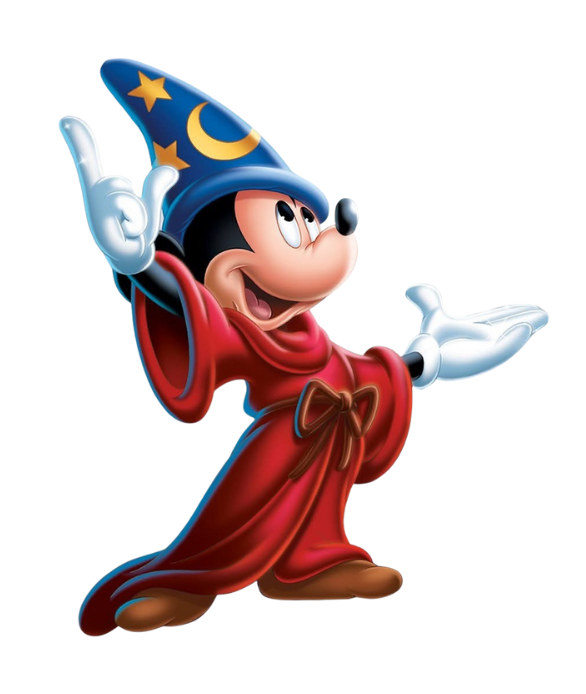
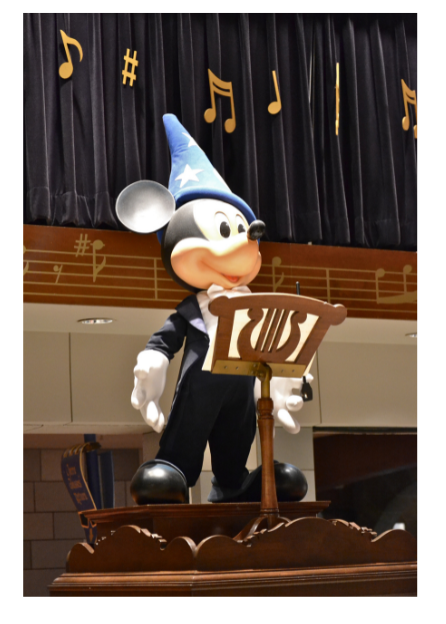
The same “magic” Mickey wielded on the big screen – the audacious ability to turn a dream into a tangible, moving reality – became the philosophical foundation for building physical worlds. That blue, star-studded hat evolved from a simple movie prop into a badge of office for the artists and engineers who realized that “imagination” required “engineering” to truly come alive. Today, whether he is conducting the mist-screens of Fantasmic! or guiding us through the 4D chaos of Mickey’s PhilharMagic, Sorcerer Mickey remains the essential bridge between Walt’s earliest artistic ambitions and the immersive, high-tech wonders of the modern Disney Parks era.
Origins: The Sorcerer’s Apprentice (1940)
The character known as “Sorcerer Mickey” made his big-screen debut in 1940 as the protagonist of “The Sorcerer’s Apprentice” segment in the feature film Fantasia. Because this segment originally began in early 1938 before the concept of what came to be known as Fantasia was developed, the “new” Mickey Mouse was released in three shorts between 1938 and 1940.
The Problem: By the late 1930s, the classic “pie-eyed” Mickey Mouse, while beloved, was starting to be overshadowed in popularity by more boisterous and comedic characters like Donald Duck and Goofy. Walt Disney sought an ambitious project to bring Mickey back into the spotlight.
The Concept: The idea originated as an elaborate Silly Symphony short based on the 1897 symphonic poem by Paul Dukas, which was itself inspired by the 1797 poem “Der Zauberlehrling” by Johann Wolfgang von Goethe. The plot involves a young apprentice of the sorcerer Yen Sid (an anagram of “Disney”), who borrows his master’s magical hat to bring a broomstick to life to do his chore of filling a cistern.When the apprentice forgets the counter-spell, the magic spirals wildly out of control, leading to a near-disastrous flood.
The Expansion: The project grew in scope and budget, particularly after Walt Disney began collaborating with legendary conductor Leopold Stokowski. To justify the immense expense, the decision was made to expand the single short into a revolutionary, full-length animated feature film set to classical music – Fantasia.
Key Differences in the Character
“The Sorcerer’s Apprentice” was the catalyst for a significant redesign and shift in Mickey’s on-screen persona.
Feature
Classic Mickey (Pre-1940)
Sorcerer Mickey (Fantasia) and After
Visual Design
“Pie-eyes” (black ovals with no pupils) and a less-rounded body.
First appearance with pupils for greater expression; rounder, more child-like features (redesigned by animator Fred Moore).
Costume
Signature red shorts, white gloves, and yellow shoes.
Iconic blue wizard’s cap adorned with white stars and a crescent moon, a long red robe, and exaggerated brown shoes.
Personality
Often a mischievous prankster, happy-go-lucky, or an everyman hero.
Eager, ambitious, and slightly reckless, showcasing a powerful but uncontrolled desire for magic and grandeur. He is a character of pure awe and fantasy.
Significant Uses Since 1940
Sorcerer Mickey’s image has become one of the most powerful and recognizable symbols of the Walt Disney Company, frequently used to represent magic, creativity, and the entire Disney Parks experience.
1950s – Present: Disney Parks Iconography: The costume quickly became a symbol of Disney magic. Sorcerer Mickey appears frequently in character meet-and-greets, merchandise, and as a mascot for major milestones.
1989 – Present: Fantasmic!: Sorcerer Mickey is the central figure in the long-running nighttime spectacular Fantasmic! at both Disneyland Park and Disney’s Hollywood Studios at Walt Disney World. In this show, he uses his imagination and the Sorcerer’s Hat to battle villains and save the day, solidifying his role as a heroic wielder of magic.
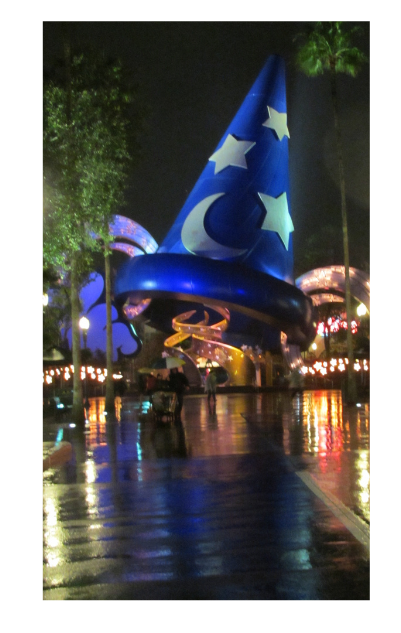
1990s – 2015: Disney’s Hollywood Studios Centerpiece: A massive, 122-foot-tall Sorcerer’s Hat stood for many years as the park’s primary icon, serving as a powerful visual tribute to Fantasia.
2000: Fantasia 2000: The original “Sorcerer’s Apprentice” segment was remastered and included in the sequel film, Fantasia 2000, reaffirming its importance.
2002 – Present: Kingdom Hearts Video Game Series: King Mickey often adopts his Sorcerer Mickey outfit and powers in the popular Kingdom Hearts video game franchise, further expanding his presence in contemporary media.
Why the Character is Beloved
Sorcerer Mickey is cherished by Disney fans for several profound reasons:
Symbol of Ultimate Disney Magic: He is the visual embodiment of the magic inherent to the Disney brand. The starry hat and sweeping robe instantly conjure feelings of wonder, fantasy, and the limitless potential of imagination.
The Human Element of Mickey: The “Apprentice” story is highly relatable. Mickey’s desire for an easy shortcut (letting the brooms do the work) and his subsequent panic when the situation spirals out of control showcase a vulnerability that fans connect with. He is a dreamer who makes mistakes, unlike the more perfect, ambassadorial Mickey of later years.
Aesthetic Grandeur: The music of Paul Dukas and the magnificent, expressionistic animation of the sequence make it one of the most visually stunning pieces of Disney film history. The image of Mickey standing on the mountaintop, directing the cosmos, is a moment of pure, transcendent artistry.
Legacy and Nostalgia: As the face of Fantasia – a film that, for many, represents Disney’s most audacious and artistic endeavor – Sorcerer Mickey is inextricably linked to a time of creative innovation and grandeur.
The Sorcerer Mickey character, therefore, is not just a costume change; it is the iconic representation of Mickey as the dreamer, the innovator, and the powerful, if sometimes clumsy, master of his own destiny.
Sorcerer Mickey and Walt Disney Imagineering (WDI)
The story of Sorcerer Mickey within the parks is inseparable from the history of Walt Disney Imagineering (WDI). WDI, the highly creative and secretive arm of The Walt Disney Company responsible for designing and building all Disney theme parks and attractions, has a history rooted in the creation of Disneyland.
1952: WED Enterprises: Walt Disney founded the company on December 16, 1952, originally calling it Walt Disney, Inc., to handle the immense task of designing Disneyland. The name was quickly changed to WED Enterprises -standing for Walter Elias Disney – to keep it separate from the publicly traded film studio.
A Unique Blend: WED was a combination of artists, architects, engineers, writers, and technicians. The term “Imagineering” is a portmanteau combining Imagination and Engineering, perfectly defining the division’s mission: to dream up fantastic worlds and figure out the technology to make them real. Walt Disney himself later championed the term, and it officially became Walt Disney Imagineering (WDI) in 1986.
The Sorcerer as the Mascot
Sorcerer Mickey naturally became the unofficial, and often official, mascot and visual signature of Imagineering for decades.
Element
Rationale
Magic and Engineering
The character perfectly embodies the fusion of imagination and engineering. Sorcerer Mickey uses the magical hat to bring his designs (the brooms) to life, but his lack of control requires the Sorcerer/Yen Sid (the master Imagineer) to step in and restore order. It’s a parable for the creative process: inspiration (the magic) must be balanced with discipline and engineering (the counter-spell).
The WDI Logo
For many years, an image of Sorcerer Mickey, often standing with his arms raised, appeared on internal WDI merchandise, pins, and as a primary visual identifier for the division. Cast Members who worked for WDI received exclusive merchandise featuring the character, reinforcing the internal identity.
The Park Icon
In the most explicit Imagineering use, a colossal, 122-foot-tall Sorcerer’s Hat was constructed at the end of Hollywood Boulevard in Disney’s Hollywood Studios (then Disney-MGM Studios) in 2001. Though sometimes controversial with guests who felt it blocked the view of the Chinese Theatre, its existence was a monumental testament to Imagineering’s ability to create a symbol of pure Disney magic on an epic, structural scale.
Moving Away in Recent Years
In the 21st century, the prominent use of Sorcerer Mickey as the singular emblem for Imagineering and the parks has gradually been phased out, driven by a desire for a more diverse and contemporary identity.
Removal of the Icon: The most symbolic change was the removal of the Sorcerer’s Hat at Disney’s Hollywood Studios in early 2015. This decision was part of a larger, long-term effort to transform the park from a generalized “studio” concept back to its original vision of celebrating the Golden Age of Hollywood and, more recently, to focus on immersive, specific IP-based lands (like Star Wars: Galaxy’s Edge). The removal restored the sight lines and eliminated a universal symbol of magic in favor of more specific narrative architecture.
The Rise of Specific IP: Modern Imagineering projects are increasingly focused on creating fully immersive environments based on powerful intellectual properties (IPs) – from Pandora – The World of Avatar to Toy Story Land. Using a character like Sorcerer Mickey as the universal symbol is less critical when the park’s primary icons are now the Millennium Falcon or the Tree of Life.
Shift in Internal Branding: While Sorcerer Mickey is still revered, WDI has moved toward using less character-specific or more abstract, modernized logos for official communication. This shift emphasizes innovation and the future of placemaking over a single, historical character portrayal.
Despite these changes, the spirit of Sorcerer Mickey – the ambitious blending of fantasy and feasibility – remains the core principle of Walt Disney Imagineering.
The Origins and Development of Fantasmic!
Fantasmic! is Disney’s premier nighttime spectacular, marrying fire, water, light, and fireworks into a grand, character-driven narrative. Its creation marked a significant moment in Disney Parks entertainment.
The Need for a New Spectacle
The Setting: The show premiered at Disneyland Park in Anaheim, California, on May 15, 1992.
The Motivation: By the early 1990s, Disneyland needed a new, spectacular nighttime offering, particularly for the Rivers of America area. While the area hosted the Main Street Electrical Parade and fireworks, Imagineering wanted a show that utilized the unique geography of Tom Sawyer Island (now Pirate’s Lair on Tom Sawyer Island) and the river itself.
A “Character-Driven” Show: Unlike traditional fireworks shows that focused on pyrotechnics and music, Fantasmic! was conceived as a story-first production. The core creative challenge was: How do you create a massive, exciting water and light show that focuses entirely on a beloved character? The answer was Sorcerer Mickey.
Imagineering’s Creative Breakthrough
The show’s concept originated with Show Director and Creative Vice President Barnette Ricci and her team at Walt Disney Imagineering. The goal was to place Sorcerer Mickey at the center of a dream-like, epic conflict.
The Premise: The show is presented as a journey inside Sorcerer Mickey’s imagination and dreams. It starts with him conducting the water and light (much like he conducts the cosmos in Fantasia), transitioning through nostalgic Disney moments, and culminating in a terrifying nightmare where the Disney villains try to turn his imagination against him.
Technological Innovation:Fantasmic! required the invention of new technology to achieve its scale and integration of elements:
Mist Screens: The show famously uses high-pressure water cannons to create immense, concave sheets of water vapor that serve as 30-foot tall projection screens. This was a breakthrough, allowing animated clips and effects to appear suspended over the water.
The Dragon: The original show’s centerpiece was the confrontation with a massive, animatronic Maleficent Dragon that breathes real fire. This was one of the largest and most complex animatronics created for an outdoor stage at the time. The dragon was destroyed in a fire in April 2023 and replaced with by an elevated Maleficent figure in her human form during the finale battle with Sorcerer Mickey Mouse.
The Island Stage: Tom Sawyer Island was completely refitted with hidden pyrotechnics, lighting trusses, and launch mechanisms to serve as the sprawling, multi-level stage for the live actors and boats.
Legacy and Expansion
Fantasmic! was an immediate and overwhelming success, driving attendance and solidifying its place as a cornerstone of the Disneyland experience.
Walt Disney World Version (1998): Due to its popularity, a second, redesigned version of the show opened at what is now Disney’s Hollywood Studios in Florida. This version is performed in a permanent, custom-built stadium called the Hollywood Hills Amphitheater, allowing for greater seating capacity and a much larger stage, featuring different characters and unique effects compared to the California version.
Fantasmic! – in both versions – cemented Sorcerer Mickey’s role not just as a symbol, but as an active, heroic protagonist who uses the power of his imagination – the very magic of Disney – to defeat evil and restore harmony.
No history of Sorcerer Mickey is complete without discussing his “appearance” in the 4D spectacular Mickey’s PhilharMagic. While Donald Duck is the true star of this show, the entire plot hinges on the magical power of the Sorcerer’s Hat.
Mickey’s PhilharMagic: A 4D Sym-Funny
Opened in 2003 at Magic Kingdom (and later at Disney parks worldwide), Mickey’s PhilharMagic is a 12-minute 4D experience that serves as a modern love letter to Disney’s musical legacy.
The Sorcerer’s Connection
The story begins with Mickey Mouse preparing to conduct the PhilharMagic Orchestra. Before he takes the stage, he leaves his famous Sorcerer’s Hat on the podium, strictly warning his stagehand, Donald Duck, not to touch it.
Naturally, Donald cannot resist. Upon donning the hat, the magical instruments rebel, and Donald is sucked into a whirlwind journey through the greatest hits of the Disney Renaissance. The hat serves as the “portal” that allows Donald (and the audience) to travel between musical worlds.
Groundbreaking Technology
Imagineering pushed the limits of sensory storytelling with this attraction:
The World’s Largest Screen: The show features a 150-foot-wide seamless wraparound screen, the largest of its kind ever built. At the climax, the proscenium disappears, and the image expands to fill the guest’s entire field of vision.
First-Ever 3D Models: This was the first time classic characters like Ariel, Lumière, and Simba were modeled and animated entirely in 3D CGI. Imagineering even brought back original animators (like Glen Keane for Ariel) to ensure the 3D versions remained true to their hand-drawn roots.
Sensory “4D” Effects: To deepen the immersion, the theater is equipped with:
Scents: The smell of fresh apple pie during Be Our Guest.
Water: Light mists during the Sorcerer’s Apprentice broom segment.
Wind: A cool breeze while flying over London and Agrabah.
Significant Scenes & Updates
The show features iconic sequences including Part of Your World, I Just Can’t Wait to Be King, and A Whole New World. In 2021, a new segment based on Pixar’s Coco was added, featuring the song “Un Poco Loco,” marking the first time a Pixar property was integrated into the show.
The attraction ends with a classic “slapstick” Disney moment: Mickey returns to reclaim his hat and restore order, while a defeated Donald is launched out of a tuba and – through the use of a physical animatronic – ends up stuck in the back wall of the theater.
The story of Sorcerer Mickey is one of resilience, proving that a character born from a “great experiment” in 1940 could become the very soul of a global entertainment empire. As we look toward the future, his role continues to evolve from a mere mascot into a profound symbol of the creative process itself.
The Future: A Return to the Magic
While the mid-2010s saw a temporary “de-Mickeyfying” of some park aesthetics (most notably the removal of the giant Sorcerer’s Hat from Disney’s Hollywood Studios in 2015), the late 2020s are ushering in a “Great Re-Integration.”
The Return of the Hat (2026): In a move that delighted long-time fans, Disney recently announced that the Sorcerer’s Hat will return to Disney’s Hollywood Studios in 2026. Rather than a standalone icon, it will top the newly reimagined “Magic of Disney Animation” attraction – a replica of the iconic building at the Walt Disney Studios in Burbank. This placement signals a shift: Sorcerer Mickey is no longer just a “signpost,” but a guide to the actual artistry of animation.
The Hero of the High Seas: On the newest fleet of ships, such as the Disney Destiny (launched in November 2025), Sorcerer Mickey has been elevated to a “Hero” archetype. He serves as the thematic anchor for high-end concierge spaces and elevator banks, positioned as the heroic counterpart to villains like Maleficent.
A Symbol for the Next Generation: Beyond physical statues, the “Apprentice” persona has become a metaphor for Innovation and AI. As Disney explores new technologies like augmented reality and smart-animatronics, the Sorcerer’s Apprentice remains the perfect avatar for the Imagineer: someone who uses powerful tools to create wonder, while always respecting the “magic” (and the responsibility) behind the craft.
The Eternal Apprentice
Ultimately, Sorcerer Mickey’s impact lies in his relatability. He isn’t a master who knows everything; he is the eternal student. By keeping this version of Mickey at the forefront of the parks, Disney reminds every guest that they, too, possess a “magic hat” – their own imagination – and that with a little courage (and perhaps a bit of pixie dust), they can conduct their own destiny.
Today “Fantasia” and its imagery retain their favored status in American culture. The vision of Mickey, the eternally youthful optimist, atop the promontory – not only reaching for the stars but directing them in their courses – remains one of his most beloved images. (J.B. Kaufman)
Worlds to Conquer is essential reading for any serious Disney enthusiast, animation historian, or art lover. It doesn’t just chronicle the making of the movie; it argues for Fantasia’s enduring place as one of the great cinematic masterpieces of the twentieth century, providing an unparalleled appreciation for the audacity and genius of Walt Disney and his team.
J.B. Kaufman continues his tremendous depth and breadth of Disney animation knowledge with meticulous research, transforming it into a wonderful read and must-have gift for the Disney enthusiast or film historian.
Part of a regular series on 27gen, entitled Wednesday Weekly Reader.
During my elementary school years one of the things I looked forward to the most was the delivery of “My Weekly Reader,” a weekly educational magazine designed for children and containing news-based current events.
It became a regular part of my love for reading, and helped develop my curiosity about the world around us.
Regular readers know of my fondness – no, fanaticism for Walt Disney and the “kingdoms” he created. Having been enamored of Walt Disney since the early 1960s, and expanding the childhood attraction of films and television to visiting parks as a teenager and then as an adult, in all aspects of Disney history, I am truly a Disney nerd.
With that being said, there are two very special attractions found in the U.S. Disney parks that have totally captivated me since my first visit to Walt Disney World in 1975. That captivation means that when I go to the parks, these two attractions are always at the top of my list, and will be ridden many times. (That can be a lot of repeat rides – in one recent year, I was on Disney properties 31 days – more than some seasonal cast members).
You know what I’m talking about, don’t you?
The Pirates of the Caribbean.
The Haunted Mansion.
My attraction to these two attractions may have shown up in various ways…
The Enduring Legacy of Immersion
The Pirates of the Caribbean (1967) and The Haunted Mansion (1969) are not merely rides; they are masterpieces of kinetic storytelling that fundamentally redefined what an immersive theme park experience could be. By blending innovative Audio-Animatronics® technology with sophisticated theatrical techniques – including compelling scripts, iconic theme music, and seamless transitions between scenes – these attractions broke the mold of simple amusement park transportation.
They set the gold standard by creating completely enveloping, richly detailed worlds that expertly manipulate light, sound, and atmosphere to transport millions of guests from a queue line into a fully realized, three-dimensional narrative. This blend of technical wizardry and timeless, engaging storytelling ensures that their spooky and swashbuckling adventures remain as captivating and popular today as they were over half a century ago.
As I moved from enjoying the attractions to learning all about them, I soon discovered that a single man had a tremendous impact on each. Over the years, as my Disney book collection grew, the name “Xavier “X” Atencio” was mentioned time and again in all phases of their development.
While these references were good, I wanted to know more. X Atencio’s work was a masterclass in immersive attraction design, and I knew there was more to his story.
Finally, his life story is available in a newly released book!
The book provides the most complete look to date at the life and career of Francis Xavier “X” Atencio (1919-2017), an original Disney Imagineer who was honored as a Disney Legend in 1996. The narrative traces X’s journey from his early life to his retirement, set against the backdrop of the historic and creative evolution of The Walt Disney Company.
Early Career & Animator: X began his career at Disney at the age of 18 in 1938 as an apprentice animator, contributing to classics like Pinocchio. His work was interrupted by service in the U.S. Army during World War II. Upon his return, he continued to work on animated shorts, including becoming an expert on Goofy, and worked on special projects, including stop-motion for films like Mary Poppins.
Transition to Imagineering: In 1965, at Walt Disney’s personal invitation, X officially transferred to WED Enterprises (now Walt Disney Imagineering). Despite initial uncertainty about his new role, he became a pivotal figure in theme park storytelling.
Defining Legacy: His most famous and enduring contributions are the attractions for which he wrote the scripts and, crucially, the immortal lyrics for their theme songs:
“Yo Ho (A Pirate’s Life for Me)” for Pirates of the Caribbean.
“Grim Grinning Ghosts” for The Haunted Mansion.
His talents extended to writing scripts and dialogue for attractions like Adventure Thru Inner Space and the Country Bear Jamboree.
Later Career & Retirement: X played a key role in the development of EPCOT attractions, including Spaceship Earth and El Rio del Tiempo, and contributed to the opening of Tokyo Disneyland before his retirement in 1984.
The book is uniquely personal, written by his eldest daughter, Tori Atencio McCullough (a former Imagineer herself), his eldest granddaughter, Kelsey McCullough, and a close family friend, Bobbie Lucas. It features a wealth of previously unpublished artwork and photographs from X’s personal collection.
In the annals of Walt Disney Imagineering, few figures possess the quiet, multidisciplinary significance of Francis Xavier Atencio – known to generations of colleagues and fans simply as “X.” Spanning a remarkable 46-year career with The Walt Disney Company, Atencio began as an animator on classic animated films before being personally requested by Walt Disney in 1965 to join the burgeoning creative division known as WED Enterprises (now Imagineering).
This late-career pivot, which saw the animator transform into a narrative architect, was key to shaping the thematic landscape of the Disney Parks. Atencio was initially unsure of the move, recalling, “I went over there reluctantly because I didn’t know what I was getting into”. Yet, Walt believed in his untapped potential, asking Atencio to “stretch his talents” into storytelling. After a brief tenure on small projects , Atencio received the definitive assignment from Walt that would cement his legacy: “I want you to do the script for the Pirates of the Caribbean”.
Atencio’s genius lay in his ability to synchronize script, visual gags, and – most importantly – music, creating attractions that were profoundly immersive and tonally coherent. His dual mastery as both artist and writer positioned him as arguably the first Imagineer to successfully integrate these roles, ensuring the writer’s vision flowed directly into the ride’s auditory and emotional execution. This skill defined the tone of Disneyland’s two foundational dark rides: Pirates of the Caribbean and The Haunted Mansion.
Yo Ho: The Pirate Problem Solver
When Atencio was tasked with scripting Pirates of the Caribbean, Imagineers like Marc Davis had already conceptualized many elaborate, comedic scenes featuring Audio-Animatronics figures. The major internal challenge was figuring out how to thread these vignettes into a single, cohesive narrative and, critically, how to handle the pirates’ morally dubious, often “lecherous behavior” in a family park. Walt Disney was reportedly concerned about the guests’ reaction to the general criminality of the characters.
Atencio provided the definitive solution: a song. He convinced Walt that a rousing sea shanty could “soften up these hardened criminals” and provide a strong sense of continuity that tied the dozens of scenes together. He immediately developed the central concept, drawing inspiration from the classic nautical phrase “Yo-ho-ho and a bottle of rum”. He delivered the melody and the core refrain – “Yo ho, yo ho, a pirate’s life for me” – directly to Walt, who instantly approved. Atencio served as the lyricist, crafting the lyrics that cheerfully recount theft and plunder, and was paired with composer George Bruns to score the music. The resulting song, “Yo Ho (A Pirate’s Life for Me),” became an anthem, reframing scenes of looting and villainy as boisterous, theatrical fun.
Atencio’s connection to the ride went beyond the lyrical. He also provided several vocal performances for the attraction. He voiced the recognizable Talking Skull situated just before the drop into the main ride area, and the drunken pirate who heckles the auctioneer. Furthermore, due to time constraints and the cost of recalling professional voice actors late in development, Atencio’s voice was used for the functional safety spiel in the Disneyland version, ensuring the ride’s audio integrity was maintained under pressure.
Grim Grinning Ghosts: The Playful Macabre
Following the swashbuckling success of Pirates of the Caribbean, Atencio was given the complex task of writing the script and lyrics for The Haunted Mansion. This project was complicated by a deep creative rift among Imagineers: some favored a genuinely terrifying house of horrors, while others advocated for a purely humorous experience.
Atencio mediated this tension by defining a tone of “Playful Macabre.” His central narrative concept was that the mansion’s 999 “happy haunts” weren’t necessarily focused on frightening guests, but primarily wanted to “socialize” with them. Walt Disney approved of this defining concept, recognizing that “Socialize” was the key word that balanced the dread with Disney’s family-friendly ethos.
Atencio’s dialogue set the stage for the attraction’s macabre humor, beginning with the iconic, chilling greeting from the Ghost Host: “Welcome, foolish mortals, to the Haunted Mansion”. He established the central, repeating premise that the ghosts were actively looking for a 1,000th member to join their party, providing a comfortable, repeatable framework for the eerie tour: “Actually, we have 999 happy haunts here — but there’s room for 1,000. Any volunteers?”.
For the attraction’s theme song, Atencio collaborated with composer Buddy Baker to create “Grim Grinning Ghosts (The Screaming Song)”. The title itself was an intentional nod to Shakespeare’s poem Venus and Adonis, setting a tone that deliberately juxtaposed the eerie with the humorous. Like “Yo Ho,” the song acted as a thematic glue, its melody adapted for organs, choirs, and full ensembles to underscore every scene, from the somber opening to the lively graveyard party.
And, as he did with the pirates, Atencio lent his voice to the mansion, providing the vocals for the Coffin Ghost located in the Conservatory scene. Furthermore, his authoritative yet calming voice is still heard in the Disneyland attraction, delivering the emergency spiel with the now-famous phraseology: “Playful spooks have interrupted our tour. Please remain seated in your… Doom Buggy”.
Atencio retired from the Company in 1984, but his legacy remains unsurpassed. As the scriptwriter and lyricist for Pirates of the Caribbean and The Haunted Mansion, he provided the distinct narrative voice and enduring musical themes that continue to captivate guests today. His work established the creative standards for immersive, Audio-Animatronics-based storytelling, earning him the prestigious title of Disney Legend in 1996.
Intimate and Personal Tone: Because the book is written by his family, it offers a beautifully nuanced and warm portrait of the man behind the magic. Readers learn about X’s humility, humor, continuous curiosity, and his devotion to his family, providing a richer understanding of his character alongside his achievements.
Inspirational Creative Process: The text does a masterful job of illustrating X’s storytelling philosophy – that Disney stories should be layered, alive, and endlessly rewarding. Reading about his ability to transition seamlessly from animation to theme park lyricist and scriptwriter offers a valuable look at the creative DNA of Disneyland’s most classic attractions.
Rich Visual Content: The large-format hardcover is visually gorgeous, featuring rare photos from the Disney archives alongside candid family snapshots. The inclusion of his personal artwork and photos grants a unique look into his private life and professional process.
A Well-Deserved Tribute: The book thoroughly documents X’s diversified resume – a man who worked across decades of Disney’s evolution – from animator to one of Walt’s most trusted and versatile Imagineers. His life serves as a lesson in achieving an enormous creative mark through imagination and generosity.
The authors successfully capture the spirit of X Atencio – a Disney fan who greatly admired Walt, but never aspired to be Walt, instead finding and cultivating his own unique genius. For anyone who has ever hummed the tunes of a pirate or a hitchhiking ghost, this book is not just a biography, but a heartfelt thank you to a true Disney Legend whose imagination made the parks sing.
Part of a regular series on 27gen, entitled Wednesday Weekly Reader.
During my elementary school years one of the things I looked forward to the most was the delivery of “My Weekly Reader,” a weekly educational magazine designed for children and containing news-based current events.
It became a regular part of my love for reading, and helped develop my curiosity about the world around us.
Long before Mickey Mouse and Disneyland, a thirteen-year-old Walt Disney had simpler dreams: a fashionable pair of high leather boots with metal toes and decorative strips over the laces. It was 1914, and every kid at school seemed to own a pair.
What Walt couldn’t have known was that this Christmas gift would become a turning point that would shape his entire future – though not in the way anyone expected.
In the Vault of Walt Christmas Edition, author Jim Korkis – one of the most respected chroniclers of Disney history – curates a festive collection of essays exploring how Christmas traditions have woven themselves into the fabric of Disney storytelling, parks, films, and corporate legacy.
The book is structured as a series of standalone chapters, each spotlighting a specific piece of Disney Christmas lore. Topics include:
Walt Disney’s personal Christmas traditions, including anecdotes about the Disney family’s holiday rituals at home and in the studio.
Behind-the-scenes stories of classic Disney Christmas productions, such as Mickey’s Christmas Carol, Babes in Toyland, and various holiday television specials.
The evolution of Disneyland and Walt Disney World holiday celebrations, from early parades and decor to today’s highly orchestrated seasonal events.
Obscure and rarely told stories, such as abandoned concepts for Christmas attractions, little-known character appearances, and holiday tie-ins with Disney marketing and merchandising.
True to the Vault of Walt series, the book presents a mixture of deep archival digging, oral histories, and Korkis’s signature informal, conversational storytelling.
As an example, here’s a little-known story from Walt’s childhood that literally changed his destiny…
A Newsboy’s Hard Life
Young Walt’s childhood in Kansas City was far from magical. Working as a newsboy on a route owned by his father Elias, Walt experienced hardships that would stay with him forever. His days began at 3:00 in the morning, when most children were still sleeping soundly. By 3:30 a.m., he’d already be out in the brutal Kansas City winters, trudging through snow and slush to deliver newspapers. He’d barely make it back in time for school, exhausted before his day had truly begun.
When Walt spotted those stylish boots, he saw more than just a fashion statement. He tried to convince his father they were practical – they’d give him better traction in the slush and rain, helping him deliver papers more quickly. But Elias Disney wasn’t buying the argument. Money was desperately tight, and such extravagances were out of the question.
Walt persisted, hoping the boots might appear for his birthday on December 5th. Instead, he received something practical and forgettable. With his birthday falling so close to Christmas, Walt often had to settle for one gift to cover both occasions.
A Mother’s Secret Sacrifice
What Walt didn’t know was that his mother Flora had been quietly setting aside pennies from the housekeeping budget, hiding her savings from her husband. Walt’s older brother Roy had found extra work and contributed his earnings to the cause. Together, they made the impossible possible.
On Christmas morning, there beneath the tree sat a wrapped package. When Walt tore it open, his face lit up with pure joy. The boots were finally his.
Pride Before the Fall
Unable to contain his excitement, Walt immediately put on his prized boots and ran downtown. He positioned himself against a drugstore at the intersection of Thirty-First and Indiana, hoping his school friends might pass by and see his new footwear. It was an unusually warm winter, and the ice had begun to melt.
As darkness fell around six o’clock, Walt started walking home. The streets were filled with chunks of ice – remnants of winter that melted first on the roadway. With his new boots, Walt invented a game to pass the time: kicking the hunks of ice across the street, experimenting with different angles and force.
Then came the kick that changed everything.
Trapped in the Twilight
Walt approached what seemed like just another chunk of ice. But when his boot made contact, he couldn’t pull his foot back. Panic set in as he realized the horrible truth: a large horseshoe nail frozen in that block of ice had pierced straight through his new boot and into his foot. He was stuck to the ice, unable to move.
The street was empty. Everyone was home celebrating with family. Walt yanked and pulled, but without leverage, escape was impossible. He began shouting for help, frantically waving at passing streetcars. People looked at him and continued on their way, assuming he was just a kid playing around.
For more than twenty minutes, Walt remained trapped on that darkening street, fear mounting with each passing moment. Finally, a horse-drawn delivery wagon approached. The driver initially didn’t believe the boy’s cries for help and started to move on – until Walt broke into tears.
The driver got down and assessed the situation. He had to fetch a tool to chop the ice loose, then carried the small, frail boy to a nearby doctor’s office. Without any anesthetic to ease the pain, Walt had to endure the doctor cutting off his boot and using metal pliers to dig out the nail while two men held him down. After cleaning the wound came the dreaded tetanus shot.
Adding insult to injury, Walt’s father had to be called to pick him up and pay the medical bill.
Two Weeks That Shaped a Legacy
Walt spent two weeks laid up on the living room couch with his foot elevated, consumed by guilt and shame. The boots his mother and brother had sacrificed for were destroyed. The family could never afford another pair. Nightmares of being trapped alone on that cold, darkening street haunted his sleep.
With no school, radio, or other entertainment, Walt had only books and a sketch pad given by his aunt. He had once considered becoming a doctor or lawyer, but his exhausting work schedule left him catching catnaps in class and missing important lessons. He lacked the grades for a good college, and his family couldn’t afford tuition anyway.
During those two weeks of convalescence, something crystallized in Walt’s mind. He realized he loved cartooning. His drawings earned chuckles at the local barbershop, where the barber would accept cartoons as payment and display them in the window. His classmates loved his work. Each day, when his mother delivered his homework assignments, she’d drop off his cartoons and return with reports of enthusiastic reactions.
By the time his foot healed, Walt Disney had made a firm decision: he would become a professional cartoonist.
The Gift That Kept Giving
Reluctantly, Elias allowed Walt to take Saturday morning art lessons at the Kansas City Art Institute. When the family moved to Chicago, Walt pursued classes at the Chicago Academy of Fine Arts, studying three nights a week after school. As his daughter Diane later recalled, Walt loved being at a drawing board so much that he’d hold off going to the bathroom until class ended.
Almost three years after that fateful Christmas, Walt returned from serving with the Red Cross Ambulance Corps in France, ready to pursue his cartooning dreams.
Those Christmas boots – longed for, briefly cherished, and tragically destroyed – became the unexpected gift that gave the world Walt Disney. Sometimes the most transformative presents aren’t the ones we keep, but the ones that force us to discover who we’re truly meant to become.
A Gift for Fans of Disney Lore
The Vault of Walt Christmas Edition stands out as one of the more personal and intimate volumes in Korkis’s long-running series. Christmas already carries emotional weight for many readers, and Korkis skillfully blends that sentimentality with his extraordinary knowledge of Disney history.
Rich, Primary-Source Material: Korkis’s strength has always been his access – to artists, Imagineers, animators, and studio staff – and he uses it here to paint a vivid picture of how Walt Disney approached the holidays both personally and professionally. Chapters about Walt’s own family are particularly compelling and help humanize a figure many only know in mythic form.
Deep Cuts for Enthusiasts: Hard-to-find stories are where this book shines. Fans who think they “know everything” about Disney Christmas will discover, including: abandoned scripts, forgotten televised specials, rare park entertainment initiatives, and internal studio celebrations from the 1940s–1960s. These chapters reflect the best of Disney historiography: carefully researched, yet told with warmth.
Accessible for Casual Readers: While Disney historians will appreciate the depth, the writing style makes the book approachable for anyone. The standalone essay format means readers can dip in and out like opening doors on an Advent calendar – each chapter its own small surprise.
Tone and Style: Korkis’s voice is friendly, nostalgic, and occasionally humorous. He avoids academic dryness without sacrificing accuracy – a tricky balance he manages well.
As with all Vault of Walt books, the essay structure can feel slightly episodic; readers looking for a single cohesive narrative may prefer other histories. But this format is also part of the series’ charm.
A warm, meticulously researched, and heartfelt exploration of Disney’s holiday heritage. For anyone fascinated by Disney parks, animation history, or Walt Disney himself, The Vault of Walt Christmas Edition is a delightful seasonal read packed with stories that rarely appear in official company publications. It captures the magic of both Christmas and Disney in equal measure – an ideal addition to any Disney historian’s bookshelf.
Part of a regular series on 27gen, entitled Wednesday Weekly Reader.
During my elementary school years one of the things I looked forward to the most was the delivery of “My Weekly Reader,” a weekly educational magazine designed for children and containing news-based current events.
It became a regular part of my love for reading, and helped develop my curiosity about the world around us.
(Though the eyes and words of my 5-year-old grandson and a 2-year-old granddaughter)
Hi! My sister and I are excited because GrandBob is at our house right now. Mom and Dad went to the hospital to get our new baby brother, so we have to tell GrandBob how to take care of us.
It’s like we are babysitting him!
GrandBob, listen up!
Morning Time is Snuggle Time!
My sister always wakes up really early, like around 5 o’clock! We let her snuggle with Mom and Dad, or sometimes we watch a show in the playroom so Mom and Dad can go back to sleep. Take your pick!
If it’s a school day, I usually get up an hour after my sister. I get to watch my tablet or TV with my sister for a few minutes before getting dressed. I don’t need any help to pick my outfit or help me get dressed! My sister gets a diaper change then, too.
She is very opinionated about her clothes and shoes now. You can just let her pick them if that’s easier! I love my Crocs, and I don’t need socks with them because I don’t really go outside at school in the winter.
We don’t need breakfast because we get food at school! But we do get to pick a yummy snack.
School Drop-Offs!
We need to be in the car and headed to school by 7:30 a.m. or the drop-off at my school takes a long time.
First, we go to my school; Dad gave you the address so you can put it in your phone and I can watch the map and our car moving. The school is on the left, and there is a big drop-off circle. People will usually open the door for me and help me get out. Mom always gets out to give me a big hug and a kiss. Even though I think they don’t like it when she gets out, she says she will kiss me as long as I let her! I walk in all by myself because I’m a big boy.
Then you take my sister to her school. I used to go there so I know the teachers. After dropping off my sister Dad says you’re free the rest of the day until it’s time to pick us up. What do you do all day while I’m in school?
Afterschool Pickup, Supper, and Bed Time Rules!
GrandBob, in the afternoon I ride a bus from my school to where Mom works, so Dad told me you would pick me up at the bus drop-off. If you get there early, don’t worry – my bus will go right by your car, but will return to drop me off in about ten minutes. I kinda get “hangry” (that’s the word Mom uses) so I hope you will have a snack waiting for me.
We can go home and I can do my homework and then play for a little while until it is time to go pick up my sister. By the time we pick her up, it will be time for supper because she has an early bedtime – and she likes to eat!
Mom and Dad told me that even though you can cook, we will probably go out for supper after we pick up my sister. You know all my favorite foods, and she eats everything, so I will be happy to go wherever you choose each night.
After supper we have a little time to play before bedtime. My sister is first for bedtime; after you get her jammies on, read her a book, turn the sound machine on, and give her a couple of glow sticks. Since our new brother is getting a room of his own, my sister and I are sharing a room and I like it dark. The glow sticks help my sister go to sleep (and I get one too). She likes three “silly blankets” to cover up in. Sing her a song – “Twinkle, Twinkle Little Star” is her favorite and she usually goes right to sleep.
You can get my jammies out when you are getting my sister ready for bed, and I get dressed for bed around an hour later. Mom and Dad ask if my tummy is full around then, because they say I like to stall before bedtime. If I’m hungry, I can get a snack, but then the kitchen closes.
You can help me brush my teeth, read me a book, and say prayers before I open the door and sneak into my bed so I don’t wake my sister.
The Doggo!
Toby is our dog. He gets one scoop of food in the morning and one at night. We usually let him out before we leave for school, again before supper, and then before you go to bed. More outside time is always good when you are home.
My Dad says he sometimes gets the “zoomies” after we’ve gone to bed, so you might have to play with him. He will try to lay in bed with you when you go to sleep. If you don’t want him there, just tell him “down” a couple of times, and he’ll hop off the bed and sleep right by you on the floor.
When we wake up the next morning, we start everything all over again!
Just Be Respectful!
GrandBob, there are very few rules when Mom and Dad are not home. We just have to be respectful to each other, Poppa, and you. They don’t care about what we eat or how much screen time we get; Mom and Dad say “Survival is the name of the game”!
Note: GrandBob has taken over the narration, because of a big surprise! Wesley wanted to know what I do during the day, so I’ve been planning…
GrandBob’s Winter Wonderland Adventures!
The kids will discover the following in their playroom, with new things added each day when they get home from school:
A white fuzzy blanket on the floor to simulate snow
An indoor tee-pee that will become an “igloo” with white lights wrapped around it
A flashing star on top of the tee-pee
Flashing icicle lights around the room
An inflatable “Frosty the Snowman”
Snowman blankets to snuggle up in
Bunches of special “snow” activities and crafts
Yummy “snow” treats each day
Fun kid’s videos about snow
New books about snow, snowmen, and icicles
When the new baby comes home, I’m guessing the big brother and sister will need a little distraction, so the Winter Wonderland Adventures were born!
Todd James Pierce’s new book Making Mary Poppins is an essential read for anyone interested in the making of the 1964 classic Mary Poppins or the complex dynamics of creative adaptation. It excels by moving beyond the warm, “feel good” mythologies presented in the film Saving Mr. Banks to deliver a detailed, academic, yet highly engaging account.
The central thesis isn’t the magic of Disney, but the three-way dynamic interplay between Walt Disney’s vision for family entertainment, P.L. Travers’ fiercely protective, esoteric, and ultimately more somber literary vision, and an unlikely pair of brothers who delivered musical magic.
When we watch “Mary Poppins” today, we see seamless magic – Julie Andrews descending from the clouds, Dick Van Dyke dancing across rooftops, and a spoonful of sugar making everything delightful. What we don’t see is the extraordinary twenty-year war of wills that made this masterpiece possible, a conflict between two creative, stubborn individuals with fundamentally opposing visions of what children’s entertainment should be paired with an unlikely duo of musical brothers.
Beyond the Fairy Tale
If you’ve seen Saving Mr. Banks, you know the Hollywood version of this story – a heartwarming tale of Walt Disney melting the icy heart of difficult author P.L. Travers. The reality, as revealed in Pierce’s exhaustive research, is far more complex, fascinating, and revealing about the nature of creative adaptation. This wasn’t a story of one person being right and another being wrong. It was a collision between two legitimate but incompatible artistic philosophies, each championed by a brilliant, stubborn creator who refused to compromise their core values.
The Woman Who Wouldn’t Be Charmed
P.L. Travers was not simply obstinate, as she’s often portrayed. She was a deeply private literary artist who viewed Mary Poppins as something almost sacred – a mystical figure drawn from esoteric traditions, mythology, and her own complex inner world. To Travers, Mary Poppins wasn’t meant to be likable or warm. She was meant to be transformative, enigmatic, and even frightening at times.
For two decades, Walt Disney pursued her, not with simple charm but with persistent negotiations, contract loopholes, and the considerable financial leverage of his studio. Travers resisted because she understood something fundamental: Disney didn’t just want to adapt her books. He wanted to translate them into an entirely different language – the language of American family entertainment, with its emphasis on optimism, sentiment, and emotional transparency.
Her concerns were genuine and literary. She worried that additions like the animated penguin sequence or the nonsense word “Supercalifragilisticexpialidocious” would strip away the story’s emotional and mystical core, replacing depth with spectacle. She feared her complex character would be flattened into mere cheerfulness. And in many ways, she was right to worry – Disney absolutely intended to transform her creation. The miracle is that the final film somehow honored both visions.
Walt’s Last Great Crusade
For Walt Disney in the early 1960s, Mary Poppins represented something personal and urgent. This was his last major attempt to personally champion a new type of feature film, one that could blend live-action sophistication with the enchantment that had made his animated features legendary. He was deeply involved in every aspect, viewing the project through his famous three-part creative lens: as dreamer, as realist, and as critic.
Disney’s genius manifested in unexpected ways on set. He possessed an unusual ability to tour a finished set, examine the physical props and environments, and spontaneously generate comedic moments and bits of character business. Associates described watching him immerse himself in a scene, feeling every expression and reaction, discovering spontaneous ways the characters might interact with their world. The famous color-changing medicine trick – a multi-chambered prop bottle that elicited genuine surprise from the child actors – exemplified this approach. Disney understood that magic needed to feel immediate and real, not just technically proficient.
His team had to navigate Travers’ constantly shifting demands, often placating her while simultaneously moving the production forward. It was a delicate dance, requiring both respect for her concerns and commitment to Disney’s own vision of what the film needed to be.
The Unsung Heroes: Robert and Richard Sherman
Between these two powerful personalities stood Robert and Richard Sherman, the musical brothers who became the creative buffers this impossible project required. Their background made them uniquely qualified for this nearly impossible task.
As sons of Tin Pan Alley songwriter Al Sherman, they’d grown up immersed in American popular song, learning to write music that was accessible, catchy, and told complete stories in three minutes. Their early success with pop hits like “Tall Paul” gave them an ear for contemporary arrangements that would keep the songs from sounding dated. When Walt hired them in 1960, they became his in-house composers, creating music for theme park attractions and films, absorbing the Disney philosophy of balancing fantasy, family appeal, and narrative clarity.
Mary Poppins demanded unprecedented range from them. They had to satisfy Walt’s desire for spectacle while accommodating Travers’ demand for psychological complexity – and somehow make these opposing requirements work together.
Their musical discipline allowed them to write songs that spoke directly to characters’ inner lives. “The Life I Lead” and “A Man Has Dreams” are almost operatic in their dramatic focus on Mr. Banks’ misery and eventual epiphany – far more complex than typical Disney fare. “Feed the Birds,” Walt’s personal favorite, embodied the gentle yet profound message of charity and neglected beauty that resonated with Travers’ deeper themes.
Simultaneously, their Disney experience enabled them to create grand spectacle numbers like “Jolly Holiday” and “Step in Time,” with complex rhythmic structures and vivid imagery perfectly tailored for animation and cinematic choreography.
Their masterwork of balance might be “Supercalifragilisticexpialidocious” – pure Disney showmanship and fun, yet cleverly framed by Bert as something to say when you haven’t anything to say, subtly aligning with Travers’ theme of language’s limitations. The Sherman Brothers were equipped with the technical skill of pop writers and the thematic understanding of Disney collaborators, enabling them to create a score that was simultaneously a commercial smash and a deeply textured, narrative-driven masterpiece.
The Transformation of Bert
One of the most significant creative departures from Travers’ original books was the character of Bert. In the novel, he’s a minor figure – a “Match Man” who briefly appears as a chalk artist and has tea with Mary Poppins in one of his drawings before largely disappearing from the narrative.
Disney and the Sherman Brothers recognized that the film’s episodic structure needed a friendly, recurring presence to hold it together. They expanded Bert into a jack-of-all-trades figure, positioning him as Mary Poppins’ confidant and an unofficial narrator guiding the audience and the Banks children through the magic.
Bert cycles through several distinct jobs throughout the film: one-man band and pavement artist (leading to the animated “Jolly Holiday” sequence), chimney sweep (leading to “Step in Time”), and kite seller (providing the means for Mr. Banks’ ultimate redemption). This continuous presence allowed Bert to act as a foil to Mr. Banks – a poor, happy grown-up versus a wealthy, miserable one – providing the structural glue that held the musical’s fantastical segments together.
Dick Van Dyke’s warm, accessible performance made Bert the audience’s entry point into Mary Poppins’ world, a creative decision that Travers initially resisted but which proved essential to the film’s success.
The Messy Reality of Creative Genius
What emerges from Pierce’s detailed historical account is a truth that Hollywood prefers to gloss over: great art often comes from friction, not harmony. The enduring magic of Mary Poppins lies not just in its performances or technical effects, but in the volatile yet ultimately productive tension between opposing creative visions.
Travers never fully made peace with the adaptation. Disney never fully understood why she couldn’t see the magic he was creating. The Sherman Brothers spent years caught between them, somehow finding ways to honor both perspectives. And from this uncomfortable, frustrating, brilliant process came a film that has enchanted audiences for six decades.
The real story behind “Mary Poppins” isn’t about one genius bending another to their will. It’s about the messy, human reality of creative compromise – about what happens when talented, passionate people with fundamentally different values are forced to work together. Sometimes, just sometimes, the result transcends what any single vision could have achieved alone.
This article is the first of four planned for December, three highlighting brand new Disney books just released and one classic about Christmas and Disney:
Part of a regular series on 27gen, entitled Wednesday Weekly Reader.
During my elementary school years one of the things I looked forward to the most was the delivery of “My Weekly Reader,” a weekly educational magazine designed for children and containing news-based current events.
It became a regular part of my love for reading, and helped develop my curiosity about the world around us.
I was six years old in the summer of 1964 when my mother took me to see my first movie in a theater. The lights dimmed, the curtains parted, and there she was – Mary Poppins, floating down from the clouds with her parrot-headed umbrella, about to change the Banks family forever. That experience imprinted itself on my memory: Julie Andrews’s crisp British accent, the animated penguins, the magic of it all. For decades, that was Mary Poppins to me. It wasn’t until much later that I discovered P.L. Travers’s original books and realized I’d only met half the story.
For most people, this is the definitive Mary Poppins – cheerful, warm, and practically perfect in every way. But P.L. Travers, who created the character in 1934, had a very different vision in mind.
Of course, it was necessary to pop back into my Mary Poppins library to refresh my memory in preparation for writing about a newly-released book, Making Mary Poppins (article coming soon).
The Mary Poppins of the Books
P.L. Travers introduced Mary Poppins to the world in her first novel, simply titled Mary Poppins, and continued her story across seven more books spanning over five decades, concluding with Mary Poppins and the House Next Door in 1988. In these pages lives a Mary Poppins who would likely terrify the children who grew up watching the Disney film.
Travers’s Mary Poppins is vain, brusque, and often downright rude. She is obsessed with her appearance, constantly admiring herself in shop windows and mirrors. When the children ask her questions, she frequently responds with a sharp “I never explain anything” or denies that magical events ever happened, even when the children witnessed them firsthand. She is enigmatic and unknowable, maintaining an emotional distance that keeps everyone – including the reader – perpetually off-balance.
This Mary Poppins doesn’t coddle. She expects immediate obedience and has little patience for nonsense. Her severity is palpable; she can silence a room with a glance. Yet despite her stern demeanor, the Banks children adore her with an intensity that borders on desperation. They fear her departure more than anything, knowing instinctively that she appears and disappears according to her own mysterious rules, carried on the East Wind and departing on the West.
The magic in Travers’s books is strange and often unsettling. Mary Poppins takes the children to visit her uncle who floats helplessly near the ceiling when seized by laughter. They meet the Bird Woman, communicate with infants who still remember the language of sunlight and wind, and journey to the edges of the world where mythological figures reside. These adventures feel ancient and mythic, drawing from folklore and fairy tale traditions where magic is powerful, capricious, and not necessarily kind.
Travers, who studied mythology and mysticism throughout her life, imbued her nanny with archetypal power. Mary Poppins is less a caregiver than a liminal figure – a bridge between the mundane world and realms of wonder, part governess and part goddess. She belongs to no one, answers to no one, and her true nature remains forever just out of reach.
The Mary Poppins of Disney
When Walt Disney released his film adaptation in 1964, he created something entirely different – a Mary Poppins designed to charm American audiences and become a beloved family classic. Julie Andrews’ portrayal transformed the character into someone warmer, gentler, and far more accessible.
Disney’s Mary Poppins still has high standards and maintains a certain formality, but she’s fundamentally kind. She smiles readily, shows genuine affection for Jane and Michael Banks, and clearly enjoys their company. When she arrives at 17 Cherry Tree Lane, she brings not just magic but joy. Her adventures – jumping into chalk pavement drawings, having tea parties on the ceiling, and visiting Uncle Albert’s laugh-filled floating sessions – are whimsical and delightful rather than mysterious and slightly dangerous.
This Mary Poppins teaches lessons explicitly rather than through enigmatic experiences. She sings about staying positive (“A Spoonful of Sugar”), seeing potential in everyone (“Sister Suffragette” notwithstanding), and the importance of finding wonder in ordinary life. The film adds the subplot of Mr. Banks’s redemption, making Mary Poppins instrumental in healing the entire family, not just entertaining the children.
Perhaps most significantly, Disney’s version explains her magic and makes her motivations clear. She comes to fix the Banks family, and once her work is complete, she leaves – sad to go, but satisfied. The film gives her emotional transparency that Travers’s character never possesses. Julie Andrews plays her with twinkling eyes and barely suppressed delight in her own cleverness, making the audience feel they’re in on the joke.
The musical score by the Sherman Brothers became inseparable from the character. Songs like “Supercalifragilisticexpialidocious” and “Chim Chim Cher-ee” are now cultural touchstones, their melodies instantly recognizable decades later. This Mary Poppins is Technicolor optimism incarnate, a nanny who makes everything better through a combination of magic, music, and good old-fashioned love.
Disney’s commitment to their version of Mary Poppins has only deepened over time. The 2013 film Saving Mr. Banks dramatized the contentious relationship between Walt Disney and P.L. Travers during the original film’s development, revealing how fiercely Travers fought against Disney’s softening of her character – a battle she ultimately lost but never accepted. More recently, Mary Poppins Returns (2018) brought Emily Blunt to Cherry Tree Lane as an older Mary Poppins returning to help the next generation of Banks children. While Blunt’s portrayal incorporated slightly more of Travers’s tartness than Andrews’s version, the film remained firmly in Disney’s magical, musical tradition, proving that their interpretation has become the definitive one in popular culture.
Why She Endures
So why has Mary Poppins – in both her incarnations – captivated audiences for over ninety years? The answer lies in what both versions share despite their differences.
At her core, Mary Poppins represents something children desperately need and adults nostalgically remember: the presence of someone utterly competent and unflappable who makes life extraordinary. Whether stern or sweet, she possesses absolute confidence and capability. In a chaotic world, she is certain. She knows exactly what to do in every situation, and she does it.
Both versions offer escape into wonder. Whether through Travers’s mythic strangeness or Disney’s musical whimsy, Mary Poppins proves that magic exists alongside the ordinary. She validates children’s intuition that the world contains more than what adults acknowledge—that truth and wonder aren’t opposites but companions.
Additionally, Mary Poppins serves as a bridge between childhood and adulthood. She respects children’s experiences and emotions while maintaining adult authority. She takes their concerns seriously without diminishing her own power. This balance is rare in children’s literature and film, and it resonates deeply.
Finally, there’s the bittersweet element of her departure. Mary Poppins never stays. This temporary quality makes her precious – a golden season that must end, teaching children about impermanence while giving them something beautiful to remember. She proves that endings don’t negate meaning; rather, they concentrate it.
Whether you prefer the mysterious, mythic nanny of the books or the singing, smiling governess of screen and stage, Mary Poppins endures because she embodies a timeless promise: that somewhere, somehow, there exists someone who can make everything better, at least for a while. And in that promise lies a magic more powerful than flying umbrellas or enchanted carpetbags – the magic of hope itself.
In August 2016, during a month-long, daily teaser to my children and grandchildren prior to our week-long Walt Disney World Trip, here was the image and text 17 days prior:
In 1964 Walt Disney combined unforgettable performances, memorable songs, and wonderful special effects into one of Hollywood’s biggest hits, “Mary Poppins.”
Mary Poppins is a proper British nanny who is “practically perfect in every way” and can do almost anything. Flying via umbrella into the Banks household at No. 17 Cherry Tree Lane, Mary Poppins arrives to help put the household back in order. Along the way, we are introduced to a wonderful cast of characters including Bert, Constable Jones, Admiral Boom, the Banks household staff, Uncle Albert, the directors of the Dawes, Tomes, Mousely, Grubbs Fidelity Fiduciary Bank, and a host of animated characters.
Those special effects work on “Mary Poppins” was the most challenging Disney Studios had ever attempted. With live-action characters popping into chalk drawings, amazing musical and choreography, and a heart-tugging story, “Mary Poppins” remains one of Disney’s most beloved family films.
At Walt Disney World Mary Poppins can be found in Town Square at the Magic Kingdom and in England at Epcot.
On a personal note, “Mary Poppins” is GrandBob’s favorite Disney live-action movie, and he has been known to turn the family room into a theater reminiscent of the movie’s premier at Grauman’s Chinese Theater.
The narrative uses the history, culture, and dedicated players of the tuba as a lens to explore themes of purpose, community, and the rewards of hard work in modern America. After years of chronicling the darkness of America’s opioid crisis, Quinones shifts his focus to a pursuit of light, finding it in the dedicated people who master the cumbersome, often-overlooked tuba. His core argument – that true fulfillment comes not from instant gratification, but from the slow, communal process of hard, persistent work – deeply resonated with me.
That’s because, unlike the glamorous trumpets and melodic flutes, the tuba and its cousins – the baritone horn and the euphonium – are instruments of humble service. They demand dedication, physical strength, and a willingness to be the anchor rather than the star. I know this firsthand; for years, I hauled the tenor voice of the low brass, first a baritone horn and later a four-valve euphonium (also known as a tenor tuba), through the chaotic world of high school and community bands.
From Cornet to Conical Bore
My mother, a music teacher, ensured my brother and I picked an instrument in elementary school and stuck with it at least through high school. My brother chose the alto saxophone; I started my musical life in the 5th grade on the cornet, enjoying its bright, mellow tone. But by 7th grade, the band director needed more depth, and I shifted to the baritone horn, pitched an octave lower and playing the critical tenor harmony line. It was here, in the heart of the low brass section, that I began to understand the quiet power of support.
The baritone horn offered no instant gratification. You couldn’t wail solos or dazzle a crowd with flashy finger work. Your part was the foundation, the quiet, harmonic filler that blended with the rest of the bass instruments to give the melody its depth and weight. It was the aural equivalent of the unsung road crew that paves the highway for the celebrity motorcade.
Yet, this lack of celebrity bred a certain camaraderie among the low brass. We were the ballast of the band – and we knew it. We had to work harder than anyone else just to be heard clearly, not to mention perfectly in tune. My fondest high school memories aren’t of scoring a winning point in a game, but of those exhausting, sweaty band camp practices under the summer sun, where we meticulously drilled the rhythmic march patterns. The sense of accomplishment culminated in the summer of 1975, when my band participated in a national competition, including marching in Walt Disney World’s “America on Parade,” celebrating the nation’s Bicentennial. That shared, unforgettable experience was an early, invaluable lesson in purpose. The goal wasn’t just to play the notes right; it was to hold the entire structure of the music together. When the band director, who procured a brand-new euphonium before my senior year, would stop practice and say, “The low brass is carrying this,” a silent, deep satisfaction would run through our section. The five of us were not the stars, but we were essential.
Finding Community in the Commitment
Quinones dedicates significant space in his book to inspirational stories, such as the visionary high school band directors in Roma, Texas, who used band programs to instill discipline, pride, and opportunity in a challenging environment. This echoes the experience of countless band kids who find a sense of belonging and structure outside the main social currents of high school. The band room became a haven – a place where the hard work was respected and the only currency was effort.
The pursuit of the titular “perfect tuba” – two mythical 1930s York instruments now held by the Chicago Symphony Orchestra – is a compelling quest in the book, yet Quinones finally concludes that the perfection is unattainable and therefore, irrelevant. What matters is the striving -the dedication of the craftsmen, the long hours of practice, and the selfless collaboration.
This commitment transcended my school years. Following graduation, for several decades I continued an on-again, off-again relationship with the horn, playing in an assortment of church ensembles, TUBA Christmas events, and much later, joining a community orchestra and even serving as a substitute band teacher for a couple of years. These groups, often comprised of retired professionals, local teachers, and lifelong hobbyists, are the living embodiment of Quinones’s counter-narrative to modern distraction and commercialism. No one is paid. No one is seeking fame. Everyone shows up simply for the love of the work and the communal joy of making music.
I still remember the satisfaction of performing a particularly challenging (for a 50 year-old hobbyist!) piece at a concert in Birkdale Village. My supporting euphonium part was a fast-moving succession of sixteenth notes – a constant churning of sound that felt impossible to execute perfectly. But after weeks of diligent practice, I nailed it. No one in the audience cheered my performance specifically; they cheered the magnificent sound of the entire band. That feeling – the intoxicating sense of having contributed my utmost to a shared, beautiful creation – was the ultimate reward. It was, as Quinones notes, a feeling entirely earned from within, not bought or found instantly.
The Unexpected Heart of the Bass: Tennessee Tech
One of the ultimate testaments to the dedication Quinones celebrates is the unlikely international phenomenon created by R. Winston Morris at Tennessee Technological University – my school!Starting in 1967 at an institution renowned more for its engineering and sciences than its fine arts, Morris founded the Tennessee Tech Tuba Ensemble (TTTE). This ensemble not only carved out a niche for the low brass but virtually invented the modern tuba ensemble movement worldwide. I had the distinct pleasure of participating in TTTE Tuba Symposiums in 1974 and 1975, along with several hundred low brass players from all over the south.
Over more than 40 years, the depth and breadth of their work has been staggering: they are the most-recorded collegiate tuba ensemble in history (with over 30 commercial albums), have performed in major venues like the Kennedy Center and eight times at Carnegie Hall, and have commissioned or inspired over 1,200 arrangements and compositions. The TTTE’s repertoire spans from classical arrangements and original concert works to jazz (including arrangements of Duke Ellington and Chick Corea), proving that the versatile, foundation-laying tuba is capable of both humble service and astounding virtuosity.
As I read through the book, the inclusion of the TTTE was a pleasant surprise, and a fitting tribute to the work of Morris and the hundreds of tuba and euphonium players who have enriched the program at TTU, many I knew from my college years there.
The Antidote to Modern Life
Quinones suggests that the slow, deliberate work required by the tuba is the “mirror opposite of addiction.” My experience confirms that sentiment. The dopamine hit of mastering a difficult passage, the resilience built by accepting failure and starting over, and the profound connection felt when a hundred people breathe and play as one – this is a narcotic of genuine fulfillment.
In an era of instant access, fleeting trends, and mass distraction, the tuba, baritone horn, and euphonium teach us a radical and beautiful idea: The most valuable things in life are those that require patience and sacrifice. To truly succeed, you must commit to the grunt work, be willing to be the anchor in the back, and trust that your quiet contribution is what allows the entire performance to soar.
The physical horn might be heavy and unglamorous (a fact I confront now in my current on-again, off-again relationship with the instrument due to medical issues limiting my playing), but the lesson it carries is one of the lightest and most enduring: Find your “tuba” – that one hard, noble thing you can devote your creative energy to – and in the striving, you will find your self-worth and your community. The perfect sound might be a myth, but the perfect feeling of having earned it is absolutely real.
The Perfect Tuba is far more than a book about a musical instrument. It is an exuberant ode to tenacity, craftsmanship, and the quiet dignity of a life spent in service to a demanding but rewarding craft. It is highly recommended for anyone looking for an inspiring, profoundly human story about how humble effort can lead to self-fulfillment and a stronger sense of community.
Part of a regular series on 27gen, entitled Wednesday Weekly Reader.
During my elementary school years one of the things I looked forward to the most was the delivery of “My Weekly Reader,” a weekly educational magazine designed for children and containing news-based current events.
It became a regular part of my love for reading, and helped develop my curiosity about the world around us.
There are certain melodies that define a generation. For those of us who grew up in the latter half of the twentieth century, no composer has shaped our collective memory quite like John Williams. From childhood TV shows to teenage adventures at the cinema, from raising our own children to sharing stories with grandchildren today, Williams has been there, his music weaving through the fabric of our lives. It’s no exaggeration to say that John Williams is the composer of the soundtrack of our life.
With a music teacher mother, music was always a part of my early life, and I was captivated by its many forms. I remember sitting in front of our family’s television set in the 1960s, completely mesmerized by the themes of TV shows as arranged by a composer who would go on to define what movies should sound like. Williams cut his teeth in television during those golden years when families gathered around the glowing screen together. He composed for “Lost in Space,” “Gilligan’s Island,” and “Land of the Giants” – shows that became fond memories of my childhood. That distinctive “Lost in Space” theme, with its otherworldly electronic sounds and driving rhythm, promised adventure in the great unknown every single week.
But it was the movies where Williams truly became part of our DNA. In 1975, when “Jaws” hit theaters, we learned something profound: two simple notes could create visceral terror. That ominous, pulsing theme didn’t just accompany the shark – it became the shark in our minds. Swimming in the ocean has never been quite the same since. Williams won his first Academy Award for Original Score for that work, but more importantly, he demonstrated that film music could be a character unto itself.
Then came 1977, and everything changed. When the opening crawl of “Star Wars” appeared on screen, accompanied by that triumphant, brass-heavy fanfare, we didn’t just hear music – we felt the universe expand before us. Williams had reached back to the grand symphonic traditions of Golden Age Hollywood, to composers Erich Wolfgang Korngold and Max Steiner, and made them relevant again for a new generation. Coming at the end of my freshman year in college, my friends and I left the theater humming those themes, unable to articulate it at the time, but knowing we’d experienced something transcendent. Williams had given us a musical language for heroism, for the Force, for an entire galaxy far, far away.
The late seventies and eighties became the John Williams era, though we barely noticed how omnipresent he was. “Close Encounters of the Third Kind” taught us that five notes could represent communication with the infinite. “Superman” gave us a theme so perfect, so purely heroic, that it defined what nobility sounds like. Personally, the love theme from “Superman” – “Can You Read My Mind” – became “our song” for my wife and I. “Raiders of the Lost Ark” brought back the spirit of adventure serials with a march that made us want to grab a fedora and seek ancient treasures. “E.T. the Extra-Terrestrial” broke our hearts and mended them again with music of such tenderness and wonder that many of us wept openly in darkened theaters. Williams’ work for the 1984 and 1988 Olympics and the 1986 100th Celebration of the Statue of Liberty brought the spirit of America to the forefront with its bold, brassy sound.
As we moved through the nineties and into the new century, the music depth and breadth kept expanding: the “Viet Nam” trilogy – “Born on the Fourth of July,” “JKF,” and “Nixon;” “Saving Private Ryan;” a new Star Wars prequel trilogy; the initial Harry Potter movies; and “The Patriot,” among many more.
Certainly for our family, Williams music has accompanied us from college to kids to grandkids. As our generation raised families of our own, Williams was there too. We introduced our children to Indiana Jones, watched them wave toy lightsabers while humming “The Imperial March,” and saw their eyes widen during “Jurassic Park” as those majestic dinosaur themes swelled. In our house, three generations have now grown up with Williams’ music as their reference point for how emotion and image combine.
What many forget is that Williams has also been a champion of concert music. For a decade and a half, he conducted the Boston Pops, bringing orchestral music to millions and proving that the boundary between “serious” music and film scores was always artificial. His Olympic fanfares and ceremonial pieces have marked important moments in our national life. He’s composed concertos for violin, cello, and other instruments – even the tuba! – ensuring his legacy extends beyond the screen. Dozens of celebration pieces have given a memorable sound to a wide-ranging list of events from the wedding of Japanese Crown Prince Naruhito and Crown Princess Masako (“Sound the Bells!”) to a commemoration of the Boston Red Sox’s 100th anniversary (“Fanfare for Fenway”).
Williams has composed for seven decades, earning five Academy Awards, four Golden Globes, and over fifty Oscar nominations – more than any living person. He’s worked with Steven Spielberg on nearly thirty films, creating one of the most fruitful artistic partnerships in cinema history. Yet numbers don’t capture his true impact.
The real measure of Williams’ genius is this: his music has become inseparable from our memories. We can’t think of summer blockbusters without his heroic brass. We can’t imagine childhood wonder without his soaring strings. We can’t conceive of movie magic without his harmonic language.
For those wanting to delve deeper into the life and craft of this remarkable artist, John Williams: A Composer’s Life offers an comprehensive look at both the man and his methods, exploring how he created the scores that shaped our cultural landscape. As I read through the book, I would often pause and play a specific tune just referenced, and the memories came flooding back each time.
As this was being written, a surprise announcement was made: John Williams is scoring Steven Spielberg’s new, untitled movie, set to be released in 2026. This will mark the duo’s 30th film together, and if history is any indication, this 93-year-old film music icon’s collaboration with one of the most celebrated directors of our time will be another classic.
We Baby Boomers have been fortunate. We’ve witnessed the moon landing, the digital revolution, and profound social change. Through it all, John Williams has been our constant companion, giving voice to our dreams, our fears, our sense of wonder. When we close our eyes and hear those familiar themes, we’re not just remembering movies – we’re remembering who we were when we first heard them, and who we’ve become since.
That’s the mark of a true master: John Williams didn’t just compose film scores. He composed the soundtrack of our life.
Part of a regular series on 27gen, entitled Wednesday Weekly Reader.
During my elementary school years one of the things I looked forward to the most was the delivery of “My Weekly Reader,” a weekly educational magazine designed for children and containing news-based current events.
It became a regular part of my love for reading, and helped develop my curiosity about the world around us.
In the heart of North Carolina’s Piedmont region lies Salisbury, a city whose significance in American colonial and frontier history far exceeds what its modest size might suggest. As a crucial waypoint along the Great Wagon Road – the primary route for westward migration in 18th-century America – Salisbury emerged as a vital commercial, administrative, and cultural hub that helped shape the settlement patterns and development of the American South.
The Great Wagon Road: America’s First Highway
To understand Salisbury’s importance, one must first appreciate the monumental role of the Great Wagon Road itself. Stretching over 800 miles from Philadelphia through the Shenandoah Valley and into the Carolina Piedmont, this route served as the primary artery for migration and commerce during the colonial period. Between 1730 and 1775, an estimated quarter-million settlers traveled this road, making it arguably the most significant thoroughfare in pre-Revolutionary America. These migrants – predominantly Scots-Irish, German, and English settlers – were seeking fertile land and economic opportunity in the southern backcountry.
Strategic Establishment
Salisbury was officially established in 1753 as the county seat of Rowan County, which at the time encompassed a vast territory extending to the Mississippi River. The town’s location was no accident. Positioned at a strategic point where the Great Wagon Road crossed the Trading Path – an ancient Native American trail running east-west – Salisbury became a natural crossroads. This intersection of major routes transformed the settlement into an indispensable stop for travelers, traders, and settlers moving south and west.
The town was named after Salisbury, England, reflecting the British colonial influence, though its character would be shaped by the diverse stream of settlers flowing through on the wagon road. Its founders, including surveyor John Dunn, recognized the commercial potential of this location and deliberately planned a town that could serve the needs of the constant flow of migrants.
Before the official establishment, at least seven log homes already dotted the landscape. Among those early settlers was Johannes (John) Adams – evidence that these trails served as vital migration and trade corridors. Originally part of Anson County, the growing influx of families prompted the creation of Rowan County, with Salisbury designated as its county seat due to its thriving population.
The settlers brought more than farming traditions. Adams and his son, arriving from Lancaster, established themselves as potters – Adams purchased a lot in 1755 and became Salisbury’s first documented potter of European descent. Their lead-glazed earthenware reflected German ceramic traditions from Central Europe, contributing to North Carolina’s rich pottery heritage alongside influences from the Piedmont Quaker community and the Moravian settlement in Salem. Salisbury’s economy thus developed around both its geographic advantages and the specialized trades its settlers introduced.
John Adams died in 1762, and his sons evidently did not continue in the pottery trade. I am still trying to track down when they left Salisbury, but there is little doubt they did. There are no records of burials before 1793 in the Lutheran Cemetery, which means that John Adams was probably buried in an unmarked grave, possibly on the site of his log cabin.
Economic and Commercial Hub
As traffic along the Great Wagon Road intensified, Salisbury rapidly developed into a thriving commercial center. Taverns, inns, and ordinaries sprang up to accommodate weary travelers who needed rest, provisions, and their wagons repaired before continuing their journeys. Blacksmith shops, general stores, and trading posts proliferated, creating a bustling economy centered on serving the migration corridor.
The town became a crucial resupply point where settlers could purchase essential goods, livestock, and seeds before pushing farther into the frontier. Merchants in Salisbury established trade networks that connected the Atlantic seaboard with the developing backcountry, facilitating the flow of manufactured goods westward and agricultural products eastward. This commercial vitality attracted skilled craftsmen, professionals, and entrepreneurs, further diversifying the local economy.
Administrative and Political Significance
Beyond commerce, Salisbury served as an important administrative center for the sprawling North Carolina backcountry. As the county seat, it housed courts, government offices, and facilities that brought order to the frontier. The courthouse became a symbol of British authority and, later, American governance. Legal proceedings, land transactions, and official business conducted in Salisbury affected settlement patterns across a vast territory.
During the Revolutionary War, Salisbury’s strategic location made it militarily significant. The town served as a supply depot and recruiting center for Continental forces. Lord Cornwallis occupied Salisbury briefly in 1781 during his southern campaign, recognizing its importance as a logistics hub. The town’s prominence in the war effort underscored its role as a regional center of gravity.
Cultural Melting Pot
The constant flow of diverse settlers through Salisbury created a unique cultural environment. Scots-Irish Presbyterians, German Lutherans, English Anglicans, and others brought their distinct traditions, crafts, and worldviews. This diversity fostered a pragmatic, cosmopolitan atmosphere unusual for frontier settlements. Religious institutions, schools, and cultural organizations established in Salisbury served not just the town but the wider region, making it a center for learning and cultural development.
Lasting Legacy
While the Great Wagon Road’s importance diminished with the rise of railroads in the 19th century, Salisbury’s foundational role in regional development left an indelible mark. The town’s early prosperity enabled investment in infrastructure, education, and civic institutions that sustained its growth through subsequent eras. Today, Salisbury preserves numerous historic buildings and sites that tell the story of its wagon road heritage, including preserved sections of the Trading Path and 18th-century structures.
The city’s historic downtown reflects the layers of its past, from colonial-era foundations to antebellum architecture. Museums and heritage sites interpret the wagon road story for modern visitors, connecting present residents to this crucial chapter in American westward expansion.
Salisbury’s development along the Great Wagon Road exemplifies how geography and timing intersect to create places of outsized historical importance. As a crossroads of migration, commerce, and culture, this North Carolina town facilitated the settlement of the American South and helped write the story of a nation pushing westward toward its continental destiny.
And Now – A Twist!
All this month of October, I have been on a journey – physically and digitally – tracing the Adams family’s coming to North America before the founding of the United States of America. As I referenced in the introductory post, it has been a double-barreled journey of discovery: one focused on the Great Wagon Road’s strategic historical significance, and the other on solving the enduring mystery of my 2nd great-grandfather, John Washington Adams. The path beyond him is currently fractured into two intriguing, yet conflicting, ancestral branches.
This month has been the German branch, tracing a path from arrival in Philadelphia in 1727 to Lancaster and down the Great Wagon Road, arriving in Salisbury in the early 1750s. At this point, I’m going to have to find new resources and possibly take more physical trips to continue this journey.
However, during my research, I’ve come up on the possibility of another branch with English roots, and coming to North America in 1621!
While sharing all this with my brother, he made an interesting comment: I wonder if there are ever any conclusive genealogies that go back hundreds of years? I guess with “royalty” there is, but I’m guessing few lines among the peons have 100% certainty.
With that as a teaser, stay tuned for more in the future!
Part of a regular series on 27gen, entitled Wednesday Weekly Reader.
During my elementary school years one of the things I looked forward to the most was the delivery of “My Weekly Reader,” a weekly educational magazine designed for children and containing news-based current events.
It became a regular part of my love for reading, and helped develop my curiosity about the world around us.