Inspiration Comes from Things That Are Infused with Life

The word inspire means “to breathe into or upon; to infuse with life by breathing.” When we say, “I am inspired,” it has a deeper significance than we think. We are “breathing in” the living environment of ideas, enthusiasm, and energy that comes with the creative process.

If we look in the Bible, we see the same idea. In Hebrew and Greek the words for “spirit” are the same as the words for “breath” and “wind.”

WheatWind

In fact even in English our word “spirit” comes from Latin word meaning breath. “Inspiration” and “respiration” have the same root. This is no mistake. From the earliest times people could see the connection between breath and active life. When a person’s body stops breathing, it also becomes inactive and dies. Breath is the outward manifestation of activity and life. This intimate connection between breath and active life is the reason why the same word is used for both “spirit” and “breath” in Hebrew (ruach) and in Greek (pneuma).

Inspiration comes from things that are infused with life.

In creating, Disney’s Imagineers always work from a basis of their training, exposure to others’ work, their research, and their life experience.  Working together, they are inspired by their collective histories, training, experience, predecessors, and mentors.

When we are inspired, ideas that are living inside us will find a way to be expressed.

Thistle

Here’s an exercise from the Imagineers: Select a creative challenge – painting, writing, inventing – anything that requires creativity. Now, make a list of creative souls that could inspire a solution: artists, scientists, inventors, musicians, writers. Select one or more people from the list, reflect on their talent, research their work, and let them breathe life into your thinking and imagination.

Now, find your own answers by letting your imagination soar with multiple solutions.


part of a series of ideas to shape and tone your creative muscles

Inspired and adapted from The Imagineering Workout

The Disney Imagineers

 Imagineering logo

They Made It – We Borrow It

There is no such thing as a truly original idea. – David Kord Murray

Great thinkers throughout history have understood this and used it to their advantage.

courtesy ledenergy.ca

courtesy ledenergy.ca

Connecting to and building on other people’s ideas and insights can compensate you better than the exclusivity of building something from scratch. Why try to come up with an original idea when someone else has already done the hard work for you? All great innovators cast a wide net to incite creative thought by looking beyond their category and into analogous organizations around the world.

Good ideas are everywhere, but only you can make them relevant to your world.

Debra Kaye, author of Red Thread Thinking, calls this process World Mining. She encourages us to mine deeply to:

  • Seek external inspiration internationally from other companies’ successes, from outside experts, and from creative consumers
  • Identify valued benefits delivered by analogous categories that speak to potential brand promises, brand characteristics, or product experience
  • Review innovative products that are changing competitive landscapes in other categories
  • Assess new technology as a basis for interest

David Kord Murray espouses a similar train of thought in his book Borrowing Brilliance. It will challenge you as it examines the evolution of a creative idea. It also offers practical advice, taking the reader step-by-step through Murray’s unique thought process. Here are the six steps:

  • Defining – define the problem you’re trying to solve
  • Borrowing – Borrow ideas from places with a similar problem
  • Combining – Connect and combine these borrowed ideas
  • Incubating – Allow the combinations to incubate into a solution
  • Judging – Identify the strength and weakness of the solution
  • Enhancing – Eliminate the weak points while enhancing the strong ones

Read a quick summary of the six steps here. You can also get more information here.

Any pool of ideas or existing assets, no matter how divergent from your own organization, can unlock new and even revolutionary areas of discovery and innovation.

The key to finding and borrowing rich resources is becoming attuned to the environment and seeing beyond what’s in front of you, whether you’re just an engaged consumer or looking at other cultures.

Set yourself on the lookout for threads and connections when you observe your surroundings, ask yourself questions, and free your mind.

Somebody probably made it first – it’s up to you to make it better.

inspired by 

Red Thread Thinking, by Debra Kay with Karen Kelly

Borrowing Brilliance, by David Kord Murray

Red Thread ThinkingBorrowing Brilliance

The Dangers of Words Getting in the Way of Your Vision

A guest post by Auxano Navigator Bryan Rose

John F. Kennedy from Rice University at the dawn of the Space Age.
Dr. Martin Luther King Junior on the steps of the Lincoln Memorial.
Ronald Reagan in front of Berlin’s Brandenburg Gate.

All three of these iconic moments share one critical ingredient: words that created worlds. A language of vision has the power to move people to reach the moon, cross racial divides and tear down political walls. But, words can also get in the way.

Auxano has more than 13 years of walking alongside hundreds of church leaders seeking clarity of identity and direction. As a part of this team, I am more aware than ever of how the right vision language, or the lack thereof, can make all of the difference in the world. Here are 3 painful ways that I have seen words get in the way:

1. When there are too few vision words to foster alignment. Your leaders are leading to a vision. If you have not invested time and team resources into articulating identity and direction for your top level of leaders, their vision leadership is siloed and not shared. Conflicting ministry vision always leads to sideways energy and wasted resources. A senior leader with too few words likely spends more time mediating staff conflict than meditating on God’s preferred future. Jesus did not hesitate to paint a clear and detailed picture of the crucifixion, fueling sacrificial alignment in each disciple’s life from Pentecost forward.

2. When the vision words are too generic to inspire hearts. Safe vision language is actually dangerous to the health of your church. We live in a world of competing messages, in which skilled marketing practitioners move your congregation to buy their latest product or vote for their latest candidate. Many leaders fail to realize that their safe, yet sound words, either fly under the radar or over the heads of busy families and distracted people. Jesus never shied away from powerful words that struck the deepest nerve in the hearts of His listeners: “From now on I will make you fishers of men” wasn’t a slick marketing tagline, it was a vibrant and specific picture of His compelling calling.

3. When there are too many vision words to create confidence. The team cannot execute if the play keeps changing. Overhauling your language and vision with every new conference method or leadership mantra leaves your leadership confused. If everything changes every six months, why should they ever be involved to begin with? The fast-following leader’s desire for “new” starts to get old very quickly. Instead, seek to emulate Jesus as He consistently deployed a simple message of faith and repentance, to the point of rejection and ultimately, death.

Vision Headwaters is a two-hour trek designed to safely start the right conversations among your leadership. This engaging tool will calibrate your vision language using challenging assessment questions and memorable church-personality profiles.If you are not sure which, if any, of the above fits your church, you can be sure that the rest of your team does! To employ an honest assessment of your vision language, download your free copy of Auxano’s latest tool for break-thru leaders: The Vision Headwaters TeamUP 

In this TeamUP tool you will:
Unpack your communication baggage in order to properly prepare for the vision journey ahead
Plot your “Trailhead Type” using key waypoints of missional language and church age
Step onto the clarity pathway with experienced trail guides cheering you onward

Don’t continue to let words get in the way of the world God is calling you to create!

Immerse Yourself in the Creativity of the Disney Imagineers

My admiration for the creative brilliance of Walt Disney and the amazing group of geniuses he gathered around him runs deep and long.

WDWQuote1

As a boy growing up in the 60s, Walt Disney’s Wonderful World of Color television show was something I looked forward to every week. My father, an owner-operator of a Gulf gasoline station, was the recipient of various advertising tie-ins involving such Disney classics as 101 Dalmatians, The Jungle Book, and the amazing nature films. I was fortunate to be part of a high school band marching in Disney on Parade in 1975, just a few years after Walt Disney World opened.

Then marriage and four children came, just in time for the rejuvenation of Disney animation of the late 80s-early 90s. That meant endless viewings of The Little Mermaid, Beauty and the Beast, and the rest of the Disney library.

By the time the 2000s had rolled around, I was beginning to accumulate different types of books on the Disney organization – biographies, behind-the-scene details, first-person accounts, and various types of business-related books. I was beginning to use them in leadership and teaching positions I held.

In 2011, the fortunate circumstances of my daughter graduating from college in three years before beginning her master’s degree and her request for a much-talked-about-but-never-fulfilled Disney trip led to a week-long adventure in Walt Disney World with a 23-year old graduate student and her two early 50’s parents.

Before that, I knew about Disney. That week, I experienced Disney.

That may seem like a small thing, but in reality it is a HUGE difference.

In the last five years, I have been to Walt Disney World at least several days each year, with the last year being the highlight: by the time this fall rolls around, I will have been on Disney property 19 days.

The experience of Disney – primarily in the theme parks, but now expanded to other resorts, retail shops, and cruise ships – can be traced back to Walt Disney. His untimely death in 1966 could have left a void in the creativity of the Disney empire.

But I believe his greatest act of genius had its origins in 1952, as he began to pull together veterans of film and animation work for a special project that came to be known as Disneyland.

That group of versatile animators and art directors was the foundation of a group that came to be called the Imagineers.

Out of this group, Disney historian Tim Hauser reflects, “came the theories, aesthetics, design, and engineering of Disneyland; the advancement of three-dimensional storytelling; the development of robotic techniques in Audio-Animatronics; and the perpetuation of an ‘architecture of reassurance’ as inspired by Walt Disney’s personal sense of optimistic futurism.”

Today Walt Disney Imagineering remains the design, development, and master-planning branch of company, with over 140 disciplines working toward the common goal of great stories and creating great places.

Walt Disney wanted Disneyland to be essentially a movie that allows you to walk in and join in the fun. Imagineers – many whom had worked with Walt Disney since the 1930s – literally brought those movies to life with their multiple disciplines. He knew from his filmmaking experience that story was everything to the audience. Disney knew he must immerse the theme park guest in living storytelling scenarios.

And for over 60 years, the Imagineers have delivered – time and time again. To date, the Imagineers have built eleven theme parks (with Shanghai Disney opening in just a few weeks); dozens of resort hotels; 4 cruise ships with two more under construction; 2 water parks; and ongoing development in existing parks.

The Imagineers deliver the experience of Disney.

Now I want to bring you full circle by highlighting the recent work of author Louis Prosperi in The Imagineering Pyramid.

Using existing material published by Disney plus conversations with Imagineers, Prosperi weaves together an interesting thought captured in the book’s subtitle: Using Disney Theme Park Principles to Develop and Promote Your Creative Ideas.

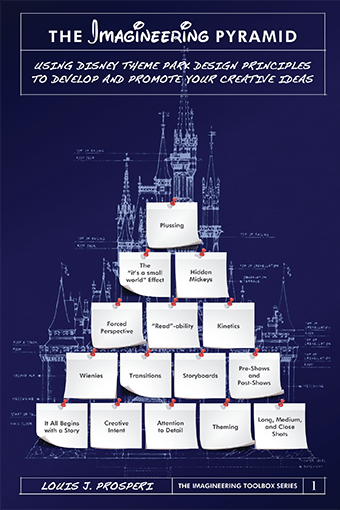
It’s a very compelling challenge: look at the existing body of work done by the Imagineers for Disney’s theme parks and translate those principles into a “pyramid” of 15 principles grouped into 5 tiers.

Here’s an outline for an appetizer:

Tier 1: Foundations of Imagineering

  • It All Begins with a Story – Using your subject matter to inform decisions about your project.
  • Creative Intent – Staying focused on your objective.
  • Attention to Detail – Paying attention to every detail.
  • Theming – Using appropriate details to strengthen your story and support your creative intent.
  • Long, Medium, and Close Shots – Organizing your message to lead your audience from the general to the specific.

Tier 2: Wayfinding

  • Wienies – Attracting your audience’s attention and capturing their interest.
  • Transitions – Making changes as smooth and seamless as possible.
  • Storyboards – Focusing on the big picture.
  • Pre-Shows and Post-Shows – Introducing and reinforcing you r story to help your audience get and stay engaged.

Tier 3: Visual Communication

  • Forced Perspective – Using the illusion of size to help communicate your message.
  • “Read”-ability – Simplifying complex subjects.
  • Kinetics – Keeping the experience dynamic and active.

Tier 4: Making It Memorable

  • The “it’s a small world” Effect – Using repetition and reinforcement to make your audience’s experience and your message memorable.
  • Hidden Mickey’s – Involving and engaging your audience.

Tier 5: Walt’s Cardinal Rule

  • Plussing – Consistently asking, “How do I make this better?”

But instead of building an object like an attraction, Prosperi challenges the reader to do something with the principles that may be even more daunting: be creative.

Even though I was familiar with most of the principles and their origins, I enjoyed reading how Prosperi linked the ideas together into a unified whole. Especially helpful were the questions at the end of each chapter, with a general focus as well as specialized applications for game design, instructional design, and management and leadership. The questions will help anyone have a better grasp of the concept and how to apply it an almost any field.

The Imagineering Pyramid was especially beneficial to me on a recently completed 3-day “field trip” to all four theme parks at Walt Disney World. As I walked through each park, the genius of the Imagineers inspired me to fill several pages of my Disney journal with new ideas for development as well as take over 1,000 photographs of design details – exactly what I believe Louis Prosperi had in mind when writing the book.

Leaders in any capacity will benefit from The Imagineering Pyramid as a helpful tool, providing a creative framework for solving problems.
ImagineeringPyramid

At Their Service

Ask yourself daily:

What did I specifically do today to be “of service” to members of my group or team? Was I truly a “servant” to them?

Robert Greenleaf, writing in the classic Servant Leadership challenges leaders to be servants. To help leaders understand the concept, he had two “exam” questions that leaders should ask concerning the people on their teams:

  1. Do those served grow as persons?
  2. Do they, while being served, become healthier, wiser, freer, more autonomous, more likely themselves to become servants?


Tom Peters translates these questions as follows:

  1. Leaders exist to serve their people. Period.
  2. A team well served by its leader will be inclined to pursue Excellence.

Use the word “Serve.” (That’s what you do.)

Use the word “Service.” (That’s what you provide.)

Use the word “Servant.” (That’s what you are.)


John Maxwell, writing about the Law of Addition:

When you think of servanthood, do you envision it as an activity performed by relatively low-skilled people at the bottom of the flow chart? If you do, you have a wrong impression. People are drawn toward those who serve them sacrificially, not repelled by them. It’s about attitude.

Leaders seek ways they can add value to others, and the primary way they do it is by serving them. In John 13, the Savior of the world exhibited that He was also the greatest Servant of all time. In a powerful object lesson of servanthood, Jesus stripped down to a garment around his waist, looking the part of a servant. He took a basin of water and a bowl and began washing his disciples’ feet.

Christlike Servant-Leaders

  1. Are motivated by love to serve others (vv. 1,2)
  2. Possess a security that allows them to serve others (v. 3)
  3. Initiate servant-leadership to others (vv. 4-5)
  4. Receive servant-ministry from others (vv. 6, 7)
  5. Want nothing to hinder their relationship with God (vv. 8, 9)
  6. Teach servanthood by their example (vv. 12, 15)
  7. Live a blessed life (vv. 16, 17)

When leaders serve, they add value to the people who receive their service. It might be something as simple as feeling special; it could be a resource we give others or a word of encouragement. Whatever it is, people always receive something and feel better about themselves because of their leader.

Leaders should add value to everyone they serve. Seek to replenish and resource them to live the higher life God has called them to.

Jesus served – should you do any less?


It’s Always Easier When You Work With Someone Who’s Been There Before

It’s very easy to become overwhelmed by the size and complexity of some tasks you undertake.

…like planning a week-long visit to Walt Disney World.

That’s the place I found myself in five years ago, when my wife and I began planning a Walt Disney World trip for our 22-year old daughter, as a delayed college graduation gift.

I had been to the Magic Kingdom once. As a senior in high school. For a day. In 1976. A long time ago…

Some things had changed a lot, and my memory wasn’t that good about the trip anyway. Being the research kind of guy, I began looking online at various websites about 9 months prior to the trip. I also checked out some guide books from the library. But the hands down, absolutely best way to plan a trip to Disney World is to use a travel planner. Better yet, a travel planner whose specialty is the Disney Empire, and is an Authorized Disney Vacation Planner.

Enter Annette at Small World Vacations. When some good friends found out what we were going to do, they heartily recommended I get in touch with Annette. I’m so very glad I did! She walked me through the basics, helped me choose the best options for a fun week, made great recommendations for things to do and places to eat, and generally helped created a great week for us.

Amy WDW2011

This picture pretty much speaks for itself.

Through her services, we were able to get a fabulous room in a great resort, get all the dinner reservations we wanted, and plan plenty of surprises for our daughter. Annette’s service didn’t stop in the preplanning, either. When I had a couple of questions just before I left, she was quick to answer them. And waiting for us when we got back was an email welcoming us home and wanting to know how our week went.  And so, over the last five years, in preparing for many return trips to Walt Disney World, my first call has always been to Annette. Whether it’s a year in advance (planning a week-long trip for my immediate family of 13) or a week before (a last-minute change in schedule allowing me a day in the parks), the help and guidance of an expert is invaluable.

Planning is easier when you work with someone who’s been there before.

This takeaway doesn’t just apply to planning to go to Disney – I also found out it applied to what Disney itself does in their development for future attractions. While they are reluctant to just “copy” what has worked in one Park and transfer it to another, they do learn valuable lessons and apply a continuous learning cycle to all their operations.

The takeaway also applied to how they staffed Disney World prior to its opening in 1971: a year before the Park opened, they hired several hundred college sophomores for seasonal work; the next year, they went after juniors, and the following year, when the Park was really hitting its stride, they hired seniors. The best of this experienced group were offered entry-level management positions after graduation, and many went on to achieve high-level positions all across the Disney companies.

How do you take advantage of experience in planning and staffing at your organization?


Oh, there’s one other thing: Even with the best of outside help, you still have to do the work yourself.

AFAWDWPlanning

Less is Almost Always More, Even When We Ask for More

The bread aisle at the grocery store confounds me.

courtesy Mike Mozart, CC jeepersmedia/15026803517

courtesy Mike Mozart, CC jeepersmedia/15026803517

I just wanted to buy a loaf of bread to make a sandwich – I didn’t really want to wade through 7 long shelves of every imaginable type of bread possible.

My grocery store is just like your grocery store: when you stand in any aisle in any retail store in the U.S., you will be inundated with choices. Whether you are buying cereal, candy, TVs, or jeans, you’ll likely have huge number of items to choose from. Whether it’s a retail store or a Web site, if you ask people if they’d prefer to choose from a few alternatives or have lots of choices, most people will say they want lots of choices.

This is true in ChurchWorld, too.

Too Many Choices Paralyze the Thought Process

The book Art of Choosing by Sheena Iyengar details research on choice. In graduate school, Iyengar conducted what is now known as the “jam” study. She decided to test the theory that people who have too many choices will not choose at all. In a booth set up in a busy grocery store, Iyengar and her associates posed as store employees. They alternated the selection on the table: half the time there were 6 choices of fruit jam and half the time there were 24 jars of jam.

When there were 24 jars of jam, 60 percent of the people coming by would stop and taste. When there were only 6 jars of jam only 40 percent of the people would stop and taste. More choices were better – right?

courtesy Chris Martino, CC chrismar/4596518235

courtesy Chris Martino, CC chrismar/4596518235

Not exactly.

You might think that people would taste more jam when the table had 24 varieties – but they didn’t. People stopped at the table, but they only tasted a few varieties whether there were 6 or 24 choice available.

People can only remember 3 or 4 things at a time; likewise, they can decide from among only 3 or 4 things at a time.

The most interesting part of Iyengar’s study is that 31 percent of the people who stopped at the table with 6 jars actually made a purchase. But only 3 percent of the people who stopped at the table with 24 jars actually mad a purchase.

More people may have stopped by, but less people purchased.

The study may have proved that less is more, but why do people always want more choices?

Information is addictive.

Dopamine, a chemical created and released in our brains, is critical in all sorts of brain functions: thinking, moving, sleeping, mood, attention, motivation, seeking, and reward. Dopamine also causes you to want, desire, seek out, and search. Dopamine makes you curious about ideas and fuels your search for more information. A fascinating topic, but it will have to wait for later!

It’s only when people are confident in their decisions that they stop seeking more information.

Application for ChurchWorld Leaders

  • Resist the impulse to provide large number of choices
  • If you ask people how many options they want, the will almost always say “a lot” or “give me all the options.” If you ask, be prepared to deviate from what they ask for
  • If possible, limit the number of choices to 3 or 4. If you have to offer more options, try to do so in a progressive way. Have people choose first from 3 or 4 options, and then choose again from that subset.

inspired by and adapted from 100 Things Every Designer Needs to Know About People, by Susan Weinschenk

100 Things Every Designer Needs to Know About People

A short note about this occasional design series:

ChurchWorld leaders are designers. They create actions, processes, and services that people use to engage in life-changing decisions. Designing without understanding what makes people act the way they do is like exploring a new city without a map: results will be haphazard, confusing, and inefficient. If leaders know a little more about the psychology of design, their audience will benefit from that design.

LEGO Bricks: Toys for Kids, Lessons for Adults

LEGO Bricks and I go a long way back.

As a boy growing up in the mid-60’s, LEGO play sets were a treat at our church. After we completed our Sunday School lesson, and if we had any free time, and if the weather wouldn’t allow outside play, our teachers would bring out a big box of LEGO Bricks and let us have at it.

Lego Bricks - pile

When I became a parent in the early 80’s, it wasn’t long before the first of dozens of LEGO sets appeared. Over the years, our four children (now 35, 31, 27, and 23) were the recipients of LEGO play sets with themes like Castles, Undersea Adventures, Cities, and of course, Star Wars. For some reason, our second son was captivated by the Star Wars universe, especially LEGO sets with a Star Wars theme. Even at age 31 and in the Air Force, he still manages to acquire a new LEGO set every Christmas (my wife and I – guilty as charged!).

With 4 grandchildren now part of our extended family, the LEGO fascination has been passed on to a new generation of Adams kids. It started with Duplos for Jack, but at age 8 he has rapidly progressed to creating masterpieces with traditional LEGO sets. Lucy, age 5, is enjoys regular LEGOs but always eyes her dad’s Star Wars collection. Lola, 3 years old, left Duplos quickly after eying her brother’s LEGOs. Leia, almost 3, doesn’t have a chance! Between her Star Wars dad and sister, she will probably pass us all in LEGO abilities!

LEGO Bricks are not just for kids. The LEGO Group – reluctantly at first, but now all in – regularly connects with AFOL (Adult Fans of LEGO) groups. There are user groups like LUGNET (LEGO User Group Network) and dozens of conventions, competitions, and the like all over the world.

The full-scale replica of a Star Wars X-Wing Fighter astounds me: It’s 43 feet long with a 44-foot wingspan, weighs over 22 tons, and was built with over 5 million LEGO bricks. A crew of 32 builders took over 4 months to construct it.

Amazing.

All from a plastic toy brick which only has value when it’s connected to another brick.

Authors Ron Hunter and Michael Waddell recognized this, and included the LEGO Brick in their book Toy Box Leadership. Here’s how they saw the value of LEGO Bricks when talking about leadership:

LEGO Bricks provide the essence of the leadership lesson on Relationships: Building begins with connecting.

LEGO Leaders recognize connectional value

  • Connecting builds a strong foundation
  •  Connecting unleashes the power of synergy
  • Connecting utilizes the strength of unity

LEGO Leaders recognize connectional ability

  • LEGO bricks are reliable
  • LEGO bricks are reusable
  • LEGO Leaders recognize connectional failure

LEGO Leaders recognize connectional failure

  • Misplaced bricks
  • Forced bricks
  • Isolated bricks
  • Unorganized bricks


Leaders often get so caught up in the programs that they forget about the people – the building blocks of any organization. There may be tremendous value in plans, but the strength of any organization is in its relationships.

In LEGOS – and in organizations – building always begins with the clicking sound of connections.


Toy Box LeadershipToy Box Leadership

Consider the LEGO Brick…

It’s the ubiquitous toy.

Lego red brick

Lego pieces of all varieties constitute a universal system. Despite variation in the design and purpose of individual pieces over the years, each remains compatible in some way with existing pieces. Lego bricks from 1958 still interlock with those made in the current time, and Lego sets for young children are compatible with those made for teenagers and adults.

It’s been named the Toy of the Year, Decade, and Century.

Who hasn’t been mesmerized for hours, building things, tearing them down, and starting over? It’s been a part of children’s lives since 1949 – but before that, LEGO meant wooden toys.

Speaking of meaning, the word LEGO in Danish means “play well.”

That applies to adults, too. LEGO bricks may have been designed with children in mind, but it didn’t take long for adults to get into the act.

A global Lego subculture has developed, supporting movies, games, competitions, and themed amusement parks. All for the kids, right?

 Right.

Each Lego piece must be manufactured to an exacting degree of precision. When two pieces are engaged they must fit firmly, yet be easily disassembled. The machines that make Lego bricks have tolerances as small as 10 micrometers.

The Lego Group estimates that in the course of five decades it has produced some 400 billion Lego blocks. Annual production of Lego bricks averages approximately 36 billion per year, or about 1140 elements per second.

And yet with all this, remember these two complementary facts about LEGOs:

  • The unique and singular purpose of a LEGO brick is to connect with another brick.

  • A single LEGO brick is worth, well, practically nothing.

What will you learn from LEGO today?