If You Think Reading is Boring, You’re Doing It Wrong

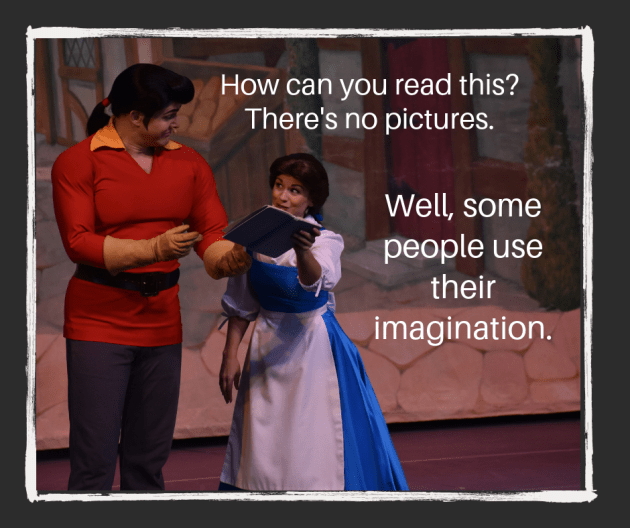
They may be hand-drawn animation, or computer-generated imagery, or even real actors in a stage play or musical.

Whatever the media, there’s a powerful story – and life lessons – from the characters in Beauty and the Beast.

To Gaston, a book with no pictures might as well have blank pages.

To Belle, a good story doesn’t need pictures to be understood.


No matter how busy you may think you are, you must find time for reading, or surrender yourself to self-chosen ignorance.

– Confucius


Need book ideas? How about trying SUMS Remix?

Regular daily reading of books is an important part of my life. It even extends to my vocation, where as Vision Room Curator for Auxano I am responsible for publishing SUMS Remix, a biweekly book “excerpt” for church leaders. Published since 2012, we have looked at over 480 books for solutions to common problems leaders face every day.

Each Wednesday on 27gen I typically take a look back at previous issues of SUMS Remix and publish an excerpt.

>>Purchase an annual subscription to SUMS Remix here for only $48<<

>> Purchase prior issues of SUMS Remix here<<


Economics Principles at Your Church

My college experience included four years serving as a student assistant in the office of the chairman of our school’s economics professor. For 10 hours each week I got a healthy dose of Economics – everything from Econ 101 to advanced statistical analysis. Dr. Cho certainly knew his subject matter, and the quizzes, exams, and homework I graded made me appreciate the field of study, even to the point of taking extra classes and obtaining a minor in economics.

Over the 30 years since college, various economic concepts have popped up in my work on a church staff and as a church consultant. The most regular of these has been “The Pareto Principle,” first written about in 1906 by Italian economist Vilfredo Pareto.

You probably know it as the “80/20 Rule.”

John Maxwell recalls learning of it in a college business management course, calling it one of the most profound eureka moments in his life:

The professor was teaching the Pareto Principle, and as he explained its impact, my eyes were opened. He explained that:

  • 80 percent of traffic jams occur on 20 percent of the roads
  • 80 percent of classroom participation comes from 20 percent of students
  • 80 percent of the time you wear 20 percent of your clothes
  • 80 percent of the profits come from only 20 percent of the customers
  • 80 percent of problems are generated by 20 percent of the employees
  • 80 percent of all decisions can be made on 20 percent of the information

What an eye opener! It meant that the best 20 percent of my activities were sixteen times more productive than the remaining 80 percent. (from Leadership Gold, by John Maxwell)

Dozens of books in my Leadership Library refer to the 80/20 rule, most often in terms of resource and time efficiency. In this context, I think it is appropriate, and a very useful rule of thumb. Certain assumptions can follow from this idea – you should focus on your best customers, or your hardest working staff members, or your most profitable selling item – with these you reap the greatest results for the least effort.

In ChurchWorld, a handful of members typically account for most of the effort in the congregations. (A corollary to this principle is that a few members cause most of the headaches, but I’ll save that for another day.)

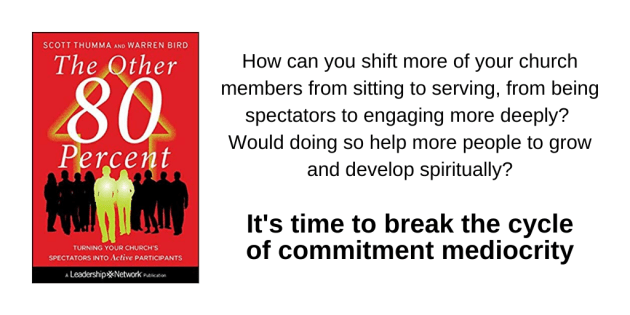
  • How can you shift more of your church members from sitting to serving, from being spectators to engaging more deeply?
  • Would doing so help more people to grow and develop spiritually?

A classic Leadership Network publication may just be what you are looking for to answer those questions. The Other 80 Percent is a practical guide for church leaders, written by respected researcher Scott Thumma and noted author Warren Bird. The authors draw upon research across a broad range of Protestant churches of all kinds.

I can almost hear Dr. Cho now: “the distribution of your sheep can be shown like this…”

Beginning tomorrow, I would like to invite you to look deeper into The Other 80 Percent and see how you might use it to help move your church forward.

Join Me on a Trip in the Yellow Time Machine

Note: During the current “stay-at-home” mandates and other restrictions in place across the country, I am diving back into 12 years of posts, articles, and reviews across my different websites to bring back timely information for today.


There are times when pictures are worth more than a thousand words…

My wife travels to Baltimore, MD at least once a month on business. Because I work for a virtual company (Auxano) with no “office,” my primary role of Vision Room Curator requires only an Internet connection to “set up shop.” Occasionally, I accompany her and we spend the evening or weekends visiting in the area. Recently we found ourselves with a couple of hours to spare before leaving Washington DC to return home. We have a standing list of places to visit, and we agreed on the National Geographic Museum. Located in the heart of the city just a few blocks from the White House, the Museum had a surprise in store for me:

A literal wall of all the National Geographic magazine covers since the magazine’s launch in 1888.

NGwall1

A story I wrote a few years ago, and updated later, immediately came to mind:

The image below,  from the December 2012 issue of National Geographic magazine, once again stirred memories.

Giant sequoia

The following is an updated repost from 2009:

NGM Oct 2009

Images are often powerful reminders of our past. One of my boyhood memories is that of eagerly anticipating the monthly delivery of “National Geographic” magazine.

The familiar yellow border outlining an amazing photo was my ticket for travel around the country and the world. It’s a pleasure I enjoy to this day, as my mother continues give the magazine as a gift each year. Until recently, I kept them all – now going on 36 years, plus dozens of other pre-1979 issues I have picked up at occasional yard sales (but that’s another story!).

The October 2009 issue has a striking image of a redwood tree on it. As soon as I saw the magazine in its shrink-wrapped shipping bag, I was transported back to first grade show and tell: my crude drawing of a redwood tree, taken from a July 1964 NG story.

I filed that thought away, and not long afterwards, had the occasion to visit my boyhood home in Tennessee. I asked my dadNGM July 1964 (who was still living at the time) about that magazine, and sure enough, he had kept the magazines too! I pulled the issue off the shelf and thumbed through it, gazing again at living giants thousands of years old, comparing them to the same family of trees 45 years later. While I enjoyed that trip down memory lane, there was still something tugging at my thoughts.

When I returned home, I searched my library and found the answer: Growing Spiritual Redwoods by William Easum and Thomas Bandy. Published in 1997, it was a striking call for church leaders to understand the new paradigm the church was entering. They likened the healthy church to a redwood tree. I remember reading the text when it first came out, and my copy bore highlighted sections, Post-It© Notes, and scribbles throughout.

Using the metaphor of the redwood tree, the authors described the growing and healthy church as follows:

  • They stand taller than any other tree, but their visibility is less a function of the numbers of their adherents, and more the magnitude of their ministries
  • They hold aloft an enormous umbrella of intertwined branches, which shelter a huge diversity of life in an atmosphere of peace and mutual respect
  • They are resistant to crisis from beyond and disease from within. Political winds do not break them, and ideological fires cannot burn them down
  • They put down strong, extensive root systems that intertwine with those of other Redwoods. They draw nutrition from unexpected sources, and reach out into unlikely places
  • They regenerate in abundance. Not only do seeds initiate new life across the forest floor, but they sprout vigorously even from the stumps of felled trees

What can your church learn from the redwood tree?

The Lesson of the Redwood Tree aside, I was again reminded of the power of the visual image in communicating. That visit gave me a sobering perspective on what it takes to deliver that image. Walking through the rest of the museum, I was struck by the lonely quest the NG photographers had embarked on: months of often-solitary work, shooting 50,000 to 90,000 images to get the few dozen that ultimately become a story.

That’s the price they willingly paid to bring their vision to fruition.

What price are you paying to bring your vision to reality?


How to Thrive in Turbulent Times

Note: During the current “stay-at-home” mandates and other restrictions in place across the country, I am diving back into 11 years of posts, articles, and reviews across my different websites to bring back timely information for today.


In the first and second centuries, the Christian church was communal, organic, and unstructured – a lot like the Internet today. Within the Roman Empire, the Christian church grew from a handful of believers in AD 40 to over 31 million adherents by AD 350, making it the world’s first viral organization. By contrast, today’s mainline churches are institutionally powerful, but spiritually weak.

What’s true for churches is true for other institutions: the more “organized” and tightly “managed” they are, the less adaptable they are. Not surprisingly, the most resilient thing on the planet, the Internet, is loosely organized and lightly managed, and so was the first century Christian Church. The lesson here? To thrive in turbulent times, organizations must become more disorganized and unmanaged – less structural, less hierarchical, and less routinized.

As institutions mature, the positive thrust of missions diminishes and the pull of habit strengthens – until one day, the organization can no longer escape the gravitational field of its own legacy.

No pastor would ever tell you that the goal of his or her church is to create a place where members can gather each week to be expertly entertained while congratulating themselves on their moral superiority. And yet this often seems to be the case.

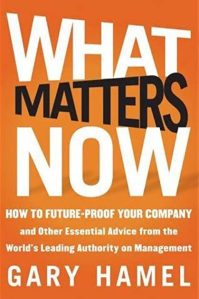
Speaking to the Willow Creek Global Leadership Summit a few years ago, Hamel asked the crowd “Is there a difference between ‘doing church’ and ‘doing Jesus’?”

Following a positive response, he then asked, “So where do your loyalties lie? Is it with the mission of redemption and reconciliation, or with the traditional programs and policies of your church? And if it’s the first, how would people know? What would be the evidence? Wouldn’t it be your willingness to sacrifice some of these familiar practices on the altar of a bigger purpose?”

Silence.

I’ve never met a leader who swears allegiance to the status quo, and yet few organizations seem capable of proactive change.

Gary Hamel

It’s impossible to build adaptable organizations without adaptable people – individuals who are humble, honest, and inspired.

Are you adaptable?


inspired and adapted by What Matters Now, by Gary Hamel

Are You Asking the Right Questions?

Our capacity for learning is a part of being a human being. From birth, we are on a fast track of learning – movement, speech, understanding, and so forth. Unfortunately, many people equate “learning” with “schooling,” and when you’re done with school, you’re done with learning.

We are uniquely endowed with the capacity for learning, creating, and growing intellectually – and it doesn’t have an expiration date tied to an event, like graduation.

The practice of lifelong learning has never been more important to leaders than it is today. The necessity of expanding your knowledge through lifelong learning is critical to your success.

Take reading, for example. Many of the most successful people in today’s organizations read an average of 2-3 hours per day. No longer limited to books, reading is a lifelong learning activity that can be done online anywhere at anytime.

Learning is the minimum requirement for success as a leader. Because information and knowledge on everything is increasing every day, your knowledge must also increase to keep up.

Learning how to learn is more important than ever. Dedicate yourself to trying and learning new ideas, tasks, and skills. You don’t need to be aware of everything all the time but learning new skills faster and better – that in itself is a tough skill to master.

THE QUICK SUMMARY – The Book of Beautiful Questions by Warren Berger

From the bestselling author of A More Beautiful Question, hundreds of big and small questions that harness the magic of inquiry to tackle challenges we all face–at work, in our relationships, and beyond.

By asking questions, we can analyze, learn, and move forward in the face of uncertainty. But “questionologist” Warren Berger says that the questions must be the right ones; the ones that cut to the heart of complexity or enable us to see an old problem in a fresh way.

In The Book of Beautiful Questions, Berger shares illuminating stories and compelling research on the power of inquiry. Drawn from the insights and expertise of psychologists, innovators, effective leaders, and some of the world’s foremost creative thinkers, he presents the essential questions readers need to make the best choices when it truly counts, with a particular focus in four key areas: decision making, creativity, leadership, and relationships.

The powerful questions in this book can help you:
– Identify opportunities in your career or industry
– Generate fresh ideas in business or in your own creative pursuits
– Check your biases so you can make better judgments and decisions
– Do a better job of communicating and connecting with the people around you

Thoughtful, provocative, and actionable, these beautiful questions can be applied immediately to bring about change in your work or your everyday life.

A SIMPLE SOLUTION

Nothing has such power to cause a complete mental turnaround as that of a question. Questions spark curiosity, curiosity creates ideas, and ideas lead to making things better.

Questions are powerful means to employ (read unleash) creative potential – potential that would otherwise go untapped and undiscovered.

When we are confronted with almost any demanding situation, in work or in life, simply taking the time and effort to ask questions can help guide us to better decisions and a more productive course of action. But the questions must be the right ones – the ones that cut to the heart of a complex challenge or enable us to see an old problem in a new light.

Questions can help steer you in the right direction at critical moments when you’re trying to 1) decide on something; 2) create something; 3) connect with other people; and 4) be a good and effective leader.

Decision-making demands critical thinking – which is rooted in questioning. It’s up to each of us to make more enlightened judgments and choices. Asking oneself a few well-considered questions before deciding on something can be surprisingly effective in helping to avoid the common traps of decision-making.

Creativity often depends on our ability, and willingness, to grapple with challenging questions that can fire the imagination. For people within an organization trying to innovate by coming up with fresh ideas for a new offering or an individual attempting to express a vision in a fresh and compelling way, the creative path is a journey of inquiry.

Our success in connecting with others can be improved dramatically by asking more questions – of ourselves and of the people with whom we’re trying to relate. While many of us tend to rely on generic “How are you?” questions, more thoughtful and purposeful questions can do a better job of breaking the ice with strangers or bonding with clients and colleagues.

Leadership is not usually associated with questions – leaders are supposed to have all the answers – but it is becoming increasingly clear that the best leaders are those with the confidence and humility to ask the ambitious, unexpected questions that no one else is asking. Today’s leaders must ask the questions that anticipate and address the needs of an organization and its people, questions that set the tone for curious exploration and innovation, and questions that frame a larger challenge others can rally around.

Warren Berger, The Book of Beautiful Questions

A NEXT STEP

Developing the art of questioning does not require an advanced degree. As a matter of fact, one of the best ways to learn how to become a better questioner is to learn from the typical four-year-old girl.

If you have ever been a parent, you understand this. Studies show that children at this age may ask anywhere from 100 to 300 questions per day. While it may seem like child’s play, it’s actually a complex, high-order level of thinking. It requires enough awareness to know that one does not know – and the ingenuity to begin to do something about it.

Ask “why.”

To begin to develop the abilities of a better questioner, consider the broad questions developed by author Warren Berger in each of the four areas listed above.

Decision-making

  • Why do I believe what I believe? (And what if I’m wrong?)
  • Why should I accept what I’m told?
  • What if this isn’t a “yes or no” decision?
  • How would I later explain this decision to others?

Creativity

  • Why create?
  • Where did my creativity go?
  • What is the world missing?
  • What if I allow myself to begin anywhere?

Connecting with others

  • Why connect?
  • What if I go beyond “How are you?”
  • How might I listen with my whole body?
  • What if I advise less and inquire more?

Leadership

  • Why do I choose to lead?
  • What’s going on out there – and how can I help?
  • Am I looking for what’s broken – or what’s working?
  • Do I really want a culture of curiosity?

Excerpt taken from SUMS Remix 113-3, released February 2019


Part of a weekly series on 27gen, entitled Wednesday Weekly Reader

Regular daily reading of books is an important part of my life. It even extends to my vocation, where as Vision Room Curator for Auxano I am responsible for publishing SUMS Remix, a biweekly book “excerpt” for church leaders. Each Wednesday on 27gen I will be taking a look back at previous issues of SUMS Remix and publishing an excerpt.

>>Purchase SUMS Remix here<<

>> Purchase prior issues of SUMS Remix here<<


Change Without Trauma

Note: During the current “stay-at-home” mandates and other restrictions in place across the country, I am diving back into 11 years of posts, articles, and reviews across my different websites to bring back timely information for today.


As noted in yesterday’s post, change often comes in only two varieties: the trivial and the traumatic. Frantic, crisis-driven change is a poor substitute for timely transformation. There must be a better way.

We need look no further that our body’s automatic systems for some useful metaphors.

When you jump on a treadmill or pick up some weights, your heart starts to pump more blood, automatically. When you stand in front of a large audience to speak, your adrenal glands ramp us the production of adrenaline, spontaneously. When you walk from shade to bright sunlight, your pupils contract reflexively. Automatically, spontaneously, reflexively – these aren’t the words we use to describe how our organizations change, but they should be. That should be our goal: change without trauma.

In the mind flipping, VUCA world we live in, what matters is not merely an organization’s success at a point in time, but its evolutionary success over time. I recently remarked that being a part of my church’s rapid growth was like a “rocket ride” – and then a friend reminded me that rockets follow a parabolic path, and that most of the rocket sections ultimately come back to earth in a flaming shower of debris. Ouch!

How do you keep an organization – like your church – in “orbit?” Building a truly adaptable organization is a lot of work. It requires a shift in aspirations, behaviors, and operating systems.

  • An adaptable organization rethinks its strategy without having to walk through the valley of the shadow of death; it reinvents itself before getting mugged by the future.
  • An adaptable organization is one that captures more than its fair share of new opportunities. It’s always redefining itself, always pioneering the new.
  • An adaptable organization is more successful in attracting and retaining talent; it will have team members who are more engaged, more excited to show up every day, and are enthusiastic about their work.
  • An adaptable organization will be more productive in responding to emerging “customer” needs. It will take the lead in redefining customer expectations in positive ways.

Building a church that is as resilient as it is efficient may be the most fundamental organizational challenge facing today’s ChurchWorld leaders.

Adaptability really matters now.


Inspired by Gary Hamel’s What Matters Now as part of my research for a presentation at WFX Atlanta 9/19/12

It’s Time to Change the Way We Change

Note: During the current “stay-at-home” mandates and other restrictions in place across the country, I am diving back into 11 years of posts, articles, and reviews across my different websites to bring back timely information for today.


In our generation, the rate of change has gone hypercritical.

Change has changed.

Other centuries were convulsed by famine, disease, and war, but never before have so many things been changing so rapidly. We live in a world that seems to be all punctuation and no equilibrium, where the future is less and less and extrapolation of the past. Change is multifaceted, relentless, seditious, and occasionally shocking. In this maelstrom, long-lived political dynasties, venerable institutions, and hundred year old business models are all at risk.

Today the most important question for any organization is this: Are we changing as fast as the world around us? In industry after industry, it’s the insurgents, not the incumbents, who’ve been surfing the waves of change. But they, too, are just as vulnerable to change as their victims. Success has never been more fleeting.

Given all this, the only thing that can be safely predicted is that sometime soon your organization will be challenged to change in ways for which it has no precedent. Your organization will either adapt or falter, rethink its core assumptions or fumble the future – and to be honest, a fumble is the most likely outcome.

Of course, change brings both promise and peril, but the proportion facing any particular organization depends on its capacity to adapt. And therein lies the problem: our organizations were never built to be adaptable.

Especially the church.

Honest leaders will look at the Church, and more importantly their church, and see the words above lived out all too often. Churches are built as organizations of discipline, not resiliency. Efficient ministry comes from routinizing the nonroutine, adapting a management philosophy to the real life of people. As the old saying goes, the 7 words of a dying church are “We’ve always done it that way before.”

Adaptability, on the other hand, requires a willingness to occasionally abandon those routines – but in the church, there are precious few incentives to do so. So especially in ChurchWorld, change tends to come in only two varieties: the trivial and the traumatic. A review of the average church’s history will produce long periods of incremental fiddling punctuated by occasional bouts of frantic, crisis-driven change.

It’s time to change the way we change.

Inspired by Gary Hamel’s What Matters Now as part of my research for a presentation at WFX Atlanta 9/19/12

Your Organization’s Mission is Question Zero

Remember the last time you sat down to do a jigsaw puzzle? The work proceeds in two basic steps. First, you put the edges together. Finding all of the little pieces with straight edges is the easiest way to begin. As you piece together the top and bottom and sides, the puzzle is framed up within a relatively short period of time.

The second part of the process is now ready to begin, because you have defined the basic shape and outline of the puzzle. Before building the frame, it would have been exceedingly difficult to put many of the middle pieces together. But now, all of those elusive jigsaw shapes and unclear image fragments have perspective and boundaries.

Even though the frame makes the puzzle-building project easier, more work remains. You pick up awkward shape after awkward shape, twisting and turning them and turning again, until you get just the right fit and-snap-the image develops, one piece at a time. After a long journey that may take days or even months, the final image emerges.

Articulating your church’s vision is like working on a jigsaw puzzle.

Auxano co-founder Will Mancini developed the Vision Frame concept to show you how to articulate your vision the same way you would build a puzzle: in two basic steps.

Here is the first of four parts introducing the Vision Frame, guiding you to first think about the four outer edges – the components of your church’s identity that frame everything else you do. These edges anchor the second part of the process (a future SUMS Remix), which involves the direction of living and articulating the dynamic vision of your Church Unique through the daily work of turning and twisting the pieces of the organization. The edges of the frame are definitive, but the middle of the puzzle is dynamic. The fixed nature of step one, building the frame, anchors the fluid nature of step two, where your vision picture slowly develops into the better intermediate future God has entrusted to you. 

THE QUICK SUMMARY – Mission Drift: The Unspoken Crisis Facing Leaders, Charities, and Churches by Peter Greer and Chris Horst

Without careful attention, faith-based organizations drift from their founding mission. It’s that simple. It will happen. 

Why do so many organizations wander from their mission, while others remain Mission True? Can drift be prevented? In Mission Drift, HOPE International executives Peter Greer and Chris Horst show how to determine whether your organization is in danger of drift, and they share the results of their research into Mission True and Mission Untrue organizations.

Even if your organization is on course, it’s wise to look for ways to inoculate yourself against drift. You’ll discover what you can do to prevent drift or get back on track and how to protect what matters most.

A SIMPLE SOLUTION

The first side to Auxano’s Vision Frame is the missional mandate, defined as a clear and concise statement that defines what the church is ultimately supposed to be doing. The Mission answers “question zero” – the question before all other questions. Why do we exist? What is our raison d’etre? The Mission is your church’s compass and guiding North Star. As such, it provides direction and points everyone in that direction. The mission is like the heartbeat of the organization. It should touch members on an emotional level and act like a cohesive force and binding agent. 

Without careful attention, faith-based organizations will inevitably drift from their founding mission. Slowly, silently, and with little fanfare, organizations routinely drift from their original purpose, and most will never return to their original intent.

In its simplest form, true organizations know why they exist and protect their core at all costs. They remain faithful to what they believe God has entrusted them to do. They define what is immutable: their values and purposes, their DNA, their heart and soul.

That doesn’t mean Mission True organizations don’t change. And it doesn’t mean they aren’t striving for excellence. In fact, they understand their core identity will demand they change. And their understanding of Scripture will demand they strive for the very highest levels of excellence. But growth and professionalism are subordinate values. To remain Mission True is to adapt and grow, so long as that adaptation and growth does not alter the core identity.

Mission True organizations decide that their identity matters and then become fanatically focused on remaining faithful to this core.

The pressures of Mission Drift are guaranteed. It is the default, the auto-fill. It will happen unless we are focused and actively preventing it.

The Gospel of Jesus Christ is the very thing our world so desperately needs. And the infusion of the Gospel in our organization is what we most need to protect.

Peter Greer and Chris Horst, Mission Drift: The Unspoken Crisis Facing Leaders, Charities, and Churches

A NEXT STEP

Mission Defined

The mission is the guiding compass of the church. The mission answers the question, “What are we ultimately supposed to be doing?” It makes the overall direction of the church unquestionable and points everyone in that direction. The mission is also like a golden thread that weaves through every activity of the church. Therefore, it brings greater meaning to the most menial functions of ministry.         

Mission Icon as a Compass

The average guy, Joe, will encounter the mission first by hearing it everywhere by many different people. So we say that mission is “what Joe hears” at the church.

Mission Reminders

  • Aim for clear, concise, compelling, catalytic and contextual
  • Remind people that the church exists for those outside of it
  • Reflect your Kingdom Concept
  • Don’t think “billboard marketing” but “military mission” – it’s internal, not external language
  • Promote “be the church” not “go to church”
  • Create the big world of ministry with the best, few words (words create worlds)

Gather the team and ask this question: How does our current mission measure up to the bullets above? What is missing from our mission?

Excerpt taken from SUMS Remix 115-1, released March 2019.


Part of a weekly series on 27gen, entitled Wednesday Weekly Reader

Regular daily reading of books is an important part of my life. It even extends to my vocation, where as Vision Room Curator for Auxano I am responsible for publishing SUMS Remix, a biweekly book “excerpt” for church leaders. Each Wednesday on 27gen I will be taking a look back at previous issues of SUMS Remix and publishing an excerpt.

>>Purchase SUMS Remix here<<

>> Purchase prior issues of SUMS Remix here<<


How’s Your Delivery Model Doing Now?

Note: During the current “stay-at-home” mandates and other restrictions in place across the country, I am diving back into 11 years of posts, articles, and reviews across my different websites to bring back timely information for today.


An interesting observation of the church by noted business thinker and strategist Gary Hamel:

It is worth noting that many churches adhere to the same “delivery model” for “spiritual services” and that the standard template is less the product of Biblical injunction than of habit. Unchallenged assumptions include:

  • Church happens in church
  • Preaching is the most effective way of imparting religious wisdom
  • Clergy lead while lay people follow
  • More programs equal more impact
  • The church service follows a typical order: greet, sing, read, pray, preach, bless, dismiss (repeat weekly)
  • Believers, rather than curious skeptics, are the church’s primary constituency
  • Going to church is the primary manifestation of a spiritual life
  • Church is a lecture, not a discussion
  • The primary mission of a church is to serve its members, rather than those outside the church who are searching for a spiritual connection
  • The best way to grow the Christian community is to plant little churches that are replicas of big churches
  • To bring people to faith, churchgoers need to market their beliefs more professionally rather than live them out more convincingly

What could you add to this list of things that mindlessly perpetuate the past in your organization?

If organized religion has become less relevant, it’s not because churches have held fast to their creedal beliefs; it’s because they’ve held fast to their conventional rituals, roles, and routines.

The problem with organized religion isn’t the “religion” bit, but the “organized” bit. Today’s mainline churches are institutionally powerful but spiritually weak


Inspired by Gary Hamel’s What Matters Now as a part of ongoing research in preparation for a presentation on change at WFX Atlanta 09/19/12

Real Learning Always Starts With Unlearning

Our capacity for learning is a part of being a human being. From birth, we are on a fast track of learning – movement, speech, understanding, and so forth. Unfortunately, many people equate “learning” with “schooling,” and when you’re done with school, you’re done with learning.

We are uniquely endowed with the capacity for learning, creating, and growing intellectually – and it doesn’t have an expiration date tied to an event, like graduation.

The practice of lifelong learning has never been more important to leaders than it is today. The necessity of expanding your knowledge through lifelong learning is critical to your success.

Take reading, for example. Many of the most successful people in today’s organizations read an average of 2-3 hours per day. No longer limited to books, reading is a lifelong learning activity that can be done online anywhere at anytime.

Learning is the minimum requirement for success as a leader. Because information and knowledge on everything is increasing every day, your knowledge must also increase to keep up.

Learning how to learn is more important than ever. Dedicate yourself to trying and learning new ideas, tasks, and skills. You don’t need to be aware of everything all the time but learning new skills faster and better – that in itself is a tough skill to master.

THE QUICK SUMMARY –Unlearn by Barry O’Reilly

The transformative system that shows leaders how to rethink their strategies, retool their capabilities, and revitalize their businesses for stronger, longer-lasting success.

There’s a learning curve to running any successful business. But once you begin to rely on past achievements or get stuck in outdated thinking and practices that no longer work, you need to take a step back―and unlearn. This innovative and actionable framework from executive coach Barry O’Reilly shows you how to break the cycle of behaviors that were effective in the past but are no longer relevant in the current business climate, and now limit or may even stand in the way of your success.

With this simple but powerful three-step system, you’ll discover how to:

  1. Unlearn the behaviors and mindsets that prevent you and your businesses from moving forward.
  2. Relearn new skills, strategies, and innovations that are transforming the world every day.
  3. Break through old habits and thinking by opening up to new ideas and perspectives to achieve extraordinary results.

Packed with relatable anecdotes and real-world examples, this unique resource walks you through every step of the unlearning process. You’ll discover new ways of thinking and leading in every industry. You’ll identify what you need to unlearn, what to stop, what to keep, and what to change. By intentionally and routinely applying the system of unlearning, you’ll be able to adapt your mindset, adopt new behaviors, acquire new skills, and explore new options that will totally transform your performance and the business you lead. This book will help you let go of the past, and encourage your teams and organization to do the same. When you think big but start small, choose courage over comfort, and become curious to tackle uncertainty, you can achieve new levels of success you never dreamed possible.

Good leaders know they need to continuously learn. But great leaders know when to unlearn the past to succeed in the future. This book shows you the way.

A SIMPLE SOLUTION

As futurist Alvin Toffler once wrote, “The illiterate of the 21st century will not be those who cannot read and write, but those who cannot learn, unlearn and relearn.”

Welcome to the 21st century. Living in our time requires different skills, one of the most important of which is unlearning activities, skills and formerly productive (or wise) activities such that new learning can take place.

One problem is that they’ve been focused on the wrong thing. The problem isn’t learning: it’s unlearning. In every aspect of business, we are operating with mental models that have grown outdated or obsolete, from strategy to marketing to organization to leadership. To embrace the new logic of value creation, we have to unlearn the old one.

Highly effective leaders are constantly searching for inspiration and for new ideas. But before any real breakthroughs can happen, we need to step away from old models, mindsets, and behaviors that are limiting our potential and current performance.

The system of unlearning is based on a three-step approach to individual and collective growth that I have dubbed the Cycle of Unlearning.

Adopting the Cycle of Unlearning doesn’t rely on being smart, or lucky, or desperate, or all of the above. It relies only on you – your courage and commitment to use it intentionally in your work and your life to achieve extraordinary results.

Step One: Unlearn

There are a variety of reasons why individuals get struck doing the same things over and over again; the main one is the erroneous belief that doing what brought you success today will bring you success tomorrow. Unfortunately, the systems, models, and methods that work today can actually limit your ability to change – and succeed – tomorrow.

Do you have the courage to recognize that what you are doing is not working, be willing to accept it, let go, and try something different?

Unlearning does not lead with words; it leads with actions. You must first embrace your purpose by clarifying your why and your what.

This first step in the Cycle of Unlearning requires courage, self-awareness, and humility to accept that your own beliefs, mindsets, or behaviors are limit your potential and current performance and that you must consciously move away from them.

Step Two: Relearn

As you unlearn your current limiting but ingrained methods, behaviors, and thinking, you can take in new data, information, and perspectives. And by considering all this new input, you naturally challenge your existing mental models of the world. By exploring difficult tasks, you will discover a tremendous amount about yourself.

There are three challenges to relearning effectively, and we create many of these challenges ourselves:

  1. You must be willing to adapt and be open to information that goes against your inherent beliefs.
  2. You may need to learn how to learn again.
  3. You must create an environment for relearning to happen outside your comfort zone.

Step Three: Breakthrough

Once you learn how to relearn and open yourself up to new information flows, networks, and systems from every possible source, you are poised to develop the kind of breakthrough thinking that has the potential to vault you into the lead.

As we break free of our existing mental models and methods, we learn to let go of the past to achieve extraordinary results. We realize that the world is constantly evolving, innovating, and progressing, so too must we. Our breakthroughs provide an opportunity to reflect on the lessons we have learned from relearning and provide a springboard for tacking bigger and ore audacious challenges.

This process can be as simple as asking yourself what went well, not so well, and what you would do differently if you were to try and unlearn the same challenge again.

Barry O’Reilly, Unlearn

A NEXT STEP

Unlearning does not mean you will be forgetting old knowledge and ways; instead, it’s all about creating a new mental model or paradigm. New learning does not eliminate the old; it adds new skills and knowledge to what’s already in place.

Unlearning is an ongoing and continuous habit that must become a deliberate practice.

Author Barry O’Reilly has developed a series of “Unlearning Prompts” throughout his book. Using the following as examples, develop similar prompts that you can instill and practice on a regular basis:

  • When was the last time you truly unlearned how you ____________ (fill in the blank)?
  • What prompted it?
  • Did you recognize it, seek to uncover it, or be informed of it?
  • How can you make unlearning in this area more intentional?
  • What is the first small step you can take to get started?

Excerpt taken from SUMS Remix 113-2, released February 2019.


Part of a weekly series on 27gen, entitled Wednesday Weekly Reader

Regular daily reading of books is an important part of my life. It even extends to my vocation, where as Vision Room Curator for Auxano I am responsible for publishing SUMS Remix, a biweekly book “excerpt” for church leaders. Each Wednesday on 27gen I will be taking a look back at previous issues of SUMS Remix and publishing an excerpt.

>>Purchase SUMS Remix here<<

>> Purchase prior issues of SUMS Remix here<<