Be a Curator

You don’t make a great museum by putting all the art in the world into a single room. 

That’s a warehouse

What makes a museum great is the stuff that’s not on the walls. Someone says no. A curator is involved, making conscious decisions about what should stay and what should go. There’s an editing process. There’s a lot more stuff off the walls than on the walls. The best is a sub-sub-subset of all the possibilities.

It’s the stuff you leave out that matters.

So constantly look for things to remove, simplify, and streamline. Be a curator. Stick to what’s truly essential. Pare things down until you’re left with only the most important stuff. Then do it again. You can always add stuff back in later if you need to.

What will you curate today?

The inspirational words above come from the book Rework by Jason Fried and David Heinemeier, the founders of 37signals.

If you don’t own it, you should.

The artwork is by illustrator Mike Rohde.


The Unwritten Rules of Visual Thinking

We can solve our problems with pictures.

With that simple proposition, author and visual thinking consultant Dan Roam invites the reader to a four-day workshop on visual thinking in his book “Unfolding the Napkin.”

Central to his idea are the unwritten rules of visual thinking:

  1. Whoever is best able to describe the problem is the person most likely to solve it.
  2. We can’t solve a problem that overwhelms us. To understand what we’re seeing, we need to break it into bite-size pieces.
  3. Problems don’t get solved by the smartest or the fastest or the strongest; they get solved by the one who sees the possibilities.
  4. The more human your picture, the more human the response.

Sound too simplistic to be true? Maybe.

But I saw it begin to work last night in a client meeting involving a several million dollar project and a two-year brick wall.

I’m a believer.

Got problems? You need pictures!

The Power of the Humble Napkin

Any problem can be made clearer with a picture, and any picture can be made using the same simple set of tools and rules. (The Back of the Napkin, Dan Roam)

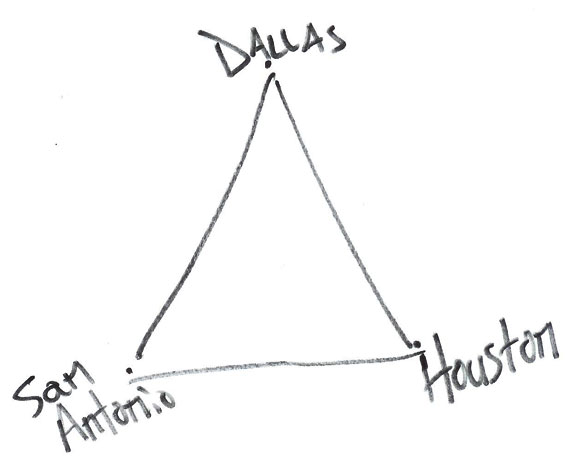
When Herb Kelleher was brainstorming about how to beat the traditional hub-and-spoke airlines, he grabbed a bar napkin and a pen. Three dots to represent Dallas, Houston, and San Antonio. Three arrows to show direct flights.

Problem solved.

The napkin sketch made it easy to sell Southwest Airlines to investors and customers – and the rest is history.

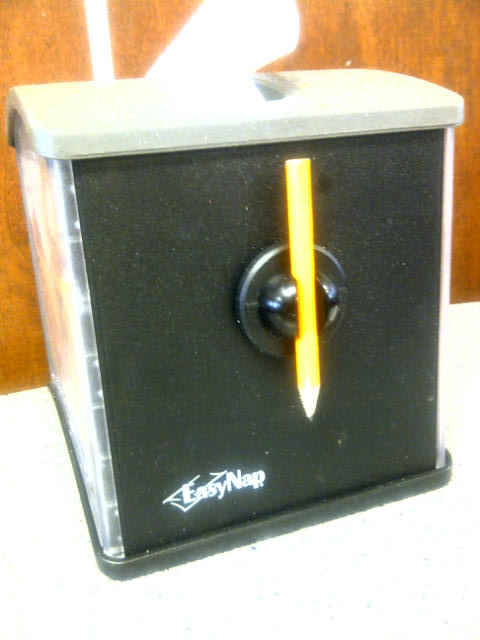
Sitting in Hardees yesterday eating a late lunch, I couldn’t help but notice the napkin dispenser.

What will you create today?

Want to know more about visual thinking?

Think Visual

Your Visual Thinking Toolkit

The Art of Visualization

Valentine’s Day in the Future

Well, at least what scientists are telling us how chocolate will change in the future…

2014Melt-Proof Wrappers. Candy companies are developing wrappers that prevent chocolate from melting in temperatures up to 104 degrees.

20163D Chocolate Printer. Using edible purees in place of ink, engineers have created a printer that creates totally edible forms.

2018Low-Fat Chocolate. Through selective breeding of cacao trees, scientists hope to grow beans with less fat.

2021Cookie-Baking Robot. Scientists have created a robot that can mix up a batch of cookies and pop them in the oven; it takes 2 1/2 hours currently.

2032$20 Candy Bars. Some industry experts say the world is running out of affordable chocolate, primarily because of declining production.

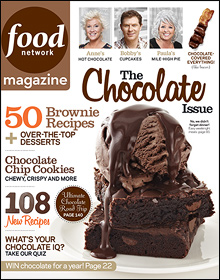
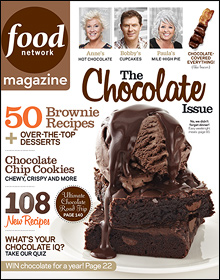
The delicious (except for the final one) tidbits above came from the Food Network Magazine March 2012 issue.

I hope you have enjoyed these enticing chocolate posts (start here to see the whole series) on Valentine’s Day 2012!

Now, it’s off for a late dessert date with my Valentine!


Beware of Bite Size Chocolate Bars

During a three-year study by researchers in Canada, people showed more restraint when eating regular-size candy bars than when eating mini ones. Bite-size snackers tended to eat four or five treats – about 50 percent more than the full-sized candy bar eaters consumed.

That’s why I only eat regular sized candy bars!

Okay, so I define regular size a little different from most people…

I’m Only Trying to be Generous

People with a sweet tooth are sweeter.

According to a study by Gettysburg College psychology professor Brian Meier, if you treat yourself to chocolate, you’re probably a more generous person. In his study, researchers gave subjects either a piece of chocolate, a cracker, or no food at all and then asked the subjects to volunteer for something and estimate how much time they could give.

The chocolate eaters offered 42 percent more time than the cracker group and almost 68 percent more than the subjects who ate nothing, During another part of the study, subjects prejudged others based on whether they liked sweets; those who did were ranked more agreeable.

According to Meier, “It’s hard to imagine people fighting while eating chocolate.”

I agree; pass me a Hershey’s bar, please.

What’s Your Chocolate IQ?

That would be “Super Sweet,” according to Food Network Magazine’s Chocolate IQ Test in the March 2012 issue.

To earn that dubious honor, I scored a 16 out of 20. Willy Wonka would be proud.

Grab a copy of the magazine to take your own Chocolate IQ test.

And there’s also…


…50 brownie recipes

…secrets to make different types of chocolate chip cookies

…how to cover anything in chocolate

…a chance to win chocolate for a year

…dozens of recipes and tips involving all things chocolate

Now that I’ve proven my IQ, I think it’s time to pursue a PhD in Chocolate!

Study materials…


Chocolate Can Help Your Workout

Give yourself a reward before you hit the gym: Dark chocolate might increase your exercise performance.

University of California researchers gave mice a dose of epicatechin, a purified form of cacao’s most prevalent flavonoid and had them hit the treadmill. The mice ran 50 percent farther and faster than the control mice who received water. The experts predict similar results in humans, but don’t go celebrating with a king-size candy bar.

You need only five grams (about the size of one Hershey’s Kiss) to reap the benefit.

Don’t you just hate the fine print?

(Brain) Death by Meeting

Participants in organizations around the world have long suspected it, but now there is some evidence to back it up:

Meetings may make you “brain dead.”

“You may joke about how committee meetings make you feel brain-dead, but our findings suggest that they may make you act brain-dead as well,” Read Montague, the study leader, wrote in the Carilion, a Virginia Tech Research Institute publication.

Somewhere, Patrick Lencioni is smiling.

Lencioni, a noted author, speaker, and consultant on leadership and organizational principles, wrote a book in 2004 entitled “Death by Meeting.”

Even though It’s been around awhile, it’s worth taking a look at – and one of the best ways to do that is by taking a quiz.

Here’s the quiz; go ahead and take it – I’ll wait. 

Back already? You must have a meeting to go to! Or else you figured out that his suggested answers are on the next page of the quiz.

Lencioni believes that there are four basic types of meetings:

  • Daily Check-in, lasting 5-10 minutes
  • Weekly Tactical, lasting 45-90 minutes
  • Monthly Strategic, lasting 2-4 hours
  • Quarterly Off-Site Review, lasting 1-2 days

Check here for a complete description. Looking for quick tips for effective meetings? Check out these 5 great ideas.

Remember – as a leader, the meetings you run are a direct reflection on your leadership skills, preparation, and effectiveness.

And you don’t want any brain-dead team members around the table.