
How America’s First Ghost Story Became an Adult October Tradition
Coming in a close second to synoptical reading articles on Wednesday Weekly Reader are the crossroads of holidays, little-known information about them, and of course, Disney!
Pull up a chair, pour a warm mug of apple cider, and let’s talk about a curious phenomenon that arrives every late October. Have you noticed lately that Halloween isn’t just for the plastic-bucket-toting set anymore?
Somewhere between the childhood memories of trick-or-treat neighborhood strolls and our present era of elaborate lawn displays, artisan pumpkin carving, and grown-ups spending big bucks on six-foot animated skeletons, Halloween underwent a massive metamorphosis. It transformed from a children’s sugar-frenzy into a full-blown adult cultural holiday.
If you trace the breadcrumbs – or rather, the pumpkin seeds – back to where this autumn infatuation truly began, you won’t land in ancient Celtic rituals or Victorian spiritualist parlors. You’ll land right on the eastern bank of the Hudson River in Tarrytown, New York.
To understand why modern adults are so utterly charmed by the spooky, the cozy, and the nocturnal in late October, I want to look at an entertaining trio – two books and an animated short – that that will help us see what’s behind the pumpkin: Washington Irving’s seminal 1820 short story The Legend of Sleepy Hollow, Walt Disney’s mid-century animated masterpiece in The Adventures of Ichabod and Mr. Toad (1949), and J.W. Ocker’s delightfully modern travelogue-meets-field-study, Chasing the Headless Horseman (2026).
Together, these three sources form a neat trifecta: the foundational myth, the pop-culture amplifier, and the modern pilgrimage map.
The Ink and the Atmosphere
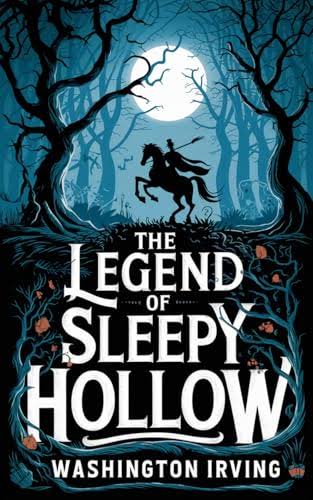
When Washington Irving published The Legend of Sleepy Hollow as part of The Sketch Book of Geoffrey Crayon, Gent. in 1820, he wasn’t trying to invent a Halloween story. In fact, the word “Halloween” doesn’t appear in the text at all. Irving was living in England, feeling a bit homesick, and writing a comedic satire about the quiet Dutch enclaves of the Hudson Valley – places where time seemed to stand delightfully still while the rest of a young, frantic America marched forward.
Yet, in doing so, Irving gave us the ultimate atmospheric template for American Autumn.
Re-reading Irving’s prose today is an absolute joy because he writes with a rich, leisurely wealth of words that demands slow savoring. Listen to how he sets the stage for the quiet Dutch glen:
“A drowsy, dreamy influence seems to hang over the land, and to pervade the very atmosphere… The whole neighborhood abounds with local tales, haunted spots, and twilight superstitions; stars shoot and meteors glare oftener across the valley than in any other part of the country, and the nightmare, with her whole nine fold, seems to make it the favorite scene of her gambols.”
Irving’s genius wasn’t just in bringing forth a ghost; it was in creating a sense of place. Sleepy Hollow is a landscape where the natural world and the supernatural world share a fence line. It’s cozy, yet slightly unsettling.
And then, of course, there is the unlikely protagonist: Ichabod Crane.
Ichabod is hardly your heroic lead. He is tall, lanky, ravenous, and enormously superstitious. Irving describes him as looking like “the genius of Famine descending upon the earth, or some scarecrow eloped from a cornfield.” He comes into the valley not out of civic virtue, but to teach school, sing psalmody, consume vast quantities of home-cooked Dutch meals, and lay siege to the heart (and substantial inheritance) of Katrina Van Tassel.
Contrast Ichabod with his rival, Abraham “Brom Bones” Van Brunt – a burly, roaring, horse-riding prankster who represents physical vigor, local folk humor, and practical jokes. Their contest for Katrina’s hand culminates at the Van Tassel autumn feast, an event Irving describes with a food-lover’s passion:
- Platters of Dutch cakes: dough-nuts, oly-koeks, and crullers.
- Piles of golden sweet-cakes and short-cakes.
- Pies of pumpkin, apple, and peach, accompanied by roasted chickens and bowls of spiced ale.
It is at this very feast that the local elders sit around smoking pipes and trading Revolutionary War ghost stories. They speak of White Plains, of local skirmishes, and above all, of the Trooper without a head – in later versions of the story, a Hessian soldier whose head was carried off by a cannonball in some nameless battle, and who now rides the night in search of his missing noggin.
When Ichabod leaves the party late that night, filled with rich pie and richer ghost lore, his journey home through the dark woods becomes a masterclass in psychological terror. Every creaking branch is a groan; every rustling leaf is a footstep. And when he encounters the dark, looming figure by the brook at Major André’s tree, the nightmare comes alive.
The chase to the church bridge is hilarious, terrifying, and iconic. Ichabod frantically urges his broken-down plug of a horse, Gunpowder, toward safety – only to turn back at the crest of the bridge and see the dark rider reach back and hurl his severed head straight at him.
“It struck his cranium with a tremendous crash, – he was tumbled headlong into the dust, and Gunpowder, the Black Steed, and the goblin rider, passed by like a whirlwind.”
The next morning? A shattered pumpkin lies beside a trampled hat, Gunpowder is found grazing calmly by his master’s gate, and Ichabod Crane has vanished into thin air.
What Irving gave American literature was a masterpiece of ambiguity. Was it truly a supernatural ghoul? Or was it simply Brom Bones with a hollowed-out squash and a flair for theatrical revenge? Irving leaves the door ajar, letting the reader decide – and in doing so, he planted the very seed of autumn enchantment in the American imagination.
The Animation and the Amplification
If Irving planted the seed, it was Walt Disney Animation Studios that fertilized it for the modern media age.
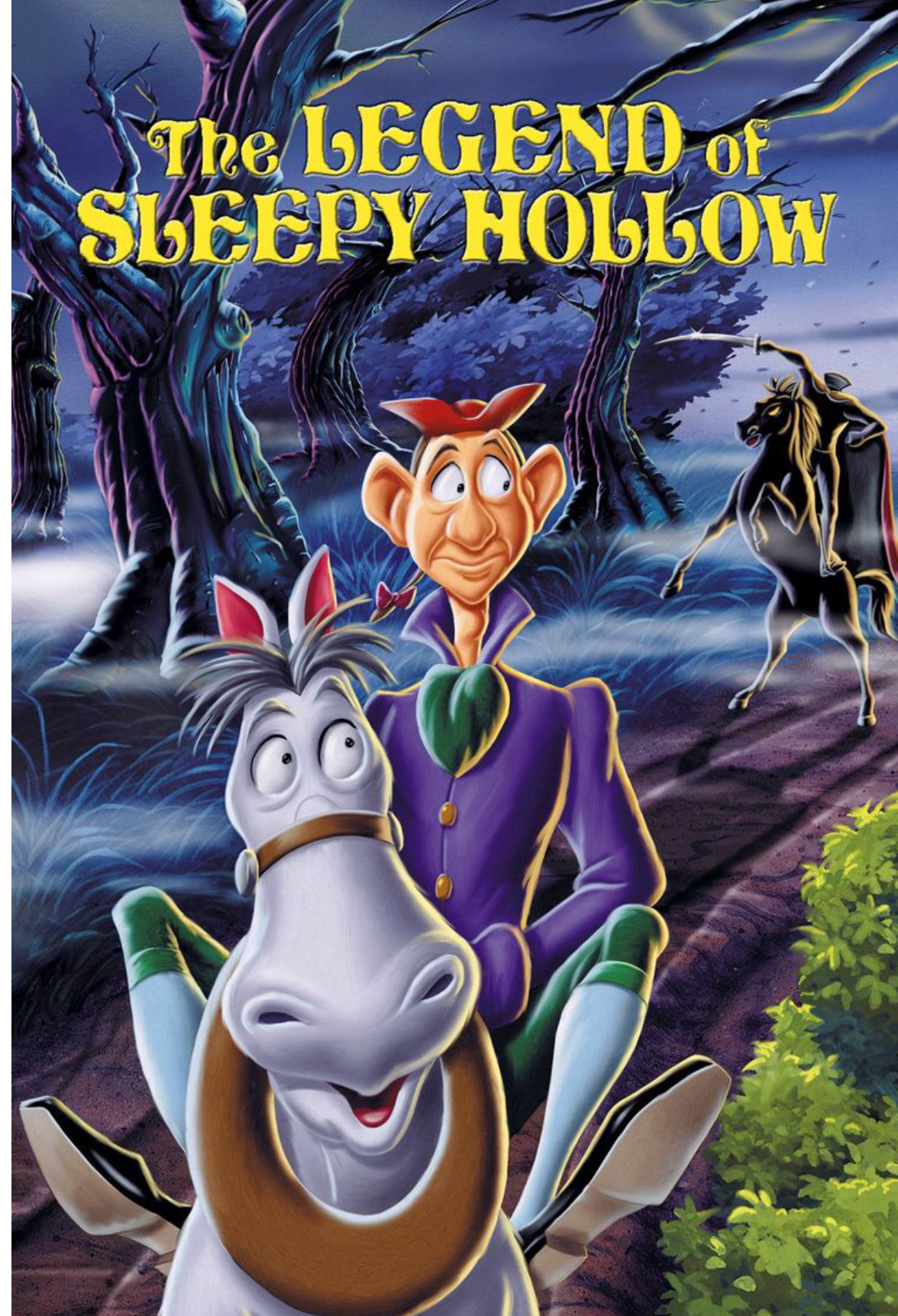
In 1949, Disney released The Adventures of Ichabod and Mr. Toad, pairing Kenneth Grahame’s The Wind in the Willows with Irving’s Hudson Valley tale. Narrated and sung with silky, smooth-talking charm by Bing Crosby, the 34-minute animated segment of The Legend of Sleepy Hollow brought Irving’s story to millions of mid-century households.
Disney’s animators – including the legendary “Nine Old Men” (Disney’s best and most experienced team) – did something extraordinary here. They took Irving’s literary satire and translated it into pure visual rhythm and comedy.
Watch the Disney version with a writer’s eye, and you see how brilliantly character is built without heavy dialogue:
- Ichabod’s Design: He glides through town like a folded lawn chair on legs, carrying his tuning fork and eating a succession of stolen pies. He is absurdly gangly, yet charmingly confident.
- The Musical Storytelling: Bing Crosby’s vocal narration balances light comedy with creeping dread. The songs – especially “The Headless Horseman” sung by Brom Bones at the Van Tassel party – serve as both musical theater and foreshadowing.
- The Midnight Ride Sequence: This is arguably some of the finest atmospheric animation ever drawn. The forest sequence plays with darkness, moonlight, and sound effects: frogs croaking “Ichabod… Ichabod…”, owls hooting, trees grasping like skeletal hands.
When the Horseman finally appears – accompanied by booming thunder, terrifying operatic laughter, and a glowing, fiery red horse – the tone shifts from comedy to genuine cinematic thrills. The scene where the Horseman holds the flaming pumpkin high above his head before hurling it directly into the camera lens became an indelible image for generations of kids who grew up watching television broadcasts every October.
For children of the 1950s, 60s, and 70s, this animated film was often their very first encounter with gothic fiction. It made the spooky feel fun. It showed that fear, when safely wrapped in storytelling, color, and music, is actually an absolute blast.
And as those young viewers grew up into adults, they took that nostalgic love for the seasonal macabre right along with them.
A Modern Pilgrimage
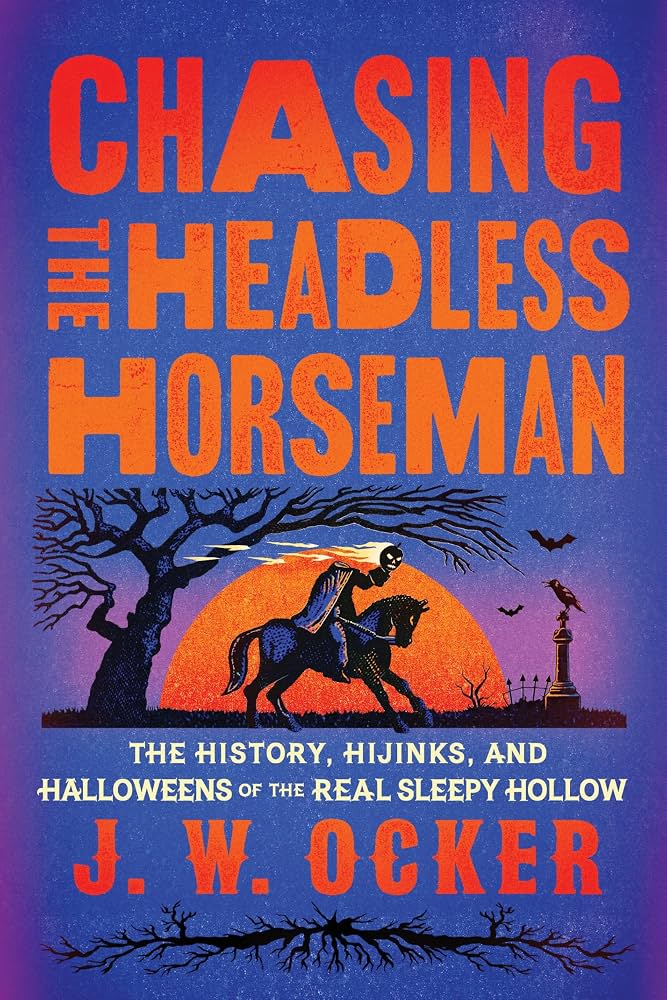
Now for the third primary source: J.W. Ocker’s excellent 2026 book, Chasing the Headless Horseman: Probing the Literary Grounds of America’s Most Haunted Legend.
Ocker – a travel writer, blogger, and keen observer of dark heritage – sets out to answer a simple question: Why does a 200-year-old short story still hold such an iron grip on our contemporary collective imagination?
To find out, Ocker travels to the real-life Sleepy Hollow and Tarrytown, New York. He visits Old Dutch Church, wanders the gravestones of Sleepy Hollow Cemetery, walks the banks of the Pocantico River, and explores how this small Hudson Valley region transforms every October into the epicenter of American Halloween culture.
Ocker’s prose is bright, humorous, self-aware, and wonderfully observant. He is not a dusty academic, but an enthusiastic lover of books, history, and seasonal travel.
In Chasing the Headless Horseman, Ocker points out a fascinating shift: Sleepy Hollow isn’t just a setting in a book anymore; it is a living monument to literary tourism and adult Halloween celebration. Every autumn, tens of thousands of grown-ups flood into Tarrytown – not to take toddlers trick-or-treating, but to experience:
- Dramatic night-time readings of Irving’s story inside historic churches.
- Walking tours of the cemetery where Washington Irving himself rests under a modest headstone.
- Lighting displays featuring thousands of individually hand-carved jack-o’-lanterns.
- Craft beer tastings, fall festivals, and theatrical performances.
Ocker writes with great affection about how Washington Irving essentially created America’s first homegrown ghost story – one that gave a young nation, desperate for its own folklore, a myth as enduring as anything in Old Europe.
More importantly, Ocker captures why adults keep returning to this myth. It isn’t because we genuinely believe a headless German soldier is galloping down Route 9 on a black steed. It’s because the story provides an invitation to step out of our hyper-digital, hyper-scheduled adult lives and step back into a world of shadow, mystery, and harvest magic.
The Great Adult Halloween Resurgence
And now to the idea launching this article: How did we get from Ichabod Crane to the current explosion of Halloween as a major adult cultural phenomenon?
If you look at the economics and social trends of the past twenty years, the statistics are staggering. Halloween is projected to be a 13.5-billion-dollar industry this year, with a massive percentage of spending coming directly from adults purchasing decorations, hosting elaborate dinner parties, building outdoor autumn displays, and traveling for seasonal tourism.
Why have adults embraced this holiday with such runaway enthusiasm?
- The Search for Nostalgia and Play
Adulthood in the 21st century can be taxing, demanding, and predictable. Halloween offers something rare: permission to play. Unlike winter holidays, which often carry heavy family obligations, travel logistics, and formal expectations, Halloween is delightfully low-pressure. It is a holiday purely about atmosphere, creativity, and neighborhood fun.
- The Aesthetics of Autumn (The “Cozy Spooky”)
Washington Irving understood something fundamental back in 1820: crisp fall weather creates an emotional mood like no other season. The smell of woodsmoke, the crunch of dry oak leaves underfoot, the early orange sunset, and the cool evening breeze create a desire for cozy gathering.
Modern adults haven’t abandoned Halloween; they’ve simply refined it. They’ve traded cheap plastic costumes for heritage wool sweaters, pumpkin patch trips, hard cider, and literary re-reads by the fireplace.
- The Power of Local Heritage and Storytelling
As J.W. Ocker so brilliantly demonstrates in his book, human beings have an innate hunger for regional folklore. We want our towns to have stories. We want our woods to hold a little mystery. When we read Irving, watch Disney’s animation, or visit historic sites, we are grounding ourselves in a shared American narrative that stretches back over two centuries.
A Final Page Turn
As the calendar pages turn and October winds down, there’s something comforting about knowing that Ichabod Crane is still riding that tired old horse Gunpowder through the dark woods of our imagination.
Whether you experience the legend through Washington Irving’s rich, rolling 1820 sentences, through Bing Crosby’s crooning narration in the 1949 Disney classic, or through J.W. Ocker’s witty modern travel writing, the lesson remains the same:
We need stories that make us look over our shoulder in the dark woods. We need stories that celebrate the harvest, and give us an excuse to light a candle inside a hollowed-out pumpkin.
So this season, leave a light on, keep a good book on the nightstand, and if you happen to hear the thundering hoofbeats of a midnight steed near a wooden bridge… well, just make sure you hold onto your hat and watch out for flaming pumpkins!
Happy reading, and happy autumn!
Part of a regular series on 27gen, entitled Wednesday Weekly Reader.
During my elementary school years one of the things I looked forward to the most was the delivery of “My Weekly Reader,” a weekly educational magazine designed for children and containing news-based current events.
It became a regular part of my love for reading, and helped develop my curiosity about the world around us.


