
A few weeks after I wrote about the slow work of downsizing my personal library, I received a comment that stuck with me longer than I expected. A friend said he’d benefited over the years from the ideas in my shelves, the writing that came from them, and, eventually, some of the hard copies themselves – books that had passed from me to him at exactly the moment he needed them. I hadn’t set out to make that point in the original piece, but he found it anyway: a book doesn’t stop working when it leaves your hands. Sometimes that’s when it starts.
That comment has been on my mind while I’ve packed the next round of boxes, because this round is different from the last. The beginning of culling was mostly about subtraction – deciding what no longer served me and letting it go to a used bookstore or donated for charity. The next round involved about 300 volumes on a specific topic to a good friend who knew everything in them, but still took them on for use in his expanded role.
This one has a different destination. Somewhere north of a thousand volumes on leadership and vision, trimmed down from a collection that once ran closer to two thousand several years ago, are headed to the amazing staff members of my church. And the more I’ve thought about who’s going to be reading them, the less this has felt like my story to tell.
So I’ll keep this part short: over several decades, I built a leadership shelf the same way I built the others – one book leading to the next, one author’s argument prompting a search for someone who’d answer it differently. Vision, organizational culture, the specific discipline of leading people who didn’t have to follow you but chose to. It grew because the questions never really stopped being useful. What’s changed is that I’m no longer the only person those questions belong to.
Who Actually Needs These Books
Church staff members, especially the younger ones, tend to be leadership-rich and leadership-resource-poor. Someone in their twenties or early thirties gets handed real responsibility fast – a ministry area, a team of volunteers twice their age, a budget, a Sunday morning that will not run itself – and very little formal preparation for the part of the job that has nothing to do with theology. Seminary teaches you to read a text. It doesn’t always teach you how to run a staff meeting, manage conflict between two volunteers who’ve served together for twenty years, or figure out why a team that agrees on the mission still can’t agree on the plan. That’s a different kind of literacy, and it’s the kind this collection was built to develop.
What a shelf like this offers a young leader isn’t a single right answer – it’s range. One book on vision will tell you to cast it boldly and repeat it until people live it out in front of you. Another will tell you vision emerges from listening, not proclamation, and that leaders who arrive with the answer already formed miss what their people actually need. Both are right, in different seasons, with different teams. A twenty-six-year-old three months into their first real leadership role doesn’t yet have the experience to know which season they’re in. What they can have, if the books are sitting on a shelf down the hall instead of in a secluded and unused collection, is quick access to people who’ve already worked that question through.
That’s really the whole case for donating a library like this instead of simply letting it disperse. A used bookstore will always find a buyer eventually. What it won’t do is put the right book in front of the right twenty-eight-year-old the week she’s staring down her first genuinely hard personnel decision, unsure whether to be more patient or more direct. Proximity is the value here as much as content. A resource you have to seek out gets used rarely. A resource sitting in a newly-commissioned staff library gets picked up on a Tuesday afternoon by someone who didn’t know they needed it until they saw the spine.
What I Hope Happens Next
I don’t expect every book to get read cover to cover, and honestly, that was never the standard for me either. Some of these were read in full three times over the years; others got mined for a single chapter and then sat, still useful, waiting for the next question that would send someone back to them. I’d rather see this collection get treated that way by its next owners than sit unopened out of some misplaced obligation to finish what I started. A leadership library is a reference tool as much as a reading list. Its job is to be there when the specific problem shows up, not to be completed.
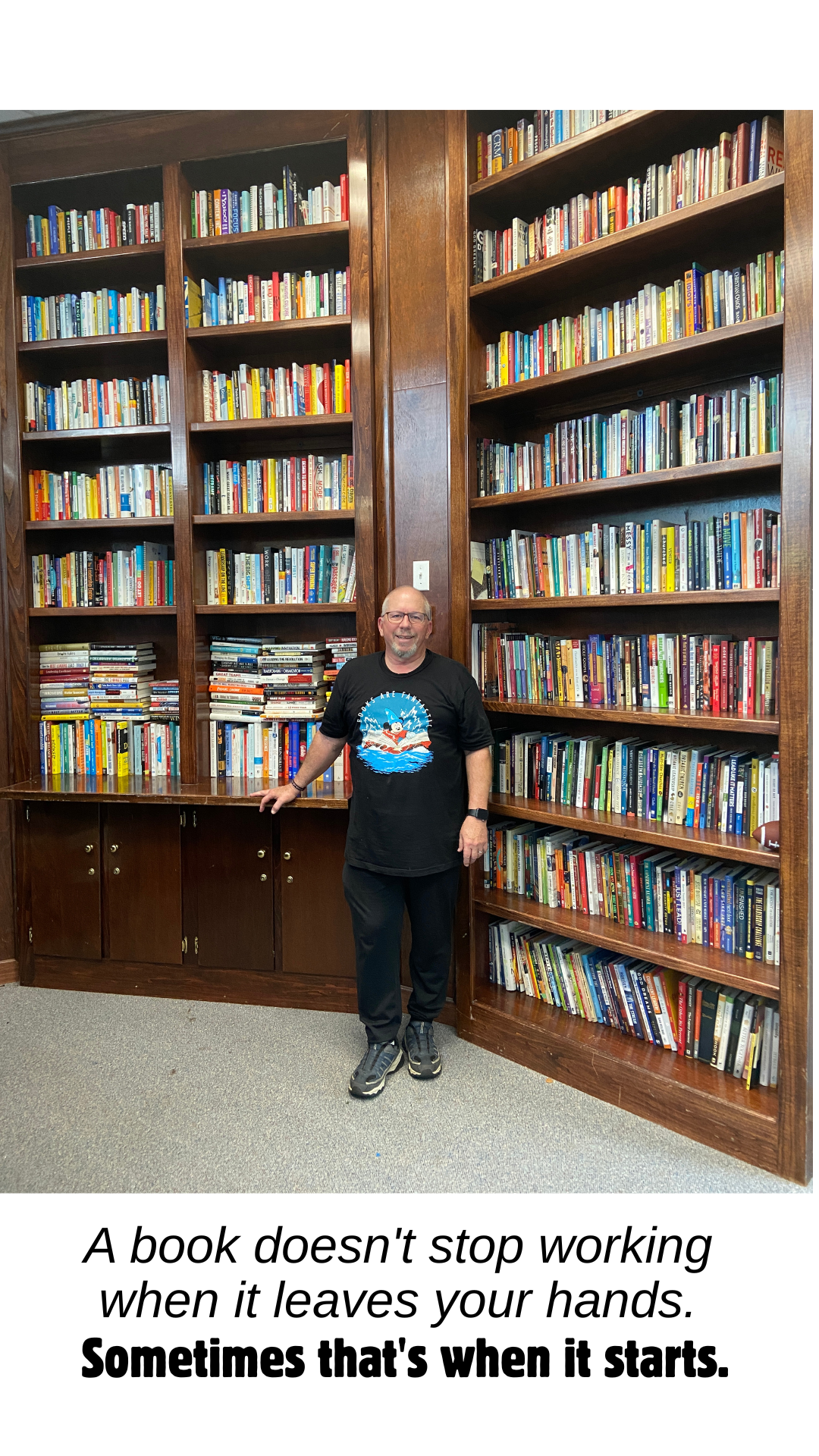
What I’m hoping for more than anything is that a few of these books become to somebody on that staff what certain books became to me at their age – not just information, but a kind of company. The comfort of knowing someone else has wrestled with the exact frustration you’re wrestling with this week, and wrote it down clearly enough that you can borrow their thinking until yours catches up. That’s what a good leadership book actually offers a young leader: not a script, but companionship in a job that can feel isolating even when you’re surrounded by people all day.
The shelves in my house will be lighter for it. I’m entirely at peace with that trade. A library that sits still and simply accumulates was never really the point – mine included. The point was always what the books could do once they reached the person who needed them most.
For the next chapter of this particular collection, that person just happens to be someone who is much younger than me, standing in front of a room full of volunteers and trying to figure out what to say next. I love and respect them deeply, and hope this collection of ideas can help them on their journey.
I know one of these books will say it for them like it said it for me.
A special thanks to Rick, Anita, Debbie, and Carroll for loading up, moving, unloading, and shelving the library in a little over an hour!


Part of a regular series on 27gen, entitled Wednesday Weekly Reader.
During my elementary school years one of the things I looked forward to the most was the delivery of “My Weekly Reader,” a weekly educational magazine designed for children and containing news-based current events.
It became a regular part of my love for reading, and helped develop my curiosity about the world around us.

