6 Essential Guest Experience Disciplines

All organizations routinely perform a set of sound, standard practices that result in a high-quality outcome. It’s true for your church just like any other organization. You don’t get up on Sunday morning and wonder how you will have a sermon that morning – or take care of children, or lead in worship. It’s a part of what your organization is, and does.

Organizations that want to produce a high-quality Guest experience also need to perform a set of sound, standard practices. Harley Manning and Kerry Bodine, in their book Outside In, have developed six high-level disciplines which can be translated into the Guest experience: strategy, Guest understanding, design, measurement, governance, and culture.

These disciplines represent the areas where organizations that are constantly great at Guest experience excel. If you want to deliver a great Guest experience, they are where you need to focus.

12DaysGE1

On the sixth day of Christmas Guest Experiences, your Guest Experience peers give to you:

6 Essential Guest Experience Disciplines

Strategy – this is your game plan. It’s a set of practices for crafting a Guest experience strategy, aligning it with the organization’s overall attributes and brand attributes, and then sharing that strategy with team members to guide decision-making and prioritization across the organization. The strategy discipline is critical because it provides the blueprint for the experience you design, deliver, manage, and measure.

Guest Understanding – a set of practices that create a consistent shared understanding of who Guests are, what they want and need, and how they perceive the interactions they’re having with your organization today. This discipline includes research practices, analyzing the information you’ve collected, and documenting your findings. Guest Understanding provides a foundational level of insight that guides the rest of the disciplines.

Design – a set of practices that help organizations envision and then implement Guest interactions that meet or exceed Guest needs. Design weeds out bad ideas early and focuses your Guest experience efforts on changes that really matter to Guests.

Measurement – a set of practices that lets organizations quantify Guest experience quality in a consistent manner across the organization, and deliver actionable insights to team members. This discipline is key because it lets organizations understand the current state of the Guest experience they provide, uncover opportunities for improvement, and tract progress over time.

Governance – a set of practices that helps organizations manage Guest experiences in a proactive and disciplined way. This practice is essential because it holds the entire team accountable for their role in the Guest experience ecosystem. These practices range from  leader oversight to day-to-day coaching of frontline team members.

Culture – a set of practices that create a system of shared values and behaviors that focuses the team members on delivering a WOW! Guest experience. These practices include volunteer enlistment, socialization activities, and rewards. This discipline is perhaps the most powerful of all the disciplines because it embeds practices from the other five disciplines into team DNA.

Mastering the six essential disciplines of Guest experience takes time and effort but it’s something that you have to do if you want to succeed in connecting with and developing relationships with your Guests.


If you don’t like change, you’re going to like irrelevance even less.

General Eric Shinseki, former Chief of Staff, US Army

inspired by and adapted from Outside In, by Harley Manning & Kerry Bodine

Outside In


7 Guest Service Guidelines: Old School Disney at Its Best

The Disney organization is perhaps the greatest practitioner of Guest Experiences around today. Books have been written about what the “cast members” at Disney do to make people feel welcome (I know – I’ve read all of them, and own most of them).

A year ago about this time, my wife and I “opened and closed” the Magic Kingdom (we were there from the opening at 8 AM to closing at midnight) including Mickey’s Very Merry Christmas Party as a part of our 34th wedding anniversary celebration.

Once again, I was amazed at the exceptional attitude of the cast members.

Observing hundreds of Cast Members, dealing with tens of thousands of Guests, there’s only one word to describe their attitude: Magical.

IMG_5090

So I’m sure you won’t mind if we go backstage and back in time at Disney to learn about their 7 Guest Service Guidelines – a list of actions that every Disney team member learns during their orientation.

When Disneyland opened in 1955, Disney was looking for a set of generic behaviors that ensured that cast members knew how to act courteously and respect the individuality of each Guest. Over the first ten years, the four values of Safety, Courtesy, Show, and Efficiency became the foundation from which all succeeding service standards were developed.

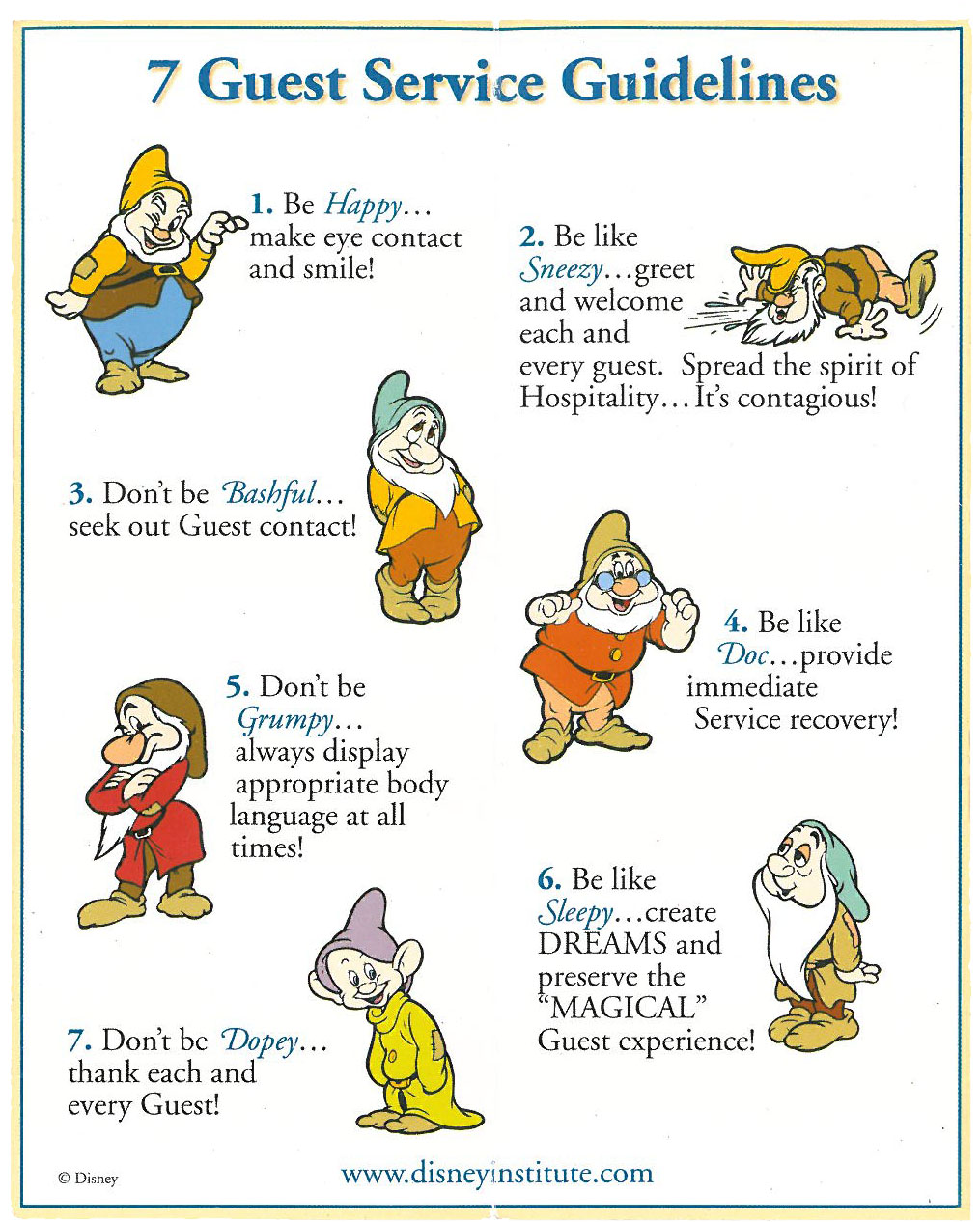
During the 1960s, these standards were translated into a set of behavioral actions called Guidelines for Guest Services, which became the centerpiece of training for all Disney cast members. Appropriately enough, the seven guidelines were personalized with the characters from the seven Dwarfs:

7 Guest Service Guidelines
courtesy of The Disney Institute

On the seventh day of Christmas Guest Experiences, your Guest Experience peers give to you:

7 Guidelines for Guest Services

  • Make eye contact and smile
  • Greet and welcome each and every Guest
  • Seek out Guest contact
  • Provide immediate service recovery
  • Display appropriate body language at all times
  • Preserve the “magical” Guest Experience
  • Thank each and every Guest

These seven phrases serve a variety of purposes. First, they define behavior in terms of Guests. They also communicate cast member responsibilities. Finally, they showcase ways to customize service to individual Guests.

Even though these Guidelines don’t exist in this form anymore, my experiences last year reminded me that the spirit of the Guidelines are very much in practice by cast members today.

Your church won’t have tens of thousands of people coming through your doors every day – but the principles Disney uses as a baseline starting point for training its cast members are appropriate in the context of your church.

inspired by and adapted from Be Our Guest, by The Disney Institute

Be Our Guest revised


8 Ways for the Introvert to Serve on Your Guest Services Team

Bob

and I’m an introvert.

Hello, Bob!

The introduction and response above would be my way of introducing myself at an IA Meeting – Introverts Anonymous

  • Susan Cain’s Quiet is one of my favorite books…
  • I’ve been told to come out of my shell so much I look like a turtle…
  • Speaking in front of 500 people is less stressful than mingling with them afterwards…

I could go on, but I think you get the picture.

My passion for Guest Experiences may seem strange to those who think all Guest Services teams must be filled with outgoing people-persons. There is certainly a need for many of those types of people, especially in the more visible, front-line positions.

 And yet…

Not everyone must be a “people magnet” to serve your Guests. Many folks in our church have a passion to connect people to God and to one another, but they aren’t wired to greet Guests. Find a way to include them, for they, too, are invaluable to the success of a Guest Services ministry.Mark Waltz

Mark Waltz, Pastor of Connections and a Campus Pastor at Granger Community Church, wrote the book on Guest Services – literally. Actually, he wrote 3 of them, and this “hat trick” of Guest Services books ought to be the first 3 books you buy when building your Guest Services Resource Library. They are: First Impressions, Lasting Impressions, and How to WOW Your Church Guests. Put them on the top of your Christmas list now!

In First Impressions, Waltz lists 8 ways that less gregarious members of your church can connect people to others and God through your Guest Services teams.

12DaysGE1

On the eighth day of Christmas Guest Experiences, your Guest Experience peers give to you:

8 Ways for the Introvert to Serve on a Guest Services Team

  1. Mail reminder postcards to team members
  2. Purchase or prepare food for serving teams
  3. Prepare programs for the weekend
  4. Set out parking lot cones and signs
  5. Pray for the weekend teams and Guests
  6. Update team rosters and profiles
  7. Coordinate systems that ensure all ministry information is gathered for the Guest Services center
  8. Stock the Guest Services center with information and registration jackets

 How will you involve the quieter members of your Guest Services Teams?

inspired by and adapted from First Impressions by Mark Waltz

First Impressions

9 Principles of Innovative Guest Experiences

Value-added has long been the service solution for the best-of-class service providers. They take what customers expect and add a little more.

Chip Bell, award-winning author, speaker, and consultant on customer service, thinks its time to up the game:

It’s time for value-unique service.

Value unique is different from value-added. It is not about addition – “they gave me more than I anticipated.” It is about a unique and unexpected creation. If your team members are asked to pleasantly surprise customers by creating unique experiences, they feel prized.     – Chip Bell

Bell’s book The 9½ Principles of Innovative Service is your instruction manual and inspirational guide to providing an experience that causes your Guests to be surprised, smile, and sing your praises to others.

Innovative


On the ninth day of Christmas Guest Experiences, your Guest Experience peers give to you:

9 Principles of Innovative Guest Experiences

  1. Put a surprise inside – design Guest experiences that constantly astonish and amaze.
  2. Connect with respect – deliver Guest experiences with an extra helping of sincerity, an enduring act of benevolence, and a genuine interest in making a difference for your Guest.
  3. Elevate the class – create processes and systems for your Guest experiences that ensure red carpet treatment.
  4. Put total sense into service – what should your Guest experience smell like-sound like-feel like-look like-taste like if you wanted to create an experience not easily forgotten?
  5. Before and beyond service – anticipate Guest needs before they arrive.
  6. Hardwire wisdom into service – look for chances in your Guest experience that can be turned into opportunities for learning.
  7. Monogram the moment – display the upbeat attitude you want your Guests to have.
  8. Effort removal squared – examine all Guest experience processes through your Guest’s eyes and find ways to remove angst where needed.
  9. Turn an oops into an opportunity – understand, empathize and mine the Guest’s expectations until a good solution is found.

The more principles you can appropriately build into your Guest’s experience, the more likely it will be experienced as exceptional rather than expected, remarkable rather than routine.     – Chip Bell

inspired by and adapted from The 9½ Principles of Innovative Service by Chip Bell

9 1:2 Principles of Innovative Service

10 Commandments from Mickey Mouse

Disney Imagineer Marty Sklar, who retired in 2009 as the only Disney cast member to have participated in the opening of all eleven theme parks around the world, is noted for many things, but one of the most cherished has to be his creation of “Mickey’s Ten Commandments.”

During his 54-year career, Sklar was involved in all facets of the theme parks – from concepts to design to operations. Along the way, he developed, refined and practiced key principles of leadership based on what he learned from Walt Disney and other Disney Legends, especially designer John Hench. He crystallized these “learnings” into the first of what he called Mickey’s Ten Commandments.

Mickey'sTenCommandments

On the tenth day of Christmas Guest Experiences, your Guest Experience peers give to you:

Mickey’s Ten Commandments

  1. Know your audience – Identify the prime audience for your attraction or show before you begin design
  2. Wear your Guests’ shoes – Insist that your team members experience your creation just the way Guests do
  3. Organize the flow of people and ideas – Make sure there is a logic and sequence in our stories and the way Guests experience them
  4. Create a wienie (visual magnet) – Create visual “targets” that will lead Guests clearly and logically through your facility
  5. Communicate with visual literacy – Make good use of color, shape form, texture – all the nonverbal ways of communication
  6. Avoid overload – create turn-ons – Resist the temptation to overload your audience with too much information and too many objects
  7. Tell one story at a time – Stick to the story line; good stories are clear, logical, and consistent
  8. Avoid contradictions – maintain identity – Details in design or content that contradict one another confuse an audience about your story or the time period it takes place in
  9. For every once of treatment, provide a ton of treat – Walt Disney said you can educate people, but don’t tell them you’re doing it. Make it fun!
  10. Keep it up! (Maintain it) – In a Disney park or resort, everything must work. Poor maintenance is poor show!

Exceeding Guests’ expectations is Disney’s Guest Service strategy, and paying attention to every detail is the tactic by which it is accomplished.

inspired by and adapted from Dream It, Do It: My Half-Century Creating Disney’s Magic Kingdoms, by Marty Sklar

Dream It Do It

11 Reasons to Smile

The greatest symbol of a Guest Experience is a smile.

A great deal of research has been done on why smiling matters.  A journey through neuroscience, anthropology, sociology and psychology has helped uncover the untapped powers of the smile.

A smile is a simple and surprisingly powerful way to significantly improve your own life and the lives of others.

Smile


On the eleventh day of Christmas Guest Experiences, your Guest Experience peers give to you:

11 Reasons to Smile

A genuine smile:

  1. Makes us more attractive.
  2. Helps us to change our mood.
  3. Makes you look good and feel good.
  4. Helps us stay more positive.
  5. Releases endorphins that act as natural painkillers.
  6. Makes us look younger.
  7. Releases a warmer vocal tone.
  8. Becomes contagious with others.
  9. Relieves our stress.
  10. Triggers certain hormones that lower heart rate and steady breathing.
  11. Eases the tension in a tense moment.

 Having a smile is part of what makes Disney legendary. For years making eye contact and a smile were the first of Disney’s Seven Service Guidelines. Under Disney’s current Service Basics, Smiling is listed as the first way to project a positive image and energy. It’s been a heritage of Disney’s to have their Cast Members greet others with a smile.     – J. Jeff Kober

inspired by and adapted from The Wonderful World of Customer Service at Disney

The Wonderful World of Customer Service at Disney

12 Principles of Guest Experience Leadership

In a little over two weeks it will be Christmas Eve. Many churches will hold special services, or will be adding to their regular worship on the Sunday before. Often, these services are among the top 3 largest services in the church year – with many new faces of family and friends in the audience.

What have you done to get ready for them?

With a wink and a nod to the holiday classic, here are the 12 Days of Christmas Guest Experiences for your church. Enjoy, yes, but even more importantly – learn. 

12DaysGE1

On the twelfth day of Christmas Guest Experiences, your Guest Experience peers give to you:

12 Principles of Guest Experience Leadership

  1. Provide the quality and value that Guests expect
  2. Focus strategy on the key drivers of Guest satisfaction
  3. Provide the setting that Guests expect
  4. Define and sustain a total Guest culture
  5. Discover and retain people who love to serve
  6. Train your teams, and train them some more
  7. Recognize, motivate, and empower your teams
  8. Glue the Guest experience together with information
  9. Deliver seamless Guest experiences
  10. Pursue perfection relentlessly
  11. Don’t fail the Guest twice
  12. Lead your teams to excel

Organizations that deliver exceptional Guest Experiences understand the fundamental concept that everything the organization does should focus on the Guest. These organizations lead from the outside in by starting with the Guests.

These organizations study their Guests endlessly; they know what they want, need, value, expect, and actually do. Having understood their Guests, these organizations can focus everyone on how to do a better job of exceeding Guest expectations.

inspired by and adapted from Managing Quality Service in Hospitality

Managing Quality Service in Hospitality

The 12 Days of Christmas Guest Experiences

The Twelve Days of Christmas is an English carol that has its origins in the tradition of continuing to celebrate Christmas for 12 days after the day itself.

With a little Guestology license, I want to borrow the concept and turn it into 12 helpful reminders for church leaders and their Guest Services teams as they make final preparations for their Christmas worship services.

12DaysGE1

Two weeks from Sunday will be the Sunday before Christmas. Many churches will be adding to their regular worship on that Sunday, or will be holding special services on Christmas Eve. Often, these services are among the top 3 largest services in the church year – with many new faces of family and friends in the audience.

What have you done to get ready for them?

With a wink and a nod to the holiday classic, beginning Monday December 8: 12 Days of Christmas Guest Experiences for your church.

Enjoy, yes, but even more importantly – learn

The 6th Discipline of Guest Experiences: Culture

Organizations that want to produce a high-quality Guest experience need to perform a set of sound, standard practices. Harley Manning and Kerry Bodine, in their book Outside In, have developed six high-level disciplines which can be translated into Guest experiences: strategy, Guest understanding, design, measurement, governance, and culture.

An overview of all six Disciplines can be found here. These disciplines represent the areas where organizations that are consistently great at Guest experiences excel.

If you want to deliver a great Guest Experience, these disciplines are where you need to focus, too.  

Culture 

Now matter how solid your strategy is or how carefully you design your Guest Experience, it’s simply impossible to plan for every single Guest interaction at every last touchpoint. At some point, you need to put your trust in your organization’s most valuable resource – your team members – to do the right thing for Guests.

Building a Guest-centric culture is critical to your success.

How exactly to you get to this level of a Guest-centric culture? First, you overhaul your recruiting practices so that you get Guest-obsessed people on the front lines. Second, you need to socialize the importance of Guest-centricity through storytelling, rituals, and training. Third, you’ve got to reinforce new values and behaviors through informal and formal rewards. Finally, tie it all together with a steady cadence of communication that never lets team members forget why they’re doing all of this in the first place.

Measurement Practices

  • Screen candidates for Guest-centric values as a part of the recruitment process
  • Screen candidates for the specific skills needed to deliver on the organization’s Guest Experience strategy as a part of the recruitment process
  • Provide training to help new and existing team members build and maintain the skills they need to deliver on their part of the organization’s Guest Experience strategy
  • Communicate the importance of Guest Experiences to all team members and partners
  • Collect and share stories of Guest Experience best practices with all team members
  • Perform rituals and routines that reinforce the importance of Guest Experience and what it takes to deliver it
  • Use informal rewards and celebrations to highlight exemplary Guest-centric behavior
  • Connect formal reward structures to performance on Guest Experience metrics

Guest-centric values are the building blocks for reprogramming your organizational DNA. Behaviors are how you turn all of the other practices form the other five disciplines – strategy, Guest understanding, design, measurement, and governance – into habits that your organization just can’t kick.

Application to ChurchWorld

  1. You need to build a Guest-centric culture that pervades your church from bottom to top
  2. Recruit leaders of your hospitality teams for Guest passion and cultural fit
  3. Socialize the key behaviors required to deliver a great experience throughout your organization
  4. Reward team members to reinforce Guest-centric behaviors
  5. Solidify your Guest Experience efforts with constant communication about the “why”

Series Concluding Thought – Mastering these six essential disciplines of Guest Experience takes time and effort but it’s something that you have to do. If you want to succeed at connecting with Guests coming to your campus, you have to decide – right here, right now – to roll up your sleeves and do the work of building competence in these six disciplines. That may scare you – but what should scare you more is the thought of becoming irrelevant to your Guests – which is what will happen if you don’t take action.

To read an overview of the Six Disciplines of Guest Experiences, go here. To begin reading an in-depth review of each of the six, go here.

If you haven’t already, order your personal copy of Outside In right now. This is an excellent guide to developing a Guest Experience ministry in your church – one that you will refer to time and again. Harley Manning and Kerry Bodine have done an amazing job of writing a business text that has immediate and far-reaching implications for your church. Go ahead and gift it to yourself for Christmas this year!


Want to know more about the Guest Experience in your church?

  • Learn why the Guest Experience matters here
  • Contact me here
  • Read up a little here


The 5th Discipline of Guest Experiences: Governance

Organizations that want to produce a high-quality Guest experience need to perform a set of sound, standard practices. Harley Manning and Kerry Bodine, in their book Outside In, have developed six high-level disciplines which can be translated into Guest experiences: strategy, Guest understanding, design, measurement, governance, and culture.

An overview of all six Disciplines can be found here. These disciplines represent the areas where organizations that are consistently great at Guest experiences excel.

If you want to deliver a great Guest Experience, these disciplines are where you need to focus, too.  

Governance

The word governance may bring to mind images of executives in closed-door meetings talking about compliance. Senior decision makers are important part of governance at many organizations, but governance isn’t about a committee that hands out edicts from the top floor.

In reality, governance models are as varied as the organizations they support.  Governance practices will help you drive accountability by assigning specific Guest Experience management tasks to specific people within your organization.

You need to use your insights and metrics to identify Guest Experience improvement opportunities and, as you put new programs into place, keep tabs on the progress of those initiatives.

Measurement Practices

  • Define a consistent set of Guest Experience standards across the organization
  • Include alignment with the Guest Experience strategy as a criterion for evaluating project funding and prioritization decisions
  • Include impact to Guest Experience as a criterion for organizational decisions about policies, processes, technology, and communications
  • Maintain a dedicated queue of Guest Experience improvement projects
  • Review Guest Experience program status and metrics regularly to monitor progress toward organizational goals, adjusting tactics or resource allocations if needed
  • Assign role-specific Guest Experience management tasks to team members as a requirement of their positions
  • Evaluate team member performance against role-specific Guest Experience metrics
  • Facilitate the necessary coordination across groups that share responsibility for a given experience
  • Whenever a change is approved to a policy, organizational process, or other system that affects the Guest Experience, proactively redesign that experience to reflect the change

The Guest Experience governance discipline is designed to help you adhere to practices that will consistently deliver a great Guest Experience. Your job is to decide the rules of your own game – the right Guest Experience governance model and policies for your organization.

Application to ChurchWorld

  1. Make Guest Experience Governance part of basic job responsibilities
  2. Find and fix Guest Experience problems
  3. Keep Guest Experience problems from happening in the first place
  4. Define a consistent set of Guest Experience standards

The governance discipline is all about intentional management and oversight.

I will be happy to discuss Guest Experience initiatives for your church and partner with you to design a WOW! Guest Experience.

Next: To help reinforce the rationale behind your governance practices and make sure team members actually adopt them, you’ll need to develop a Guest-centric culture.

Want to know more about the Guest Experience in your church?

  • Learn why the Guest Experience matters here
  • Contact me here
  • Read up a little here