Creating an Experience Blueprint

The past few posts have given you a basic understanding of some of the foundations of guest services. Now it’s time to go back to school – design school.

Becoming an Experience Architect

One of the game-changing concepts related to guest services comes from Tim Brown’s book “Change by Design”. Brown, the CEO of the innovation and design firm IDEO, has challenged my thinking about design in a number of ways: it’s not just for creative industries or people designing products. Design thinking is most powerful when applied to abstract, multifaceted problems that address a wide range of issues and concerns.

Problems that the typical church encounters every day!

Here’s a great example from one chapter on the design of experience:

Design has the power to enrich our lives by engaging our emotions through image, form, texture, color, sound and smell. The intrinsically human-centered nature of design thinking points to the next step: we can use our empathy and understanding of people to design experiences that create opportunities for active engagement and participation.

Wow-that’s a lot to think about! In the world of serving the church where I work and live, the concepts of designing for experience are so important, yet so often totally overlooked. Brown goes on to talk about 3 “themes” of the design of experiences:

  • The experience economy – people have shifted from passive consumption to active participation
  • Best experiences are not scripted at corporate headquarters but decided on the spot by service professionals who create an authentic, genuine, and compelling experience
  • Implementation is everything-an experience must be as finely crafted and precision-engineered as any other product

Just as a product begins with an engineering blueprint and a building with an architectural blueprint, an experience blueprint provides the framework for working out the details of a human interaction, including emotive elements, from beginning to end.

It captures how people travel through an experience in time. Rather than trying to choreograph that journey, its function is to identify the most meaningful points and turn them into opportunities to positively impact the individual. What might be a source of discomfort or pain is now an opportunity for an experience that is distinctive, emotionally gratifying, and memorable.

The experience blueprint is at one and the same time a high-level strategy document and a fine-grained analysis of the details that matter.

It’s time to create an Experience Blueprint for your Guest Services!

Guest Services: Making Your First Impressions LAST!

Can the church learn anything from Walt Disney, Starbucks, Nordstrom’s, and the Ritz-Carlton?

My answer is a resounding YES!

Over the past four years I’ve been working on a project exploring the world of hospitality, looking for key principles that have application to the church world I live and work in. Early motivation for this effort came from great guest experiences over consecutive days from two establishments at opposite ends of the dining spectrum: Ruth’s Chris Steakhouse and Taco Bell. In both instances, the staff went beyond the expectations to deliver exemplary service. You expect it at one, but are surprised at the other, right? Why should price be any indicator of the level of service delivered? What about a place with no “price” at all – the church?

The companies I named in the opening sentence have been my primary research targets, but you could say that the hospitality industry in general is my field of research. My proposition is that the world of restaurants, coffee shops, fine hotels, and the ultimate in customer expectation and experience – Disney – can provide tangible and beneficial principles for the church to adapt in welcoming guests and members alike.

Along the way, I’ve supplemented my research with practical application in my own church: I lead one of the Guest Services (Parking) Teams at Elevation Church’s Uptown location. As the “first face” of Elevation, my crew and I get weekly opportunities to practice guest services and make a lasting first impression.

We don’t just park cars; we:

• Sanitize all touch points and spray air freshener in the elevator cabs and stairwells of the parking garage we use

• Pick up trash along the route from the garage to the theater

• Put up 22 parking signs along the entrances

• Man the elevator lobbies to call elevators for guests

• Hold the parking deck door for guests coming and going

• Pull the parking ticket and personally hand it to guests

• Validate parking for all Elevation guests

• Provide VIP (our first time guests) and family parking right next to the theater

• Know what’s going on Uptown so we can help any and everyone who has a question (sporting events, concerts, special activities, etc.)

• Provide umbrellas to guests in the rain

• Give a verbal greeting to everyone coming and going

And that’s just the parking crew! Elevation’s audacious Guest Services team also has Greeters, a First Impressions Team, VIP Tent, and Connections Tent. All this BEFORE a guest has stepped into the theater for worship.

You might say Guest Services is a big deal.

I think it is – and you should too.

Your Church has Competition…

…and it’s not the church down the street.

Like it or not, we live in a consumer-driven society, and the people who come to our church – you and me – and the people we are trying to reach are consumers. With consumers comes competition. If your church is going to be effective in its mission, you must beat the competition.

Pretty strong words by Mark Waltz, author of “First Impressions.” But dead on accurate.

The good news is that our “competition” is not the other churches in your town. As a matter of fact, they’re on your team. So who is your competition?

Here is how Waltz sees it: Your competition, the rival that will keep people away from your church, is any business, services, or experience your guests have encountered in the past few weeks.

That competition includes restaurants, malls, golf courses, amusement parks, movie theaters, sporting events, and so on.

Bottom line: the competition for your guests began when they were wowed in another environment. Your guests have high expectations that are formed every day from new encounters with excellence and conscientious care. Although too much of their world is merely adequate, they know excellence, and they return to place where they experience it.

Bottom bottom line: Will your guests’ experience in your church be worth getting out of bed?

Thanks, Mark, for a challenging word on the critical importance of understanding who our competition is.

Now it’s time to do something about it.

Making Your First Impression a Lasting Impression

Mark Waltz, author of “First Impressions,” suggests the following word-association exercise: Look at the following list, and jot down your first thought about each place. Don’t spend a lot of time on this – just write the first thought that comes to mind.

  • McDonald’s
  • Your last hotel stay (not the name of the hotel, but your impression of it)
  • Your last airline experience (again, not the name of the company)
  • Your bank
  • Your local church
  • Starbucks

Now take a moment to evaluate the impressions you jotted down. Which reflect your feelings from initial encounter, and which ones describe your thoughts at the end of your experience with that organization? What does this tell you about the impressions we retain?

Organizations that understand the lasting nature of first impressions also understand that people matter. When people matter, guests are wowed. And when guests are wowed, they know they matter.

What kind of lasting impression is your first impression making?

Want to know more about Church Guest Services? The single best resource for Guest Services available today is the book “First Impressions” by Mark Waltz, Connections Pastor at Granger Community Church near South Bend, IN, and campus pastor of their Elkhart campus. If you want to know about Guest Services, get a copy of this book today!

Another helpful resource: “Customer Satisfaction is Worthless; Customer Loyalty is Priceless” by Jeffrey Gitomer, a sales and customer service expert. His primary market is the business world, but I’ve found dozens of applications to ChurchWorld in his writings.

Looking Ahead: Who is your competition? and Turn the Ordinary into EXTRAORDINARY!

Making a WOW! First Impression

Several years ago I experienced a WOW! First Impression while eating out. It came from great guest experiences over consecutive days from two establishments at opposite ends of the dining spectrum: Ruth’s Chris Steakhouse and Taco Bell. In both instances, the staff went beyond the expectations to deliver exemplary service. You expect it at one, but are surprised at the other, right?

Why should price be any indicator of the level of service delivered? What about a place with no “price” at all – the church?

When was the last time you had a WOW! experience – at church or anywhere else?

  • WOW! is great service
  • WOW! separates the EXTRAordinary from the ordinary
  • WOW! separates the sincere from the insincere
  • WOW! separates the yes’s from the no’s
  • WOW! is doing what others can’t (or won’t)
  • WOW! is what you do for others in an exceptional way
  • WOW! is communicating you care
  • WOW! is creating a memorable experience

Remember some WOW! moments

Recall a couple of times you’ve been wowed. Who blew you away with excellent service? Who surprised you with remarkably good quality? Who impressed you with a product’s value? What did the people involved in these experiences do? How did the actions and behavior affect you?

Did those experiences want to make you return to that place?

My guess is a definite yes! The same is true of guests in our churches. The churches delivering experiences which exceed guests’ expectations are those to which people return, again and again, until they’re no longer guests but full-fledged members of the church community.

Now that’s a WOW!

The Consumer in Your Mirror

Does the word “consumer” bother you when used in the context of ChurchWorld?

If you view a consumer strictly in the language of business, it can be offensive when used in the context of church. Who wants to be a part of consumer mentality where the object is to satisfy the wants (both stated and unstated) of individuals? Who wants to focus on telling people what they want to hear? Who really enjoys enabling a selfish, me-first attitude. Not you, right?

Go look in the mirror.

Standing before you is a consumer – whether you like it or not. You are a consumer: you have daily or weekly food needs that are satisfied by the grocery store or a restaurant. You need clothing – provided by a variety of stores. You have cash coming in and going out, so you need the financial services of a bank. The house or apartment you live in requires maintenance and upkeep, so it’s off to the local home improvement store. When you have leisure time, it’s off to the movie theaters, or downloading the latest movie, or maybe taking in a concert. For birthdays and certain holidays, there are gifts to buy for your loved ones. Parents with kids in school have multiple occasions to buy this book or that resource in order to meet the requirements. And on and on and on… The fact is, we consume. (too much, but that’s another story altogether)

Guess what? The people coming to your church – for the first time or the fifteenth time – are consumers too.

Ignore that fact, and your guests will come once – and never return.

Recognize that fact, take appropriate actions, and you will soon have guests who become regular attenders who become involved members.

Are you ready for the journey to WOW?

You’ve Planned the Music and the Sermon Well…

…but will your guests even notice?

The Power of a First Impression

Seven minutes is all you get to make a positive First Impression. In the first seven minutes of contact with your church, your first-time guests will know whether or not they are coming back.

That’s before a single worship song is sung and before a single word of the message is uttered.

Nelson Searcy, pastor of Journey Church in New York City, wrote the above words in his book “Fusion.” They’re a timely reminder that we only get to make a first impression once.

Obviously, the First Impression isn’t a logical decision based on theological integrity or staff character or doctrinal character. The power of a First Impression comes from a more rudimentary level – our subconscious.

What is the subconscious of your Guests finding at your place?

How to Avoid Innovation’s Seven Deadly Sins

There are many traps that litter the ground in front of the would be innovator.  Author and business thinker Scott D. Anthony has developed the concept of innovation’s seven deadly sins, introduced in yesterday’s post. He found the idea of the seven deadly sins had very clear parallels in the world of innovation.

7DeadlySins

Here are Anthony’s summaries on how to avoid those deadly sins today.

  • Pride – take an external viewpoint to make sure you understand how the customer measures quality
  • Sloth – release your inner Edison (who said genius is 1 percent inspiration and 99 percent perspiration”)
  • Gluttony – embrace selective scarcity – constrain resources in the early stages of creativity to enable creativity
  • Lust – focus your innovation efforts; remember that destruction often precedes creation
  • Envy – actively celebrate both the core business and new growth efforts
  • Wrath – reward behavior, not outcomes
  • Greed – be patient for growth and impatient for results

How will you avoid falling into one of these traps when faced with it this week?

Explore more on this topic in Anthony’s excellent book The Little Black Book of Innovation.

Innovation’s Seven Deadly Sins

Innovation – something different that has impact – is both more important and more accessible than ever before

          Scott D. Anthony, The Little Black Book of Innovation

Something different that has impact.

This simple definition of innovation by author Scott Anthony belies the deep and resonating ideas in The Little Black Book of Innovation. From this simple definition, Anthony breaks down the essential differences between various types of innovation and illuminates its vital role in organizational success and personal growth.

What better way to introduce the topic to ChurchWorld leaders than start off with a list of Innovation’s Seven Deadly Sins:

  • Pride – forcing your view of quality onto your audience; often results in overshooting
  • Sloth – having innovation efforts slow to a crawl
  • Gluttony – suffering from the curse of abundance; leads to overly lows, overly linear innovation efforts
  • Lust – getting distracted by pursuing too many “Bright, shiny objects”
  • Envy – creating an us-versus-them relationship between the core and new growth efforts
  • Wrath – punishing risk takers severely
  • Greed – impatience for growth; leads to prioritizing low-potential markets

Tomorrow: How to Avoid the Seven Deadly Sins

What Color is Your Pen?

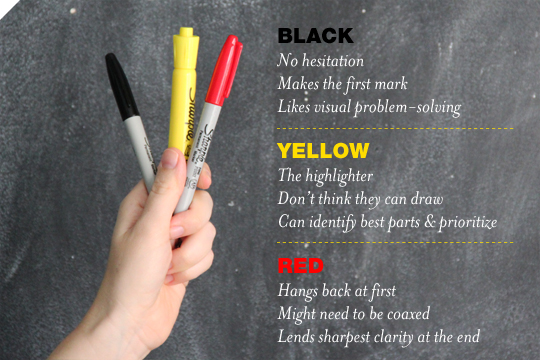
According to author Dan Roam (The Napkin Academy) there are three kinds of visual thinkers:

  • people who can’t wait to start drawing (the Black Pen people)
  • those who are happy to add to someone else’s work (the Yellow Pen people)
  • those who question it all – right up to the moment they pick up the Red Pen and redraw it all.

Which are you?

Hand me the pen! Black pen people show no hesitation in putting the first marks on an empty page. They come across as immediate believers in the power of pictures as a problem-solving tool, and have little concern about their drawing skills – regardless of how primitive their illustrations may turn out to be. They jump at the chance to approach the whiteboard and draw images to describe what they’re thinking. They enjoy visual metaphors and analogies for their ideas, and show great confidence in drawing simple images, both to summarize their ideas and then help work through those ideas.

I can’t draw, but… Yellow Pen people (or highlighters) are often very good at identifying the most important or interesting aspects of what someone else has drawn. These are the people who are happy to watch someone else working at the whiteboard – and after a few minutes will begin to make insightful comments – but who need to be gently prodded to stand and approach the board in order to add to it. Once at the board and with pen tentatively in hand, they always begin by saying “I can’t draw, but…” and then proceed to create conceptual masterworks. These people tend to be more verbal, usually incorporate more words and labels into their sketches, and are more likely to make comparisons to ideas that require supporting verbal descriptions.

I’m not visual Red Pen people are those least comfortable with the use of pictures in a problem-solving context – at least at first. They tend to be quiet while others are sketching away, and when they can be coaxed to comment, most often initially suggest a minor corrections of something already there. Quite often, the Red Pens have the most detailed grasp of the problem at hand – they just need to be coaxed into sharing it. When many images and ideas have been captured on the whiteboard, the Red Pen people will finally take a deep breath, reluctantly pick up the pen, and move to the board – where they redraw everything, often coming up with the clearest picture of them all.

Roam’s conclusion of these different types of people?

Regardless of visual thinking confidence or pen-color preference, everybody already has good visual thinking skills, and everybody can easily improve those skills. Visual thinking is an extraordinarily powerful way to solve problems, and though it may appear to be something new, the fact is that we already know how to do it.

What color is your pen?